FILM SCHOOL AFRICA (doc, 2019)

January 16, 2020

 Greetings again from the darkness. The reason for the delayed release is unknown to me (it was filmed in 2017), and has no bearing on the inspirational message and story provided by Nathan Pfaff’s film. In this era of divisiveness and distasteful comments and judgments, it’s a true pleasure to watch folks dedicating themselves to a cause that changes the lives of those less fortunate.

Between 1941 and 1991 Apartheid racially divided the country of South Africa. The line between rich and poor was almost exclusively black and white, and even 30 years later, many of the impoverished citizens have been unable to improve their standard of living. When hope is lost, all is lost. And hope is what Hollywood casting director Katie Taylor was offering when she founded Film School Africa (FSA). For those raised in poverty, filmmaking was never considered a viable career option – it was for “them” not “us”.

Ms. Taylor changed that in 2008 by offering eager youngsters the opportunity to learn filmmaking techniques. Her classes covered how to hold a camera, how to shoot a scene, editing techniques, how to effectively use music and sound, and the details of structuring a 3-act story. All of this was new to the first class of students, but the enthusiasm was infectious. It was clear, the class had made a difference for these students.

Eight years later, with a blossoming career in film, Ms. Taylor decided to leave it all behind and return to South Africa – making FSA her life’s work. She sensed that “Art Therapy” could not only turn the personal lives of these students into fascinating film projects, but more importantly the skills she was teaching could offer the students a path out of poverty. These personal lives included abuse, alcoholism, poor nutrition, and overall challenging family dynamics.

We also meet Marie, a professional film editor and native to South Africa. Her work with FSA began as something temporary where she was helping out, but evolved into her being someone the students and Katie depend on. The enthusiasm and energy of these students makes us excited for them. We look forward to seeing clips of their work, and mostly we enjoy watching as they take on new skills and learn the value of collaboration and teamwork.

When asked what they want to accomplish with filmmaking, the students’ answers include “be awesome” and “change the world.” They get it. They know film gives them a shot they never dared dream of. It’s easy to see that Katie Taylor has found her life’s calling, and the students show her the ultimate respect by giving her the title “sisKatie”. She is a mentor, yet so much more. One of the students describes her as becoming a mother to the black community. It’s people like Katie Taylor who give us hope that the racial divide may one day vanish.

watch the trailer:


INTRIGO: DEATH OF AN AUTHOR (2019)

January 16, 2020

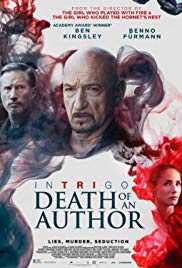
 Greetings again from the darkness. Daniel Alfredson directed two of the three films in the original “Millenium” trilogy by fellow Swede, the late Stieg Larsson. He handled THE GIRL WHO PLAYED WITH FIRE and THE GIRL WHO KICKED THE HORNET’S NEST. Alfredson has now signed on to direct a trilogy of films based on Hakan Nesser’s “Intrigo” novellas. This is the first in the series, with “Dear Agnes” and “Samaria” coming soon (each with completely different casts).

Nesser’s stories have been adapted for the screen by Alfredson and Brigitta Bongenheim, and they face the challenge of all crime stories making the move to movies … how to create an equal level of suspense. Benno Furmann (JOYEUX NOEL, 2005) stars as David, a translator by profession who has written his first novel. We first see David on vacation with his wife Eva (Tuva Novotny, ANNIHILATION, 2018), who spoils his plans by telling him she is leaving him for her therapist. We next see him planning or imagining her death.

Flash forward three years and David has arranged a meeting with successful writer Alex Henderson (Sir Ben Kingsley, Oscar winner for GANDHI, 1982) in hopes of receiving advice on his debut novel. Their meeting takes place at Henderson’s isolated island retreat, which serves as his primary residence away from ‘people’, the lot of whom he readily admits he doesn’t much care for. Henderson agrees to let David read passages of his novel, and the ‘cat and mouse’ game is afoot.

David has been contracted to translate the final book of Austrian writer Germund Rein, who recently committed suicide (mysteriously) while at sea. As the twists and turns unfold, David begins to wonder if there is a connection between Rein and his own story. A simple cough heard while listening to a radio concert sends David on the road. He discovers a code within Rein’s manuscript, and the film bounces between the multiple stories and layers.

When David’s fiction crosses over with his own reality, it’s our job as viewers to keep up and distinguish between the two. It’s not always easy as the structure seems designed to confuse. On the other hand, some of the aforementioned twists and turns might as well have neon signs explaining what is about to happen, why it happens and how it is related to what has already happened. Because of this, the film lacks the tension suspense and conflict necessary for this type of story. Storytelling is the focus, but it’s that storytelling that is the film’s downfall. While it’s always fun to watch Kingsley tear into a role, and some of the scenery is drop-dead gorgeous, we do hope the next two chapters of Nesser’s books transfer better to the screen.

watch the trailer:


THE HOST (2020)

January 16, 2020

 Greetings again from the darkness. The success of Ryan Murphy’s “American Horror Story” has inspired many writers and filmmakers to dive headfirst into the genre. The results have been mixed – some really creative works, and some ho-hum copycats. What has been interesting to watch is the genre-bending (or stretching) when what traditionally would have been a suspenseful drama or thriller, has elements of horror added to spice things up. That’s my best lead-in for director Andy Newbery’s film based on a story by Laurence Lamers, and adapted for the screen by Lamers, Finola Geraghty, Brenda Bishop, and Zachary Weckstein.

Sixty years ago this would have fit right in as an episode on “Alfred Hitchcock Presents”, even down to the bookend therapy sessions led by the fine British actor Derek Jacobi as Dr. Hobson. He tells his patient (whose face we don’t see) that his is “an unusual and disturbing case.” We then ‘see’ the story unfold … or maybe unravel is a better description. Robert Atkinson (played by Mike Beckingham, younger brother of Simon Pegg) is a bank employee enjoying a lunch break tryst with a beautiful woman. Sarah (Margo Stilley, 9 SONGS) just so happens to be married to Robert’s boss, and she clearly has only one use for Robert since he has no money and his life is a mess.

It’s not long before we discover Robert has many vices: gambling, smoking, drinking, and of course, romping with married women. In a moment that can be attributed to a desperate attempt to legitimize his existence, Robert nabs a 50,000 pound cash deposit from a new bank customer and promptly heads over to his favorite gambling hall. Things don’t go well, and dumb-as-a-rock Robert is soon cutting a deal with Chinese cartel leader Lau (played by the always reliable Togo Igawa).

Robert’s deal sends him to Amsterdam, a city where many things can go wrong – and often do. Local resident Vera Tribbe (Maryam Houssouni) offers Robert a room in her mansion, and, as we expected, things don’t go well for him. Both the cartel and Robert’s brother Steve (musician Dougie Poynter) are on the trail to find out what happened to Robert. DEA Agent Herbert Summers (played by Nigel Barber and his silky voice) is also involved, and what we find is a whole bunch of ‘nothing good’ thanks to the creepy rich Tribbe family,

Familiar faces pop up throughout the film, yet it’s difficult to buy into the sense of dread when most of the characters are making the kind of dumb decisions that Geico riffed in their commercial about ‘the running car’ and hiding behind the chainsaws. The lessons are pretty simple. Don’t steal money. Don’t sleep with your boss’ spouse. Don’t agree to run an errand for the Chinese cartel … or any other cartel flavor. Only if you can overlook the cluelessness of the characters will you find some entertainment value here.

watch the trailer:


LES MISERABLES (France, 2019)

January 15, 2020

 Greetings again from the darkness. Being the new student in school can be an emotionally trying experience for some kids. Now take that pressure and put it in a patrol car for law enforcement in a tough part of town where racial and religious tensions are always on edge. The ‘new kid’ in this case isn’t a kid, but rather an adult cop … and the experience will eclipse ‘trying’ and shift directly to life-altering. “Ever since 2005 …” is a line that reminds us that the Paris riots of that year remain fresh in the minds of locals, and police harassment is applied to most every stop or interrogation. This is an area that has yet to reclaim balance and writer-director Ladj Ly, having grown up in this part of the city, is more qualified than anyone to tell these stories.

Montfermeil is the Paris suburb where Victor Hugo wrote his classic 1862 novel “Les Miserables”. Recently divorced Stephane (played by Damian Bonnard) has transferred to the Anti-Crime Squad (ACS) in the area to be closer to his young son. His first day on the new job involves riding on patrol with local officers Chris and Gwada, who are veterans of these streets. Chris (played by Alexis Manenti) is a racist, hardened by the locals who have nicknamed him “Pink Pig”. Chris’s intimidation methods are old school and iron-fisted. Gwada (played by Djebril Zonga) is an African-Muslim who tries to capitalize on his own roots with locals, even though they now consider him a traitor.

Immediately obvious is the fact that Stephane’s ‘by-the-book’ approach doesn’t meld with the forceful posture assumed by Chris and Gwada. “Greaser” is the nickname Chris gives to Stephane, emphasizing that the new cop doesn’t fit on the streets or in the patrol car. As the prime example of how this environment can cause a small situation to escalate quickly due to one wrong word or movement, a young thief named Issa takes a lion cub from a travelling circus as a prank. The next thing we know, the Muslim Brotherhood is involved and threats are flooding every interaction, creating tensions for all. When the cops finally track down Issa, an accident occurs that further escalates the tensions between various street factions and the cops. Things get really ugly when it’s discovered a young boy captured the event with his drone.

Director Ly opens on citywide excitement at the 2018 World Cup with a backdrop of Paris sites such as The Eiffel Tower and Arc de Triomphe. The script from Ly and co-writers Giordano Gederlini and Alexis Manenti doesn’t allow us to wallow in the happiness for long. Soon, we are on the streets with the cops in Victor Hugo’s (and Ly’s) setting – contemporary only in look, not feel or substance. We are dropped into an environment where each moment is dictated by racial-social-political lines. Foot chases, car chases, and confrontations are de rigeur. Disenchantment cloaks kids and adults alike, and the fear of anarchy never wanes. A bad day for Issa turns into maybe the worst ever first day for Stephane. This is one of the year’s most incredibly tense and gripping films, and one that leaves us exhausted and dumbfounded. It’s a brilliant work.

January 2020 UPDATE: The film has been Oscar nominated for Best Foreign Language Film

watch the trailer:


INVISIBLE LIFE (Brazil, 2019)

January 15, 2020

 Greetings again from the darkness. Masterful storytelling when combined with expert filmmaking is a treasure to be appreciated and enjoyed, even if the story is not so pleasant. Such is the case with this gem from writer-director Karim Ainouz, who adapted the screenplay with Murilo Hauser and Ines Bortagaray from the novel “The Invisible Life of Euridice Gusmao” by Martha Bathala. Based in Rio de Janiero, the film blends the vibrant colors of the area with the traditional and restrictive Latin American family expectations of the 1950’s.

The story spans 5 or 6 decades, and when we first meet sisters Euridice and Guida, it’s clear they share a tight emotional bond that goes deeper than blood. Though their personalities differ greatly, they are both ahead of their time and out of step with the conventions of the era. Euridice (a strong performance by Carol Duarte) longs for independence and aspires to be a concert pianist after a hoped-for Conservatory in Vienna, while Guida (a powerhouse Julia Stockler) is a dreamer seeking true love, and whose party girl ways must be kept hidden from their conservative father. Both young ladies are spirited, yet respectful.

Their lives are forever altered when Guida runs off to Greece with her sailor lover. As is too often the case with young dreamers, she returns home once her spontaneous choices prove to be poor judgment. Her father rejects his pregnant daughter since, in his eyes, she has disgraced the family. The parents mislead Guida about her sister’s whereabouts, so Guida assumes Euridice is off at conservatory fulfilling her dreams. This sets Guida off on her own solitary path.

In actuality, Euridice has married and experienced one of the worst ever wedding nights, featuring what is likely cinema’s most unsexy bathroom lovemaking scene. There is an element of horror films to this segment of the film, as the sisters are living their worst nightmares, while being separated from each other … unable to communicate. The male-dominated Latin culture and family traditions prevent their mother from ‘disobeying’ the father’s order, so the cruel lie continues as the sisters unknowingly live their lives within the same town. There is even one excruciatingly painful-to-watch scene that finds them in the same restaurant at the same time, yet oblivious to the presence of the other.

Each woman’s inner-strength pushes them forward. Guida (now Gisele) befriends a wise former prostitute Filomena (an excellent Barbara Santos) who becomes her mentor in poverty. Euridice tries to make the best of her situation while keeping her dream alive. Mostly what we have is a tragic story without one specific tragedy – other than the daughter spurned by her father. There are so many moments of pain and frustration, with undelivered mail being among the worst. The film is beautifully shot by cinematographer Helene Louvart, and it reminds us that ‘life happens’, and it’s not all love and Bach. This is an emotional and heart-breaking story, and devotees of The Lifetime Channel will likely be disappointed in the ending. For me, I have no qualms about the emotional wringer the film puts viewers through – even after the opening scene foreshadowing.

watch the trailer:


UNDERWATER (2020)

January 10, 2020

 Greetings again from the darkness. The opening credits have an “X-Files” look and feel. Newspaper headlines and redacted reports zip by … in fact, the rapid cuts are so quick that very few viewers will be able to keep up. Even if you haven’t finished your Evelyn Woods speed-reading course, the gist is clear: there is a (very) deep-water drilling lab located 36,000 feet below the ocean’s surface. Yep, that’s almost 7 miles deep for the crew of 316, and some mysterious bad things may or may not be lurking. That’s really our only set-up … unless you want to count Kristen Stewart brushing her teeth.

It’s literally less than 5 minutes in when the rig is rocked by an explosion of some kind. We are told the structure is 70% damaged. The survivors are quickly identified. Nora (Ms. Stewart) and Rodrigo (Mamoudou Athie) are together in the immediate aftermath. Nora is a mechanical engineer and computer whiz. They soon come across a co-worker buried in rubble. It’s wise-cracking TJ Miller and his (actual) stuffed bunny. Next up are the Captain (Vincent Cassel) and lovebirds Emily (Jessica Henwick) and Smith (John Gallagher Jr). With no time for early character development, we learn tidbits as their perilous journey hopefully leads them towards rescue. Of course anyone who has ever watched a movie can tell you, they won’t all make it. Maybe the 8 year old girl sitting in the row behind me wouldn’t know that … but no parent should take their 8 year old to a PG-13 movie that has “terror” in the parental warnings.

Director William Eubank and co-writers Brian Duffield and Adam Cozad create plenty of tension, danger and suspense. The movie is at its best when they let the moment speak. It’s the dialogue that is mostly cringe-worthy, as well as the predictable and unnecessary jump-scares. These people are stranded miles deep in the ocean and are running out of oxygen and options … and are being chased by something they can’t identify. The visual effects are successful in generating the environment of danger and claustrophobia.

It’s in the little things where the film falters. When we first see the Captain, he has his arm in a sling. He’s obviously injured. Once the bulky underwater suits are donned, his bad arm seems just fine … he’s even pulling one of the others with a rope! Nora makes a big deal about being the “smallest” of the group and volunteers to explore a narrow passage. The problem is that they are all wearing the same suits – a fact that should negate any advantage of Ms., Stewart’s slim, toned body. Lastly, the film has borrowed heavily from James Cameron’s classic ALIEN. In fact, it has been referred to as “Underwater Alien”. Of course, this film isn’t nearly as well-rounded or complete as that one … but then few are.

Mr. Eubank’s film is a sci-fi/horror mash-up, but it’s really more a survival thriller than science fiction or creature feature, although the sea creatures have their moments. Cinematographer Bojan Bazelli does a nice job in keeping with the ‘play it straight’ approach, and his camera work is complemented by the electronic score from Marco Beltrami and Brandon Roberts. Ms. Stewart and her buzzed blond hair hold their own amidst the danger. A blatant lecture about how we are going places (deep sea) we shouldn’t go and doing things (drilling) we shouldn’t do is included for those who might not figure it out on their own, but mostly we spend our time trying to figure out how to survive the deep sea pressure with little oxygen and no escape pods. Just leave the 8-year olds at home.

watch the trailer:


LIKE A BOSS (2020)

January 9, 2020

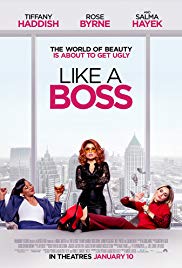
 Greetings again from the darkness. It’s no secret that all movies aren’t made to appeal to all movie goers. Even for someone like me who watches an average of 5 movies per week, there are going to be some that are simply not in my wheelhouse. In the case of this latest from director Miguel Arteta (BEATRIZ AT DINNER, 2017), it seems to have been formulated as a “Girls Night Out” treat … a sub-genre with a track record of success.

Although I’m not the target market, I’m not precluded from commenting on the film and making observations. It merely means I’ve watched the movie from a different perspective than many paying customers will. So let’s start with the positives. The cast is excellent. After being wasted and miscast is last year’s disappointing THE KITCHEN, Tiffany Haddish is cut loose and allowed to do what she does best – searing one-liners peppered with raunchiness. Rose Byrne has long been what was once called a comedy “straight man.” Of course that term is no longer used, but I’m not sure what today’s acceptable terminology is. The simple fact is, very few people are as brilliant as Ms, Byrne at playing off an acid-tongued comic. She is a rare talent. As for Salma Hayek, her body of work (and Oscar nomination for FRIDA) speaks for itself.

Mia (Ms. Haddish) and Mel (Ms. Byrne) have been friends since childhood, and are now roommates, best friends, and business partners at the beauty/cosmetic company they founded. The creative and shoot-from-the-hip Mia and the pragmatic and meticulous Mel are personality opposites to the point that Mel has been reticent to explain their serious financial woes to the always upbeat Mia. When cosmetics tycoon Claire Luna (Ms. Hayek) makes an offer to save the struggling company, Mel welcomes the financial relief, while Mia senses trouble.

As you would guess, Mia is right … Claire Luna has darker motives, and soon she is driving a wedge between the two partners and friends. The talented supporting cast includes: Jennifer Coolidge, Billy Porter (who manages to remain flamboyant while being subdued for him), Ari Graynor (“I’m Dying Up Here”), Jessica St. Clair, and Karan Soni (DEADPOOL) as Claire’s assistant. There is also a cameo near the end for those who enjoy a bit of friendly comedy.

Danielle Sanchez Witzel, Adam Cole-Kelly, and Sam Pitman combined on the story and script, and have inserted a few gags that play to the strength of the cast – pot smoking ghost peppers, and boyfriend humor are all at play, and balanced by the strength of female friendships. The business side is so cartoonish (especially Ms. Hayek’s character) that it will likely somewhat offend anyone who actually runs a business, but the raunchy humor and overly emotional character reactions will likely satisfy the intended audience.

watch the trailer:


JUST MERCY (2020)

January 9, 2020

 Greetings again from the darkness. 2019 movie year brought us BRIAN BANKS, CLEMENCY, and now JUST MERCY. Three movies centered on death row and racism in the justice system. Being imprisoned for a crime one didn’t commit is simply something most of us can’t fathom. Add in the death penalty, and it truly becomes a horrifying tragedy. Bryan Stevenson is a Harvard Law graduate who founded Equal Justice Initiative, a non-profit organization whose mission is to get innocent/wrongly convicted people off of death row.

Filmmaker Destin Daniel Cretton (SHORT TERM 12, THE GLASS CASTLE) brings Mr. Stevenson to the screen through the story of Walter “Johnny D” McMillian. Mr. McMillian was so obviously not guilty, that the road block set up to stop him on his way home from work speaks to the deep-rooted racism embedded in an Alabama police force so desperate to solve the murder of a white woman. Oh, and the town is Monroeville. The same town where Harper Lee wrote “To Kill a Mockingbird.” Cretton’s script, co-written with Andrew Lanham (THE GLASS CASTLE) follows attorney Stevenson’s efforts to unravel the racism and miscarriage of justice.

Michael B Jordan plays Bryan Stevenson, and Oscar winner Jamie Foxx plays Walter McMillian. Their shared scenes are extraordinary, and bring out the best in Mr. Foxx. Oscar winner Brie Larson (Mr. Cretton’s good luck charm) plays Stevenson’s assistant Eva Ansley, a hard-working idealist, who unfortunately is given little to do here. Tim Blake Nelson makes quite an impact as Ralph Myers, a convicted murderer with a twitchy delivery – and the state’s only witness against Walter. Rafe Spall is the corrupt DA with a southern accent that is painful to our ears, and Karan Kendrick plays Walter’s wife Minnie. In an all-too-brief turn, O’Shea Jackson plays death row inmate Anthony Ray Hinton, whose story could just as easily be at the center of movie like this one.

The film opens in 1987 and continues through McMillian’s re-trial in 1992. Along the way Mr. Jordan effectively portrays a man that realizes things are much worse than he anticipated. The film is based on Stevenson’s 2014 memoir “Just Mercy: A Story of Justice and Redemption”, but it’s Mr. Foxx who excels here. He conveys the feelings of resignation that the man has for his situation … a situation so beyond his control, and one that he understands is biased against him. Watching McMillian come to trust Stevenson through actions rather than words, is exceptional acting by Foxx. We’ve seen how hope can be a dangerous thing on death row, and it’s certainly an emotion that Foxx’s McMillian is slow to embrace.

Bryan Stevenson is now a world renowned Civil Rights attorney and his foundation has made a difference for many convicts. He continues to fight against a racially-biased system, and it does seem that the attention is causing a change in attitudes. The movie comes across a bit slick and formulaic for the message it carries, but perhaps that’s by design so that more people will give it a watch. The intent is certainly admirable.

watch the trailer:


THE SONG OF NAMES (2019)

January 9, 2020

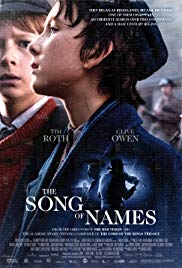
 Greetings again from the darkness. The title refers to a sacred Jewish ritual where the names of the Holocaust victims are recited in a musical style. It’s a process that (sadly) covers a few days. In this film, it takes on a personal, as well as historical, significance. British cultural affairs expert Norman Lebrecht wrote the 2001 novel on which writer-director Francois Girard (THE RED VIOLIN, 1998, plus plays, operas and 2 Cirque de Soleil shows) and co-writer Jeffrey Caine based the film.

We open in 1951 London just minutes before the scheduled performance of young violin virtuoso Dovidl “David” Rapoport. He is to play Bruch and Bach in a concert sponsored by his “adoptive” father figure Gilbert Simmonds, who has sunk his entire life savings into producing the concert. Despite the assurances of Simmonds’ son Martin, who has become like a brother to David, the featured performer is a no-show … leading Martin to search for him over the next 35 years.

The film covers the story from the time Dovidl’s Polish-Jewish father (played by Jakub Kotynski) agrees to his leave 9 year old, a violin prodigy, with the non-Jewish Simmonds in an attempt to protect the boy from the German invasion of Poland in the late 1930’s. As Dovidl and Martin grow together, their bond become stronger. Martin is present when Dovidl renounces Judaism, even as becomes more proficient with his instrument and more saddened by the Holocaust that he avoided in his home country.

Both boys are played at three different ages by three different actors. Dovidl is played by Luke Doyle at ages 9-13, Jonah Hauer-King at ages 17-23, and by Clive Owen in middle age. Martin is played by Misha Handley at ages 9-13, Gerran Howell at ages 17-23, and by Tim Roth in later life. The actors do a good job of capturing Martin’s early irritation at Dovidl’s arrogance, the shock of the no-show betrayal, and the later in life man who changed everything when he found out about his family, as well as the music teacher so desperate to find his long lost friend/brother.

The film bounces between the three timelines so that we have a full picture of the impact they have had on each other’s lives, and how Dovidl’s disappearing act was quite devastating. Much of the film centers on Martin tracking down leads and talking to folks for some idea of the path taken by Dovidl. Mr. Roth is especially effective (and surprisingly understated) in his performance as a man haunted by the unexplained actions of a loved one. His wife, played by Catherine McCormack, is simultaneously understanding, patient, and emotionally affected.

Stanley Townsend plays Martin’s father. He cares for Dovidl as if her were a son, and provides what’s necessary for the prodigy to develop and be groomed for performance. Three-time Oscar winner Howard Shore delivers a score that follows the good times and bad, not an easy task for a family drama within the shadow of the Holocaust. One specific sequence stands out, and it is filmed on the hallowed grounds of Treblinka – now a memorial, where the extermination camp once stood.

There are many facets to the story, and most involve heavy emotions. We see children bearing more than they should. Parents protecting their children in times of crisis. The difference between religion and ethnicity is discussed. Broken trust proves especially damaging. Dovidl’s disappearing act could be compared to that of JD Salinger, in that he seemingly vanished for years. And maybe most of all, the idea of survivor’s guilt is a theme, as Dovidl explains, “You don’t have to be guilty to feel guilty.” The film may have some pacing issues, but it affords such a wealth of conversation topics, that any flaws are easily forgiven.

watch the trailer:


THE SONATA (2020)

January 9, 2020

 Greetings again from the darkness. A throwback to 1970’s cinema is easy to appreciate, whether it was intended or nor. Writer-director Andrew Desmond’s debut feature film certainly serves up the feel and style of so many of those low-budget horror films I watched as a youngster (many, it seemed, featured the late Roddy McDowall). Mr. Desmond and co-writer Arthur Morin (also his first feature film screenplay) likely viewed some of those same films, as this one succeeds in capturing the same creepy tone.

For some, the music they create comes from their soul … it makes them who they are. For these musicians, their obsession and quest for perfection can be off-putting to others. In an early sequence, we see young violist Rose Fisher (Freya Tingley, “Once Upon a Time”) react to news of her father’s death by shrugging and stating she wants to continue with her recording session. See, Rose’s father deserted the family when she was a toddler, and the two never spoke again. Richard Marlowe (the late great Rutger Hauer) was an exciting and brilliant young composer when he chose to drop out and live as a recluse (think Salinger). He’s even compared to Pink Floyd founding member Syd Barrett. Rose chose to never use her genetics as a springboard to success; never even telling her manager Charles Vernais (Simon Abkarian, CASINO ROYALE) of the connection.

Rose visits Marlowe’s house, and before learning of the startling manner in which his life ended, she discovers his final composition locked away in a drawer … a violin sonata seemingly left for her to find. Neither Rose nor Charles recognize some of the non-musical symbols included on the sheet music, but it’s clear there are elements of genius in the piece. While Charles envisions piles of cash to be made by capitalizing on this situation, Rose sets about tracking down clues to the unknown symbols by exploring her father’s estate.

It should be noted that Marlowe’s “house” is actually the 19th century Cesvaine Palace, and it makes a wonderfully gothic setting for this story. This sub-genre of horror films is always best when the setting is a creepy old mansion/castle, and includes a mysterious housekeeper, other-worldly children, a leather-bound book of secrets, and a subterranean room (this one is beneath a chapel) with curious wall murals telling some forbidden legend of the occult. The only element missing here is vicious dog that pops up periodically.

The symbols lead to a French secret society, and in their own ways, both Rose and Charles learn that finishing Marlowe’s final piece will conjure the Anti-Christ. While Charles pursues greed, Rose pursues the music. Spoken words pale in comparison to the music Rose creates. Screen veteran James Faulkner appears as Sir Victor Ferdinand in a vital supporting role. While it’s a bit disappointing that the late, great Rutger Hauer has very little screen time, it’s quite enjoyable to watch Ms. Tingley carry the lead. Mr. Desmond filmed in Latvia, and delivers a film that fits quite nicely for those who enjoy the creepy throwback horror style.

watch the trailer: