THE UPRISING (2026)

September 10, 2026

Greetings again from the darkness. It can be challenging to relate to an historical drama set in the 14th century, yet the Peasants’ Revolt of 1381 in medieval England sometimes hits quite close to home. Writer-director Paul Greengrass directed three of the Jason Bourne movies, so we can expect the action sequences to be frenetic and thrilling … often relying too heavily on handheld cameras.

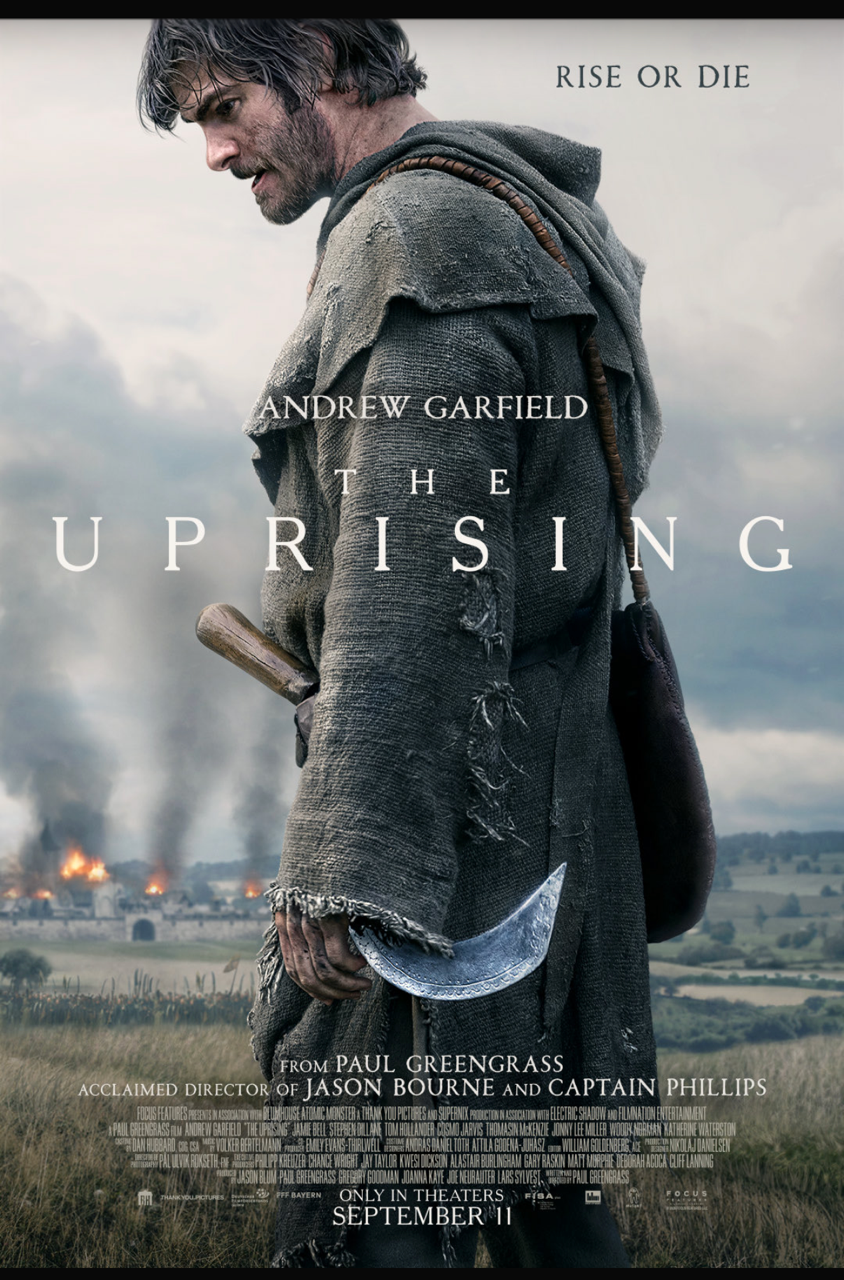
Andrew Garfield is ‘Ploughman’, a self-imposed moniker since “I am what I do”. We watch as he works his plot of land around the three graves near his cabin. He’s grieving and lonely, having paid a steep price from the bubonic plague known as “Black Death”. While he’s toiling away, the council for teenage King Richard II (Woody Norman, C’MON C’MON, 2021) is plotting behind closed doors whether to save the kingdom by taxing the rich or by taxing the poor. The rich would expect a seat at the proverbial table, so it all falls to the poor, of course. Ploughman doesn’t take kindly to the announcement and violently lashes out in anger … an action that John Ball (Jamie Bell) and Wat Tyler (Cosmo Jarvis) use as step one in the uprising of the frustrated masses.

The king’s council of corruption and manipulation is made up of elders: Archbishop Sudbury (Stephen Dillane), Chief Justice Belknap (Stanley Townsend), Treasurer Hales (Tom Hollander), and Mayor of London William Walworth (Jonny Lee Miller). While this group protects their own cone of power, the young king cowers in dark corners, escaping nightmares and uncertainty. Even his mum (Katherine Waterston) struggles to get him to govern.

Those in the rebellion are joined by Alyce (Thomasin McKenzie), a character clearly designed to represent the strong and determined women of the era. Injustice is readily accepted in no particular era, so an upswell of anger towards an oligarch by the oppressed is not surprising … although Ploughman’s elite fighting skills certainly are. The progression of the story and the battle scenes deliver significant intensity, and we can’t help but wince as those involved prove the adage, ‘power corrupts’.

If you know any of this history, you know the timid King makes a shocking turn, and one can only assume filmmaker Greengrass had no qualms about any modern-day symmetry shown in this saga from almost 650 years ago. The performances are quite good, and the Bavarian shooting locales perfectly capture the time period. Cinematographer Pal Ulvik Rokseth (ARMAND, 2024) embraces the feel of this setting, despite the trademark Greengrass overuse of handhelds. History can provide lessons of inspiration or lessons of caution, sometimes within the same story.

Opens nationwide in theaters on September 11, 2026

WATCH THE TRAILER


THE SONG OF NAMES (2019)

January 9, 2020

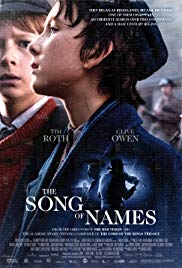
 Greetings again from the darkness. The title refers to a sacred Jewish ritual where the names of the Holocaust victims are recited in a musical style. It’s a process that (sadly) covers a few days. In this film, it takes on a personal, as well as historical, significance. British cultural affairs expert Norman Lebrecht wrote the 2001 novel on which writer-director Francois Girard (THE RED VIOLIN, 1998, plus plays, operas and 2 Cirque de Soleil shows) and co-writer Jeffrey Caine based the film.

We open in 1951 London just minutes before the scheduled performance of young violin virtuoso Dovidl “David” Rapoport. He is to play Bruch and Bach in a concert sponsored by his “adoptive” father figure Gilbert Simmonds, who has sunk his entire life savings into producing the concert. Despite the assurances of Simmonds’ son Martin, who has become like a brother to David, the featured performer is a no-show … leading Martin to search for him over the next 35 years.

The film covers the story from the time Dovidl’s Polish-Jewish father (played by Jakub Kotynski) agrees to his leave 9 year old, a violin prodigy, with the non-Jewish Simmonds in an attempt to protect the boy from the German invasion of Poland in the late 1930’s. As Dovidl and Martin grow together, their bond become stronger. Martin is present when Dovidl renounces Judaism, even as becomes more proficient with his instrument and more saddened by the Holocaust that he avoided in his home country.

Both boys are played at three different ages by three different actors. Dovidl is played by Luke Doyle at ages 9-13, Jonah Hauer-King at ages 17-23, and by Clive Owen in middle age. Martin is played by Misha Handley at ages 9-13, Gerran Howell at ages 17-23, and by Tim Roth in later life. The actors do a good job of capturing Martin’s early irritation at Dovidl’s arrogance, the shock of the no-show betrayal, and the later in life man who changed everything when he found out about his family, as well as the music teacher so desperate to find his long lost friend/brother.

The film bounces between the three timelines so that we have a full picture of the impact they have had on each other’s lives, and how Dovidl’s disappearing act was quite devastating. Much of the film centers on Martin tracking down leads and talking to folks for some idea of the path taken by Dovidl. Mr. Roth is especially effective (and surprisingly understated) in his performance as a man haunted by the unexplained actions of a loved one. His wife, played by Catherine McCormack, is simultaneously understanding, patient, and emotionally affected.

Stanley Townsend plays Martin’s father. He cares for Dovidl as if her were a son, and provides what’s necessary for the prodigy to develop and be groomed for performance. Three-time Oscar winner Howard Shore delivers a score that follows the good times and bad, not an easy task for a family drama within the shadow of the Holocaust. One specific sequence stands out, and it is filmed on the hallowed grounds of Treblinka – now a memorial, where the extermination camp once stood.

There are many facets to the story, and most involve heavy emotions. We see children bearing more than they should. Parents protecting their children in times of crisis. The difference between religion and ethnicity is discussed. Broken trust proves especially damaging. Dovidl’s disappearing act could be compared to that of JD Salinger, in that he seemingly vanished for years. And maybe most of all, the idea of survivor’s guilt is a theme, as Dovidl explains, “You don’t have to be guilty to feel guilty.” The film may have some pacing issues, but it affords such a wealth of conversation topics, that any flaws are easily forgiven.

watch the trailer: