mother! (2017)

September 14, 2017

 Greetings again from the darkness. Him. Mother. Man. Woman. When those are the identifiers of the four main characters (none have a real name), one might assume that the filmmaker is lazy. However, after watching the latest from the psycho-creative force known as Darren Aronofsky, we understand that names weren’t necessary, and even if they had been, he was probably too mentally exhausted from finding ways to torture those characters and confound the viewers.

The first half of the film is discomforting and creepy while the second half is downright crazed and deranged. You won’t find many story details in this review, as the fun is in the shock. Most of the film is through the eyes of Jennifer Lawrence, and we share her confusion and disoriented state. She is married to a famous poet played by Javier Bardem (yes, the age difference is acknowledged). While she spends her days refurbishing their stunning country home, he battles severe writer’s block. Needless to say, their domestic bliss goes wrong … but it’s not the kind of wrong we’ve ever seen before.

Aronofsky and cinematographer Matthew Libatique (both Oscar nominees) confine us in excruciatingly tight shots resulting in further disorientation and claustrophobia through most of the film. By the time we get a single wide shot of the home’s exterior, we’ve just about given up hope. And once Ed Harris and Michelle Pfeiffer show up, we kick into full ROSEMARY’S BABY mode … only more frenetic and hyper.

It should be noted that it’s not a traditional horror film – heck, it’s hardly a traditional film at all. It’s built on confusion, and metaphors abound. Aronofsky seems intent on causing endless post-viewing discussions and debate over what it “means”. A case can be made for commentary on ego, fame, Mother Nature, deity/religion, and a sign of the times – the entitled “takers” of the world. The most obvious explanation is that the price paid for creativity is quite dear, and often causes a release from reality. There is a vicious cycle occurring here and our realization happens after the crescendo of insanity that is the film’s peak.

WTF moments are too many to count, and Ms. Lawrence pulls off what has to be the roughest on screen pregnancy we’ve seen. It’s a real treat to see Michelle Pfeiffer back in form after being out of the spotlight for four years. The score from Johan Johannsson is remarkable and there are ground-breaking visual effects (easy to miss during the audacious, frenzied second half action). Aronofsky is clearly provoking us, though it’s abundantly unclear to what end. His previous twisted, mind-benders include REQUIEM FOR A DREAM and BLACK SWAN … both of which seem like mainstream family fare in comparison. This is a love it or hate it project, and most will likely fall into the latter. But for those who embrace the deranged and audacious, the love will be everlasting.

watch the trailer:


THE UNKNOWN GIRL (2017, La Fille Inconnue, France)

September 10, 2017

 Greetings again from the darkness. A nice story set-up is always welcome, and this one delivers a creative attention-grabber that draws us in pretty quickly. Brothers and long-time filmmaking collaborators Jean-Pierre Dardenne and Luc Dardenne (TWO DAYS, ONE NIGHT, THE KID WITH A BIKE) edited the film a bit after its Cannes screening, and the result is a quiet little whodunit with an interesting lead actress performance.

A doctor and her intern have a disagreement at closing time, and opt not to answer the clinic door when a young lady rings after hours. The doctor’s guilty conscience leads her to become obsessed with finding out the name of the lady when she turns up murdered the next morning. It’s passionate and amateur sleuthing at its most awkward, unconventional, and dangerous.

Dr Jenny Davin has recently accepted a post at the prestigious Kennedy Hospital, replacing a retiring doctor. The tragedy causes a change of mind on the job so that she may focus on the case and on continuing patient care through her clinic. The filmmakers initially wanted Marion Cotillard for the role (what filmmaker wouldn’t?), but Adele Haenel (LOVE AT FIRST FIGHT) brings her own approach, and though she doesn’t come across as the warmest person, it’s quite apparent that she is a dedicated doctor who cares very much for her patients. Even when she tells her intern Julien (Olivier Bonnaud) that “a good doctor must control his emotions”, she is ever-stoic with her delivery.

The story is missing the usual Dardenne brothers’ twist, and instead, at its core is an ill-advised detective story and a case of morality, guilt, and the drive to do the right thing. The house calls and open communication with doctors will confound some U.S. viewers, but the various vignettes during Dr. Davin’s gumshoe work keep us engaged. The sub-plot with Dr. Davin reigniting intern Julien’s passion for medicine also maintains the minimalist approach and restrained performances … all with a very grounded approach with mostly handheld cameras.

watch the trailer:


REBEL IN THE RYE (2017)

September 7, 2017

 Greetings again from the darkness. “Holden Caulfield is dead.” So states Jerry’s letter to his mentor. You likely know Jerry better as J.D. Salinger, and he wrote that while hospitalized with Post Traumatic Stress Syndrome after WWII. Of course, we know this proclamation is premature, as Holden Caulfield is the main character from Mr. Salinger’s famous (and only) novel, “The Catcher in the Rye” … a high school literature staple for decades.

Imagine your dream is to become a great writer, but your own father continually reminds you that “meat and cheese distribution has been good for this family.” Your restlessness often works against you, and though you are hesitant to admit it, a mentor for writing and life direction is desperately needed if you are to avoid the family business. Enter Columbia professor Whit Burnett (Kevin Spacey).

This is Danny Strong’s first feature film as a director, though you would surely recognize his face from his frequent acting appearances – often as a weasly character. He is also the creator of TV’s “Empire” and wrote the screenplays for THE HUNGER GAMES: MOCKINGJAY (Parts I and II) and LEE DANIELS’ THE BUTLER. Strong does an admirable job in showing the commitment required to hone one’s writing skills and proving “the difference in wanting to be a writer and actually being one.”

Jerome David Salinger is played well by Nicholas Hoult. His scenes with Spacey’s professor are the film’s best, and Hoult also shoulders the responsibility of Salinger’s writing frustrations, personal life challenges, military service, and finally, his decision to become the most famous and long-lasting recluse (by comparison, Howard Hughes was an amateur).

We learn that Burnett was instrumental in getting Salinger’s first short story published, which finally gave Jerry the answer needed for a writer’s most dreaded question, “Have you been published?” Quite a bit of time is devoted to his odd romantic relationship with Oona O’Neill (Eugene’s daughter and the future, long-time wife to Charlie Chaplin). Zoey Deutch (daughter of Lea Thompson) plays Oona as an enigmatic lover attracted to Salinger’s genius, but incapable of being patient for his career that might happen (and might not). She opts for the sure bet.

Salinger’s military service included Utah Beach on D-Day, and nearly as remarkably, his toting the tattered manuscript ‘Catcher’ pages throughout his tour. He returned home in 1946, and in 1951 “The Catcher in the Rye” was published. It’s been referred to as the Great American novel and a rite of passage, while also being banned and derided for its whiny Holden.

Director Strong emphasizes Salinger’s turn to Zen Buddhism and his sessions with Swami Nikhilanda, as well as his evolving distrust of stalking fans and two-faced media. Support work is provided by Sarah Paulson as Salinger’s salty agent, Lucy Boynton as his wife, Victor Garber as his father, and Hope Davis as his supportive mother. Just as in real life, we get nothing of Salinger’s later years of solitude and isolation in New Hampshire, where he died at age 91.

The book has sold more than 65 million copies, and continues to sell well today. In a shift from the recent documentary SALINGER by Shane Salerno, and the book “J.D. Salinger: A Life Raised High” by Kenneth Slawenski, this dramatization doesn’t dig too deep, but it does allow a new generation to personify the legend. Perhaps it even paints a picture of a better/nicer man than what his real life actions showed. Regardless, the older Salinger certainly seemed to embrace the cause of “write and get nothing in return”.

watch the trailer:


IT (2017)

September 7, 2017

 Greetings again from the darkness. There are two clown schools: Funny clowns (Bozo, Ronald McDonald), and Terrifying clowns (the one in POLTERGEIST, Pennywise the Dancing Clown). Stephen King first introduced Pennywise in the 1986 novel, and the great Tim Curry brought him to life (and our nightmares) in the 1990 TV mini-series (2 episodes). So, that’s 27 years since the TV version. How fitting that director Andy Muschietti (MAMA) introduces a new generation 27 years later, since that’s how often the supernaturally evil clown visits Derry, Maine to frighten and feast on kids. It’s a terrific update.

Horror films are similar to comedy films in that it often comes down to one’s own personality quirks … what makes you laugh, and what scares you. This new version covers the first half of King’s novel, focusing on “The Losers Club” – the seven kids who band together to fight their fears. Director Muschietti sets the story in 1989 (rather than the 50’s) and the obvious comparisons are to THE GOONIES, STAND BY ME (another King story), and the recent hit “Stranger Things”.

The opening sequence gets us off to a great start. You’ve probably seen it in the trailer. Young Georgie (Jackson Robert Scott) is joyfully splashing through the rain puddles following his paper boat as it disappears into the storm drain. It’s there that he meets, and we get our first look at, Pennywise (Bill Skarsgard, son of Stellan and brother of Alexander). Giving us an early peek at what we came to see creates time for the development of a long list of characters. Of course the mini-series and the novel didn’t have the time restrictions of a feature film, so it’s impressive how quickly we connect with the kids.

Georgie’s older brother Bill (Jaeden Lieberther, MIDNIGHT SPECIAL) is the leader of The Losers despite his propensity to stutter, and his belief that little Georgie may still be alive. Motormouth Richie (Finn Wolfhard, “Stranger Things”) is the bespectacled wiseass, while Beverly (Sophia Lillis, an Amy Adams lookalike and star in the making) is the tough-on-the-outside female who deals with the rumors that accompany being a teenager. Hypochondriac Eddie (Jack Dylan Grazer), straight-laced son of the Rabbi Stanley (Wyatt Oleff), chubby brainiac new kid Ben (Jeremy Ray Taylor), and home-schooled Mike (Chosen Jacobs) round out this group of outsiders who are all frequently the target of bully Henry Bowers (Nicholas Hamilton), creepy parents, and of course, Pennywise.

A couple of the set pieces are outstanding. Beverly’s bathroom (especially the sink), the creek for the rock fight, and the rickety old house and its corresponding clown lair all contribute to the overall level of menace. Rising star composer Benjamin Wallfisch produces a score that guides us through the thrills and spills, as well as the quieter moments. As for Pennywise, even though the dancing clown had more screen time in the mini-series, Skarsgard is memorable, although the modern day special effects (those teeth!) often diminish the humanistic feel of Curry’s clown and escalate things to an other-worldly level.

Expect more of the Halloween Haunted House type of scary rather than the emotionally crippling stuff of horror films like THE EXORCIST or THE SHINING. The sudden bursts of sinister are surprisingly balanced with the humorous one-liners from the kids, and the actualization of the infamous “you’ll float too” is a stunning effect. The nostalgic feel complements the best part of the story … the power of friendship and connected groups. Watching these kids face their biggest fears certainly provides a bit of a chill to the upcoming fall season … and as a bonus, it’s a fun time for viewers.

watch the trailer:


HOME AGAIN (2017)

September 6, 2017

 Greetings again from the darkness. Let’s just get this out of the way upfront. There is a proven and established market for mindless fluff designed to allow women to laugh at the messes created by “real life” relationships, careers, and parenting. In fact, first time writer-director Hallie Meyers-Shyer is merely continuing the traditions set by her bloodline. She is the daughter of filmmakers Nancy Meyers and Charles Shyer who shared an Oscar screenwriting nomination for PRIVATE BENJAMIN (1980), and collaborated on other Romantic-Comedies such as FATHER OF THE BRIDE (I and II), and BABY BOOM (1987). Rom-Coms exist to bring some balance to the universe of Comic Book film adaptations for fan boys. It is possible to have quality filmmaking on both sides … no matter how rare it seems.

Oscar winner Reese Witherspoon stars as Alice Kinney. It’s her 40th birthday, and she’s a chipper lady recently separated from her music industry husband (Michael Sheen) and moved with their two daughters (Lola Flanery, Eden Grace Redfield) from New York to Los Angeles. Alice is in full “starting over” mode, including kicking off a new home decorating business. During a drunken birthday celebration with her friends, Alice hooks up with a younger man. The next morning, Alice’s mom (Candice Bergen) invites Harry (the young man played by Pico Anderson) and his two buddies (Nat Wolff, Jon Rudnitsky – all 3 are budding filmmakers) to move into Alice’s house. What follows is a maybe/maybe not romance between Harry and Alice, a bonding between the fellows and Alice’s daughters, new business struggles for Alice, the sudden return to the scene of Alice’s husband, and an endless stream of movie-making meetings for the 3 guys.

That’s a recap of the story, but it doesn’t address the real issue. For years, we have been hearing that the good-old-boy Hollywood network needed to back more female-centric projects: movies about women, movies directed by women, movies written by women, movies produced by women. Well this one has ALL of that, and yet I can only imagine the outrage if a man had written/directed/produced this exact film. Let’s discuss.

Alice is positioned as a “brave” and “strong” woman for moving her kids across the country and starting over. What allows this woman to be so courageous? Well see, she is the daughter of a deceased filmmaker who had a successful career and left her a multi-million dollar California estate … conveniently, one with a guest house for the three young men to live in. And who in their right mind, and with two young daughters, would invite three total strangers to move in – especially the night after – even if one of them looks to be yanked right out of an Abercrombie ad? There is also Alice’s interaction with her first client (played by Lake Bell). Despite despicable treatment from the rich lady, Alice doesn’t stand her ground until yet another drunken bout of liquid courage occurs. The two daughters are smart and cute, but there is an obvious shortage of daily parenting happening here – the daughters seem to show up only when a dose of precociousness is required. The scenes with Alice and her estranged husband are appropriately awkward, but the communication seems hokey … at least until we witness true hokeyness in the cartoonish exchanges between the (now) four gentlemen. In fact, all male characters are written as cartoons, which we might view as “getting even” with the many times female characters were poorly written; however, since the female lead here is just as unreal, that theory doesn’t hold.

The paint-by-numbers approach carries through as we check all the boxes: cute kids, a pet dog, apologetic ex, hunky new suitor, no financial hardships, loads of delightful dialogue, Ms. Witherspoon flashing more facial contortions than Jim Carrey at his peak, at least two cheesy musical montages, a mad dash to the kid’s play/recital/game, and even the cherry on top … a Carole King song at the end. In a year with so many wonderful female-centric films, this one is difficult to comprehend – except that maybe, given who her parents are, perhaps Ms. Meyers-Shyer is actually the beneficiary of that good old boy network of which we’ve heard tell.

watch the trailer:


SCHOOL LIFE (2017, doc)

September 6, 2017

 Greetings again from the darkness. With all the talk about statues these days, maybe it’s career teachers like John and Amanda Leyden who deserve their bronzed images displayed in public so that we may all pay proper respect. The film follows the married couple during their 46th and final year as educators at Headfort School, the only remaining primary boarding school in Ireland. These two have been inspirational and influential to so many students over the years, and now they find themselves in a quandary about how to leave the only life they’ve known since becoming adults.

Co-writers and co-directors Neasa Ni Chianain and David Rane, along with script consultant Etienne Essery, use a loose structure in documenting the daily activities, and the blending of traditions with modernity, within the somewhat imposing walls of Headfort. We find it pleasurable to focus on passionate, dedicated teachers rather than on what’s broken with today’s education system.

John’s hard line stance and frequent use of sarcasm (“That wasn’t entirely bad”) effectively masks his caring nature and desire to help students learn and improve. He teaches Latin, Math and coaches the student band that plays many familiar rock songs. He considers this just as important as any class. Amanda takes a more traditional approach in teaching Literature. She uses a well-refined mixture of encouragement and books to facilitate the lessons and motivate students to read more.

The past and present are always on display here … with both the institution and this couple. School and home are blurred lines for the students as well as for John and Amanda. “If we don’t come here, what’ll we do all day?” This line speaks to the uncertainty and wariness that are weighing on the couple as their career end approaches.

As viewers, we must keep in mind that these are privileged children, all of whom are likely to move on to elite secondary schools. In fact, the arrival of selection letters plays a role near year end. When alone at home, we hear John and Amanda complain about students, not unlike you probably complain about your co-workers. The difference here is that this man and woman are truly dedicated to helping each student become their best self.

The film style allows the day-to-day challenges to appear as they may, and while little is learned about individual students, it’s clear that John and Amanda are lost about leaving the only working life they’ve experienced … a devotion to helping kids develop. In fact, the Headmaster, Dermot Dix, is a former student of the Leyden’s. The film’s original title, In Loco Parentis, translates to “in place of parents” … we wish these pseudo-parents nothing but the best in the biggest transition of their life. They certainly have earned happiness, and maybe even a statue.

watch the trailer:


VICEROY’S HOUSE (2017)

August 31, 2017

 Greetings again from the darkness. The 1947 Partition of India is personally important and influential to director Gurinder Chadha (BEND IT LIKE BECKHAM), though we don’t understand exactly how until the closing credits roll. Until that point, we find ourselves questioning why Ms. Chadha and her co-writers Paul Mayeda Berges (her husband) and Moira Buffini attempt such an obvious crowd-pleasing structure for this historical saga. Perhaps the strategy was to educate as many as possible on the events from 70 years ago.

An opening quote tells us “History is written by the victors.” Is this true? If so, who are the victors in this story? The British Empire ruled India for three centuries and their last Viceroy, Lord Mountbatten (great-grandson of Queen Victoria), was charged with structuring a peaceful transition to independence. The near impossibility of this challenge should have been readily apparent given the deep divisions created by religious and cultural differences, plus the immense friction between Hindus, Sikhs and Muslims. “Giving a nation back to its people” is not so simple when dealing with 20% of the world’s population.

Hugh Bonneville and Gillian Anderson play Lord Louis and Lady Edwina Mountbatten, respectively. Despite managing what history has proven to be a disastrous decision, he is treated quite kindly by the filmmakers. Seemingly with his heart in the right place, Lord Mountbatten is presented as a pawn for the real power broker in England. His wife, on the other hand, is quite progressive and appears sincere in her efforts to better understand the Indian citizenry. In fact, as the most intriguing figure in the film, more focus on Edwina would have been welcome.

Michael Gambon plays General Hastings Ismay, while Tanveer Ghani is Jawaharlal Nehru (India’s first Prime Minister) and Denzil Smith plays Muhammed Ali Jinnah (Pakistan’s leader). These are the key players in negotiations, while inexplicably, the filmmakers choose to veer from history and offer up the worst kind of cinematic melodrama: star-crossed lovers in the vein of Romeo and Juliet.

As a metaphor for the Partition, the two lovers being torn apart by forces beyond their control is quite simply an unnecessary distraction. Mani Dayal (so good in THE HUNDRED FOOT JOURNEY) plays Jeet, a Hindu servant (one of 500) at the Viceroy House, while Huma Qureshi plays Aalia, the beautiful Muslim daughter of Ali (the late great Om Puri). Furtive glances are about as close as the two come to an actual relationship, but the film spends an inordinate amount of time on their wishes to be together.

There are too many cringe-inducing moments for the film to be considered a serious historical epic. Gandhi gets some screen time and is absurdly described as “The British Empire brought to its knees by a man in a loincloth”. Other moments seem all too relevant today. The promise that “Muslims will not be treated as second class citizens” could easily be heard on a current newscast. The decision to split Pakistan and India seems motivated by Britain’s design on oil and geographic protection from Russia … both contemporary motivations for many decisions these days.

The closing credits highlight the effects of the Partition: 14 million people migrated with approximately one million dead. We also get actual newsreel footage of the key figures from the story, as well as the documented reasoning of why this was so personal for director Chadha … perhaps too personal.

watch the trailer:


MENASHE (2017)

August 31, 2017

 Greetings again from the darkness. If the synopsis were phrased, “Based on the real life story of a figure within a secret society”, we would likely be prepared for either a spy movie or yet another undercover look at a cult. Instead director Joshua Z Weinstein provides a rare glimpse into a community we outsiders rarely see: the ultra-Orthodox Hasidic Jews of Brooklyn. He does so with a deft touch and due respect, while bringing to light traditions that have existed for generations.

Supposedly shot in secret and featuring non-actors, the dialogue is almost entirely Yiddish (with subtitles), and the sets are mostly small apartments, back rooms, and the streets and stores of the community. There is no sound stage in sight. The story centers on Menashe, a sweaty schlub of a man. Menashe is neither matinee idol nor hero of the silver screen. He’s a regular guy whose wife passed away, and who wants little more from life than to raise his son Rieven (Ruben Niborski). Unfortunately, tradition calls for every child to be raised in a home with a mother, so Menashe’s former brother-in-law Eizik (Yoel Weisshaus) has taken on the parenting role.

As the memorial for the one year anniversary of his wife’s death approaches, we initially believe Menashe’s actions may be related to his mourning. But we soon discover, he didn’t really have things together when she was alive either, and his borderline incompetence at work, and failings as a father, simply define who he is. Menashe Lustwig plays the lead in the movie based on his life events, and his approach leaves us wondering if we are witnessing his worst days or merely his every day.

Menashe is hard-headed, but not ambitious. He is anxious to show his Rabbi The Ruv (Meyer Schwartz) that he is independent enough to organize the memorial and raise his son. The Rabbi is understanding and reminds him The Torah states what makes a good life: a nice wife, a nice house, and nice dishes. Menashe falls short on all three, and his actions on dates set by The Matchmaker prove that he has little interest in a new wife, despite that being one of the conditions to his regaining his son.

The tight camera shots throughout play up the closeness of the community and the claustrophobic feel of Menashe’s life. The writers Alex Lipschultz, Musa Syeed, and Joshua Z Weinstein (director) detail the traditions that seem foreign to us in a way that evokes authenticity and realism, rather than compromise for a wide audience. There is an odd intensity to the film, and it’s more naturalistic than sentimental. The violin pieces written by Aaron Martin and Dag Rosenqvist complement the perspective that even in a close-knit community, every one of us goes through “stuff” in life that deserves a touch of empathy and understanding. Is it a happy ending? It’s certainly not a Hollywood ending, but it does stay true to the vaguely hopeful tone.

watch the trailer:


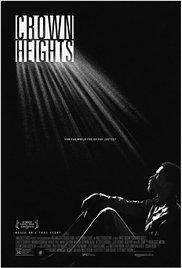
CROWN HEIGHTS (2017)

August 31, 2017

 Greetings again from the darkness. Being wrongly accused of a horrible crime would be a nightmare. Being wrongly convicted would be the worst possible nightmare. Prison life must be a daily nightmare. What could make such nightmares even worse? How about serving 21 years for a crime you didn’t commit, with about 4 years of that in solitary confinement.

Numerous recent projects have focused on a legal and justice system that sometimes seems broken. Some of the best include: HBO’s “The Night Of”, Ana DuVernay’s documentary 13TH, and Jamie Meltzer’s documentary TRUE CONVICTION. Writer/Director Matt Ruskin has adapted this most recent based-on-a-true-story docudrama from a podcast episode of “This American Life”.

While the general topic of “justice” is interesting enough, it’s the individual personal stories of justice denied that add such power, immediacy and emotion. In April 1980, in the Crown Heights section of Brooklyn, a young man is arrested on suspicion of murder. Lakeith Stanfeld (SHORT TERM 12) plays Colin Warner, a local petty thief whose family is from Trinidad. The “suspicion of murder” is really not accurate, since the arresting cops knew Colin wasn’t the guy, but were more interested in clearing the case than actually solving it.

What follows is a commentary on crooked cops, a flawed judicial system, and the willingness by the guilty party to let another go to jail if it means they remain free. However, more than any of that, this is a wonderful story of one man’s unrelenting pursuit of justice for his friend. Former NFL star Nnambi Asomugha (married to Kerry Washington) plays Carl “KC” King – Colin’s friend who refuses to give up on him and constantly hunts for someone to ensure justice is served … no matter how much time has passed. KC never stops, even when he realizes this is a system that doesn’t often admit its mistakes. The tenacity of KC is likely to have viewers questioning if they have a friend so loyal … or if they themselves could be such a friend.

Supporting work is provided by Zach Greiner, Josh Pais, Luke Forbes, Marsha Stephanie Blake, Adriane Lenox, Nestor Carbondell, Bill Camp, and Yul Vazquez. Natalie Paul plays Antoinette, the saintly woman who falls in love with Colin and marries him while he is incarcerated.

We watch as the wheels of injustice roll over Colin – even demanding that he admit remorse in order to have his request for probation considered. Being a man of strong conviction, Colin holds firm on his innocence despite being hardened by life behind bars. Director Ruskin has delivered a decent movie, but with its vital story and issue, it’s one probably better suited to a documentary structure. He wisely chooses not to pile on the legalities, and focuses more on the frustrations with a flawed system while also including an anti-death penalty message supported by the statistic of 2.4 million in prison – an estimated 120,000 of which are innocent.

watch the trailer:


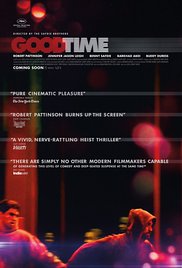
GOOD TIME (2017)

August 24, 2017

 Greetings again from the darkness. The Drifters and later George Benson sang “the neon lights are bright on Broadway”. Well, we aren’t on Broadway, and though they aren’t bright, the neon lights are ever present and crucial to the tone of the latest from brothers and co-directors Benny Safdie and Josh Safdie.

Robert Pattinson stars as Constantine “Connie” Nikas, and turns in a performance unlike anything we have previously seen from him. Connie is protective of his brother Nick (played by director Benny Safdie), and he’s also a grungy unhinged bank robber. He doesn’t look like a man with a plan, but fortunately, Connie is a smooth talker who thinks ‘quick on his feet’. We say fortunately, because he is barraged with an endless stream of danger, catastrophes and near traumatic events as the story progresses.

A botched bank robbery separates the brothers and sends Nick to jail and Connie on the lam. Co-writers Ronald Bronstein and Josh Safdie seemingly take immense pleasure in launching Connie off-the-rails has he desperately attempts to avoid capture while simultaneously figuring out how to spring brother Nick. With a frenetic pace that escalates Griffin Dunne’s misery in AFTER HOURS, Connie’s escapades have him crossing paths with his girlfriend played by Jennifer Jason Leigh (wish she had more screen time), a psychiatrist played by Peter Verby, a new anxious-to-help acquaintance in Taliah Webster, an accidental partner-in-crime played by Buddy Duress, an amusement park security guard played by Barkhad Abdi (“Look at me!”), and a brutish thug played by hip-hop artist Necro.

The pounding, pulsating techno/synth music perfectly complements the unusual tone (almost noirish, and bordering on comedic), feverish pace, and fascinating visuals throughout this hyper-kinetic frenzied trip. Some viewers will be turned off quickly, and those that stick with it will be rewarded with an entertaining crime thriller featuring Pattinson’s best performance to date.

watch the trailer: