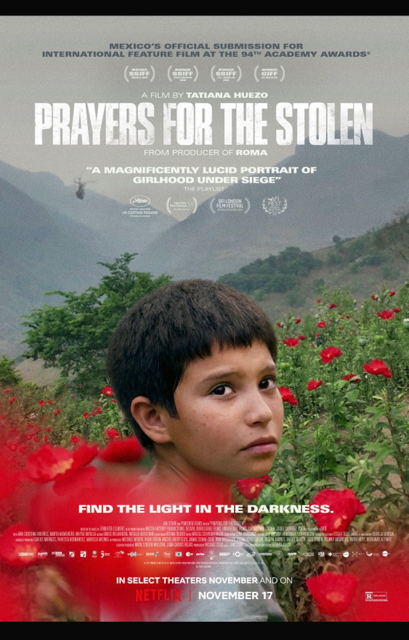
 Greetings again from the darkness. This is Mexico’s official Oscar submission for 2021 Best International Feature Film. Written and directed by Tatiana Huezo (her first narrative feature), the story is adapted from the 2014 best-selling novel by Jennifer Clement. It’s an unusual film that lacks a traditional plot, and instead focuses on the daily lives within a small village in Mexico.
Young girls Ana, Paula, and Maria are good friends. They live in a poverty stricken area, and most of the males work in the quarry/mine or for the cartel, leaving women and children to make do scrounging for food and working in the poppy fields at harvest time. Rita (Mayra Batalla) is Ana’s mother. She’s a proud, hard-working woman who is very protective of her daughter. Why? Well the area is patrolled by the cartel, and neighbors regularly go ‘missing’ – especially young girls. When Ana shows up wearing lipstick, Rita doesn’t find it cute. Instead she serves up a harsh reprimand to the girl too young to understand the risk.
Our view is from Ana’s perspective, and there are two distinct halves. In the first, Ana and her friends are very young (likely between 7 and 9). When we flash forward, the girls are 13 or 14. As a youngster, Ana is played by Ana Cristina Ordonez Gonzales, and she cries when her mother chops off her long hair and styles it like a young boy. This is not done for punishment, but rather to make her less desirable to the cartel. Her friend Paula goes through the same ordeal, while Maria’s cleft palate is deemed to serve the same purpose. As a teenager, Ana is played by Marya Membreno, and the haircut no longer hides her femininity, though her friend Maria faces a tough decision when medical assistance becomes available.
Director Huezo and the actors do a superb job in conveying the ever-present aura of danger hovering over the village. Rita digs a grave-like hole as a hiding place for Ana, and their strategy is put to use. In one particularly tense scene in conflict with the cartel, what keeps Rita alive is that she works in the poppy field – so she is viewed as an asset. As if possible starvation or abduction aren’t enough to keep everyone worried, the poppy fields are sprayed with poison in an attempt to control the crops – only the poison gets dumped on the village instead, as the helicopter pilots have been bribed and threatened by the cartel.
This is a haunting film and we connect quickly with Rita and Ana. We feel the relentless pressure of living in an environment where the cloak of danger is always worn and constant fear is a part of daily life. School provides the girls with a glimmer of hope, although it’s fleeting. This is no place for childhood innocence, and the responsibilities of parenting are almost beyond anyone’s ability. Cinematographer Dariela Ludlow perfectly captures the images, the acting is terrific, and director Huezo has delivered a gem.
Available on Netflix beginning November 17, 2021


 Posted by David Ferguson
 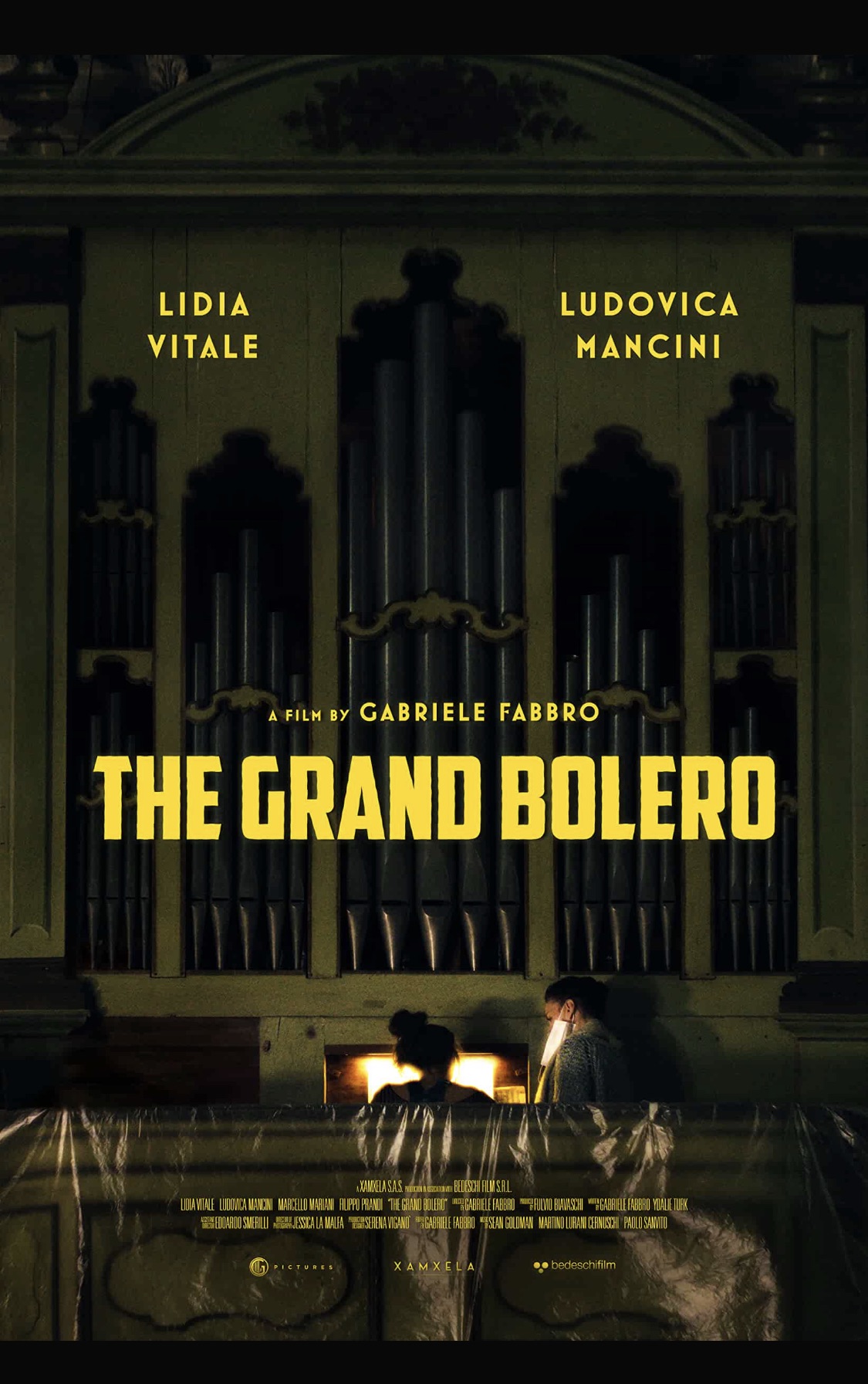 Greetings again from the darkness. The symphonic crescendo of Maurice Ravel’s “Bolero” is perfectly synched with this film’s crescendo, creating a heart-racing, frantic few moments of passion, lust, revelation, and shock – for both the characters and viewers. Also shocking is discovering that this is writer-director Gabriele Fabbro’s first feature length narrative film (after many shorts and videos). This is expert filmmaking and creative storytelling that harkens back to classic 1970’s cinema in a time when it’s certainly needed and appreciated.
 Greetings again from the darkness. Sometimes what we see on screen doesn’t tell the whole story about a movie. Writer-director Kazuya Murayama delivers his first feature film, and it’s based on the true story of a 1992 murder in Japan. Not only did Murayama fund the making of this film (there is no producer or Production Company), but the murder took place in the town where he was growing up … and in the same park where he often played.
 Greetings again from the darkness. This compelling film is the debut narrative feature film from co-writers and co-directors Adam Sjoberg and Seanne Winslow. Filmed on location in Oman (not sure I’ve ever seen another filmed there), it’s based on a true story and features first time actors in the key roles.
 Greetings again from the darkness. After watching the trailer, I settled in for what I expected to be a traditional French farce, always a welcome relief from the usual festival heaviness. While I can’t say the trailer is misleading – all of the scenes are present in the movie – it’s just that writer-director Stevan Lee Mraovitch has delivered more of a dark comedy with a message than a laugh-a-minute joy ride in his feature film debut.
 Greetings again from the darkness. The opening sequence is surreal and a bit creepy, and with it, first time director Valdimar Johannsson accomplishes a couple of things. First, we witness the rugged beauty of rural Iceland, and second, he sets us up for a bizarre tale, as we follow a heavy-breathing unseen creature (or being) that frightens some wild horses before making its way into the sheep pen. Johannsson co-wrote the script with Sjon, the renowned Icelandic novelist, poet, screenwriter, songwriter, and composer.
 Greetings again from the darkness. German filmmaker Christian Petzold has a track record of creating thought-provoking, intelligent, and ambitious films such as
  Greetings again from the darkness. Remember when an exonerated OJ Simpson vowed to dedicate his time to finding “the real killer” of Nicole Brown Simpson and Ronald Goldman? For some reason that memory came back in the early stages of this film as a Melbourne-based Australian Federal Police agent returns to his isolated hometown after his childhood friend is implicated in a murder-suicide. See, that agent left town as a teenager when he was suspected of being involved in the murder of a local teenage girl.
 Greetings again from the darkness. “You say you want a revolution … well, you know … we all want to change the world.” Writer-director Michel Franco hits head-on the always hot, and very current topic of the haves versus the have-nots, and I immediately thought of those Beatles’ lyrics.
 Greetings again from the darkness. Carl Jung coined the term synchronicity to describe occurrences that appear related, yet lack a clear connection. Writer-director Anders Thomas Jensen (Nicolaj Arcel is credited with the idea) starts us off with a slew of coincidences: Mathilde’s bike is stolen, her dad calls to say his military assignment has been extended, her mom decides they should take the train to town, a man surrenders his seat to Mathilde’s mom, a passenger throws away his sandwich while getting off the train, a bomb derails the train after that stop, a key witness in a criminal trial is killed, and the man who gave up his seat is a probability expert who begins assembling the pieces before going to Mathilde’s dad to present his case. Were these coincidences related or is it possible meaning is being found where none exists?
