DRIVE MY CAR (2021, Japan)

December 18, 2021

Greetings again from the darkness. If you are a fan of little films that seem quiet on the surface but deep down have jarring tremors of emotions, then this 3 hour art-house gem from Japanese writer-director Ryusuke Hamaguchi is a must-see. The director, along with co-writer Takamasa Oe, adapted the script from the short story by Haruki Murakami, part of his “Men Without Women” collection. The story revolves around Russian playwright Anton Chekhov’s “Uncle Vanya”.

In what may be the longest prologue in cinematic history, the opening credits finally roll about 35-40 minutes in. But that first segment is absolutely terrific. Yusuke Kafuku (played by Hidetoshi Nishijima) is a stage actor and director married to playwright and TV series writer Oto (Reika Kirishima). Their long relationship is bound by their love for each other despite the loss of a child many years earlier. Oh yes, there is one thing. Oto’s creative juices flow best during and after sex. The intimate moments are filled with story ideas that she bounces off her partner. These conversations may continue over meals or during a car ride, but they always begin during the throes of passion.

Husband Kafuku has come to accept these terms, and beyond that, he’s learned that Oto’s infidelities are a continuing of her creative process. Because of this, he says nothing when walking in at a most inopportune time – Oto is ‘creating’ while in the arms of rising star Koji Takatsuki (Masaki Okada). Kafuku elects to remain silent on the issue and allow Oto to have her way. Just when it seems the married couple might address the unspoken, an unexpected tragedy strikes. Each scene to this point has been meticulously crafted and acted. We know these people and feel the connections.

Flash forward two years, and Kafuku has been contracted by a Hiroshima theater group to direct a production of the ‘Vanya’ play for which he’s well known for his acting. He chooses not to cast himself due to the stress the role puts on him … one that forces the actor to face ‘the real you’ and the missed opportunities in life. Instead he puts together a multi-cultural, multi-language cast, including one actor who speaks only Korean sign language. And yes, the actor he chooses to play his Vanya role is Koji, the same actor he previously witnessed with his wife.

Koji has been a lost soul the past couple of years, and he claims it’s Oto who brought him and Kafuku together. A key element here is that Kafuku’s contract with the theater group requires him to accept Misaki (Toko Miura) as the chauffeur of his beloved, always spotless red Saab. During the hour long drives, Kafuku recites his familiar lines of dialogue in conjunction with a recorded tape of Oto reading opposite. It’s his way of keeping her close, yet this also assists with the warming of the relationship between him and his driver Misaki. Both are stoic individuals who keep their emotions hidden under a mask of self-control. It’s fascinating to see the bond slowly develop.

It’s actually Misaki’s backstory that means the most here. It’s a reminder to Kafuku (and us) that every person’s life has a certain complexity that we likely have no window into. The building of this bond actually begins a mutual healing of personal pain previously held inside. It’s also a stark reminder of the difference between these characters and many Americans who barely delay in laying bare their soul on social media. The play’s cast varies in age and background and language, but their collaboration, as well as the connectivity between Kafuku and Misaki are the central theme here. This may be best exemplified by the large video screen above the stage presentation, where the subtitles are displayed in multiple languages. A brilliant touch to an excellent film.

Currently playing in a limited theatrical release.

WATCH THE TRAILER


THE POWER OF THE DOG (2021)

December 4, 2021

Greetings again from the darkness. Don’t mess with the smart ones, as brains often outlast brawn. I’m conflicted on how best to describe this film. Perhaps … It’s nuanced storytelling at its finest. Jane Campion won an original screenplay Oscar for THE PIANO (1993), while also becoming only the second woman to receive a nomination as Best Director. This is her 8th feature film to direct, and the first since the underrated BRIGHT STAR (2009). Ms. Campion is such a smooth filmmaker, and her latest is so expertly crafted and so beautifully filmed, that some may find themselves not recognizing the underlying tension between characters. I urge you to remain diligent and take note of the subtle gestures and facial expressions, as the emotions run deep.

Benedict Cumberbatch stars as Phil Burbank. He runs a successful cattle ranch with his brother George, played by Jesse Plemons. Though they sleep in the same room and have been driving cattle together for 25 years, the brothers couldn’t be less alike. George is a soft-spoken man with few needs or aspirations other than wishing to not grow old alone. He lives in the shadow of his formidable brother, an educated man with a domineering personality. Phil is constantly proving how tough and macho he is by bullying others, even calling his more sensitive brother “Fatso”. That thundering you hear is Phil purposefully slamming his heels into the wood floors so that his spurs never stop jangling.

Phil is playing a game that only he knows the rules to. George bows his head in shame as he hears Phil belittle the frail and effeminate teenage Peter (Kodi Smit-McPhee), who is waiting on their table at the Red Mill. Peter’s widowed mother Rose (Kirsten Dunst) owns the place, and after George provides some comfort to her, George and Rose secretly marry. Viewing this as a personal affront, Phil is merciless in his cruelty towards Rose and Peter. It turns out that Phil is masquerading as one thing in order to hide another truth. An intriguing sequence (that is so well acted I could watch it 10 times) leads to a warming of the relationship between Phil and Peter. The two bond over horseback riding, rope-braiding, and stories of Phil’s now-deceased ‘mentor’, Bronco Henry.

This setting is 1925 Montana, though it’s filmed in New Zealand. The majestic mountain range constantly looms on the horizon. Yet despite the beauty, it’s a tough life made tougher by Phil’s menacing behavior – psychological torturing of Rose that leads her to the bottle – something that clearly holds unfavorable memories. The four leads are truly outstanding, and supporting work is provided by Thomasin McKenzie as the young housekeeper, and Keith Carradine, Frances Conroy, Allison Bruce, and Peter Carroll as uncomfortable guests at a dinner party.

Jonny Greenwood provides the music. It’s not so much a score as it is mood-enhancing messaging through guitars, violins, and pianos – each piece delivering just the right note. Cinematographer Ari Wegner (THE TRUE HISTORY OF THE KELLY GANG, 2019) works seamlessly with director Campion to capture the shifts in tone and the minutiae of the performances. An early shot through the kitchen windows captures Phil strutting through the ranch. The shot is repeated later with a contrasting look. The film is based on the 1967 novel by Thomas Savage, and it includes some of his personal experiences. Nothing haunts us more than the lingering effect of words Peter provides as narration near the film’s opening, when he informs us that a real man must save his mother. Oh yes, this is nuanced storytelling at its finest. By the way, you know how to whistle, don’t you?

Streaming on Netflix

WATCH THE TRAILER


BENEDETTA (2021)

December 3, 2021

Greetings again from the darkness. Filmmaker Paul Verhoeven has long made his cinematic living on the fringes: the brutality of the Middle Ages in FLESH + BLOOD (1985), the violence and thirst for power through technology in ROBOCOP (1987), the buried dark side (and other uses of ice picks) of our personality in BASIC INSTINCT (1992), more thirst for power combined with a baffling lack of sex appeal in SHOWGIRLS (1995), and the unbridled desire for revenge in ELLE (2016). This latest displays his mastery of ‘nun-on-nun’ eroticism and the duplicity of religious faith. Verhoeven’s usual goal is to provoke, and along with his co-writer David Birke, this ‘based on true events’ story (adapted from the 1986 Judith C Brown book, “Immodest Acts: The Life of a Lesbian Nun in Renaissance Italy”), is a natural fit.
Benedetta Carlini is delivered to the convent at a young age by her well-heeled parents. The girl claims to have a direct line to God, who delivers well-aimed bird droppings when called upon. OK, that’s just the first somewhat comical event in this film that seems less interested in the documented antics of the real Sister Benedetta, than in tantalizing today’s viewers with the behind closed doors sins of the flesh between she and fellow nun, Bartolomea (Daphne Patakia). Portraying Sister Benedetta, Viginie Elfira never shies away from the material, whether it’s the stigmata, bedtime play with a specially carved Virgin Mary statuette, or channeling the voice of God during outbursts claiming blasphemy.

Felicita, the abbess of the convent, is played by the always interesting Charlotte Rampling. Sister Felicita’s real talent seems unrelated to issues of God, and instead lies in matters of money. Because of this, she capitalizes on Benedetta’s visions as a form of fundraising, while turning away (except during moments of voyeurism) from her other activities and claims. Our early caution comes from Benedetta being told upon arrival that, “Your body is your worst enemy”. After more dreams and visions, and a possible miracle or two, we understand that nuns are to believe that suffering is the road to salvation and redemption … a theory that leads to one of the more humorous moments as a sword-wielding Jesus saves Benedetta from a gaggle of attacking serpents.

Is there such thing as erotic religious satire played straight? We must assume that Verhoeven has his tongue planted firmly in cheek for this one, as it goes beyond skepticism of religion and directly to the morally adrift. Whether Benedetta’s claims of visions are/were true or fake, Verhoeven is a filmmaker who takes pleasure in the pleasure of nuns, no matter how prohibited it might be. We can just never be certain whether his objective is to expose religion, or simply expose.

Available in theaters on December 3, 2021 and On Demand beginning December 21, 2021

WATCH THE TRAILER


PRAYERS FOR THE STOLEN (2021)

November 17, 2021

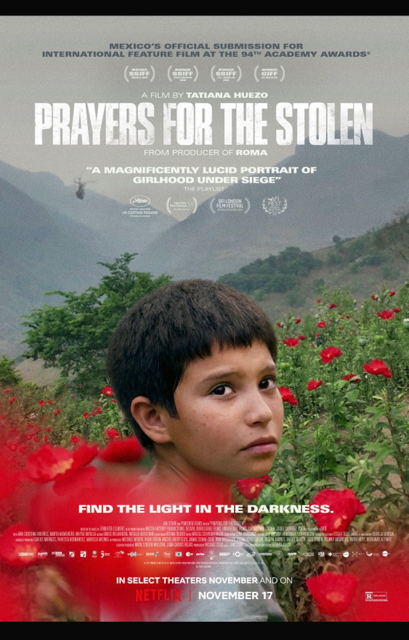
Greetings again from the darkness. This is Mexico’s official Oscar submission for 2021 Best International Feature Film. Written and directed by Tatiana Huezo (her first narrative feature), the story is adapted from the 2014 best-selling novel by Jennifer Clement. It’s an unusual film that lacks a traditional plot, and instead focuses on the daily lives within a small village in Mexico.

Young girls Ana, Paula, and Maria are good friends. They live in a poverty stricken area, and most of the males work in the quarry/mine or for the cartel, leaving women and children to make do scrounging for food and working in the poppy fields at harvest time. Rita (Mayra Batalla) is Ana’s mother. She’s a proud, hard-working woman who is very protective of her daughter. Why? Well the area is patrolled by the cartel, and neighbors regularly go ‘missing’ – especially young girls. When Ana shows up wearing lipstick, Rita doesn’t find it cute. Instead she serves up a harsh reprimand to the girl too young to understand the risk.

Our view is from Ana’s perspective, and there are two distinct halves. In the first, Ana and her friends are very young (likely between 7 and 9). When we flash forward, the girls are 13 or 14. As a youngster, Ana is played by Ana Cristina Ordonez Gonzales, and she cries when her mother chops off her long hair and styles it like a young boy. This is not done for punishment, but rather to make her less desirable to the cartel. Her friend Paula goes through the same ordeal, while Maria’s cleft palate is deemed to serve the same purpose. As a teenager, Ana is played by Marya Membreno, and the haircut no longer hides her femininity, though her friend Maria faces a tough decision when medical assistance becomes available.

Director Huezo and the actors do a superb job in conveying the ever-present aura of danger hovering over the village. Rita digs a grave-like hole as a hiding place for Ana, and their strategy is put to use. In one particularly tense scene in conflict with the cartel, what keeps Rita alive is that she works in the poppy field – so she is viewed as an asset. As if possible starvation or abduction aren’t enough to keep everyone worried, the poppy fields are sprayed with poison in an attempt to control the crops – only the poison gets dumped on the village instead, as the helicopter pilots have been bribed and threatened by the cartel.

This is a haunting film and we connect quickly with Rita and Ana. We feel the relentless pressure of living in an environment where the cloak of danger is always worn and constant fear is a part of daily life. School provides the girls with a glimmer of hope, although it’s fleeting. This is no place for childhood innocence, and the responsibilities of parenting are almost beyond anyone’s ability. Cinematographer Dariela Ludlow perfectly captures the images, the acting is terrific, and director Huezo has delivered a gem.

Available on Netflix beginning November 17, 2021

WATCH THE TRAILER


THE GRAND BOLERO (2021)

October 27, 2021

Austin Film Festival 2021

Greetings again from the darkness. The symphonic crescendo of Maurice Ravel’s “Bolero” is perfectly synched with this film’s crescendo, creating a heart-racing, frantic few moments of passion, lust, revelation, and shock – for both the characters and viewers. Also shocking is discovering that this is writer-director Gabriele Fabbro’s first feature length narrative film (after many shorts and videos). This is expert filmmaking and creative storytelling that harkens back to classic 1970’s cinema in a time when it’s certainly needed and appreciated.

Veteran Italian actor Lidia Vitale stars as Roxanne. The film opens on her haggard face as she utters, “F-you”. Right on cue, the organ music thunders over the opening credits. Her bitterness is aimed at the banner hanging outside the church where she works. The words on the banner dare state, “Everything will be fine”. This is March 2020, and Italy has just begun the initial shutdown over COVID-19.

Roxanne is a passionate restorer of pipe organs, and this 1700 church currently houses two – one from 1500 and one from 1900. After a workplace tragedy, Roxanne’s supervisor, Paolo (Marcello Mariani), finds her an assistant who will work for organ-playing lessons and food. Lucia (Ludovica Mancini) is a young, eager-to-learn mute. Her soft, soulful eyes are in stark contrast to Roxanne’s sharp facial features and stone cold glares of loathing. Whereas Roxanne is angry, annoyed, and hot-tempered, Lucia remains spirited, open, and energetic.

Of course, the barriers between the two slowly break down, but the twists and surprises and secrets are gradually unveiled. Roxanne’s obsessions are not limited to the beautiful pipe organs and sweet Lucia has a side to her no one would have predicted. Ms. Vitale’s performance really drives the story and the building of trust between Roxanne and Lucia. The manner in which conveys the softening of her barriers and the re-directing of her focus is fascinating.

Without being overbearing, the film reminds us of the pandemic through Paolo’s all too frequent ringing of the ‘death bell’, the television reports playing in the background, the protective mask defiantly looped around Roxanne’s ear, and the warning that nature may carry out God’s wrath. And speaking of nature, the camera work outside the church is, at times, stunning in its beauty, striking angles, and message. It’s rare to find a filmmaker’s ‘first’ feature so original and well-executed, and that is on top of Mr. Fabbro’s use of powerful pipe organ music throughout. This is a truly fine film that hopefully will find an audience.

WATCH THE TRAILER


TORAO (2021)

October 27, 2021

Austin Film Festival 2021

Greetings again from the darkness. Sometimes what we see on screen doesn’t tell the whole story about a movie. Writer-director Kazuya Murayama delivers his first feature film, and it’s based on the true story of a 1992 murder in Japan. Not only did Murayama fund the making of this film (there is no producer or Production Company), but the murder took place in the town where he was growing up … and in the same park where he often played.

Still, Murayama goes a step further. He cast the actual detective from that unsolved case, Torao, as himself. Kayako, a University student, is researching metasequoias (Dawn Redwood), which are known as “a living fossil”. She stumbles on the unsolved murder case of a young swimming coach and is drawn to finding out more. She attempts to interviews those who would have knowledge, though no one is willing to share any real information since the case was closed years ago.

Everything changes for her when she meets Torao, the former investigator/detective on the case. More interviews and an attempt to re-create the victim’s last day still don’t satisfy the girl. It’s Torao who is haunted by the case – it’s something he lives with and dwells on every day. The cinematic joy here is derived from contrasting the older, knowledgeable (one particular undisclosed detail), retired detective with the younger, eager, uninformed ‘partner’ in this re-investigation. It’s an unconventional end for a procedural murder case movie, and it’s one that should appeal to fans of the genre. The extraordinary elements beyond the movie simply add to the intrigue.

WATCH THE TRAILER


THE FALCONER (2021)

October 27, 2021

Austin Film Festival 2021

Greetings again from the darkness. This compelling film is the debut narrative feature film from co-writers and co-directors Adam Sjoberg and Seanne Winslow. Filmed on location in Oman (not sure I’ve ever seen another filmed there), it’s based on a true story and features first time actors in the key roles.

Local teenager Tariq (Rami Zahar) and privileged Westerner Cai (Rupert Fennessy) are best friends working at a rundown zoo. Cai is the more idealistic of the two, and dreams of rehabbing animals and releasing them back into the wild. Tariq is more grounded, and views it mostly as a job that allows him to help his family make ends meet. He does, however, enjoy learning about the animals from Cai.

When Tariq’s recently married sister Alia (Noor Al-Huda) confides to him that she wants a divorce from her abusive husband (“a bad man”), Tariq agrees to help. In this culture, a divorce is no simple matter. Her family must pay back the dowry – money the poor family doesn’t have. It’s here where the clash of cultures comes to a head. Right versus wrong means different things to Tariq and Cai. One is committed to doing right by his family, while the other wants to do right by the animals. The friendship is tested as Tariq sees opportunity in selling animals on the black market … in particular, a much valued trained falcon.

Beautifully filmed by cinematographer Nicholas Bupp, it’s fascinating to see the contrasting cultures of two close friends. In fact, friendship, family, and devotion are the prevalent themes here. The closing credits include clips and photographs of the real life friends.

WATCH THE TRAILER


HOLIDAYS AT ALL COST (2021)

October 27, 2021

Austin Film Festival 2021

Greetings again from the darkness. After watching the trailer, I settled in for what I expected to be a traditional French farce, always a welcome relief from the usual festival heaviness. While I can’t say the trailer is misleading – all of the scenes are present in the movie – it’s just that writer-director Stevan Lee Mraovitch has delivered more of a dark comedy with a message than a laugh-a-minute joy ride in his feature film debut.

Oumar Diaw (brilliantly) stars as Frederic, a technology installer who works for a boss that never hesitates to take advantage of Fred’s natural passivity. Set to take his lovely wife Fanny (Donia Eden) and young son Max (Swann Nguma-Torre) on the first family vacation in years, Fred runs into money issues thanks to a broken promise from his boss. Rather than come clean and disappoint his wife, Fred cuts a deal with his childhood friend Jean-Luc (Benjamin Garnier) who runs a luxury resort in the area where they all grew up together. Frederic agrees to work for Jean-Luc in exchange for the price of a room.

It becomes apparent to us (not to Fred) that Jean-Luc’s ulterior motives include winning back the girl of his dreams … Fanny. So the evil Jean-Luc initiates an elaborate plan, not for world domination, but to keep Fred occupied with increasingly outrageous pranks, so that Fanny will be forced to spend time with Jean-Luc. The sabotage of a relationship is a bit painful to watch because we really like Frederic, and can’t much stand the sight of Jean-Luc.

There are some funny gags here, with the best being “Frozen Surfer” during yoga. “Digital nomad” becomes a nice catchphrase for those in today’s generation who carry little interest in excelling at an occupation. Vacation-gone-wrong movies are plentiful, but here it serves as the foundation for a story about relationships, friendship, selfishness, and self-worth. Filmed in the gorgeous countryside and beaches of the South of France, director Mraovitch has made quite an impact with his first film.

WATCH THE TRAILER


LAMB (2021, Iceland)

October 8, 2021

Greetings again from the darkness. The opening sequence is surreal and a bit creepy, and with it, first time director Valdimar Johannsson accomplishes a couple of things. First, we witness the rugged beauty of rural Iceland, and second, he sets us up for a bizarre tale, as we follow a heavy-breathing unseen creature (or being) that frightens some wild horses before making its way into the sheep pen. Johannsson co-wrote the script with Sjon, the renowned Icelandic novelist, poet, screenwriter, songwriter, and composer.

Noomi Rapace (THE GIRL WITH THE DRAGON TATTOO, 2009) stars as Maria, and we watch as she and her husband Ingvar (Hilmer Snaer Gudnason) work their remote sheep farm mostly in silence. There seems to be no joy and little connection between them as they go about their chores and duties. The seasons pass until its time for the sheep to give birth (as you might have guessed from the title). It’s at this point where I simply must be careful about what I write, as the less one knows about this one going in, the more effect it’s likely to have. Personally I knew nothing ahead of time, and had not even watched the trailer. Because of that, this easily rates as one of the most bizarre movies I’ve ever watched.

Remember the old margarine commercial, “It’s not nice to fool Mother Nature”? Well, Maria and Ingvar interpret one strange occurrence as “a gift” from nature and the key to their re-discovered happiness. When Ingvar’s troubled brother Petur (Bjorn Hlynur Haraldsson) shows up, his first question is “WTF is this?” That’s as close to a spoiler as I’ll come here, but there are multiple interpretations to be had: the power of nature, loneliness, the challenges and rewards of parenting, commentary on those who treat their pets as kids, and the devastation of grief followed by the hope of redemption.

There are moments of irony with wool sweaters and entrée selections, as well as some dark humor in regards to bath time, an observant cat, a loyal and smart dog, and one specific irked ewe. This is a remote farm in rural Iceland and the setting adds to an already unorthodox story … one which is pulled from Icelandic folklore. Johannsson is to be commended for his initial work. It easily could pass as a project from the creative mind of Yorgos Lanthimos (THE LOBSTER) or Robert Eggers (THE WITCH). In fact, the film’s co-writer, Sjon, is also writing Eggers next film, THE NORTHMAN, slated for April 2022.

Beyond the setting, the atmosphere, and bizarre aspects of the story, what makes it work is how the characters play it straight. These aren’t talkative folks and we believe they could exist in this environment. Ms. Rapace delivers a strong performance, and that shocking ending reminds us not to mess with nature.

A24 is releasing the film in theaters beginning October 8, 2021

WATCH THE TRAILER (if you must)


UNDINE (2021)

June 3, 2021

Greetings again from the darkness. German filmmaker Christian Petzold has a track record of creating thought-provoking, intelligent, and ambitious films such as BARBARA (2012) and TRANSIT (2018). This time out he re-teams his TRANSIT co-stars Paula Beer and Franz Rogowski in a film that’s more fable or fairy tale than conventional storytelling. If forced to label, we might go with Fantasy-Romance-Drama-Mystery, which really means the film doesn’t easily fit into a known genre.

The film opens with a very uncomfortable break-up scene between Johannes (Jacob Matschentz) and Undine (Ms. Beer). When he says they are done, she responds, “If you leave me, I’ll have to kill you. You know that.” While researching the name Undine, I stumbled upon the 1811 German fairy tale of a water nymph Friedrich de la Motte Fouquet, which clearly inspired Petzold. The story has some similarities to “The Little Mermaid”, itself a Danish fairy tale originally written by Hans Christian Anderson. It helps to know all of this upfront to prevent some of the frustration that goes with deciphering what is real and what is imagined.

As one would imagine, water is a recurring element throughout – beginning with Undine’s chance and unusual café meet-cute with Christoph (Mr. Rogowski). The two find themselves attracted and connected after being drenched. Christoph is an industrial diver, so water is a part of his life … as is ‘Big Guenther’, the legendary giant catfish he spots while on a job. Undine is a historian who holds sessions for tourists during which she recounts the architectural evolution and urban sprawl of Berlin over the past centuries, by utilizing scale models of the different eras. We also learn that “Berlin” means marsh, or a dry place in the marsh … yet another water-related aspect.

Ms. Beer, who was so good in FRANTZ (2016) and NEVER LOOK AWAY (2018) continues her fine work, and reuniting with her TRANSIT co-star, Mr. Rogowski (VICTORIA, 2015) works out beautifully, as they have a nice rapport. Mr. Petzold’s film has a supernatural element and is dreamlike at times, and though I’ve used the “fairy tale” description, it’s clearly a very high concept film for grown-ups … and there is enough humor (“Stayin’ Alive by the Bee Gees) to offset the doomed relationships and Undine’s return to her natural element. It’s quite a trip for those who are up for it.

In theaters and On Demand June 4, 2021

WATCH THE TRAILER