BETTER DAYS (2021, China)

April 12, 2021

Greetings again from the darkness. Chinese gaokao is the College Entrance Exams that determine the future of high school students and their families. The pressure is extreme for the kids, and when the film opens, the exams are only 60 days away. One of the students leaps to her death from an upper breezeway to the concrete courtyard below. Her fellow classmates converge on the scene with cell phones recording the tragedy. One girl, Chen Nian, quietly covers up the body. While most assume the pressure of the impending test was too severe for the girl, Nian knows better. The relentless bullies that motivated the suicide have now turned their attention to Nian.

Director Derek Tsang (aka Kwok Cheung Tsang) delivers a beautiful film with compelling characters and a heart-wrenching story. Jiuyue Xi’s novel, In His Youth, In Her Beauty” has been adapted for the screen by co-writers Wing-Sum Lam, Yuan Li, Yimeng Xu, and Nan Chen. Filmed in 2018, the Chinese government delayed its release due to concerns over how its society would be perceived, given extreme bullying, class differences, and the extensive use security cameras throughout. Instead, we note the similarities in people, and how young people carry burdens that often go unacknowledged.

Zhou Dongyu gives a terrific performance as Chen Nian. She’s an excellent, devoted student who has no one to depend on thanks to a mostly absentee mother who spends her time scamming for money and dodging creditors. Nian has no real friends, and her closest companion was the one whose body lay crumpled in the courtyard. Nian stumbles into a situation that could not be described as a ‘meet-cute’, and soon she has requested street punk Xiao Bei (played by Jackson Yee) to act as her protector against the bullies, so that she may focus on the exams. Additionally, she’s been questioned by the police in regards to the suicide, and Detective Zhang (Yin Fang) takes a particular interest given his knowledge of schoolyard bullies.

The bond between equally adrift and confused teenagers Nian and Bei grows, despite his being a dropout. Are they star-crossed lovers? Is it a budding romance? What makes it interesting is that it doesn’t even matter. What does matter is the courage these two youngsters show in the face of adversity. Does it go too far? The third act will leave you wondering just what is the answer to their dilemma. How harshly can you judge those in self-preservation mode when the school motto is “Work Hard. No Regrets”? There is a retro feel to Tsang’s filmmaking style, and we are left with the reminder that “used to be” infers a sense of loss … and we all experience different types of loss. Excellent filmmaking that rightly earned an Oscar nomination.

WATCH THE TRAILER


AMUNDSEN: THE GREATEST EXPEDITION (2021)

April 1, 2021

Greetings again from the darkness. Director Espen Sandberg continues his string of movies highlighting the heroes of Norway. Previous movies include MAX MANUS: MAN OF WAR (2008) and the Oscar nominated KON-TIKI (2012), the tale of legendary explorer Thor Heyerdahl. And then to earn some coin, Sandberg also directed PIRATES OF THE CARIBBEAN: DEAD MEN TELL NO TALES (2017). This latest project, written by Ravn Lanesskog, takes on another legendary explorer – this time it’s Roald Amundsen, the first to traverse the Northwest Passage, the first to reach the South Pole, and the first to reach the North Pole by plane.

Pal Sverre Hagen stars as Roald Amundsen, and he also played Thor Heyerdahl in Sandberg’s KON-TIKI. Hagen bears a striking resemblance to the photos of Amundsen, and utilizes a low key, yet very direct communication style to give us a look at the relentless commitment to achieving his goals. We learn he held grudges – against the Brits and even against his own brother – and used this as motivation. Director Sandberg uses a conversation as a framing device throughout the film. Roald’s estranged brother Leon (Christian Rubeck, SWIMMING WITH MEN, 2018) and Roald’s lover Bess Magids (Katherine Waterston, THE WORLD TO COME, 2020) share their insights and perspective while awaiting word on Roald’s latest excursion. This begins after the opening sequence where we see Roald’s prop plane crash land on an Arctic ice shelf.

Of course, this is the story of one of the greatest explorers and adventurers in history, so there is a nice blend of that conversation, some backstory, and a first-hand look at some of Roald’s expeditions. The elements are incredibly harsh, but Sandberg never lingers too long on any one piece of this puzzle. It seems he is more interested in what made Roald tick – what drove him to these pursuits at the expense of most relationships. The rivalry with the Brits is clear and we see the humiliation Roald endured after besting Robert Falcon Scott to the South Pole. Rather than accolades, he faced criticism and judgment of his methods.

Roald Amundsen was clearly not a man to rest on his laurels, even after being presumed dead on more than one occasion. He was always a body in motion. We see his childhood fascination towards unexplored areas. No map? No problem. Roald’s harsh treatment of his brother is explored, and it’s interesting to note the differences in how Bess and Leon describe Roald. Amundsen went missing while on an Arctic rescue mission in 1928. He was 55 years old, but looked 20 years beyond that. This film is not hero worship or even a traditional tribute. Then again, maybe it’s the type of tribute a man like Roald Amundsen would appreciate. For those who wish to learn more, search out the 6-hour 1985 PBS mini-series, “The Last Place on Earth.”

Opening in Virtual Cinemas and VOD April 2nd

WATCH THE TRAILER


THE AFFAIR (2021)

March 3, 2021

 Greetings again from the darkness. The world famous Villa Tugendhat is a physical, emotional, and visual metaphor for the collapse of the Czech Republic in this film from director Julius Sevcik (LOST GIRLS AND LOVE HOTELS, 2020). Writer Andrew Shaw (VOICE FROM THE STONE, 2017) adapted the script from Simon Mawer’s 2009 best-selling book, “The Glass Room”. The family melodrama is fictionalized, but the house itself is the character around which everything else revolves. And what a house it is.

Viktor (Claes Bang, TV mini-series “Dracula”, and THE LAST VERMEER, 2020) commissions noted architect Von Abt (Karel Roden) to build a home for Viktor’s new bride, Liesel (Hanna Alstrom, the KINGSMAN movies). Liesel works closely with the architect to create a modern masterpiece that is the envy of their Czechia town of Brno. The heart of the stunning structure is a glass room, causing Abt to ask Liesel, “Are you ready to live in the light?” Liesel’s close friend Hana (Carice Van Houten, LOST GIRLS AND LOVE HOTELS, 2020), who wishes they were even closer, spends a great deal of time visiting at the home. Liesel’s bliss is shaken when she discovers Viktor is having an affair with their nanny, Kata (Alexandra Borbely, ON BODY AND SOUL, 2017).

If she thought that was the worst thing that could happen, Liesel soon finds things much worse. She and her Jewish husband escape to Zurich just as the Nazi occupation occurs. Hana and her Jewish husband are not so fortunate, and not only is she separated from her lifelong friend, she is forced to do what she must to protect her husband, and that includes an affair with a German contractor named Stahl (Roland Moller, THE LAST VERMEER, 2020). It seems all of our characters are doing what they must, and they all seem to be thinking of someone other than the one they are with.

The second half of the film is much stronger than the first, as real tension exits. Ms. Van Houten is superb in her performance as Hana, and she carries this part of the story. It’s through her eyes that we see the transformations of Liesel’s beautiful home. The symmetry with what’s happening in the country is unmistakable, and Hana is at the heart of the film’s message … love endures and overcomes. The issue with the film is that we never really connect with any character but Hana. Viktor and Liesel are out of sight for an extended period of time, leaving us with what is a great idea for a film – but one that lacks the necessary depth.

Regardless of that, it’s a gorgeous film to watch … thanks in no small part to the work of cinematographer Martin Strba. The film stretches from the early 1930’s to the late 1960’s and the production design is spot on. Some interesting notes include Villa Tugendhat was actually designed by German architects Ludwig Mies van der Rohe and Lilly Reich, and the Tugendhat family did actually flee the home. German plane designer Willy Messerschmitt actually lived in the house while it was being used as a design studio, much like the character Stahl in the film. It’s a shame the script doesn’t do justice to the cast and the home, but this one falls short of being a must see.

Available VOD on March 5, 2021

WATCH THE TRAILER


NIGHT OF THE KINGS (2021, Ivory Coast)

February 27, 2021

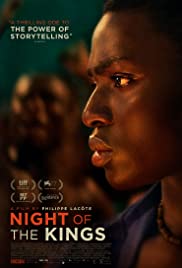
 Greetings again from the darkness. Could you tell a story that lasts all night? What if you were standing on a box in front of a few hundred rowdy inmates? What if your life depended on it? Writer-director Phillippe Lacote (RUN, 2015) opens the film with an aerial shot over the jungles of the Ivory Coast and slowly makes way to the isolated prison known as La MACA.

The camera takes us to the bed of a police pickup truck where a handcuffed young man is being escorted by an armed guard. It’s the first day of his prison sentence. La MACA has a warden and prison guards, but even they admit the place is mostly run by the inmates. The warden (Issaka Sawadogo) meets with the new prisoner (newcomer Bakary Kone), but it’s Blackbeard (Steve Tientcheu) who summons the newbie to his cell. Blackbird has been the Dangaro, Chief of Prisoners, for years, and only recently has his hulking presence led to chatter of diminishing losing power. With his fatigue requiring regular intake from oxygen tanks, Blackbird realizes his reign is near … and tradition requires that, once too weak to lead, he take his own life.

Blackbird names the wide-eyed new prisoner Roman, meaning he will be the storyteller at that evening’s Red Moon. Blackbeard has this planned as his final hurrah as leader. Two prisoners are vying to become the new Dangaro: Blackbeard’s loyal assistant Half-Mad (Jean Cyrille Digbeau) and rival faction leader Lass (Abdoul Karim Konate). They each have their eye on wearing the “crown”.

If all this sounds a bit convoluted, you should know it’s fascinating to watch unfold on the screen. The rules and rituals are followed vigorously, and just like in any political situation, behind-the-scenes maneuverings are ongoing. We never lose sight of the fact that there are hundreds of criminals gathered in a confined area, yet the structure of their organization lends itself to Roman’s storytelling.

As a member of the Microbes gang in the Lawless Quarter of Abidjan, Roman doesn’t consider himself a storyteller, and is reluctant to begin. Urged on by the aggressive reactions of his audience, he’s soon weaving tales blending his childhood, the recent arrest of local legend Zama King, and the mythology and history of the Ivory Coast. Stunning flashbacks and visuals are utilized in just the right dosage to help us understand the stories without losing the danger Roman faces. What danger, you ask? Well a fellow prisoner named Silence (played by Denis Lavant, from 2012 cult favorite HOLY MOTORS), who keeps a chicken perched on his shoulder, warns Roman that his story must last through the night until the Red Moon sets on the horizon … or the ritual demands he be killed. Talk about motivation – as if the metal hook in the stairwell wasn’t enough!

Filmmaker Lacote excels with his ‘story within a story’ and the blending of truth and fiction. The fed-up guards watching through the small window in their protected office says more than words could. And cinematographer Tobie Marier Robitaille works wonders within the claustrophobic confines of the prison, and by capturing the emotions of the participants. This is an original film that could be equally effective as a stage production, as both vehicles can convey the glory of the moment morning breaks. Let’s hope this isn’t “once upon a time” for Lacote, and that he has more to offer at this level.

Available February 26, 2021 in select theatres and Virtual Cinemas

WATCH THE TRAILER


PINOCCHIO (2021)

February 23, 2021

 Greetings again from the darkness. Part ‘Frankenstein’ and part parable for parenting is how I’ve always thought of the story of Pinocchio. In this latest version, director and co-writer (with Massimo Ceccherini) Matteo Garrone adds a splash “Alice in Wonderland” to Carlo Callodi’s 1883 novel, “The Adventures of Pinocchio”. The result is a grim, not-kid-friendly live-action presentation that’s a bit uneven, yet still engaging.

Oscar winner Roberto Benigni (LIFE IS BEAUTIFUL, 1997) is wood-carver Geppetto, a poverty-stricken man who works magic with a chisel, but is never quite sure where his next meal will come from. When the traveling Grand Puppet Theater hits town, Geppetto dreams of creating a beautiful puppet and traversing the globe to show it off. A fellow wood worker gifts him with the enchanted piece of wood from which Pinocchio is born. When he discovers the puppet can talk, Geppetto is so proud of his new son that he shows him off around town and walks him to his first day of school.

Of course we know that Pinocchio is a curious boy, and he immediately sneaks off to watch the puppet show. This sets off his many adventures, while simultaneously making Geppetto quite sad as he undertakes a search and rescue mission. Pinocchio crosses paths with the kinda creepy Talking Cricket (Davide Marotta), the fire-eating Mangiafuoco (Gigi Proeitti), a couple of tricksters in Cat (Rocco Papaleo) and Fox (co-writer Ceccherini), a confused gorilla judge (Teco Celio), and a friendly, but slimy snail (Maria Pia Timo) who lives with the Fata Turchina/Blue Fairy (played young by Alida Baldari Calabria, and older by well-known French actress Marine Vacth).

The enticement of playing all day and having no responsibilities leads Pinocchio to accept an invitation to Toyland, although the train of donkeys pulling the wagon load of kids is our tipoff to what’s about to go down. Pinocchio’s subsequent swim in the ocean and encounter with the sea monster are handled well visually, and the reunion with Geppetto is quite pleasant. You should know that the iconic Pinocchio nose that grows upon telling lies is limited to a single scene, albeit a memorable one.

Benigni was the writer-director-star of the critically-panned 2002 PINOCCHIO, which also failed at the box office. He’s much better suited to the role of Geppetto and does a nice job of capturing the essence of the character. Federico Ielapi handles the role of Pinocchio quite well, and the “wooden” effects of his face are quite impressive. The story is a metaphor for the struggles and challenges of life, and the life lessons are easy to discern … for instance, there is no ‘field of miracles’, regardless of what Cat and Fox promise. Nicolai Bruel’s cinematography is at times visually stunning as we make our way through the countryside of Italy. It’s just that director Garrone (two excellent films: TALE OF TALES 2015, and GOMORRAH 2008) chooses to emphasize the bleakness, and it’s important to note that this is far-removed from the 1940 Disney animated classic. Most will struggle to find an emotional connection, though the look of the film and life lessons are top notch. Guillermo del Toro has a stop-action animation version currently in production and it’s not surprisingly rumored to be even darker than this one.

After a long delay, the film gets a digital release on February 23, 2021

WATCH THE TRAILER


DARA OF JASENOVAC (2021, Serbia)

February 4, 2021

 Greetings again from the darkness. Knowing that kids are resilient doesn’t lessen the impact of their mistreatment or abuse. Director Predrag Antonijevic and writer Natasa Drakulic (who also stars) focus their film on the fascist Croatian Ustase government during WWII. Croatia housed the only extermination camp run by non-Germans in Europe during the war. The purpose was to preserve the purity of Croatian blood by murdering Serbs, Jews, and Roma. There was even a camp at the Jasenovac complex specifically for kids.

The film opens with armed soldiers marching Serb citizens across the countryside to the awaiting trains. The men are separated from the women and children, and the film mostly follows 10 year old Dara (Biljana Cekic). She is traveling with her mother, older brother, and younger brother Bode, who is not yet two years old. Dara is quiet and strong, and exceedingly observant for her age.

We see bodies being dumped in the river, and then at Gradina Concentration Camp, we watch in horror as the military forces the prisoners into a morbid game of musical chairs. The sole purpose of this is simply to add a level of excitement for the executioners. Even the visiting Nazis seem appalled by this. The film periodically bounces to the camp where Dara’s father is digging mass graves and dumping bodies … at gunpoint, of course. He’s desperate in his attempts to find out if his family is still alive – almost oblivious to how close he is to death himself.

This is young Biljana Cekic’s first screen credit, and she’s remarkable in her ability to convey so much thought and emotion, while maintaining the stone-face necessary to avoid drawing unwanted attention. Her Dara sacrifices much as she kicks into protective mode after tragedy strikes. We’ve seen other Holocaust movies where the day-to-day will to survive is this strong, but the stories are rarely told through the eyes of a 10 year old girl. The Croatian fascists are portrayed as eager sadists, and the healthy boys are brain-washed into “little Serbs”, while the sick children are allowed to die … with Nuns as accomplices.

The frantic actions of the Red Cross are shown as one of the ways we see that even in the worst possible conditions, good-hearted people find a way to help. For Dara, everyone in her life gets taken from her, and we watch relentless misery, dread, pain, and suffering unfold on screen. It’s a reminder of the evils of fascism and the dangers involved with looking down on others due to race or religion. For non-Serbs, this is mostly and unknown and untold story of atrocities and cruelty – upwards of 100,000 were killed. Now that we know of this “Balkan’s Auschwitz”, and we think of modern day Balkan conflicts, we can’t help but wonder what purpose it served. It’s a tough watch, and yet another reminder of the importance of remembering history.

In select theaters February 5, 2021

WATCH THE TRAILER


THE MAN WHO SOLD HIS SKIN (2021, Tunisia)

January 28, 2021

 Greetings again from the darkness. Lao Tzu wrote, “Being loved deeply by someone gives you strength, while loving someone gives you courage.” But to what extreme would you go for true love, and how far is too far? Writer-director Kaouther Ben Hania offers an early scene on a commuter train as Sam Ali and Abeer flirt and tease to the point that he publically, and loudly, proclaims his love for her. Unfortunately for him, his outburst occurs in Syria, where human rights are always in peril. In fact, this love story is burdened with the weight of human rights, individual choices, and the power of art.

Ms. Ben Hania bookends her film with a choreographed art installation coated in a blizzard of white walls and white gloves. It’s 2011, when a distant relative in law enforcement assists Sam Ali (Yahya Mahayni) with his (quite creative) escape from Syria to Lebanon – after a painful slap of reality accompanies Sam’s goodbye to his beloved Abeer (Dea Liane in her first screen credit). As Sam flees for his life, Abeer is pressured by her family into an arranged marriage.

We then flash forward one year to find Sam working in a Beirut chicken factory. He scrounges for food at the buffet of local art galleries until one day he is spotted by Soraya (a blond Monica Bellucci), the agent for acclaimed artist Jeffrey Godefroy (Koen De Bouw). When Sam and Godefroy meet, the artist tells him that art is “alive” and, more precisely, “I want your back”. A Faustian deal is cut. Godefroy turns Sam Ali into a living piece of art by tattooing his back, and Sam gets the travel visa he desperately needs to reunite with Abeer.

With Sam basically a commodity (there are even T-shirts of his back in the gift shop), there are protests to his being exploited – this despite Sam enjoying the nice hotels, room service, and promise of the visa. Of course, as with any commodity, it’s only a matter of time before the almighty dollar comes into play, and soon Sam is auctioned off to a collector. Subtle humor has a role throughout much of the film, and Mr. Mahayni is quite believable as a Syrian refugee sacrificing for love. Ms. Ben Hania’s film is inspired by “Tim”, an original artwork tattoo by Wim Delvoye sold to a collector in 2008. Mr. Delvoye, a controversial Belgian artist, even makes a brief appearance here as an insurance agent. This is a thought-provoking love story, survival tale, and commentary on the bent side of the art world. When is a man truly free? We don’t typically think of Tunisia as a hotbed for cinema, but this film deserves attention.

This is Tunisia’s entry for the Foreign Language Oscar

WATCH THE TRAILER


BABY DONE (2021)

January 21, 2021

 Greetings again from the darkness. “I don’t want to not have a baby.” This is just one of the zingers Zoe rattles off during this charming, and often quite funny film from director Curtis Vowell and writer Sophie Henderson. Fellow New Zealander Taika Waititi is an Executive Producer, and his influences are apparent (and always welcome). In a light-hearted way, while still maintaining plenty of heart, the film explores the fear of losing or compromising one’s true self when parenthood strikes.

Rose Matafeo delivers a terrific performance as Zoe, a tree-climbing arborist by profession, and a thrill-seeking adventurer by choice. Her partner in life, and in the tree-trimming business and in the thrill seeking, is Tim (Matthew Lewis). They are the type of couple who go to a friend’s baby shower and peek into the gender reveal box before dominating the party games. Zoe is fed up with losing friends, and describes the life cycle as “Married, house, baby, done”, implying that people aren’t the same after having completing these steps and no longer want to hang out with free-wheelers and the unencumbered like her and Tim.

Denial. That’s the best description of how Zoe reacts to finding out she’s pregnant. Besides not telling Tim (a major relationship gaffe), she continues on with tree-trimming and pursues the “Tree Climbing Championship” she has qualified for (I still wonder if that’s really a thing). When Tim and her friend Molly (Emily Barclay) find out about the secret, feelings are hurt and emotions wreak havoc. Comedy is provided through the prenatal/antenatal class instructor, as well as through Zoe’s new acquaintance Brian (Nic Sampson) whom she connects with online. See, Nic … well, he, uh … has a thing for pregnant women. Not babies, mind you. But pregnant women – which by definition seems to limit the prospects of a long-term relationship.

The always-great Rachel House makes a brief appearance as the headmaster at a local school, and much of what we see is a mess created by pregnant Zoe as she attempts to stay focused on her “bucket list”. The film excels at presenting two versions of anxiety with Zoe and Tim, and it’s loaded with relatively small moments that are quite relatable – some funny, some more serious. Like it or not, parenthood creates life changes, and the topic benefits from New Zealand wit, and a cast that perfectly complements the sharp and insightful script.

In select theaters and VOD on January 22, 2021

WATCH THE TRAILER


THE LAST VERMEER (2020)

November 19, 2020

 Greetings again from the darkness. Knowing the film is based on Jonathan Lopez’s 2008 book, “The Man Who Made Vermeers” removes some of the mystique from the story; however Dan Friedkin’s (stunt pilot on DUNKIRK) directorial debut is an enticing look at a blending of art history and world history. The screenplay was co-written by John Orloff, Mark Fergus, and Hawk Ostby.

It’s May 29, 1945, three weeks after the fall of Hitler’s Reich, and the Dutch military is on a mission to reclaim valuable art and collectibles confiscated by the Nazis during the war. Some of these were hidden in Austrian salt mines by order of Hermann Goring, actions also depicted in the 2014 film, THE MONUMENTS MEN. After serving in the war, Captain Joseph Piller (Claes Bang, “Dracula” 2020) is tasked with tracking down those who stole the art, and those who sold the art to Germans. It’s a task meant to preserve his country’s culture. One particular piece, “Christ with the Adulteress” held special significance, as it was billed as ‘the last Vermeer’, a long lost painting by Dutch master Johannes Vermeer (“The Girl with the Pearl Earring”), for which Goring had paid a record price.

Investigation on this painting led Piller and his assistant Minna (Vicky Krieps, PHANTOM THREAD 2017) to Han Van Meegeren (played with panache by Guy Pearce and his stylish eyebrows). Piller is also helped by his friend Esper Vesser (Roland Moller, ATOMIC BLONDE 2017) who supplies a bit of muscle and brawn. Van Meegeren has a fancy manner of speech, and Piller determines he’s the key to the case, and to unlocking what occurred and how. At the same time, the Ministry of Justice (August Diehl, INGLORIOUS BASTERDS 2009) is after Van Meegeren for conspiracy, and the parties end up in court.

Piller and Van Meegeren existed in real life, and though some dramatic license is taken, much of what we see actually happened. Art experts and politics collided. And it’s not surprising that egos ruled the day (not unlike today). The twist may or may not be a shocker to those who know the story, but it’s still fascinating that folks would risk their lives in such a manner during the darkest of times. It seems opportunists exist regardless of the era. Mr. Bang and Mr. Pearce are both excellent here, and it’s quite fun to watch their verbal wranglings. Director Friedkin adds an Epilogue that will surely bring a smile to most viewers.

Opening in theaters November 20, 2020

watch the trailer


HEARTS AND BONES (2020)

November 19, 2020

 Greetings again from the darkness. How would you feel if someone photographed the worst moment of your life, and then exhibited it for the world to see? That question is at the heart of this drama, the first narrative feature from writer-director Ben Lawrence. His co-writer is Beatrix Christian, who also wrote the screenplay for JINDABYNE, an excellent 2006 film directed by Ben’s father, Ray Lawrence.

Daniel Fisher (Hugo Weaving, “The Matrix” and “The Lord of the Rings” franchises) is a renowned war photographer, and we first see him on assignment in 2018 Iraq. When he returns home to the Western Sydney suburbs, his longtime partner Josie (Hayley McElhinney, THE BABADOOK 2014) surprises him with news that she’s pregnant. They still struggle with the pain of losing their previous daughter, Eve. On top of that, Fisher’s work is scheduled to be the centerpiece of a high profile exhibit coming soon. The stress manifests itself physically through shaking hands and fainting spells.

Fisher is a bit of a mess when he’s tracked down by Sebastian Ahmed (the screen debut of Andrew Luri), who requests that Fisher not include photographs of the massacre which occurred in his south Sudan village 15 years prior. Sebastian says the memories are too painful, as he lost his family during that time. He’s now a refugee building a new life for his pregnant wife Anishka (Bolude Watson) and their young child. Sebastian works as a taxi driver and in a commercial laundry, and when he pushes Anishka to let him buy a house for their family, she says matter-of-factly, “We work. That is our life. It’s all we do.” It’s a frustrating dose of reality for Sebastian who sees a house as confirmation that they belong.

There is so much going on in what, on the surface, appears to be a quiet little film where two men form an unlikely friendship. PTSD is a factor for both men, as war has left its mark, as it so often does. Sebastian has kept his past life a secret from his wife, but that’s only part of the story when it comes to why he doesn’t want the photographs exhibited. Fisher is described as “documenting human pain and misery”, while his work is labeled “misery porn”. Is that fair? We get both sides of the gray area associated with that question noted in my first paragraph above.

Filmmaker Lawrence benefits from four terrific performances, and though the ending is a bit shaky, the stress and emotional turmoil that those four characters endure is extremely well handled. “Who are you?” is a question Anishka asks her husband, and by the end it can be asked of all four characters. There is little wonder why this has been so warmly received on the film festival circuit … it’s thought-provoking and emotional.

In theaters and On Demand November 20, 2020

watch the trailer