BADLAND (2019)

October 31, 2019

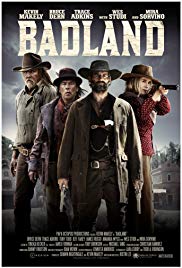
 Greetings again from the darkness. Westerns are always a risky proposition for a filmmaker, but some are drawn to the genre and seem to thrive on the intricacies that fans have come to expect. Justin Lee is one such filmmaker. He wrote and directed this film and follows the familiar tropes: a quiet, proud protagonist; the strong, lonely woman; the corrupt gunslinger – maybe wearing a badge, maybe not; and of course, the battle of good versus evil.

Kevin Makely stars as Matthias Breecher, a Civil War veteran and now Pinkerton detective carrying out the orders of Senator Benjamin Burke (Tony Todd, CANDY MAN, 1992). Senator Burke has pledged to track down war criminals and hold them accountable by administering justice. Breecher is the Senator’s hired hand who travels from town to town, serving warrants and dealing with those who refuse to abide

Mr. Lee’s film is divided into four chapters. Chapter 1, “The General”, finds Breecher face-to-face with tough-talking General Corbin Dandridge (Trace Adkins). It’s here where Breecher first flashes his impressive gun skills, and it’s soon after where he crosses paths with Harlow (recent honorary Oscar recipient Wes Studi), a competitor in the “bounty-hunter” game. Chapter 2, “The Cooke’s” has Breecher tracking down Reginald Cooke (played for all it’s worth by a finger-wagging Bruce Dern), a sickly old man dying slowly from pneumonia and living with his daughter Sarah (Oscar winner Mira Sorvino). Local bad guy Fred Quaid (James Russo) is trying to seize the Cooke’s land (apparently this is the possessive apostrophe in the chapter title). During this segment we get a nasty fist fight, an ugly shootout, and Breecher falling for Sarah and actually shushing his horse. Chapter 3, “The Sheriff”, brings us to the terrifically named town of “Knife’s Edge” where equally terrifically named evil guy Huxley Wainwright (Jeff Fahey) wears a badge and rules the town with a reign of terror, and with Old West waterboarding. There is even a double-tap grave side shootout. It’s an old mining town and the citizens live in fear – especially the good-hearted barkeep Alice (Amanda Wyss). The segment ends with a ‘high noon’ duel in the dusty street.

Chapter 4, “Breecher”, acts as a finale for our hero, a man we are told was “born to violence.” His dreams of owning land may have faded, and soul-searching has him reckoning with the man he’s become. Mr. Makely reminds of actor Anson Mount in his ability to hold a scene, and we can’t help but think that in his younger years, Mr. Fahey could have easily played the Breecher role. Despite the out-of-place linguistic stylings, director Lee proves the lessons of the old west never get old, and it leaves us with the message … ‘Be still, young man.”

watch the trailer:


THE DIVIDE (2018)

November 8, 2018

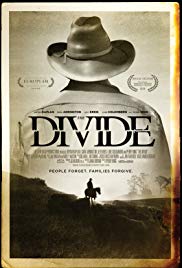
 Greetings again from the darkness. Those of us who were watching movies in the 1970’s recall Perry King as one of the fresh-faced, hunky twenty-somethings in THE LORDS OF FLATBUSH (1974) … along with Sylvester Stallone and Henry Winkler. Now, more than 40 years later, not only does Mr. King star as crusty old rancher Sam Kincaid, but he also directs his first feature film. The script is written by Jana F Brown, in what is also her first screenplay. Due to its setting, the film could be labeled as a western, but it’s really a personal drama emphasizing the importance of family reconciliation.

Sam Kincaid (King) is an elderly rancher who lives on land that looks a great deal like the Lucas McCain ranch from the TV classic “The Rifleman”. We first see Sam as he shares his philosophy of mending fences with his hired help. If you are curious, it has to do with knowing “why the holes are there”. Luke (Bryan Kaplan) is the young ranch hand who must not only deal with the severe drought-plagued northern California climate of 1976, but also the past-their-prime tools and equipment. Presenting even more of a challenge is Sam himself.

Sam is suffering from Alzheimer’s disease and his house is decorated with personal notes reminding him how the light switch works, or to perform some other menial task. A particularly pointed note on the phone states, “your daughter doesn’t want to talk to you”. Luke figures out the father and daughter had some kind of falling out, but he soon realizes Sam’s disease is progressing pretty quickly. He tracks down daughter Sarah (Sara Arrington) and pleads with her to come visit her father.

As much as I enjoyed the banter between Sam and Luke, the film picks up a bit when Sarah and her son (Sam’s unknown grandson) arrive. Family issues, secrets and skeletons in the closet make communication between these folks more than a tad uncomfortable at times. However, slowly we see the “fence” mending … and Sam’s early philosophy becomes crystal clear. Campfire-style music plays throughout much of the film, and Sam’s repeated questions allow Luke, Sarah, and grandson CJ to comprehend what’s happening and what needs to be done. Sam’s recurring nightmare can only be stopped with a reconciliation that’s painful for all involved. Perry King proves his effectiveness as an aged rancher, and also as a first time filmmaker. He and Ms. Brown deliver a nice message … and the black and white photography serves the faces and setting quite well.

watch the trailer:


BIG KILL (2018)

October 18, 2018

 Greetings again from the darkness. It’s been 6 years since Scott Martin directed his last feature film, and most of his credits are as a producer. This time out, the Texas filmmaker proves his love of the western genre, and he’s so committed to the cause that he dons many Stetsons for the project: writer, director, producer, editor, and one of the lead actors. We always admire those who overcome obstacles and see their vision become a reality. Every movie doesn’t need to be a classic … it’s a Herculean task just to get a film made, and hopefully it provides some entertainment value (which this one does).

Mr. Martin plays Jake, who along with his friend Travis (Clint Hummel) travels the old west countryside finding trouble and making waves at every turn. Jake is the sharpshooter, while Travis is the ladies’ man. Neither seem to have any marketable skills, other than the knack for staying alive – which is an accomplishment given that they seem to be shot at quite frequently and run out of every place they ride into … even Mexico!

The opening shootout sets the mood for us, as it comes across as tongue-in-cheek, with just enough realism to let us know danger exists. Danny Trejo has an entrance worthy of his cult status as Mexican General Morales … a man very displeased with Jake and Travis. An annoying electronic score accompanies a chase scene that crosses the border and ends at a Cavalry outpost run by a Colonel played by the great Michael Pare (EDDIE AND THE CRUISERS), whose two scenes are over far too quickly.

Jake and Travis accompany city slicker Jim Andrews (Christoph Sanders) on a road trip via horseback to Big Kill, Arizona … a town Jim’s brother has promised him is booming. A recurring punchline of “Never heard of it” adds some levity every time Big Kill is mentioned. Instead of a lucrative silver mining town, they find a once boom town gone bust, and now the town is run by the most unethical “Preacher” (steely-eyed and square-jawed Jason Patric) that one is likely to find. The preacher is aided by his muscle: quick-draw Johnny Kane (Lou Diamond Phillips in a gaudy red suit and evil grin) and Stephanie Beran as a knife toting Felicia Stiletto – just one of the character names pulled straight out of the comic book universe.

Jim’s brother (played by KC Clyde) is located, and though Jim begins the courting process with local girl Josie Strong (a standout Elizabeth McLaughlin), the troubles and violence and literal backstabbing in town soon draws the boys into the fracas. Much of the film has the look of kids playing dress up, but as a tongue-in-cheek western, there is enough entertainment value to hold our interest for 2 hours. Fortunately music director Kays Al-Atrakchi resorts to more traditional trumpet-based western music after that opening chase. Most of the shootouts provide some humor, whether intended or not, but we can be sure the cast had a grand time making this one … that shines through loud and clear – especially in a town where the undertaker is named Digger.

watch the trailer:


THE SISTERS BROTHERS (2018)

September 27, 2018

 Greetings again from the darkness. It was a good news – bad news kind of day for westerns. First, it’s announced that Mel Gibson will direct a remake of Sam Peckinpah’s 1969 classic THE WILD BUNCH. Talk about an undesired and unnecessary project! Fortunately, the movie gods understood this gut-punch and as a peace offering, delivered this near-masterpiece that doesn’t so much re-invent the Western, but rather provides a tonal and stylistic twist to the genre.

This is the first English language project from writer/director Jacques Audiard, who has previously delivered such powerful and well-crafted films as A PROPHET (2009), RUST AND BONE (2012), and DHEEPAN (2015). Based on the Patrick DeWitt novel, with a screenplay from Mr. Audiard and his frequent collaborator Thomas Bidegain, this latest is a very unusual film that teeters on satire at times, but is simply too bleak to be a comedy – although it’s too darn funny to be an outright drama.

A terrific opening sequence in 1851 Oregon features a nighttime shootout that sets the stage both visually and tonally for what we will experience for the next couple of hours. It’s beautifully shot and there is some misdirection on what exactly the Sisters brothers are made of. John C. Reilly is absolutely wonderful as Eli Sisters, the soulful forward-thinking one who also has a dash of goofiness to him. His younger brother Charlie Sisters, played by Joaquin Phoenix, is the slightly unhinged one who frequently follows in his hated father’s footsteps by drinking heavily. Charlie is alternatingly quietly menacing and drunkenly menacing. The two brothers are hired assassins, and while Eli dreams of a peaceful retirement, Charlie can’t imagine not doing what they do.

The brothers have been contracted by ‘The Commodore’, a rarely seen power broker played in brief glimpses by the great Rutger Hauer. They are to meet up with advance scout John Morris (played by Jake Gyllenhaal with a quasi-British accent) and kill Hermann Kermit Warm (Riz Ahmed), who has supposedly stolen from The Commodore. Of course, there is more to the story. Warm has actually developed a chemical compound that allows for the easy gathering of gold from waterways – remember this is the height of the Gold Rush.

This is kind of a road trip film … only it’s on a horse trail from Oregon to San Francisco, and it’s kind of a buddy film … only it’s two brothers. Along the way, bonds are forged and broken, and paths are crossed with a kind-hearted saloon gal (Allison Tolman), a greedy town lord (trans actor Rebecca Root), and the brothers’ mother played by the always interesting Carol Kane. There is also a cringe-inducing run-in with a spider, an unfortunate end for a favorite horse, and the hilarious first use of a toothbrush. There is also a Dallas joke that drew quite the laughter from my Dallas audience.

It’s such an unusual film, and it’s presented with a non-traditional pace and rhythm. The moments of laughter surround a core with a dramatic story of destiny, the meaning of life, dreams and visions, and the greed of man. All of this is set to yet another terrific score from Alexandre Desplat and the visually striking photography of Benoit Debie. Director Audiard has delivered a bleak comedy or a comical drama, and he’s done so with more than a fair share of violence. Whether you consider yourself a fan of westerns or not, this one deserves a look.

watch the trailer:


BLACK 47 (2018)

September 27, 2018

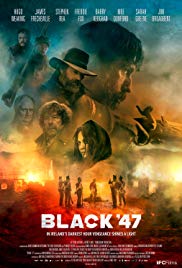
 Greetings again from the darkness. While filmmakers don’t tend to shy away from sad or even depressing characters or events, Ireland’s Great Famine has rarely been depicted on the big screen, for whatever reason. The film’s title refers to the worst year of the famine (1847). These were bleak times and folks were desperate – nearly without hope. More than one million people died, and between one million and two million emigrated from Ireland (depending on what time frame you exam). It all began with potato blight.

Director Lance Daly co-wrote the script with PJ Dillon, Eugene O’Brien, and Pierce Ryan, and have chosen to explain history through a personal story rather than an epic big picture one. Feeney (James Frecheville, ANIMAL KINGDOM, 2010) goes AWOL from the British Army in order to check on his family. The home he finds hardly resembles the one he left. His mother is dead from starvation and his brother was hanged. The rest of his family has been evicted and is soon dead as well. Apparently what he witnessed in war prepared Feeney for the horrors he discovers in his homeland. To complicate matters, he is not only viewed as a deserter by the British, but also a traitor within his own community (for fighting for the British).

Feeney becomes a renegade on a mission to avenge the deaths in his family. The film plays like one of those Charles Bronson movies, where a man of principle believes in doling out his own form of justice. A posse of 4 is assembled to track down Feeney. Captain Pope (Freddie Fox, THE THREE MUSKATEERS, 2011) is a despicable soul and by-the-book soldier who blindly follows orders and ignores the suffering of citizens he views as barely human. Young Hobson (Barry Keoghan, THE KILLING OF A SACRED DEER, 2017) is the Captain’s personal valet, while Conneely (Stephen Rea) is local added as a translator – and some much needed comic relief. The most interesting of the group is Hannah, a disgraced Inspector and Feeney’s former commanding officer.

Hugo Weaving (THE MATRIX) plays Hannah as a man driven to the edge by his war experience. One a hero, now slightly unstable in his actions, Hannah agrees to join the posse instead of spending his life in prison. His commitment to the cause is always in question, as we are led to believe there is much to the connection of Hannah and Feeney … a connection that plays out dramatically when they finally cross paths again. Mr. Weaving’s great face is contrasted nicely by Mr. Frecheville’s dead eyes (‘like a doll’s eyes’).

The revenge mission plays out with some violence, but director Daly never stoops to gratuitous gore. Instead, we typically see the aftermath … one of which brings a twist to the phrase “pig-headed”. Feeney’s time as a soldier has well prepared him for this mission. Even Crocodile Dundee would be proud of Feeney’s knife, and he does tend to make a statement with each of his killings.

Supporting work is provided by Jim Broadbent, Moe Dunford (“Vikings”), and Sarah Greene (“Penny Dreadful”). There are a couple of themes on display here: the politics (and power grab) of the time, and one man’s drive to knock down corruption and clean up his beloved country … while showing no mercy to those who have harmed his family. The contempt for the British is quite clear. Religion doesn’t escape commentary and judgment, with a sequence involving a Protestant minister, a Roman Catholic priest and a soup line with a catch.

Director of Photographer Declan Quinn (MONSOON WEDDING, IN AMERICA, LEAVING LAS VEGAS) does work capturing the contrast between beautiful vistas and incredible hardships. The stunning Connemara (western Australia) landscape is offset by immense suffering and cruelty … only the art design is a bit shaky, which is understandable given budgetary challenges. Though we’ve rarely, if ever, seen such a cinematic treatment of this era, it’s clear the guns misfired more often than this production.

watch the trailer:


THE RIDER (2018)

April 26, 2018

 Greetings again from the darkness. Sometimes the universe creates its own balance. Watching this little independent gem the day before watching the new Avengers movie reinforces what a diverse art form the cinema provides. Writer/director Chloe Zhao continues to make her presence felt as a filmmaker, and movie lovers are the beneficiaries.

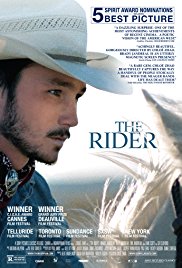
While filming her feature film debut SONGS MY BROTHER TAUGHT ME on the Pine Ridge Reservation in South Dakota in 2015, Ms. Zhao met Brady Jandreau, a rising young star on the rodeo circuit. She knew a movie was in their future, but it wasn’t until the following year when the story wrote itself. Brady suffered a severe head injury after being bucked by a bronco. He was in a coma for 3 days, and a metal plate was screwed into his skull. Doctors warned Brady that riding a horse again could kill him.

This is not a documentary, but it’s pretty darn close. Brady Jandreau plays Brady Blackburn, a rodeo bronco rider and horse trainer who is recovering from a severe head injury. Mr. Landreau’s real father Tim and sister Lilly also appear as themselves. In fact, most of the characters are locals rather than actors, and many (including the Jandreaus) are part of the Oglala Lakota Sioux tribe on the reservation. Also playing himself is Lane Scott, Brady’s best friend who is now paralyzed and unable to speak – the tragic result of another rodeo ride gone wrong. These two are like brothers, and their interactions provide some of the most emotional moments in the movie.

The film is more cycle of life, than circle of life. It’s about having a lifelong dream snatched from your clutches. We follow Brady as he searches for his new place in life. Campfire confessions with his rodeo buddies portray the bond created by risking life and limb. His mother is dead, and Brady’s dad has spent a lifetime telling him to “cowboy up” – meaning, be a man and fight through every situation. Now dad is telling him to “let it go” and “move on”. This contradicts his friends who encourage him to not give up on his dream.

Brady’s moments with his sister Lilly are some of the sweetest and most poignant. Despite her autism, Lilly is precious as she sings songs and offers clear insight to her brother. This is less about acting and more about being. Guns, horses, and pot play significant roles throughout, as does the stunning South Dakota landscape as photographed by cinematographer Joshua James Richards. The intimacy of Brady’s internal struggle somehow dwarfs the breathtaking sunsets. His quietly simmering intensity is masked by a stone face that only seems to brighten when around friend Lane, sister Lilly, or training yet another “unbreakable” horse.

Rather than traditional story arc, this is simply a compelling way of life for people who put up no false fronts. Brady is trying to figure out how to be a man after life has stolen his dream. One’s purpose is essential to one’s being, and thanks to filmmaker Zhao we witness how one tough cowboy fights through.

watch the trailer:


SWEET COUNTRY (2018)

April 21, 2018

 Greetings again from the darkness. For whatever reason, Australia and Westerns seem to go together quite well. Perhaps it’s the naturally beautiful vistas that seem to stretch forever. Maybe it’s the slower pace and the accent that provide the perfect blend of comfort and danger. What matters is that director Warwick Thornton has delivered another gem from the Outback genre.

That previously mentioned blend of slow pace and danger is evident in the opening scene. Fred Smith (Sam Neill) is napping in a rocking chair on his front porch until being startled awake by the snorting of a stranger’s horse only a few feet away. The new neighbor is Harry March (played by Ewen Leslie), an ornery war vet who drinks too much and is racist to his core.

The film is set in the 1920’s, although it doesn’t really matter when. It’s more about the what, the why and the who. The racism on display would be just as believable in contemporary times, though this Outback seems especially far out. Neighbors are rarely seen, and the town is so small, they watch silent movies (The Kelly Gang) and hold court outside on the dusty main street.

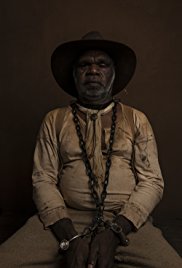
Co-writers Steven McGregor and David Tranter have created a story that likely has played out in real life, although hopefully not to this extreme. A series of events occurs: indigenous Australian Sam Kelly (played exceptionally well by non-actor Hamilton Morris) is coerced into helping March put up a fence, March crosses the line with Sam’s wife, a young boy Philomac (played by twins Tremayne and Trevon Doolan) is always stirring up trouble and pilfering things, and a drunk March accuses Sam of hiding the boy and violence erupts leaving the “white fella” dead and Sam and his wife on the run.

Sergeant Fletcher (Bryan Brown) is the local law – he even proclaims “I am the law” – and he forms a posse to track down Sam so he can stand trial. The posse includes March’s friend Kennedy (Thomas M Wright), Sam’s employer Fred Smith (Mr. Neill), and Archie (Gibson John), an indigenous Aussie employed by Kennedy.  Director Thornton uses this chase sequence to paint some extraordinary visions on screen. The natural land is beautiful, and then we come across a stunning and deadly desert in the salt flats. Mr. Thornton acts as co-cinematographer with Dylan River, and the result is a movie that’s a thing of beauty to look at.

Director Thornton uses an array of flashbacks and flash-forwards, sometimes in quick cut form. This approach keeps us on our toes, sometimes foreshadowing, sometimes filling gaps. Against the wishes of the locals, this is a developing country, and many of the locals feel it’s no longer their country – they are kept as laborers, and rarely treated as equals by the new inhabitants. In this world, for this man (Sam), doing the right and necessary thing places he and his family in instant peril. It’s better to run than surrender. The story is very good, though the dialogue is a bit lacking at times. The photography is world class. Though we would have preferred screen vets Bryan Brown and Sam Neill to have more scenes together, the panoramic majesty of Australia is certainly enough … with an added and fitting bonus of Johnny Cash singing “Peace in the Valley” over the closing credits.

watch the trailer:


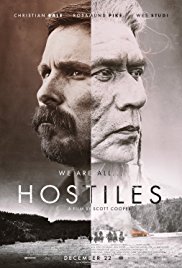
HOSTILES (2017)

January 2, 2018

 Greetings again from the darkness. When a filmmaker is influenced by one of the all-time classics, that filmmaker best deliver a movie that not only stands up to inevitable comparisons, but also one that has its own identity, playing as more than a copy. Writer/director Scott Cooper (from a manuscript by the late Oscar winner Donald E Stewart) succeeds on both counts even as he tips his Stetson to John Ford’s western classic THE SEARCHERS.

If you are familiar with Mr. Cooper’s CRAZY HEART and OUT OF THE FURNACE, then you know his style is never hurried, and to expect minimal dialogue. You might think of him as the anti-Aaron Sorkin. Cooper’s characters tend to only say what must be said, and prefer to communicate through subtle gestures and actions that define their character. In this latest, he re-teams with Oscar winner Christian Bale, who plays the quietly simmering Captain Blocker. It’s 1892, and the legendary Army officer/soldier/guide is ordered to escort a Cheyenne Chief and his family through dangerous and unchartered New Mexico territory, so that the Chief may die in peace in his native Valley of the Bears, Montana. During a career of brutal warfare against the Native Americans, Captain Blocker has developed a deep-seeded hatred, and only accepts the assignment after his pension is threatened.

The opening sequence immediately immerses us in the constant danger faced during this era. Rosamund Pike watches as her homesteading family is brutally slaughtered by Comanche warriors. She survives only by escaping into the woods, although it’s a bit of stretch to believe that this homemaker marm could outwit the Comanches. Circumstances find Ms. Pike’s traumatized character (the actress’s go-to wide-eyed look) joining and complicating Captain Blocker’s convoy.

Wes Studi plays Chief Yellow Hawk, and the film’s only weakness is in his not having a more substantive role, as we are teased a couple of times with nuanced exchanges between he and Bales’ Blocker. The stellar supporting cast includes Rory Cochrane, Jonathan Majors, John Benjamin Hickey, Stephen Lang, Bill Camp, Jesse Plemons, Timothy Chalamet, Adam Beach, Peter Mullan, and Scott Wilson. Ben Foster also appears as an Army soldier accused of murder … another addition to the convoy, as he is to be escorted to prison.

The somber film follows this traveling party as they move slowly and methodically across the open plains and wilderness. There are no moments of levity, as death and danger are constantly hovering. No real reason for optimism exists, and surviving the day is the only goal. Despite the appearance of little happening, there is much going on here for the characters and in commentary on the times. At its core, the story is about Blocker’s reclamation of his soul and humanity; although redemption may not be possible as he recalls Julius Caesar and getting used to killing, but not to losing men.

Political correctness is avoided in many scenes, though the message is clear that the hatred between the Native Americans and the mostly Anglo settlers and soldiers stems from the unethical seizure of land by violent force. Amends are not possible even with a change of heart. It’s in these moments where we desire a more in-depth look at the various native factions.

Cinematographer Masanobu Takayanagi works with some amazing vistas, landscapes and rock formations. He deftly balances the breathtaking beauty of the land with the intimacy of the mission. There is a relentless undercurrent of simmering emotion throughout the film, much of which comes courtesy of Christian Bale. Sporting a mustache to rival Poirot, Bale is remarkably adept at silently expressing disgust, rage, resolve and resignation. His groans and grunts convey as much as soliloquies for many actors. While he feels remorse and seeks redemption, we are left with the not-especially-upbeat message that we are what we are.

watch the trailer:


THE MAGNIFICENT SEVEN (2016)

September 25, 2016

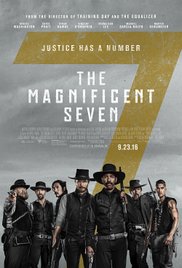
mag-7 Greetings again from the darkness. In this era of endless remakes, sequels and superheroes, I strive to keep an open mind when it comes to mainstream movies. All I ask is that the classics be left alone. Most will agree that there is no need for a new version of The Godfather, Citizen Kane or Gone with the Wind; however, disputes arise in the gray areas. An old guy like me may cringe at the thought of updating this western, though it’s easy enough to understand how Hollywood studio types view it as an opportunity to sell tickets to a younger audience. In art vs. commerce, making money usually prevails.

The 1960 original, directed by John Sturges was itself a remake/reimagining of one of the greatest films ever made: Akira Kurosawa’s Seven Samurai (1954). Both are must-see’s for any movie lover. Given the technical advancements in filmmaking over the past 50-60 years, it only makes sense that director Antoine Fuqua (Southpaw, Training Day) would go bigger, faster, louder. What he can’t do is match the cool factor of Steve McQueen, Yul Brenner, James Coburn, Charles Bronson, or of course, Toshiro Mifune.

Mr. Fuqua does bring a more racially diverse cast with Denzel Washington taking the lead as Chisolm, the dignified man-on-a-couple-of-missions. Chris Pratt basically buckles a holster onto his Jurassic World character and becomes Faraday, the wise-cracking sharp-shooter, who is as likely to cheat in a card game as lay his life on the line for a good cause. The “seven” are rounded out with Ethan Hawke as war hero Goodnight Robicheaux, Vincent D’Onofrio as bear-sized man Jack Horne, Byung-hun Lee as knife specialist Billy Rocks, Manuel Garcia-Rulfo as Vasquez, and Martin Sensmeier as native-American outcast Red Harvest. You might think the only thing missing from this culturally diverse group is a woman, but Haley Bennett (and her distractingly terrible hair dye) plays a key role as a recently widowed town person intent on revenge against the heartless robber-baron Bogue, played by a sneering Peter Sarsgaard.

Co-writers Nic Pizzolatto (“True Detective”) and Richard Wenk (The Expendables 2) devote so much screen time to Denzel and Pratt that we never much get a feel for what makes the other characters tick. What’s not missing is the thundering hooves of galloping horses, steely-eyed glares, and gunfire … lots and lots of gunfire. This is where today’s sound technology really adds a welcome element – the cocking of a rifle, the leather of the holster, and of course, the near-deafening chorus from the Gatling gun all benefit from Sony 4k sound.

Fuqua’s stylistic approach may have more in common with Silverado (1985) than the 1960 Sturges film, but it’s important to note that this was legendary composer James Horner’s final score before he passed away. While we hear Horner’s unique take, we can’t miss the influence of the iconic original score by Elmer Bernstein. So while Pratt’s “So far, so good” joke may be a Steve McQueen re-tread, your appreciation of this latest probably correlates to your appreciation of the 1960 version.

watch the trailer:


STAGECOACH (1939) revisited

August 21, 2016

stagecoach Imagine you are 25 year old Orson Welles, and you are obsessed with creating cinematic history with your next film. You have spent hour after hour studying the best and most creative works of the finest filmmakers from all over the world. You come across a particular John Ford western, and are so inspired by its technical precision that you watch it at least three dozen times while working on your masterpiece … Citizen Kane (1941). Such is the influence of Ford’s Stagecoach. It may or may not be the greatest western film of all-time (a matter of preference), but it’s inarguably the most influential.

More than 75 years later, it’s difficult to imagine a time when John Ford and John Wayne were not joined at the swaggering hip making movies together. By 1939, Ford had won an Oscar for The Informer (1935) but had not directed a western in more than a decade, while John Wayne’s career to this point consisted of bit parts and B movies. The “firsts” here include: John Ford’s first movie with John Wayne, the first movie filmed in Monument Valley, Ford’s first talkie-western, and the first starring role in a major motion picture for John Wayne

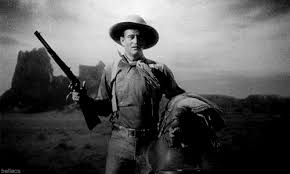
It’s difficult to think of a more iconic star-making screen introduction than that first shot of John Wayne twirling and cocking the rifle as the camera zooms in on his face (see photo below). It should be noted that The Duke (as he was often referred) was 32 years old in the film and is wearing his own cowboy hat – one he would wear in many movies over the years (until it finally was in such bad shape, it was placed in a glass display case at Mr. Wayne’s home).

The film hit while the industry was still experiencing some of the pains of leaving the “silent” world behind and taking advantage of “talkies”. Additionally, the technology of color film was just beginning to be used more frequently, but many studios and directors were clinging to the traditional black and white look. As a genre, westerns had never been able to make that step into the mainstream … that is, until Ford and Wayne came stampeding to the forefront with Stagecoach.

Dudley Nichols (Oscar winning screenwriter for Ford’s The Informer) adapted the original story from Ernest Haycox (a prolific writer who helped elevate westerns from dime story pulp to respectability and box office profitability) into a screenplay that examines the early attempts at transitioning the “wild west” into a more civilized society. Social commentary abounds as several characters from disparate background are crammed into a confined space (the titular stagecoach) for an extended period of time. Some viewers may complain about the use of clichés, but in fairness, what we have come to label as cliché, was anything but at the time.

Adding their own special touch to the wide range of characters were some of the finest actors of the era. Claire Trevor was the best known star in the cast at the time, and she plays Dallas, the good-hearted woman whose past/profession causes her to be treated as an outcast by most in the group. Ms. Trevor would go on to accept the unofficial title of Film Noir Queen, win a Best Supporting Oscar for Key Largo (1948), and have the School of Arts at UC-Irvine named for her. Donald Meek plays the meek (yes his name often fit his character) travelling salesman ironically named Peacock. Contrary to what one would guess given his diminutive physical stature, Mr. Meek fought in the Spanish-American War. John Carradine is perfectly cast as Hatfield, the elegant gambler carrying a secret. Mr. Carradine is the father of the acting Carradine brothers (including David and Keith), and enjoyed a 65 year career with more than 350 projects. Drunken Doc Boone is played by Thomas Mitchell, who many will recognize as memory-challenged Uncle Billy in It’s a Wonderful Life. He also appeared in such top shelf films as Gone with the Wind, High Noon and Lost Horizon. Louise Platt plays Lucy Mallory, the pregnant wife who is on a mission to reunite with her soldier husband. The villainous banker is played with gusto by Berton Churchill, and the only thing he’s missing is a twirly mustache. Mr. Churchill was a co-founder of the Screen Actors Guild (SAG) in 1933. Law Enforcement is represented by Marshal Wilcox, played by George Bancroft, and the stagecoach is driven by the great Andy Devine (as Buck). Mr. Devine manages to create a bit of comedy relief by the use of his trademark high-pitched raspy voice, as well as his underrated physical acting movements. Other notables making an appearance are Tom Tyler (once known as the strongest man in America) whose initial shaky transition from silent film to talkies is readily apparent in his few scenes; Woody Strode (one of the saloon patrons) who is known best for his fight scene in Spartacus; and Tim Holt who brings the charging Calvary to the rescue, and is best known as one of the prospectors in The Treasure of the Sierra Madre (1948).

Of course, it’s John Ford and John Wayne who draw most of the attention when this film is discussed. Born Marion Morrison, The Duke played football at USC before turning his full attention to acting. Here he plays bad-guy-with-a-heart Ringo Kid, and gets to show a pretty full spectrum of machismo, humanity, dignity and sensitivity. His extraordinary physical screen presence led him to the top of the film world with roles in some of the most popular films over the next 4 decades, capped by a Best Actor Oscar for True Grit (1969). John Ford, who was 45 years old at the time of Stagecoach, won 4 Best Director Oscars (plus two special Oscars for his WWII documentaries): The Informer (1935), The Grapes of Wrath (1940), How Green was my Valley (1942), and The Quiet Man (1952).

Two others deserve special mention. Stuntman extraordinaire Yakima Canutt (a World Champion rodeo cowboy) was seemingly involved in just about every risky stunt in Hollywood during the 1920’s, 30’s and 40’s. Stagecoach provided the opportunity for what may be his best and most daring stunt – leaping onto the moving stagecoach and its 6 horse team and then sliding down under the carriage and out the back … all at breakneck speed! It’s fascinating to watch, and in this age of computerized special effects, it demands a level of awe and respect. While this film provided the first on screen glimpse of Monument Valley, it was Cinematographer Bert Glennon who figured out the best ways to take advantage of this breathtaking setting. Mr. Glennon was nominated for 3 Oscars (including Stagecoach), and was a frequent collaborator with both John Ford and Cecil B DeMille. The second half of his career was devoted mostly to TV series, rather than movies.

Stagecoach received 7 Oscar nominations including wins for Thomas Mitchell as Best Supporting Actor and Best Music (score) for Richard Hagerman, W Frank Harling, John Leipold, and Leo Shuken. The other nominees were for Best Picture, Best Director (Ford), Best Cinematographer, Best Art Direction and Best Editing. While it might seem implausible that such a ground-breaking film could only win two Oscars, it’s a reminder why 1939 is considered by many to be the best ever year for movies. Check out this list of other releases that same year: Gone with the Wind; Mr Smith Goes to Washington; Wuthering Heights; Goodbye, Mr Chips; Ninotchka; The Wizard of Oz; Of Mice and Men; The Hunchback of Notre Dame; Young Mr Lincoln.

Despite being the first movie to feature the “dead man’s hand” – a pair of black aces and a pair of black eights (the hand Wild Bill Hickok was holding when he was gunned down), this film continues to live on in cinematic lore. Often included in the discussion of the best westerns of all-time – along with High Noon, Shane, Unforgiven, Once Upon a Time in the West, The Wild Bunch, The Good The Bad and the Ugly, and The Searchers – it was a joyful experience to finally get to see this one on the big screen in a theatre setting (thanks to Dallas Film Society and Chris Vognar). It’s clear how this film elevated the western genre, and it certainly deserved recognition by the National Film Registry in 1995.
stagecoach2