VICEROY’S HOUSE (2017)

August 31, 2017

 Greetings again from the darkness. The 1947 Partition of India is personally important and influential to director Gurinder Chadha (BEND IT LIKE BECKHAM), though we don’t understand exactly how until the closing credits roll. Until that point, we find ourselves questioning why Ms. Chadha and her co-writers Paul Mayeda Berges (her husband) and Moira Buffini attempt such an obvious crowd-pleasing structure for this historical saga. Perhaps the strategy was to educate as many as possible on the events from 70 years ago.

An opening quote tells us “History is written by the victors.” Is this true? If so, who are the victors in this story? The British Empire ruled India for three centuries and their last Viceroy, Lord Mountbatten (great-grandson of Queen Victoria), was charged with structuring a peaceful transition to independence. The near impossibility of this challenge should have been readily apparent given the deep divisions created by religious and cultural differences, plus the immense friction between Hindus, Sikhs and Muslims. “Giving a nation back to its people” is not so simple when dealing with 20% of the world’s population.

Hugh Bonneville and Gillian Anderson play Lord Louis and Lady Edwina Mountbatten, respectively. Despite managing what history has proven to be a disastrous decision, he is treated quite kindly by the filmmakers. Seemingly with his heart in the right place, Lord Mountbatten is presented as a pawn for the real power broker in England. His wife, on the other hand, is quite progressive and appears sincere in her efforts to better understand the Indian citizenry. In fact, as the most intriguing figure in the film, more focus on Edwina would have been welcome.

Michael Gambon plays General Hastings Ismay, while Tanveer Ghani is Jawaharlal Nehru (India’s first Prime Minister) and Denzil Smith plays Muhammed Ali Jinnah (Pakistan’s leader). These are the key players in negotiations, while inexplicably, the filmmakers choose to veer from history and offer up the worst kind of cinematic melodrama: star-crossed lovers in the vein of Romeo and Juliet.

As a metaphor for the Partition, the two lovers being torn apart by forces beyond their control is quite simply an unnecessary distraction. Mani Dayal (so good in THE HUNDRED FOOT JOURNEY) plays Jeet, a Hindu servant (one of 500) at the Viceroy House, while Huma Qureshi plays Aalia, the beautiful Muslim daughter of Ali (the late great Om Puri). Furtive glances are about as close as the two come to an actual relationship, but the film spends an inordinate amount of time on their wishes to be together.

There are too many cringe-inducing moments for the film to be considered a serious historical epic. Gandhi gets some screen time and is absurdly described as “The British Empire brought to its knees by a man in a loincloth”. Other moments seem all too relevant today. The promise that “Muslims will not be treated as second class citizens” could easily be heard on a current newscast. The decision to split Pakistan and India seems motivated by Britain’s design on oil and geographic protection from Russia … both contemporary motivations for many decisions these days.

The closing credits highlight the effects of the Partition: 14 million people migrated with approximately one million dead. We also get actual newsreel footage of the key figures from the story, as well as the documented reasoning of why this was so personal for director Chadha … perhaps too personal.

watch the trailer:


MENASHE (2017)

August 31, 2017

 Greetings again from the darkness. If the synopsis were phrased, “Based on the real life story of a figure within a secret society”, we would likely be prepared for either a spy movie or yet another undercover look at a cult. Instead director Joshua Z Weinstein provides a rare glimpse into a community we outsiders rarely see: the ultra-Orthodox Hasidic Jews of Brooklyn. He does so with a deft touch and due respect, while bringing to light traditions that have existed for generations.

Supposedly shot in secret and featuring non-actors, the dialogue is almost entirely Yiddish (with subtitles), and the sets are mostly small apartments, back rooms, and the streets and stores of the community. There is no sound stage in sight. The story centers on Menashe, a sweaty schlub of a man. Menashe is neither matinee idol nor hero of the silver screen. He’s a regular guy whose wife passed away, and who wants little more from life than to raise his son Rieven (Ruben Niborski). Unfortunately, tradition calls for every child to be raised in a home with a mother, so Menashe’s former brother-in-law Eizik (Yoel Weisshaus) has taken on the parenting role.

As the memorial for the one year anniversary of his wife’s death approaches, we initially believe Menashe’s actions may be related to his mourning. But we soon discover, he didn’t really have things together when she was alive either, and his borderline incompetence at work, and failings as a father, simply define who he is. Menashe Lustwig plays the lead in the movie based on his life events, and his approach leaves us wondering if we are witnessing his worst days or merely his every day.

Menashe is hard-headed, but not ambitious. He is anxious to show his Rabbi The Ruv (Meyer Schwartz) that he is independent enough to organize the memorial and raise his son. The Rabbi is understanding and reminds him The Torah states what makes a good life: a nice wife, a nice house, and nice dishes. Menashe falls short on all three, and his actions on dates set by The Matchmaker prove that he has little interest in a new wife, despite that being one of the conditions to his regaining his son.

The tight camera shots throughout play up the closeness of the community and the claustrophobic feel of Menashe’s life. The writers Alex Lipschultz, Musa Syeed, and Joshua Z Weinstein (director) detail the traditions that seem foreign to us in a way that evokes authenticity and realism, rather than compromise for a wide audience. There is an odd intensity to the film, and it’s more naturalistic than sentimental. The violin pieces written by Aaron Martin and Dag Rosenqvist complement the perspective that even in a close-knit community, every one of us goes through “stuff” in life that deserves a touch of empathy and understanding. Is it a happy ending? It’s certainly not a Hollywood ending, but it does stay true to the vaguely hopeful tone.

watch the trailer:


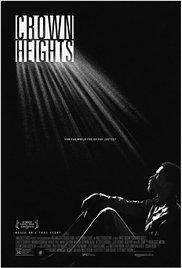
CROWN HEIGHTS (2017)

August 31, 2017

 Greetings again from the darkness. Being wrongly accused of a horrible crime would be a nightmare. Being wrongly convicted would be the worst possible nightmare. Prison life must be a daily nightmare. What could make such nightmares even worse? How about serving 21 years for a crime you didn’t commit, with about 4 years of that in solitary confinement.

Numerous recent projects have focused on a legal and justice system that sometimes seems broken. Some of the best include: HBO’s “The Night Of”, Ana DuVernay’s documentary 13TH, and Jamie Meltzer’s documentary TRUE CONVICTION. Writer/Director Matt Ruskin has adapted this most recent based-on-a-true-story docudrama from a podcast episode of “This American Life”.

While the general topic of “justice” is interesting enough, it’s the individual personal stories of justice denied that add such power, immediacy and emotion. In April 1980, in the Crown Heights section of Brooklyn, a young man is arrested on suspicion of murder. Lakeith Stanfeld (SHORT TERM 12) plays Colin Warner, a local petty thief whose family is from Trinidad. The “suspicion of murder” is really not accurate, since the arresting cops knew Colin wasn’t the guy, but were more interested in clearing the case than actually solving it.

What follows is a commentary on crooked cops, a flawed judicial system, and the willingness by the guilty party to let another go to jail if it means they remain free. However, more than any of that, this is a wonderful story of one man’s unrelenting pursuit of justice for his friend. Former NFL star Nnambi Asomugha (married to Kerry Washington) plays Carl “KC” King – Colin’s friend who refuses to give up on him and constantly hunts for someone to ensure justice is served … no matter how much time has passed. KC never stops, even when he realizes this is a system that doesn’t often admit its mistakes. The tenacity of KC is likely to have viewers questioning if they have a friend so loyal … or if they themselves could be such a friend.

Supporting work is provided by Zach Greiner, Josh Pais, Luke Forbes, Marsha Stephanie Blake, Adriane Lenox, Nestor Carbondell, Bill Camp, and Yul Vazquez. Natalie Paul plays Antoinette, the saintly woman who falls in love with Colin and marries him while he is incarcerated.

We watch as the wheels of injustice roll over Colin – even demanding that he admit remorse in order to have his request for probation considered. Being a man of strong conviction, Colin holds firm on his innocence despite being hardened by life behind bars. Director Ruskin has delivered a decent movie, but with its vital story and issue, it’s one probably better suited to a documentary structure. He wisely chooses not to pile on the legalities, and focuses more on the frustrations with a flawed system while also including an anti-death penalty message supported by the statistic of 2.4 million in prison – an estimated 120,000 of which are innocent.

watch the trailer:


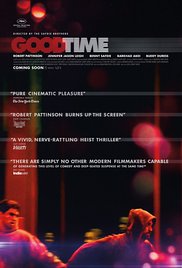
GOOD TIME (2017)

August 24, 2017

 Greetings again from the darkness. The Drifters and later George Benson sang “the neon lights are bright on Broadway”. Well, we aren’t on Broadway, and though they aren’t bright, the neon lights are ever present and crucial to the tone of the latest from brothers and co-directors Benny Safdie and Josh Safdie.

Robert Pattinson stars as Constantine “Connie” Nikas, and turns in a performance unlike anything we have previously seen from him. Connie is protective of his brother Nick (played by director Benny Safdie), and he’s also a grungy unhinged bank robber. He doesn’t look like a man with a plan, but fortunately, Connie is a smooth talker who thinks ‘quick on his feet’. We say fortunately, because he is barraged with an endless stream of danger, catastrophes and near traumatic events as the story progresses.

A botched bank robbery separates the brothers and sends Nick to jail and Connie on the lam. Co-writers Ronald Bronstein and Josh Safdie seemingly take immense pleasure in launching Connie off-the-rails has he desperately attempts to avoid capture while simultaneously figuring out how to spring brother Nick. With a frenetic pace that escalates Griffin Dunne’s misery in AFTER HOURS, Connie’s escapades have him crossing paths with his girlfriend played by Jennifer Jason Leigh (wish she had more screen time), a psychiatrist played by Peter Verby, a new anxious-to-help acquaintance in Taliah Webster, an accidental partner-in-crime played by Buddy Duress, an amusement park security guard played by Barkhad Abdi (“Look at me!”), and a brutish thug played by hip-hop artist Necro.

The pounding, pulsating techno/synth music perfectly complements the unusual tone (almost noirish, and bordering on comedic), feverish pace, and fascinating visuals throughout this hyper-kinetic frenzied trip. Some viewers will be turned off quickly, and those that stick with it will be rewarded with an entertaining crime thriller featuring Pattinson’s best performance to date.

watch the trailer:


PATTI CAKE$ (2017)

August 23, 2017

 Greetings again from the darkness. A gritty, New Jersey based story of a blue-collar white girl trying to make it in hip-hop sounds like the makings of a film festival favorite – especially since it’s the first feature from its director and features a star-making turn from an unusual leading lady. After being warmly received at Sundance and Cannes (and other festivals), the only remaining question is, will mainstream audiences show the love?

The obvious comparison here is Eminem’s 8 MILE, but there is also a touch of ROCKY, THE COMMITMENTS, and most all other sports and music movies featuring the dreams of those from ‘the other side of the tracks’. Writer/director Geremy Jasper has a nice feel for setting and actors, and it’s only the (at times) formulaic nature of the script that keeps this one in the crowd-pleasing category rather reaching a level of greatness.

Australian native Danielle Macdonald plays Patti Dombrowski, also known as Killa P, and most every other cruel nickname (Dumbo, White Precious) one might pin on a plus-sized Anglo girl found street rapping. As you would expect, her tough outer visage masks an all-too-familiar inner insecurity borne from a larger than life mother who blames her daughter for every misery in life. Bridget Everett plays the mother Barb, a hard-drinking, hard-singing, hard-blaming type who gives such sterling mother advice as ‘lose the top button’ for that job interview. Mother Barb, providing proof of her distance from reality, refers to herself and daughter Patti as “the Dombrowski sisters”, whom she claims are “setting the world on fire”.

The tenuous mother-daughter relationship is at the core of the film, and these two actresses (and the movie) are at their best in their scenes together. On the music side, Siddarth Dhananjay plays Jhen, Patti’s eternal optimist-pharmacist-music partner, while Mamoudou Athie is Basterd, a self-proclaimed anti-Christ anarchist. The three form a band called PB&J (Patti, Basterd, Jhen) which provides friendship, a creative release, and, mostly, a reason for existence. Their band, and especially Patti, gets a boost from Nana (a remarkable Cathy Moriarty) on vocals and the CD cover. Ms. Moriarty is now 56 years old (playing older here), and was only 19 when she made her stunning screen debut in RAGING BULL. Other supporting work is provided by MC Lyte, Wass Stevens and Sahr Ngaujah.

The neighborhood is Bayonne New Jersey (see CHUCK), an area where lines such as “blood is thicker than Jager” actually make sense. A 23 year old would-be rapper can work as a bartender and caterer, and still find time to hone her musical skills. It’s the land of misfits and music that only sounds sweet to a few ears – where dreams don’t consist of owning yacht, but rather “making it across the bridge”. Crowd-pleasing movies are quite welcome these days, and filmmaker Jasper has joined with dynamite actresses Macdonald and Everett in delivering just that. Expect all to reach greater heights over the next few years.

watch the trailer:


LOGAN LUCKY (2017)

August 17, 2017

 Greetings again from the darkness. When we think of public figures retiring, we typically accept that athletes, politicians and entertainers will no longer be honing their craft or grinding in their profession. Perhaps they will write their memoirs, or even dodge TMZ completely by spending their days fishing or playing golf. When Oscar winning film director Steven Soderbergh announced he was “retiring” from making movies after his 2013 SIDE EFFECTS, he simply transitioned to television (excellence in “The Knick”). Most of us assumed it was only a matter of time until he returned to the medium that made him famous. This “retirement” lasted less than 4 years.

When a line in the film describes it as “Ocean’s 7-11”, we can assume this is Mr. Soderbergh admitting that his “Ocean’s” trilogy was the inspiration for this comedy-satire heist film focusing on a well-planned crime by a team of siblings, rednecks and convicts. Channing Tatum, Adam Driver and Riley Keough star as the Logan clan – Jimmy, Clyde, and Mellie, respectively. With NASCAR as the target, the Logans are joined by the Bangs: Sam (Brian Gleeson), Fish (Jack Quaid), and Joe (a scene-stealing bleached blonde Daniel Craig).

Joining in the unconventional Hicksville fun are Katie Holmes and David Denman as Jimmy’s ex-wife and her new husband, a recently shorn Sebastian Stan as a race car driver, Seth MacFarlane as an obnoxiously rich blow-hard, Katherine Waterston in a too-brief role as a traveling medic, Hilary Swank as a determined FBI Agent, and Dwight Yoakum as a prison warden who rarely admits a problem. Also playing a key role is the music of John Denver … a move that teeters between tribute and punchline.

The set up and characters lend themselves to more laughter than we actually experience. There are more awkward moments than hilarious ones. As examples, brother Clyde’s (Driver) artificial hand is the center of focus on a few occasions, as are Joe Bang’s (Craig) expertise in science, and the small town West Virginia addiction to child beauty pageants. Their racetrack robbery plan is both ingenious and preposterous, which is also a fitting description of the film.

A writing credit goes to “Rebecca Blunt”, which in keeping with Soderbergh’s tradition, is a pseudonym (or nom de plume) for an unnamed writer (likely Soderbergh himself). The film mostly succeeds in delivering the opposite of the traditional Ocean’s slickness, and it’s entertaining to watch Channing Tatum and Daniel Craig (the credits list him as “introducing Daniel Craig) having such a good time on screen. While it doesn’t deliver the laughs of FREE FIRE or TALLADEGA NIGHTS, it is nice to have Soderbergh back where he belongs. Rather than an instant classic, it’s more likely to be remembered for Soderbergh’s attempt to change the movie distribution channels … Google can provide the details if you are interested.

watch the trailer:


IN THIS CORNER OF THE WORLD (Japan, 2017)

August 17, 2017

 Greetings again from the darkness. There is something hypnotic about the hand-drawn animation of writer/director Sunao Katabuchi’s film based on the 2007-09 Japanese manga (comic) by Fumiyo Kouno. With some similarities to Takahata’s 1988 classic Grave of the Fireflies, it’s more than a wartime drama – it’s a story of the human spirit.

It’s 1935 and Suzu is a young girl who lives in Eba, a town in Hiroshima. She is an exceptional artist with a vibrant imagination and an adventurous approach to life. Her innocence and pleasant childhood existence is rocked when, as a teenager, she receives an out-of-the-blue marriage proposal from a stranger. Life with his family in Kure forces Suzu into a daily routine of cleaning, mending and cooking – all while longing for her family in Eba.

The film clicks through the months and years, and provides a history of war time from the perspective of a family and village. While the date of August 6, 1945 hovers on the viewer’s mind, we experience how family dynamics are affected by war time. For Suzu, her daily routines such as food preparation provide a necessary structure and distraction, despite the ever-worsening shortage of food and supplies. These stresses are compounded by air raid warnings over the radio and Suzu suffers through vivid nightmares.

We so easily connect with Suzu as she continually fights through hardships – both physical and emotional – because of her determination to live a good life and overcome all obstacles. This is such expert story telling with a beautiful presentation, that the film periodically reminds us that war is close by. Even in a war torn country, the people must find a way to go about daily life while treasuring the rare moments of joy and understanding the strength of togetherness. It’s rare that an animated movie can deliver such a humanist look at fully formed characters and their feelings … all within a historical setting.

watch the trailer:


WIND RIVER (2017)

August 14, 2017

 Greetings again from the darkness. With his two most recent screenplays, Sicario (2015) and the Oscar nominated Hell or High Water (2016), Taylor Sheridan seemed acutely attuned to the fine line between right and wrong, and the twisted complexity of new age American values when contrasted with “old school”. This time out, he both writes and directs. The themes remain familiar while the landscape shifts to the frozen tundra of Wyoming.

We first meet Fish & Wildlife Service tracker/hunter Cory (Jeremy Renner) as he picks off (with a long range rifle) a pack of wolves that is methodically encircling goats on a ranch. A very similar type situation plays out later in the film … only with humans in place of wolves and sheep. Not long after dispensing with the wolves, Cory stumbles upon the barefoot corpse of a young girl he recognizes as the former best friend of his daughter. Her frost-bitten bare feet visible, face buried in the snow, bleeding from an apparent assault, and miles from the nearest house or dwelling, the girl’s corpse is telling a story that Cory knows requires the immediate attention of law enforcement.

Ben, the Native American Reservation Police Chief (Graham Greene) has jurisdiction unless the Medical Examiner rules it a homicide. In the meantime, FBI Agent Jane Banner (Elizabeth Olsen) shows up dressed more for winter in her native Florida than the brutally cold Wyoming plains. Jane quickly proves she is no ordinary “fish out of water” (even if she lacks experience for such a case), and commissions Cory to help her out with the local people and land.

The film has many ties to the fine TV series “Longmire”, and though Mr. Renner and Ms. Olsen are well known in the Marvel Universe as Hawkeye and Scarlet Witch, there are no superheroes present here – just a convoluted society within a seemingly forgotten (or at least) ignored part of the country. It’s a police procedural blanketed in the always-falling snow, an underground drug culture, and the quiet animosity between the outside world and the Reservation (where many have given up hope).

These aren’t people that talk much, although they say plenty. Sometimes the dialogue is a bit too obvious in Mr. Sheridan’s goal of leaving no viewer behind, especially when combined with overly detailed flashback that will have the amateur sleuths in the audience feeling a bit letdown in receiving a full explanation. However, when cinematographer Ben Richardson (Beasts of the Southern Wild, The Fault in Our Stars) loses the shaky-cam from indoors, and beautifully lays out the vastness of the snow vistas, forest and mountains, the remoteness and stunning landscape becomes a character as important as any other.

The supporting cast is stellar and features Julia Jones, Gil Birmingham (Jeff Bridges’ partner in Hell or High Water), Jon Bernthal, Kelsey Asbille, and a crazed James Jordan. Mr. Greene adds a touch of deadpan humor and resignation to his plight, while Ms. Olsen is effective as the ‘green’ agent dealing with an unfamiliar white-out. Mr. Renner truly excels as the throwback cowboy carrying out his duties while bearing a burden exacerbated by this case. The crunching snow, predatory lions, and high-speed snowmobiling never cause us (or Cory) to lose sight of how important it is to know the land and the people … and walk that line between right and wrong.

watch the trailer:


BRIGSBY BEAR (2017)

August 10, 2017

 Greetings again from the darkness. Many kids get obsessed with their favorite TV show and characters. Perhaps it’s Minnie Mouse, Sesame Street or even Teenage Mutant Ninja Turtles. Whatever or whomever it is, they typically enjoy sharing their experiences with their friends. When we first meet James, he is staring, fully-engaged, at an odd, poorly produced show that appears to be a relic from the 1970’s. His room is packed with franchised merchandise like a bedspread, a lamp, toys, and even a stuffed animal. We immediately notice two problems: we don’t recognize this talking TV bear and James appears to be not a child, but a twenty-something with a 3 day beard growth.

Kyle Mooney has gained a following with his work (especially his quirky short films) on “Saturday Night Live”. Here he collaborates with director Dave McCrary (another SNL stalwart) and co-writer Kevin Costello on their first feature film. Mr. Mooney also stars as James, the “Brigsby Bear” expert who was kidnapped as an infant, held captive in a desert bunker and brainwashed by his captor “parents” Ted and April (an excellent Mark Hamill, Jane Adams).

Being confined and isolated in a controlled environment with only artificial culture in no way prepares James for the long-delayed release back into the wild known as society. His biological parents Greg and Louise (Matt Walsh, Michaela Watkins) are thrilled to reunite with their long lost son, and very patient with James’ struggles to assimilate.

James is unceremoniously dumped into the real world without his one security blanket: a TV bear that doesn’t exist. He goes from being disconnected from the outside world to being disconnected inside a new world he doesn’t know or recognize. Despite the pressures he is up against (police, family, new friends), he refuses to let go of his obsession.

It’s at this point where we really root for Mooney and McCrary to embrace the weirdness. Instead, the story takes a bit of a conventional turn and we find ourselves no longer reveling in oddity, but instead cheering for James to continue influencing those who initially viewed him as the proverbial fish out of water. The film ends up as a creative story about creativity … if that’s what it’s about (or if it’s about anything).

Strong supporting work is provided by Greg Kinnear as Detective Vogel (with a secret passion), Ryan Simpkins (sister of Ty) as James’ somewhat reluctant sister, and Alexa Demie and Jorge Lendeborg Jr as the new friends who come to appreciate him for his perspective. Claire Danes is a misguided psychiatrist, Buck Bennett is a detective, Andy Samburg appears an acquaintance, and Kate Lyn Scheil is Arielle (and Nora).

The film can best be described as Funny-Sad, and a blend of ROOM (isolated and held captive), NAPOLEON DYNAMITE (a quirky dude), BEING THERE (an innocence that influences others), and ENCINO MAN (a guy being introduced to a new world). It has an emotional and heartfelt climax that is crowd-pleasing, and certainly deserves bonus points for not being a superhero movie, remake, sequel or reboot. Still, it leaves us wondering what direction this could have gone had the filmmakers remained true to the cause of embracing the weirdness.

watch the trailer:


THE GLASS CASTLE (2017)

August 10, 2017

 Greetings again from the darkness. We all have our stories. The stories that make up our life. Some of us dwell on the “bad” things, while others remember only the good times. A few even romanticize the past, which could also be termed embellishment. Where exactly on this scale that Jeannette Walls’ story falls is debatable, but the facts are that her life story is the foundation for a best-selling book and now a high-profile movie.

Ms. Walls’ memoir describes her unconventional childhood with bohemian parents who cared more for freedom and independence than for feeding their kids. Writer/Director Destin Daniel Cretton (a ‘must-follow’ filmmaker after his powerful 2013 indie gem SHORT TERM 12) chose this as his next project, co-wrote the screenplay with Andrew Lanham, and wisely opted to work again with Brie Larson, who stars as the oldest Jeannette (from late teens through adult).

The film bounces around in time from Jeannette’s childhood in the 1960’s and 1970’s to her time as a New York gossip columnist in 1989. The timeline isn’t all that bounces, as we watch this family of six, seemingly always on the run, ricochet across America with all their belongings strapped to the top of the battered station wagon – usually on the run from creditors or following the latest dream from Rex (Woody Harrelson).

Rex is the type of guy who rants against most everything that makes up what we know as society. He can’t (or won’t) hold a job and fills his trusting kids’ heads with hopes and dreams of a better tomorrow – going as far as drawing up plans and specs for the off-the-grid fantasy home referenced in the title. Rex then spends what little money the dirt poor family has on drinking benders which cause him to become a nasty, abusive threat.

Rex’s wife Rose (Naomi Watts) is a free-spirited artist who somehow possesses even fewer parental instincts than her husband. Although she could be labeled an enabler of his abusive ways, she might actually be the more interesting of the two, even if the story (and Jeannette) focuses much more on Rex. The best scene in the movie is when mother and grown daughter share a restaurant booth, and the two worlds collide.

Of course the real story here is how Jeanette managed to rise above this less-than-desirable childhood and achieve her own form of freedom as a writer. The stark contrast between the squalor of her West Virginia shack and the million dollar apartment she later shares with her fiancé (Max Greenfield) makes this the ultimate depiction of the American Dream – pulling yourself up by your bootstraps (even when you don’t have boots).

The acting is stellar throughout. Mr. Harrelson could garner Oscar attention as he manages to capture both the dreamer and failure that was Rex. Ms. Watts maximizes her underwritten role and turns Rose into someone we believe we know and (at least partially) understand. Ms. Larson embodies both the desperation of a teenager whose environment forced her to be wise beyond her years, and the iciness of a grown-up trying so hard to leave the past behind. In just a few scenes, Robin Bartlett manages to create a memorable and horrific grandmother – one whose actions explain a great deal. The most remarkable performance of all, however, belongs to Ella Anderson (the only good thing about THE BOSS). She captures our hearts as the adolescent Jeannette – the closest thing to a parent this family had.

There are some similarities between this film and last year’s expertly crafted CAPTAIN FANTASTIC. In fact, two of the young actors (Shree Crooks, Charlie Shotwell) from that film also appear in THE GLASS CASTLE. The biggest difference being that Viggo Mortensen’s character could be considered to have an over-parenting approach, while Woody Harrelson’s Rex never over-did anything, except drink and dream.

The movie probably has a bit too much Hollywood gloss and sheen to adequately portray the hardships of a large family living in poverty, though the top notch acting keeps us glued to the screen. By the end, we can’t help but wonder if some of Ms. Walls’ romanticism of her father and past might be due as much to her immense writing talent as to her childhood challenges.

watch the trailer: