PHANTOM THREAD (2018)

January 11, 2018

 Greetings again from the darkness. There is a certain feeling that envelops me while experiencing exquisite filmmaking. It’s a singular blend of peacefulness and excitement as an anticipation of greatness builds in those early scenes. That feeling has rarely swept over me as quickly as the opening moments of this new film from writer/director Paul Thomas Anderson, a six-time Oscar nominee.

We need only watch Reynolds Woodcock (Daniel Day-Lewis) go through his morning ritual to understand that he is a fastidious individual to the point that could easily be described as obsessive-compulsive. It’s 1955 London, and this is the House of Woodcock. He lives and works in a home that serves as the canvas for his art, as well as a place to lay his head for sleep. His art is dressmaking. It’s also his obsession and purpose for living. This is the story of a man with transformative talent, who, despite his stated lack of need for those outside his solitary realm, is dragged into the humanity of love and caring.

This is an odd film about odd people. It’s about a dressmaker and it features people making beautiful clothes … yet it’s not a fashion movie. No, this is the study of a genius man and his muse – who is also his lover – and their unconventional saga of love. It’s also a consistently funny movie (and surprisingly so). Evidence that that 3 will always be a crowd, Woodcock’s devoted sister and buttoned-up business partner Cyril (a terrific Leslie Manville) runs a tight ship, while simultaneously using her near preternatural ability to read his moods and idiosyncrasies and respond accordingly. He refers to her as “my old so-and-so” in a way that reflects a lifelong bond unlikely to be broken.

The woman who prevents this from simply being a story of a reclusive genius is the aforementioned muse Alma (played by the effervescent Vicky Krieps). Is she his muse, a model, or his lover? Well, yes to all. And yet those labels fall short in describing the subtleties and nuances of their relationship. When does she play which role in order to maintain the balance so key to his work? Alma is often confused about the best approach in any moment, but she reaches him as none before. When she tells Woodcock that a certain client “doesn’t deserve your dress”, it strikes a chord with him that no one else has ever understood. It’s as close to ‘getting him’ as one can attain.

Ms. Krieps goes toe-to-toe with Daniel Day-Lewis in their scenes. He is simply the greatest living actor, and maybe the best ever at his profession. Her blushy cheeks and determined eye of observation bely an inner strength that isn’t necessarily obvious at first glance. The twist in this “romance” is unlike any other love story from the big screen. While he is haunted by the memories of a cherished mother, Alma presents a more immediate force of reckoning. Is she his tender savior or a menace of danger? It’s fascinating to watch this unfold.

Most know by now that Daniel Day-Lewis has announced this will be his final acting role. We can only compare this to the retirements of Sandy Koufax or Jim Brown. We feel cheated by the void of greatness left by their departures, and if this is truly his final role, the DDL legacy is supremely secure. His meticulous performance shines not only through the quirky OCD moments, but even moreso in the seemingly spontaneous moments of bickering and annoyance … moments that come across ad-libbed instead of scripted – these sound (and feel) like real life arguments!

Supposedly, filmmaker Anderson based the character on Spanish-Basque designer Cristobal Balenciaga, and Day-Lewis research added other elements of authenticity. It’s their first movie together since the fantastic THERE WILL BE BLOOD ten years ago, and theirs seems to be a synchronicity that few actors and directors ever share. Mr. Anderson shot the movie himself, and his use of close-ups – faces, fingers, sewing needles – capture the delicacies as well as the power. The final piece of this glorious puzzle is the orchestral score provided by Radiohead’s Jonny Greenwood. It’s both prominent and intricate, with stunning piano work that stands on its own. This is a movie about greatness by those who are also great.

watch the trailer:


ABE & PHIL’S LAST POKER GAME (2018)

January 9, 2018

 Greetings again from the darkness. There really isn’t an age where one’s level of horniness is of interest to the outside world. The topic is certainly cringe-inducing as we listen in on two old men bemoaning their current state of dysfunction, while simultaneously recalling their glorious past conquests. Were these two gents played by lesser actors than screen legends Martin Landau and Paul Sorvino, there would be no need to tune in.

Writer/director Howard Weiner (a Neurologist and Harvard professor – thanks Google) delivers his first narrative feature film as a statement on old age, pride and dying. In Mr. Landau’s final film, he plays Dr. (not Mister!) Abe Mandelbaum (I’m giving credit as a “Seinfeld” reference, whether intentional or not), who, along with his dementia-riddled wife Molly (Ann Marie Shea), moves into Cliffside Manor – a Retirement Center and Nursing Home. Abe quickly bonds with fellow resident Phil (Mr. Sorvino) as the two exchange dirty jokes and tales of yesteryear.

The other story line involves a nurse (Maria Dizzia, MARTHA MARCY MAY MARLENE) who has reason to believe the biological father she’s never met is a resident at the manor. The obvious development is whether Abe or the notoriously womanizing Phil might be her father. Other minor story lines include the center’s director (Alexander Cook) who admittedly hates old people as he searches for a miracle potion to prevent his own aging, Molly’s struggle with dementia which can only be soothed with her fur coat or relief in bed, and a last hurrah field trip to a local sports bar with the nurse, Abe and Phil.

If not for the vulgarities and three of the most uncomfortable sex scenes you’ve likely ever witnessed, this would have been a textbook Lifetime Channel movie. Watching two pros like Mr. Landau and Mr. Sorvino go at each other is quite a treat – though you best enjoy old men talking about sex, as the subtleties of pride, masculinity and self-identity of men are mere afterthoughts here. Oscar winner Landau (ED WOOD) deserved a send-off more in line with Harry Dean Stanton’s LUCKY, but fortunately he has a 60 year career as his legacy.

watch the trailer:


DJANGO (2018)

January 4, 2018

 Greetings again from the darkness. Don’t mistake this for either the Franco Nero (1966) or Jamie Foxx (2012) movie. This latest from writer/director Etienne Comar centers on Django Reinhardt, one of the most talented and influential musicians of the twentieth century. Based on the novel “Folles de Django” by Alexis Salatko, the story follows the challenges of his escape from German-occupied France.

He is already a renowned (and enigmatic) performer when the film kicks off in 1943 Ardennes, as Django and his band are being contracted by the Nazis to tour and entertain the troops. Of course, he refuses to sign the contract and tour under their terms with limit the style of music he can play. Because of this, Django and his family must flee and disappear underground, while they plan an escape to Switzerland.

His musical influence proliferated the area, and his influence and respect is clear at each step of his travels. In fact, it’s the musical pieces and segments that really stand out here. Reda Kateb (A PROPHET, 2009) gives a terrific and expressive performance as Django, but the musical portions are so outstanding, that we find ourselves not as engaged in the personal saga of escape as we should. Clearly, the war and Nazis are a threat, and when Django says “I’m a musician. It’s what I do”, that serves as his admission that he takes an apolitical stance and does not envision himself as a hero to the people.

As a driving force behind European jazz, and being such an influence on so many guitar players, Django’s legacy is something other than as a war icon. The film certainly could have benefited from more attention to either how his music gained popularity, or what drove him to avoid any political notoriety until it was too late for many of his fellow Gypsies. Admittedly, his escape was crucial and led to his 1945 score, “Requiem for Gypsy Brothers”, of which his conducting leads to the most emotional moment of the film.

watch the trailer:


THE STRANGE ONES (2018)

January 4, 2018

 Greetings again from the darkness. Having been well received at film festivals throughout 2017, this film is journey of patience for both the characters and its viewers. Co-directors Christopher Radcliff and Lauren Wolkstein have expanded their 2011 short film into their first feature length film, and though some evidence of ‘stretching’ is present, so is a somber, moody style that provides an interesting look and feel.

It’s more mysterious and atmospheric than it is thriller, and at times it even has a “Twilight Zone” vibe. Nick (Alex Pettyfer) and Sam (James Freedson-Jackson) are traveling together as brothers, though we never really believe they are related. An impending dread hovers around each move they make, and the film tortures/teases us with unspecified relationships and connections. Nick and Sam are semi-desperate and clearly on the run, yet it’s not until the end when things somewhat come together.

Young Freedson-Jackson is the key to the film, and his facial reactions are critical. His astounding blank stares seem to hold meaning. It’s a bleak film with a gloomy tone, and while I’m all for slow and deliberate story-telling, the technique is usually more effective when there is a reason for it. This is a deep cut indie that lacks mass appeal, but for those patient enough to commit, the supernatural aura will likely keep you engaged for the run time.

watch the trailer:


HOSTILES (2017)

January 2, 2018

 Greetings again from the darkness. When a filmmaker is influenced by one of the all-time classics, that filmmaker best deliver a movie that not only stands up to inevitable comparisons, but also one that has its own identity, playing as more than a copy. Writer/director Scott Cooper (from a manuscript by the late Oscar winner Donald E Stewart) succeeds on both counts even as he tips his Stetson to John Ford’s western classic THE SEARCHERS.

If you are familiar with Mr. Cooper’s CRAZY HEART and OUT OF THE FURNACE, then you know his style is never hurried, and to expect minimal dialogue. You might think of him as the anti-Aaron Sorkin. Cooper’s characters tend to only say what must be said, and prefer to communicate through subtle gestures and actions that define their character. In this latest, he re-teams with Oscar winner Christian Bale, who plays the quietly simmering Captain Blocker. It’s 1892, and the legendary Army officer/soldier/guide is ordered to escort a Cheyenne Chief and his family through dangerous and unchartered New Mexico territory, so that the Chief may die in peace in his native Valley of the Bears, Montana. During a career of brutal warfare against the Native Americans, Captain Blocker has developed a deep-seeded hatred, and only accepts the assignment after his pension is threatened.

The opening sequence immediately immerses us in the constant danger faced during this era. Rosamund Pike watches as her homesteading family is brutally slaughtered by Comanche warriors. She survives only by escaping into the woods, although it’s a bit of stretch to believe that this homemaker marm could outwit the Comanches. Circumstances find Ms. Pike’s traumatized character (the actress’s go-to wide-eyed look) joining and complicating Captain Blocker’s convoy.

Wes Studi plays Chief Yellow Hawk, and the film’s only weakness is in his not having a more substantive role, as we are teased a couple of times with nuanced exchanges between he and Bales’ Blocker. The stellar supporting cast includes Rory Cochrane, Jonathan Majors, John Benjamin Hickey, Stephen Lang, Bill Camp, Jesse Plemons, Timothy Chalamet, Adam Beach, Peter Mullan, and Scott Wilson. Ben Foster also appears as an Army soldier accused of murder … another addition to the convoy, as he is to be escorted to prison.

The somber film follows this traveling party as they move slowly and methodically across the open plains and wilderness. There are no moments of levity, as death and danger are constantly hovering. No real reason for optimism exists, and surviving the day is the only goal. Despite the appearance of little happening, there is much going on here for the characters and in commentary on the times. At its core, the story is about Blocker’s reclamation of his soul and humanity; although redemption may not be possible as he recalls Julius Caesar and getting used to killing, but not to losing men.

Political correctness is avoided in many scenes, though the message is clear that the hatred between the Native Americans and the mostly Anglo settlers and soldiers stems from the unethical seizure of land by violent force. Amends are not possible even with a change of heart. It’s in these moments where we desire a more in-depth look at the various native factions.

Cinematographer Masanobu Takayanagi works with some amazing vistas, landscapes and rock formations. He deftly balances the breathtaking beauty of the land with the intimacy of the mission. There is a relentless undercurrent of simmering emotion throughout the film, much of which comes courtesy of Christian Bale. Sporting a mustache to rival Poirot, Bale is remarkably adept at silently expressing disgust, rage, resolve and resignation. His groans and grunts convey as much as soliloquies for many actors. While he feels remorse and seeks redemption, we are left with the not-especially-upbeat message that we are what we are.

watch the trailer:


COCO (2017)

December 26, 2017

 Greetings again from the darkness. Despite my two-decades long worshipping at the animated alter of Pixar, the trailer for this one just never struck a chord with me. Thank goodness there was a late night showing aboard my recent Disney cruise, or I might still not have caught this gem that ranks among Pixar’s best … and this is the studio that has gifted us the TOY STORY franchise, THE INCREDIBLES, UP, and INSIDE OUT – instant classics, each and every one.

Lee Unkrich and Adrian Molina team up as co-writers and co-directors for the 19th feature film from Pixar Studios. It’s the second Pixar film this year (CARS 3), but the first original (non-sequel) since 2015 (THE GOOD DINOSAUR, INSIDE OUT). This latest not only offers the most advanced visuals to date, it also features a complex story that touches on numerous topics: Mexican culture, family legacy, religious traditions, loyalty, following one’s own path, respect for the elderly, and remembrance of those deceased. If all of that sounds a bit too heavy-handed and deep for kids, keep in mind that Pixar charmed us with UP, the story of a man whose wife dies – yet, they kept us laughing with one word …”squirrel!”

The story focuses on young Miguel and his desire to sing and play guitar despite his long-standing family ban on music. Miguel is convinced he is related to the most famous Mexican performer in history, Ernesto de la Cruz, and he concocts a plan that corresponds to Dia de Muertos to convince his family that he must be allowed to play music. The film is respectful to this tradition as the living pay tribute to those who have passed. The deceased are invited back for this one night with beautiful flowers guiding them from the Land of the Dead to that of the living.

Miguel’s adventure is quite a wild ride as he navigates the path between the living and the dead. Somehow the film is even a visual step up from the colorful beauty of UP and INSIDE OUT, with the city and the unique flying creature being exceptionally stunning. The Pixar charm and personality are evident throughout – even in Dante, the ever-present dog. Many Mexican celebrities and historical figures (including Frida Kahlo) are noted, but at its core, this is the story of a boy pursuing his dream, no matter the obstacles.

Pixar fans will be relieved to know that the Pizza Planet truck makes an appearance, as does A113, and numerous other Easter eggs. John Ratzenberger keeps his Pixar streak alive, and though Anthony Gonzalez (Miguel), Gael Garcia Bernal (Hector) and Benjamin Bratt (Ernesto de la Cruz) all do fine work, this one is not so much about the voice acting as it is about the tremendous story and art work. Remarkably, Pixar has done it again … an animated masterpiece that is among its finest yet. Parents should note that the film is rated PG, rather than G. There are talking skeletons and a couple of scenes that could frighten young kids.

watch the trailer:


THE POST (2017)

December 25, 2017

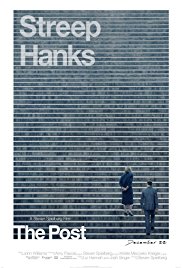
 Greetings again from the darkness. It’s the first time a movie marquee has read “Spielberg-Streep-Hanks”, so expectations are sky high – and rightly so. The result is level of cinematic preciseness we don’t often see. As an added bonus, it also features both historical and contemporary relevance – the type of relevance that forces us to consider where we stand and what type of society we prefer. So for the price of a ticket, we get Hollywood star power, a history lesson, and current societal commentary … now that’s a holiday bargain!

Meryl Streep stars as Katharine (Kay) Graham, the first female publisher of a major U.S. newspaper, and she delivers her most nuanced performance in years … that of a conflicted woman coming to grips with her immense power at a time when many men believed she lacked the capacity for making such far-reaching and weighty decisions. Tom Hanks slides into the loafers of Ben Bradlee, the hard-charging editor of Ms. Graham’s newspaper, The Washington Post. The role fits Hanks like a glove, and he even brandishes Bradlee’s trademark growling speech pattern. Bradlee is laser-focused on what he believes is the right thing to do, and steadfast in his commitment to the cause.

Of course, the dilemma faced by these two involved the Pentagon Papers scandal of 1971. The film kicks off with a quick timeline of the political maneuverings that led to, and escalated, the Vietnam War. When Daniel Ellsberg (Matthew Rhys) leaked documents from the Defense Department’s study on decision-making during the Vietnam War, and the New York Times published some of the pages, the ramifications were numerous and the fallout was ugly. The complicated web of deceit and bad decisions spanned 5 Presidential administrations (Truman, Eisenhower, Kennedy, Johnson, and Nixon). It became obvious that those in power continued a war they knew we couldn’t win. The cover-up was widespread and the string of lies were delivered by many. The government lost the people’s faith, and then tried to crush the free press that had exposed its dirty secrets.

It’s only been a couple of years since SPOTLIGHT won the Oscar for Best Picture, and now that film’s Oscar winning writer Josh Singer teams with Liz Hannah on a script that is elevated by an extraordinary cast and crew. We get the real feel of the organized chaos of a newsroom, and it’s a thing of beauty. The clacking of typewriters, exuberant phone conversations, and a cloud of cigarette smoke all blend to create the fabric of an institution designed and intended to deliver the truth. As with all things, it’s never quite so simple. We learn of the historical collusion between press and politics, as reporters and editors commingled with politicians, only to draw the line when deemed necessary. Both sides have flaws, yet as citizens, we simply can’t tolerate the government manipulating and even quashing the free press – a free press designed to protect the governed, not those that govern (per the Supreme Court decision).

Steven Spielberg has delivered a master class of ethics vs legalities vs political power, touching on not just the responsibilities of all parties, but most crucially on the conflicting objectives of a free press (making money) and the government system (getting elected) it is charged with holding accountable. Cinematographer Janusz Kaminski (two time Oscar winner, SAVING PRIVATE RYAN, SCHINDLER’S LIST) captures the authenticity of the newsroom, the intimacy of private discussions, and the fascinating look back at typesetting machines and a newspaper delivery system that silently forces us to recognize the power of today’s internet.

As you would expect, the supporting cast is remarkable and deep. Bradley Whitford, Bruce Greenwood (as Robert McNamara), Alison Brie (Kay’s daughter), Carrie Coon (reporter/editor Meg Greenfield), Sarah Paulson (as Bradlee’s wife), Jesse Plemons (attorney Roger Clark), and Michael Stuhlbarg (as NY Times publisher Abe Rosenthal) all bring realism to their roles. Two particular standouts are Tracy Letts (Ms. Coon’s real life husband) as Kay Graham’s trusted advisor Fritz Beebe, and Bob Odenkirk as The Post reporter Ben Bagdikian who meets with Ellsberg.

Gender inequality of the era is front and center for many scenes – sometimes even a bit too showy or distracting. The prime example is the scene where Ms. Graham is leaving the Supreme Court through a sea of silently admiring women – an unbelievably disproportionate crowd make-up. The gender point is made clearly through the position of Kay Graham and her actions, and no further proverbial slaps upside the head were required for the audience to “get it”. A rare Hindenburg joke is tossed in, and Bradlee is referred to as a pirate … two attempts to lighten the mood on a story that deserves serious attention. Composer John Williams’ score is never over the top, and perfectly complements the various conversations throughout. The film is quite clearly meant to impress how history repeats itself = those in power believing they are above all, while the free press tries to expose the abuses. It also makes the point that we as citizens must remain vigilant in our pursuit of the truth, as all sides have an agenda … sometimes it’s as complicated as covering up bad decisions, while other times it’s as simple as driving up the stock price. With its cliffhanger ending, Spielberg’s film could be viewed as a prequel to the fantastic 1976 film ALL THE PRESIDENT’S MEN, and that’s pretty lofty company.

watch the trailer:


ALL THE MONEY IN THE WORLD (2017)

December 23, 2017

 Greetings again from the darkness. The grandson of J Paul Getty, the wealthiest man in the world, was kidnapped while in Rome in 1973. That fascinating story holds more than enough drama for an engaging movie, and certainly did not need the notoriety or artistic challenges brought on by the Kevin Spacey scandal. With filming completed and a release date mere weeks away, director Ridley Scott made the decision to erase all evidence of Mr. Spacey’s J Paul Getty, and replace him with Oscar winner Christopher Plummer. The “do-over” is nearly seamless and it’s not a stretch to believe the second version turned out better than the first.

The precisely descriptive titled 1995 John Pearson book “Painfully Rich: The Outrageous Fortunes and Misfortunes of the Heirs of J Paul Getty” is adapted by screenwriter David Scarpa, and it’s the storytelling instincts of Mr. Ridley, and remarkable acting of Mr. Plummer and Michelle Williams that keep us engaged for the 132 minute run time.

16 year old John Paul Getty III is played by rising star Charlie Plummer (“Boardwalk Empire”, no relation to Christopher), and though this is the story of his kidnapping and violent torture, the movie mostly focuses on the contrasting personalities of his devoted mother Gail Harris (Michelle Williams) and his miserly grandfather J Paul Getty (Christopher Plummer), the wealthiest man in the world. She is a woman totally committed to her children while spurning the strings attached to family money. He, on the other hand, has devoted his life to money and winning, ignoring anything that might be construed as loyalty or compassion to family. With Mr. Plummer having just starred as Ebenezer Scrooge in THE MAN WHO INVENTED CHRISTMAS, this is just about the easiest transition an actor could hope for, given so little prep time for a new role.

The billionaire Getty refuses to pay the ransom, instead dispatching his security specialist Fletcher Chase (Mark Wahlberg) to negotiate the boy’s release. As a former CIA operative, Chase misreads both the situation with the abductors and the strength and determination of Gail. We get periodic looks at the captors and the environment where the grandson is being held. Romain Duris (THE BEAT THAT MY HEAR SKIPPED) is excellent as Cinquanta, the captor who spends the most time with the boy. The “ear” scene is explicit enough to elicit groans and shrieks from the audience, so be advised.

“We are not like you” is what the younger Getty tells us as narrator, and he’s right. The ultra-rich live in a different world than you and I (assuming you aren’t one of “them”), and that’s never more clear than when the elder Getty explains his preference for things over people. While we never empathize with the rich miser, director Scott at least helps us understand what made him tick. To him, life was a negotiation and it’s all about winning – though his definition of winning could be debated.

The two octogenarians, Mr. Scott (80) and Mr. Plummer (88) work wonders with the outstanding Ms. Williams to make this a relatable story and captivating movie. The elder Getty died in 1976, two months to the day after Howard Hughes, while the grandson Getty had a massive drug overdose in 1981, and died in poor health in 2011, leaving behind his son, actor Balthazar Getty.

watch the trailer:


MOLLY’S GAME (2017)

December 23, 2017

 Greetings again from the darkness. Aaron Sorkin’s dialogue is like a rap battle with proper grammar and no down-beat. He must have been abused by pregnant pauses and moments of silence as a kid, as his screen banter gives new meaning to ‘the fast and the furious’. This latest is his directorial debut, but his loquacious diatribes have previously tested our attention spans in such films as STEVE JOBS, MONEYBALL, and of course, THE SOCIAL NETWORK (for which he won an Oscar).

Molly Bloom’s memoir is the adapted source material, and though her story might be a bit challenging to show, there is certainly much to tell … which is right in Mr. Sorkin’s wheelhouse. The verbal sparring amongst characters rarely pauses, and when it does, we have Molly immediately jumping in as narrator and guide.  The ultra-talented Jessica Chastain (ZERO DARK THIRTY) takes on the Molly role, and narrates her back story at break-neck speed (there is a pun in there). We learn her psychologist father (Kevin Costner) pushed her hard as a kid and she became off-the-charts intelligent while also being a world-class downhill skier.

A freak accident ended her athletic career, and after deciding to delay law school, Molly found herself working for a real estate agent in Los Angeles. Soon he got her involved with hosting the high-stakes underground poker games he ran for local celebrities, and being a quick study, she was soon running and managing her own games. When Molly was forced to take her game to New York, the players transformed from movie stars and professional athletes to business magnates, hedge-fund managers and, unbeknownst to her, the Russian mob.

Don’t mistake this for a poker movie. Cards and chips are everywhere, but this is Molly’s story, and Sorkin wisely simplifies the poker details and focuses more on Molly’s brilliant strategy to build her business. Of course, there wouldn’t be much to this were it just rich people playing poker. Less than a decade in, Molly is arrested in an overblown FBI sting featuring 17 armed agents at her pre-dawn door. The charges ranged from money-laundering to hedge-fund fraud to dealings with the Russian mob.

The criminal charges lead Molly into the offices of defense attorney Charlie Jaffey (Idris Elba), who is reticent to take what appears to be an unwinnable case. The Sorkin back-and-forth kicks into full gear as Molly and Jaffey expertly verbally spar until she convinces him that she is adamant in not wanting anyone else to get hurt – even if it might save her proverbial rear-end.

Although Sorkin doesn’t name names, it takes very little research effort to determine some of the featured players in Molly’s games. Hints are provided such as “green screen”, New York Yankee player, and Oscar winner. Michael Cera is identified only as Player X, but it’s quite obvious he is playing the noted green screen actor, and he does a nice job in a small, but vital role. The rest of the cast offers up colorful work: Jeremy Strong as Molly’s first boss, a very funny Chris O’Dowd, Brian d’Arcy as “Bad Brad”, Justin Kirk as a rock star, Angela Gots as the wise table dealer, and the always great Bill Camp as Harlan, whose story highlights the true risk in this supposed game of skill. Graham Greene has a nice moment as the judge hearing Molly’s case, and it’s likely the first time he and Kevin Costner have appeared in the same film since DANCES WITH WOLVES.

At times the film and story bear a slight resemblance to THE WOLF OF WALL STREET, but mostly it’s one woman’s journey through entrepreneurship and a web of legalities. Arthur Miller’s “The Crucible” is used as a comparable for protecting one’s own name, as well as a life lesson for Jaffey’s young daughter. Writer Sorkin predictably surpasses first time director Sorkin, and never is that more obvious than a cringe-inducing father/daughter scene on a park bench near the end of the film. It’s designed to wrap up Molly’s inspiration and influence, but plays like a cheap Hollywood ploy to mop up loose ends. Molly deserved better, and fortunately most of the movie delivers.

watch the trailer:


CALL ME BY YOUR NAME (2017)

December 21, 2017

 Greetings again from the darkness. Although confusing the two is understandable, there is a difference between a story of romance and a story of love. That’s not to say that the two can’t overlap; in fact, they often do. In movies, romance is the dish most often served because it’s usually more interesting. Watching the flirtatious dance and often awkward exploratory stage of what was once called the rituals of courting offers a writer, actor and director infinitely more possibilities than what we associate with the years of deep connection labeled as love. Andre Aciman’s novel is adapted by James Ivory (of Merchant-Ivory fame, and 3 times Oscar nominated for Best Director) and the script leans heavily on romance … lustful romance, to be specific.

Director Luca Guadagnino (A BIGGER SPLASH, I AM LOVE) is an expert at making movies that engage our senses. His movies delicately tease us – they slowly absorb us into the emotions and feelings of the characters. Very few filmmakers have the skill to subtly seduce the viewer, and draw us into the story so that we are no longer merely observing. It’s nuanced story-telling at the highest level.

Elio’s (Timothee Chalamet) family spends the summer at their estate in northern Italy. You’ve likely never met a more cultured family. His father (Michael Stuhlbarg) is a renowned professor, his mother (Amira Casar) a recognized translator, and Elio himself is a musical prodigy who whiles away the days by transcribing classical music and reading every book he can get his hands on. Oh, he also flirts with the local girls because he is, after all, a 17 year old boy. His intelligence and corresponding wit is of a much older person, standing in stark contrast to his innocence and childlike maturity level with all other pieces of life’s puzzle.

Elio’s world is rocked when his father’s newest research assistant, Oliver (Armie Hammer), shows up. An “Americano” who offsets his extreme politeness with an unrefined “Later” when departing any encounter, Oliver explodes on the scene like a Greek God. He and Elio have an initial passive-aggressiveness towards each other as they test the boundaries for weakness, and more importantly, interest. Things move very slowly as the passion and curiosity brews during their bike rides, walks through the apricot orchards (forbidden fruit), swimming in every watering hole, and competitive banters on intellectual topics. There is a sensuality to most every scene, though those same scenes are filled with unspoken tension.

The sunlit beauty as each summer day passes initially masks the emotions, and the stunning setting, people, colors, and music is accentuated by the camera work of cinematographer Sayombhu Mukdeeprom. Nature is on display in its full glory; not just through trees, sunlight, and water, but in that elusive and unexplained connection between two people so strongly drawn to one another.

Director Guadagnino’s film easily slides into the romantic sub-genre of such films as BLUE IS THE WARMEST COLOR, BROKEBACK MOUNTAIN, and CAROL, and the artistic approach provides a gentleness that even the peach scene can’t undo. Michael Stuhlbarg (who seems to be everywhere these days) has an extraordinary father/son scene near the end which reminds us that each one of us has a story on how life may or may not have turned out as planned. The gut-wrenching pain with sharing that story usually means it remains untold; however, the invaluable lesson is not lost on Elio. First love and first heartbreak bring both emotional ecstasy and emotional devastation, and whether you believe the film’s statement “We have less to give each new person”, you’ll likely agree that the use of Psychedelic Furs “Love My Way” is spot on.

watch the trailer: