KEEP THE CHANGE (2018)

March 24, 2018

 Greetings again from the darkness. More attention is being paid these days to those on the spectrum, and it’s fascinating to see how the entertainment world deals with these folks. Writer/director Rachel Israel has developed her short story into her first feature length film with an unusually naturalistic approach by having numerous non-actors on the spectrum play key characters. Rather than observing from the outside, we are privileged to join in with how they handle life’s daily challenges.

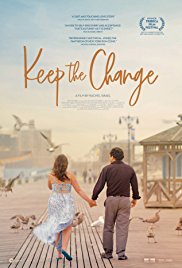
Brandon Polansky is David, a self-proclaimed filmmaker who lives with his very wealthy parents (Jessica Walter, Tibor Feldman). We first meet David as he’s being dropped off at some type of support group meeting. His attendance is court-ordered as an alternative to jail after he was arrested for telling a pig joke to a cop. It’s pretty clear to us that David doesn’t subscribe to traditionally accepted social behavior, though he aims to be a cool guy while hiding behind sunglasses that mask his insecurities. He thrives on telling jokes, although he is unable to discern what is appropriate and what isn’t, learning the hard way that rape jokes aren’t proper for a first date.

The support group meetings leave us trying to figure out exactly how these folks got here … and why. Autism and other forms of personality disorders are part of each of the members, and yet we quickly come to understand the various traits of each person. Some are shy, while others are outgoing – and each is a distinct individual. David is initially annoyed by the enthusiasm and positivity offered by Sarah (Samantha Elisofon), but the two quickly form a relationship that is probably good for both of them, though quite different than what we usually see in a Romantic Comedy.

Ms. Israel films all around NYC, and some of the street scenes are terrific with a realism we don’t often see. These are outsiders and outcasts, and we soon come to appreciate the ebbs and flows of their community. The quirks that we all have are at a heightened level here. These may include sand on our feet, or the trauma of a merry-go-round. Social anxiety abounds, and David even admits to his parents that one of the reasons he likes Sarah is that they are both “weird”.

There is a blend of sweetness, sadness, and cruelty throughout and Mr. Polansky and Ms. Elisofon are a pleasure to watch. That is the life these folks live. They may be able to tell a funny Bernie Madoff joke, while not understanding that their “perfect pitch” is anything but. We do get to hear David’s joke, and he prefaces it with “I got in trouble for this one”. Understanding leads to acceptance, and though Ms. Israel’s film tells us “sometimes change happens for the worse”, it also shows us a bit of empathy goes a long way.

watch the trailer:


FOXTROT (Israel, 2017)

March 22, 2018

 Greetings again from the darkness. The most dreaded knock on the door. Every parent or spouse of someone who has served their country during war time fully understands that indescribable feeling of opening the door and seeing uniformed soldiers waiting to deliver the worst possible news. That knock is how Israeli writer/director Samuel Maoz (LEBANON, 2009) chooses to open his film. Knowing her son Daniel is dead sends Daphna (Sarah Adler) into hysterics, and the experienced messengers know to administer something to help her relax and sleep. Her husband Michael (Lior Ashkenazi, FOOTNOTE) stands stunned, mostly unable to respond.

What follows is one of the most stunning first Act performances we’ve seen on the big screen. That is not hyperbole. Mr. Ashkenazi is remarkable over the first approximately 20 minutes as a parent in shock, experiencing devastating grief. The news is debilitating to his physical and mental being. Additionally, the filmmaking during this segment is quite something to behold. The close-ups add a heavy dose of humanity, while the terrific overhead camera angle presents Michael as trapped, while also adding to the disorientation that is so key. The one-hour alarm set to remind him to “drink some water” would be humorous if not for the fact that its structure prevents the man from totally breaking down.

The second Act takes us away from Daphna’s and Michael’s contemporary Tel Aviv apartment and plops us into a remote military outpost where 4 young soldiers are charged with guarding a road passage. Thanks to this boring assignment, the young men find ways of adding interest to their days: timing canned goods that roll down the ever-increasing slope of their sinking-in-the-muck domicile container, raising the bar for the periodic camel that lopes by, and giving the rare passers-by a bit of a hard time as their ID’s are checked. ‘Of course, this is war territory, so when something goes wrong, it goes terribly and horrifically wrong.

Our final Act takes us back to the original apartment as Michael, Daphna and their daughter are working to reconcile their feelings and somehow re-assemble the pieces of their shattered lives … though the shifts from that heartbreaking first Act are what sets the script apart from so many movies. Cinematographer Giora Bejach continues the exemplary camera work during this curious segment that leaves us feeling somewhat uncertain at first.

This family is stuck in the war that never ends. Like so many in the area, they carry burdens, guilt and grief that, like the war, also never ends. That first Act is transcendent filmmaking and acting, and the three acts work together as a prime example of the melding of visual and emotional storytelling. Most of the film takes place in one of two locales, and it’s the subtleties in each shot that tell us what we must know. And yes, the foxtrot dance does play a role, but like most of this film, it’s best discovered on your own.

watch the trailer:


FLOWER (2018)

March 22, 2018

 Greetings again from the darkness. Despite being early in her career, actress Zoey Deutch has often been the highlight of her film projects. Although that sounds like a good thing, in her case it speaks not just to her talent, but also the quality of those choices. Her father is director Howard Deutch and her mother is Lea Thompson, so her industry bloodlines run deep. Her eyes and smile are truly luminescent on the big screen, where she comes across as a natural. It’s now time for her take control of her career. Muck like this latest make us question whether she is a next level talent.

Director Max Winkler (son of Henry “The Fonz” Winkler) co-wrote the script with Matt Spicer (a terrific INGRID GOES WEST) and Alex McAuley, and they are fortunate to have such talent as Ms. Deutch, Kathryn Hahn and Adam Scott. A profane, voyeuristic exercise in disturbed behavior becomes something nearly watchable when these three and newcomer Joey Morgan are on screen.

Ms. Deutch plays Erica, a motor-mouthed (in more ways than one) force of nature teenager whose ‘BJ’s for Dad’s bail’ involves seducing older men and then extorting money from them after Erica’s posse catches them on camera. Oh, and she keeps a sketch book of her victims … no, not their faces. The fundraising approach to springing her dad from jail is difficult to accept, but Deutch sells it as best she can. Her mother (Kathryn Hahn) is desperately trying to build a relationship with Bob (Tim Heidecker), whose son Luke (Joey Morgan) is being released after a lengthy rehab stint for pills.

Luke is a hefty young man who finds solace in food and little else. He and Erica could keep multiple therapists busy for years. His problems are exacerbated by an improper school incident involving Will Gordon, a teacher played by Adam Scott. Coincidentally, this same teacher has been labeled “Old Hot Guy” by Erica and her friends at the bowling alley. Once she learns about Luke’s history with the pedophile, Erica plots an evil revenge. You can probably imagine where it goes from there.

Those same eyes and smile mentioned in my first paragraph even light up when Erica describes herself as “the d*** whisperer”. It’s this kind of moment that finds us hoping Ms. Deutch and her agent quickly learn to distinguish between edgy indie project and trashy script not likely to lead to more work. This is an uncomfortable movie to watch, but not in the way where we walk out feeling enlightened. The title does deserve applause because even the scratchiest and toughest flower has a delicate side.

watch the trailer:


THE LEISURE SEEKER (2018)

March 15, 2018

 Greetings again from the darkness. Getting older is often used as comedy fodder for entertainment purposes; however, there is fine line that can be crossed into disrespect and melancholy. Long time Italian director Paolo Virzi (HUMAN CAPITAL, 2013) delivers his first English-language film, and it’s at times quite uncomfortable to watch. Marketed as a dramatic-comedy road trip by a long married couple, the film provides a few laughs, but an overwhelming pall of sadness mostly sets the tone, while sliding right into my category of Grey Cinema.

Helen Mirren is Ella Spencer, and Donald Sutherland is her husband John. They are a happily married couple who, to the shock of their grown children and neighbor, hit the road in their 1970’s era Winnebago. Isn’t it interesting that an RV of age is considered “classic”, while old people are just referred to as “old”? John is a curmudgeonly former Professor and Helen is a gregarious, adventuresome woman who fondly recalls the many family trips in this same RV. She is clearly the one in charge, and has planned this road trip from their upscale Wellesley, Massachusetts home to Ernest Hemingway’s house in Key West.

Although John recites his favorite passages from Hemingway and Melville, he is certainly battling the effects of dementia … a battle that frequently has a negative impact on Ella’s enjoyment of their time together. While he may recall details of a long-ago student, he often forgets the names of his own kids – or even his wife! While John’s mental state is causing emotional pain for Ella, it’s her own untreated cancer that is driving her body to fail her. They are each slipping away in different ways, though their paths lead to the same destination.

Based on the novel from Michael Zadoorian, four different writers worked on the screenplay, and that is likely the cause of the distorted tone and approach. It’s quite difficult to be funny when the moments are so poignant and sad. There is even a political undercurrent which is teased, but carries no heft or substance. Taking place during the most recent Presidential campaign, Trump rallies are used as punchlines, and a Hillary rally is inferred. Neither have any impact, though a sequence involving a roadside robbery ends with (unintended?) support of carrying a gun, even if it was an odd attempt at humor.

Janel Moloney and Christian McKay are little more than caricatures as the grown kids, while we do get to see Dick Gregory’s final on screen appearance (he passed away last year).  Carole King and Janis Joplin songs are put to obvious use, and there aren’t enough “Happy Swirls” in the world to overcome the inherent fear that most aging folks have towards a failing body or mind … and this film shows both sides, while attempting to inject humor on that one last road trip that most of us dread.

watch the trailer:


7 DAYS IN ENTEBBE (2018)

March 15, 2018

 Greetings again from the darkness. Freedom fighters or terrorists? Which label gets applied is often dependent upon one’s point of view. In 1976 an Air France flight from Tel Aviv to Paris via Athens was hijacked. Director Jose Padilha (“Narcos”, ROBOCOP, 2014) brings us the big screen version of Gregory Burke’s (’71) screenplay.

The 7 day ordeal bounces between the captors and hostages at the abandoned terminal in Uganda and the political maneuverings of the Israeli government officials as they deliberate whether to break with policy and negotiate with terrorists. There are also flashbacks to the planning stages with the hijackers, in an attempt to help us understand their perspective.

Daniel Bruhl plays Wilifried Bose and Rosamund Pike plays Brigitte Kuhlmann. These are the two main hijackers who get most of our attention. Mr. Bruhl seems destined to always play the ultra-serious character, and Ms. Pike is once again miscast … something that happens whenever she is cast. Although she seems to throw down her best Patty Hearst look, we never really buy these two as committed to the cause, which prevents the necessary build-up of suspense.

The film’s biggest flaw is not capitalizing on the opportunity afforded by Nonso Anozie’s Idi Amin Dada, and even more disappointing is the abbreviated scenes between Shimon Peres (Eddie Marsan) and Yizhak Rabin (Lior Ashkenazi, FOXTROT). The two actors excel in their head-to-head confrontations, but we feel cheated every time it cuts away.

Once a strategy is formed, we are introduced to the Special Ops team (IDF). They only have a day or two to train and rehearse, and one of the key players is Ben Schnetzer (THE BOOK THIEF, 2013). He and his girlfriend quarrel over his duty, which keeps him away from her dancing performance with Batsheva Dance Company.  As Operation Thunderbolt proceeds, the crosscuts between Special Ops training and the dance rehearsals are setting the stage for the film’s climax.

So the hijackers never really generate the feeling of danger, the government deliberations are cut short, and the filmmaker takes a huge creative risk by synchronizing the final rescue mission with the opening night dance performance. The film is negatively impacted by poor pacing, an overall lack of tension for such a terrifying historical event, and questionable, albeit creative, story-telling structure. It does serve the purpose of educating those unfamiliar with the story, and it’s a reminder that even 4 decades later, the Israeli – Palestinian hostilities continue. As a special note of interest, the only Special Ops member killed in the raid was Yoni Netanyahu, the brother of the current Prime Minister of Israel.

watch the trailer:


JOURNEY’S END (2018)

March 15, 2018

 Greetings again from the darkness. R.C. Sheriff wrote this 1928 play based on his experience as a British Army officer in WWI. The play’s successful two year run led to a 1930 big screen adaptation directed by James Whale and starring Colin Clive – two legends of cinema who also collaborated on FRANKENSTEIN and BRIDE OF FRANKENSTEIN. Now, exactly 100 years after “the Spring Offensive”, director Saul Dibb (THE DUCHESS, 2008) delivers screenwriter Simon Reade’s version of Sheriff’s story and a tribute to those who served in the Great War.

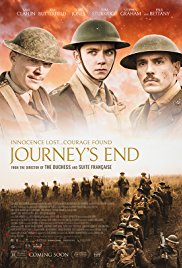
It’s the Spring of 1918 and a stalemate in the trenches of Northern France has occurred during the fourth year of the war. Fresh from training, a baby-faced Lieutenant named Raleigh (Asa Butterfield, HUGO) is assigned to a front line unit whose commanding officer is his former school mate, Captain Stanhope (Sam Claffin, THE HUNGER GAMES: MOCKINGJAY). The others in the unit include Trotter (Stephen Graham), who eats and talks incessantly to mask his anxiety; Hibbert (Tom Sturridge), who suffers from shell-shock; Mason (Toby Jones), the cook who brings subtle comedy relief: and Osborne (Paul Bettany), the heart and soul of the team.

Slowly cracking under the untenable pressure is Captain Stanhope. His coping method involves a problem with whiskey which drives his raging temper. That temper masks a not-so-obvious commitment to his men … men who walk on eggshells around him. Most of the movie takes place in the dugout over 6 days, and though the soldiers spend much time in a holding pattern, the battle sequences involve an ill-planned surprise attack on a nearby German hold, and of course, the famous battle that kicks off the Spring Offensive – a 3 month run that cost the lives of more than 700,000 from both sides.

With military orders such as “hold them off for as long as you can”, this is no romanticizing of war. Bravery and courage in the face of likely death are balanced with overwhelming human emotions. Confusion and disorientation abound as bombs explode in an environment that offers no place to hide or escape. The war ended later that year on November 11, and trench warfare would never again be the predominant strategy.

watch the trailer:


GRINGO (2018)

March 8, 2018

 Greetings again from the darkness. In a perfect cinematic world, great acting elevates a terrific script. However, the best case scenario for a weak script, or in this case a messy one, is that it can be offset by acting. Fortunately for director Nash Edgerton (it’s been 10 years since his underappreciated THE SQUARE), he has assembled such a quality cast that what amounts to little more than organized chaos is mostly watchable – even if it’s not consistently entertaining.

The cast is loaded with international talent from Australia, England, South Africa and Latin America. David Oyelowo, far removed from his Martin Luther King role in SELMA, stars as Harold/Harry, a Nigerian immigrant just trying to do his job and live his life according the morals and work ethic instilled by his father. Harold is the trusting type who believes that his free-spending wife is faithful and that his boss is his friend. That boss is Richard Rusk (we should call him Dick) played by Joel Edgerton (the director’s brother), and together with Charlize Theron as his Executive VP Elaine, combine to exemplify modern day douche-baggery.

The story revolves around the formula for a medicinal marijuana pill that their company is making, and the secretive proposed merger being ironed out. To clean up the books for the audit, Richard and Elaine travel to Mexico to convince their supplier to stop the illicit sales to a local drug lord. They bring the unaware Harold along for his contacts. The turmoil that follows includes a faked kidnapping and staged ransom phone call, two local hotelier brothers scheming for a big take, an American tourist couple with conflicting reasons for their trip, DEA involvement, a grown-up tantrum, an un-retired mercenary on a mission, and an ongoing argument over the best Beatles’ album. And you wonder why I described it as messy?

Of course, rarely if ever does staging one’s own kidnapping go well, so we know Oyelowo’s Harold is in for a rough and tumble ride. Multiple car chases turn into multiple car crashes, guns are fired, tequila is consumed, and backs are stabbed – in the proverbial sense. Oyelowo seems to be enjoying his trip outside of movie drama, and Edgerton and Theron do their best to create savage jerks. Sadly, Ms. Theron’s character sets the women’s movement back a few years with her sexual boardroom viper approach. On top of that are the stream of fat and ethnic jokes that would make Archie Bunker cringe.

Co-writers Matthew Stone (muck like BIG TROUBLE, MAN OF THE HOUSE) and Anthony Tambakis (the compelling WARRIOR) are responsible for delivering a script that tries so hard to be too many things: action, comedy, satire, white collar crime, and an expose of greed and lack of integrity. The deep cast also includes Thandie Newton (as Harold’s wife), Melonie Diaz (as Rusk’s receptionist), Amanda Seyfried as the aptly named Sunny and Harry Treadaway as her misguided boyfriend, Diego Catano and Rodrigo Corea as the brothers running the motel, Yul Vasquez as Angel, Alan Ruck as the schmuck who falls for Elaine’s wiles, Carlos Corona as the drug lord Black Panther (talk about bad timing!), Michael’s daughter Paris Jackson in her film debut, and a standout as always, Sharlto Copley as the brother-mercenary-humanitarian. As is often said, it’s better to be good at one thing, and though this one brings a few laughs and some creative moments, it’s mostly an overblown mess that aims to high – or at too many targets.


THOROUGHBREDS (2018)

March 8, 2018

 Greetings again from the darkness. Each year provides us with (at least) a few hidden gems sprinkled amongst the superheroes and newfangled special effects displays, and although this feature film debut from filmmaker Cory Finley is only now hitting theatres, it seems safe to say it likely won’t draw the size audience it deserves. If you enjoy dark, twisted, and devilishly clever films, you owe it to yourself to track down this one.

Olivia Cooke (ME AND EARLY AND THE DYING GIRL) stars as Amanda, someone who walks a miniscule line between neurotic and psychopath. The startling and quite ominous opening features Amanda, a horse, and a large knife. Next, and some time later, we see Amanda re-connecting with her childhood friend and boarding school brainiac Lily (Anya Taylor-Joy, SPLIT and THE WITCH) in what appears to be a tutoring session being held in the palatial estate where Lily lives with her mother and “evil” stepdad Mark (Paul Sparks).

What follows is the mind-bending, winding-road of us attempting to fit either or both of these characters into some “normal” category of human behavior. Instead, what lies beneath is slowly unsheathed. As Amanda and Lily interact, we especially come to realize that Amanda is drawing out what’s behind the proper front that Lily wears on a daily basis. A plot to murder the stepdad is developed, and caught in the wicked web is Anton Yelchin as Tim, a dreamer and schemer who quickly realizes the trouble these two bring. This was one of the last roles Yelchin filmed before his tragic death. His brief time on screen here reminds us of his immense talent.

An atmosphere of dread and pending doom hovers over most every scene, yet somehow it’s simultaneously funny and disturbing. We find ourselves asking if it’s OK to laugh at some of the exchanges. As Amanda explains she’s “not a bad person”, the line makes us chuckle, while also making us realize she actually believes it and we shouldn’t! As she teaches her tutor Lily “the technique”, we become convinced the line has been crossed into psychopathy.

Suburban Connecticut and its corresponding privileged life has rarely generated more queasy feelings, and with our hope for humanity in the balance, we watch Amanda and Lily bounce from plotting to problem solving and from conspiring to collaborating. The absence of empathy goes beyond disconcerting and into a feeling of resolved fear. The lack of emotions and empathy can be more frightening than vampires or fictional monsters.

Cinematographer Lyle Vincent does nice work displaying this world, and he will always deserve a mention after his sterling work on 2014’s A GIRL WALKS HOME ALONE AT NIGHT. The dark, twisted work is well accompanied by the abrupt and jarring music, and filmmaker Finley deserves recognition for crafting this creepy corner of a universe none of us want to join. His film is in the vein of something Yorgos Lanthimos (THE LOBSTER) might deliver, and that’s quite high praise for oddity … in fact, Odin Impetus Lowe even gets a screen credit, and he’s the opening scene horse!


LOS ANGELES OVERNIGHT (2018)

March 8, 2018

 Greetings again from the darkness. Low budget independents must be analyzed differently than a tentpole or a status-pic with money behind it. That’s only fair, and in fact, quite necessary for cinematic sanity. This first feature film from director Michael Chrisoulakis is one that we might catch at a film festival, and at first glance, it appears he has done everything right. The film has a blend of familiar faces and newcomers. Much effort has gone into the stylish look of the film, and there is even unconventional music accompanying the oddball characters.

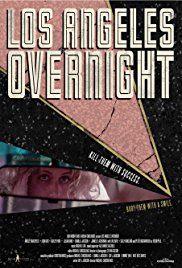
Sometimes taking all the right steps still doesn’t mean the finished product will click with audiences, and that appears to be the case here. Priscilla (Arielle Brachfeld) is being treated by her hypnotherapist played by legendary director Peter Bogdanovich in a terrific opening that grabs our attention immediately. Priscilla is a struggling/aspiring actress who is also a Marilyn Monroe waitress at a crummy little diner.

Benny (Azim Rizk) is one of the diners few customers, and his motivation is less about food and more about Priscilla. One day she overhears a couple of small time crooks (led by Lin Shaye) chatting in riddles – “Apple Jacks down the rabbit hole”. Financially strapped Priscilla proceeds to draw lovestruck mechanic Benny into a situation that will likely end badly.

Writer Guy J Jackson (who also plays one of the criminals) seems to try and shove all of his ideas into the script, so what’s lacking is a cohesive story or any chance for viewers to connect to Priscilla – or certainly any other character.  We can’t even take the “big” crime boss seriously since his goal is to build some type of sanctuary that will benefit humanity. Benny does have the best line in the film when he admits, “I dance like a mechanic”. Other comedic bits mostly fall flat (although a tip of the cap for the mortgage broker joke), as do most of the attempts at building suspense, due in part to an excess of groan-inducing dialogue.

The film is a noir-wannabe with some effort given towards the atmosphere and tone, but the overwrought electronic score is too generic, and the arbitrary slow-motion effects simply remind us of the lack of budget (better to take advantage of imagination). One of the worst cinematic on-foot chase scenes takes up a chunk of the film, but on the bright side, we do get the rarely seen Sally Kirkland, and it is fun to pick out the director’s influences based on how a scene plays out. The jury is still out on Ms. Brachfeld. She might be worth keeping an eye on, as she has a Miranda July quality about her, though without the comedic instincts. First films are challenging, and there might be enough here to push Mr. Chrisoulakis on to better projects.


LOVELESS (2018)

March 1, 2018

 Greetings again from the darkness. Divorce is rarely simple or clean or amicable. By definition it changes people’s lives and is typically cluttered by a wide range of emotions that distort one’s thoughts. When kids are involved, the process is even more delicate, even treacherous. Russian filmmaker Andrey Zyyaginstev and his co-writer Oleg Negin follow up their exceptional Oscar nominated LEVIATHAN (2014) with this very intimate project focusing on the tragic impact of resentment and self-centeredness. They have been rewarded with another Best Foreign Language Film Oscar nomination, and deservedly so.

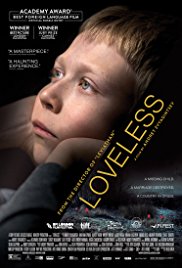
The film begins with stark, almost harsh music as a young boy walks home in the woods after a day of school. Later that evening, his parents are involved in an extremely vicious and demeaning argument. The camera then glimpses the boy from the woods, their son Alyosha (Matvey Novikov), behind a door. He has overheard the entire argument and is devastated, quietly sobbing and unable to deal with words no child should hear. As viewers, we too are overwhelmed.

Zhenya (Maryana Spivak) and Boris (Aleksey Rozin) are the boy’s parents, and to say they dislike each other is an understatement. She is a salon owner and he is a generic “salesman” at a Christian company that doesn’t allow divorced employees. She is focused on her phone and new lover, while he is worried about losing his job while his girlfriend (Marina Vasileva) is pregnant. They are fighting over who should raise their son. Neither want him.

With each of these despicable people going about their business, neither notice that the boy doesn’t come home one night. A teacher calls to say he has missed two days of school. It’s at this point where the tone shifts from poor parenting to lackluster police work. In what could be described as the polar opposite of an ‘Amber Alert’, the Russian police rule it a runaway, and in ho-hum manner suggest that the parents give him a few days to return home. This lackadaisical approach lead Zhenya and Boris to turn to an organization that specializes in locating lost kids.

The coordinated search creates a quiet tension that is quite effective. Cinematographer Mikhail Krichman’s camera work is extraordinary as it tracks the searches through the forest and an abandoned building that could be a character unto itself. The parents head to the home of Zhenya’s estranged mother. What follows is one of the most explosive movie scenes of recent years. Natalya Potapoya plays the mother and delivers a memorable no-holds-barred diatribe at her daughter Zhenya, who refuses to fight back. We easily understand how a disconnect between parents and kids can gain traction across generations.

The brilliance of the movie is in how we somehow maintain empathy for all of these less-than-ideal people. When Zhenya calmly pronounces that her mother is “God and the Devil rolled into one”, we understand her point while at the same time hope it stimulates self-analysis.

Although we do get a rare Jill Stein reference, it’s quite easy to spot the differences between story-telling in Russia and the United States. It wouldn’t be surprising to see a Hollywood remake, but it would likely tread a bit lighter on the dwelling of past mistakes without losing one’s humanity, and it would surely come up with a more Americanized ending. The detail in Zyyaginstev’s filmmaking is exceptional, and while it may not be entertainment for the masses, the film is a prime example of cinema as emotionally powerful art.

watch the trailer: