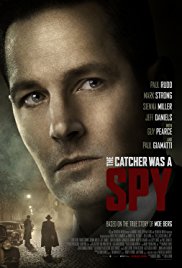
THE CATCHER WAS A SPY (2018)

June 22, 2018

 Greetings again from the darkness. World War II. Baseball. Spies. A true story. Assemble all those pieces and you have Morris “Moe” Berg. Director Ben Lewin (THE SESSIONS, 2012) brings the fascinating story to the big screen with Robert Rodat’s (Oscar nominated for SAVING PRIVATE RYAN) screenplay adapted from the 1994 biography “The Catcher was a Spy: The Mysterious Life of Moe Berg” written by Nicholas Dawidoff. This is neither your typical spy movie nor your typical baseball movie.

Background information is provided by pre-movie title cards: in 1938 German scientists split the atom for the first time, ushering in the nuclear age; renowned German physicist Werner Heisenberg (1932 Nobel Prize winner) was charged with building an atom bomb; the United States responded by sending a baseball player to assassinate him. It’s 1944 Zurich and two men exchange uncomfortable glances across a dimly lit room.

We then flashback 8 years to see Moe Berg utilizing his gut instincts to survive as a veteran journeyman catcher for the Boston Red Sox at Fenway Park. We later learn his sixth sense is not limited to the baseball diamond, and is used in situations much more important than whether a baserunner is stealing a base. Growing up Jewish, Berg had always been somewhat of an outsider, admitting, “I don’t fit in.” In baseball, they called him a walking enigma. Educated at Princeton, Columbia and Sorbonne in Paris, Berg spoke several languages, had a ‘fake’ wife, was a regular on quiz shows, and was constantly followed by insinuations of homosexuality … though he only admitted to being good at keeping secrets.

Berg’s is a truly fascinating story, but unfortunately Paul Rudd is a bit overmatched in the lead role. He just doesn’t quite have the dramatic acting chops to convey the intellectual depth of the man. However, the rest of the cast is stellar: Paul Giamatti (as Samuel Goudsmit), Connie Nielsen, Mark Strong (Heisenberg), Sienna Miller, Hiroyuki Sanada, Guy Pearce, Jeff Daniels (as William J Donovan), Tom Wilkinson (as Paul Scherrer), Giancarlo Giannini (a 50+ year career), and Shea Whigham (as Joe Cronin). Many of these are little more than cameos, and the choppy feel of the film’s flow prevents us from ever really connecting to characters.

An extended battle scene volleys from intense and well-filmed to slightly comical as Mr. Giamatti is forced to run and dodge bullets. The look, tone and color palette of the film is quite similar to Spielberg’s BRIDGE OF SPIES (another true story), though this current one pales in comparison, as director Lewin presents it as a “will he won’t he kill the guy?” scenario. Berg’s story is likely more suited to documentary treatment, as his time with the U.S. Office of Strategic Services (OSS, later the CIA), resulted in his being awarded the Medal of Freedom. Upon his death in 1972, Newsweek’s headline read “3rd String Catcher, 1st String Spy”.

watch the trailer:


THE PASSION OF JOAN OF ARC (1928) revisited

June 20, 2018

Oak Cliff Film Festival 2018


 Greetings again from the darkness. It’s a rare treat to watch a 90 year old silent movie. Especially in a remastered format. Especially on the big screen. Especially at a historic theatre. Especially with a nearly packed house. And especially with a live score! The 7th annual Oak Cliff Film Festival, held at the Texas Theatre (opened 1931), afforded just such a treat with its Friday evening screening.

Most know the story of Joan of Arc (Jeanne d’Arc), a teenage heroine of France for her role in the Hundred Year War. She claimed that she received spiritual and religious guidance through voices and visions. Once she was captured by English allies, she was charged with heresy and burned at the stake in Rouen in 1431. A quarter century later, the Pope declared her a martyr and she became a symbol of France – canonized as a saint in 1920. Of course, here the story is as much about the film as it is the martyr and historical figure.

The eyes are what first grab our attention. The eyes of actress Maria Falconetti as Joan of Arc. It was Falconetti’s only screen appearance, and though she spent the rest of her career on stage, this role cemented her place in cinematic history. Without the benefit of sound and voice, the silent era performer had to emote through eyes, facial expression and body movement. Few ever did it better than Falconetti. It’s gut-wrenching to watch the church counsel attempt to break her resolve. Our minds hear the intensity of their voices though we only read the subtitles.

Renowned Danish filmmaker Carl Theodor Dreyer directs the script from writer Joseph Delteil (taken mostly from the transcripts of the trial), and the cinematography is through the eye of 5 time Oscar nominee Rudolph Mate’ (FOREIGN CORRESPONDENT, PRIDE OF THE YANKEES). It’s impossible not to notice a style so different from modern day filmmaking. The harsh lighting and almost exclusive use of close-ups and medium shots bring an immediacy of which we aren’t accustomed. The single piece set is quite unusual and provides a stage aura. Another thing that stands out is the editing style. Continuity of scene wasn’t important here. What mattered was the sense of frantic pacing and over-bearing stress brought on by the rapid-fire questioning. We share the claustrophobic feeling with Joan, though of course, we know where this is all headed.

As part of this special showing, the Oak Cliff Film Festival arranged for a live score performed by composer George Sarah, a 4 piece chamber orchestra, and a vocal group accompanying the music.

Perhaps this meant even more to me since I visited Rouen last year, and the lasting legacy (almost 600 years) of this courageous young woman is evident throughout much of France. The re-mastered film is stunning to look at, and even more historically important knowing that the film had long thought to be lost to a fire. The story and the film are quite something to experience.

watch the trailer:


HOTEL ARTEMIS (2018)

June 8, 2018

 Greetings again from the darkness. The feature film directorial debut of Drew Pearce is original and clever, while teasing with hope for a bit more than it delivers. Mr. Pearce is best known for writing the screenplay for IRON MAN 3, and now as a first time director, he shows enough promise to leave us interested in what comes next.

The film is set in dystopian Los Angeles a mere 10 years in the future. The streets are flooded with desperate rioters after a mega-corporation shuts off the clean water supply. The company is the film’s real villain, and the only one that The Nurse (Jodie Foster) can’t treat. See, she runs Hotel Artemis, an underground hospital for top tier criminals – the element that can’t just pop into the local community clinic for treatment on the latest bullet hole or knife wound. These patients follow a subscription plan and must stay current on their dues to gain admission.

The Nurse forgoes any attempt at personal vanity and is instead an agoraphobic, booze-chugging, (mostly) stick-to-the-rules type, who pops in anti-anxiety tapes and ear buds whenever her pulse quickens. She has run the place since it opened 22 years prior and is assisted by a mountain of man named Everest (get it?) played well by Dave Bautista. He’s a combination bodyguard, bouncer, handyman and assistant healthcare professional (check his badge).

The set design by Ramsey Avery deserves special mention as the Hotel Artemis is quietly housed in the shell of a former grand art deco hotel, now a victim to the city’s carnage – though the neon sign remains illuminated. Its vacation spot-themed rooms are a sight to behold, despite the frustratingly low lighting. Occupants are incognito and use their room names as identifiers. Sterling K Brown is Waikiki, a philosophical bank robber who dragged his brother Honolulu (Brian Tyree Henry) here for treatment after a heist went wrong. Acapulco (the always energetic Charlie Day) is a crass, motor-mouthed arms dealer, while Nice (Sofia Boutella, THE MUMMY) is a freakishly skilled assassin.

The stress level picks up when the biggest crime lord of Los Angeles shows up seriously wounded. Known as The Wolf King, an admittedly bad choice for a nickname, Jeff Goldblum brings some smooth-talking toughness, humor and twisted class to the proceedings. More than a few tentacles are attached to The Wolf King and other folks we’ve previously met, not the least of which is a very special ink pen stolen by Honolulu. Mix in an injured cop (Jenny Slate) with a personal link to The Nurse and her constantly alluded to tragic backstory, and the movie puts off a Graphic novel vibe … missing only the off-the-cuff insanity. It’s just a bit too grounded for its own good.

The high tech/low rent feel forces us to recall BLADE RUNNER and ESCAPE FROM NEW YORK, but of course, this film isn’t at the level of either, as it lacks top tier suspense. It is a terrific reminder of what a talented actress two-time Oscar winner Jodie Foster is, and what a shame that we haven’t seen her in such a substantial screen role since 2013’s ELYSIUM. She really sinks her teeth into this odd character, and more than the action scenes, she keeps us interested the entire run time. The score is a bit too heavy on the droning electronic bass line, and while the Florida joke and nod to John Phillips (The Wolf King, “California Dreamin’”) earns some bonus points, it’s really the performance of Ms. Foster and the set design that saves a too-safe script.

watch the trailer:


ADRIFT (2018)

May 31, 2018

 Greetings again from the darkness. Ever since the “Master of Suspense” Alfred Hitchcock captured the intensity of being stranded at sea in LIFEBOAT (1944), there have been numerous films, with varying levels of success, taking advantage of this fear shared by many folks: ALL IS LOST (2013), LIFE OF PI (2012), OPEN WATER (2003), THE PERFECT STORM (2000), DEAD CALM (1989), and THE POSEIDON ADVENTURE (1972). While some of these feature elements of true events, it’s this latest film, adapted from Tami Oldham’s memoir “Red Sky in Mourning: The True Story of Love, Loss, and Survival at Sea”, that tells the remarkable true story of Tami and her boyfriend Richard.

Icelandic director Baltasar Kormakur has had a hit and miss career (EVEREST, 2 GUNS, CONTRABAND, THE SEA), and this one mostly works on many levels: romance, adventure, suspense, natural catastrophe, and survival. Beyond that, it’s fantastic to look at thanks to the work of Cinematographer Robert Richardson (9 time Oscar nominee, 3 time winner: HUGO, THE AVIATOR, JFK).

Even though Tami’s remarkable saga occurred in 1983, it took all these years for the film to get made – further proof that it’s a new day in Hollywood!  The story of a woman isolated in nature, fighting the odds to live another day would have (and this one often has) previously been back-burnered or shifted to have yet another manly man in the lead. Not this time. Shailene Woodley plays Tami and it’s her most physical role to date.

The opening scene shows Tami waking up on the damaged boat in the aftermath of Hurricane Raymond. It then flashes back 5 months to her arrival in Tahiti and her initial introduction to Richard (Sam Claflin), a charming solo sailor who is nearly, but not quite, her equal in free-spiritedness. The 3 co-writers, twin brothers Aaron and Jordan Kandell (MOANA) and David Branson Smith (INGRID GOES WEST) wisely opt against a first half romance followed by second half survival tale. Instead, the bits and pieces are doled out in segments that allow us to connect with the soul-bonding without losing the intensity of the stranded at sea tale. It’s a delicate balancing act that works thanks to the performance of Woodley and the camera of Richardson.

For many of us, the concept of sailing from Tahiti to San Diego with someone we’ve known for a few months would be a bit overwhelming. But these two lovebird and adventurous spirits head off thinking of it as fun and an opportunity to fund even more fun. It’s a story of the power of love and the strength of survival instincts. Rarely (OK, never) have a sextant, Skippy Peanut Butter and Tom Waits music combined for such vital roles in a movie, and it’s nice to see Ms. Woodley gain a Producer’s credit since she was a driving force in getting the film made.

The 41 day ordeal is told from Tami’s view (it is, after all, based on her book), and the strength of this 23 year old gets the treatment it deserves with some absolutely terrific sequences filmed at sea. Though Tami doesn’t battle sharks or have Wilson the volleyball to keep her company, her coping mechanism is even more mind-bending. It may not be the light-hearted summer fare we are accustomed to, but it’s one worth watching.

watch the trailer:


FIRST REFORMED (2018)

May 31, 2018

 Greetings again from the darkness. “A crisis of faith” is merely the tip of the theological iceberg in this gripping, thought-provoking, debate-inspiring oddity from legendary filmmaker Paul Schrader. Mr. Schrader has long specialized in messed up/conflicted gents struggling in a world-gone-wrong in films like HARDCORE (1979), AMERICAN GIGOLO (1980), AFFLICTION (1997), and AUTO FOCUS (2002). Of course he is best known for his TAXI DRIVER (1976) and RAGING BULL (1980) screenplays. This latest is his best work in years, though few will likely describe it as entertaining.

Ethan Hawke digs deep in his performance as Toller, a former military Chaplain now relegated to caretaker for a small church whose historical marker informs us was organized in 1767 and built in 1802. Although Toller has a very small congregation, the church itself is now mostly a tourist stop and throwback to the days of rural community churches.

Thanks to Toller reading us his daily journal entries, we know that he is already dealing with doubt and grief even before Mary (whose name is no coincidence) approaches him about speaking with her husband Michael (Philip Ettinger). Toller’s teetering emotional stability is further jolted by a mesmerizing talk with Michael, whose work as an environmental activist/extremist leaves him unable to reconcile bringing a child into this doomed world … despite his wife Mary (an excellent Amanda Seyfried) being pregnant. (Though no further proof is needed that I should never offer counseling to confused folks, I couldn’t help but wonder why Toller didn’t challenge Michael on why he risks having sex if he is so adamant against making a baby.)

With Michael’s global and societal warnings piling on Toller’s personal tragedy and disintegrated marriage, he sinks deeper into his funk and deeper into the bottle. There is also the pressure of the upcoming 250 year reconsecration ceremony and the expectations of Abundant Life’s Pastor Jeffers (Cedric the Entertainer in perfect casting). Abundant Life stands in for all of the mega-churches that specialize in money grabbing these days (more business than religion). Here, big money is represented by billionaire industrialist Edward Balq (played by a less than patient Michael Gaston). He is truly the higher power in this relationship.

Toller explains to us that we hold both hope and despair in our thoughts, and that these are life itself. He has an intensity towards life and his role in the church that would make most uncomfortable, if not a bit frightened of and for him. And those concerns would be quite accurate. Some people are just never comfortable in their own skin, and these are often the most intriguing movie characters. Schrader and Hawke ensure that Toller is every bit of that and more. It’s a bleak story with some dark and twisted humor, and it’s shot in old style ratio which adds an element of harshness to every moment. Austere might be the best one word description of the look captured by Schrader, but the story is sure to generate some colorful and intense post-viewing debate … with an open for interpretation ending being the cherry on top. Welcome back Mr. Schrader and kudos to Mr. Hawke.

watch the trailer:


HOW TO TALK TO GIRLS AT PARTIES (2017)

May 31, 2018

 Greetings again from the darkness. Filmmaker John Cameron Mitchell exploded onto the scene in 2001 with his instant cult favorite HEDWIG AND THE ANGRY INCH, and in 2010 he delivered the expertly crafted and somber marital drama RABBIT HOLE. In his first feature film since the latter, Mitchell revisits the punk world in what has been described as Romeo and Juliet with punks and aliens.

Mitchell and co-writer Philippa Goslett adapted the screenplay from a short story by Neil Gaiman (“American Gods”). It’s set in 1977 Croydon (outside London) and though music plays a vital role, it’s not really a musical. And even with some funny moments, it’s not really a comedy. And while there are aliens, one wouldn’t label this as science fiction. There is a budding romance at the core, and maybe the romance description fits best … although, any unwitting group of film goers heading to the theatre expecting a typical romantic drama will likely walk out in the first 15 minutes.

Zan (Elle Fanning) and Enn (Alex Sharp) are star-crossed (or is it intergalactic-crossed?) lovers – she being an alien, he a young punk rocker. This is less about two worlds colliding than two worlds exploring each other: the freedom of punk vs the conformity of the alien colony. We cross paths with the local Queen of punk known as Boadicea (one of the most extreme Nicole Kidman roles of her career), the alien Stella (Ruth Wilson), and Enn’s punk mates Vic (Abraham Lewis) and John (Ethan Lawrence).

Far and away the most interesting puzzle piece here is the connection between Enn and Zan. Mr. Sharp (a Bob Geldof lookalike) and Ms. Fanning are terrific together and the film suffers when they aren’t on screen. Their live duet onstage is a true highlight and her wide-eyed curiosity combined with his zany punk persona provide most of the film’s energy.

“Punk … the best thing to happen to ugly people” is likely the best line in the film, although Zan requesting “Do some more punk to me” isn’t far behind. There are messages here about parenting, diversity and globalization, but mostly it’s a creative and wild ride that’s not likely to please everyone … especially those looking for a Nicholas Sparks romance or anyone who might take the title literally.

The film is scheduled to show at the Texas Theatre in Dallas beginning June 1, 2018.

watch the trailer:


A KID LIKE JAKE (2018)

May 31, 2018

 Greetings again from the darkness. Hot societal topics often become fodder for new movies, and this usually results in a slew of similar stories – some good, others not so good. Currently, discussions of gender identity is second only to Trump-bashing in terms of media attention, and so we can expect Hollywood to rush-to-production in order to capitalize. This latest from director Silas Howard had a timing advantage as it was adapted by writer Daniel Pearle from his own play.

The titular Jake is a 4 year old (his 5th birthday party plays a role) who enjoys fairy tales and dressing like a princess. His stay-at-home mom (Claire Danes as Alex Wheeler) and psychologist father (Jim Parsons as Greg Wheeler) are aware of Jake’s preferences, but as with most things in their marriage, what minimal conversation occurs is of the over-the-top arguing type. The “issue” is painfully and awkwardly brought to the forefront as the parenting couple subject themselves to the Private Pre-School application process.

The challenges of parenthood, including judgmental friends and relatives, and the competitive nature of comparisons, are beyond obvious in most every scene of Act 1. Even Alex’s (probably not coincidental that her name is gender-neutral) mother (Ann Dowd) is passive-aggressive in her judgments of Alex quitting her job as a lawyer to stay home with her son. Octavia Spencer co-stars as Jake’s teacher and counselor to the Wheelers during the application process, and even her role has a twist designed to elicit more judgment and discrimination.

There is really nothing convincing throughout the film. It’s barely Lifetime Channel material, with a simplified emphasis on the difficulties of raising a non-conforming child. The incessant arguing amongst parents, family members, and friends makes each successive scene more annoying than the previous. The film should have been entitled “Parents Like Jake’s” because Jake has almost no screen time, while Ms. Danes flashes her “Carrie cry-face” (for “Homeland” fans) incessantly.

Certainly the topic of gender identity and non-conformity is worthy of discussion and analysis, as it has entered mainstream conscience in less than one generation. Anxiety and confusion exists, and even well-meaning conversation can take a wrong turn quickly. We just need – and deserve – better guidance than this film provides.

watch the trailer:


SUMMER 1993 (2017, Spain)

May 31, 2018

 Greetings again from the darkness. In Sean Baker’s 2017 surprise indie hit THE FLORIDA PROJECT, we viewed a challenging family environment through the ever-optimistic eyes of a young girl intent on making the best of every day. On the opposite end of the spectrum is this autobiographical tale from writer/director Carla Simon in her first feature film. Co-written with Valentina Viso, this story is about one young girl’s struggle with grief and a cold-water splash into a new family.

Six year old Frida is left orphaned when her mother dies. She eavesdrops through half-closed doors as adults make arrangements for who will take care of her. Uncle Esteve (David Verdaguer) and Aunt Marga (Bruna Cusi) agree to raise her, requiring the young girl to relocate from Barcelona to a remote Catalonia village bordering a forest. It’s an idyllic setting for most young kids, however, paradise doesn’t exist for a young girl who has lost both parents.

Initially it seems to be simply ‘kids being kids’. As more oddities occur while Frida plays with her 3 year old cousin Anna, we begin to believe that Frida’s rebellious acts may actually be that of a disturbed young child incapable of dealing with nearly unbearable sorrow. Clearly Aunt Marga runs a more disciplined household than Frida’s (apparently) eccentric mother, though it’s quite obvious to any parent that Frida is vying for attention – literally competing with the younger Anna for the love of parents. It’s heartbreaking to watch.

We view most everything from the viewpoint and perspective of the kids. Even the camera angles are often eye-level for a 6 year old. This is a terrific approach by filmmaker Simon since Child Psychology is at the core of the story. As adults, we look to teach and protect, while sometimes overlooking the undeveloped emotional maturity in youngsters.

There is brilliance in the story-telling process here as adult viewers (it’s certainly not a movie for kids) will catch the hints and partial details that Frida can’t possibly process. The disease that killed her mother, though never stated, becomes clear. That cause also leads to unexpected reactions to Frida by others. The lack of sentimentality or over-dramatization is delivered through lazy summer days that lull us into complacency before awakening us to what could be. Two amazing child actresses, Laia Artigas (Frida) and Paula Robles (Anna) keep us captivated as director Simon unfolds her life onscreen.

watch the trailer:


ON CHESIL BEACH (2018)

May 30, 2018

 Greetings again from the darkness. This is one of those movies that has the look and feel that leaves me believing I should like it more than I do. Ian McEwan (the excellent ATONEMENT) adapted the screenplay from his own novel, and it’s by no means a cookie-cutter story. The feature film debut of director Dominic Cooke features one of today’s most talented leading ladies, a strong supporting cast, and some stunning outdoor scenery from a very beautiful part of the globe.

The story kicks off in 1962 England with a setting that could easily be a one-Act stage play. We are in a hotel room immediately after the ceremony of a newlywed couple. Awkward movements and forced conversation are interrupted by a formal dinner being served in the room by two waiters. The expected post-dinner gawkiness leads to a bedroom scene ravaged by emotional trauma that goes far beyond inexperience. It’s disastrous and leads to full disclosure along the shoreline of Chesil Beach, Dorsit.

Saoirse Ronan stars as Florence and Billy Howle is Edward. Through flashbacks we witness both their budding romance as eager youngsters, as well as pervious childhood moments that now seem to matter. We learn Florence is Mozart, while Edward is Chuck Berry. Maybe opposites do attract, however, the class differences become more obvious as we meet the respective parents. Florence’s mom (Emily Watson) and dad (Samuel West) are upper crust types who don’t take kindly to her infatuation with one not of their ilk. Edward’s dad (Adrian Scarborough) is a school teacher and his mother (a marvelous Anne-Marie Duff) is an eccentric artist, “brain-damaged” in a freak train accident.

Florence and Edward are victims of their time … a time of sexual repression, where such conversations simply did not occur. It’s not so much a story of rejection as it is of being not accepted, though it’s clear how childhood led each down their path. Had the film remained focused on this fascinating story line, it likely would have been better received by this particular viewer. Instead, we are subjected to an ending that crashes and burns as it attempts to provide resolution for characters that should have none. A flash forward to communal living in 1975 and a 2007 farewell concert at the beautiful and historic Wigmore Hall (opened in 1901), are little more than a show of disrespect to those viewers who invested in the unfortunate tale of Florence and Edward.

watch the trailer:


DARK CRIMES (2018)

May 30, 2018

 Greetings again from the darkness. A neo-noir “inspired by actual events” and based on a compelling 2008 “New Yorker” article by the great David Grann (THE LOST CITY OF Z) seems to have the necessary components for a satisfying thriller. So what went wrong? Unfortunately, a messy script from Jeremy Brock (THE LAST KING OF SCOTLAND) prevents this one from ever having a chance at grabbing our attention, much less holding it.

This is the first English language film from director Alexandros Avranas (MISS VIOLENCE, 2013) and his cast is led by Jim Carrey as police inspector Tadek, a disgraced cop who takes care of his elderly mother while also obsessing over the now coldcase that ruined his career. Carrey sports a Polish accent through “most” of his performance … a performance that is mostly subdued, especially given his career. Joining him as co-leads in the cast are two other excellent actors: Martin Csokas and Charlotte Gainsbourg. Csokas plays Kozlow, the main antagonist and suspect – an author with clues to the key murder highlighted in his novel. Ms. Gainsbourg is underutilized as Kasia, the former sex worker, now intimate acquaintance of Kozlow. She is the key to solving the case.

Grann’s article entitled “True Crimes: A Postmodern Murder Mystery” told the story of novelist/convicted murderer Krystian Bala. It’s an article worth reading and one that bears only passing resemblance to this screen adaptation. The film is purposefully drab, bleak, dark, grey and dour, with a stark, cold look to the characters and most every scene. Tadek is a man on a mission to save his reputation, even at the expense of his family life, or really any life at all. The game of cat and mouse between Tadek and Kozlow never reaches the level of tension that the film seems to think it does … even in the one-on-one interrogation scene or the seemingly endless blabbering of the recordings Tadek listens to.

There is a terrific international cast of supporting actors including iVlad Ivanov, Robert Wieckiewicz, Piotr Glowacki and Agata Kulesza, but the cast is only able to do so much with the material. Perhaps the draw is supposed to be Jim Carrey is the darkest role of his career. On the bright side, the story is neatly wrapped up at the end thanks to one character who deserves a “win”.

watch the trailer: