ANOMALISA (animated, 2015)

January 1, 2016

anomalisa Greetings again from the darkness. Seeing Charlie Kaufman’s work described as “strange”, “weird” or “bizarre” makes me cringe a little because most of his films hit my sweet spot of curiosity, insight and expression. I easily relate to his creative vision and commentary in films like Being John Malkovich, Adaptation, Eternal Sunshine of the Spotless Mind, and Synecdoche, New York. His characters are always searching for something and trying to discern the meaning of life … or at least of their own life. This latest has Kaufman adapting his own stage production, and collaborating with co-director Duke Johnson for what is likely (for the vast majority of us) our most startling existential stop-action animated puppet cinematic experience.

The unusual opening of the film is a black screen with only background noise and voices, and the first chuckle occurred within about a minute thanks to one of my favorite cultural references of the year: “Kojak, not Kolchak”. Slowly the screen evolves to show clouds in the sky, and soon an airplane appears and our first peek at Michael occurs … he’s a passenger on a flight. The vast majority of the rest of the film takes place inside the Fregoli Hotel – aptly named because Michael seems to suffer from a twist on Fregoli Delusion (a person believes those around him are all the same person in disguise).

We soon notice that Michael appears beaten down, even exasperated with life. He is an author in town to give a presentation on his specialty … Customer Service. The story continues along familiar lines of a business traveler in the midst of a mid-life crisis, until things change for him when he stumbles on a couple of his fans who are in town for his presentation. One of them is Lisa, whom Michael is attracted to thanks to her innocent energy and wonderful voice. What makes her voice so wonderful? Well, it turns out that Michael is voiced by British actor David Thewlis, Lisa is voiced by Jennifer Jason Leigh, and EVERY other character in the film (male or female) is voiced by Tom Noonan. Lisa and her voice are the anomaly that makes up the film’s title … Michael is smitten with her because her voice is not like all the others – providing a spark of hope.

Mr. Kaufman seems intent on making us realize how easily we can slip into a rut and simply go through the motions in life … every day and every person being pretty much like the rest. Michael has learned to wear his Customer Service mask – one who pretends to care about the issues of others. It’s a terrific metaphor for someone refusing to face the responsibility for their own happiness. His awakening occurs at the hands (and in bed) with Lisa. Yes, you should be prepared for the uncommon and slightly unsettling site of Puppet Private Parts. The clumsy passion of the first encounter between Michael and Lisa does wonders for each of them … restoring her self-esteem and awakening him from his daily slumber of hopelessness.

While the story itself is quite simple, the use of puppets prevents us from getting overly personal or judgmental with the characters, and forces us to deal with the emotional and mental aspects of what keeps so many from leading happy lives. Lisa’s acapella version of “Girls Just Want to Have Fun” ignites the fuse in Michael, and just like that, both he and Lisa are jolted from their own self-imposed limitations. No longer able to just go through the motions, Michael’s overreactions at breakfast and during his presentation are all part of his re-awakening … the most profound puppet awakening since Pinocchio. Perhaps Mr. Kaufman thought we might be more receptive to his message and observations if delivered by a non-threatening puppet, and perhaps he’s correct. The message is delivered loudly and clearly … though I will probably hear Tom Noonan’s voice in my nightmares. The look of the movie and the puppets is fantastic, and Carter Burwell provides yet another spot-on score.

watch the trailer:


OTHER PEOPLE’S CHILDREN (2015)

January 1, 2016

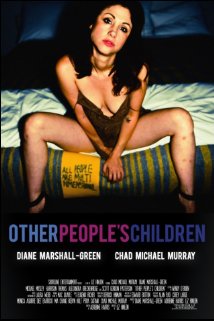
other peoples children Greetings again from the darkness. Every new independent film offers the hope of discovering an exciting new writer, director or actor … someone who will bring a new edge to the world of filmmaking. Of course, not every new film is ground-breaking, and sometimes we have to be pretty observant to spot a glimmer of shiny new gold.

The feature film debut from director Liz Hinlein proves she and her cinematographer Edward Button each have the eye of a photographer, as the beauty of many of the shots provide the feel of a better movie than what we are watching.

Diane Marshall-Green stars as Sam, a wannabe filmmaker whose life is in a downward spiral with no direction following the death of her famous painter father Frank Trassler (Scott Patterson, who baseball fans will remember as McGrevey in Little Big League). A happenstance coffee shop meet provides Sam with a subject for her new documentary … a homeless young man named P.K. (Chad Michael Murray). Sam takes to photographing and interviewing P.K. and his fellow young homeless group. In the blink of an eye, her loft apartment is transformed into a crash pad for all homeless peeps that cross paths with P.K. and his band of misfits.

Sam and P.K. quickly fall into a relationship, and … well … basically the whole thing is simply too neat and tidy to buy into. There is nothing realistic or gritty or believable about these homeless folks. They all look like Hollywood actors with great hair and make-up … only dressed down with tattered clothes. To his credit, Chad Michael Murray appears to have lost a significant amount of weight to pull off the drug addict physique (well except for the sculpted abs and biceps), it’s just unfortunate that he’s too darned attractive to pull off the living-on-the-streets kid. Diane Marshall-Green has a delightful onscreen persona (and she is very pleasant to look at), it’s just that she doesn’t yet have the acting chops to elevate the material and unrealistic setting.

The best supporting work comes courtesy of Harrison Thomas (“Banshee”) as Eddie and Alyssa Diaz (“Ray Donovan”) as Trina. Once again, they are both entirely too attractive and polished for their life on the street, however, they do bring an element of intrigue to their limited roles. In fact, there is hardly a grungy moment in the film (other than beer bottles strewn about the apartment), which doesn’t really work … even for the homeless in always sunny Los Angeles. We know suffering is a daily challenge for the homeless, and a movie about them shouldn’t gloss over this.

So while the film probably won’t shake up the movie industry or shatter box office records, there are a few nuggets here that provide some hope for future projects. Notably director Liz Hinlein, and actors Diane Marshall-Green, Harrison Thomas and Alyssa Diaz are a few to keep an eye on.

watch the trailer:


THE REVENANT (2015)

December 28, 2015

the revenant Greetings again from the darkness. “Keep breathing.” A flashback in the opening sequence has Hugh Glass whispering the phrase as advice to his young son Hawk, the product of Glass and his beloved Pawnee bride. The phrase has a recurring role throughout the film … possibly serving as a courtesy reminder from director Alejandro Gonzalez Inarritu to the moviegoers mesmerized (and nearly traumatized) by the incredible brutality of what is on screen.

It’s a master class in filmmaking by those at the top of their game. Inarritu is the reigning Oscar winning director for Birdman or (The Unexpected Virtue of Ignorance), and he has re-teamed with the reigning Oscar winning cinematographer from that movie, Emmanuel Lubezki. Two of the finest actors of their generation, Leonardo DiCaprio and Tom Hardy, strip away any semblance of pampered movie stardom to deliver ultra-realistic performances in a story “based in part” on the true to life novel by Michael Punke.

An early action sequence is startling in its ferocity as Arikara surround and attack a group of hunters and trappers, and the whoosh of arrows – many of which find their mark – abruptly drag us into a world that we are unfamiliar with and certainly unprepared for. It’s early 19th century U.S. frontier, and just about everyone and everything can kill you.  Providing just enough time for us to pry our fingers off the armrests, Inarritu stuns us with what is undoubtedly the most fantastic grizzly bear attack on a movie star ever filmed. In what appears to be a single take (which also happens to be the number of breaths I took), Mama Grizzly treats Leonardo the way a young puppy treats its first chew toy.  Scratched, chewed, tossed and stomped.  This scene is savage and brutal, and sets the stage for the true, yet still unbelievable odyssey of survival by frontiersman Hugh Glass.

Tom Hardy excels as the calmly psychotic villain Fitzgerald, though some of his early hillbilly-tinged dialogue is difficult to catch. His hulking presence fits with our imagined look of the frontiersman of the era … tough and unforgiving nearly beyond belief. His bullying of youngster Jim Bridger (played by Will Poulter) and power struggles with Captain Henry (Domhnall Gleeson) are at frightening levels of intensity. Fans of Tarantino’s Inglourious Basterds will smile as they recognize the name of mountain man Jim Bridger … though that’s one of the few smiles offered by this 156 minute gut-wrenching ordeal. It would not be surprising if DiCaprio’s mantel sports an Oscar in a few months. He is that superb in a role that has nothing to do with good looks or charm.

A tale of survival. A quest for revenge.  It’s both of those, as well as a reminder that nature can be both beautiful and brutal. Some of the photography is almost poetic, and often reminds of the work of director Terrence Malick.  And in the blink of an eye, that moment is shattered by the torrential force of river rapids carrying Glass over the waterfall, or his taking a horseback ride off a steep cliff (one of the most dramatic shots of the film). The journey of Glass is unknown in distance or time in the movie, but there is no question as to the numerous struggles with the elements and the raw physicality required to persevere. If you can avoid diverting your eyes, there are visuals here that will be sincerely appreciated – even as you squirm, cringe and moan throughout.

From a technical standpoint, the film was shot on location in Canada and Argentina using only natural lighting, and emphasizing aspects of nature that often are overlooked. The sound of arrows, bears, and even DiCaprio’s breathing are profound and crucial to the overall effect, as are the animal skin garments and other costumes. It’s impossible to tell where CGI meets reality, but the visceral experience will be quite unique for most viewers … and not soon forgotten.

watch the trailer:


THE HATEFUL EIGHT (2015)

December 27, 2015

hateful 8 Greetings again from the darkness. If one is to believe Quentin Tarantino, the leaked script scandal nearly turned this into a novel, rather than what it clearly needed to be … a Quentin Tarantino movie (his 8th).  It could even be considered a companion piece to Django Unchained (though this takes place in snowy Wyoming, as opposed to the balmy Deep South). It’s set soon after the Civil War and there still exists a palpable uneasiness between Confederate and Union types, creating a constantly teetering milieu between violence and progress.

Tarantino’s obsession with classic film led him to utilize the same Ultra Panavision 70 lenses used for Ben-Hur (1959), which required the retrofitting of 50 theaters across the country for the “road show”. This presentation includes an opening musical Overture, a midpoint Intermission, approximately 6 minutes of footage that highlight this rarely used format … stunning snow-filled vistas and wide shots of the frontier, and zero previews for upcoming releases.  When the film opens nationwide, the digital version will be straight-forward (though still nearly 3 hours in run time). The “road show” features are bonuses for us film geeks, and will have no impact on whether one enjoys the film or not.

Rather than follow in John Ford’s majestic Western footsteps, QT has the vast majority of the story take place within a one-room set called Minnie’s Haberdashery. Thanks to a record blizzard, the general store/saloon turns into a human snake pit filled with nefarious types who are quick with a quip and a trigger. The diabolical assemblage is made up of John “The Hangman” Ruth (Kurt Russell, featuring world class whiskers), a bounty hunter who is handcuffed to his latest prize Daisy Domergue (Jennifer Jason Leigh); another bounty hunter (Union) Major Marquis Warren (Samuel L Jackson); British fancy boy Oswaldo Mobray (Tim Roth) who says he’s the hangman for Red Rock; the self-professed new Sheriff of Red Rock Chris Mannix (Walton Goggins); General Sandy Smithers (Bruce Dern), a former Confederate officer; quiet cowpoke Joe Gage (Michael Madsen); and Senor Bob (Demian Bichir), whom Minnie left tending the store in her absence.

Now as you might expect, some of the above descriptions may be true, while others could be considered “conveniences”. What you also might expect is a steady rain of Tarantino dialogue delivered by the perfectly chosen cast. Each of these players grasps the cadence required to make this work … they have the rhythm of a stage play – a new direction that Tarantino has hinted at. And have no fear, over-the-top violence fills the second half of the story as the confined space and contradictory missions begin to clash.

No more need be said about the characters or the story. Russell, Jackson, Goggins and Ms. Leigh are especially effective at enlivening their scenes, and they are joined by supporting actors such as Dave Parks (son of the great Michael Parks), Gene Jones (who didn’t wish to call the coin flip in No Country for Old Men), Dana Gourrier (as Minnie), QT favorite Zoe Bell (as Six-horse Judy), and even Channing Tatum.

Legendary composer Ennio Morricone delivers his first western score in about 40 years, which is important since he’s the man behind the iconic music of Sergio Leone’s spaghetti westerns. On the topic of music, Morricone’s score is complimented by only a smattering of other songs (including a Roy Orbison gem and a solo from Jennifer Jason Leigh), which is unusual in the Tarantino canon. Three-time Oscar winner Robert Richardson re-teams with Tarantino and seems to have a blast with the challenges presented by the one-room set … he plays with focus and depth to create some fantastic shots. It should also be noted that the Sound is spectacular – everything from gunshots, to swirling wind, to boots and spurs, to galloping stage coach horses, and even the pouring out of coffee.

All of the above results in a stunning movie experience with the anticipated QT humor, violence, and anti-racism sentiment (though the N-word usage is once again tough to take) … yet somehow the final product doesn’t equal the individual moments of genius. It comes across as a blend of Agatha Christie, (Tarantino’s own) Reservoir Dogs, and John Carpenter’s The Thing minus the cohesiveness required for a great movie. So enjoy the characters, the technical achievements, and the terrific dialogue, but know that it’s unlikely to be one of those that cause you to stop down while surfing cable channels in a couple years.

watch the trailer:


CAROL (2015)

December 26, 2015

carol Greetings again from the darkness. When Patricia Highsmith first wrote her novel “The Price of Salt”, she had it published in 1952 under a pseudonym (Claire Morgan). This was a sign of the unforgiving social conventions of the era, which also play a key role in the story. At the time, no author would publically admit to writing a book about lesbian lovers, much less admit their participation in such an affair. Highsmith’s novel is the source material for director Todd Haynes’ bookend to his stellar 2002 film Far From Heaven. In that film, Dennis Quaid’s character struggles with his secret life as a gay man while married to Julianne Moore. In this new movie, Cate Blanchett is a married upper class socialite trying to deal with her true feelings for the opposite sex, while fighting to not lose custody of her young daughter.

Haynes has a real feel for attraction … what causes two people to be attracted to each other, and how do they handle it? He re-teams with cinematographer Ed Lachman to create yet another beautiful film with camera work, sets, costumes and a score (Carter Burwell) that complement the romance depicted by the two outstanding lead actresses: Cate Blanchett (Carol) and Rooney Mara (Therese). Ms. Blanchett is a 2-time Oscar winner (5 time nominee), and has become one of the few actors who make each of their films a must-see. She is a true force here as she sweeps into the captivating first sequence (a wonderful long take) and has her first interaction with wide-eyed shopgirl Therese as the two dance together through words and innuendo. It may be the best scene of the movie … at least up to the stunning final shot.

At its core, this is a pretty simple romance of two opposite worlds colliding at a time when their attraction was just not tolerated. 1950’s social conventions, being what they were, meant Carol’s husband (Kyle Chandler) could use her sexual preferences as evidence of immorality in his fight to gain sole custody of their daughter. Cinematically, it’s much more about style. Carol is a beautiful mink-wearing work of art, while Therese is seeking her place in the world, while trying to make sense of her feelings. Every scene drips with style … the cars, the clothes, the restaurants; even cigarettes become a fashion accessory between the fingers of Carol.

Carol and Therese take a road trip, and it’s not until Iowa that the relationship is consummated – a scene that finds neither actress shying away from the moment. Fittingly, this occurs in a motel located in Waterloo … leaving little doubt the turn this story will take.

Supporting work is provided by Sarah Paulson (“American Horror Story”) as Carol’s friend and ex-lover, Jake Lacey (“The Office”) as Therese’s would-be suitor, John Magaro (The Big Short) as her friend and supporter, and Cory Michael Smith (“Gotham”) as a double-life salesman. But this show belongs to Blanchett and Mara. They are terrific together – capturing the unspoken, subtle gestures required by the repressive era they find themselves.  Mara’s character is difficult to describe, but most intriguing to watch and absolutely vital to the message.

Phyllis Nagy adapted Ms. Highsmith’s novel (which was re-published in 1990 under her own name), and her care for the material is clear. Todd Haynes then worked his magic with the look of the film, and the two lead actresses deliver a clinic in nuance and dealing with oppression. As it plays, the strength of the film is with the internal struggles faced by the two lead characters. It leaves us to wonder if the film might have been more powerful had it delved a bit deeper into what the characters would have faced from the outside world.

watch the trailer:


JOY (2015)

December 26, 2015

joy Greetings again from the darkness. The movie is inspired by the true story of entrepreneur Joy Mangano (listed here as an Executive Producer) and her 1990 invention of the Miracle Mop. You should know that neither “Mangano” nor “Miracle Mop” is mentioned, and much of the story sprung from the mind of writer/director David O Russell. Also, if you have been a fan of Mr. Russell’s past few Oscar nominated films (American Hustle, Silver Linings Playbook, The Fighter), you should be warned that even though there is a large cast of familiar supporting players, it doesn’t play like his usual ensemble piece, but rather as a true star vehicle for Jennifer Lawrence (who plays Joy).

This is a working class Italian-American family, and the multi-generational aspect is in full play as Joy (a single, working mom) and her two kids share the house with Mimi (Joy’s grandmother played by Diane Ladd), Joy’s mom (Virginia Madsen) who is a recluse dressed in 60’s party attire and addicted to daytime soap operas, and Joy’s dad (Robert DeNiro) and her ex-husband Tony (Edgar Ramirez) who share the basement. Tony is the rare combination of slacker-Tom Jones impersonator. Also involved are Joy’s agitating and envious step-sister Peggy (Elizabeth Rohm) and Dad’s new wealthy girlfriend Trudy (Isabella Rossellini). This family makes The Royal Tenenbaums look suburban stale.

Flashbacks and dreams, along with the supportive words of Mimi, convince us that Joy is a creative genius, whose once promising abilities have been stifled by the harsh realities of raising kids, and overseeing a bunch of free-loaders who mostly never miss a chance to steal a bit of Joy’s light. All of that changes one day thanks to glass shards in her palm and the close proximity of crayons and drawing paper. Poof! Just like that, Joy has invented a revolutionary new kind of mop.

Given her family history and current situation, even when things go right for Joy, they never go all the way right. Having to borrow money from Trudy and depend on those who may or may not have her best interest at heart, makes for an endless chain of obstacles and challenges. But Joy is all about perseverance and self-actualization. The story emphasizes Joy’s stick-to-it-ness, and the process of learning about the legalities and pitfalls of starting and running one’s own business. Even those who should be supportive often ridicule and voice their doubts.

The film shifts when Joy meets Neal Walker (Bradley Cooper) who runs QVC. This was the time period when TV home shopping was in its infancy. Joan Rivers (played here by her daughter Melissa) was one of the early stars, and Joy’s Miracle Mop was one of the early successes. It’s a new world to Joy, but she’s a quick study and her tough-mindedness and sense of fairness and right come in to play on multiple occasions.

The above is much more story than I would typically describe, but it helps make the point that although Jennifer Lawrence continues to prove she is something quite special as an actress, the story is a bit of a mess and the pacing of the film is clumsy – slapstick blended with ultra-serious. It’s impossible to connect with this oddball group of folks, who mostly seem to be pulled right off of various TV sitcoms. Even using the soap opera (complete with Susan Lucci, Donna Mills, and Laura Wright) as a parallel to Joy’s life never quite works.

Jennifer Lawrence’s performance deserves to be ranked right with Joan Crawford’s in Mildred Pierce, but the different styles of the two movies results in only one being unforgettable. Director Russell mines the fractured family/group in many of his projects, and given his immense talent, we can be sure future projects will be more in line with the level of his recent past.

watch the trailer:


THE BIG SHORT (2015)

December 24, 2015

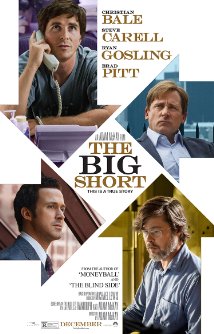
big short Greetings again from the darkness. Since there are so few subjects more hilarious than the 2008 financial crisis, let’s get the writer/director of Anchorman and Step Brothers to adapt the Michael Lewis best-selling book. OK, so it’s improbable that was the thought process, but kudos to whomever was responsible for bringing Adam McKay to the project. Before you go assuming it’s a poor fit, it should be noted that McKay is also one of the creative minds behind “Funny or Die”, a site filled with political and social satire. It’s that satirical approach that makes this explanation of what went wrong so accessible to the masses. Make no mistake … this is entertaining and educational and thought-provoking and nauseating and infuriating and funny and disheartening.

If the film were described as a tutorial on MBS (Mortgage-backed Securities), CDO (Collateralized Debt Obligations), Credit Default Swaps, Tranches, Bond Ratings, and Sub-Prime ARMs, most people’s eyes would glaze over and they would keep skimming for showtimes of other new movie releases. In truth, it is those things – and so much more. This is the story of how the housing market collapsed leading the government to the massive bailout that saved some of our largest financial institutions … and how a small group of people recognized what was happening and literally bet against the U.S. economy. It follows the bread crumbs to re-assemble the slow process of spotting the fault in the analysis that lead to massive corruption that finally crossed over into systematic fraud … and does so by using creative presentation approaches like a Bond Rating game of Jenga, and celebrity snippets for definitions and examples.

Ryan Gosling stars as Jared Vennett (based on Greg Lippmann), a slick Deutsche Bank trader who acts as our guide through the muck of shorting securitized mortgages, while simultaneously working the system for his personal benefit. He works with Mark Baum (a character based on Steve Eisman, played by Steve Carell) who manages FrontPoint Partners, and Baum’s team played by Rafe Spall, Hamish Linklater and Jeremy Strong (whom you might remember as Lee Harvey Oswald in Parkland). While this is going on, there are two other similar story lines we are following. The first is Christian Bale playing hedge fund manager and savant analyst Dr. Michael Burry at Scion Hedge Fund. Burry is often cited as the first to recognize the impending collapse and invest against the market. Finally, we have the “garage band” investment company based on Cornwall Capital run by (names changed) Jamie Shipley (Finn Wittrock) and Charlie Gellar (John Magaro) with a big boost from former trader Ben Rickert (played by Brad Pitt in a role based on Ben Hockett). The stellar cast is rounded out by Marisa Tomei as Baum’s concerned wife, Tracy Letts as the head of Scion, Max Greenfield and Billy Magnussen who play cocky and clueless subprime mortgage brokers, and Melissa Leo who plays a Standard & Poor’s employee.

It’s difficult to tell this story without casting blame, and few escape the wrath of Lewis, McKay and co-writer Charles Randolph. Those absorbing shots to the bow include: the Federal Reserve, the SEC, Rating Agencies, big Banks and Investment firms, Fund Managers, Traders, Realtors, and Mortgage Brokers. Companies specifically named include JP Morgan Chase, Bank of America, Deutsche Bank, Barclays, Merrill Lynch, Goldman Sachs, WAMU, Option One, Lehman Brothers, Bear Stearns, and The Wall Street Journal. The point made is that the problem goes/went beyond greed, and is/was truly system-wide, with each segment protecting themselves and their turf. Somehow the name Barney Frank is not mentioned, and FNMA and FHLMC escape mostly unscathed, while CRA lending requirements are not discussed.  It’s not politically correct (and not mentioned here) to question why so many borrowers who couldn’t pay their rent regularly accepted loans that they knowingly couldn’t afford to repay. But that’s a topic for another time.

With full disclosure, I will admit to having been in the mortgage business for 18 years. Though I was never involved with subprime loans, I will always disagree with the stance that the industry and institutions were not aware of the risk and impending collapse. It was common knowledge that “no doc” loans were absurd, and the adjustable rate schedules and prepayment penalties for subprime (and some conventional) loans were beyond impractical and more like homicidal (from a lending perspective). In the film, Baum interviews an exotic dancer who owns multiple homes … all loans made with minimal documentation due to the cash basis of her business. The terms of the loans set her, and other similar borrowers, up for financial ruin … right along with the housing sector and economy. The subprime mortgage brokers portrayed by Max Greenfield and Billy Magnussen may seem cartoonish, but Baum’s confusion with their “confession” versus “bragging” is spot on. There were many just like these two clowns who considered themselves “rock stars”, when in fact, there were really “bartenders who now own a boat”.  These weren’t the type to question whether the loans made sense … only how many could they close to pad their 5 and 6 figure per month income levels.  Of course, in defense of these morons, it was the banks and lenders who designed the loan programs to “feed the machine” with more and by necessity, higher risk loans … to the point where it was no longer possible to spread the risk wide enough for protection. Hence, the collapse.

By the end of the movie, you should expect to have a headache and feel quite cynical towards the system. Despite the humor interjected by quick-hit segments from Margot Robbie, Selena Gomez and Anthony Bourdoin, the seriousness of the topics is more than bubble baths, blackjack and fish stew. The film leaves us angry and nauseous from what happened in 2008, but more importantly questioning … Has anything changed? Have we learned anything? These answers are likely to cause a more sickening reaction than looking back seven years.

A recommended Economic Movie Marathon would include: Inside Job (2010 documentary from Charles Ferguson), Margin Call (2011, JC Chandor), The Big Short (2015, Adam McKay), and 99 Homes (2015, Ramin Bahrani)

watch the trailer:


CREED (2015)

December 23, 2015

creed Greetings again from the darkness. Tis the season for the revival of two extremely successful and popular film franchises, each nearly 40 years old.  Both stay true to their roots. For Star Wars that means big budget and ground-breaking special effects, while for Rocky, that means a personal mission and Sly. Writer/director Ryan Coogler and his Fruitvale Station (2013) star Michael B Jordan unite with the Italian Stallion himself, Sylvester Stallone, to add another chapter to a story we all thought concluded with Rocky Balboa (2006).

Thirteen year old Adonis Johnson is an angry boy who doesn’t shy away from fights. While being held in a juvenile detention center, he is visited by a woman named Mary Ann (Phylicia Rashad); she adopts him and fills in the gaps of his family tree. Adonis is the illegitimate son fathered by Apollo Creed, the champion boxer who died during Rocky IV. Mary Ann is Apollo’s widow and she plops Adonis into her world of affluence, and sets him up for a career in finance. Of course, thanks to YouTube, Adonis studies his dad’s old fights and promptly sneaks off to Tijuana to test out his own boxing skills.

It’s a foregone conclusion that Adonis will persuade his father’s old adversary/friend to train and mentor him, and just like that, the owner of Adrian’s Restaurant slips into a similar role made famous by Burgess Meredith. That’s right; Rocky Balboa becomes the Mickey to Adonis … right down to the (slower) chickens. Sure, it’s a bit formulaic, but that’s the idea behind a franchise. We have a history with Rocky, and know that he is basically a sweet guy who thrives on competition. Here, he has to tame a wild, self-trained young boxer who is connected to him through history.

The film does so many things right that it’s easy to forgive the missteps. Adonis’ love interest is a young singer named Bianca (Tessa Thompson), who easily could have had a more substantive role in the story – in fact, it’s a bit disappointing when she disappears for long segments. Also, there is a medical/health sub-plot that comes across a bit contrived and serves only the purpose of putting Stallone’s role on more equal footing with Jordan’s. Minor qualms, but annoyances just the same.

What the film does right is create a terrific synergy between Rocky and Adonis. It’s a bond both men need, though for different reasons. Stallone is so good as the aging Rocky that it’s reason to forgive and forget his many cinematic foibles over the years. Also, the boxing cinematography from Maryse Alberti (The Wrestler, 2008) is stunning … especially her extended long take in the ring during Adonis’ first professional fight. For the final fight, Adonis dons a special pair of trunks and takes on the nasty, thunderous punches of “Pretty” Ricky Conlan (played by boxer Tony “Bomber” Bellew), providing some of the most realistic cinematic boxing scenes (right there with Southpaw from earlier this year).

It’s a relief that Mr. Coogler and his co-writer Aaron Covington avoided the expected cheesiness, and instead focused on the intimate personal stories while also paying tribute to the legacy of the franchise … Bill Conlon’s original score is heard at least once, the Philadelphia MOA steps have their moment, as does the Rocky statue that draws fans and selfies. Heck, there is even a disclosure of who won the Rocky III fight between Rocky and Apollo. It’s that kind of nostalgia that complements this modern story and contemporary character.

watch the trailer:


45 YEARS (2015)

December 22, 2015

45 years Greetings again from the darkness. Relationships are messy and complicated. Even the best ones. Even those that last 45 years. Writer/director Andrew Haigh (Weekend, 2011) understands this and delivers a film not about older people, but instead about the secrets, the doubts and the regrets experienced by anyone and everyone who is part of a committed relationship. His message is delivered through the extraordinary performances of Tom Courteney and especially Charlotte Rampling.

Just four days prior to a planned party to celebrate their 45th wedding anniversary, the stillness and quiet of Geoff’s and Kate’s long-established familiarity is disrupted by the startling news that his girlfriend of 50 years ago has been discovered preserved in a Swiss glacier.  What could have been a simple blip on the radar turns out to be a slow revelation of true emotions that have clouded this marriage. Kate’s realization that her seemingly fine life is now undeniably tainted is gut-wrenching to behold.

Ms. Rampling’s performance is subtle and brilliant. The camera captures the whirlwind of emotions through her facial expressions and telling body language. She carries herself with grace and dignity, even as she emotes devastation. A scruffy Mr. Courteney seems oblivious to how deeply his reaction has wounded his wife, even as he dives more and more into the past … a journal, a slideshow, smoking cigarettes, a trip to the travel agency.

Haigh’s script and direction are such that the intimacy and personal pain is evident even in scenes that feature only one of the two leads. The lack of raised voices or outbursts belies the pain felt by both Geoff and Kate, and the pain is never more evident than when we finally reach the anniversary party. As Geoff delivers a rambling speech about the ups and downs of marriage, the camera equally captures the face of Kate as she expertly dons the façade required in public for those who are lost emotionally. The couple then dances to The Platters’ “Smoke Gets in Your Eyes” and Kate’s faces hides little of her internal turmoil. Haigh ends with one of the most soul-crushing final shots one could ever expect to see. It’s the perfect ending to a dose of reality most of us hope to never experience.

watch the trailer:


LIFE (2015)

December 22, 2015

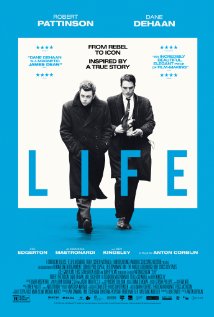
life Greetings again from the darkness. The film’s title has multiple meanings: “LifeMagazine as the source for the famous photographs we have seen so many times; the crossroads in “Life” of both rising star James Dean and photographer Dennis Stock; and a philosophical look at “Life” – how quickly things can change, and how we should appreciate the moments.

Director Anton Corbijn (A Most Wanted Man, The American) and screenwriter Luke Davies offer up a snapshot of 1955 as the not-quite-yet-famous James Dean (Dane DeHaan) traveled cross-country with photographer Dennis Stock (Robert Pattinson) from Los Angeles to New York to Indiana. Each man was searching for their true self as Stock’s professional ambition and personal stress are palpable, while 24 year old Dean’s ambivalence about his pending superstardom borders on self-destructive.

DeHaan and Pattinson both underplay their roles, and it’s certainly more than a little confusing to see Pattinson in a movie about James Dean where he is not the actor playing the icon. DeHaan captures the low key, soft-spoken side of Dean but only teases at the “rebel” studio head Jack Warner (Sir Ben Kingsley) wanted so badly to control. We get a feel for Dean’s vision of challenging roles in quality productions … a commitment to the art of acting he no doubt sharpened in his time with acting guru Lee Strasberg. The story leans more heavily to the tale of photographer Stock, which is unfortunate, because he is significantly more awkward than interesting. Pattinson plays him as a social misfit who broods nearly as much as the “moody” young actor he is stalking through the streets.

The period look is well appointed, and we are privy to some of the moments of Dean’s life just prior to the release of East of Eden and his being cast in Rebel Without a Cause. His relationship with Pier Angelli (Alessandra Mastronardi), friendship with Eartha Kitt (Kelly McCreary), and his bond to the family and farm of his childhood in Indiana are all captured. In fact, it’s the clumsy relationship with Stock that comes across as the least realistic portion … though it may very well have happened this way. Even the manner in which the famous photographs were taken is underplayed … although it makes for a terrific tie-in with the closing credits where the real Stock/Life Magazine photographs are displayed.

It’s now been 60 years that James Dean has exemplified Hollywood “cool”, a label that can never be removed due to his tragic death in 1955 after making only three films. Capturing the essence of what made Dean cool is unnecessary because it’s present in every scene of those three films, as well as the photographs taken by Dennis Stock. That’s all the legacy either man needs.

watch the trailer: