NOCTURNAL ANIMALS (2016)

November 17, 2016

nocturnal-animals Greetings again from the darkness. First rule of Write Club … ABC. Always Bring Conflict. Alright, so I blended famous lines from a couple of movies there, but the point is a good script inevitably has conflict throughout. Director Tom Ford (A Single Man, 2009) adapted the screenplay from Austin Wright’s novel “Tony and Susan”, and while significant conflicts abound, it’s the multiple and vivid contrasts that take this one to the next level.

Director Ford jolts us with one of the most unique and unwelcome opening scenes ever as the credits flash by. A high gloss art gallery is the setting for a combination of video/performance art taking place that could only be appreciated by those with very specific tastes … those who favor obese naked dancing ladies. Extremely obese and absolutely naked. It’s not the last time we as viewers will be uncomfortable, but it is the last time we will chuckle (even if it is awkwardly).

The curator of the art gallery is Susan, played by the always excellent Amy Adams. She lives in a stunning, ultra-contemporary mansion with her picturesque husband played by Armie Hammer. Their relationship is apparently as cold as his business, resulting in an empty relationship and the need to maintain the façade with their friends while quietly selling off assets to buy time. On the day that he leaves on a “business trip”, she receives a package containing a galley of her ex-husband Edward’s (Jake Gyllenhaal) first novel … some interesting reading during her time alone.

A creative story structure has Susan reading the book (dedicated to her) in bed while we “see” what she’s reading/envisioning. The story starts out as just another road trip for a husband (Gyllenhaal in a dual role), wife (Isla Fisher) and their teenage daughter (Ellie Bamber). However, on the desolate back roads of west Texas things get intense – almost unbearably so. The young family is terrorized by a trio of rednecks led by sociopath Ray Marcus (played by Aaron Taylor-Johnson in what is head and shoulders above anything he’s done to date). What follows is the fear of every man … unable to protect his family, and every woman … being abducted.

Thanks to flashbacks and some simple inferences, we soon realize the novel is corresponding to Susan and Edward’s past relationship, as well as Susan’s current situation. The previously mentioned contrasts really kick into gear. It’s the past versus the present, west Texas tumbleweeds versus the sleek and glamorous art world, Susan’s first artsy husband versus her new ideal one, young Susan versus current Susan, the physical beauty of those in Susan’s world versus the grit and ugliness of the novel, and finally, reality vs what’s not real.

The revenge-thriller portion of the novel makes for fascinating story-telling, and we get drawn in fully once Michael Shannon (playing a west Texas detective) arrives on the screen. Always one to disappear into his role, this may be Mr. Shannon’s best yet. Though he doesn’t have significant screen time, we are mesmerized by him during his scenes. He and Gyllenhaal are terrific together. Also appearing in supporting roles are Michael Sheen, Andrea Riseborough, Jena Malone, and a chilling scene from Laura Linney as Susan’s high society mother.

The two parts of the film play off each other like Brian DePalma against Sergio Leone. Slick against dusty … but of course, there is misery and disappointment and deceit in each. The cinematography (2 time Oscar nominee Seamus McGarvey) and editing (Joan Sobel) are superb and complemented by a spot on score from composer Abel Korzeniowski (a mixture of Bernard Hermann and Basic Instinct). The ending may frustrate some (not me) and though it may not find a huge audience, a loyal fan base is quite likely.

watch the trailer:


ELLE (2016, France)

November 17, 2016

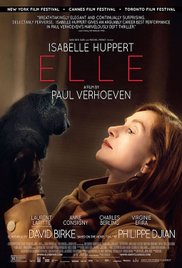
elle Greetings again from the darkness. It’s best not to pre-judge what to expect in a new Paul Verhoeven directed film. We haven’t seen or heard much from him in the past decade (the underrated Black Book, 2006), but we know surprises and twists and entertainment will be part of his work given his track record of Robocop, Total Recall, Basic Instinct, and Showgirls. Factor in that he is now working with one of the best actresses on the planet in Isabelle Huppert, and we walk into the theatre with no assumptions but a high level of anticipation.

The phrase ‘tour de force’ is no exaggeration for Ms. Huppert’s performance here. No time is provided for settling into one’s seat as the opening scene stuns us with a brutal sexual attack by a masked intruder. Afterwards, the bloodied victim calmly cleans the house, soaks in a tub and orders takeout. This is our introduction to Michele (Huppert) and begins our two hour mission of trying to figure her out.

Is she the ultimate feminist? She is the co-owner (with her best friend Anna) of a video game company that specializes in highly stylized and violent fantasy games (no subtle irony in that). Is she demented? She fools around with the husbands of her best friend and neighbor. Is she simply off-center? She scolds her mother for wanting to marry a much younger man, and her son for living with his selfish girlfriend who has a new baby via another man. She is not a good friend, business partner, mother, daughter, wife or person. This is no sympathetic character, yet thanks to Ms. Huppert, we simply can’t take our eyes off of her or stop wondering how she will handle the next situation (of which there are many).

Based on the novel “Oh …” by Phillipe Dijan, with a screenplay from David Birke (who has a similar theme in much of his work), the film spares us little from the daily life of Michele. We see her as a confident business person, a sexual being – whether peering through binoculars at a neighbor or trysting with a married man – and a somewhat devious and devilish person intent on revenge. It’s not until later in the film that we learn the family history that has been the driving force behind her rebuilding her life while also being unable to escape the past.

Ms. Huppert is in most if not every scene. It’s a powerful and rare performance that is complemented by some fine supporting actors: Anne Consigny as Anna (Michele’s friend and business partner), Christian Berkel as Robert (Anna’s husband and Michele’s play toy), Charles Berling as Richard (Michele’s ex-husband), Judith Magre as Michele’s mom, Laurent Lafitte as Patrick (the neighbor), and Jonas Bloquet as Vincent (the dim bulb son). Michele has interactions with each of these characters … none better than the Christmas dinner party where all are in attendance.

Verhoeven’s film can be viewed as a slightly sleazy guilty pleasure, or as a profile of a strong, independent woman with a flawed moral compass. It’s a reminder that we never fully escape the shadow cast by our parents, and some pay a greater price than others. It’s rumored that no major American actress would take on the role, which in the end, benefits the film greatly … no other actress could have provided what was needed (except perhaps Barbara Stanwyck, who died more than 25 years ago). Ms. Huppert’s performance allows this to cross many genres, and it is undoubtedly the best of the year in this category: a comically mean rape-revenge psychological thriller centered on consent and desire. Should you doubt this, perhaps Michele’s own words will convince: “Shame isn’t a strong enough emotion to stop us from doing anything at all.” It’s a pleasure to meet you ma’am.

watch the trailer:


BLEED FOR THIS (2016)

November 17, 2016

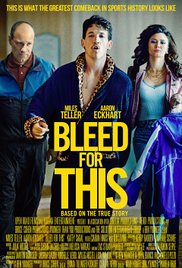
bleed-for-this Greetings again from the darkness. You may be excused if you believe there have been enough boxing movies recently. Just last year, we saw Creed and Southpaw – both critically acclaimed and featured significant screen time inside the ropes. Writer/director Ben Younger returns with his first movie since 2005 (Prime) and teams up with screenwriter Angelo Pizzo to present the “based on a true story” of Rhode Island’s own Vinny Pazienza.

Mr. Pizzo is known for his work on inspirational sports films like Hoosiers, Rudy, The Game of Their Lives, and My All-American; so the fascinating and true story of Paz is right in his wheelhouse. See, The Pazmanian Devil (his nickname) was a terrific fighter, and is even more famous for his medically-defying comeback after a horrific car accident. The doctors doubted he would ever walk again, and offered Vinny no hope at all of ever fighting again.

Miles Teller (Whiplash, The Spectacular Now) plays Vinny Pazienza and obviously trained very hard to get in tip top shape. His boxing skills are well suited to the training sequences but must be creatively edited for the scenes in the ring. This is especially obvious when clips of the real Paz are inserted. Beyond that, Teller softens the overblown machismo of Pazienza and the boxing world. He captures the single-minded commitment of Pazienza, while making him a bit more likeable than the real man came off in interviews.

Aaron Eckhart is excellent as Pazienza’s (and Mike Tyson’s former) trainer, Kevin Rooney. It’s puzzling how Eckhart’s name ever came up for the role of a balding, pudgy, alcoholic who believes he’s been put out to pasture … but Eckhart and Teller together produce some wonderful scenes. Other support work comes from Ciaran Hinds and an underutilized Katey Sagal as Vinny’s dad and mom, and Ted Levine and Jordan Gelber as boxing promoters Lou and Dan Duva.

The comeback was as improbable as it was inspirational, and the decision to go with the Halo (metal brace that screws into the skull) over the neck fusion surgery could easily be categorized as foolish rather than courageous. But much of the story revolves around the internal make-up and competitive drive that made Vinny the man and the boxer that we see.

The film has more in common with The Fighter than either of the movies mentioned in the first paragraph, but it’s even more character study than boxing movie. This proud, driven, egotistical local from Providence held world titles at three different weight classes, refusing to be limited by the opinions of others. Rather than end with a classically Hollywood shot of victorious Paz celebrating in the ring, the film ends with an odd interview centered on his debate against the phrase “it’s not that easy”. It’s a stance that makes us question whether he ever learned the lessons of gamble vs risk. Mostly though, we marvel and agree that he’s a guy who deserves to be on a box of Wheaties.

watch the trailer:


BILLY LYNN’S LONG HALFTIME WALK (2016)

November 17, 2016

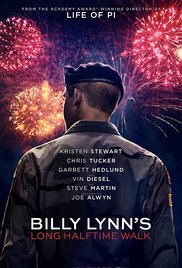
billy-lynn Greetings again from the darkness. “Thank you for your service.” For those of us who have never served in the military, we say the words because we don’t know how else to show our appreciation. Do the words ring hollow to those in uniform? Maybe. Probably. But how else can we honor these brave souls? What if we have them share a stage with a pop singing group during halftime of a football game? It’s this line between honor and propaganda that takes up much of the new movie from two-time Oscar winning director Ang Lee (Life of Pi, Brokeback Mountain).

The story is based on Ben Fountain’s 2012 novel, and revolves around soldier Billy Lynn’s and his fellow “Bravo” squad members as they make the rounds back home (in 2004) for publicity after their intense battle sequence is caught on camera. There is much at play here: how the soldiers interact with each other, how they are treated by the general public, how they are used by the team’s owner and the Army for self-serving reasons, and how Billy juggles the stress of war, the spotlight of heroism, and the demands from his family.

Director Lee opted to experiment with the ultra-realism of the new 120 frames per second in 4k 3D, rather than the standard 24 fps. Though this may seem like a minor detail that shouldn’t be addressed in a review of the movie, it’s impossible to ignore this impact. Technical advancements in film and digital have resulted in some exciting new effects for movies, but this high speed approach creates a soap opera look and feel that will likely be disorienting to many viewers. Although the full effect will only be available in New York and Los Angeles (due to shortage of projectors), the clarity on the close-ups is distracting, while leaving the background quite fuzzy and out of focus. Many will find this new look to be “not right” for a movie, and prefer the traditional look. Others may embrace the heightened sense of reality … of being right there with the characters. Of course, this is Ang Lee’s film, so there is no shortage of stunning visuals and expert shots.

Beyond the technical aspects, this movie is simply a bit clunky to watch, not very well written (screenplay by Jean-Christophe Castelli), not very well acted, and has an overall awkward and unfinished feel to it. Kristen Stewart plays Billy’s sister, and her limited screen time is the best part of the movie. Newcomer Joe Alwyn makes a decent reluctant (and lucky) hero in playing Billy, but he doesn’t have the chops to overcome the script weakness and the burden of carrying so many scenes. This is especially obvious in his unrealistic bonding scenes with cheerleader Faison (played by Makenzie Leigh). Their scenes together are nearly unwatchable.

Supporting work comes from Vin Diesel as Billy’s philosophical officer in recurring flashbacks to the war, Garrett Hedlund as the current squad leader, a miscast Steve Martin as team owner Norm Oglesby (a Jerry Jones type), and Chris Tucker as the incessantly yammering agent/producer trying to put a movie deal together for the soldiers. Other minor contributors include Tim Blake Nelson, Bruce McKinnon (in horrible make-up), Ismael Cruz Cordova, Deidre Lovejoy, and a couple of All-Pro players in Richard Sherman and JJ Watt.

Since there are some interesting and important elements to the story, the assumption here is that most effort went towards the experimental technical aspects. More attention to scene detail could have more effectively contrasted the soldier’s take on war versus the never-ending inclination of Americans to turn most anything into more and bigger entertainment … even Destiny’s Child isn’t enough. The questionable filmmaking decisions leave us with the shell of a good story, and too many sappy close-ups of actors emoting directly to the camera lens. The soldier vs hero debate deserves better, and the propaganda aspect deserves a more critical eye.

watch the trailer:


AQUARIUS (2016, Brazil)

November 12, 2016

aquarius Greetings again from the darkness. If you were an avid movie-goer in the 1970’s, you likely fell in love with Sonia Braga while watching Dona and Her Two Husbands (1976) and Kiss of the Spider Woman (1978). Those movies catapulted the Brazilian actress to global stardom, and a long career limited only by some regrettable script choices.

Writer/director Kleber Mendonca Filbo wisely casts Ms. Braga in the lead of his latest, and she delivers what may be her best performance ever … and certainly one of the best by any actress this year. Clara is the lone holdout in a beachfront apartment complex against a corporate developer intent on modernizing the old building in order to maximize profits.

The film is divided into three parts: “Clara’s Hair”, “Clara’s Love”, and “Clara’s Cancer”. The initial segment is set in 1980 when Clara is recovering from cancer treatment and is attending the 70th birthday party for her beloved Aunt Lucia (Thaia Perez). Lucia’s flashbacks to her younger days bring a subtle smile to her face, while providing parallels to what we see later with Clara. Some secrets from family are treasured memories, not meant to be shared. As the story moves forward, we grow to admire and respect Clara and join in her defiance of the smirky hotshot developer.

The big company bullying the old lady would be an interesting and predictable story, but here it’s secondary to the story of a strong woman – a woman who overcomes cancer, carries on after the death of her husband, fights to keep her home, and generally lives life on her own terms. She maintains her strength and dignity despite outside influences.

A recurring theme throughout is “old vs. new”. From the first sequence with the “old” Aunt passing the baton to her younger niece, to the old lady battling the young developer in order to prevent the historic building from being turned into a modern co-op, to the contrast of the vinyl records of Clara’s collection to the digital music of the younger generation, to Clara’s preference for actual phone calls to texting. It’s the classic now versus then argument, and it’s summed up by Clara’s line to her kids: “When you like it, it’s vintage. When you don’t, it’s old.”

There are some similarities to Sebastian Lelo’s 2013 film Gloria, which featured an exceptional performance from Paulina Garcia, and this one utilizes some terrific “little” scenes … conversations with family and daily life with her housekeeper – all while staying close to a glass of wine, her favorite music, a cozy hammock, and her Barry Lyndon poster. While the ending is a bit disappointing, and Brazilian politics prevented it from being that country’s Oscar submission, those don’t negatively impact the strength of Sonia Braga’s Oscar worthy performance as we rejoice in the strength of an independent woman.

watch the trailer:


ARRIVAL (2016)

November 12, 2016

arrival Greetings again from the darkness. Our cinematic love affair with aliens goes back decades, and these films typically fall into one of two categories: evil aliens attack earth, or aliens come in peace and humans react poorly. We’ve seen aliens trying to provide us with righteous advice (The Day the Earth Stood Still, 1951). We’ve connected via a few musical notes (Close Encounters of the Third Kind, 1977) and radio frequencies (Contact, 1997). And we have certainly had our share of surprise and unwanted meetings (Alien, 1979; The Thing, 1982). Leave it to cutting edge director Denis Villeneuve (Sicario, Prisoners, Incendies) to find a new, more head-and-soul approach for the genre.

This high concept project is born from Eric Hiesserer’s screenplay of Ted Chiang’s short story “Story of Your Life” … a title that makes sense by the end of the movie, but one a bit too blah for a big time production with Oscar hopes. Five time Oscar nominee Amy Adams plays Dr. Louise Banks, a renowned linguist and interpreter. There is an interesting and well done sequence at the beginning of the film that provides the back story for her character and the foundation for the final reveal.

A dozen oddly shaped spaceships have docked (mid-air) at various points around the globe. The one in the U.S. is hovering over … no, not Area 51 … Montana of all places. Forest Whitaker plays the military officer charged with assembling the team that will try to communicate with the aliens. He chooses Dr. Banks due to her remarkable track record with languages. She is joined with uber-Science and Math guy, Physicist Ian Donnelly played by Jeremy Renner.

We do see the aliens and their artsy style of communicating (a touch of Rorschach), but this is about so much more than learning a new inner-galactic language. It’s about how the military reacts, how the general populace reacts, how the world leaders work together (or not), and even how the military, intelligence agencies and academia coexist. It’s about smart people working out a plan when the problem isn’t even clear … a between-the-ears head-scratcher.

Mr. Villeneuve utilizes what appear to be flashbacks in helping us better understand Dr. Banks, but the element of time may not be what we typically accept in story-telling. The story, characters, cinematography and score (one of the best matches of music and movie all year thanks to composer Johann Johansson) work together to provide an engaging, nearly hypnotic movie going experience. Plus, I’m fairly certain this is the first alien movie to reference Abbott and Costello and crack a Sheila Easton joke. This is beautiful filmmaking that is also thought-provoking and encouraging of some species self-analysis (our species).

watch the trailer:


LOVING (2016)

November 12, 2016

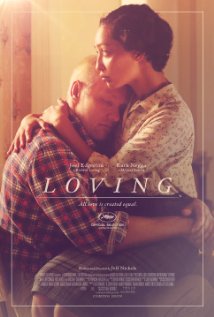
loving Greetings again from the darkness. Imagine you are sound asleep in bed with your significant other. It’s the middle of the night. Suddenly, the sheriff and his deputies crash through your bedroom door with pistols drawn and flashlights blinding you. You are both taken into custody. For most of us, this would be a terrible nightmare. For Mildred and Richard Loving, it was their reality in June of 1958. Their crime was not drug-dealing, child pornography, or treason. Their crime was marriage. Interracial marriage.

Writer/director Jeff Nichols (Mud, Take Shelter) proves again he has a distinct feel and sensitivity for the southern way. There is nothing showy about his style, and in fact, his storytelling is at its most effective in the small, intimate moments … he goes quiet where other filmmakers would go big. Rather than an overwrought political statement, Nichols keeps the focus on two people just trying to live their life together.

Joel Edgerton plays Richard Loving, a bricklayer and man of few words. Ruth Negga plays Mildred, a quietly wise and observant woman. Both are outstanding in delivering understated and sincere performances (expect Oscar chatter for Ms. Negga). These are country folks caught up in Virginia’s Racial Integrity Act of 1924, though as Richard says, “we aren’t bothering anyone”. The counterpoint comes from the local Sheriff (an intimidating Martin Csokas) and the presiding Judge Bazile (David Jensen) who claim to be enforcing “God’s Law”.

Nichols never strays far from the 2011 documentary The Loving Story from Nancy Buirski, who is a producer on this film. When the ACLU-assigned young (and green) lawyer Bernard Cohen (played with a dose of goofiness by Nick Kroll) gets involved, we see how the case hinges on public perception and changing social mores. Michael Shannon appears as the Life Magazine photographer who shot the iconic images of the couple at home … a spread that presented the Lovings not as an interracial couple, but rather as simply a normal married couple raising their kids.

In 1967, the Supreme Court decision in Loving v. Virginia, unanimously held Virginia’s “Racial Integrity Act of 1924” as unconstitutional, putting an end to all miscegenation laws (interracial marriage was still illegal in 15 states at the time). In keeping with the film’s direct approach, the Supreme Court case lacks any of the usual courtroom theatrics and is capped with a quietly received phone call to Mildred.

Beautiful camera work from cinematographer Adam Stone complements the spot on setting, costumes and cars which capture the look and feel of the era (over a 10 year period). Nichols forsakes the crowd-rallying moments or even the police brutality of today’s headlines, but that doesn’t mean there is any shortage of paranoia or constant concern. We feel the strain through these genuine people as though we are there with them. The simplicity of Richard and Mildred belies the complexity of the issue, and is summed up through the words of Mildred, “He took care of me.”

Watch the trailer:


HACKSAW RIDGE (2016)

November 3, 2016

hacksaw-ridge Greetings again from the darkness. Why doesn’t every high school student learn about Desmond Doss in History class? Beyond that, why isn’t Desmond Doss profiled in every Psychology and Philosophy class? It’s inexplicable that more Americans aren’t familiar with his story, much less failing to honor his legacy with a well deserved tribute. Fortunately director Mel Gibson (Braveheart) and screenwriters Andrew Knight (The Water Diviner) and Robert Schenkkan (“The Pacific”) bring us a spirited look at this underappreciated American war hero.

Andrew Garfield (The Amazing Spider-Man) plays Desmond Doss and perfectly embodies the conviction and dedication of this extraordinary (not hyperbole in this case) man. See, Desmond Doss was one of the first conscientious objectors in the U.S. Army. His religious beliefs (Seventh Day Adventist) prohibited him from using a weapon or killing another person … two things that don’t go over well with fellow soldiers or commanding officers. Yet, Doss was committed to serving his country as a medic and saving lives, rather than taking them.

Unbelievable may be the best description even though his story is absolutely true. Credited with saving the lives of at least 75 wounded soldiers, Doss and his fellow soldiers are depicted in the film fighting the Battle of Okinawa at Hacksaw Ridge … a topographical challenge punctuated by the need to climb a rope wall in order to scale the face of the cliff. Their reward was facing thousands of Japanese hiding in tunnels and bunkers, waiting patiently to kill in mass. There will be no spoilers here on the courageous actions of Doss … you should see for yourself.

The early part of the film features a heart-warming first love story involving Desmond Doss and Dorothy Schutte (Teresa Palmer, The Choice). Watching young love bloom is precious and provides a stark contrast to the battle scenes. The two make a lovely couple and we can’t help but root for them. Once Doss hits basic training, we find Vince Vaughn in the role of Sergeant Howell, Sam Worthington (failing to hide his Aussie accent) as Captain Glover, and Luke Bracey (Point Break, 2015) as Smitty, one of the soldiers who initially has no interest in serving with Doss. The Army Psychologist is played by Richard Roxburgh, whom movies lovers will recognize as The Duke from Moulin Rouge! (2001).

Some of the best scenes involve Desmond’s parents played by screen vets Hugo Weaving and Rachel Griffiths. Both are excellent in roles requiring very different and extreme emotional moments. It’s a credit to Gibson’s filmmaking expertise that he is able to add depth to all aspects – family turmoil, a classic love story, the brutality of war, and the deep religious convictions. There are a few moments of “artistic license” and some of the CGI is inconsistent and even over-produced at times, but the intensity of the battle scenes rival that of Saving Private Ryan and the landing at Omaha Beach. It’s a passionate piece of filmmaking centered on a most passionate man. You may disagree with much of what Mel Gibson has said and done in his personal life (and I hope you do), but as a film director he has earned much respect. And speaking of respect … Desmond Doss. Enough said.

watch the trailer:


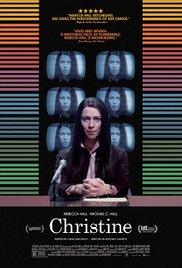
CHRISTINE (2016)

November 3, 2016

christine Greetings again from the darkness. On July 15, 1974, television news reporter Christine Chubbuck read a prepared statement and then committed suicide on-air by putting a gun to her head and pulling the trigger. You may not recognize her name, but you have likely heard the story … it’s no urban legend. Director Antonio Campos and writer Craig Shilowich offer up a biopic with some insight into Ms. Chubbuck’s personal and professional life so that we might better understand what drove her to such a public and tragic end.

Rebecca Hall takes on the titular role (don’t mistake this for the 1983 John Carpenter/Stephen King film), and despite her usual stilted on screen mannerisms, she delivers what is an emotionally raw and nuanced performance that is the best of her career … and one that keeps us glued to a story of which we already know the ending. We see a woman dedicated to her vision of the profession, while being maddening to those who know her, love her, and work with her. She has an awkward intensity that compounds her lack of social skills and an ongoing struggle with depression. Somehow, Ms. Hall allows us to understand the personal and professional struggles and how things could have spiraled into hopelessness for Christine.

The commentary on the early days of tabloid journalism (“If it bleeds, it leads”) is especially interesting given how the current Presidential campaigns have been covered more than 40 years after the film is set. One might also note the parallels to the character of Howard Beale in Network (1976) … though Christine Chubbuck was less vociferous and never took to yelling “I’m mad as hell, and I’m not going to take it anymore” while on camera (though she evidently felt that way).

Support work comes from Tracy Letts as the frustrated news director, Michael C Hall as the mixed-signals anchorman on whom Christine has a quiet crush, J. Smith-Cameron as her mother and housemate, Maria Dizzia as her friend and co-worker, and Timothy Simons as the misunderstood and ignored weatherman.

The film clearly makes the point that Christine was a misfit in her work and personal life, and though some of the timeline and known specifics are either re-worked or ignored for artistic purposes, Ms. Hall must be commended for highlighting the effects of depression. Even the best meaning friends and family can unintentionally make things worse. We see a clip of Walter Cronkite’s actual report of her death, and Christine’s own words – “The latest in blood and guts” – were actually ahead of her time.

watch the trailer:


AMERICAN PASTORAL (2016)

October 20, 2016

american-pastoral Greetings again from the darkness. Tackling one of the great American novels is a difficult challenge for even the most seasoned film directors … and a dubious undertaking (at best) for a first-timer. Philip Roth won a Pulitzer Prize for his 1997 novel “American Pastoral”, and there have been rumblings of a Hollywood production for more than a decade. It’s somewhat surprising that the screen version is directed by first time director Ewan McGregor … with the Scottish actor also taking on the lead role of local Jersey boy and sports hero Seymour “Swede” Levov.

The story examines the cracks behind the façade of a seemingly perfect family … the sports hero marrying the beauty queen. Of course, there is always more going on within a family than most care to admit (at least that was the case in the days prior to Facebook). There’s an early scene where Swede has introduced Dawn (Jennifer Connelly) to his father (Peter Riegert), and the philosophical and religious differences perfectly capture the changing times and mores from one generation to the next. Never has this been more true than the late 1960’s and early 1970’s … political and social upheaval were daily occurrences – and sometimes quite violent.

The first half of the movie is exceptionally well done and captures the essence of why the second half feels like a total decimation of everything Swede thought he had. He and Dawn’s daughter Merry is beautiful and feisty and stutters … something that only enhances the anger she expresses and anguish she causes for her parents. Her innocent questions as a young child evolve into radical political beliefs and affiliations as she grows up.

Merry (ironically named) is by far the most interesting character in the story, but with the focus on Swede, Dakota Fanning only has brief moments that are worthy of her talent, and Dawn has only a few emotional moments that allow Ms. Connelly to flash the acting depth she hasn’t shown in years. So much time and attention is devoted to Swede that the second half is a bit of a letdown and leaves too many details and questions unanswered.

John Romano’s (The Lincoln Lawyer) adaptation of the American classic took a different direction than we might have preferred, but it’s a thankless job since so many have considered this as unfilmable. McGregor shows a good eye as a director, though it’s obvious this material needed a more experienced filmmaker at the helm. The great Alexandre Desplat provides a classy score … the piano pieces are especially well suited. Supporting work is solid from David Strathairn as narrator Nathan Zuckerman, Rupert Evans as Swede’s brother, Molly Parker as Merry’s therapist, Uzo Aduba as Swede’s employee, and Valorie Curry as a misguided revolutionary. It’s a reminder that family dynamics may be the most complex organism, and when blended with the volatile times of the Vietnam War, a generational gap should be expected … even if it’s difficult and emotional to accept.

watch the trailer: