T2 TRAINSPOTTING (2017)

March 23, 2017

 Greetings again from the darkness. Sequels are big business in Hollywood these days. In fact, it’s not unusual for sequels to be announced even before the premiere of the first! At the other end of the spectrum we have cult films which carry the added pressure of not disappointing (or worse) their rabid fan base. Such is the case with Trainspotting from 1996. So the big question is … can the much anticipated follow up generate the frenetic pace and enjoyable discomfort of the first?

Director Danny Boyle (and his Oscar from Slumdog Millionaire) is back at the helm, and re-joining him is writer John Hodge who is once again working with the main characters from Irvine Welsh’s source novels. Of course what has the fans excited is the reunion of Ewan McGregor as Mark Renton, Ewen Bremner as Spud, Jonny Lee Miller as Sick Boy Simon, and Robert Carlyle as Begbie. Despite high expectations and fear of disappointment, it’s difficult to imagine the fans not having a blast with this second go round. Sure, the boys are a bit older – but to say they are much wiser, would be stretching things farther than these off-kilter blokes already do.

For reasons never really made clear, Mark returns to face the fellows he left high and dry some twenty years ago. Perhaps it’s guilt and he accepts that he deserves a good ass-kicking, or perhaps he simply realized he didn’t belong anywhere else. Simon has an attractive new partner named Veronika (Anjela Nedyalkova), who seems to be the one generating whatever income the couple has. Spud is still struggling mightily with his addiction, while Begbie is planning a quite painful escape from prison.

The reunions happen separately and slowly throughout the film, and each carries its own awkwardness. These guys are all similar to the guys we know, yet nobody’s quite the same. It’s not until near the end when all four share a scene. However, getting to that point involves everything we could hope for: flashbacks, quirky camera angles, flash-cut edits, familiar music blasting, and exaggerated sound effects … in other words, all of the style from the original (only with a higher budget).

Also making return appearances are Kelly McDonald as Diane (only one scene), novelist Irvine Welsh (this time buying stolen goods from Begbie), and the always great Shirley Henderson as Gail, whose single line of dialogue is pitch perfect. It’s nice that Ewen Bremner gets such an interesting and unexpected path in this sequel, and we can’t help but smile at director Boyle’s tributes to David Bowie, Stanley Kubrick, and of course, his original Trainspotting. You may ask why and in what form, but it’s clear all four main characters have decided to “choose life”. The next cult favorite up for sequel treatment is 1982’s Blade Runner, which likely faces an even more challenging journey to satisfy fans from 35 years ago.

watch the trailer:


CHIPS (2017)

March 23, 2017

 Greetings again from the darkness. In a Hollywood self-congratulatory world that considers sequels, reboots and remakes as creative projects; and imitation as the most sincere form of flattery … not to mention the safest hedged bet … it’s not in the least surprising that we now have a film version of “CHiPs”, a lightweight and popular TV show that ran from 1977 through 1983. What should be surprising is that a studio entrusted Dax Shepard with the ultimate slash role of Director/Writer/Producer/Actor for this contemporary version.

Of course, as with film versions of “21 Jump Street” and “Starsky and Hutch”, the target audience isn’t really those who watched the original TV series, but rather the group of big-spending millennials who seem to thrive on raunchy humor, while placing minimal value on a coherent or interesting story. Buddy cop films that blend tense drama, wise-cracking partners and eye-widening action have long been popular, with the jewel of the genre being Lethal Weapon. This latest entry does nothing to threaten the now 30 year reign of Mel Gibson and Danny Glover.

Dax Shepard stars in his own film as Jon Baker, now reinvented as a former X-games motorcycle champ who is attempting to save his long-fizzled marriage by becoming a cop. The rookie’s partner is undercover FBI Agent Frank “Ponch” Poncherello played by Michael Pena. Each has their own personal issues: Jon is addicted to prescription painkillers, and Ponch struggles to control certain urges … and unfortunately for viewers, the two spend an inordinate amount of time discussing these issues.

The crime wave they are attempting to bust involves a corrupt cop. Seeing that Vincent D’Onofrio is in the cast immediately takes away any mystery about the bad guy’s identity, but were there any doubt, the film exposes him in the first action sequence. After that comes the onslaught of verbal sparring, explosions, gunplay and one especially gory moment.

With Dax Shepard at the helm, we understand going in that the raunchy humor faucet will be fully open. Topics covered in one-liners, gags and recurring themes include: homophobia, sexting, masturbating, bowel movements, marriage therapy, d**k jokes, prescription drugs, paparazzi, and yoga pants. But seriously, how many “eating a**” jokes does one movie need? It’s a topic that goes from uncomfortable to unnecessary pretty quickly.

Cars and bikes are vital here, though it seems that the motorcycle stunts could have been jazzed up a bit, and we certainly expected more cameos than the mandatory one near the end. The original series thrived on being ‘tongue in cheek’, and Mr. Shepard’s version brings new meaning to the phrase. The opening credits state “The California Highway Patrol does not endorse this film. At all.” It’s an understandable stance.

watch the trailer:


I, OLGA HEPNAROVA (2017)

March 23, 2017

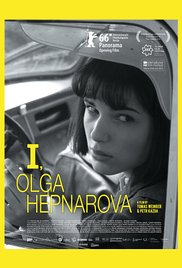
 Greetings again from the darkness. Most youngsters have executed a perfect eye roll on at least one occasion after receiving a dose of parental advice that seemed irrelevant to them at the time. An early scene in this biopic finds teenage Olga listening as her mother says, “To commit suicide you need a strong will, my child. Something you certainly don’t have. Accept it.” This is a warning shot fired at the audience to be cautious when judging the actions of the last woman executed in Czechoslovakia.

Co-directors Petr Kazda and Tomas Weinred seem to believe that most viewers will be familiar with Olga’s story, and presume the film’s austere look, lack of flow, and structure of seemingly unrelated scenes will provide a sense of the choppiness and isolation that might explain her otherwise inexplicable actions. Based on Olga’s true story and the book from Roman Cilek, the film will have you questioning whether her behavior was the result of horrible parenting, or more closely related to her psychological issues – perhaps even schizophrenia.

Michalina Olszamska (The Lure) delivers a committed performance as Olga, the 22 year old woman who in 1972 drove a truck into a group of people in Prague, killing 8 (all between the ages of 60 and 79). A year later she was hanged, becoming the last woman executed in Czechoslovachia.

The movie focuses on the various elements and key moments of her life – father’s abuse, mother’s iciness, attempted suicide, treatment in asylum, rejection by a lover – that led to her isolation and feelings of alienation. We sense her internal rage building over time, and her inability to cope or even connect with others; though at times we question whether her troubles are by choice or a result of her treatment … it’s kind of a twist on the nature vs. nurture debate.

There have been other fine movies that have dealt with a similar theme: There’s Something About Kevin, The Omen, The Bad Seed. Each of these deal with the whole good vs evil idea … are some kids born “bad” or are they pushed that way? Either way, it’s a parent’s worst nightmare. This black and white presentation allows us to keep our emotional distance from Olga, and the no frills approach provides a quite chilling reenactment of how Olga ended up sending a letter to the local newspaper announcing her intention to seek “revenge” for the hatred that society had heaped upon her for years.

watch the trailer:


THE SENSE OF AN ENDING (2017)

March 16, 2017

 Greetings again from the darkness. In 1967 Cat Stevens wrote “The First Cut is the Deepest” and the song has since been recorded by many artists (including Rod Stewart and Sheryl Crowe). The song’s title is also an apt description of director Ritesh Batra’s film version of the popular 2011 novel from Julian Barnes. It’s one man’s look back at the impact of his impulsive actions more than 50 years ago.

“When we are young, we want emotions to be like what we read in books”. So says the narrator and lead character Tony Webster (as played by Jim Broadbent). Tony runs a tiny second hand camera store (specializing in Leica models) while leading a mostly benign life – rising daily at 7:00am, coffee with his ex-wife, and periodic errands for his pregnant daughter. One day a certified letter arrives notifying him that he has been named in the Last Will and Testament of the mother of a girl he dated while at University. And so begins the trek back through Tony’s history and memories.

Of course, a film version can never quite cut as deeply as a novel, but this preeminent cast works wonders in less than two hours. Curmudgeonly Tony is accessible and somewhat sympathetic thanks to the stellar work of Mr. Broadbent, who always seems to find the real person within his characters. Harriet Walther (“The Crown”) turns in a tremendous performance as Margaret, Tony’s most patient and quite wise ex-wife. Michelle Dockery (“Downton Abbey”) is their pregnant 36 year old daughter Susie, and just these three characters could have provided a most interesting story. The film’s best scenes feature the comfort and familiarity of a once-married couple, as Tony and Harriet talk through previously never mentioned topics. However, there is so much more to explore here as Tony’s thoughts bring the past splashing right smack dab into the present.

Billy Howle does a nice job as young Tony, an aspiring poet, who falls hard for the enigmatic Veronica (Freya Mavor). Complications arise when Tony spends a weekend with Veronica at her parents’ estate. It’s here that Emily Mortimer energizes things (and clouds thoughts) with minimal screen time as Veronica’s mother. It’s also around this time where new student Adrian Finn (played by Joe Alwyn of Billy Lynn’s Long Halftime Walk) captures Tony’s imagination and a friendship bond is formed … only to be later shattered in a most painful manner.

There is so much going on that director Batra’s (The Lunchbox, 2013) low-key approach is often misleading. Looking back on one’s life can lead to the twisted version that our mind has edited/revised in order to make things seem better or worse – definitely more colorful – than they likely were at the time. Tony’s distorted view of history crumbles when documented proof of his actions is presented at his first face to face meeting with Veronica (the great Charlotte Rampling) in five decades. It’s at this point that regret and guilt rise up, and the only question remaining is whether this elderly man can overcome his repressed emotions and self-centeredness in order to make the best of what time he has left. Each of us has a life journey, and though few of us ever actually tell the story, there are undoubtedly numerous lessons to be had with an honest look back.

watch the trailer:


PERSONAL SHOPPER (2017)

March 10, 2017

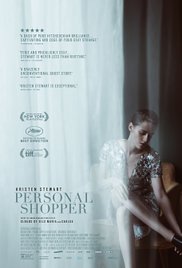
 Greetings again from the darkness. This is quite probably the first ghost story where the most suspenseful moments center on the texts popping up on a smart phone screen. From writer/director Olivier Assayas (Clouds of Sils Maria), this one is more than a ghost story – it’s also a story of grief, a search for identity, and yes, that desire or need to connect with the afterlife.

It’s important to note that the film kicks off not with Maureen (Kristen Stewart) carrying out her duties as described in the title, but rather by being dropped off at a once grand country home, now abandoned and the source of some terrific sound mixing. Creaking floorboards, squeaking doors and groaning walls all serenade Maureen as she spends the night in search of the spirit world. We soon learn she was actually hoping to connect with her recently deceased brother Lewis … a twin with whom she had a pact that whomever passed first (they shared a heart “malformation”) would make contact with the other from beyond.

Maureen then returns to her day job as personal shopper and all-around go-fer to her egotistical celebrity boss Kyra (Nora von Waldstatten), a high profile fashion model whose snooty ways have Maureen spewing hatred of her job during Skype sessions with her long-distance boyfriend Gary (Ty Olwin). With incessantly slumped shoulders, Maureen zips around Paris on her scooter toting shopping bags filled with expensive dresses, jewelry and shoes. She’s on the outskirts of wealth and celebrity, but the to-do notes and lack of personal interaction with Kyra epitomize how far outside the circle Maureen really sits.

There are moments of acting support from Sigrid Bouaziz as Lewis’ girlfriend, and Lars Eidinger as a suspiciously low-key creep, but it’s Kristen Stewart who carries the full weight of the film, and continues her streak of very interesting work. She does so in a manner not shy about showing her body, but also with the authentic body language of someone whose frustration grows with each successive text from “unknown”. As a modern twist to the traditional thriller, the film also ties in the past with such touches as Swedish mystic Hilma of Klint and amateur spirit hunter Victor Hugo. It’s understandable how Mr. Assaya’s film received both boos AND a standing ovation at Cannes … no one is really sure how to react to the first texting ghost story!

watch the trailer:


THE OTTOMAN LIEUTENANT (2017)

March 10, 2017

 Greetings again from the darkness. A story of romance smack dab in the middle of war is always a bit risky and sometimes difficult to sell. Make it a love triangle and toss in distinct religious differences, and if it’s not a mess, it’ll do till the mess gets here (a sentiment borrowed from the Coen Brothers).

This is director Joseph Ruben’s first feature since The Forgotten (2004), and he’s also known for Sleeping with the Enemy (1991), the breakout dramatic role for Julia Roberts after Pretty Woman. The film is written by Jeff Stockwell, who is best known for Bridge to Terabithia (2007), and the script leans heavily on melodrama while also sprinkling in some acts of war.

Hera Hilmar (who favors Abbie Cornish) stars as Lillie Rowe, a head-strong free-thinking nurse living a life of privilege in 1914 Philadelphia, but committed to an ideal of justice for all. She meets a handsome and equally idealistic Dr Jude Gresham (Josh Hartnett) who is fundraising for his hospital located in the remote hills of Turkey. Circumstances are such that a Turkish officer is assigned to escort Lillie to Gresham’s hospital. As if enough sparks haven’t already flown between Jude and Lillie, it’s pretty clear that the attraction between her and Ismail (an excellent Michiel Huisman, “Game of Thrones”) is even stronger. The fourth key character here is Jude’s partner, Dr. Woodruff (Sir Ben Kingsley), whose immediate dislike of Lillie is quickly dispensed once she exhibits her medical competency.

Lillie is warned … war is coming. It’s WWI and it’s the Muslim Ottoman Empire vs the Christian Armenians. To label this revisionist history is an understatement. The 1915 Armenian Genocide is only alluded to with passing mention that the Ottomans “took steps” to control the Armenians. Even in such a lightweight and hokey melodrama, an omission like that jumps out. Whether it’s selective memory or outright propaganda, it seems obvious that the Turkish financiers were hoping to make a political/historical statement hidden behind a romantic triangle wrapped in war. The sweeping score by Geoff Zanelli and the beautiful cinematography of Daniel Aranyo both emphasize the romance aspects, while minimizing the fighting and cultural clashes.

watch the trailer:


TABLE 19 (2017)

March 3, 2017

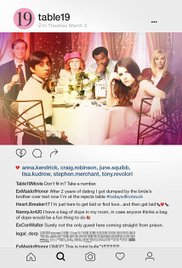
table-19 Greetings again from the darkness. Writer/director Jeffrey Blitz (Spellbound) takes the approach that many wedding guests would prefer – he skips the wedding and heads straight to the reception. Another wise move by the filmmaker is assembling a very talented ensemble of funny folks. This cast proves they can wring a laugh from dialogue and moments that would probably otherwise not elicit much of an audience reaction. Instead, the full house on this evening had quite boisterous responses on numerous occasions.

The initial set-up drags a bit as we are introduced to the characters that will soon enough populate Table 19 at the reception. Tony Revolori (The Grand Budapest Hotel bellhop) is Renzo, the longing for love (or anything similar) high schooler who might be a bit too close to his mother (voiced by the great Margo Martindale). Lisa Kudrow and Craig Robinson are the Kepp’s, a mostly unhappily married couple who own and run a diner together. June Squibb is Jo, the bride’s long-forgotten nanny who sees and knows more than most. Stephen Merchant plays the outcast nephew/cousin who has been recently released from his prison sentence for white collar crime. Lastly we have Anna Kendrick as Eloise, the fired maid of honor and former girlfriend of the bride’s brother (Wyatt Russell), who also happens to be the best man and now dating the new maid of honor.

This is the island of misfit wedding guests known as Table 19, and purposefully placed in the back corner as far as possible from the family and favored guests. Of course we know immediately that this Team Reject will unite for some uplifting purpose at some point, and the movie improves immediately once that goal has been revealed. Comedic timing in a group setting can often come across on screen as forced, and it’s a tribute to the cast that these characters come across as human and real.

Make no mistake though, this is Anna Kendrick’s movie. She plays Eloise as we would imagine Anna Kendrick in this real life situation. Sure, a wedding reception is low-hanging fruit for comedy, but it’s the third act where Ms. Kendrick’s talent really shines. Comedy drawn from emotional pain is the most fulfilling because we’ve all been there. The melodrama that creeps in is pretty predictable, but that doesn’t mean it’s not a good time. The scenes with Ms. Kendrick and Wyatt Russell (Everybody Wants Some!, and Kurt and Goldie’s son) are the best, and it leaves us wishing for more attention to both.

Don’t worry, the film features the required wedding cake mishap, a flirtatious wedding crasher (Thomas Cocquerel) and a drunken mother of the bride singing karaoke to Etta James’ “At Last”. It’s designed to be a crowd-pleaser, and mostly succeeds with a nice blend of silly, cute, and emotional tugs.

watch the trailer:


WOLVES (2017)

March 3, 2017

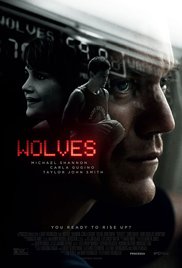
wolves Greetings again from the darkness. Anthony is a good kid with a bright future. He’s a star basketball player and a bright student, and has a loyal girlfriend and seemingly normal home life. It comes as no surprise that most of those elements either aren’t as smooth as they seem, or are more complex than on the surface.

Writer/director Bart Freundlich (known for his 1997 debut feature The Myth of Fingerprints, and for being married to Julianne Moore) slowly unveils the cracks in Anthony’s (Taylor John Smith) façade. His college professor dad (the always great Michael Shannon) is a drunk, abusive man with a short fuse and severe gambling addiction. He’s the kind of guy who is always working on his great American novel, while juggling gambling debts and throwing down quiet jealousy of his son. His mother (Carla Gugino) has good intentions and clearly wants the best for her son, but she’s just not capable of standing up to the menace. It plays like a Maslow’s hierarchy of crappy parenting.

There are plenty of clichés that we’ve seen in many movies, but it’s a pleasure to see so much real basketball being played. Anthony has a sweet jump shot and a sweet girlfriend named Victoria (Zazie Beetz), and the interpersonal relationships all have nuances that come across as real life. Even Uncle Charlie (Chris Bauer) seems torn about which family member most needs his protection. Emotional-physical-financial strains abound and it all seems to crash down on Anthony as he strives to earn a college scholarship by impressing the coaches from Cornell.

As Anthony navigates the choppy waters towards independence, the film teases us with some sub-plots that could have been further explored. Anthony hits it off with an older, wiser street baller (John Douglas Thompson) who starts mentoring him. We also are given hope that Anthony’s mom will actually do something for her son rather than regretting what she hasn’t done. Lastly there is a quick tease as to an alternative past that would make some sense – though whether that’s real or imagined is left up to the viewer’s perspective.

The film ultimately plays like a Disney film that utilizes an inordinate number of “F-words”, and it even reminds a bit of the Paul Giamatti movie Win Win. It’s the acting and the periodic sequences of real emotion that allow us to remain interested in the characters right up until the end … even if our hopes differ from one of Anthony’s own parents.

watch the trailer:


THE SALESMAN (Forushande, 2016, Iran)

February 25, 2017

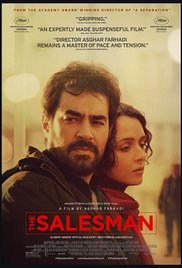
salesman Greetings again from the darkness. Iranian writer/director Asghar Farhadi won the Best Foreign Language Film Oscar for his 2011 A Separation, and with his latest (also Oscar nominated), he proves yet again that his unique approach to family/domestic dramas might best be described as simmering suspense artistry. He certainly knows how to tell a story and structure a film for maximum impact.

Shahab Hosseini (A Separation) and Taraneh Alidoosti (About Elly) star as Emad and Rana, a normal and seemingly happily married couple. One morning, some heavy equipment jeopardizes the stability of their apartment building and they escape to the streets. Husband and wife are both performing in a community theatre production of Arthur Miller’s “Death of a Salesman” and at that evening’s rehearsal, one of their castmates, Babak (Babak Karimi) offers the couple the use of a rooftop apartment … he has recently evicted the tenant.

Of course, this bit of luck comes with some baggage … specifically, the baggage and belongings of the previous tenant who (unseen to viewers) keeps telling Babak she will return for her stuff. Meanwhile, the neighbors inform Emad and Rana that the previous tenant and her “many acquaintances” (paying clients, if you get my drift) will not be missed. This history comes into play when one evening a home invasion leaves Rana dazed, injured and being treated at a local hospital. This sets off the cultural commentary about the roles and power of Iranian men vs women, as well as a psychological study of wounded pride, a need for revenge, and a scarred psyche who wishes to be neither alone nor coddled.

The strained marital relationship has some interesting parallels with the scenes depicted in the Miller play, and there are also a few key moments in the build-up … moments of subtlety for the discerning viewer. Foreshadowing occurs in a seemingly humorous moment when one of Emad’s students asks during class, “How does a man become a cow?”, and Emad answers “Gradually.” A throwaway line is never really that in a Farhadi script.

Most of the film centers on how Emad and Rana react to the traumatic event, and for the first two-thirds, it’s Emad’s movements that we follow. However, during the extraordinary final act, Rana becomes the focus and there is a tremendous performance from Farid Sajjadi Hosseini as an older gent in a key role. So much raw human nature is on display here – pride, revenge, forgiveness, trust, weakness, etc. It’s the type of film that has much going on even during the parts that might seem slow on the surface. Farhadi is an exceptional filmmaker, and evidently, he will just continue to prove it so.

watch the trailer:


A UNITED KINGDOM (2017)

February 23, 2017

a-united-kingdom Greetings again from the darkness. Sometimes I just know immediately that I’m going to be out of touch with popular opinion on a movie, and this historical-romantic-biopic from director Amma Asante (Belle) and screenwriter Guy Hibbert (Eye in the Sky) is one of those times.

It’s a crowd-pleaser featuring David Oyelowo and Rosamund Pike in a real life story with some similarities to last year’s Loving (the chronicle of Richard and Mildred Loving’s interracial marriage). Mr. Oyelowo plays Seretse Khama, a 1947 university student in London when we first meet him. Ms. Pike is Ruth Williams, a local Londoner working clerical at an insurance company when the two meet at a local dance. The attraction is immediate.

Not long after, Seretse discloses to Ruth that not only is he in love with her, but he’s also the King-in-waiting for Bechuanaland in Africa. The marriage is met with dissent from all fronts: family (racism), Seretse’s people (cultural and societal reasons), and Great Britain (mostly concerned with appeasing its ally South Africa and the growing notion of Apartheid). Seretse and Ruth believe their true love is strong enough to win over those dissenters. The backlash is much worse than anticipated.

A very cool element with the film is the use of the actual house Ruth and Seretse lived in, and the locals were more than willing to contribute. While the strength of these two individuals remains inspirational to this day, the film falters in a few ways. Both Jack Davenport and Tom Felton are stuck playing British foils in the overwritten manner in which we would expect from a 1940’s movie on TCM. Again acknowledging my out of step opinion, Ms. Pike simply lacks the range for such a role. Her deer-in-the-headlights go-to facial expression is a slap to the courageous woman she is portraying. However, the biggest issue with the film is its lack of continuity … its choppiness, if you will. So many scenes abruptly end right as the substance is beginning. Multiple times we are left hanging, wondering why we don’t get to finish a conversation or finalize a conflict. There are some terrific moments that are torn apart by the numerous butchered scenes, though the strong performances of Oyelowo and Terry Pheto (Tsotsi) as his sister shine through.

This is a terrific and interesting piece of history that deserved a better film. In 1966, Bechuanaland gained its independence and became what’s known today as Botswana, and the story of Seretse and Ruth is one that needs to be told. Most viewers likely won’t be bothered by the things that irritated me, and that’s probably a good thing.

watch the trailer: