FANTASTIC FUNGI (doc, 2019)

October 14, 2019

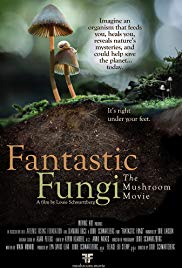
 Greetings again from the darkness. Why did the mushroom get invited to the party? Because he’s a fun guy (fungi)! That joke works better when spoken rather than read, but it made me laugh as a kid, even though it wasn’t enough to keep me (and half my classmates) awake during those dull science films in junior high. Documentarian Louie Schwartzberg obviously stayed awake in class, and now he’s showing us how those films should be made … interesting, informative and entertaining.

“We brought life to Earth. You can’t see us. We are mushrooms!” Narrator Brie Larson (yes, Captain Marvel herself) introduces fungus, or more accurately, fungi … since we are told there are 1.5 million species – 20,000 of which produce mushrooms. Despite the presence of Ms. Larson, this isn’t a superhero movie. No, it’s much more important. In fact, the real star of the documentary – other than fungi – is an amateur mycologist named Paul Stamets. That’s right, this informative project devotes much of its time to some guy who just likes science (oh my, does he like it); specifically, the study of fungus and mushrooms. He even tells us some of his personal story, allowing us to connect with a guy who is proud to be known as a mushroom nerd.

Director Schwartzberg is an accomplished documentarian, and noted time-lapse photographer and visual artist. He even uses impressive digital animation periodically to guide us along. He’s also smart enough to complement Mr. Stamets’ observations with input from real life scientists, as well as authors and researchers. Admittedly, it’s not really fair to classify Stamets as an amateur. He has written books and his research has been invaluable to some of the world’s foremost experts.

You may wonder why you should care about fungi. Heck, it’s described as something between vegetable and animal. We hear that it’s been around since the beginning, and that it plays a role in rebirth, reincarnation, and regeneration. This is shown via a memorable time-lapse segment, and with the bold proclamation that Mycelium is “the mother of us all.” We learn how fungi is such a vital part of our existence through medical research, penicillin (and chees), antibiotics, bio-terrorism, psychedelics, and now even the treatment of depression and cancer. Fungi can feed you (it’s good on pizza), heal you, and even kill you. The film is quite a fascinating and educational treat … and a lesson in biological resilience. And I never once fell asleep – my junior high teacher wouldn’t believe it.

watch the trailer:


ELEVATION CHANGE (2019, doc)

October 2, 2019

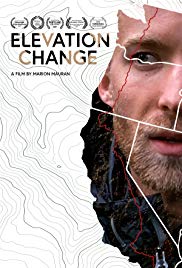
 Greetings again from the darkness. When former Yale University high-jumper Sam Fox announces he is setting out to break the speed record on the Pacific Crest Trail, he does so with a confidence-bordering-on-arrogance that seems to be a natural trait amongst endurance athletes. This was 2011 and Sam’s goal was to raise $250,000 for the Michael J. Fox Foundation, a quite personal cause, given that his mother Lucy was diagnosed with Parkinson’s disease.

The Pacific Crest National Scenic Trail (PCT) is 2653 miles long and connects Canada to Mexico via Washington, Oregon, and California, across the Sierra Nevada and Cascade mountain ranges. Yes, it’s roughly 100 marathons covering some rugged terrain, so we can’t help but chuckle when Sam initially states that he’s not worried about the physical challenge, only the mental aspects of covering 44 miles per day for 60 days to break the record.

Running, hiking, and climbing every day for 2 months is more than most of us can imagine. We see Sam after Day 1 when he has traveled 66 miles in 21 hours, and the reality of his journey strikes us, as well as him. Sam has been described as ultra-competitive, and he’s told us his mother is his motivation. Thru-hiking is a serious endeavor and Sam’s support group includes his girlfriend Chloe, and two good friends John and Eric, who have agreed to assist with food, water, communication, logistics, navigation, and any other obstacles that arise. They are even handling his social media, which is being used as a promotional tool for fundraising.

This is director Marion Mauran’s first film, and in addition to selecting a fascinating subject, she gets lucky in that the PCT record-holder Scott Williamson (who deserves his own film) is not only a few days ahead of Sam on the trail, but he also agrees to be interviewed for the film. Mr. Williamson’s personal story is jaw-dropping, and he makes for a very interesting contrast in personality to Sam Fox. They each have their own motivations for taking on the trail, and Mr. Williamson is quite introspective, while the irritable Mr. Fox appears to seek and appreciate the spotlight. Unfortunately, we get no film of Williamson on the trail, but some of the segments of Fox filming himself provide terrific insight into the struggles.

Weather, rattlesnakes, bears, foot and leg injuries, and solitude are some of the obstacles faced, and when John gets hospitalized with shingles, Sam’s dad jumps in. We quickly see where Sam gets his determination, as the no-nonsense patriarch offers up his philosophy of pushing one’s self to the limit. Director Mauran and her crew mix in some breathtaking shots along the way, with the beauty of nature set against the pain and struggles of Sam’s trek.

We can’t help but compare this to the fantastic 2018 film FREE SOLO chronicling Alex Honnold’s climb of El Capitan in Yosemite. These are individuals that push through pain and mental turmoil, and take themselves to limits most of us can’t fathom. Ms. Mauran’s film might have been even more impactful had the parallels and contrasts between Sam Fox and Scott Williamson been further explored, but what we see is more than enough for us to sit back in our recliners and marvel at the spirit and commitment of endurance athletes.

watch the trailer:

https://www.imdb.com/title/tt3410342/videoplayer/vi2510405401?ref_=tt_ov_vi


MILES DAVIS: BIRTH OF THE COOL (2019, doc)

September 26, 2019

 Greetings again from the darkness. The idea of a PBS “American Masters” documentary on jazz great Miles Davis could be cause for concern. The series is known for its high-level and mostly favorable profiles of influential people. Would the series go “deep” enough?  Would it gloss over the dark side? Would it be able to capture the essence of an enigmatic man who changed the music world more than once? The final result is a documentary that acts as a terrific primer for those unfamiliar with Miles Davis, and one that should satisfy his most ardent fans as it chronicles each stage of the music. For this we can thank Stanley Nelson, a documentarian who has delivered several projects on the history of African-Americans.

By definition, the ‘cradle-to-grave’ approach limited to a 2 hour run time means certain aspects must be glossed over. We learn that Miles’ father was a dentist in East Saint Louis, allowing them to be the second wealthiest black family in the state. Of course, this did not shield them from racism and segregation, or even domestic violence within their home … a trait that Miles would carry throughout his own relationships later in life.  “Music comes before everything.” It’s a battle cry from the memoir, “Miles: The Autobiography”. The film features actor Carl Lumbly narrating many of Miles’ own words throughout the film – with Lumbly’s voice bearing a sufficient resemblance to Miles’ distinct sound.

Montages of photos are utilized, initially to kick off the film with shots of Miles performing on stage, and then to mark the specific social and political era as the timeline shifts (1944, 1955, 1969, etc). Interviews are conducted with East Saint Louis residents, Miles’ childhood friends, musicians – those he played with and those he influenced, writers, and historians. Each brings their own perspective to telling Miles’ story, and perhaps none is more insightful than former dancer Frances Taylor, who was married to him from 1968-78. This era and their marriage was a key element of the 2015 film MILES APART starring Don Cheadle. Ms. Taylor passed away in 2018, and her recollections hold much weight and insight into Miles off stage.

The advantage of a chronological recap of his career is that it allows for a clear grasp of just how often the music of Miles Davis evolved over the years. At age 17, he was playing with Dizzy Gillespie and Charlie Parker, and in 1955 at the Newport Jazz Festival he introduced a new style that shook the industry and landed him a lucrative recording contract. He took film score to a new place with Louis Malle’s ELEVATOR TO THE GALLOWS and later played with the great John Coltrane. Of course Miles’ seminal 1959 album “Kind of Blue” is discussed by many who note the impact it had on jazz and music in general. We hear from Wayne Shorter, Herbie Hancock and Carlos Santana as each tries to describe a sound that defies description.

As he himself proclaimed, Miles was all about the music; and because of this, it makes sense that the film focuses on his innovative approach. Director Nelson does not, however, ignore the dark side of the man. As far back as high school Miles was “a genius and weird”, but lifelong battles with drugs and alcohol, and his history of being a difficult and violent partner, put the personal side in stark contrast to the beauty of his music. His first two wives, Frances Taylor and singer Betty Mabry, both documented his violent temper, and it’s a little disappointing that his third wife, actress Cicely Tyson was not interviewed for the film. They were married from 1981-88. Ms. Tyson turns 95 years old this year, and is still a working actor. It was the younger Ms. Mabry that revamped Miles’ fashion and introduced him to Jimi Hendrix and Sly Stone, helping usher in the jazz fusion era.

We do learn the story behind the recognizable raspy voice, and the film covers his time at Julliard, his first trip to Paris (where he met actress Juliette Greco), his collaboration with arranger Gil Evans, the influence of Clive Davis, and his performance with Quincy Jones not long before Miles died in 1991. It’s details like Miles Davis music provided the template for Hip-Hop that make the film click, but of course the real joy is derived from hearing his music from 5 decades of work. Someone in the movie states “I want to feel the way Miles sounds.” And we know exactly what she means.

watch the trailer:


JIM ALLISON: BREAKTHROUGH (doc, 2019)

September 26, 2019

 Greetings again from the darkness. We don’t hear much about renegade scientists, at least not outside of science-fiction novels. It seems Jim Allison, the subject of this documentary, proudly embraces the label in real life. Many can thank him and his research and his hard-headedness for their being alive and cancer-free today.

Allison’s family hails from a quiet little, mostly Hispanic, south Texas town named Alice. He traces his Alice family roots to 1840, and his ancestors experienced the oil boom, agricultural advances, and the subsequent busts. His father later moved Jim, his two brothers and their mother to Dallas, which is where she died when he was 11 years old. Only near the end did Jim learn she had been suffering with lymphoma. Thus began his lifelong quest to cure the disease that killed his mother (and later his brother), and sent his dad into such a depressive state that Jim had to be raised by others.

In regards to the above mentioned hard-headedness, Jim’s brother discloses that, from an early age, they called him “diamond head”, a description that is quite self-explanatory. Much of the film takes us through Jim’s timeline. He studied Biology at the University of Texas in Austin in 1965, ultimately earning his Ph.D in 1973. It’s also where he met his wife Malinda, forming a couple that somehow worked despite his obsession with research and dalliances with music after hours. That’s right, Jim is a self-taught harmonica player who rarely misses a chance to play on stage in a club. There is even a clip of him performing with Willie Nelson at Austin City Limits. The infusion of Jim’s personal life helps balance the heavy dose of science served up – a necessary by-product of profiling a genius immunologist.

The film tracks Jim as a researcher at the Scripps Clinic in San Diego in 1974, and then as he was lured back to Texas in 1977 when MD Anderson opened a lab in Smithville, not far from Austin. He worked there until 1985 when UC Berkeley offered him a full professorship at a time when Immunology was still considered a quasi-science. We learn that it was really Jim’s research and work over many years that not only resulted in advancements in cancer treatment, but also the acceptance of Immunology within the Scientific community.

Bill Haney is not your typical documentarian. He is Harvard educated, a successful inventor and entrepreneur, and has founded businesses and non-profits. Mr. Haney seems focused on making the world a better place, and he recognizes that a man like Jim Allison deserves to have his story told … in fact, he deserves to be a household name. As a filmmaker, Mr. Haney understands that we connect best with personal stories. He introduces us to Sharon Belvin who was diagnosed with melanoma at age 22. Sharon tells her story and how none of the traditional chemotherapy treatments were working for her, and it wasn’t until she became part of the trial for Allison’s approach that she saw improvement. Hers is a fascinating case study, and that one that resonates with us because she is so personable and likable.

We are informed that various types of cancer kill up to 9 million people each year. Two reporters, Eric Benson from “Texas Monthly” and Andrew Pollack from “The New York Times” fill in the story with some of the industry progressions. There is even an attempt at simplifying T-Cells, T-Cell receptors and CTLA-4 for us non-science folks. The importance of Bristol-Myers Squibb and their patents is discussed, and we gain insight from Allison’s best friend and professional associate, Lewis Lanier. All of this helps us understand the challenging path Allison chose to pursue his work. The descriptions of him as a passionate and creative scientist may contrast with our predisposed impressions of scientists, but by the end, we understand why Jim Allison was awarded the Nobel Prize for Medicine in 2018. His Ipilimunab and its follow-up Immuno-Oncology have saved hundreds of thousands of lives. Director Haney’s choice of Woody Harrelson as a narrator for a science film deserves to be questioned, but his choice of Jim Allison as a man whose work deserves to be recognized, and whose name should be known, is beyond reproach. I’ll now think of him every time I hear a harmonica.

watch the trailer:


LINDA RONSTADT: THE SOUND OF MY VOICE (2019, doc)

September 12, 2019

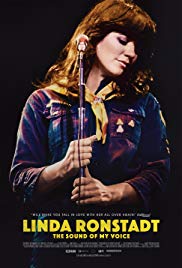
 Greetings again from the darkness. This may be a conventionally-structured documentary profiling a well-known person, but that person possessed extraordinary talent, and her story deserves to be told … or better yet, heard. Parkinson ’s disease has robbed Linda Ronstadt of her celestial vocal gift, but co-directors Rob Epstein and Jeffrey Friedman succeed in proving how dynamic she was as a singer, and also how she influenced so many others.

The film opens with the audio of Johnny Cash, Glen Campbell, Johnny Carson and Dick Cavett introducing her on their respective TV programs, while a montage of magazine covers and album covers remind of us of her once immense and widespread popularity. We then take a journey through Ronstadt’s childhood. Her grandfather invented the electric stove and electric toaster, and music played a significant role in all family gatherings. She describes how, as a young girl in Tucson, the radio was her “best friend in the world” as she listened to music from both sides of the border.

In 1964, at the age of 18 and the urging of her musician friend Bobby Kimmel, Ronstadt moved from Tucson to southern California to join a community of musicians. She rented a flat in Santa Monica for $80 per month – a price point that barely secures a meal at a decent restaurant in the area these days. Thanks to The Byrds, folk rock was exploding on the scene. Ronstadt sang back up on Neil Young’s huge hit “Heart of Gold”, and she, along with many others, performed regularly at The Troubadour. It’s here where she crossed paths with Don Henley, Jackson Browne, and JD Souther, the latter of which became her boyfriend, songwriter, and producer.

The steady stream of interviews includes Henley, Browne, and Souther, as well as LA Times music critic Robert Hilburn, Asylum Records founder David Geffen, Bonnie Raitt, producer John Boylon, the legendary Ry Cooder, Cameron Crowe, Karla Bonoff, and (former Beatles) agent and producer Peter Asher. Most memorable are the recollections of Dolly Parton and Emmylou Harris, who collaborated with Ronstadt on the 1987 Grammy winning album “Trio”. Ms. Parton’s segment is especially insightful as she contrasts her own instinctive singing style with that of Ronstadt’s analytic and perfectionist approach. Ms. Harris is featured in a clip of herself performing at a very young age, and she’s quite emotional when discussing Ronstadt’s gift.

It’s quite fascinating to follow the number of shifts in her career and musical style. After achieving so much as a folk and pop singer, she was incredibly successful in country music, and as a tribute to her mother’s favorites with American Standards arranged by Nelson Riddle. She also mesmerized with the operatic songs in “Pirates of Penzance” and stunned the music industry with her best-selling album of Mexican standards. Although she labels herself a balladeer and harmonizer, those descriptions are far too humble, and underscore the opinionated talent she was. The clips of her performing onstage are breath-taking. Her voice combining power, texture and nuance.

Linda Ronstadt was never a songwriter. She was an expert song interpreter like Elvis and Sinatra. She claims “every song has a face”, and the numerous clips of her singing provide visual proof of what she means. The film touches on her early addiction to diet pills/speed, as well as her relationship with Jerry Browne, the duets with Aaron Neville and Ruben Blades, and for bonus points mentions the influence of the late great Harry Dean Stanton. We see her 2013 Rock n Roll Hall of Fame tribute performed by five fabulous female singers … and it’s their performance that really drives home just what a pure and unique voice Ronstadt possessed. While the trip through the many genres is interesting, what really stands out are the clips of her on stage … making yet another song all hers. Linda Ronstadt certainly sang to the beat of a different drum, and we were fortunate to hear her.

watch the trailer:


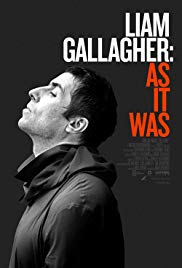
LIAM GALLAGHER: AS IT WAS (2019, doc)

September 12, 2019

 Greetings again from the darkness. Co-directors Gavin Fitzgerald and Charlie Lightening could have ended this profile of singer Liam Gallagher by playing the theme song to “Family Feud” over the closing credits. While they do offer up an unflinching look at the talented singer of suspect character, we come away with the feeling that the entire project was designed to reunite Liam and his brother Noel. The two supposedly haven’t spoken since they nearly brawled backstage at a scheduled Oasis concert: Paris 2009 Rock en Seine.

A blend of clips from that final Oasis show and Liam’s 2017 comeback concert in support of his solo album “As You Were” kick off the film. However, before the opening credits roll, we hear Liam spewing enough f-words to make any teenager blush. The assumption is that we are to be reminded of what a prig Liam was, and the reputation he earned as being a bad boy of rock. The filmmakers, along with Liam and his mum, then spend the rest of the run time trying to convince us that he’s a changed man and is actually devoted to his family and to his craft. We do believe the latter, but the former is quite a stretch. We do see his sons accompany him on a later tour, but Liam’s numerous affairs and broken marriages are glossed over.

To his credit, Liam faces the camera with some candid self-assessment. It’s unclear whether this is his own personal therapy or whether he’s choosing to come clean for his fans. Others with featured input here include former Oasis guitarist Bonehead Arthurs, Liam’s brother Paul, and Liam’s mother Peggy (who is very proud of her boy). Also offering up praise is Debbie Gwyther, Liam’s former assistant, who is now his lover and manager. He credits her with getting him back on track in life and back on stage in music.

Although the film features very little music, we do get enough concert clips to recognize Liam’s stage presence; however, it’s the camera time in the studio that is most fascinating – and leaves us feeling a bit short-changed. Seeing Liam work through songs at historic Abbey Road Studios could have made for an entire film. He is admittedly not a true songwriter, so being forced to collaborate due to the absence of Noel, probably displays the most personal growth for Liam (even if it’s out of necessity).

Liam and Noel supposedly haven’t spoken in the 10 years since that backstage fight killed off a superband and a brotherhood. The reconciliation evades the filmmakers, but they salvage the project as Liam’s solo career takes off, and he travels with sons Gene (born to singer Nicole Appleton) and Lennon (born to actress Patsy Kensit). I chuckled when it’s mentioned that Liam is ‘the greatest rock front man’ … a line easily contradicted by mentioning Mick Jagger, Bono, or Bruce Springsteen. We are told “he is who he is”, and can’t help but wonder if that’s a good thing. Having others say that he is grateful for a second chance is not the same as him stating it for himself.

watch the trailer:


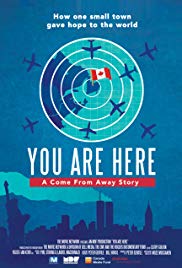
YOU ARE HERE: A COME FROM AWAY STORY (doc, 2019)

September 5, 2019

 Greetings again from the darkness. September 11, 2001 provided us examples of human nature at its worst, followed by human nature at its finest. Filmmaker Moze Mossenen begins with audio from the September 11 news reports playing over somber and beautiful shots of the Ground Zero memorial. We are immediately transported back to that fateful day, and the emotions come flowing back.

Rather than focus on the terrorists, Mr. Mossenen takes us to Gander, Newfoundland, a Canadian rock island on the far eastern shore of North America. A spectacular aerial view provides perspective for this remote village with a population of around 9000. Gander will forever be remembered as an example of human nature’s finest. On September 11, 2001, when United States air space was closed, Gander airport became a landing spot and parking spot for 38 passenger planes.

We hear from Beverly Bass, an American Airlines Captain who was directed to land at Gander. We also hear from Air Traffic Controllers, passengers, and local Gander citizens, including a local TV personality and Police Chief Oz Fudge and Mayor Claude Elliot. One of the teachers at Gander Academy relays what it was like that day. The locals shared in the worldwide shock from the terrorist acts. They feared for their own safety as the breadth of the terror plan was unknown. They watched in wonder as plane after plane landed at their small airport. And finally, they kicked into gear realizing there were thousands of passengers on the planes … each of whom were hungry, tired and frightened.

The “come from away” folks – Gander’s terms for anyone from somewhere else – numbered 6700, nearly doubling the town’s population. It took approximately 24 hours before the passengers could be taken from the planes, and in one of dozens of fascinating elements, we learn school buses are used for transport since the town only had 15 taxis. The local bus drivers were on strike, but all agreed to volunteer to drive the passengers to the churches, schools, and organizations providing shelter.

Mossenen does end up showing the footage of the planes hitting the towers, but it’s important to know that this is a film of personal stories … people doing extraordinarily kind things for those they don’t know. The spirit of Gander was something to behold. Religious and cultural differences were overcome and hospitality was the norm. It’s stunning to see the United States radar with zero planes in the air, but it’s life-affirming to see folks serving those in need, expecting nothing in return.

The film excels while Gander citizens and the air passengers recollect those few days, but it loses a bit of steam towards the end. On the 10th anniversary of September 11, Irene Sackoff and David Heim began interviewing folks and collecting stories in order to write a musical of the events. And they succeeded. Yes, “Come From Away” became a Broadway hit, and the film shows those from Gander who made the trip to NYC to see the show. This is one time where the lights of Broadway pale in comparison to ‘101 ways to cook goulash’. The willingness to do what needed to be done is the inspirational message delivered by Gander. Neighborly love and generosity in the aftermath of tragedy turned this into a beautiful story … the best of humanity. Moose stew anyone?

watch the trailer:


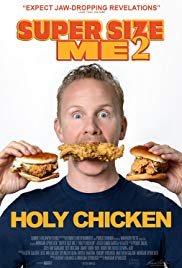
SUPER SIZE ME 2: HOLY CHICKEN! (doc, 2019)

September 5, 2019

 Greetings again from the darkness. What we expect in a documentary is a presentation of the topic in a manner slightly slanted towards the filmmaker’s beliefs. What we hope for in a documentary is to learn something new or to be exposed to a different way of looking at a subject. We don’t typically expect a great many laughs or even a film with significant entertainment value. For those who recall Morgan Spurlock’s 2004 Oscar nominated SUPER SIZE ME, you likely won’t be surprised that his latest is heavy on humor and entertainment, and a bit light on education. Still, his formula works – and we allow ourselves to be dragged along.

Spurlock kicks the film off by announcing that he wants to open his own fast food restaurant. He proceeds to confer with some celebrity chefs, a marketing firm, and a business strategist. Capitalizing on his success as a documentary filmmaker is a key element to the strategy, and of course, his mission is to once again expose the fast food industry for perpetuating myths of healthier fast food options.

He legitimately asks, “Have things gotten better?” We are meant to interpret this as … have things gotten better since 2004 when Spurlock documented his self-imposed all-McDonalds food every meal for an entire month. It’s at this point where the research kicks in. Facts and statistics are discussed. We learn that 44% of us eat fast food regularly, and that chicken overtook beef a couple of years ago as the protein of choice. We first assume this must be due to consumers making the “healthier” choice, but then we are informed that fried chicken outsells grilled chicken – and the gap is widening.

The most interesting segment of the movie occurs as the buzzwords and their meanings are discussed. Having “nutrition” broken down from a marketing perspective truly exposes the outright fraud being perpetrated on the public. “Health Halo” is the moniker applied to descriptions like “fresh”, “all-natural”, and “no added hormones”. Even “crispy” is used in place of the more accurate “fried”, which is obviously a word no consumer would associate with healthy food. Spurlock is in his element when providing a startling visual for what qualifies as “free range” according to the FDA.

‘Big Chicken’ is compared to ‘Big Oil’, as 5 corporations control 99% of the chicken farming industry: Tyson, Perdue, Pilgrims, Koch Foods, and Sanderson Farms. We get an explanation of how these corporations apply enormous pressure on the farmers, keeping them in a constant state of debt – or worse for farmer Jonathan Buttram who has been blackballed for helping Spurlock make this movie. Spurlock bounces from Columbus, Ohio to Boulder, Colorado to Tennessee to Kentucky to Washington, D.C, to Alabama; and from Chick-Fil-A to Wendy’s to 7-11 to Popeye’s, and even to McDonalds – Spurlock’s first visit in 12 years to the establishment that put him on the movie map.

Very little new information is provided here, but Spurlock does what he does best – entertain with examples of extremes. While his “fried grilled” chicken sandwich is a publicity stunt, the real story is how menus and labels are used to manipulate the consumer, many who don’t seem to much care.

watch the trailer:


RAISE HELL: THE LIFE AND TIMES OF MOLLY IVINS (doc, 2019)

August 29, 2019

 Greetings again from the darkness. We can’t help but be drawn to that rare breed who possess a perfect blend of intelligence, humor, wit, and communication skills (whether written or oral). These people tend to make us laugh while they educate us and motivate us to think. Documentarian Janice Engel delivers a fascinating look at a fascinating woman, Molly Ivins.

With a subject like Molly Ivins, there is no question the time spent watching this will be entertaining; however, Ms. Engel doesn’t miss an opportunity to dig a little deeper. Of course we see many archival clips of Molly delivering her own expertly chosen words – typically at the expense of some conservative politician, and we also are treated to personal insights from her siblings, as well as a couple of childhood/lifelong friends.

A traditional timeline is used for this anything-but-traditional woman. She stood 6 feet tall at age 12, and even as an adult she was a physically imposing presence in an occupation where women were still battling for acceptance. Her dad was a right-winger and she was a 3rd generation Smith College graduate, yet Molly remained an independent and (very) critical thinker … delighting in exposing political corruption and incompetence. Her favorite punchlines typically skewered Texas politics and Texas politicians. A Master’s degree from Columbia finalized her educational pedigree, but it was her colorful writing style that elevated her observations to a level of brilliance.

Molly Ivins once described the idea of objective reporting as “horse pucky”. It’s this type of honesty and straight talk that set her apart from so many reporters – both in her day, and even more so today. She knew and admitted that her own political views affected what she wrote, yet readers from both sides lapped up anything she committed to the page. That’s not to say she didn’t ruffle feathers. In fact, her feather-ruffling was world class. During her career, she held newspaper gigs in Minnesota, Austin, New York, Denver, and Dallas … including The New York Times and The Texas Observer. Her column peaked when she was syndicated in more than 400 papers nationally. Molly Ivins was a big deal.

Others interviewed include Rachel Maddow, Dan Rather, Paul Krugman, and Ann Richards’ daughter Cecile. Everyone loves to talk about a woman who brings a 6-pack of beer to a job interview, and referred to herself as the “resident communist”. She admitted to being an alcoholic, and to being lonely at times; but the one thing she never did was sacrifice the work for personal gain. She wrote best-selling books, was a fabulous public speaker, appeared on TV and radio talk shows, and of course, spread her words on the page.

Molly Ivins was a wizard of words. She had much to say and many of us paid attention – whether we agreed or not. Her exceptionally strong and aggressive attacks on George W Bush might be what she is best remembered for, but “gang-pluck” may be a close second. Mostly we admire the tenacity and wit and genius that was the one and only Molly Ivins.

watch the trailer:


AQUARELA (doc, 2019)

August 29, 2019

 Greetings again from the darkness. This is not your father’s Nature documentary. It’s more like Mother Nature giving us a glimpse at her most beautiful, peaceful, ferocious and terrifying self. And it’s just water. Simple H2O. Only it’s not so simple. In fact, water takes many forms, and Russian filmmaker Victor Kossakovsky serves up some stunning water photography from around the globe.

The film begins with a rescue team working frantically to pull out a car that has fallen through the ice. When the camera finally does pull back, we see the vast space of the lake covered in ice. Other cars speed across the frozen body of water as if it’s a sport or thrill for the driver. When another mishap occurs, we realize the tragedy is blamed on ice that has melted “3 weeks” earlier than usual. So we brace ourselves for another lecture on climate change.

It’s a lecture that never comes. Surprisingly, there is no narrator. Perhaps Morgan Freeman signed a non-compete with the penguins. Kossakovsky allows the camera and nature to show the story, albeit with periodic musical accompaniment from composer Eicca Toppinen – sometimes with heavy metal chords, sometimes with soothing strings. Filmed in Greenland, Venezuela, Siberia (Lake Baikal), and Miami, Florida, where we see the effect of Hurricane Irma, water is shown in its glory. At times peaceful, at times violent. A sailboat captain fighting a storm might be followed by a breath-taking waterfall, which might be followed by a flooded town … and even a swimming horse is photographed underwater.

Waves, glaciers, whales and dolphins combine for an unusual cinematic experience, and the most staggering sound comes courtesy of the ice moaning and water running. It’s one best enjoyed with theatre screen and sound, and a film that will likely lose something even on the finest home systems.  Filmed at 94 frames per second (rather than industry norm of 24 or 48), the visuals are truly breathtaking … and sometimes disorienting. As George (on “Seinfeld”) once said, “The sea was angry that day, my friend”; and now we have witnessed the anger for ourselves.

watch the trailer: