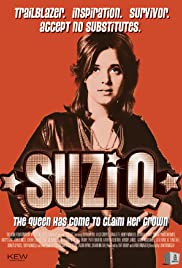
SUZI Q (2020, doc)

July 2, 2020

 Greetings again from the darkness. “Home is where the heart is.” That’s a two thousand year old phrase whose sentiment has multiple interpretations. It’s the phrase that came to mind while watching Liam Firmager’s profile of Suzi Quatro, the pioneering female Rock ‘n Roller. She started as a middle-class Detroit girl who went on to have a huge international career, though her music never really clicked with the U.S. audience. The emotions from and towards her family are even more complicated.

Playing a bass guitar that made her look even smaller than her diminutive 5 foot frame, Quatro was quite the stage presence in her leather jump suits (inspired by Jane Fonda’s character in BARBARELLA) and constant motion. Kathy Valentine of The Go-Go’s admitted that she had never even thought about women playing instruments in a rock band until she saw Suzi. Most of the interviews here have a similar thread: Suzi Quatro was a main influence for such female rockers as Cherie Currie and Lita Ford of The Runaways, KT Tunstall, Debbie Harry, Tina Weymouth of The Talking Heads, and of course, Joan Jett. We hear from each of these musicians as they pay tribute to their trailblazer. When Suzi is described as “the quintessential rock ‘n roll chick”, it’s obviously a term of respect.

The film has a bit of a disjointed structure and uneven flow, but that doesn’t diminish the message. Suzi Quatro was a daring ground-breaker. We get some of the backstory regarding her family, as she credits her mother for instilling Catholic morals, and her dad for passing along his performing gene. But it’s the sisters who provide the most insight. These are the type of sisters who didn’t tell Suzi about an offer from renowned music producer Mickie Most, because they didn’t want her to quit their band and have success without them. It’s these same sisters who, almost 50 years later, refuse to give Suzi the respect she so craves.

Alice Cooper speaks to her influence, and Henry Winkler recalls her time as Leather Tuscadero, a recurring character on “Happy Days.” We also hear from Len Tuckey, Suzi’s guitarist and first husband, who offers insight to the band and the person. There is also a segment (with a clip) on her success in the stage musical “Annie Get Your Gun”, and, on a personal note, we learn Suzi is the aunt to actress Sherilynn Fenn (“Twin Peaks”).

Suzi Quatro has sold over 55 million records in her career … and she still plays live gigs today (well at least prior to the pandemic). The driving ambition that motivated her to pursue her dream is still there, although she admits “most girls gave up music to have a life.” We see her in 1973 and in 2019. The leather and the energy are still present, as is the mystery of why she was so much more popular internationally than in her home country. The film touches on the male-oriented business and the sexism that occurred. There is footage of a stunning moment on a British talk show where the host actually slapped her on her leather-clad derriere. Imagine that moment today! Was Suzi Quatro ahead of her time, or did she come along at just the right moment? Either way, the professional success contrasted with the unresolved family issues, make this more than a standard rock bio. It’s a history lesson with a moral to the story.

Available on VOD July 3, 2020

watch the trailer:


MADAGASIKARA (2020, doc)

June 25, 2020

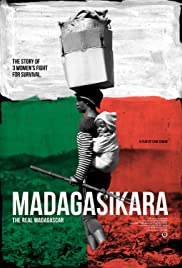
 Greetings again from the darkness. Madagascar is the fourth largest island in the world at 228,900 square miles. 90 percent of its wildlife is found nowhere else, and it features a unique ecosystem with staggering natural resources. It’s been the subject of National Geographic specials and very successful (and cute) animated kids’ movies. Contrasting to all of those details, is the fact that the vast majority of the citizens live in extreme poverty and suffer from malnutrition, while the government is in near-constant turmoil.

Cam Cowan is a former attorney, and this is his first documentary feature. Rather than bury us in bottom-of-the-world economic data, or frustrate us with details of years of political corruption and upheaval, he allows us to focus on the very personal stories of three women … each woman striving to survive the day and provide for her family.

Lin offers laundry services for the community. The first day we see her, she makes 28 cents, which just about covers the cost of 2 cups of white rice. One of Lin’s babies died a few months after birth, and she buried the young girl at the front door stoop, so that she never forgets. Deborah began as a sex worker at age 12. She recounts how some physically abuse her and don’t pay. Her dream was to be a lawyer, but now hopes her kids can get the education she was denied. Tina busts rocks in local quarry. She spends hours each day under the sun without even the luxury of gloves to protect her hands.

In 2009, Malagasy citizens took to the streets to protest corruption in government. The international community responded by cutting off support. That support accounted for 60% of social services, including food, healthcare, and education. A sinking country sunk even lower. We learn that Madagascar is the only country untouched by war where the populace is now poorer than they were in 1960. In fact, the majority of citizens earn less than $2.00 per day, and 80-90% fall below the poverty line.

As a mother plucks fleas and larvae from her kids’ feet, she admonishes them with, “From now on, tell me when you have fleas in your feet.” We may think parenting is difficult, but the guess is, you’ve never warned your kids about fleas nesting under their skin. The film touches on some of the issues with government structure, but there really isn’t enough time for a deep dive. We also learn about humanitarian Father Pedro, who helps educate and feed children. He’s the subject of Mr. Cowan’s next documentary, OPEKA, which is being released as a follow up to this one.

The island’s natural resources are not really discussed here, as the focus is on the people and the daily hardships they endure. There is an undeniable spirit amongst these people, even though it’s a struggle to find hope. Some of the international support has returned, but it’s clear real change won’t happen until the government is structured to support the citizenry and trust is restored. This is tough to watch, but we must.

Opens on Amazon Prime June 26, 2020

watch the trailer:


THE GHOST OF PETER SELLERS (2020, doc)

June 24, 2020

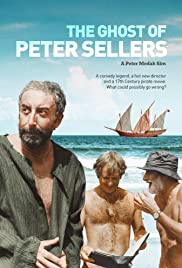
 Greetings again from the darkness. Watching someone go through therapy – exorcising the demons of their life – is a bit uncomfortable. So while we understand Peter Medak’s ‘need’ to revisit the project (from almost 50 years ago) that nearly derailed his promising career, there are plenty of moments here where we feel like we are intruding. As a filmmaker, Mr. Medak’s most natural form of expression is with a camera, so re-tracing a dark time as a documentary makes some sense; we just wonder why he had to drag us along to share his misery.

A “67 day nightmare” is how Peter Medak describes the experience of filming GHOST IN THE NOONDAY SUN, a film that was never officially released. It was 1973 and Medak was a hot young director, fresh off THE RULING CLASS with Peter O’Toole. When Peter Sellers, one of the most sought-after international film stars, agreed to sign on, the 17th century Pirate movie based on the novel by Albert Sydney Fleischman, was thought to be a sure-thing box office smash. In reality, it was the beginning of Medak’s nightmare that still haunts him today.

While re-visiting the original Cyprus sets, and meeting with seemingly anyone who was involved with production and is still alive, Medak recollects specific instances of things that went sideways. The vast majority of it leads right back to the behavior of Peter Sellers, who seemed to be sabotaging the film from very early on. Was it arrogant “star” behavior? Was Sellers depressed over his breakup with Liza Minnelli? Was he bi-polar? We get interviews with co-writer (and Sellers’ buddy) Spike Milligan’s agent Norma Farnes, as well as the film’s Costume Director Ruth Myers, and Sellers’ stuntman Joe Dunne. None of these folks seem to have any pleasant memories of making the movie, and when you add in commentary from other filmmakers like director Piers Haggard (THE FIENDISH PLOT OF DR FU MANCHU, Sellers’ final film, 1980) and director Joseph McGrath (CASINO ROYALE, THE MAGIC CHRISTIAN), it appears the common denominator in creating anguish was Peter Sellers.

Among the tales we hear are in regards to Sellers firing a producer, his clashes with Medak and co-star Tony Franciosa, his push to keep Spike Milligan involved as writer and director of some scenes, and most shocking of all, Sellers’ faking a heart attack on set, and the admission of collaboration in fraud from Dr. Greenburgh. We expect artists to have unusual personalities and quirks, but it’s unfortunate when one person can affect the livelihood of so many others.

‘Why go through the pain of re-visiting this?’ Medak is asked the question a couple of times, and it certainly runs through our head while watching. Clips from the film are dropped in throughout the documentary, and it comes across as a pirate farce that appears to have been disjointed at best. I recently watched a “lost” Sellers film entitled MR TOPAZE (aka I LIKE MONEY) from 1961. It was the only feature film where he was credited as director, and if the stories from behind-the-scenes are true, it was yet another case was Sellers was guilty of sabotage.

Medak’s mission with this documentary seems to be one of catharsis. Or maybe it’s his chance to prove he wasn’t to blame for the tragedy of this project. When he talks to producer John Heyman, it seems clear that Heyman, despite losing millions on the film, was able to move on – to get over the setback … something Medak still hasn’t done. While no cast or crew members attended the wrap party, we do wonder if anyone will have an interest in this mess that occurred nearly five decades ago. The only value may be from the perspective of cinematic history or lore, at least other than, hopefully, Peter Medak’s mental well-being and soul cleansing.

Available on VOD June 22, 2020

watch the trailer:


RETURN TO HARDWICK (2020, doc)

June 9, 2020

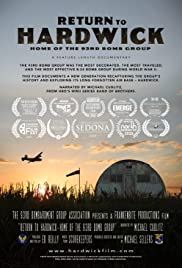
 Greetings again from the darkness. ‘The greatest generation.’ Some might consider it an overused colloquialism, but watching this documentary from Michael Sellers proves yet again just how true that “greatest” description is. Mr. Sellers blends the history of the 8th Air Force, 93rd Bombardment Group, the personal stories of those who served, and the airfield that was so crucial to their record number of missions … Hardwick Aerodrome 104 in East Anglia.

As the grandson of John L Sullivan, a bombardier/navigator in the 93rd, Sellers has followed the group closely, and decided to make a film on the 2015 reunion as veterans and family members visited Hardwick. The result is a touching tribute that weaves personal stories with WWII history. Opening with the beautiful prose written by Ed Reilly, a radio operator with the 93rd, on his 1975 (30 years after the war) trip to Hardwick, we then shift to the narrator, actor Michael Cudlitz (“Band of Brothers”) and this trip to Hardwick 40 years after Reilly’s.

Sons, daughters, grandchildren and surviving unit members make the trip, and we are told that the 93rd Bomb Group was the most decorated, most traveled, and most effective of the WWII bomb groups. With much of the airfield now farm land, it would be easy to classify Hardwick as ‘forgotten’, but that’s simply not the case. The main runway was bulldozed years ago, and many of the structures are long gone, but there is a group of locals who maintain a museum dedicated to Hardwick and those who served. There are multiple albums with organized photographs, and remnants including what’s left of a pilot’s jacket after a horrific plane crash. That pilot’s nephew is on the trip, seeking any details he might discover.

It’s that kind of personal touch that grabs us. There is even a love story – one that either blossomed due to WWII, or in spite of it. The daughter of the woman who fell in love and got married is on the trip. The museum’s albums hold a photo of her parents that she’s never seen, and she gets to visit the local chapel where their service was help. We hear from locals who recall watching the airfield being constructed, and how appreciative they are of 1942 when the US Air Force joined the Allies in the fight against Hitler.

Interviews are shown with those who served (Navigators, Pilots, Gunners, Ground Crew), their families, and those keeping the memories and history alive. We see photos, personal letters, and archival video of a time that truly changed the world. Director Sellers uses animated graphics to superimpose images of the original airfield and structures over today’s topography so that we have a visual of what Hardwick once was. The 93rd is credited with flying 396 missions, the most in the Air Force, including air sport over Normandy on June 6, 1944. As if all of the personal tales weren’t emotional enough, Sellers takes his camera to the Memorial Day ceremonies at Cambridge American Cemetery and Memorial. It’s quite a sight. Finally, we learn that hot dogs were the “hurry up food” for those headed to their next mission!

DVD and Digital Download via iTunes on June 9, 2020

watch the trailer:


LOST IN AMERICA (2020, doc)

June 8, 2020

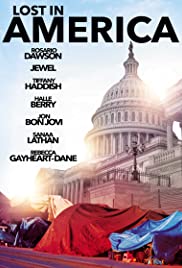
 Greetings again from the darkness. The thought of anyone being homeless should not sit well with any of us. And whether you are a parent or not, the thought becomes even less tenable when kids are involved. Director Rotimi Rainwater accomplishes two goals with his project: making it personal, and revealing the scope.

“These are their stories.” Director Rainwater introduces us to several young homeless folks around the country and allows each to explain their situation in their own words. As you might expect, the stories are painful to tell and excruciating to hear. The project spans about four years (2013-2017) and Rainwater revisits some of these folks more than once. In addition to hearing from these homeless youngsters, we learn how little data exists, and how, as a country, we seem to be pretending the problem is minor and not worthy of more attention. With youth homeless estimates ranging from 48,000 to 2.8 million, one need not be a statistical analyst to recognize faulty and incomplete data.

We simply don’t know how many homeless youths live on our streets, and we don’t have the background information to know why they are there. Celebrity activists interviewed include Halle Berry, Jon Bon Jovi, Mylie Cyrus, Tiffany Haddish, and Sanaa Lathan, as well as co-producers Rosario Dawson and Jewel. Additionally, we learn about the efforts of Senator Patrick Leahy (D, Vermont) and Senator Susan Collins (R, Maine) as they promote their bi-partisan “Runaway and Homeless Youth and Trafficking Prevention Act” to re-authorize and update the specifics of the “Runaway and Homeless Youth Act” first passed in 1974.

The film breaks down into four key elements faced by homeless youths: the failure of the Foster Care system, Sex Trafficking, LGBT affiliation, and the underfunding and scarcity of shelters. Actress Tiffany Haddish recounts her experience with Foster Care. We learn that 300,000 youths are targeted for sex trafficking each year, and the average age is 12. Surveys report that 40% of homeless youths identify as LGBT, and this one issue has prevented additional government funding.

The most poignant sections of the film occur when we hear directly from the homeless. The word “safe” is utilized numerous times, because being alone is scary and dangerous. One of those interviewed states, “When the sun goes down, it’s a completely different atmosphere.” Chilling words. The only misstep for the film comes from Rainwater’s decision to include entirely too many talking heads. We simply can’t keep up with who is talking and what their relationship to the homeless situation is. He does make the point that many are aware of the issue and that 5000 homeless youths die each year, but it’s the personal accounts – including his own – that make an impact. It’s also the first film this year where someone uses “burrito” as a verb. As the film concludes, Jewel’s song “No More Tears” plays as the director provides updates on the individuals we met. Happy endings are not typical.

Available on DVD and Digital June 9, 2020

watch the trailer:


2040 (doc, 2020)

June 4, 2020

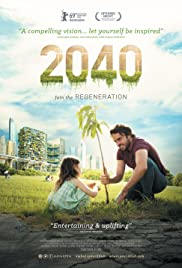
 Greetings again from the darkness.  Where do you see yourself in “X” years? That’s a common job interview question, and with a slight twist, it’s the question Damon Gameau asks himself and us … only his question is about our planet, and it’s meant to have us consider life for the next generation. Mr. Gameau makes it personal by structuring this as a (future) video letter to his 4 year old daughter Velvet, and describing what the world could be when she turns 25. What we immediately notice is that Gameau takes an optimistic approach, in contrast to the doom-and-gloom versions of climate change that we’ve come to expect. Rather than scare tactics, Gameau dishes hope.

In 2015, Australian Gameau delivered a documentary (THAT SUGAR FILM) where he dove mouth-first into the evils of sugar in our diet, and it’s his experience and training as an actor that allows him to come across as ‘one of us’ as he finagles his way through complicated topics. This time out, he tackles climate change and the environment, and he does so by focusing on the solutions and approaches that already exist. This is designed to prove to us that making a better tomorrow is within our grasp, and there’s no need for a miracle – and no excuse for waiting for one.

We follow along to different countries, and hear from many experts. The topics include carbon off-set, the oceans’ acidity level, solar-powered microgrids in Bangladesh, soil regeneration, on-demand self-driving electric cars, and doughnut-hole economics. Along the way, Gameau lets us hear from the experts, as well as a group of school kids who tell us what they’d like their future world to look like.

Science is discussed, but true science geeks may find this a bit too light on data and research. Gameau chooses instead to give us a glimpse into some available solutions from around the globe. We do learn that the oceans absorb heat and carbon, so carbon off-set through sequestering carbon and reducing emissions is essential. We learn that one-third of farmland is used to grow food for animals, so the advantage to growing more food is obvious – and it also leads to interesting discussions of soil regeneration. Given our current structure, it’s difficult to imagine if many parking lots and roads could be converted to greenspace again, and the on-demand self-driving electric cars segment was quite enlightening.

Kate Raworth wrote the 2017 book “Doughnut Economics: Seven Ways to Think like a 21st Century Economist”, and the Gameau gives us an animated overview of what this means. Whether it’s a practical solution is unclear, but Gameau has enlisted passionate people to his cause of focusing on existing solutions to provide a better future. Even though his ‘imagined’ year 2040 features him with grey hair, and the score throughout is quite obtrusive, Damon Gameau is to be commended for an entertaining and positive look at what we can do right now to ensure a better tomorrow. There is hope.

The film is available VOD on June 5, 2020, and for more information: https://whatsyour2040.com/

watch the trailer:


THE PAINTER AND THE THIEF (2020, doc)

May 21, 2020

 Greetings again from the darkness. Artists think differently than the rest of us. Not only do they see the world with an offbeat or skewed vision, but they process life events in ways we sometimes can’t fathom. For instance, if a crime were committed against you – say, your property was stolen – your natural response would be anger, or a desire for justice for the perpetrator. In Norwegian director Benjamin Ree’s documentary, Czech artist Barbora Kysilkova reacts much differently when her two most valuable paintings are stolen. She befriends the thief.

We see the security video footage. Karl-Bertil Nordland and another man break into Oslo’s Galleri Nobel and then walk out with Barbora’s paintings. Upon being apprehended, the painter and thief have a chat in the courtroom. Bertil confesses that he chose the paintings because they were “beautiful.” The artist is intrigued and invites the thief to pose for a portrait when he is released from jail. As if this situation isn’t bizarre enough, Bertil claims he has no idea where the stolen paintings are, and has no memory of what happened. Yes, he’s also a drug addict.

It’s a bit uncomfortable to watch post-prison Bertil lounging on Barbora’s sofa as she sketches him and they converse about philosophies of life. Slowly, their relationship builds into a friendship. It’s an unlikely connection through art. We get a rare glimpse of an artist at work, as we see Barbora in her studio working on her pieces. Of course, she is also saddened by the loss of the two unrecovered pieces, and we also witness the artist struggle with the commerce/business side of art, as she faces frequent rejections from galleries as she attempts to display her work. This is on top of the lectures from her boyfriend … lectures delivered in the manner a parent would talk to their kid.

One of the more surreal moments occurs when the camera films Barbora at Bertil’s place, and she sketches him and his girlfriend in a provocative pose. During all of this, we hear Barbora discussing why she finds Bertil interesting, despite his junkie-criminal lifestyle. After all, he is the kind of guy who scores a fix on his way to rehab. Things get very interesting … in a weird way … when Ree turns the tables and films Bertil analyzing Barbora.

These two have studied each other over the years, and may have a better understanding of their friend, than they do of themselves. Watching Barbora act as caregiver for an injured Bertil is a confusing development to process, but it goes back to how artists see the world through their own eyes. Her paintings may be ultra-realistic, but her life barely qualifies as our reality … at least until the rent is past due. The connections through the circle tattoo may come across as somewhat creepy, and we find ourselves a bit skeptical of many scenes where the camera is present, but there is no denying this works as a remarkable character study of two people we wouldn’t normally categorize as friends.

Neon is presenting this via Virtual Cinema beginning May 22, 2020

watch the trailer:


A TOWERING TASK: THE STORY OF THE PEACE CORPS (2020, doc)

May 21, 2020

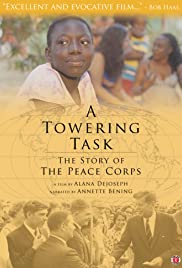
 Greetings again from the darkness. The PSAs that frequently popped up on my childhood TV are vivid memories, though it took many years before I had any concept of what the Peace Corps was, how it was formed, and what it did. Director Alana DeJoseph, herself a Returned Peace Corps Volunteer (RPCV), and writer Shana Kelly want to make sure we all know the history of the organization, what its mission has been for almost 60 years, and most importantly, that the Peace Corps still exists today.

William J Lederer and Eugene Burdick co-wrote the 1958 political novel “The Ugly American”, and the best-seller had a surprising effect on John Kennedy’s ability to get The Peace Corps established not long after he became President of the Unites States.  In 1961, President Kennedy named his brother-in-law, Sargent Shriver, as the organization’s first director. Shriver was a passionate leader and served as the director into 1966. We see archival footage and photographs of Shriver’s time with the Peace Corps, and learn that a memo from his task force was responsible for the phrase “A Towering Task”, a recurring reference over the years, and the title of this film.

From the beginning, there were vocal skeptics. An escape plan for ‘draft dodger’ is how many cynics labeled The Peace Corps, and it was a difficult label to shake. We learn that in the beginning, four out of every five applicants was denied admission, and the footage of those early training regimens looked more like the Marines than a volunteer service organization. Still, many were attracted to the stated mission: Promote World Peace and Friendship, a mission that remains in place today.

In addition to the treasure trove of archival footage and speeches, there are many interviews with authors, former volunteers, and many of the directors who have served. We view some of the recruiting films and PSAs and travel through the procession of US Presidents from Kennedy through Trump, and explore the various challenges faced by the Peace Corps. One of the more in-depth segments involves the longest-serving former director Loret Miller Ruppe, who was director from 1981-89. Her recounting the story of the Prime Minister of Fiji and his words to Ronald Reagan are a highlight.

Ms. DeJoseph and Ms. Kelly have delivered a most-informative history of the Peace Corps in a matter-of-fact manner. Four-time Oscar nominee Annette Bening serves as the narrator, and her work is serviceable, though lacking in energy. The film is neither propaganda nor a hard sell for volunteers, and it’s not what one would call entertaining. Instead, it serves as a detailed timeline of this important agency, and that is an important step for posterity.

Available in Virtual Cinema beginning May 22, 2020

watch the trailer:


MOSSVILLE: WHEN GREAT TREES FALL (2020, doc)

May 9, 2020

 Greetings again from the darkness. The film draws its title from both the town it studies and a Maya Angelou poem. It opens with a short excerpt from that poem; though not until we have watched documentarian Alexander Glustrom’s film do we fully understand the connection. Mossville is a rural community just outside Lake Charles, Louisiana. It was settled by free slaves in the 1800’s, and this is the story of how that history is literally being bulldozed from existence.

Mr. Glustrom makes the story personal by serving up the stories of Mossville residents Stacey Ryan and Erica Jackson, with Mr. Ryan getting the most attention since he is truly the last holdout. Holdout from what? Well that would be the massive industrial construction project of SASOL (South African Synthetic Oil Limited), which the state leaders excitedly announced would bring a $14 billion investment inside the Louisiana borders. We learn the Mossville population peaked at more than 8000, but after the SASOL land purchase, most of the community no longer exists.

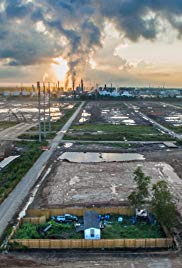
Stacey Ryan is a holdout, and aerial views show the stunning transformation of the land from majestic trees and comfortable homes to acreage stripped of anything living that’s not operating heavy equipment … other than Mr. Ryan. His little plot stands out as an anomaly – a mobile home and battered pickup in the midst of a steady stream of bulldozers and dump trucks. Even after his utilities are cut off, Mr. Ryan remains. He explains that during his school days, he was referred to as “Greasy” because he was constantly working on cars. His mechanical skills allow him to rig up electrical, water, and sewer. He’s a resourceful guy fighting industrial facility encroachment.

“Fenceline community” seems to be an insufficient description of Mossville. An EDC spill … a toxic industrial accident … affected many in the area, and that’s where Erica Jackson comes in. She’s located in the “voluntary buyout” area, and explains how her family has been inordinately impacted by disease since the spill. The widespread health issues of her family and previous neighbors are addressed by an Environmental attorney, but it’s a story we’ve heard many times before. Corporate negligence and systemic racism seem to be ignored when it comes to “progress” and when capital investments are at stake. A reasonable middle ground seems possible, though that’s rarely the case.

Mr. Ryan states, “I elected to stay behind because there is no other place for me.” He has his own personal dreams for raising his son, and no one can spend this time with him and judge him as some radical or rebel … he even introduces us to the Mossville Sabretooth Squirrel! He’s simply trying to stay connected to his family roots, though deep down, he knows the days are numbered. There is no fairy tale ending, as this is the reality of a population that is outgrowing its home planet. Mr. Ryan states, “To them, I don’t exist.” This brings us back to the Maya Angelou poem: “They existed. They existed. We can be. Be and be better. For they existed.”

now streaming in Virtual Cinemas

watch the trailer:


SPACESHIP EARTH (2020, doc)

May 7, 2020

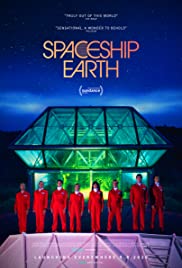
 Greetings again from the darkness. Most all of us built a terrarium for science class when we were in junior high. Did you ever fantasize about living in it? Well that’s basically what happened in 1991 when 8 scientists were sealed up in Biosphere 2, a giant terrarium built in Oracle, Arizona. Their mission was to live a self-sustained existence for two years, and this was done in the name of scientific research that might one day lead to humans living in space. It was known as Biosphere 2 since they considered Earth to be number one, and filmmaker Matt Wolf kicks off the documentary with actual news clips from that day in 1991 when the door was shut behind the eight biospherians.

After running those initial clips, Mr. Wolf immediately takes us back 25 years prior, and introduces us to The Synergists – a group of resourceful, very smart, free-thinkers who assembled in San Francisco under the charismatic leadership of John Allen. At first, it’s a little confusing why we are watching these old ‘home movies’ from what appears to be a commune, and listening to these people, now 50 years older, talking about the good old days. Of course, the backstory of these folks with nicknames like Johnny Dolphin, Flash, Salty, and Firefly turns out to be the foundation of Biosphere 2 … but not before they form Synergia Ranch in 1969 New Mexico, and then build a ship in Oakland from scrap metal in 1974. Their ship was named Heraclitus, after the Greek philosopher, and their inspiration was derived from writers Buckminster Fuller (“Spaceship Earth”), Rene Damaul (“Mount Analogue”), and William S Burroughs.

It’s understandable if your thoughts drift towards ‘cult’ or ‘commune’, but as one of them states, they were “a corporation, not a commune.” With international interests in a hotel, an art gallery, and a theatrical group, amongst other enterprises, they were able to sustain their creative pursuits … unlike the many hippies of the era numbed by drug use. Inspired by the 1972 movie SILENT RUNNING, Mr. Allen and their in-house architect Phil Hawes began working on the idea of a self-contained space colony. By 1986, design work for Biosphere 2 had begun and Ft Worth oil billionaire Ed Bass was bankrolling the project. It was a massive undertaking both from planning and construction, plus the training and selection of biospherians began in 1990.

Given today’s ‘social distancing’ due to COVID-19, it’s a bit ironic that we are looking back at a 28 year ago small group isolation in a self-contained environment. Filmmaker Wolf doesn’t shy away from the science world skeptics who, with a smidge of jealousy labeled the venture “trendy ecological entertainment.” Whatever you call it, this was an international event and drew interest from all walks of life, right up until 1993 when the biospherians walked out of the dome. In another sign of remarkable symmetry to today’s world, in 1994 Mr. Bass fired most of the original group, and put Steve Bannon (yes THE Steve Bannon) in charge of Biosphere 2. It might not surprise you that most of the scientific data and research soon disappeared.

Wolf takes us 25 years after the mission to catch up with Mr. Allen and other Synergists. The Synergia Ranch still exists and John Allen remains as energetic and idealistic as he was in the 1960’s. Biosphere 2 is now open to the public and being managed by the University of Arizona, and we still aren’t sure whether a pre-fab paradise will work in space. Wolf’s film is filled with interesting tidbits from 3 different eras, and though the early days are quite entertaining, it seems entirely too much time is devoted to the time prior to the Biosphere. And because of that, many of our questions remain unanswered as to whether the two years advanced research, or whether the effort was nothing more than a glorified publicity stunt. Either way, capturing this in documentary form allows the 1991 Biosphere 2 project to be explained to future generations … some we hope will be as innovative, and dream as big as the Synergists.

The documentary will release May 8, 2020 on Hulu, VOD, Virtual Cinemas, and participating Drive-Ins.

watch the trailer: