WICKED LITTLE LETTERS (2024)

April 4, 2024

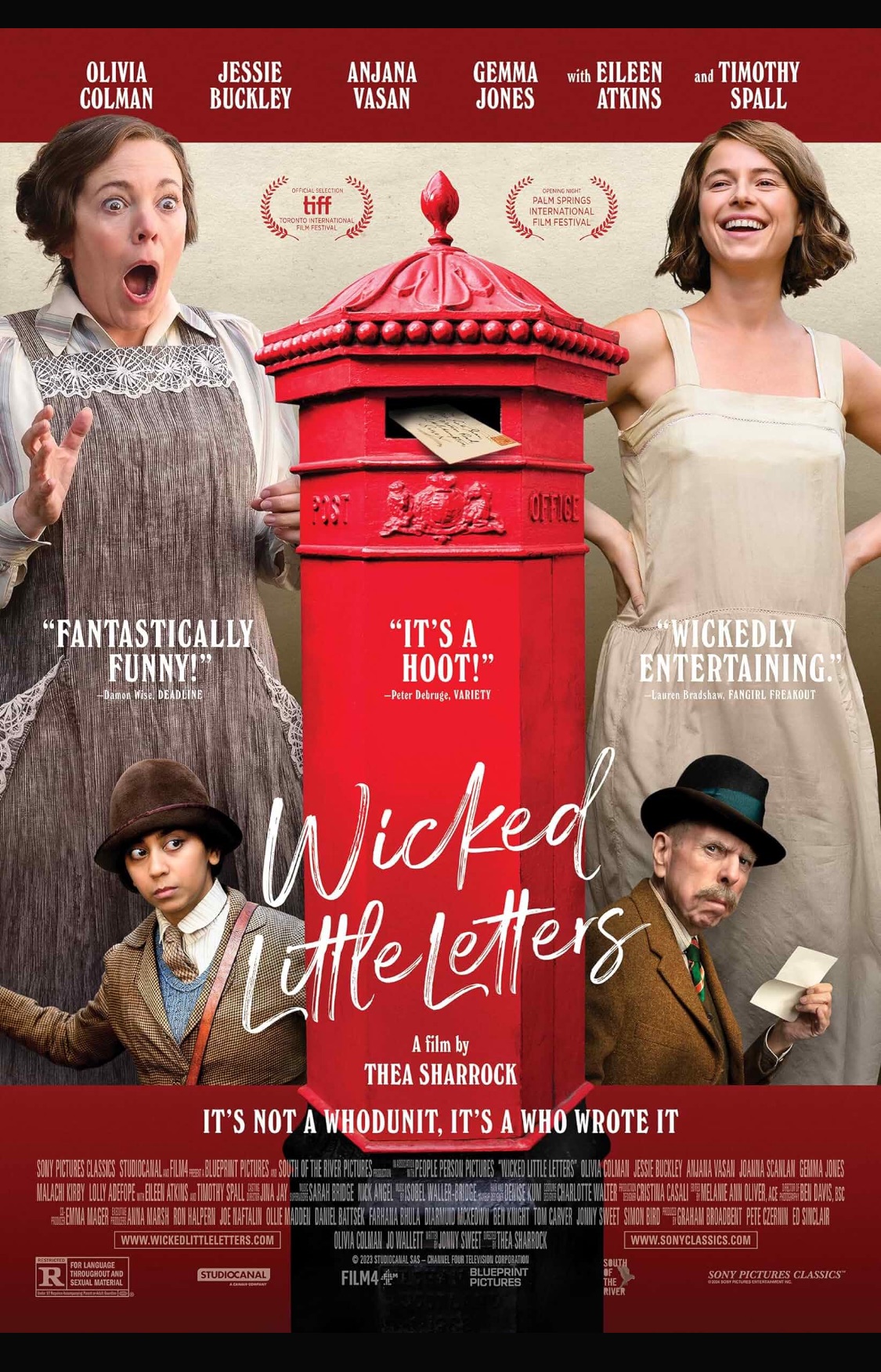
Greetings again from the darkness. “This is more true than you’d think.” Director Thea Sharrock (ME BEFORE YOU, 2016) kicks off the film with this statement. The movie then proceeds to twist and stretch and outright change many of the details from the actual story and case outlined in the 2017 book, “The Littlehampton Libels: A Miscarriage of Justice and a Mystery about Words in 1920’s England” by Christopher Hilliard. However, from an entertainment perspective, the script from Jonny Sweet combined with the stellar British cast works pretty well as a glimpse of that era’s patriarchal society, as well as the need for attention from someone who has been stifled for far too long. And it even includes a few laughs along the way.

As Edith Swan (Oscar winner Olivia Colman) and her elder parents Edward (Timothy Spall) and Victoria (Gemma Jones) gather around the table to read the anonymous profanity-laced letter, we learn it’s the 19th one received by Edith. The decision is made to contact Constable Papperwick (Hugh Skinner, FALLING FOR FIGARO), who is quick to accept as fact their presumption that the letters’ source is neighbor Rose Gooding (Jessie Buckley). See, the Swan’s are a God-fearing family (and quick to advertise the fact), while Rose is an Irish immigrant and single mom with a loud mouth … one often filled with colorful curse words. It’s little wonder holier-than-thou Edith’s accusations are believed while denials from rough-around-the-edges Rose are dismissed.

“Female” Police Officer Gladys Moss (Anjana Vasan, CYRANO, 2021) is the only one who notices the massive inconsistencies in the “evidence”, and sets out to investigate. This, of course, goes against the wishes of the police captain, and overall dismissal from fellow officers since she is such an oddity as a female officer. Moss is following in her father’s footsteps with the badge, and has more instinct and powers of observation than the others … especially Papperwick, who is clueless and arrogant.

As Edith finds pleasure in the notoriety, Moss enlists help from a couple of community ladies who don’t buy into the Swan’s pious attitude. The film’s best line is, “Congratulations on your tragedy.” These women, played beautifully by Joanna Scanlan (AFTER LOVE, 2020) and Eileen Atkins (“Doc Martin”) devise a strategy to catch the true culprit in the act. Of course, most if not all viewers will have solved the case long before the police or jury do, but that won’t lessen the enjoyment of watching the drama play out, sometimes with a dash of humor.

The 1923 Poison Pen scandal of Littlehampton was a real thing, with court case and all. The film makes a point of the Patriarchal society in place at the time (the onset of the Suffragette movement), and it helps us gain an understanding of Edith and Officer Moss, as well as the quick-to-judge folks so easily accepting Rose’s guilt. I probably enjoyed this a bit more than many since I’m a big fan of both Colman and Buckley, who also co-starred together in THE LOST DAUGHTER. Timothy Spall reminds us that few can chew scenery like he, and the other familiar English actors all do their part. Those creative and sometimes confusing epithets (more likely to result in chuckles than anger) were taken from the actual letters in the case, and Ms. Colman’s cackle at the end is itself worthy of a ticket price.

The film opens in theaters on April 5, 2024

WATCH THE TRAILER


WONKA (2023)

December 15, 2023

Greetings again from the darkness. It appears as though I’m one of the few early viewers who walked away without having been beguiled or enraptured with this musical prequel to Roald Dahl’s 1964 story, “Charlie and the Chocolate Factory”. Full disclosure requires me to admit that I actually found it a bit dull, and that’s mostly due to the lead performance by Timothy Chalamet. I understand that he’s the hottest young actor working today, and brings along an entire fan base, but for me, Willy Wonka should have a twinkle in his eye, a spring in his step, and enough charm to draw folks in … even at a younger age.

Writer-director Paul King and co-writer Simon Farnaby collaborated on the thoroughly entertaining PADDINGTON 2 (2017) and are back at it in this third film from Dahl’s classic children story. Most recently, there was Johnny Depp in Tim Burton’s CHARLIE AND THE CHOCOLATE FACTORY (2005), and it’s been more than 50 years since Gene Wilder bounded between charming and menacing in Mel Stuart’s WILLY WONKA & THE CHOCOLATE FACTORY (1971). King and Farnaby deliver a musical origin story which allows for a much nicer (or should it be sweeter) Willy Wonka, and instead sprinkles the menace on a few supporting characters, ensuring some dark themes are present.

A ”deal” with Willy’s mother (Sally Hawkins) has the illiterate Wonka arriving in town with only a few coins in his pocket, and a dream to build his chocolate factory. His innocence and naivety soon leave him penniless and contracted into indentured servitude, along with some others, at a shady laundry establishment run by the dentally challenged Mrs Scrubbitt (Oscar winner Olivia Colman) and her baritone behemoth assistant Bleacher (Tom Davis). Willy bonds with the others being held captive, including young orphan Noodle (Calah Lane), who somehow holds the same optimistic outlook as her new friend. Willy soon discovers that he has landed in the town with a chocolate cartel led by Slugworth (Paterson Joseph), Prodnose (Matt Lucas), and Fickelgruber (Mathew Baynton), the local chocolatiers who bribe the Police Chief (Keegan-Michael Key) with none other than … chocolate, in order to keep the new kid from selling his superior goodies.

Willy has even more challenges to deal with, including a knee-high, orange-faced Oompa-Loompa (Hugh Grant), who seeks restitution by stealing from Willy Wonka while he sleeps. Grant’s Oompa-Loompa is a definite highlight here (just as he was in PADDINGTON 2), especially during his song. The other familiar song in the film is “Pure Imagination”, though none of the new songs by Neil Hannon are particular catchy or memorable.

In addition to Grant’s sarcastic Oompa-Loompa, another highlight is certainly Nathan Crowley’s Production Design, ranging from Scrubbitt’s grungy basement to the picturesque town square and ultimately, the chocolate store sequence. The decision to have the young, idealistic Willy overflowing with optimism and lacking the grumpiness and menace of the grown Wonka makes sense for an origin story … I simply didn’t find it as magical, as entertaining, or as interesting.

Opens in theaters nationwide on December 15, 2023

WATCH THE TRAILER


EMPIRE OF LIGHT (2022)

December 9, 2022

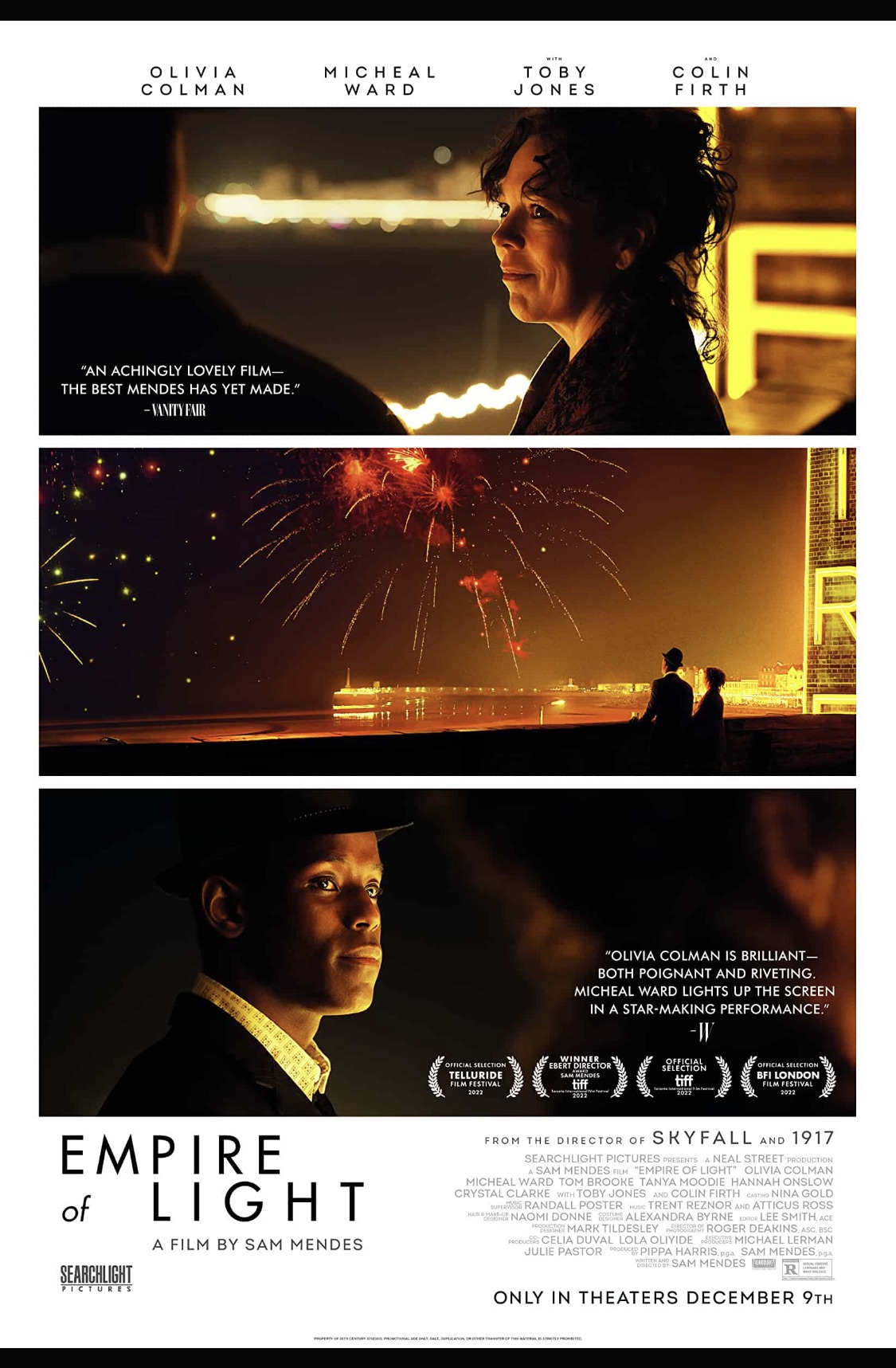
Greetings again from the darkness. Writer-director Sam Mendes won an Oscar for AMERICAN BEAUTY (1999), and has directed other popular movies, including ROAD TO PERDITION (2002) and a couple of James Bond films: SPECTRE (2015) and SKYFALL (2012). This is his first movie since the 3-Oscar winning war film 1917 (2019), and it’s a project that seems designed for Mendes to proclaim his love of movies and belief in movie magic. However, a funny thing happened on the way to movie magic … a movie about mental health, racism, and the Margaret Thatcher era broke out.

By now we’ve all realized that a movie starring Olivia Colman (Oscar winner for THE FAVOURITE, 2018) features at least one outstanding performance. Here, she delivers as Hilary, a theater manager who doesn’t watch movies, and is in therapy for some type of breakdown that occurred over the past year. Her smile for the customers isn’t always able to hide her depression and mood swings – and neither are the ‘quickie’ meetings the married theater owner, Mr. Ellis (Oscar winner Colin Firth, THE KING’S SPEECH, 2010), calls when the urge strikes. Her vulnerability and solitude are on full display.

The closeness of the theater staff is evident by the time new employee, Stephen (Michael Ward), shows up. He brings a spark, along with an ambition for advanced education, and he and Hilary hit it off immediately. Romance blossoms between the odd couple, and we soon learn Stephen has grown accustomed to facing racism, while Hilary seems oblivious to such things happening in the world. Empire Cinema is located on the seaside boardwalk, and the plush lobby is coated in heavy red velvet and adorned with sparkling brass fixtures. The timeframe is evident from the theater’s movie posters: BLUES BROTHERS, ALL THAT JAZZ, STIR CRAZY, etc.

The closed off screens 3 and 4 and the upper-level abandoned ballroom act as the rendezvous spot for Hilary and Stephen, while fireworks and a New Year’s rooftop kiss bring joy and excitement into Hilary’s life. The always interesting Toby Jones plays old school projectionist Norman, and he helps explain the second meaning of the film’s title when he describes the beam of light that flashes through the 24 frames/second of film. He terms that beam of light an “escape”, which is how so many view the movies.

Hilary’s history of schizophrenia and depression and lithium treatment mean that smooth sailing will not last for her. A street riot spills over into the theater and the scene shifts to the local hospital, where another character is introduced – one that might have added quite a bit to the story if expanded. Mendes chooses an odd approach to paying tribute to cinema, even when Hilary does finally realize the magic in a scene that recalls CINEMA PARADISO (although Hal Ashby’s gem BEING THERE is what she watches). Cinematographer extraordinaire and two-time Oscar winner Roger Deakins proves yet again how his work can elevate a film, as does the score from Trent Reznor and Atticus Ross (the Oscar winning composers).

Mendes chooses a restrained presentation, and though many of us believe in that feeling of elation associated with movies, no one believes movie magic is a cure for anything as serious as mental illness or racism. There are some terrific individual scenes that work better than the movie as a whole, but it’s unclear whether the film needed to be shorter, longer, or just better constructed.

Opens in theaters on December 9, 2022

WATCH THE TRAILER


THE LOST DAUGHTER (2021)

December 18, 2021

Greetings again from the darkness. There are so many things that go unspoken about parenting, and first time writer-director Maggie Gyllenhaal specifically focuses her lens on the pressures of motherhood, by adapting the 2006 novel from the anonymous and talented and mysterious Italian writer Elena Ferrante. Of course, we are all aware of Ms. Gyllenhaal’s fine work as an actor, yet it’s almost beyond belief that this is her debut as a feature film director. The source material is strong, but Ms. Gyllenhaal, along with a terrific performance from Olivia Colman (Oscar winner, THE FAVOURITE, 2018), turn a coastline vacation into a mesmerizing psychological case study.

Ms. Colman proves yet again what a fine and versatile actor she is. Here she plays Leda, a divorced professor on solo holiday on a picturesque Greek island, staying in a refurbished lighthouse tended by longtime caretaker Lyle (Ed Harris). Leda is packing a satchel full of books and academia work, and is a bit perturbed when her isolated beach time is suddenly interrupted by a large and noisy family of vacationers from Queens. Being an observant loner, Leda eyes young mother Nina (Dakota Johnson) who is struggling with her daughter, as well as her husband and other family members. This triggers memories in Leda that are handled via flashbacks with a terrific Jessie Buckley (I’M THINKING OF ENDING THINGS, 2020) as young Leda, stressed out wife and mother to two daughters. She longs for her own space.

At face value, this appears to be a movie about a woman annoyed that she can’t just enjoy a quiet holiday on the sandy beach as she reads her books. However, there are so many layers to the story and to Leda, that as viewers, we must remain on high alert to pick up all the queues and subtleties. Watching Nina with her daughter and husband sends Leda deep into her past … a past that still haunts her to this day. At the same time, while gazing at Leda, Nina can’t help but wonder if she is looking at her own future self.

Much of what we see (past and present) reinforces the isolation and frustration felt by so many mothers. It has nothing to do with loving one’s kids, but rather maintaining one’s sanity and self-being. There are a few key moments, including one that creates tension between Leda and the vacationing family, and another that immediately connects the two. Leda’s past includes steps that would be considered taboo for any wife and mother, and the symmetry of her past and Nina’s present are striking.

Peter Sarsgaard (director Gyllenhaal’s real life husband) has a supporting role in the flashbacks, while Dagmara Dominczyk plays a critical role as Callie, part of Nina’s large family. Bonus points are won with a Leonard Cohen reference (that may or may not be true), and also playing key roles here are a missing doll (connecting Leda’s past and present) and the proper way to peel an orange. Cinematographer Helene Louvart works wonders balancing the beautiful setting with the not-always-beautiful actions of the characters. Especially potent here is the performance of Olivia Colman, who proves she can play most any role. It’s also remarkable what first time director Maggie Gyllenhaal has accomplished here. This is a multi-layered, nuanced look at how relentless parenting can often feel overwhelming and may even lead to feelings of guilt later in life. It’s rare to see such a raw look at the emotions behind what is often referred to as the joy of motherhood. The film leaves little doubt that the always-dependable actor Maggie Gyllenhaal is now one of the most interesting new filmmakers on the scene.

In select theaters on December 17, 2021 and on Netflix beginning December 31, 2021

WATCH THE TRAILER


THE MITCHELLS VS THE MACHINES (2021, animated)

December 11, 2021

Greetings again from the darkness. What would happen if human survival depended on the Griswolds (from the VACATION movies) battling the rogue robots programmed to take over the planet? Filmmakers Michael Rianda and Jeff Rowe answer to that scenario is hyper-active, frenetic, overly-busy visual chaos that attempts to blend apocalyptic science fiction, extreme action sequences, and dysfunctional family comedy-drama. It’s a lot to tackle, and for the most part, it works.

Katie Mitchell (voiced by Abbi Jacobson) is preparing to head to film school. Her nature-loving dad, Rick (Danny McBride) is concerned about how he and Katie have drifted apart over the years, and he’s also worried that her educational choice could lead to disappointment. Katie’s mom, Linda (Maya Rudolph) is mostly supportive and upbeat, and yet a bit saddened that the once close father-daughter duo no longer speak the same language. Youngest son Aaron (voiced by co-director Rianda) and family dog Monchi have their moments, and mostly this is a fairly typical dysfunctional family. In fact, dysfunctional family seems to be a misnomer since it describes most families, even the highly organized one that seemingly have their act together … represented here by the Poseys (Chrissy Teigen and John Legend).

Katie’s generation’s adoption and dependency on technology has widened the gap in connection with the previous generation … specifically the bond between father and daughter that was so strong when she was young, and now barely hangs on by thread. Dad is the generation of the supreme screwdriver, while Katie is all about creating memes and videos. He fixes things, while she creates things. Dad decides a family road trip to drop Katie at college is the solution to fixing the frayed relationship. This happens on the same day that mega-Tech guru Mark Bowman (Eric Andre) is introducing his next-gen PAL robot, which is smart technology on steroids. However, it turns out, software has feelings too, and the original PAL (Olivia Colman) seeks revenge for being replaced. An army of robots is sent to capture the entire human race.

A couple of quirky things leave the Mitchell family as our final hope against the robots, and as you might expect, saving the world can lead to reparations in the father-daughter relationship. Dad gains an appreciation for the creative skills of Katie, while she learns of his great personal sacrifice for family. It’s an unusual blend of two distinct stories, but mostly we are left exhausted after a nearly two hour run time. The screen is often cluttered and overloaded with distractions (including old school Furbys with a twist), and although there is a cool throwback look to some of the animation, it’s simply too much of a good thing. Younger kids may be mesmerized by the frantic action, but the story lines are not likely to be followed by most under 10 or so. This one has garnered a great deal of Oscar buzz, which makes sense as adults decide such things.

Streaming on Netflix

WATCH THE TRAILER


THE ELECTRICAL LIFE OF LOUIS WAIN (2021)

October 21, 2021

Greetings again from the darkness. If you fancy yourself a cat lover, you’ve likely seen his drawings, or at least some of the many ‘copies’ that other artists have produced over the years. Louis Wain was a prolific British illustrator, best known for his anthropomorphic paintings and drawing of cats (think of the kitschy paintings of dogs playing poker). Writer-director Will Sharpe and co-writer Simon Stephenson have delivered a biopic of Wain that focuses less on his art, and more on his gradual mental breakdown.

The film opens in 1881, and Louis Wain (played by Benedict Cumberbatch) is a young man, whose life has just drastically changed. The death of his father has forced Wain into the role of breadwinner for his five younger sisters and their aging mother. Initially, we aren’t sure what to make of Wain. His stern and demanding sister Caroline (Andrea Riseborough) is unforgiving of his whims and demands that he find steady work to support the family. An interview with an editor/publisher played by Toby Jones allows us to see what a gifted illustrator Wain is … and his speed is substantially due to an incredible ability to draw with both hands simultaneously.

Wain’s eccentricities include a belief in the electrical currents that drive all life forms. The film doesn’t spend much time on this, but it seems to be a cog in his mental illness – deemed schizophrenia (though that’s been debated). Wain overcomes his insecurity around his cleft lip and marries Emily Richardson (Claire Foy), the governess to his sisters. For the times, this was quite a scandal, given the differences in age and social standing of Louis and Emily. However, it seems as though she was the only one who understood and encouraged him as an artist.

When tragedy strikes, Wain becomes inspired by their pet cat, Peter. In fact, Peter becomes Wain’s muse, and leads to thousands of drawings for publication in newspapers, magazines, greeting cards, and just about every other platform. Olivia Colman provides some lively narration, and Taika Waititi and Nick Cave both have brief cameos. Cumberbatch is a bit over-the-top with his tics in the first half of the film, but his talent is clear as he portrays a man whose mental health deteriorating, and one who must rely on his special skill to find purpose. Wain spent the last 15 years of his life in a hospital, illustrating right up until the end. While Wain’s legacy lives on in his work, there is also a message here – embrace your weirdness!

Amazon Studios will release THE ELECTRICAL LIFE OF LOUIS WAIN in theaters on October 22nd, 2021 and on Prime Video on November 5th, 2021

WATCH THE TRAILER


THE FATHER (2021)

March 11, 2021

 Greetings again from the darkness. Dementia and Alzheimer’s disease are frequent topics in movies these days for the simple reason that so many are impacted either directly or through a friend or family member. The importance of memory to our core being cannot be over-stated. It’s crucial to who we are and what we feel. The first feature film from French director Florian Zeller is an excellent and poignant tale, all too real for those who have experienced this with a loved one. Zeller adapted his own play (winning a Tony Award for Frank Langella) with his co-writer, Oscar winner Christopher Hampton (DANGEROUS LIASONS, 1988). It’s also one of the few films where Set Design is so crucial that it basically serves as a main character.

Whereas most of these movies provide the perspective of the caregiver or family members, this one is extraordinary in also giving us the point-of-view of the one suffering. Sir Anthony Hopkins (Oscar winner, THE SILENCE OF THE LAMBS, 1991) plays Anthony, an 80 year old Londoner who gets hurt, defensive and a bit churlish when his daughter Anne (Oscar winner Olivia Colman, THE FAVOURITE, 2018) informs him that she’s met a man and is moving to Paris. Anne is working to find an acceptable caregiver for her father … one that he doesn’t run off in a matter of hours. Though Anne maintains a spirited front, it’s clear the responsibility is exhausting and draining – feelings of which any caregiver can surely relate.

Just about the time we get a feel for the flow and settle in for a family drama, filmmaker Zeller spins things topsy-turvy. We suddenly aren’t sure ‘what is what’ or ‘who is who’. Olivia Williams (THE SIXTH SENSE, 1999) is now Anne. She now has a husband, Paul – maybe Mark Gatiss or Rufus Sewell. The details of the apartment are slightly different, and instead of being Anthony’s place, it’s actually Anne’s. Or is it? Anthony tries to process these differences, just as we do. The interview with an in-home caregiver played by Imogen Poots brings out the joy and liveliness of Anthony, but a painting raises questions … as does the ongoing saga with Anthony’s favorite wristwatch. As viewers, we are baffled and disoriented; however, unlike Anthony, we are slowly able to process the flashes of data and slowly put the pieces together.

Anthony Hopkins delivers his best and most emotional work in years, while Olivia Colman continues her impressive run. In fact, the entire cast his spot on. Complementing the performances is Peter Francis’ previously mentioned Set Design, which adds to both the confusion and the explanation. Also elevating the film is the work of Film Editor Yorgos Lamprinos and the score from Ludovico Einaudi.  Hopkins’ character asks, “Who exactly am I?” and we feel the excruciating pain of realizing one’s persona is slipping away. This will be a challenging film to watch for anyone who has experienced this type of agonizing loss in their life, and Zeller’s film also serves as a warning to everyone else.

Opening theatrically nationwide March 12th and available for Premium VOD on March 26th

WATCH THE TRAILER


OSCARS 2020 recap

February 10, 2020

Oscars 2020 recap

 It could be argued that the last 5 years of Best Picture announcements have each provided somewhat of a surprise as the title was announced. However, the noise level and affection directed towards the stage as those associated with PARASITE assembled, gave this year’s announcement a distinct and special feel. Filmmaker Bong Joon Ho has won over many in the industry during this awards season, and the historical significance of having the first non-English language winner shouldn’t be minimized. However, there was something else at play as the applause and whistles boomed throughout Hollywood’s Dolby Theatre. This was an auditorium filled with movie lovers who were celebrating a creative, unique, meaningful, and entertaining cinematic achievement … in other words, the things that movie making is meant to deliver. It was quite a moment.

While my predictions were correct on 20 of 24 categories this year, I can’t help but kick myself for not foreseeing this PARASITE juggernaut (it won 4 of its 6 Oscar nominations). Director Sam Mendes’ WWI visual masterpiece 1917 seemed to be on an unstoppable roll after winning Best Picture at BAFTA, Critics Choice, Directors’ Guild, and Producers’ Guild. But taking a step back and analyzing how the Oscars voting works – success is heavily dependent on how many ballots have a film in the first/favorite position – it becomes much easier to understand how this “upset” occurred. Ever since it won the Palme d’Or at Cannes, the number of crazed and vocal fans for PARASITE have been all over social media encouraging others to check it out. While almost everyone was wowed with the visual experience of 1917, it was the rabid fandom for the South Korean film that really stood out.

 So it was Bong Joon Ho’s film making Oscar history, and yet there are also other things to discuss. Choosing to go “host-less” for the second straight year, the very talented Janelle Monae opened the show by performing a take-off on Mister Rogers and then exploding into a high-octane song and dance featuring many of the nominated films, and a few that weren’t. Ms. Monae also infused the first political statement of the evening – one that would surely be followed by many more. Steve Martin and Chris Rock then took the stage, and though they apparently had not rehearsed their time together, there were a couple of good zingers … especially those aimed at Amazon’s Jeff Bezos … and more than a few that fell flat.

In his acceptance speech for Best Supporting Actor (ONCE UPON A TIME IN … HOLLYWOOD), Brad Pitt infused a bit of political commentary, as did Olaf, I mean Josh Gad, as he introduced Idina Menzel to sing the nominated song from FROZEN 2 (along with some talented international help). Diane Keaton did her best Warren Beatty/Faye Dunaway impression through incoherence and cluelessness (at the expense of good guy Keanu Reeves), and one of the best moments of the show was followed by one of the strangest. Lin-Manuel Miranda introduced a wonderful medley clip of film songs which played right into Eminem taking the stage to perform his Oscar winning “Lose Yourself.” Why is that strange?  Well, 8 MILE came out in 2002, and ‘18’ is rarely celebrated as a commemorative year (unless you are a 17 year old rejoicing in legal impendence). Eminem’s song is a favorite of many, but his inclusion here left us with one unanswered question … why?

Billie Eilish delivered a beautiful version of “Yesterday” as the annual In Memoriam slides played, but live performances from Randy Newman and Elton John (whose song won) paled in comparison to that of Cynthia Erivo. We were rewarded yet again by the brilliance of Olivia Colman, following up last year’s win with a turn as presenter. Her line, “Last year was the best night of my husband’s life” deserves to become part of Oscar lore alongside streakers, no-shows, and botched announcements. We were then subjected to two much-too-long ramblings from Acting winners Joaquin Phoenix and Renee Zellweger. Mr. Phoenix at least made some sense in his plea for justice for all (and a nice quote from his deceased brother River: “Run to the rescue with love, and peace will follow”), while Ms. Zellweger babbled “ums” and “you knows” about heroes, and proved why most actors should stick to a script.

As I’ve stated before, celebrities are welcome to their political opinions, which many share frequently and openly. My issue is that the Academy Awards ceremony was designed as a once a year opportunity to celebrate cinema and those who make it such an enticing and entertaining art form. Especially in this day of social media, I find the political outbursts to be in poor taste … similar to bringing McDonalds carry-out to a dinner party. It seems the proper approach would be to thank the Academy and those who helped the winner with their achievements, and then head backstage and tweet all the political opinions swirling about in their head. Having one’s own hair stylist, make-up artist, limo driver, and fashion designer, does not seemingly make one an expert on equality or geopolitics, so my personal preference would be for political opinions to be stifled for a few hours.

 All the best stories have memorable endings, and this year’s Academy Awards certainly delivered that. Political ramblings were forgotten as soon as Jane Fonda, after pausing for dramatic effect (and to ensure she had the correct envelope) announced PARASITE as Best Picture. Watching movie history unfold was exhilarating, and Bong Joon Ho’s promise to “drink till the morning” was well-deserved. He has announced his involvement with an HBO series based on this Oscar winning film, so we can expect to see his creativity on one screen or another for the next few years.

***NOTE: Tom Hanks announced during the ceremony that the long-awaited Academy Museum of Motion Pictures will open December 14, 2020 in Los Angeles’ Miracle Mile district.


DIFF 2019 Day 8

April 20, 2019

2019 Dallas International Film Festival

 Greetings again from the darkness. And now, the end is near … well, it’s actually over … at least as it pertains to the 2019 Dallas International Film Festival. I watched 22 feature films over the 7 days I attended (I missed opening night), and though bleary-eyed, I certainly recommend every movie lover experience the film festival life at least once. If you happen to be travel-averse, there is assuredly one held not too far from home. Of course, the quality of festivals varies greatly, as do the themes and approach to programming.

The final three movies on the final day delivered a very pleasant surprise, a second French comedy in as many days, and a cultish-thriller that was also a mini-reunion for a couple of “Justified” actors.


Here is my recap of Day 8 movies:

JUMPSHOT: THE KENNY SAILORS STORY (doc)

 Having played high school basketball, I can honestly say that I never once gave thought to who, when or how the jump shot might have been “invented”. It was ubiquitous to the game … the same as blocking out on defense or coaches yelling from the sideline. Having read the synopsis for this film, I felt a twinge of guilt in not giving any previous thought to the origins of the jump shot. However, since director Jacob Hamilton includes interviews with such hoops luminaries as Stephen Curry (also a producer on the film), Kevin Durant, Bobby Knight, and Dirk Nowitzki, each equally clueless on jump shot history, my ignorance doesn’t seem quite so burdensome.

Of course I had seen the clips of how the game was once played, and director Hamilton includes a fair amount here. Other than the ball, the hoops, and the floor, the old game from the 30’s and 40’s bears little resemblance to what is played today. Although the rules haven’t changed much, the pace of the game and the techniques certainly have.

We are introduced to Kenny Sailors, the man who many credit with originating the modern day jump shot. Mr. Sailors talks of playing his older, much taller brother in games of one-on-one and rarely being able to even get off a shot … at least until that one day when, off the dribble, he rose up and released the ball at the height of his jump – and the ball swished through the basket. A turning point in the sport occurred in Sailors’ front yard.

Included are some photos and clips of Sailors’ high school and college teams – including his having (future Hall of Fame sports announcer) Curt Gowdy as a teammate. There is a bit of Wyoming basketball history detailed, including Sailors’ University of Wyoming national collegiate basketball championship in 1943 at Madison Square Garden. It’s noted that Sailors’ jump shot was nearly indefensible at the time, but he was also an expert ball-handler, tough defender, and above all, a respected team leader.

So yes, this is a basketball story; but it’s even more the story of a very interesting and downright cool gentleman. After college, Sailors left Wyoming as part of the Marines and served in the war. He married and his wife was pregnant when he set out to serve his country – admitting that he assumed he wouldn’t be coming back. Director Hamilton includes interviews with Sailors’ 3 grandchildren and his son, but the most engaging segments of the film allow us to hear directly from the man himself – at the time, well into his 90’s.

Humble, yet proud, Mr. Sailors recounts moving to Alaska as a precaution against his wife’s severe asthma. They lived there 35 years, and he served as both a big game hunting scout and a high school basketball coach. Having two daughters, Sailors worked diligently to develop girls basketball, and he did it not for personal glory (they won a lot of games), but rather for the life lessons the games teaches. He was intent on his daughters having access to the discipline, teamwork and dedication required for a successful team.

We see the iconic Life Magazine photo of Sailors shooting his jump shot, as 9 other players on the court had both feet on the ground, and we understand the impact he had on the game. But it’s the passion he speaks of in regards to life that sticks with us after the film. A very fine athlete who left his mark on the sport, but an even better man who lived a humble and respected life. Director Hamilton’s film uses animation to fill the gaps where no clips or photos are available, and he’s wise enough to know that the greatest impact comes from allowing Mr. Sailors’ smile to light up the screen and our lives. Anyone for a game of H-O-R-S-E?


THE FALL OF THE AMERICAN EMPIRE
 French-Canadian filmmaker Denys Arcand won the Best Foreign Language Oscar for THE BARBARIAN INVASIONS (2003), and has a very loyal group of followers for his films. It should be noted that, despite the title, this is not a sequel to Arcand’s 1986 film THE DECLINE OF THE AMERICAN EMPIRE. This one is a comedy-crime drama that is as cynical as it is witty, and perhaps as much social commentary as satire. It’s yet another rip on capitalism while showing that idealism can work wonders (at least if it’s well funded).

“Intelligence is a handicap.” That’s what Pierre-Paul Daoust (played by Alexandre Landry) tells his girlfriend as he breaks up with her in a café. When she points out that he’s a delivery driver (similar to UPS), Pierre-Paul riffs on a number of famous writers and philosophers who he claims were dumb as rocks. Her inquiry into Trump being elected President leads to his conclusion, “imbeciles worship cretins”. He is the kind of guy that has an answer for everything, and possesses a type of oratory expertise that makes his excuses sound like scientific explanations.

One day while on his route, he stumbles into a robbery gone way wrong. Two thieves were in the process of stealing gang/mob money (and lots of it) when a shooting broke out. In the immediate aftermath, Pierre-Paul makes the snap decision to toss the two huge bags of cash into the back of his truck and take off. This kicks off a chain of events that includes his crossing paths with Aspasie/Camille (Maripier Morin) a high dollar escort whose website features a quote from “Racine”. Pierre-Paul is a Ph.D. in Philosophy, so he takes this as a sign.

Shortly after, Pierre-Paul is meeting with Sylvain “the brain” (Arcand regular Remy Girard), a recently released from prison biker who has become an expert on money laundering. The three form an odd partnership and are followed wherever they go by a couple of police detectives. Camille introduces Sylvain and Pierre-Paul to Mr. Taschereau (Pierre Curzi), her dapper former lover who also happens to be the foremost authority on international tax evasion and high finance.

The running joke here is that Pierre-Paul is an upright citizen who has never done anything remotely illegal in his life. In fact, he regularly doles out money to Quebec’s homeless and those down on their luck. He also volunteers regularly at a shelter that feeds those in need. The obvious statement here is pointing out the great divide between the wealthy and the poor.

Arcand’s film is close to being very good, but falls short in too many areas to reach the height it desires. There is a torture scene that seems totally out of place compared to the tone of the rest of the film, and I refuse to make the link to PRETTY WOMAN – another film where the rich guy wins over the good-hearted sex worker. This film talks about “providence” and just rewards that rarely happen. Is it acceptable to do the wrong thing for the right reasons? Does doing good correct a wrong? Heck, is it even wrong to steal from criminals? What the film actually does is serve up obvious targets with no real solutions offered. The self-congratulatory ending with close-up shots of Quebec’s homeless doesn’t help.


THEM THAT FOLLOW

 My final film of the festival was listed as a “thriller”, but is realistically more of a drama set in the harshness of Appalachia. A small community of people are devoted followers of the Pastor Lemuel played by Walton Goggins, and snake-handling is key to their interpretative Pentecostal religion. Co-directors and co-writers Britt Poulton and Dan Madison Savage offer up a too-familiar story that tries to walk the line between cult and religious fanaticism. It’s always fascinating to see folks who have somehow become entrenched in such an environment.

Alice Englert is the daughter of Oscar winning director Jane Campion and she stars as Mara, the Pastor’s daughter who tries to fall in line with her father’s preachings, but an independent streak and an attraction to Augie (Thomas Mann) really complicate things for her. Reigning Best Actress Oscar winner Olivia Colman (THE FAVOURITE) co-stars as Augie’s mother, Kaitlyn Dever (“Justified”) is Dilly, local girl and friend to Mara, Jim Gaffigan plays Ms. Colman’s true-believer husband and Augie’s dad, and Lewis Pullman is Garrett, the boy selected as Mara’s husband-to-be.

Those of us on the outside always look on bewildered at how any person ever builds a following such as this Pastor or any other cult leader. How does any parent lose the inherent protective gene they have for their child, and have it overridden by a Pastor who uses serpents to cleanse sin from the believers … some of which make life decisions based on a quilting group. The movie looks great and has terrific performances, but for whatever reason, we are never really drawn into this world – left instead to observe from a distance (which is fine by me as long as snakes are present).

OSCARS 2019 recap

February 25, 2019

OSCARS 2019 recap

 The Academy missed their goal of a 3 hour presentation, but only by 17 minutes! Ratings were up (over last year) and diversity was on full display, so it seems most can agree that things went pretty smoothly without a host. Despite some recent bungled decision-making, followed by a social media outcry which resulted in decision reversals, the Academy deserves credit for a fine presentation that featured more diversity than ever before. The days of #OscarSoWhite seem to be over.

I trust you didn’t come here to read yet another rant about why a certain award proves how out of touch the Academy is. Nope, I like movies and prefer to view the Oscars as a celebration rather than a political statement. By the time the final envelope was opened, all 8 Best Picture nominees had won at least one Oscar. Additionally, two other excellent films, IF BEALE STREET COULD TALK and FIRST MAN, also won awards (Best Supporting Actress and Visual Effects, respectively). Spreading the major award love over 10 different films speaks not just to the diversity, but also the deep lineup of quality filmmaking during 2018.

As always, the ceremony provided some fun talking/debating/arguing points. Queen opened the show with Adam Lambert proving how remarkable Freddie Mercury’s voice was, while Brian May showed us he still plays a mean guitar. Best Actor winner Rami Malek fell off the stage after giving his speech. Fortunately, he wasn’t seriously hurt. Melissa McCarthy (and a puppet) and Brian Tyree Henry fully and elaborately committed to their duties as co-presenters of Best Costume. Despite not being present, the omnipotent Oprah made an appearance – via the montage of 2018 films (from her bomb A WRINKLE IN TIME), and we saw a live quasi-reunion of WAYNE’S WORLD with Mike Myers and Dana Carvey (sans wigs and head-bobbing). Spike Lee finally won an Oscar (Adapted Screenplay for BLACKKKLANSMAN), and then proceeded to bogart the microphone from his equally deserving co-writers, before throwing a tantrum when GREEN BOOK was announced as Best Picture.

 Of course, the most Tweeted about moment came when Bradley Cooper and Lady Gaga took the stage to sing their (now Oscar winning song) “Shallow” from A STAR IS BORN. It was a very intimate duet that, had there been one more verse, might have resulted in clothes being shed on stage. The aforementioned diversity resulted in the most presented Oscars for both African-Americans and Women, and with presenter Michael Keaton being the only white male to take the stage solo. Barbra Streisand (presenting BLACKKKLANSMAN rather than A STAR IS BORN) somehow escaped backlash after comparing herself to Spike Lee … see they are both from Brooklyn and like hats; although we aren’t sure if Babs greeted her superfan, nominee Richard E Grant. And poor Christian Bale – no way that room was ever going to vote for Dick Cheney, regardless of how remarkable his transformation and performance.

Olivia Colman (THE FAVOURITE) won the Best Actress Oscar over Glenn Close (THE WIFE). This was Ms. Close’s 7th Oscar nomination without a win, keeping her one ahead of fellow nominee Amy Adams (VICE). However, neither of them gained ground on songwriter Diane Warren whose nomination for “I’ll Fight” (RBG) was her 10th without a win. It should also be noted that Ms. Colman’s acceptance speech was the funniest, most charming and most heartfelt of the evening. In contrast to Ms. Close, Ms. Adams and Ms. Warren, Regina King was thrilled to win the Best Supporting Actress Oscar with her first ever nomination (IF BEALE STREET COULD TALK).  In a show of ultimate class, Congressman John Lewis presented Best Picture nominee GREEN BOOK, and we could be certain a man with his perspective and role in history, would not partake in any tantrum throwing.

 Mahershala Ali (GREEN BOOK) won Best Supporting Actor for the second consecutive year, and Alfonso Cuaron won 3 Oscars (Best Director, Cinematographer, Best Foreign Language Film) for his autobiographical masterpiece ROMA. Also winning 3 Oscars on the night were BLACK PANTHER (Costumes, Production Design, Score) and GREEN BOOK; however, it was BOHEMIAN RHAPSODY with 4 wins that walked away with the most statuettes. Even those who are upset by GREEN BOOK’s Best Picture win must agree that it was a much smoother end to the evening than last year’s debacle and mix-up.

***Note: although there were a few political barbs tossed in throughout the evening, President Trump’s name was never mentioned on the broadcast. This allowed the focus to remain mostly on the nominees and the films … and the plug for the under-construction Academy museum (opening someday). .