OPPENHEIMER (2023)

July 22, 2023

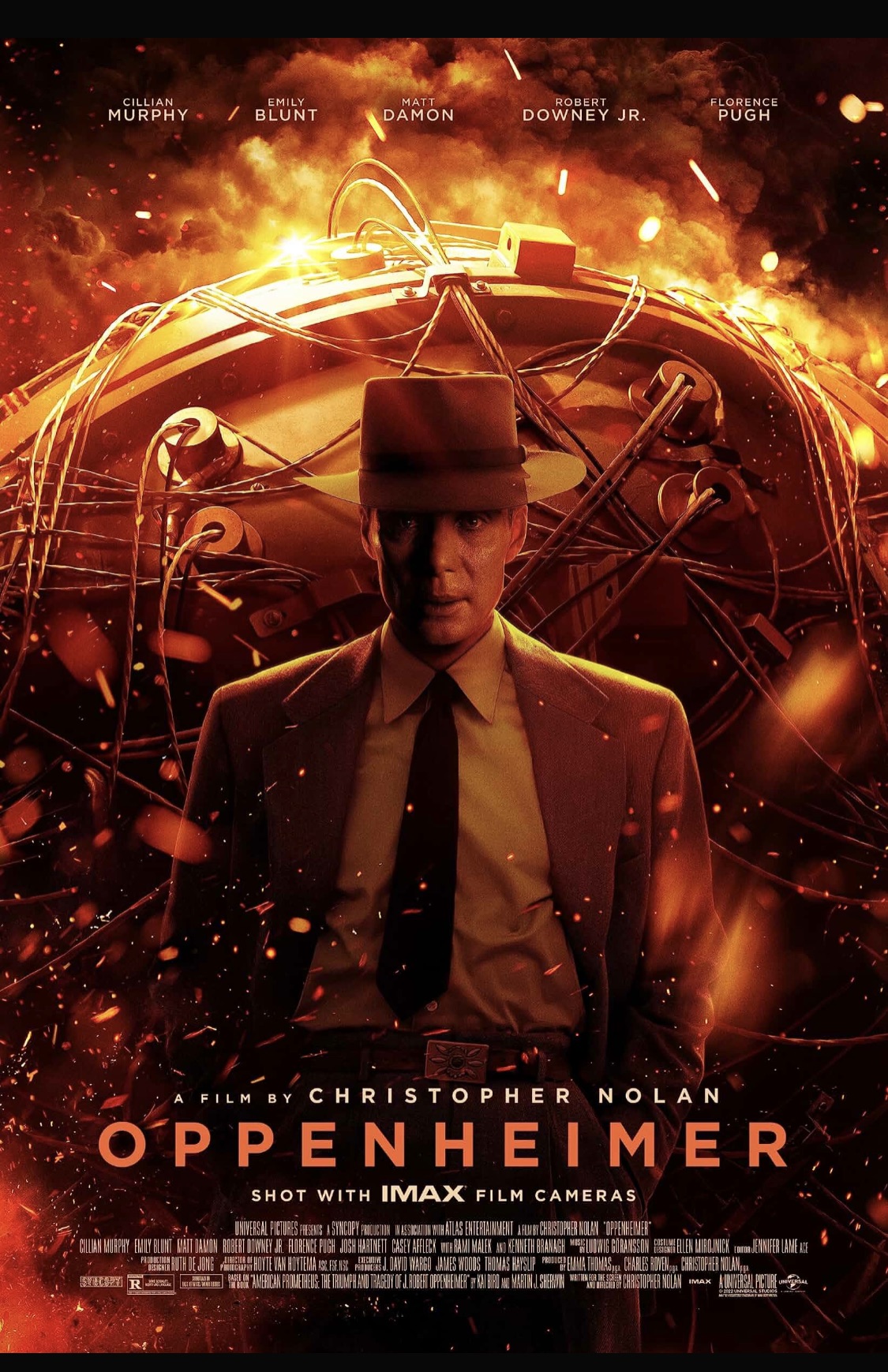
Greetings again from the darkness. As pupils slouched in our school desks during history class, we easily and naturally disassociated with the many stories of war. World War II was lumped in with WWI, the Civil War, and The Revolutionary War. There were names and dates to memorize for quizzes and final exams, yet even with relatives recounting stories of kin, a personal connection was rare. As we aged and experienced modern-day warfare, the personal connection became all too real. Reality struck that soldiers are human beings with families, and despite their missions and marching orders, most are as innocent as the ‘tragic civilian casualties’ reported on the newswires. Along these lines, an aspect of war that has often remained overlooked is the behind-closed-doors decision-making of politicians and military leaders. Filmmaker-extraordinaire Christopher Nolan takes us behind those doors through the eyes of J Robert Oppenheimer, the Father of the Atomic Bomb. What we see is quite frightening.

Prepare yourself. At a full three hours in length, Nolan’s film is a hefty undertaking for viewers. It demands full focus and attention to details and nuance, as you spend significant time listening to brilliant men talk amongst themselves. Nolan adapted the screenplay from the 2005 biography, “American Prometheus: The Triumph and Tragedy of J Robert Oppenheimer”, written by Kai Bird and Martin Sherman. The end result is a film centered on complex physics and mathematics, yet presented in a simplified manner such that it’s much more a character study than a science class. The key is what characters say to each other, how they say it, and how they debate and rationalize the morality of the objective … building a bomb designed to kill people.

The morality of The Manhattan Project is under the microscope here, as is the motivation and concern of Oppenheimer. We get some early background establishing him as an upcoming mind in the world of physics from his academic stops around the globe. Some know Cillian Murphy from “Peaky Blinders” or as Scarecrow in Nolan’s Batman movies. I’d also recommend a couple of Murphy’s underrated gems: FREE FIRE (2016) and RED EYE (2005). It’s hard to overstate how spot on Murphy is as Oppenheimer. He lost weight for the role and captures the distinctive movements and speech patterns, as well as the familiar poses and deep-in-thought eyes. We never once question whether this is Oppenheimer, the leader of the science team at the Los Alamos Lab and the Father of the Atomic bomb … the one who “sees beyond the world we live in.”

Once Major Groves (Oscar winner Matt Damon) recruits Oppenheimer to run and assemble the great scientific minds, the obvious question to those involved is … even if we can create this bomb, should we do it? This weighs heavily on Oppenheimer – a man so engulfed by science that his haunting visions are that of atoms and particles and experimental reactions (perhaps a bit too heavy in the first act). Groves is the military leader of the project and the liaison between the scientists, the military, and the government. It’s also clear that while Oppenheimer’s brilliance is recognized and necessary to the project, almost no one outside of the scientists trusts him. This is where antisemitism and fears of communism arise. Oppenheimer was Jewish and, though he never joined the communist party, was associated with many who did. This included his love interest, Psychiatrist Jean Tatlock (the fabulous rising star Florence Pugh), his wife Kitty (Emily Blunt), and his brother Frank (Dylan Arnold).  

The teamwork and stress involved with building the bomb in Los Alamos is conveyed as rooms full of brilliant minds determine the future path of the country and the world. This culminates in the stunning sequence of The Trinity Test near Alamogordo. A blending of complete silence, along with spectacular sound and light, is truly a technical highlight of the film. The initial celebration of success initially overshadows the true meaning … the bomb is now ready for Hiroshima and Nagasaki, killing two hundred thousand people and essentially ending WWII, less than four years after the bombing of Pearl Harbor by the Japanese (never mentioned here).

The bombings are heard via radio news reports, and it’s at this point where the weight of what the scientists have done is fully realized. Oppenheimer became a national hero and his Time Magazine cover proves it. A meeting with President Harry S Truman (Oscar winner Gary Oldman sporting a Missouri accent) doesn’t go well, as Oppenheimer is introduced to political gamesmanship, something he would face even more directly in the near future. Lewis Strauss (Oscar winner Robert Downey Jr) is a key player as chairman of the US Atomic Energy Commission, and through him, we witness ego, ambition, and petty behavior that leads to a level of vindictiveness typically only seen at the junior high level.

Multiple timelines are covered. There is the background information on Oppenheimer’s early years, his well-rounded academia, his love life (lives), his building of the Los Alamos lab team, the overseeing of the bomb development, his time as a hero, the later backroom kangaroo court designed to disgrace him, and Strauss’ Senate Confirmation hearing for Secretary of Commerce. All of these tie together, and it’s those final two that make up the last act of the film – giving us a taste of just how nasty politics was 70 years ago (not unlike these days).

Nolan has assembled a deep cast with numerous Oscar winners and a roster of talented actors. Among the familiar faces not already named above are: Oscar winner Kenneth Branagh as Danish Physicist Neils Bohr, Oscar winner Rami Malek as experimental physicist David Hill, Oscar winner Casey Affleck as Military security advisor Boris Pash, Tom Conti as Albert Einstein, Benny Safdie, Dane DeHaan, Jason Clarke, Josh Hartnett, David Krumholtz, Matthew Modine, Alden Ehrenreich, Scott Grimes, Tony Goldwyn, James D’Arcy, James Urbaniak, Olivia Thirlby, James Remar, and (Nolan regular) David Dastmalchian.

The film is a historical biopic and also an unconventional thriller. Is this about unparalleled advancement in science or is it about the moral dilemma of mass destruction and death? Politics, military, ego, power, science, love, revenge, and redemption are all displayed as Oppenheimer struggles with the power he has created and the lack of power in how it’s used. My favorite line in the film is aimed at Oppenheimer when someone informs him that he’s now “not just self-important, but actually important.” The stakes are clear during the test when it’s stated that there is a “near zero” chance of destroying the world.

Cillian Murphy is a shoe-in for a Best Actor nomination, and his performance mesmerizes us. It’s nice to see Robert Downey Jr remind us of his true talent, and he should be rewarded with a Best Supporting Actor nomination. Florence Pugh and Emily Blunt, in the only two substantive women roles, should both receive consideration as well. Pugh’s role is limited but memorable, while Blunt shines in her best scene during the security hearing.

Christopher Nolan has delivered near perfection in technical movie-making, and on top of that, the story and characters are real life, and the performances are top notch. His use of Black & White film for Strauss’ perspective allows the viewer to differentiate the Oppenheimer viewpoint. Impressively, while there are some visual effects, Nolan has stated that no CGI was used in the film, and that’s most evident in the relatively short closing credit roll – where we typically get dozens if not hundreds of technical experts listed. Ludwig Goransson’s (Oscar winner for BLACK PANTHER) score packs an emotional punch, and Jennifer Lame’s editing is excellent and vital. Lastly, cinematographer (and regular Nolan collaborator) Hoyte Van Hoytema drives home the power of smart men in a room, as well as the devastation of the bomb test. This is excellent filmmaking and a reminder that the only thing we love more than lifting new heroes onto the pedestal of worship is tearing down those same heroes with a dose of humility. These types of movies rarely get produced these days, so here’s hoping enough people go back to the theater to see it to inspire more filmmakers to take a shot.

Opened nationally July 21, 2023

WATCH THE TRAILER


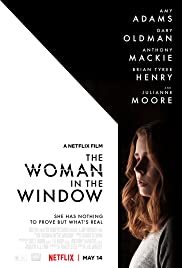
THE WOMAN IN THE WINDOW (2021)

May 13, 2021

Greetings again from the darkness. Agoraphobia (the fear of leaving one’s home) has been the topic of a few films over the years, but for whatever reason, none of them have really clicked. Of course, director Alfred Hitchcock brilliantly used a wheelchair-bound James Stewart to create his tension-packed classic REAR WINDOW (1954); however, there’s a psychological difference in being stuck at home due to injury, and being mentally and emotionally unable to bring yourself to walk out the front door due to anxiety and fear. Controversial author/editor AJ Finn (pseudonym of Dan Mallory) wrote a 2018 best-selling debut novel around this affliction, and now Tracy Letts has adapted the novel for the screen and director Joe Wright (DARKEST HOUR 2017, ATONEMENT 2007).

Amy Adams stars as Anna Fox, a child psychologist suffering from agoraphobia after a horrible car accident. She never leaves her Brownstone. She has groceries and prescription drugs delivered to her door, and conducts business over the phone. She has also mastered the internet and memorized dialogue from numerous classic films. Anna also spends an inordinate amount of time spying … um, observing … her neighbors through the window. Anna has a pet cat, and also a tenant living in her basement. We don’t learn much about David (Wyatt Russell) until later in the film.

The story is broken down by the days of the week, and begins with Monday when Anna meets Ethan (Fred Hechinger), the son of the Russells who just moved in across the street. On Tuesday, Anna meets the character played by Julianne Moore, and the two have a chat about her son Ethan, in addition to bonding over wine … a beverage of frequent choice for Anna. On Wednesday and Thursday, all heck breaks loose as Anna hears a scream and witnesses a stabbing in the home of her new neighbors. The cops don’t believe her and Ethan’s dad, Alistair Russell (Gary Oldman), shows up accusing her of lying, boozing, and hallucinating on prescription drugs. It’s not a pretty sight for Anna.

The first hour does a nice job of setting the scene for Anna and her struggles, plus creating confusion and misdirection on what she’s experiencing and “seeing” in regards to the situation in the Russell home across the street. We get a feel for the strange dynamic with David, the phone calls with her husband Ed (Anthony Mackie), and her therapy sessions with Dr. Landy (screenwriter Tracy Letts). It’s really Act 3 where things went off the rails for me. It seemed there was an attempt to cram too much into too short of time. The ending is clear and helps us make sense of everything that has come before; however, it just came across as forced, and out of step with what we had watched in the first hour.

Other supporting roles include Brian Tyree Henry as a Detective, and Jennifer Jason Leigh. In fact, the stellar cast includes two Oscar winners in Julianne Moore and Gary Oldman, a previous Oscar nominee in Jennifer Jason Leigh, and of course, Amy Adams, who has six Oscar nominations. Ms. Adams carries most of the movie with yet another terrific performance, while the others really aren’t given much to do. It’s rare for me to say this, but I believe the material would have been better served as a two- or three-parter, rather than a relatively short movie. It was initially delayed in 2019 for re-shoots and a re-edit, and then again in 2020 due to COVID. I might have been somewhat disappointed in the final project, but I suspect this will be hugely popular on Netflix.

Premieres on Netflix on May 13, 2021

WATCH THE TRAILER


CRISIS (2021)

February 25, 2021

 Greetings again from the darkness. The best thrillers often interweave multiple story lines to create a complex web of detail for viewers to unwind. Writer-director Nicholas Jarecki (ARBITRAGE, 2012) serves up three story lines, all related to the current Opioid crisis. Although the film looks great and has a deep cast, we’ve seen most of this before and no new insight is provided in regards to the struggle. Instead, it’s really standard thriller fare that never goes deep enough into any of the characters to make us care.

Armie Hammer (along with the recent personal baggage attached to him) stars as Jake Kelly, a DEA Agent who has worked undercover in hopes of exposing the Armenian-Canadian-American drug traffickers responsible for a significant portion of opioids crossing the border. Hammer spends the entire movie with an intensely furrowed brow that would likely inspire distrust amongst any potential drug syndicates.

In storyline number 2, Evangeline Lilly (Wasp in the ANT-MAN movies) is Claire Reimann, an architect and recovering drug addict, who is out for vengeance when her beloved high school athlete son is found dead with drugs in his system. The third segment features Oscar winner Gary Oldman (DARKEST HOUR, 2017) as Dr. Tyrone Brower, a science professor at a private Detroit university. He runs a drug-testing lab and faces a moral dilemma when questionable lab results for “the first non-addictive painkiller” puts people at risk, not to mention funding for his work.

Any one of these actors or stories could carry the weight of a movie, but when combined, they succeed only in crushing the entertainment value and tension level. Oldman’s story is easily the most interesting. It addresses how Big Pharma gets new drugs rubber-stamped by funding otherwise cash-strapped labs and schools. There is also the skepticism involved with the drug-producer’s influence over the supposedly independent FDA, and on top of all that, there is the ethical concerns of everyone putting the almighty dollar ahead of safety.

Director Jarecki (the brother of Andrew Jarecki who directed the superb 2003 documentary CAPTURING THE FRIEDMANS) kicks off the movie with a beautifully filmed, albeit brief, chase scene through the snowy Canadian forest. In fact, the camera work throughout is fine. It’s really the overloaded script that prevents any of the stories or characters from clicking. Mr. Oldman seems to sense that he needs to overcome the lack of complexity in his story, and because of the effort, loses his usual reserved cerebral approach for which he’s known.

Supporting work is provided by Greg Kinnear as the Dean willing to sacrifice ethics and friendship for money, Michelle Rodriguez as the DEA supervisor in a budget crunch, and Lily-Rose Depp as Jake’s strung out sister. Also contributing are Indira Varma, John Ralston, Martin Donovan, Mia Kirshner, Kid Cudi, Michael Aronov, Luke Evans, and Veronica Ferres. The weakest link here is director Jarecki himself, who for some reason, thought he could play Jake’s partner … a role that would have benefited from a more refined actor.

The horrific effects of the Opioid crisis are known to most, and the film plays like a Wikipedia explanation for anyone who doesn’t read or watch the news. Certainly not helping is the “Miami Vice” type score that accompanies many scenes, and the choppy editing that causes many scenes to fail. Better movies in this genre would include THE INSIDER (1999, ironically directed by “Miami Vice” creator Michael Mann) and Soderbergh’s TRAFFIC (2000). The obstacles faced by whistleblowers, the importance of funding to academia, budgetary concerns for law enforcement, the tragic impact of drugs on families, and the systemic corruption that has fueled the epidemic … all of these are touched on. It’s just that it all seems too obvious. If somehow you didn’t already know, the money-hungry don’t play fair – whether they be drug dealers or drug companies.

The film will hit theaters on February 26, 2021 and Digital and On Demand March 5, 2021

WATCH THE TRAILER


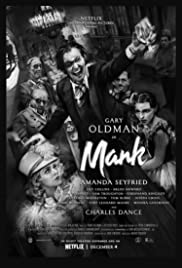
MANK (2020)

December 3, 2020

 Greetings again from the darkness. “Just a writer.” The line made me laugh. How many times have writers not received the recognition they deserved, or were underestimated, only to have their words create a lasting impact? Hollywood often likes to portray writers as socially-awkward, loner types who rarely contribute much during conversations. Not this time. The subject is Oscar winning screenwriter Herman J Mankiewicz, who was as quick with a dinner table zinger as he was writing the script to CITIZEN KANE (1941) while bedridden.

More than 20 years in the works, this is director David Fincher’s first film since GONE GIRL (2014), and it’s based on a screenplay written by his late father, Jack Fincher. Dad receives sole writing credit here, though David and producer Eric Roth (Oscar winner for FORREST GUMP, 1994) admit to some polishing. It’s a film seemingly designed for us film nerds, but likely entertaining and interesting enough for expanded appeal. CITIZEN KANE is often regarded as the “best” movie of all-time, though the origin of the film is much debated. We do know that struggling RKO Pictures gave 24 year old wunderkind Orson Welles free reign over his first film, and the result was something quite special. Director Fincher’s film offers up three distinct aspects here: a look at Mankiewicz’s writing process for ‘Kane’, some background on Mankiewicz’s career, and a somewhat fictionalized dissection of 1930s Hollywood politics.

Oscar winner Gary Oldman (DARKEST HOUR, 2017) stars as Herman J “Mank” Mankiewicz, an international correspondent-turned NYC cultural critic-turned playwright-turned screenwriter. Herman was the older brother of Joseph L Mankiewicz, a four time Oscar winning writer-director (ALL ABOUT EVE, 1950), and grandfather to Ben Mankiewicz, a well-known host of Turner Classic Movies. Herman was also renowned as a boozer and gambler, and in 1940 (where this movie begins), he was a bedridden mess recovering from a car accident. Herman was part of the sphere of the infamous Algonquin Round Table, and in most of this film, he talks like he’s still at one of those gatherings.

Mank is taken to a desolate ranch house in Victorville, California, along with his assistant Rita Alexander (Lily Collins), his nurse (Monika Gossman) and his handler John Houseman (Sam Troughton). Orson Welles (Tom Burke) has given Mank 60 days to finish the script, and his only guidance seems to be “write what you know”, and don’t drink. The result was a controversial, yet brilliant script that Welles and his crew (Oscar winning Cinematographer Gregg Toland, Editor Robert Wise, a 4-time Oscar winner) turned into a classic film that still holds up 80 years later.

We immediately start seeing flashbacks, as noted by old style on-screen typing. Ten years prior, Mank was the Head Writer at Paramount, where his staff included Ben Hecht, George S Kaufman, and Charles Lederer … writers whose work would later include NOTORIOUS (1946), multiple Marx Brothers movies, and GENTLEMEN PREFER BLONDES (1953), respectively. Lederer was also the nephew of starlet Marion Davies (played here by Amanda Seyfried), who was the long time mistress of media mogul William Randolph Hearst (Charles Dance). Are you starting to see how this wicked web all fits together? Of course, Hearst was the model for Charles Foster Kane in Welles’ classic movie, while Ms. Davies was supposedly the inspiration for Kane’s wife, Susan. Other key players in these flashbacks are Producer David O Selznick (Toby Moore), Irving Thalberg (Ferdinand Kingsley, son of Oscar winner Ben), MGM founder Louis B Mayer (Arliss Howard), Mank’s brother Joseph (Tom Pelphrey), and Mank’s wife “Poor” Sarah (Tuppence Middleton).

Director Fincher’s masterful film features a couple of standout sequences. The first involves the initial meeting between Mank and Hearst, while Marion Davies is filming a scene on the grounds of San Simeon (Xanadu in CITIZEN KANE). Rapid fire dialogue, multiple characters, and terrific editing with Mank keeping pace as Hearst overlooks the filming. Much later there is a scene following Mank and Marion as they stroll through the manicured gardens with the nearby exotic animals on display. The scene is fascinating to watch, while also reinforcing the kindred spirits of Mank and Marion – both talented, yet not quite allowed in the “club”. Beyond those two sequences, we also get a quite funny segment where Mank and his Paramount writers are improvising a pitch to Selznick and director Josef von Sternberg, plus a telegram sent by Mank to Lederer that states, “Millions to be made here and your only competition is idiots” (a sentiment some believe still holds true today).

Quite a bit of the film is focused on Hollywood politics of the 1930s, both in the studios and nationally. In particular, the 1934 Governor’s race focuses on the campaign of writer and socialist Upton Sinclair (played by Bill Nye, the Science Guy), and the concerted efforts by Hearst and studio capitalists to prevent Sinclair from being elected. The symmetry and contrasts of modern day Hollywood and politics cannot be overlooked. Also made abundantly clear is the disconnect between studio heads, directors, and writers – quite the mishmash of disrespect.

The brilliance of Fincher’s movie is that it can be relished from multiple perspectives. Is Mank attempting to salvage a near-dead career or is he settling a grudge against Hearst? Did Welles intend to hold firm to Mank’s contract and prevent him from receiving a screenwriting credit? And then there is the filmmaking side. Superb performances from Oldman and Seyfried highlight the terrific cast. It’s filmed in black and white by cinematographer Erik Messerschmidt (“Mindhunter”), but not the razor-sharp images we are accustomed to these days, rather soft and hazy in keeping with the look of the times. The production design from Donald Graham Burt takes a couple of viewings to fully appreciate, and the music from Trent Reznor and Atticus Ross is spot on, as usual. Even the opening credits provide nostalgia, as does the 1942 Academy Awards ceremony, which neither Mank nor Welles attended. Netflix delivers another winner, and one likely to receive awards consideration.

watch the trailer


THE LAUNDROMAT (2019)

October 10, 2019

North Texas Film Festival (NTXFF) 2019

 Greetings again from the darkness. The meek may inherit the earth, but if this Steven Soderbergh movie based on Jake Bernstein’s book (screenplay by Scott Z Burns) is correct, they aren’t likely to get the money too. To put it more bluntly, the first of the film’s 5 rules of creating and protecting wealth is, “the meek are screwed.” In order to follow this film that is “based on true secrets”, it helps to have a basic knowledge of the Panama Papers … a 2016 anonymous leak of more than 11 million documents exposing how the rich skirt the laws when it comes to protecting their money. Offshore entities had previously been a mainstream punchline, but these documents from Mossack Fonseca, a law firm in Panama, clearly outlined just how widespread the practice had become.

Rather than traditional narrative form, the information is presented through multiple vignettes featuring an impressive roster of well-known actors: Meryl Streep, Jeffrey Wright, Sharon Stone, Melissa Rauch, David Schwimmer, James Cromwell, Matthias Schoenaerts, Robert Patrick, Nonso Anozie, and Rosalind Chao, plus a few others you’ll recognize. In the role of tongue-in-cheek emcees are Gary Oldman and Antonio Banderas, as Jurgen Mossack and Ramon Fonseca, respectively. Their coordinating flamboyant outfits correspond to these caricatures of the real men behind this web of fraudulent activity. They are meant to add humor to the situation, but also tell “their side of the story.”

We are caught off-guard when Meryl Streep’s story and her character are not the main focus. Her slow unraveling of insurance fraud after her husband’s death is but one segment of the lesson that will likely confuse most people. The easy comparison is Adam McKay’s THE BIG SHORT (2015), which used some of this style in explaining the mortgage backed securities market. Whereas Mr. McKay won an Oscar for his screenplay, that’s highly unlikely for this one. Scott Z Burns is a talented writer, but this was simply too complex of a subject to tackle in 95 minutes. Mr. Soderbergh, as is tendency, not only directs the film, but is also the cinematographer, editor and producer.

This is a Netflix production that I caught at the inaugural North Texas Film Festival, and thanks to the presence of Ms. Streep, will likely have at least a limited theatrical release. Unfortunately, neither big screen nor small will solve the inherent issues here. There are some nuggets such as Delaware, despite its population of less than one million, being king of corporation filings (thanks to its business-friendly tax laws). Understanding shell companies, tax evasion, and other illicit financial activities among the world’s ultra-rich requires more than a talented cast, but perhaps there is enough here to motivate some to dig a little deeper with their own research. That is, if the film’s finale – a lecture on reform – doesn’t turn you off completely. Many of us appreciate being informed, but rebel against the preaching.

watch the trailer:


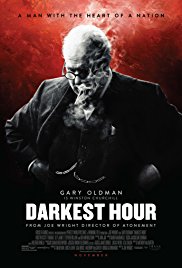
DARKEST HOUR (2017)

December 7, 2017

 Greetings again from the darkness. Cinematic historical dramas, by definition, face the challenge of overcoming a known and documented outcome. Director Joe Wright (ATONEMENT) and writer Anthony McCarten (Oscar nominated for THE THEORY OF EVERYTHING) attempt to re-create the tension-packed few days that literally changed the course of history and the free world.

It’s May 9, 1940 and the film takes us through the next 3 weeks of political wrangling that begins with Winston Churchill (Gary Oldman) being named Prime Minister almost by default, as he’s the only candidate acceptable to both parties to replace an ill and weak war time leader Neville Chamberlain (Ronald Pickup). Even King George VI (Ben Mendelsohn) is skeptical of Churchill and prefers Lord Halifax (Stephen Dillane), his friend who is likely better suited as Churchill’s adversary and a contrarian than as the actual decision-maker in this crucial time.

Uncertainty abounds within the government and the top priority of debate is whether to negotiate a peace treaty with Hitler and Nazi Germany, or fight on against seemingly impossible odds in hope of maintaining the nation’s freedom. Perspective is required here, as at this point, Germany was viewed as an unstoppable military force with Hitler as the leader. The war atrocities and his despicable vision were not yet fully understood. FDR and the United States declined to help and Churchill had few allies inside or outside his country.

We can talk all you’d like about history, but more than anything, this is a showcase for the best working actor who has never won an Oscar, Gary Oldman. This is an actor who has played Lee Harvey Oswald and Sid Vicious, and probably should have won the award in 2012 for TINKER TAILOR SOLDIER SPY. Earlier this year, I was impressed with Brian Cox as the lead in CHURCHILL (which was set four years later), but Oldman’s Churchill looks, sounds and moves like the real thing. We see the familiar profile and silhouette in numerous shots, and it’s actually kind of thrilling.

The always great Kristin Scott Thomas plays wife Clementine, and she shines in her too few scenes. Lily James plays Elizabeth Layton, Churchill’s bright-eyed secretary and confidant, and she has a couple of nice exchanges with Winston – especially the one explaining the “V” hand gesture. Another favorite line has a character state, “I love to listen to him. He has 100 ideas every day … 4 of which are good … 96 of which are dangerous.” It’s this type of writing that emphasizes the opposite approaches between this film and Christopher Nolan’s DUNKIRK, which utilized minimal dialogue as opposed to the emphasis on words taken by Mr. Wright’s film.

We go inside the House of Commons to experience real political gamesmanship, and see the hectic activities inside the war room as typewriters are being pounded while strategies and alliances are being formed. It’s an example of politics driven by a fear of action (by most) while there is a touch of hero worship as Churchill stands alone for much of the film. Some creative license is taken as Churchill rides the Underground (subway) in order to connect with citizens and take their pulse on war … despite most having no clue just how desperate things are. We see tremendous and tragic shots of Calais, and the wide range of camera work really stands out thanks to cinematographer Bruno Delbonnel, who also masters the indoor lighting and shading.

Operation Dynamo at Dunkirk is discussed briefly (this would be the perfect companion piece to Christopher Nolan’s masterpiece from earlier this year), but mostly this is the personalization of those who politicize war. The good and bad of history is made up of people, good and bad. Yes, there are a few too many Hollywood moments here, but Oldman does capture the pressure, isolation and belief of the historical figure who helped save a country, and perhaps the world. We hear two of Churchill’s most famous speeches: the “Never Surrender” speech to Parliament and “We shall fight them on the beaches …” prompted by the red glow of the “on air” radio light. There are many published books that provide more detail, but Oldman’s performance does guide us through what the Prime Minister must have gone through … and that’s worth a ticket and a gold statue.

watch the trailer:


MAN DOWN (2016)

December 3, 2016

man-down Greetings again from the darkness. Perhaps this movie and story would have hit me harder had I not recently watched Michael King’s documentary When War Comes Home. Post Traumatic Stress Disorder (PTSD) is the focus of both films, but the reality of the three soldiers in King’s film simply packs a bigger emotional punch than the fictionalized version of one soldier in this latest from director Dito Montiel. That said, the dramatization offers a few worthy moments.

The story/stories revolve around a new Marine named Gabriel Drummer (played by Shia LaBeouf). We are bounced between three timeframes: a futuristic, post-apocalyptic world; the time Gabriel is serving on the frontlines of Afghanistan; the pre-Marines time when we see Gabriel as a loving father, husband and friend … he’s the kind of dad who surprises his son with a birthday puppy, and creates a secret phrase so he can tell his son he loves him without embarrassing him at school.

An interrogation sequence between Gabriel and the military counselor (played by the great Gary Oldman) provides the film’s best scenes … the two actors go head to head in what is really psychological warfare in a trailer office. There is an “incident” that occurred, and the counselor is attempting to figure out Gabriel’s mental state. Once we are provided the details of the incident, we fully understand why Gabriel is an emotional mess, and basically shut-down from conversation and life.

Kate Mara appears as Gabriel’s wife and Charlie Shotwell (Captain Fantastic) as his son. The film probably would have benefitted from more attention on the family foundation prior to Gabriel being shipped out. Jai Courtney stars as Gabriel’s close and lifelong friend, though when Gabriel asks his friend to “watch out for my family”, we know where things are headed. It’s here where the film just stretches too far. The effects of war provided plenty to make the point director Montiel is going for, and the cheap/clumsy gimmick only distracts.

LaBeouf is in fine form and in quite a different role than his quick-with-a-quip charmer in this year’s American Honey. This latest film probably has more in common with A Beautiful Mind than with Born on the Fourth of July, or any other film dealing with post-war challenges. The statistics posted prior to the closing credits make it obvious that Montiel meant this as a message movie – making the melodrama and extreme visuals all the more misplaced. Montiel made some festival noise with his 2006 debut A Guide to Recognizing Your Saints, and it seems he is destined to make a really good movie at some point.

watch the trailer:


DAWN OF THE PLANET OF THE APES (2014)

July 14, 2014

planet Greetings again from the darkness. Admitting a weakness is the first step. Yes, I am a proud, long-time fan of this series. My soft spot for these films began when I was a kid – mesmerized by the 1968 original, while watching from the back seat of the car, as the clunky metal speaker hung on the window and my parents sat in the front. Oh, and yes, I was wearing my pajamas!

It’s pretty much impossible to describe the technological advances in movies since Charleston Heston stumbled into one of the biggest shocker endings the movies have ever provided (and that was 46 years ago!). Heck, the advances since the 2011 movie with James Franco are staggering to see. The combination of real actors, CGI and fantastic motion capture technology make for a realistic look that is unsettling at times.

Many know the work of Andy Serkis (Gollam, King Kong) who is considered the master of motion capture acting, and here he returns as Caeser, the leader of the apes. Only this time, he has real competition, especially from Toby Kebbell as Koba, his friend who was previously mistreated in the lab by humans … thereby explaining their opposite view of the few remaining humans.

This entry from director Matt Reeves (Cloverfield, Let Me In) picks up 10 years after the 2011 movie. The apes have established a very cool community in the forest, while only a few immune humans survived the lab-born simian virus that was leaked. The apes have continued to get smarter and even have their own culture and code (apes don’t kill apes). The surviving humans have fought amongst themselves and only recently organized a faction with Gary Oldman’s Dreyfus as their leader. Malcolm (Jason Clarke) takes a small group over the Golden Gate Bridge to see if they can reignite a dam which could produce the energy so desperately needed in human town.

Almost immediately, humans and apes meet. The big philosophical chess match begins with Malcolm and Caeser negotiating for cooperation and peace, while Koda and Drefus see war as the only solution. Alliances are drawn, fragile accords made, loyalties are questioned, and hierarchies crumble. See, it turns out the apes are like us, and we are like the apes.

There is a terrific battle scene, but the real joy here is the personalities and look of the apes. It is fascinating to watch the interactions … and that final shot is startling! The only downside is the caricature of Carver played by Kirk Acevedo. He is the token human d-bag but his character is so over the top it ruins most of his scenes. Luckily, he has very few … and they are offset by the really cool horse dismount displayed by Caesar. If you buy into this, it’s a tension-filled jolly good time.

SEE THIS MOVIE IF: you are fan of the series and want to be awed by the evolution of the apes – both in the story and on the screen

SKIP THIS MOVIE IF: you just can’t buy into the apes thing OR you miss Roddy McDowell and his rubber mask too much to ever give the nod to CGI.

watch the trailer:


ROBOCOP (2014)

February 14, 2014

robocop Greetings again from the darkness. The expected cringes and groans never fully surfaced as the modernized re-boot of Paul Verhoeven’s 1987 classic unfolded on the screen. Sure, I wish Peter Weller made even a cameo appearance, and yes, I missed the charm, humor and satire that has allowed the original to remain relevant; but, director Jose Padilha reimagines the story, sticks to PG-13 action, and incorporates the video game look favored by today’s filmgoers.  The result is an adequate action movie with a Dr Frankenstein twist, a dash of questionable technological morality, topped with the always evil corporate conglomerate.

The opening sequence takes place in Tehran and is extremely well done, setting the stage for incisive commentary on today’s foreign policies and drone usage. Unfortunately, THAT movie never materializes, but we do get the over-the-top conservative news host … played colorfully by Samuel L Jackson, who does manage to work in his iconic catchphrase (yes even a PG-13 movie is allowed one MF). His holographic studio reminds of Minority Report, and has the futuristic look required to distract us from any real message.

Joel Kinnaman (TV’s “The Killing“) adequately fills the part man/ part robot role (good guy and good cop Alex Murphy), but the script really lets him down when it comes to his wife (Abbie Cornish) and kid, his crime-fighting instincts, and the overlapping criminal elements – some poorly cast generic arms dealer and the ultimate villain known as mega corporation OmniCorp run by the great Michael Keaton. The movie’s best scenes involve the interaction between Keaton and the always terrific Gary Oldman, playing a conflicted doctor/robotics genius with a conscience (most of the time).

The supporting cast is stellar and features a nasty Jackie-Earle Haley, a properly proper Jennifer Ehle, a relatively straight-laced Jay Baruchel, a two-faced police captain played by Marianne Jean-Baptiste, Murphy’s partner Michael K Williams, and Oldman’s loyal assistant played by Aimee Garcia (“Dexter“). The biggest missed opportunities involve the cop partnership with Mr. Williams … such an integral part of the first movie (Nancy Allen), but here it seems most of this story was inexplicably left on the editing floor.  The story, the viewers and Mr. Williams deserved much better.

A bit too much shakycam in the first shootout left me disappointed, as did most of the action sequences. However, the effects for the robotic suit and Murphy’s “body” are fantastic.  Especially effective is the scene with Murphy first becomes aware of what remains of him and how much is robotic suit.  This is very much a tale of moralistic choices, and it could have been interesting to see Murphy go a bit deeper in his existential questioning of Man or Machine. Mostly, I was simply relieved it wasn’t terrible and didn’t tarnish the legacy.

**NOTE: the city of Detroit is the base, but the movie never really touches on the problems within the actual city.  In fact, very little crime solving is shown – but we do have the stats relayed to us.

SEE THIS MOVIE IF: you wonder what Iron Man would be like with an evil billionaire calling the shots rather than a  brilliant billionaire wearing the suit OR you never miss the rare (these days) chance to see Michael Keaton on screen.

SKIP THIS MOVIE IF: you are perfectly content to allow the 1987 film version to maintain its spot as THE Robocop movie.

watch the trailer:

http://www.youtube.com/watch?v=INmtQXUXez8

http://www.youtube.com/watch?v=INmtQXUXez8


JFK (1991)

November 22, 2013

jfk1 Greetings again from the darkness. Fifty years to the day after the tragic assassination of President Kennedy seems like the best time for me to finally write something about Oliver Stone’s controversial 1991 film. As a Dallas resident, the hallmark event has never been far removed, either mentally or geographically. I periodically see movies at the Texas Theatre where Oswald was captured. It’s impossible to drive downtown and not regularly pass the Texas School Book Depository and Dealey Plaza. The reminders are always present and maybe that’s a good thing.

When this movie was released, it shook the dust off the story and brought much attention back to the crime that had once seemed so quickly solved. The conspiracy theorists embraced Mr. Stone’s work and even those who knew little of the Warren Report were swept up in the details and accusations. It was so easily accepted as an investigative presentation, and it was a way for the people to finally get what they wanted … the answer to what happened and why.

jfk2 Viewing the film this week again for the first time since 1991, it’s understandable why so many were swept up in the frenzy. This is an expert presentation of a staggering number of theories and details and characters. With a run time well over three hours, the only opportunities for an exhale come during the somewhat lame interactions between New Orleans District Attorney Jim Garrison (Kevin Costner) and his wife (Sissy Spacek). Othewise, it’s a very well written parade of movie stars that is exceptionally photographed and expertly edited. Newsreel footage, reenactments, and dramatizations of events successfully create a mind puzzle. The film grabs you and does not let go … and this is 22 years after release and 50 years after the assassination.

Now don’t mistake that praise for believability. While Stone’s approach has been attacked from all sides, he did publish an annotated script “proving” his details. Still, his blending of theories is staggering: the military, the CIA, the FBI, LBJ, the Mafia, the pro- and anti-Castro types, the Russians, and even a likely corrupt businessman. The latter is Clay Shaw, played with evil enjoyment by Tommy Lee Jones in a role worthy of a movie unto itself.

jfk3 In Stone’s version, Garrison is the voice of truth. He’s the guy that doesn’t buy off on the Warren Report. In fact, this movie version of Garrison represents us as the viewer … the citizens who want to believe our government, but are too rational to accept things spoon fed to us. This isn’t so much a courtroom drama or investigative report, it’s more like a data dump. Stone is delivering all of the little doubts in one fell swoop. In other words, with all of these possibilities and unexplained events, how could it not be a conspiracy? Was it a coup d’etat with LBJ waiting in the wings? That makes sense if you believe defense contractors were unwilling to sit quietly as JFK pulled out of Vietnam. Was Oswald a patsy as he claimed? That argument can certainly be supported. More than one gunman? 5.6 seconds, a tree in the eye line, and smoke from the grassy knoll can lead to that conclusion. The movie serves as our emotional outburst at not knowing why this happened and who was responsible. We like our mysteries solved and this one apparently never will be.

Roger Ebert once said that facts are for print and emotions are for film. Oliver Stone seems to excel at the latter. He gives us permission to be paranoid. He takes extreme dramatic license with two extended soliloquies: Donald Sutherland as “X” (Fletcher Prouty) and Kevin Costner as Garrison in the courtroom. Neither of these events are probable, in fact the courtroom scene is borne from numerous Garrison speeches, quotes and book passages over the years.

This 50th anniversary has brought at least three new JFK inspired films: Parkland, Killing Kennedy, and Letters To Jackie. Three very different approaches to the man and the event that changed the world … it changed our perceptions and our expectations. Oliver Stone’s film gave us permission to do so out loud.

**NOTE: on the anniversary of this event, it’s important to remember that Officer JD Tippett was also brutally gunned down that day by Oswald

**NOTE: the real Jim Garrison appears in the movie as Earl Warren (yes, of the Warren Commission)

**NOTE: Unitended humor occurs with a sweaty John Candy saying “Daddy-O” and when Kevin Bacon says “People GOT to know