BLACKKKLANSMAN (2018)

August 9, 2018

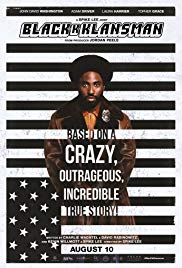
 Greetings again from the darkness. Adam Driver impersonating John David Washington or vice versa … either way is comical, except that it’s also based on a true story where their characters existed and this chain of events actually occurred. The source material is the memoir by Ron Stallworth and it’s possible, given today’s social climate, that only director Spike Lee could pull off a film that so blatantly uses racism for comedic effect, yet also reminds us of its inherent danger.

Mr. Washington (Denzel’s son) plays Ron Stallworth, Colorado Springs’ first black rookie police officer. His job interview is quite awkward and, of course, features a reference to Jackie Robinson. Quickly growing tired of his records room duty, Stallworth’s first field assignment is to infiltrate a local black activist group and report back on a Stokely Carmichael/Kwame Ture (Corey Hawkins) event. This leads to a much bigger and riskier plan of going after the KKK. Yes that’s right, no need to re-read the part about him being the first black police officer. This is the incredible story of how an African-American (with the help of his white partner) worked his way into the KKK, even speaking with David Duke on a few occasions, and ultimately prevented an attack on local black activists.

The adapted screenplay was a collaborative effort from Charlie Wachtel, David Rabinowitz, Kevin Willmott, and director Spike Lee. The film is simultaneously laugh outloud funny and provocative. The outlandish plan involves Ron Stallworth (and his white voice) being the telephone connection, and partner (and non-practicing Jew) Flip Zimmerman (Adam Driver) being the “white face” of Ron Stallworth at KKK meetings. There is extreme tension during Zimmerman’s undercover scenes, and much of the humor occurs during Stallworth’s phone conversations. Topher Grace is extremely effective as David Duke, a thankless role to say the least.

Superb support work is widespread in this film that runs 2 hour and 15 minutes. Robert John Burke plays a no-nonsense Chief Bridges; Frederick Weller is racist jackass patrolman Andy Landers; Laura Harrier is Patrice, the Angela Davis lookalike activist and love interest; Jasper Paakkonen plays skeptical and high-strung Klansman Felix; Paul Walter Hauser (I, TONYA) is the comical and unnerving Ivanhoe; and even Harry Belafonte makes a surprise big screen appearance. Other notables include Alec Baldwin (in an opening that sets the stage), Nicholas Turturro, Damaris Lewis, Ryan Eggold, Isiah Whitlock Jr, and Arthur J Nascarella. It’s a terrific and deep cast and they walk the fine line between entertainment and enlightenment. There is no shortage of Hollywood family genes and blending thanks to: Washington, Baldwin, Turturro, Buscemi, and Weller (it plays like 2 degrees of separation).

A low-budget look to the film gives it an authenticity and 1970’s vibe, and cinematographer Chayse Irvin works wonders with the camera in a multitude of situations where our attention should be on the dialogue of the characters rather than the colorfulness of set pieces. Black Ron running the show from a telephone (and a white voice) and White Ron face-first in the muck both have their burdens to bear, and much of the time, Zimmerman’s is the more interesting of the two – although as a whole, it’s an astonishing story.

Perhaps Spike Lee set out to make the polar opposite of D.W. Griffith’s 1915 most controversial film THE BIRTH OF A NATION, and he has certainly crafted one of the most effective films of his oeuvre. He also nails a few jabs at Trump and the current political climate, while the music from Terrence Blanchard perfectly complements the tone. Mr. Lee interjects some historic moments as well as some fictional ones – none more powerful than the back and forth chants of “White Power” “Black Power”. At the conclusion, Lee serves up footage of Charlottesville, reminding us that the racism that caused us chuckles over the past couple of hours, remains prevalent today … only that’s not the least bit funny.

watch the trailer:


LOGAN LUCKY (2017)

August 17, 2017

 Greetings again from the darkness. When we think of public figures retiring, we typically accept that athletes, politicians and entertainers will no longer be honing their craft or grinding in their profession. Perhaps they will write their memoirs, or even dodge TMZ completely by spending their days fishing or playing golf. When Oscar winning film director Steven Soderbergh announced he was “retiring” from making movies after his 2013 SIDE EFFECTS, he simply transitioned to television (excellence in “The Knick”). Most of us assumed it was only a matter of time until he returned to the medium that made him famous. This “retirement” lasted less than 4 years.

When a line in the film describes it as “Ocean’s 7-11”, we can assume this is Mr. Soderbergh admitting that his “Ocean’s” trilogy was the inspiration for this comedy-satire heist film focusing on a well-planned crime by a team of siblings, rednecks and convicts. Channing Tatum, Adam Driver and Riley Keough star as the Logan clan – Jimmy, Clyde, and Mellie, respectively. With NASCAR as the target, the Logans are joined by the Bangs: Sam (Brian Gleeson), Fish (Jack Quaid), and Joe (a scene-stealing bleached blonde Daniel Craig).

Joining in the unconventional Hicksville fun are Katie Holmes and David Denman as Jimmy’s ex-wife and her new husband, a recently shorn Sebastian Stan as a race car driver, Seth MacFarlane as an obnoxiously rich blow-hard, Katherine Waterston in a too-brief role as a traveling medic, Hilary Swank as a determined FBI Agent, and Dwight Yoakum as a prison warden who rarely admits a problem. Also playing a key role is the music of John Denver … a move that teeters between tribute and punchline.

The set up and characters lend themselves to more laughter than we actually experience. There are more awkward moments than hilarious ones. As examples, brother Clyde’s (Driver) artificial hand is the center of focus on a few occasions, as are Joe Bang’s (Craig) expertise in science, and the small town West Virginia addiction to child beauty pageants. Their racetrack robbery plan is both ingenious and preposterous, which is also a fitting description of the film.

A writing credit goes to “Rebecca Blunt”, which in keeping with Soderbergh’s tradition, is a pseudonym (or nom de plume) for an unnamed writer (likely Soderbergh himself). The film mostly succeeds in delivering the opposite of the traditional Ocean’s slickness, and it’s entertaining to watch Channing Tatum and Daniel Craig (the credits list him as “introducing Daniel Craig) having such a good time on screen. While it doesn’t deliver the laughs of FREE FIRE or TALLADEGA NIGHTS, it is nice to have Soderbergh back where he belongs. Rather than an instant classic, it’s more likely to be remembered for Soderbergh’s attempt to change the movie distribution channels … Google can provide the details if you are interested.

watch the trailer:


PATERSON (2016)

January 8, 2017

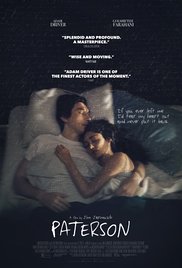
paterson-b Greetings again from the darkness. Do you find poetry in everyday life? What about poets … do you envision loners whose lives are filled with angst and suffering? Our lead character here is a pretty normal guy who drives a city bus, has a happy marriage, and walks his dog each evening. He’s also a poet – and a pretty interesting one.

Writer/director Jim Jarmusch (Broken Flowers, 2005) often seems like he is making films for his circle of friends … all whom must be much cooler than you and me. This time, however, he takes an opposite approach and brilliantly focuses on a dude that any of us could know. Paterson (Adam Driver) is a New Jersey Transit bus driver who writes poetry based on his observations of life’s seemingly minor details (his first poem notes “We have plenty of matches in our house”).

You should be forewarned: there are no murders, kidnappings, bank robberies or shootouts. Things move rather deliberately. Also missing are any special effects – heck, Adam Driver even got licensed to drive a bus for the role. Instead, we are forced to slow down and see each of the seven days of a week through the eyes and words of Paterson. He observes. He listens. He people watches. He then commits his thoughts to the page and recites them for our benefit. Sometimes he is eavesdropping on bus passengers, while other times he curiously tries to figure out the newest “dream” for his beloved wife Laura (Golshifteh Farahani). Having the soul of an artist, Laura cloaks her world in a geometric black and white color scheme while energetically bounding from cupcakes to country and western music to cooking as she pursues her place in life.

There are many Jarmusch touches throughout. Paterson the poet actually lives and works in Paterson, New Jersey … yep, Paterson from Paterson. The interactions at the neighborhood bar (run by Barry Shabaka Henley) are simultaneously real and surreal – right down to the wall of local fame (including Hurricane Carter and Lou Costello, but no mention of Larry Doby). Coincidences abound. A young girl recites her poem to Paterson … her writing style, personal book, and delivery make her seem like his poetic doppelganger – all while the recurring appearance of numerous sets of twins make us believe in the law of attraction. Lastly, the closest thing to a villain in the film is Paterson’s bulldog Marvin, in what plays like a love-hate relationship with the mailbox being center-ring.

Another local Paterson (the city) aspect is Paterson’s (the poet) admiration of the works of William Carlos Williams, a poet whose style he emulates. One of the terrific scenes near the end involves a spontaneous interaction between Paterson and town visitor (Masatoshi Nagase) that takes place next to The Great Falls, and serves as a reminder that we should accept who we are, no matter the challenges or lack of glory. This is truly director Jarmusch’s ode to the artist/poet in each of us and in ordinary life. Creating art as best we can is a very personal thing, and for some it’s a need – while for others it’s one of life’s simple pleasures. Regardless, a “normal” life with daily routines is not to be scorned, but rather embraced, should you be so fortunate. If you doubt this, Paterson asks, “Would you rather be a fish?”

**NOTE: sharp moviegoer eyes will recognize Kara Hayward and Jared Gilman, who both had their debut in Wes Anderson’s Moonrise Kingdom (2012).

watch the trailer:


SILENCE (2016)

January 5, 2017

silence Greetings again from the darkness. Martin Luther King said “Faith is taking the first step even when you don’t see the whole staircase”. Martin Scorcese’s esteemed film career could be described as unveiling that staircase, one step/film at a time. Religion, spirituality and yes, faith, have played a key role in his life and his films – most notably, Kundun and The Last Temptation of Christ, but also most of his other projects.

A high-ranking priest (Ciaran Hinds) is meeting with two younger Portuguese priests and informing them of the rumor that their mentor Father Ferreira (Liam Neeson) has reportedly renounced his faith and is now living as a Japanese Buddhist in Nagasaki. The two young Jesuit priests, Rodrigues (Andrew Garfield) and Garupe (Adam Driver) refuse to believe this and request to be allowed to track down Ferreira and bring him home. It could be termed a rescue mission, and the two men could be called missionaries, but what follows is an excruciating test of their own faith.

Martin Scorcese has been working on this passion project for more than two decades – ever since he read the Shusaku Endo novel (published in 1966). Cast members have changed through the various iterations of the project, but after the box office success of The Wolf of Wall Street, Scorcese received the financial backing to bring his vision to the screen. He co-wrote the screenplay with Jay Cocks (Gangs of New York) and the result is the visual and emotional epic that you might expect from one of the greatest filmmakers of all time.

17th century Christianity in Japan might be a difficult subject to sell to the general movie-going public, and Scorcese goes out of his way to leave unanswered the multitude of questions the film raises. Rather than wrapping it up with a clean ending, he leaves viewers craving further discussions, clarity and explanations. In other words, it lacks mass appeal and shouldn’t be confused with light-hearted entertainment.

Rodrigues is resolute in his belief that God is the answer … even when the film’s title is at the forefront. As Rodrigues and Garupe minister to the village of secret Christians (led by Yoshi Oida and Shinya Tsukamoto) at night and hide during the day, we learn of the Japanese state’s commitment to eradicating Christians and Christianity to ensure the power and isolation of the country. The oddest character in the film is that of Kichijiro (an excellent Yosuke Kubozuka). He is both guide to the priests and a constant challenge to their faith, while also providing moments of comic relief in a film with very few. Were this a Kurosawa film, this role would have been a perfect fit for the great Tishiro Mifune.

The most obvious adversary for the priests is the Japanese elder known as The Inquisitor. Issei Ogata excels in the role as a wily, half-smiling, quite knowledgeable wartime (a war on Christianity) leader intent on creating the most painful and public extermination of Christian believers and those priests who dare to infect his country (Japan’s 1614 Edict of Expulsion). The torture and persecution is too much to detail here, but it portrays how even the most ardent believers could choose life over faith.

The film blends fiction with some true-to-life aspects, and is most effective at asking questions and spurring thought. Which is more crucial – public or private faith? Is doubt allowable and even understandable? Is Rodrigues so committed to faith or is there also an element of martyrdom present? How about the “Judas” sub-plots? Is it betrayal if it saves one’s own life? Just where is that line? Is Ferreira a disgraced priest or simply a man valuing survival? The film is beautiful to look at (superb work from cinematographer Rodrigo Prieto and editor Thelma Schoonmaker) while being exceedingly tough to watch (and quite long). Be prepared to set aside time for reflection and discussion … you may even discover some surprises in your views and beliefs.

watch the trailer:


MIDNIGHT SPECIAL (2016)

March 19, 2016

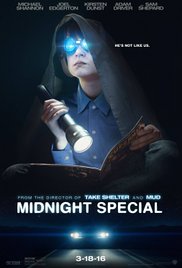
midnight special Greetings again from the darkness. Austin-based filmmaker Jeff Nichols serves up some of the familiar themes of spiritualism and parenting seen in his first three films: Mud (2012), Take Shelter (2011), Shotgun Stories (2007), but this time he goes a bit heavier on the science fiction … while maintaining his focus on the individual.

An exceptional opening scene kicks off the story, and Nichols makes sure we are alert by forcing us to absorb and assemble the slew of clues flying at us … an Amber alert, cardboard on the windows of a cheap motel, a news report tying us to San Angelo, Texas, duct tape on the peep hole, a duffel bag of weapons, two anxiety-filled men, and a goggled-boy under a white sheet who seems extremely calm in an otherwise hectic environment. We learn a lot, yet many questions remain.

As the boy and the two men speed off down the backroads, the setting switches to an eerily calm Calvin Meyer (the always great Sam Shepard), who is the leader of a religious cult similar to the Branch Davidians. “The Ranch” is desperate to get the boy back, and we learn they worship the numbers and words the boy has “received” from above. An FBI agent (Paul Sparks) leads the raid on the compound and takes us to an interrogation of Calvin by NSA analyst Paul Sevier (Adam Driver).

Alternating between sci-fi special effects and an “on the run” story line, we slowly pick up more details about the boy Alton (Jaeden Lieberher), as well as the men with him – his father Roy (Michael Shannon) and Roy’s childhood friend Lucas (Joel Edgerton). It’s not long before they reunite with Alton’s mother Sarah (Kirsten Dunst) and we really start to comprehend just how different and special Alton is.

It’s easy to see the influence of such films as Starman, E.T.: The ExtraTerrestrial, Close Encounters of the Third Kind, and The Day the Earth Stood Still. We are reminded that our society inevitably assumes the worst when something we don’t understand appears right in front of us. The Ranch sees the boy as a savior, and the government labels him a weapon. But it’s Shannon who captures the protective determination of a father trying to do the right thing for his son. Shannon again flashes the best ‘pained’ expression in the business, but it’s young Lieberher (so terrific in St. Vincent) who allows us to accept the father/son story in spite of the bright white lasers shooting from his eyeballs.

There are plenty of unanswered questions – not the least of which is, how did two “normal” parents end up with this “special” son? The visuals near the end are impressive to see on screen, but don’t appear to have much impact on the final questioning of Lucas or our understanding of how it all happened. It should also be noted that the piano score is especially impactful during both the quiet and thrilling moments. Director Nichols is a talented idea man, but he does leave us wanting more details.  (That’s his brother singing the song over the closing credits.)

watch the trailer:


STAR WARS: THE FORCE AWAKENS (2015)

December 23, 2015

star wars Greetings again from the darkness. In what can justifiably be termed a cultural event, director J.J. Abrams brings us Episode VII in a film franchise (developed by George Lucas, now owned by Disney) that date backs almost 40 years. While I was one of the lucky ones who waited patiently in line to see the first Star Wars on opening day in 1977, I can only be described as a series fan rather than a Star Wars geek. My bond is with Han Solo and Chewbacca, so I’m not here to debate the minutiae of costumes, timelines and weaponry.

What I can happily report is that Mr. Abrams (he’s also directed Star Trek and Mission Impossible films) has found just the right blend of nostalgia, science-fiction, and geeky gadgetry to appeal to the widest of all audiences. The film is an honorable tribute to the previous six in the series, yet it’s more than entertaining enough to stand alone for new comers.

As we expect and hope for, the screen is filled with fantastical visuals that somehow push our imagination, while at the same time, feel realistic to the story and action. The aerial dogfights are adrenaline-pumping and spectacular in their vividness, and the more grounded action scenes feature Stormtroopers who have clearly had lots of target practice since the previous films.

You need only watch the trailer or read the credits to know that some of the old familiar faces are back: Harrison Ford as Han Solo, Mark Hamill as Luke Skywalker, Carrie Fisher as Princess Leia, Peter Mayhew as Chewbacca, and of course, our old pals C-3P0 and R2D2. Also back is the remarkable composer John Williams – likely to receive his fiftieth (yes, 50!) Oscar nomination for his work here. In addition to the familiar, new faces abound: John Boyega as Finn, Daisy Ridley as Rey, Adam Driver as Kyle (don’t call me Ben) Ren, Oscar Isaac as Poe, Gwendoline Christie as Captain Phasma, and Domhnall Gleeson as Captain Hux. There is also the magic of Andy Serkis as Supreme Leader Snoke, and an all-too-brief sequence featuring Max von Sydow. Oscar winner Lupita Nyong’o voices Maz Kanata, and there is an impressive list of other cameos available online if you are interested (Daniel Craig being the most eye-raising).

Abrams along with action cinematographer extraordinaire Daniel Mindel take full advantage of all available technical aspects in creating stunning visuals and spine-tingling sound. It’s a film made to be watched on the biggest screen with the best sound system, so ask around if you aren’t sure. If you are a long-time fan of Han and Chewy, you’ll enjoy catching up with old friends. If you are unfamiliar with the Star Wars galaxy, this latest will hook you into the force.

watch the trailer:


HUNGRY HEARTS (2015)

June 7, 2015

hungry hearts Greetings again from the darkness. Everyone loves a good “How did you two meet?” story, and the best of these stories somehow makes the couple more interesting. It’s pretty tough to beat the meet-cute of Jude and Mina in the opening scene from writer/director Saverio Costanzo … even if it does take place in the tight and pungent confines of restaurant restroom. It’s a terrific start to a movie that has no real shot at getting better from there.

Jude (a terrific Adam Driver) and Mina (Alba Rohrwacher) fall right into bed and in love … directly from the outhouse. We catch glimpses of their romance, and quickly accept them as a well-suited, warm-yet-quirky couple. An unexpected pregnancy kicks off a gradual and troubling change in Mina. This change is turbo-charged once the baby arrives. Mina registers in the extreme of the mother’s instincts vs. modern medicine debate.  She is all about purity for her baby – food and environment. There is nothing wrong with that, right?  Well, when the baby doesn’t grow and develop, it’s understandable that the dad might freak a bit, no matter how understanding or trusting he claims to be.

The story becomes the unraveling of a once-promising relationship, as well as the unraveling of a once seemingly normal woman. With the tone of an early Roman Polanski movie, Costanzo’s film (from Marco Franzoso’s novel) has very real horror overtones, while playing out like a real life parenting drama … or a psychological thriller. The real turning point for Mina’s character seems to occur after a Psychic Reading where the Clairvoyant labels her baby as an Indigo child. Mina believes this and her psychotic actions create the intense worries of Jude and his mother (Roberta Maxwell).

With the current uproar of vaccinations, there is certainly a modern day link to the story line of mother’s instincts vs. doctor’s orders. But with a lawyer recommending kidnapping, and a triumvirate of desperate characters: father, mother, grandmother, there doesn’t seem to be much factual data here … rather it’s an effective scare tactic.

watch the trailer:


THIS IS WHERE I LEAVE YOU (2014)

September 21, 2014

this is where Greetings again from the darkness. After watching this movie, I thought about researching whether the boobs of a 76 year old actress had ever been as front and center as they are in this dramedy from director Shawn Levy – not counting Calendar Girls which was for a worthy cause. Luckily I came to my senses, and realized that’s not a topic anyone should google … except maybe a 76 year old man.

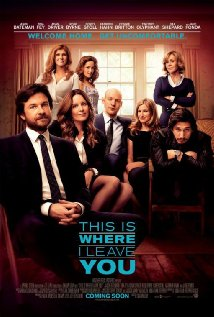
Jane Fonda is the actress whose enhanced assets are so prominently featured, and she plays the mother of four adult children brought together to mourn the death of the family patriarch. This is based on the novel by Jonathan Tropper and though it’s watchable enough, it could have benefited from a better script adaptation and a less mainstream comedy director. Mr. Levy provided the popular and entertaining A Night at the Museum, as well as a long list of simple minded movies that didn’t prepare him for the depth of Tropper’s story.

The four “kids” are played by Corey Stoll, Jason Bateman, Tina Fey and Adam Driver. Also joining them under a single roof are Stoll’s desperate-for-a-baby wife Kathryn Hahn, Fey’s two kids and self-professed a-hole husband (Aaron Lazar), and Driver’s engaged-to-be-engaged much older woman played by Connie Britton. If you think that’s an outstanding cast, note that also appearing are Timothy Olyphant (Fey’s brain-damaged former lover), Rose Byrne (she always lusted after Bateman), Dax Shepard (sleeps with Bateman’s wife played by Abigail Spencer), Ben Schwartz as an oddball Jewish rabbi, and Debra Monk (the helpful neighbor and more).

Obviously the issue with so many characters and talented actors is that screen time is limited. Somehow each of these have one key moment in the film, and that may be the biggest issue. Some of these we want to know more about (Olyphant, Byrne, Brittain), while others could have been written out of the script altogether (Lazar, Schwartz, Shepard) and the movie wouldn’t have suffered, and might have improved.

Most of the story revolves around Bateman and his situation – crumbled marriage, lost job, dead father, plus even more. Going through that and facing his sit-com worthy dysfunctional family provides an unending stream of none-too-subtle moments: a basement sleeper/sofa that won’t fold out, roof top talks with his bossypants sister, and even fisticuffs inside the family and out.

This is another in the Suburban-angst sub-genre, and the numerous contrived scenes and formulaic sequences are salvaged only by the talented casts ability to squeeze the moment from the next one-liner. There is so much rage and resentment in this family that we viewers are willing to find humor in the toddler toting his portable potty with him everywhere, or even Bateman taking the expected prat fall in an ice rink. There is little edge to this material, but it’s not difficult to glimpse how the right director could have approached the genius of The Royal Tenenbaums or the original Death at a Funeral, rather than a generic blend of Garden State and August:Osage County.

Britton, Byrne and Batemen all have their moments, and the movie is certainly watchable … though it could have been exceptional as either a straight out comedy or an indie-type drama. No need to email me if you come up with additional films featuring 76 year old boobs.

SEE THIS MOVIE IF: you are up for the challenge of keeping track of the seemingly endless number of characters who have “a moment” during this one

SKIP THIS MOVIE IF: you share the sentiment with me and Jason Bateman’s character that there is no need to focus on Jane Fonda’s “bionic breasts”

watch the trailer:


INSIDE LLEWYN DAVIS (2013)

December 15, 2013

Greetings again from the darkness. If you are a follower of the filmmaking Coen Brothers (and you should be), then you are quite aware of their complete lack of artistic interest in any traditionally successful character. Their work is inspired by life’s obstacles and tough luck, even if brought on by a character’s own poor judgment. Coen Bros stories revolve around those who carry on and have (blind?) faith that their approach, no matter how ill conceived, is the only option … the only path worth taking. Their main character this time out apparently thinks life is filled with only careerists (sell-outs) or losers (those who can’t catch a break).

llewyn6 The titular Llewyn Davis (played by Oscar Isaac) is introduced to us onstage at the Gaslight singing a beautiful folk song. Moments later he is lying in the back alley after taking a whipping from a mysterious stranger. It’s not until this scene is repeated again for the film’s finale do we understand the cause of this effect. See, Llewyn is not a very likable guy. We learn he is still grieving from the suicide of his musical partner (as sung by Marcus Mumford), and that he bounces from sofa to sofa amongst acquaintances and family members. Llewyn has no friends, only acquaintances too kind to throw him out … even if he might be the father of an unwanted baby, or if he accidentally allows a beloved pet cat to escape, or he uses excess profanity in front of kids.

The story is based in the folk music scene of 1961 Greenwich Village in the pre-Bob Dylan days. The Coen’s were inspired by the memoirs of Dave Van Ronk entitled “The Mayor of MacDougal Street“. So while the songs are real and the characters are often inspired or based upon real artists of the time, Llewyn’s story is pure Coen fiction. From a viewer’s perspective, that means cringing, levels of discomfort, uneasy chuckling and moments of rapture … such as John Goodman evoking a drugged out Doc Promus spewing harsh poetic diatribes.

llewyn5 We never really know if the Coens are making a statement or tossing it out for us to debate. Are they saying that even the ugliness of Llewyn’s personality can produce something as beautiful as music, or are they saying that we allow ourselves to get tricked by beautiful music into thinking that the artist must also be pure? Carey Mulligan (as Jean) has one of the film’s best and most insightful lines when she tells Llewyn he is “King Midas’ idiot brother“. Her pure disgust (and expert rendering of the F-word) and anger contrasts with her angelic onstage persona with husband Jim (Justin Timberlake).

As always, the Coens provide us a constant flow of interesting and oddball characters. In addition to Goodman’s jazz hipster, we get Garrett Hedlund as an ultra cool (til he’s not) valet, Adam Driver as a cowboy folk singer, Troy Nelson as a virtuous Army folk singer (based on Tom Paxton), and Llewyn’s Upper East side cat owners, his spunky sister, and best of all F Murray Abraham as Bud Grossman, the owner of Chicago’s Gate of Horn club. Based on the real Albert Grossman who discovered Peter, Paul and Mary, and managed Bob Dylan (whose spirit lingers all through this movie), Grossman is the lone witness to Llewyn’s audition. This may be the most touching musical moment of the movie (“The Death of Queen Jane”), but it’s clearly the wrong song for the moment.

llewyn3 Oscar Isaac is exceptional as Llewyn Davis. He captures that crisis of self that’s necessary for an artist whose talent and passion is just out of step with societal changes. We feel his pain, but fail to understand the lack of caring he often displays towards others. We get how his need for money overrides his artistic integrity as he participates in the absurd novelty song “Please Mr Kennedy”. Why Isaac’s performance is not garnering more Oscar chat is beyond my understanding. It’s possibly due to the fact that the movie and his character are not readily accessible to the average movie goer. Effort, thought and consideration is required.

If you are expecting a feel good nostalgic trip down the folk singer era of Greenwich Village, you will be shocked and disappointed. Instead, brace yourself for the trials of a talented musician who wrongly believes the music should be enough. Speaking of music, the immensely talented T Bone Burnett is the man behind the music and it’s fascinating to note how he allows the songs to guide us through the story and keep us ever hopeful of better days. This is the Coen Brothers at their most refined and expert.

**NOTE: It’s kind of interesting to think that both this movie and Saving Mr Banks are both based in 1961 and the two films are being released at the same time in 2013.  Though totally unrelated, they do provide a stark contrast in NYC vs LA.

SEE THIS MOVIE IF: you are a Coen Bros fan or past due for an introduction

SKIP THIS MOVIE IF: you’ve tried, but Coen Bros humor is just a bit too dark or esoteric for your tastes

watch the trailer:

https://www.youtube.com/watch?v=LFphYRyH7wc


FRANCES HA (2013)

May 30, 2013

frances ha1 Greetings again from the darkness. All the critics are raving about it. Love abounds for the latest from director Noah Baumbach and his co-writer and leading lady Greta Gerwig. What makes my ambivalence even more confounding is that I’m a fan of Baumbach (The Squid and the Whale) and Gerwig (Greenberg). The expert level of filmmaking and acting is obvious, the script details and dialogue are exceptional, and the situations and setting are realistic. So why aren’t I more excited about this one? That’s what I’ve spent the past few days wondering.

It seems Frances Ha delivers everything I look for in an indie film. The problem is that I find almost every character to be annoying and self-absorbed. The first act finds Frances (Gerwig) sitting on top of the world. She has a boyfriend, a frances ha2BFF/roomie, and is a dance company apprentice with the expectation of a dance career. Soon enough she watches Strike Three go by and her world is in a tailspin. We then watch Frances trudge on through uncertainty and instability in living arrangements, personal relationships and career path. It plays like a road trip that really never hits the highway.

Frances moves in with Lev (Adam Driver) and Ben (Michael Zegen) and she is oblivious to Ben’s interest as she obsesses about her former BFF Sophie (Mickey Sumner). See, Sophie is trying to grow up while Frances wants to stay in her dream land where she and Sophie remain “the same person with different hair“. Frances then crashes at the apartment of a fellow dancer played with all seriousness by Grace Gummer (Meryl Streep’s daughter). The two dancing opposites attend an awkward frances ha3dinner party at which Frances manages to spew an endless stream of absurd remarks that advertise her lack of maturity. Her response to this is to take a spontaneous trip to Paris … charged to a new credit card.

Make no mistake. Frances is a very energetic and sincere free-spirited twenty-seven year old. The kind that is only charming in the movies. If her quirk wins you over, you will find yourself rooting for her to get her life together. That would put you in the same corner as most other film critics. On the other hand, if you recognize the optimism, but are unmoved by the immaturity and self-absorption, then you are banished to the corner of those who “just don’t get it”. And I’ll be right there with you.

SEE THIS MOVIE IF: you can revel in the quirky world of Greta Gerwig and Noah Baumbach and find joy in a flirtateous take on Lena Dunham’s “Girls”

SKIP THIS MOVIE IF: annoyingly self-centered people talking a lot about themselves and other things of which they know little, inspires you to request a refund.

watch the trailer:

http://www.youtube.com/watch?v=WqMaeBtK9TA