OSCAR NOMINATED SHORTS – Live Action and Animated (2011)

February 15, 2012

Greetings again from the darkness. Every year I mention how the Magnolia Theatre in Dallas presents one of my favorite movie events … the Oscar nominated short films. Three hours of quality filmmaking! It’s also a reminder of just how frustrating it is that so few people actually get to see these interesting short films.  Why aren’t they screened periodically throughout the year in association with major film releases?  Pixar manages to do this successfully, so it only makes sense that others could follow suit.  With all of that being said, I must regrettably report that this year’s batch didn’t light the fire for me the way past years have.  The quality of the filmmaking was present, but the creative storytelling fell a bit short.

Below is my recap by category, and in order of preference:

LIVE ACTION
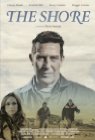
 THE SHORE (Ireland) directed by Terry George.  This one is probably the most mainstream/accessible because it tells a story that is easily relatable.  Ciaran Hinds stars as a man returning home to Ireland after 25 years.  He has his grown daughter (Kerry Condon) in tow, and she is much more anxious than he to reassemble the pieces of his past. As he reconnects with his former best friend and fiancé, we learn they have each harbored secrets and guilt since last they saw each other.  Watching how it plays out is actually quite touching, and includes some humorous moments as well.

TUBA ATLANTIC (Norway) directed by Hallvar Witzo.  Our lead character is an elderly man who has been told by his doctor that he has six days to live.  He is then visited by a self-described Angel of Death – a teenage girl volunteering to spend time with him, and help him through the stages of dying.  Their time together involves her causing him to lose one of his six days thanks to sleeping pills.  She also joins in on his personal vendetta against the local sea gulls, who clearly have been a menace for years. We also see the giant tuba that brings him some peace.

TIME FREAK (USA) directed by Andrew Bowler. One of the two characters has invented a time travel machine for the purpose of realizing his dream of visiting ancient Rome. Instead of visiting Caesar, he jumps off-track due to his inability to get over the minutae of life.  We also get the best Oceanography reference since “Seinfeld”.

PENTECOST (Ireland) directed by Peter McDaniel. We are dropped into 1977 Ireland as a young alter boy makes a critical mistake during mass.  His punishment forces him to miss his beloved futbol team’s big game. Given a second chance, we witness quite a funny pep talk by the local priest.  The sports analogy is impossible to miss, but the young man proves he may be a bit more hard-headed than first thought.

RAJU (Germany) directed by Max Zahle. A young couple travel to India to adopt an orphan boy. What they soon discover is that they are mere bit players in a human trafficking scam.  We see how differently the two people react and how self-interest can sometimes cloud one’s judgment.

ANIMATION

 THE FANTASTIC FLYING BOOKS OF MR MORRIS LESSMORE (USA) directed by William Joyce and Brandon Oldenburg. Despite a title that is impossible to remember, this little film was my favorite of the day. In a pretty creative way, it touts the impact that books can have on our lives. It has a tribute to Hurricane Katrina and The Wizard of Oz while it reminds us of the role books can play in providing hopes and dreams.  Humpty Dumpty and Pop Goes the Weasel both play a key role as we see books spring to life, and bring color to the world of kids and adults.

LA LUNA (USA) directed by Enrico Casarosa. This category wouldn’t be complete without the latest gem from Pixar. We see a young boy being introduced to a most unusual family business run by his father and grandfather. His real challenge is finding a way to keep them happy while still making his own mark. He succeeds in very dramatic fashion.

A MORNING STROLL (UK) directed by Grant Orchard. A NYC street scene plays out in three widely different eras: 1959, 2009, 2059.  The twist here is we see a chicken doing the same thing in all 3 time periods, while the people he confronts, and the environment, shift each time.

DIMANCHE / SUNDAY (Canada) directed by Patrick Doyon. A boy is searching for something interesting to do while his family carries on with their Sunday visit.  Things involved include a house-rattling train, 3 crows that mimic the old men, a “mounted” bear and a bunny rabbit.

WILD LIFE (Canada) directed by Amanda Forbis and Wendy Tilby. An English gentleman settles into a simple cabin in the harsh Alberta frontier in 1909.  His letters home paint a rosier picture than what reality dishes. The film compares his plight to that of a comet, replete with burnout.


TMI (2-15-12)

February 15, 2012

TMI (Today’s Movie Info)

February: Director’s Month

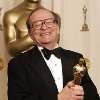
 SIDNEY LUMET (1924-2011) made one of the most remarkable feature film directorial debuts in history with the still powerful Twelve Angry Men (1957). The first half of the 1960’s brought some of Lumet’s best work.  This included: Long Day’s Journey Into the Night (1962), Fail-Safe (1964), The Pawnbroker (1964), The Hill (1965), The Deadly Affair (1966).  Lumet got on another roll in the 70’s with Serpico (1973), Murder on the Orient Express (1974), Dog Day Afternoon (1974), Network (1976).  In 1982 he directed another tense courtroom drama, The Verdict, which won Paul Newman an Oscar.  Though he would go on to direct a dozen watchable movies over the next 25 years, it wasn’t until 2007 (50 years after his first film) when he again achieved near-unanimous critical acclaim with Before the Devil Knows You’re Dead.  It would be his final film. Lumet loved New York City and filmed there whenever possible. He was once married to Gloria Vanderbilt for 7 years. Incredibly, Lumet was nominated for five Academy Awards, but never won … though he was presented with an honorary Oscar in 2005.  Having studied acting, he was considered an actor’s director. He once said “There’s no such thing as a small part.  There are just small actors.


TMI (2-14-12)

February 14, 2012

TMI (Today’s Movie Info)

February: Director’s Month

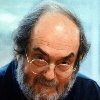
 STANLEY KUBRICK (1928-1999) only made 12 full length feature films, but 11 of them could be considered classics. His 1956 The Killing is still considered one of the best of the Film Noir genre, and Paths of Glory (1957) is a staple in Film Classes for war films. Spartacus (1960) and Lolita (1962) provided true insight into his filmmaking genius, and the turning point in his career was the critical acclaim and box office success of his war/political black comedy Dr Strangelove or: How I Learned to Stop Worrying and Love the Bomb (1964). After that, Kubrick had the power that only a handful of directors ever achieve – he was free to choose what movies he wanted to make, when he would make them, how he would make them, and with whom he would make them. In 1968 he collaborated with Arthur C Clarke to create what many still consider the best sci-fi film ever, 2001: A Space Odyssey.  In the 70’s came his ultra-violent masterpiece A Clockwork Orange (1971) and also Barry Lyndon (1975).  For many film lovers the classic modern horror film is Kubrick’s The Shining (1980), based on Stephen King’s novel (though King despised the adaptation).  In 1987, Kubrick explored the dark psychological damage caused by war in Full Metal Jacket.  His final film was Eyes Wide Shut (1999), which received very mixed critical reviews (he claimed it was his best film).  Kubrick died in his sleep in while working on another sci-fi film.  His friend, Steven Spielberg, finished the film and dedicated AI: Artificial Intelligence (2001) to Stanley Kubrick.  Over his career, Kubrick received 13 Oscar nominations, winning for Best Special Effects for “2001”. Since he gave so few interviews, he was often described as a recluse. Kubrick scoffed at the label saying “I have a wife, three children, three dogs, seven cats.  I’m not a Franz Kafka sitting alone and suffering.”


TMI (2-13-12)

February 13, 2012

TMI (Today’s Movie Info)

February: Director’s Month

 PETER JACKSON … his favorite movie is King Kong (1933), which he re-made in 2005, with Naomi Watts in the Fay Wray role.  Jackson has also been greatly inspired by George Romero’s Dawn of the Dead (1978).  He always co-writes his scripts with his wife, Fran Walsh, and his big breakthrough came in 1994 with Heavenly Creatures, starring a 19 year old relative newcomer named Kate Winslet. Jackson is one of 7 filmmakers to win Oscars for Best Picture, Best Director, Best Screenplay for the same film (Lord of the Rings: Return of the King, 2003) … he also has six other Oscar nominations. Already thought of as a cinematic genius thanks to his Lord of the Rings trilogy, Jackson is currently at work filming his two part film based on “The Hobbit” by JRR Tolkien.  Expected release date for part one is December 14, 2012.


KISS ME DEADLY (1955) revisited

February 12, 2012

 Greetings again from the darkness. This one showed up near the finish line of the classic Film Noir era, and has some features that make it stand out: unusual female characters, a quasi-parody feel, and a twisty ending unlike others from the genre. Based loosely on the Mickey Spillane pulp novel, the screenplay comes from A.I. Bezzerides, who is best known as the creator of the TV series “The Big Valley”. The biggest impact comes from director Robert Aldrich.

Aldrich (pictured below) is a bit under-appreciated in Hollywood history having also directed Whatever Happened to Baby Jane; Hush, Hush, Sweet Charlotte; The Dirty Dozen; and The Longest Yard (the good one). Here he turns up the intensity on the Private Investigator story by having Mike Hammer (a terrific Ralph Meeker) be quite a bit more forceful and aggressive than Marlowe, Spade and the other famous movie PI’s.

The film starts quite abruptly with one of the more fascinating beginnings in all of cinema. A panicky woman is running barefoot down a highway at night, wearing nothing but a bathrobe. That woman is Cloris Leachman (her screen debut) and she nearly causes Hammer to wreck his pristine Jaguar. Their relationship doesn’t end well, but it leads to a very unique torture scene that is almost entirely out the viewer’s sight line. Still, we quickly realize Hammer is in some deep trouble and he’s not the kind to let it be.

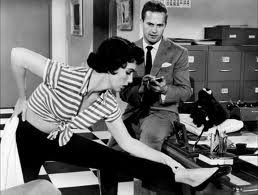
Two other very interesting female characters are part of the story: Gaby Rodgers plays Lily Carver as a conniving trickster, and Maxine Cooper (pictured below with Meeker) is outstanding as Velda, Hammer’s trusty assistant and maybe more. Ms. Rodgers and Ms. Cooper have other common ground. They soon disappeared from Hollywood films as both married powerful men in the business. Rodgers married the famous songwriter Jerry Lieber, who wrote many Elvis Presley hits. and Cooper married an Oscar nominated writer, Sy Gomberg.

 The cast features many prominent and recognizable actors of the time including Albert Dekker, Paul Stewart, Wesley Addy, Nick Dennis, Jack Elam, and Jack Lambert. There is also a Butch Cassidy and the Sundance Kid connection. Strother Martin has a brief scene as does Percy Helton (as the Medical Examiner). In the Butch Cassidy movie, Martin is the colorful Bolivian payroll supervisor who hires the boys, and Helton is “Sweetface” who gives away their hiding place. Another note on Helton: he had one of the longest acting careers in history 1915-1978 (which was 7 years after his death).

If you love films from the 40’s and 50’s, then this is a must see. It certainly has a place in Film Noir lore (say that three times quickly), and also has numerous other points of interest. Keep in mind that it was filmed at the height of the Atomic Bomb era … when scare tactics were the norm.

watch the trailer:


SAFE HOUSE

February 12, 2012

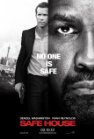
 Greetings again from the darkness. The action-thriller-spy genre can be quite fun when handled properly. The “Bourne” franchise and Salt come immediately to mind. What we have here is a ho-hum game of cat and mouse between CIA Agents elevated somewhat because they are played by Denzel Washington and Ryan Reynolds. It’s ho-hum because of the simplistic and predictable script from writer David Guggenheim.

To offset this formulaic script, director Daniel Espinosa leans heavily on near non-stop, frenzied action sequences. Luckily he has DP Oliver Wood (first two Bourne movies) to bring intensity and variety to the action. Denzel plays the veteran rogue agent who turns himself in to a U.S. Consulate after a decade off the grid. We learn he is a U.S. traitor of the worst degree. Reynolds plays a rookie agent on asignment to a going-nowhere “safe house” in South Africa. To say the action is lacking on his assignment is a bit of an understatement. That is, until Denzel is transferred to his site.

We learn a few things in this movie. First, “Safe house” is evidently CIA verbiage for “all hell breaks loose” in the form of massive gunfire and violent deception. Second, if you are an agent in charge of escorting one of the world’s most dangerous men, you would prefer your bosses not send the two of you into a crowded soccer stadium to pick up a GPS device. Things are likely to go wrong. Third, it’s not wise to walk in on Denzel when he is in a bathroom stall. Fourth, if you are Ryan Reynolds, your on screen girlfriends can be as beautiful as your real life girlfriends, and no one raises an eyebrow.

The film does remind us that it’s always cool to see Sam Shepard and Ruben Blades. Where have you been hiding Mr. Blades (pictured)? The rest of the strong cast includes Brendon Gleeson and Vera Farmiga as dueling Langley operatives, Liam Cunningham as a (surprise!) bad guy, Robert Patrick and Joel Kinnaman (from “The Killing“) as agents, and Nora Arnezeder as Reynolds’ hottie.

Being a fan of this genre, it is quite disappointing to see such an obvious and basic story … even though it has the right look and feel, and a nice match-up of stars. The overload of car crashes, gunfire, and hand to hand combat doesn’t offset the fact that everyone knows early on how this is going to end, and we suffer through quick teases of intrigue regarding the two leads. So even though Denzel makes an enjoyable good guy turned bad, and Reynolds shows he is way above the idiotic Green Lantern, this one just doesn’t offer much more than your average video game.

SEE THIS MOVIE IF: you have a hole that can only be filled with excessive noise, gun fire, car wrecks, blood and frenetic fight scenes.

SKIP THIS MOVIE IF: you are looking for something new in the spy thriller genre

watch the trailer:


TMI (2-11-12)

February 11, 2012

TMI (Today’s Movie Info)

February: Director’s Month

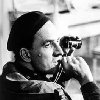
 INGMAR BERGMAN (1918 – 2007) was the son of a minister and many of his films include religious themes. He worked frequently with a small group of Swedish actors including Max von Sydow and Liv Ullman (with whom he also had a relationship and a child).  Woody Allen is huge admirer of Bergman’s work and admittedly set out to make a “Bergmanesque” film with his Interiors (1978).  Bergman (no relation to actress Ingrid Bergman) received nine Oscar nominations (no wins), but did direct 3 Oscar-winning films for Best Foreign Language Film: The Virgin Spring (1960), Through a Glass Darkly (1961), Fanny and Alexander (1982).  His other classics include: The Seventh Seal (1957, famous for the chess match with Death), Wild Strawberries (1957), Winter Light (1963), Persona (1966), Cries and Whispers (1972). Though Fanny and Alexander (1982) was his final theatrical feature, he continued writing and directing for TV and stage until his death.  His famous quote on movies: “No form of art goes beyond ordinary consciousness as film does, straight to our emotions, deep into the twilight room of the soul.”


TMI (2-10-12)

February 10, 2012

TMI (Today’s Movie Info)

February: Director’s Month

 JOHN HUSTON (1906-1987) put together an unusual career as writer, director and character actor … and excelled at all three.  He was the son of actor Walter Huston and father of actress Angelica Huston and actor Danny Huston (with different mothers).  John was writer/director for an impressive string of Hollywood classics: The Maltese Falcon (1941), The Treasure of the Sierra Madre (1948), Key Largo (1948), The Asphalt Jungle (1950), The African Queen (1951), The Red Badge of Courage (1951), Moulin Rouge (1952).  After a round of directorial success, John returned to acting and was nominated for an Oscar in Otto Preminger’s classic The Cardinal (1963).  He is also left quite an impression with his acting (as Noah Cross) in Chinatown (1974) and The Wind and the Lion (1975).  In the 1985 he directed his daughter Angelica to an Oscar in Prizzi’s Honor, making him the only one to direct his father (Walter in The Treasure of the Sierra Madre) and daughter to acting Oscars.  John was nominated for 15 Oscars, wining for Best Director and Best Screenplay for The Treasure of the Sierra Madre.  His final film The Dead was finished and released in 1987, the year he died.  He lived life to the fullest and is often described as a rebel and non-conformist … Hollywood’s version of Ernest Hemingway.  Along those lines, he once said “I`ve lived a number of lives. I`m inclined to envy the man who leads one life, with one job, and one wife, in one country, under one God. It may not be a very exciting existence, but at least by the time he`s seventy-three he knows how old he is”


RAMPART

February 9, 2012

 Greetings again from the darkness. Dirty cops happen in real life sometimes, and in the movies quite often. It can be an intriguing subject to explore … psychological demons, ego, power-mongering, etc. Typically we see it presented as a cop torn between doing the right thing and feeling like he is owed something. Rarely do we see a cop portrayed as beyond hope … so far gone morally that redemption is no longer even a possibility.

Writer James Ellroy (LA Confidential) and director Oren Moverman (The Messenger) present to us Officer Dave Brown, known to his fellow cops (and even his daughter) as “Date Rape” Dave. The moniker stems from a vice incident where Brown supposedly dished out street justice to a serial date rapist. With no proof of his guilt, Brown remained on the force and his rogue manner has now escalated to the point where he is a constant danger to himself and others. This guy has no moral filter for everyday living.

 Officer Brown is played with searing intensity by a Woody Harrelson you have never before seen. As loathsome a character as you will ever find, you cannot take your eyes off of him. He is hated by EVERYONE! Somehow he has daughters by his two ex-wives (who are sisters) and they all live together in a messed up commune where ‘hate’ is the secret word of the day, every day. Most of the time no one speaks to Dave except to tell him to “get out”. He spends his off hours drinking, smoking, doing drugs and having meaningless sex. Heck, that’s just about how he spends his time while on duty as well.  Dave’s behavior and the theme of the movie seem to be explained in a scene when he tells the IA Detective (Ice Cube) that he is not a racist because a he hates “all people equally“.  

The supporting cast is phenomenal, though most aren’t given but a scene or two. This includes Robin Wright (who nearly matches Dave in the tortured soul department), Sigourney Weaver, Anne Heche, Cynthia Nixon, Ned Beatty, Ben Foster, Ice Cube, and Steve Buscemi. The first hour feels like an Actor’s Retreat as most every scene introduces another familiar face.

 Still, as terrific as Harrelson is, and as deep as the cast is, the film is just too one note and downbeat and hopeless to captivate most viewers. Some of Moverman’s camera work is quite distracting and the sex club scene was pure overkill and unnecessary. Downward spiral is much too neutral a term to describe this character’s path and ultimately, that prevents the film from delivering any type of message. Harrelson had been mentioned as a possible Oscar candidate, but it would not be surprising if the film itself worked to his detriment.

SEE THIS MOVIE IF: you want to see a fantastic performance by Woody Harrelson OR you are just looking for a way to kill that pesky feeling of joy that’s been following you around lately

SKIP THIS MOVIE IF: you need to like at least one character in a movie

watch the trailer:


TMI (2-8-12)

February 8, 2012

TMI (Today’s Movie Info)

February: Director’s Month

 D.W. GRIFFITH (1875-1948) grew up in Kentucky as the son of a Confederate Army Colonel and Civil War hero.  His father’s war stories would greatly influence Griffith’s film career.  Remarkably, Griffith made over 450 short films and 80 feature length films (sometimes at the rate of two per week!). He was celebrated for his visionary and ground-breaking techniques (cross-cutting, split-screen, flashbacks, etc), but was also labeled a racist due to the nature of some of his films.  In 1910, he was credited with making the first film in Hollywood, In Old California.  Many of the biggest silent film stars got their start in a Griffith film: Mary Pickford, Lillian Gish, Mack Sennett, Lionel Barrymore. His renowned 1915 historical classic The Birth of a Nation was the first film shown in the White House (President Woodrow Wilson). The film is considered the birth of American cinema, but it also caused race riots throughout the country. In 1920, he became one of the founders of United Artists, along with Charlie Chaplin, Douglas Fairbanks and Mary Pickford.  Griffith only made two “talkies”.  After the second, he retired stating “We do not want now and we never shall want the human voice with our films”.  He is credited with the invention of false eyelashes (for use in his film Intolerance: Love’s Struggle Throughout the Ages (1916) … and also credited with the phrase “lights, camera, action”, which is still used today by filmmakers.