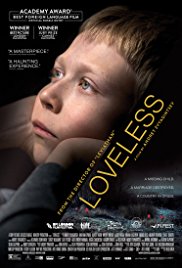
LOVELESS (2018)

March 1, 2018

 Greetings again from the darkness. Divorce is rarely simple or clean or amicable. By definition it changes people’s lives and is typically cluttered by a wide range of emotions that distort one’s thoughts. When kids are involved, the process is even more delicate, even treacherous. Russian filmmaker Andrey Zyyaginstev and his co-writer Oleg Negin follow up their exceptional Oscar nominated LEVIATHAN (2014) with this very intimate project focusing on the tragic impact of resentment and self-centeredness. They have been rewarded with another Best Foreign Language Film Oscar nomination, and deservedly so.

The film begins with stark, almost harsh music as a young boy walks home in the woods after a day of school. Later that evening, his parents are involved in an extremely vicious and demeaning argument. The camera then glimpses the boy from the woods, their son Alyosha (Matvey Novikov), behind a door. He has overheard the entire argument and is devastated, quietly sobbing and unable to deal with words no child should hear. As viewers, we too are overwhelmed.

Zhenya (Maryana Spivak) and Boris (Aleksey Rozin) are the boy’s parents, and to say they dislike each other is an understatement. She is a salon owner and he is a generic “salesman” at a Christian company that doesn’t allow divorced employees. She is focused on her phone and new lover, while he is worried about losing his job while his girlfriend (Marina Vasileva) is pregnant. They are fighting over who should raise their son. Neither want him.

With each of these despicable people going about their business, neither notice that the boy doesn’t come home one night. A teacher calls to say he has missed two days of school. It’s at this point where the tone shifts from poor parenting to lackluster police work. In what could be described as the polar opposite of an ‘Amber Alert’, the Russian police rule it a runaway, and in ho-hum manner suggest that the parents give him a few days to return home. This lackadaisical approach lead Zhenya and Boris to turn to an organization that specializes in locating lost kids.

The coordinated search creates a quiet tension that is quite effective. Cinematographer Mikhail Krichman’s camera work is extraordinary as it tracks the searches through the forest and an abandoned building that could be a character unto itself. The parents head to the home of Zhenya’s estranged mother. What follows is one of the most explosive movie scenes of recent years. Natalya Potapoya plays the mother and delivers a memorable no-holds-barred diatribe at her daughter Zhenya, who refuses to fight back. We easily understand how a disconnect between parents and kids can gain traction across generations.

The brilliance of the movie is in how we somehow maintain empathy for all of these less-than-ideal people. When Zhenya calmly pronounces that her mother is “God and the Devil rolled into one”, we understand her point while at the same time hope it stimulates self-analysis.

Although we do get a rare Jill Stein reference, it’s quite easy to spot the differences between story-telling in Russia and the United States. It wouldn’t be surprising to see a Hollywood remake, but it would likely tread a bit lighter on the dwelling of past mistakes without losing one’s humanity, and it would surely come up with a more Americanized ending. The detail in Zyyaginstev’s filmmaking is exceptional, and while it may not be entertainment for the masses, the film is a prime example of cinema as emotionally powerful art.

watch the trailer:


A FANTASTIC WOMAN (Una Majur Fantastica, 2017)

February 24, 2018

 Greetings again from the darkness. A few years ago, Chilean filmmaker Sebastian Lelio and his co-writer Gonzalo Maza delivered a terrific little indie entitled GLORIA (starring Paulina Garcia). It told the story of a single woman in her late 50’s navigating a society not designed to provide happiness for her. This time out Mr. Lelio and Mr. Maza collaborate on the story of another interesting woman, in what could easily be described as a companion piece to their previous film.

Trans actress Daniela Vega stars as Marina, a waitress who moonlights as a singer. The film begins quietly with Orlando (Francisco Reyes), a distinguished gentleman enjoying an afternoon spa treatment, before heading over to catch Marina’s singing act. See, Orlando and the much younger Marina are a couple. Their connection is obvious as they spend an evening dining, dancing, and heading to bed. Tragically, Orlando suffers an aneurysm and Marina rushes him to the hospital. When he dies, she is subjected to questioning, accusations, and a true lack of respect by most everyone – doctors, nurses, police, and Orlando’s family.

Marina is questioned by a sex crimes detective (Amparo Noguera) about her relationship with Orlando and whether she was paid or abused. The implication being that she was likely a prostitute. Orlando’s brother Gabo (Luis Gnecco), son Bruno (Nicolas Saavedra) and even ex-wife Sonia (Aline Kuppenheim) have reactions that range from passive-aggressive to threatening towards Marina and forbid her from attending the wake and funeral, and won’t even let her take the pet dog.

Cinematographer Benjamin Echazzarreta uses effectively uses light and color, and quite often has Marina front and center – either head-on or from behind. Marina’s visions and dream-like sequences allow us to understand how the stress of the situation is affecting her, and just how much she misses Orlando. She displays much inner-strength and dignity in the face of hatred and disgust … even while being treated as a criminal and/or victim – really anything except the partner she was.

The film has been nominated for the Best Foreign Language Oscar, and it’s easy to see why. Beautifully photographed with a knockout lead performance from Daniela Vega, the story emphasizes how we so often strive for “normal” that we lose our empathy and humanity in how we treat others. Music is put to good use – even the quite obvious use of Aretha Franklin singing “(You Make Me Feel Like) A Natural Woman”, and there is even a clever use of a McGuffin (a locker key). This well-made film with a powerful message is a reminder to ‘keep on keeping on’.

watch the trailer:


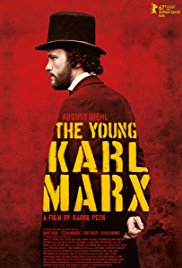
THE YOUNG KARL MARX (2018)

February 24, 2018

 Greetings again from the darkness. When the name Karl Marx comes up, most of us recall that iconic photo of the older gentleman with the large grey beard. As with all older gents, they were once young men, and that’s the focus of this film from writer/director Raoul Peck and co-writer Pascal Bonitzer.

The story kicks off in 1843 when young Marx was the editor of “Rheinische Zeitung” and carries us through the 1848 publication of “The Communist Manifesto”. We progress chronologically through Paris, Brussels and London and witness how Marx’s personal life and ideological mission intertwined, leading ultimately to the birth of Communism.

August Diehl (INGLOURIOUS BASTERDS) plays Karl Marx and Stefan Konarske plays Friedrich Engels. Their mutual admiration brought them together and their commitment, along with the support of their wives Jenny Marx (Vicky Krieps, PHANTOM THREAD) and Mary Burns (Hannah Steele), carried them through and cemented their legacies.

With the endless string of debates and discussion, and the constant struggle with poverty for Marx and his family, the film at times seems repetitive and tedious. It does, however, succeed in making comprehensible the timeline and constant struggle to continue the fight. The process of societal-changing writing is not simple, and we see the different approaches taken by Marx and the upper-crust rebel Engels. The obvious battle between Bourgeoisie and Proletariat remains at the forefront, but we also witness the painstaking networking and research that goes into the work. The two gentlemen share a drink over this toast: “to minds that truly think”.

Today, many in their 20’s, are focused on which direction to swipe, yet at the same age, Marx and Engels were committed to changing the world. The ideals and issues that so dominated their writings (and led to revolution) are every bit as relevant today. We no longer use the terms Bourgeoisie or Proletariat, but class distinction continues to be debated as a source of many global issues – both social and economic. Director Peck (Oscar nominated for last year’s I AM NOT YOUR NEGRO) uses Bob Dylan’s “Like a Rolling Stone” over the closing credits montage of revolutions and historic turning points to ensure we understand that rebellions and convictions do still exist.

watch the trailer:


HE LIED ABOUT EVERYTHING (2018, doc)

February 24, 2018

 Greetings again from the darkness. We have learned through books, movies, and especially real life, that evil can arrive in many forms and often strikes when we are at our most vulnerable. Such is the remarkable and personal story told here by Benita Alexander. As an Emmy winning Producer for NBC News, she proclaims that she should be the last person who should fall victim in the way that she did. Whether seizing the professional opportunity to tell a fantastic story or going through the process as a form of therapy, Benita guides us through a maze of deceit that rocked the medical world, as well as her personal life.

Home video from a honeymoon suite in picturesque Santorini Greece in 2014 is how Benita initiates her confession of having fallen fast and hard for Dr. Paolo Macchiarini, a world renowned surgeon. In what can best be described as a whirlwind romantic fairy tale, Benita describes love at first sight (at a 2013 interview), Cinderella-type wedding plans featuring world leaders and the Pope, and the crushing emotional angst when it all came crashing down.

Benita utilizes her investigative reporting skills to present her story in a way that helps us understand how all of this could have happened. The doctor swept her off her feet with lavish gifts and jet-setting trips, and then charmed her friends and family – all while receiving accolades for his revolutionary work with artificial trachea transplants. The film takes us to New York City, Rome, Barcelona, London and Russia, as Benita’s high and low points are revealed.

Steven Spielberg’s movie CATCH ME IF YOU CAN told the story of charlatan Frank Abignale, and though he stole money and broke trust, Abignale’s tale possesses none of the evil or madness of Dr. Paolo Macchiarini. His were no pranks. This was no episode of “Punk’d”. This doctor’s cruelty goes far beyond. We hear words like Frankenstein and murder to describe him and his reprehensible actions that left patients dying excruciating deaths. Benita tries to balance the story with her shattered dreams and the medical scandal, but seriously, it’s difficult to muster much sympathy for someone getting caught up in the social lives of the elite. It’s the doctor’s inexcusable medical fraud that is most overwhelming to us as viewers and caring human beings.

Benita is denied the ribbon on her story package as her final phone conversation leaves her lacking an answer to “Why?”  Her emotions and pain are minimized to us when she admits to being “conflicted”. This viewer found no reason for conflict, only anger and disgust. Dr. Paolo Macchiarini may have been “selling hope”, and falling for his act may be forgiven, but once the fraud is exposed, there is no room for mercy or conflict.

The documentary is scheduled to stream on Investigation Discovery starting February 14. Valentine’s Day is either the best or worst day for this airing, depending on your perspective.


THE MILLIONAIRES’ UNIT (2018, doc)

February 16, 2018

 Greetings again from the darkness. Imagine, if you will, a world where the one-percenters view their privileged life as carrying more responsibility towards civic duty, not less. While that’s difficult to conceive these days, the film takes us back 100 years to the beginning of WWI, and introduces a group of Yale students who believed exactly that. Co-directors Darroch Greer and Ron King provide the best kind of history lesson – one told through personal stories.

WWI, “the war to end all wars”, lasted about 4 years and featured new technology such as machine guns, tanks, and airplanes (Wright brothers first flight was 1903). Though U.S. President Woodrow Wilson stated the country would remain “neutral”, a young visionary named Trubee Davison saw things a bit differently. Trubee was a student at Yale University and the son of HP Davison, a powerful JP Morgan executive. Trubee was also a natural-born leader and inspired a group of his classmates to join the First Yale Unit … a flying club dubbed The Millionaire’s Unit by the media.

The film tracks their training and subsequent call to service during the war. They became the first Naval aviators in WWI, and the Naval Reserve Flying Corps actually preceded the US Air Force. We see spectacular clips from the era, along with reenactments (dogfights!), photos, and letters/correspondence to/from the men. Actor Bruce Dern enthusiastically narrates, and it’s interesting to note that he is the grandnephew of one of these Yale pilots.

Profiles of a hand full of these men are remarkably well done and help us understand that each were defined by their service and dedication to the cause and to each other. Much of the focus is on Trubee, a fascinating guy who later spent time as Assistant Secretary of Defense and Director of Personnel at the CIA; however, we also get to know Robert Lovett, Kenney MacLeish, “Di” Gates, and Dave Ingalls – each an interesting story, and in combination, stunning in that so few of us have been exposed to their courage.

The 2006 book, “The Millionaire’s Unit”, written by Marc Wortman, was the basis of this documentary that took longer to complete than WWI actually lasted. These young men were volunteers who, despite their elite social and financial standing, believed so strongly in “fighting for the ideals we hold sacred”, that they risked it all – some paying the ultimate price. As you might expect, after the November 11, 1918 Armistice was signed, most of these Elis continued serving their beloved country in some capacity. Theirs is a story that deserves to be told with the respect and personal aspect afforded by the film.

watch the trailer:


POOP TALK (2018, doc)

February 16, 2018

 Greetings again from the darkness. Poop. Poo, doodie, s**t, feces, excrement, doo-doo, dung, dookie, defecate, bowel movement, and number 2. Director Aaron Feldman threatens to waste (pun) our time by opening on comedians dumping (another one) their various forms of scatological humor. Instead he leaves us a special surprise (!) by creating some kind of docu-comedy on poop that also serves as a bit of an awkward sociological case study.

The surprise here is that the comedians from the opening never stop. They ARE the movie. It’s actually 75 minutes of comedians riffing on poop. They tell us their jokes, but more interestingly, they tell us the motivations for this line of humor. Indelicacies and embarrassment are what drives comedy, and I counted 39 different folks providing some insight here. Rather than a rant, it’s more of a case study on the realities of why we draw such a hard line between our public persona and the regular (hopefully) occurrence in the privacy (also hopefully) of a bathroom/toilet. Even that last part isn’t a given, as the process in other countries like Korea and India is detailed.

The Sklar brothers are Executive Producers and also provide some terrific on screen segments, but the list is too long to name all of the participants – most of whom you will recognize. I’ve seen some documentaries that might best be labeled as turds, but never one who focuses on that topic. Why is it taboo?  Are there differences in how men and women tend to treat this (definitely yes)? The laughs are aplenty and its flush (the last one) with insight from comedians. That’s enough reason to sit through this one … and you won’t even need a magazine!

watch the trailer:


BLACK PANTHER (2018)

February 15, 2018

 Greetings again from the darkness. Adaptations of Superheroes, Comic Books, and Graphic Novels have been driving the movie theatre box office for a few years now. Where the financial success of a film was once measured in tens of millions, it’s now hundreds of millions. Beyond that, these enormous productions are pressured to make political and social statements … providing the hope of which real life leaders seem to fail. This latest from Marvel and director Ryan Coogler (CREED, FRUITVALE STATION), carries all of that plus the expectations of an entire gender and race. It’s a heavy burden for a comic book character, however it seems, regardless of one’s perspective, it’s likely the film delivers, satisfies, and … oh yeah … entertains.

The bar has been set so high for action sequences and special effects, that we take the great for granted and only speak up on those that falter. What allows this film to take its place among the best of the genre is a combination of story depth and the payoff for showing us a world we haven’t previously seen. The cultural aspects of the (mythical) African country of Wakanda are not only interesting, but the setting itself is breath-taking. An explosion of color, texture and technology blended with intriguing and multi-dimensional characters bring the film to life and draw us into this wonderland of tradition, culture and humanity.

It seems ridiculous to speak of a comic book film in these terms, but the number of talking points raised during its runtime are too many and too varied to discuss in this format. What we can make clear is that it’s cool to watch an entire movie where people of color and women are strong, confident, and intelligent. Chadwick Boseman has played Thurgood Marshall (MARSHALL), James Brown (GET ON UP), and Jackie Robinson (42), and here he takes on a fictional icon in King T’Challa/Black Panther. He perfectly captures the pensive nature of a King balancing tradition with the needs of his people to evolve and transition. His chief adversary “Killmonger” is played terrifically by Michael B Jordan (CREED, FRUITVALE STATION) as a man out for revenge and power. For most movies this head to head battle would be enough … but not this time.

Lupita Nyong’o (Oscar winner for 12 YEARS A SLAVE), Danai Gurira (“The Walking Dead”), and relative newcomer Letitia Wright play Nakia, Okoye, and Shuri respectively; a triumvirate of three of the strongest women you’ve likely ever seen on screen. Nakia is the love interest, but also carrying out her own humanitarian missions, while also proving to be beyond adequate as a soldier. Okoye is the ultimate warrior and absolutely loyal to her country, while Nakia (T’Challa’s sister) is a contemporary version of James Bond’s Q – the ultimate technology whiz, and one with the zippiest zingers. Any of these characters could be the basis for a standalone movie, but together they elevate this to something much more than a couple of dudes in sleek suits fighting.

Martin Freeman (THE HOBBIT), Daniel Kaluuya (GET OUT), Sterling K Brown (“This is Us”), Angela Bassett, and Forest Whitaker are all contributors, and Andy Serkis is a frenzied standout in an all-too-brief turn as Klaue. The strong cast delivers even in the few moments when the script lags. In fact, the only piece of this puzzle that didn’t seem to fit was the traditional hand-to-hand combat to determine the next king. Why is it that a nation so advanced still relies on primitive courses of decision-making?  Perhaps this is merely commentary on our society, though providing a more intellectual solution would have been in line with the rest of the story.

The world of Wakanda is stunning. The costumes are sleek, colorful and fascinating. The characters are multi-dimensional. The action sequences are top notch (armored rhinos!). The cinematographer is Rachel Morrison, who recently made history by being the first woman to receive an Oscar nomination for cinematography (MUDBOUND). It’s these factors that allow Mr. Coogler’s film to achieve the level of importance that most comic book films wouldn’t dare to strive for. On top of everything, it accomplishes the one thing I demand from these type of movies … it’s quite fun to watch!

watch the trailer:


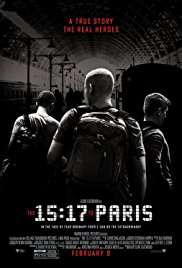
THE 15:17 TO PARIS (2018)

February 8, 2018

 Greetings again from the darkness. Allowing three regular guys to play themselves in the cinematic re-telling of their courageous and heroic actions is a fitting tribute to the men, and it’s an approach that we must be willing to cut some slack. On August 21, 2015, a terrorist aboard the Thalys train bound for Paris was thwarted in his attempt to carry out his mission of evil. Spencer Stone, Alek Skarlatos, and Anthony Sadler ultimately subdued the terrorist (who won’t be named here), likely saving many lives.

The real world heroics fall right in line with director Clint Eastwood’s two most recent films, SULLY and AMERICAN SNIPER. Unfortunately, while we admire his decision to allow these heroes to re-enact their life-saving bravery, we can’t let slide the downright boring first two-thirds of the film taking us through the origin story of their childhood (Sacramento 2005) to the backpacking trip that put them on that train. Some of the scenes are inexplicable. For instance, Judy Greer and Jenna Fischer play the mothers of Spencer and Alek respectively, and their confrontation with the boys’ elementary school teacher is a candidate for the worst and most embarrassing scene of the year.

Based on the book “The 15:17 to Paris: The True Story of a Terrorist, a Train, and Three American Heroes” (written by the three men and journalist Jeffrey E Stern), the script is adapted by Dorothy Blyskal, and when combined with some of the director’s choices, generates some unintended audience laughter … rarely a good thing. Watching three regular guys – three lifelong buddies – retrace their steps through Germany, Rome, Venice, and Amsterdam is almost tolerable because these are really nice guys. However, we can’t get over the feeling that we are watching home movies of our friends’ trip – a trip we weren’t even on. Jokes about selfie sticks and hangovers don’t make it any easier.

When the film finally gets to the moment of truth on the train, we end up where we should have started … admiring the heroics of three regular guys: Spencer Stone, Alek Skarlatos, and Anthony Sadler. We witness then French President Francois Hollande awarding them with the Legion of Honour. Themes of God, military and friendship are commonplace in Eastwood films, and eagle-eyed viewers will catch a glimpse of Alek wearing a “man with no name” t-shirt (in honor of the director). Bottom line, it plays like a film about nothing – until the end when it’s really about something special.

watch the trailer:


BOMB CITY (2017)

February 8, 2018

 Greetings again from the darkness. This feature film debut from Texas filmmaker Jameson Brooks (co-written with Sheldon Chick) was an Audience Award winner at last year’s Dallas International Film Festival. It’s based on the incredulous true story of a tragic crime and the subsequent trial that occurred in Amarillo in the late 1990’s. It’s also an introduction to a talented and exciting filmmaker with a message that is as every bit as important now for every community as it was 20 years ago in the Texas panhandle.

The courtroom scenes serve as the story structure while flashbacks are blended with the defense attorney (Glenn Morshower) commenting/mocking the evidence as it’s shown to the jury. This style keeps those unfamiliar with the story uncertain as to the actual victim and the circumstances of the crime – at least until the final act when we see a re-enactment of the crime and the final day of trial. However, even if one is familiar with the specifics of the case, it is presented in such an exceptional manner that it will surely be just as impactful.

Keeping in mind that this is west Texas (remember “Friday Night Lights”) and football reigns supreme, so the ongoing battle between the Punks and the Preps sets the stage for ultimate cultural battle … especially in an area that is home to a nuclear bomb assembly plant. Volatility abounds. There is a terrific sequence with parallel cuts between the mosh pit of a local punk rock concert and the on-field violence of a local high school football game. There are more similarities than differences, well, until the kids from the two sides cross paths in the real world. Class differences are obvious, and so is the usual teen angst and rebellious nature.

Distinct differences in how the authorities handle each group’s form of release are on full display. The punks are caught tagging, while the pasture party of the jocks gains frenzy. One of these ends with handcuffs, and the other with polite dismissal. The core of the story is the ongoing comparison between Brian (in a wonderful performance from Dave Davies), sporting a colorful Mohawk as he skateboards through town, and Cody (an effective Luke Shelton), a buttoned-up football player always striving to prove his mettle as he cruises around town in Daddy’s Cadillac. A sense of doom-filled destiny accompanies their scenes, and of course, we know it won’t end well.

Many will find the film reminiscent of Frances Ford Coppola’s 1983 film THE OUTSIDERS, which featured the Greasers versus the Socs. The biting realism and grit of Mr. Brooks’ film helps us better understand the similarities between the two groups who look so different. And that’s the real message here: judging others by looks will never lead to understanding and peaceful coexistence. The cinematography of Jake Wilgonwski is a huge part of the emotional reaction we have to this story, and the notes provided at the end of the film leave us wondering if, 20 plus years later, we are any more advanced as a society than what occurred in that Amarillo parking lot.

watch the trailer:


THE INSULT (2017, Lebanon)

February 1, 2018

 Greetings again from the darkness. When a film opens with a statement that ‘the views expressed are those of the authors and director, and not of the government of Lebanon’, one quickly understands the difference in artistic freedom in that country versus what occurs in the United States, where cartoons and memes regularly poke fun at this country’s President. Director Ziad Doueri and his co-writer Joelle Touma present an intense story of human nature that might happen anywhere, but since the leads are a Lebanese Christian and a Palestine refugee, that opening statement is warranted.

One morning, a seemingly innocuous exchange between Tony (Adel Karam) and Yasser (Kamel El-Basha) takes place. While watering flowers on his balcony, the overflow sprays Yasser on the street below. Yasser, a city contractor, orders his team to fix the drainage issue, and Tony reacts violently – leading to Yasser delivering the titular insult. From there, all heck breaks loose. Apologies are requested and never delivered. Appeals to rational reconsideration are made. Tony’s pregnant wife (an excellent Rita Hayek) pleads with him to let it go. Yasser’s boss threatens him with termination. Still, two stubborn and prideful men refuse to give in.

The subsequent courtroom drama feature other side stories, not the least of which is the relationship between the two opposing attorneys (Diamond Bou Abboud and Camile Salaheh), one a rising legal star and the other a veteran attempting to make up for a past failure. Emotions run high as two too-proud men turn what was little more than a playground standoff into a national incident being fought in the legal system and the media. Tony is a hot-head who somehow thinks an apology from Yasser is actually an apology for how Palestinians “messed up this country”. Yasser’s stoic nature barely shrouds his bitterness at the world since the Lebanon Civil War. History and childhood roots play a role, but mostly it’s human nature that is at the core of this escalation.

Though the title is not plural, there are multiple insults slung throughout the film, each reminding us of the power of words and the futility of the “sticks and stones” phrase. Our own prejudices and preconceptions alter our views and reactions, often preventing us from standing in the other fellow’s shoes. Again, this situation could have played out in most any neighborhood on the globe, but this particular locale shows various ethnic and religious groups are still grappling with what it means to live together – despite the years of wars and unrest. We don’t see a great deal of Middle Eastern cinema, but three days after I watched this film, it became the first ever movie from Lebanon to receive an Oscar nomination (Best Foreign Language Film) … proving yet again that the language of cinema is universal.

watch the trailer: