DIFF 2019 Day 5

April 17, 2019

2019 Dallas International Film Festival

 Greetings again from the darkness. Day 5 means we are now past the halfway mark for this year’s festival. Originally I had 4 films scheduled for today, but I opted out of the late movie since it would have required more than a 90 minute wait after the end of the third movie. It’s that kind of situation that makes festival scheduling a bit frustrating. Despite that, all 3 movies were worth the time: a documentary profile of an Italian model, a low budget quirky comedy, and a masterclass from two veteran screen actors.


Here is my recap of Day 5 films:


THE DISAPPEARANCE OF MY MOTHER (doc)

 Caution is usually the best policy when choosing a biographical documentary shot by the subject’s family member. Often objectivity is sacrificed in the pursuit of a worthy tribute film. Oddly enough, it’s the mother-son relationship that provides the necessary spark as cinematographer Beniamino Barrese turns the lense on his mother Benedetta Barzini, a fashion model icon in the 1960’s and feminist spokesperson in the 1970’s.

We see photographs and flashbacks that prove what a stunning beauty Benedetta Barzini was at the peak of her modeling days. We also see clips of her appearances as a feminist spokesperson, and it’s in these that we see the fiery personality that is so prevalent in the current day exchanges with her director-son as he coaxes her through the process. There are also segments where she is mentoring younger girls and a return to the catwalk during Fashion Week.

She’s now in her 70’s, and remains physically striking with a lithe body that defies her age. But it’s the words coming out of her mouth – many pushing this to an “R” rating – that define the woman of today. The title of the movie refers to her preference to ‘disappear’ rather than ‘appear’ in the images of photos, film or social media.  When discussing the obsession society has with youth, she explains that Youth equates to Life, while Old age is associated with Death. That philosophy is a bit of a downer, but is an example of the insight she brings. In describing today’s marketing, she says women are usually associated with nature, while men represent thought and reason. The outspoken and wise feminist lives on.

Home clips from 1999 and a visit with long-time friend Lauren Hutton offer up more bits of what makes the woman tick, as does her listening to Leonard Cohen and smoking cigs and vaping at an alarming rate. In her mid-70’s, whether she likes it or not, her smile still lights up the screen and any room she is in. Still, we understand she has earned her own liberation from the camera, even as she puts a cap on it. Fin.


ODE TO JOY

 You might be familiar with the disease narcolepsy, but unless you or someone close to you suffers from it, you’re likely unfamiliar with cataplexy – a symptom of narcolepsy that causes sudden and extreme muscle weakness typically brought on by severe emotions such as sadness, anger or excitement. For Charlie, the trigger is happiness, so he has learned to (mostly) cope by avoiding his triggers: puppies, weddings, random acts of kindness, kids playing, and relationships. What he couldn’t avoid was being a groomsman in his sister’s wedding, which is how director Jason Winer and co-writers Max Werner and Chris Higgins choose to begin the film. We see the full effects and fallout (no pun intended) of Charlie’s disease.

Charlie works a calm job (out of necessity) at the public library, and his co-workers have mastered the art of assisting in keeping Charlie thinking non-happy thoughts. As tends to happen, love finds a way. Charlie crosses paths with Francesca (Morena Baccarin), a lively woman who appears to be Charlie’s opposite in most ways … making the attraction even stronger. A first date to a community theatre where a one-man show titled “Great Depression” is playing, we get the full effect of the challenges Charlie faces.

Cooper (Jake Lacy), Charlie’s younger brother, has been his main support system for most of his life – which is even more remarkable when we get the story of how Cooper got his name. When things fizzle between Francesca and Charlie, Cooper swoops in to date her and they set up Charlie with Bethany (a wonderful Melissa Rauch). Bethany’s own quirks seem to be a good fit, even if Charlie’s torch for Francesca still flickers. Surely you’ve never seen an oboe sing-a-long to the Cranberries “Zombie”, and if somehow you have, it likely pales in comparison to the one Ms. Rauch performs.

The laughs are many, yet the script and Freeman’s performance remain respectful to the disease and those who suffer from it. Jane Curtin appears as Francesca’s Aunt who is cancer-stricken, and no, the purpose wasn’t to show a disease worse than cataplexy, but rather to show we all have challenges in life – and how we deal determines the type of person we are. The story was inspired by a story on Chicago TV’s “This American Life”, and it’s a nice little gem that hopefully will find distribution.


THE TOMORROW MAN

 Noble Jones worked as the second unit director on David Fincher’s award-winning film THE SOCIAL NETWORK (2010), and he has made quite a name for himself in music videos and commercials. This is his first feature film as director and he also wrote this interesting script. On top of that, he cast two top-notch veteran actors to bring the story to life: John Lithgow and Blythe Danner. At times it feels like we are watching a masterclass in acting and many of their scenes together have a live theatre feel.

Ed (Lithgow) and Ronnie (Danner) cross paths at the local grocery store where they each shop at an alarmingly frequent rate. It turns out Ed is preparing for doomsday and Ronnie is hoarder. As they spend time together, their fondness for each other grows, but we are never really sure if it’s loneliness or connection that inspires the relationship.

Despite both having a very serious approach to life, there are many moments of levity and sweetness, but also doses of reality that keep us off-balanced – just as life does. Ed proclaims the world would be such a disaster with ball bearings … of course his view is a bit skewed since he spent 17 years on the business. Ronnie is brave enough to attend Thanksgiving dinner with Ed at his son’s house, and the explosive family dynamics drive home the challenges of co-existing with others at any age.

Ed tells the new checkout clerk that it’s “good to know your neighbor. You never know when you’ll need them.” His preparations for doom and gloom … or as he calls it, SHTF … are offset by Ronnie’s sweetness, and a yard sale leads to the surprise ending. As a bonus, filmmaker Noble has finally found a good use for the song “Muskrat Love”.


DIFF 2019 Day 4

April 15, 2019

2019 Dallas International Film Festival – Day 4

 Greetings again from the darkness.  Scheduling conflicts meant I only had two films on the agenda for Sunday. With one of the films being an epic Danish film that pushed 3 hours in run time, I still managed to sit for more of the day than anyone should. The other film was a reimagining of Shakespeare’s “Hamlet”, so chuckles were expected to be few and far between.


Here is my recap of the two films watched on Day 4:


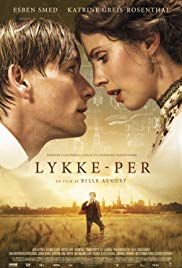
A FORTUNATE MAN (Lykke-Per)

 Turning the classic novel from Henrik Pontoppidan into a film project likely seemed nearly insurmountable; however director Bille August (PELLE THE CONQUEROR, 1987) was the perfect choice to handle the adapted screenplay written by his son Aders Frithiof August. Pontoppidan won the 1917 Nobel Prize for literature, and this novel offers a fascinating lead character and much commentary on class division and religious differences.

Esben Smed stars as Peter Andreas Sidenius, a young man from Jutland who, when we first meet him, as just received his acceptance letter to The College of Advanced Technology in Copenhagen to study engineering. Peter was raised in a pious Christian community by a respected clergyman father. Peter’s rebellion is viewed as a move against God by his father. As Peter begins his studies, we can think of him as a less compliant George Bailey from IT’S A WONDERFUL LIFE. He’s a forward thinker who dreams of converting wind and water to energy to transform Denmark into an international power.

Once he crosses paths with the wealthy Jewish Salomon family, Per (as he now calls himself) at first appears as a smart fish-out-of-water, and slowly learns the nuances of high society. There is a great line about his ‘changing lanes’ as his attraction shifts from bubbly daughter Nanny (Julie Christiansen) to the more thoughtful and socially-conscious older daughter Jakobe (a terrific Katrine Greis-Rosenthal). His affiliation with the family leads to a realistic opportunity to see his energy dreams become a reality.

This is a period drama taking place sometime around 1900, and we quickly learn that Daddy issues and pride can affect one from any era. Though he has physically escaped the abusive, repressive father he had, Per is so convinced of his own genius that he simply can’t lower himself to traditional structure – whether it be social, familial or economic.

As with contemporary times, when arrogance meets arrogance, power prevails. Returning to his home roots humbles Per for a moment, and he is constantly haunted by a reappearing pocket watch tied to the previously mentioned Daddy issues. We see his childhood scars never heal and we hear ‘fortune favors fools’, and watch as pride brings the downfall of a man who continues to search for his true self rather than finding joy in life. It’s a beautifully shot film with terrific costumes and sets, and a wonderful lead performance (even if the film runs a bit long).


OPHELIA

 Well here we are more than 400 years later, and artists are still finding new ways in which to explore and adapt the writings of William Shakespeare. Some of these attempts are quite serious, others offer a bit more whimsy, and still others are quite creative. Director Claire McCarthy is working from Emmy winning writer Semi Chellas’ (“Mad Men”) adaptation of Lisa Klein’s 2006 Young Adult novel. The general structure is “Hamlet”, but the perspective is through the eyes of Ophelia (with some dramatic effect of course).

“You may think you know my story”. Those are the first words we hear … and we think to ourselves, “yes, we do.” But we don’t really know this story. Daisy Ridley stars as Ophelia, whose spunk as a young girl leads her to being chosen for Queen Gertrude’s court of ladies-in-waiting. Not being of noble blood, Ophelia is on outcast, but her reading skills put her in the Queen’s favor … especially for those bedtime stories that aren’t exactly scripture. Two-time Oscar nominee Naomi Watts plays Gertrude, as well as a second role that carries much weight in this reimagining.

Clive Owen plays Claudius – bad guy, bad wig, bad personality. Tom Felton plays Ophelia’s brother Laertes, Devon Terrell is Horatio, and George MacKay (CAPTAIN FANTASTIC, 2016) portrays Hamlet. This Prince of Denmark is missing the familiar self-doubts he was cloaked in by the Bard, and is quite a romantic who doesn’t quite share the close bond his mother feels towards him. There is a Rosencrantz and Guildenstern sighting, but of course, most of the focus remains on Ophelia – who is a strong and independent thinker, yet dutiful in her responsibilities to the Queen. Her “crazy” scene is actually quite strategic.

Screened at Sundance last year, the film now has distribution through IFC, and the Americanized dialogue should make it accessible to younger viewers … though some of the most familiar lines will be good for a chuckle from those in the know. Elsinore Castle looks terrific and the costumes are first rate … both crucial to period pieces. Unfortunately, outside of Ms. Ridley and Ms. Watts, the cast just doesn’t bring enough to pull off a new version. I found it difficult to avoid comparison to Franco Zefferelli’s ROMEO AND JULIET (1968), and we are reminded that it’s a foolish man (Prince or not) who chooses vengeance over love. Those familiar with “Hamlet” will see this differently than those who aren’t, but it’s certainly watchable for both sides of the castle.


DIFF 2019 Day 3

April 14, 2019

2019 Dallas International Film Festival 

 Greetings again from the darkness. A stormy Saturday sets up perfectly for a full day of watching movies during a festival. Unfortunately, the DIFF scheduled lineup only allowed me to watch 3 today, which is likely my shortest ever Saturday at any film festival.  A short day would have been even shorter had any of the movies actually started on time. On the bright side, all three played to packed theatres … just the way it should be for a festival; and, I saw two terrific and memorable lead performances from (nearly) first time actors. Remember, DIFF runs through April 18, and you can find more information at www.DallasFilm.org


Here’s the recap of what I watched Day 3:


BEFORE YOU KNOW IT

 The world of cinema has been slow to evolve, but these days we are getting more projects with women telling stories about women … and few have done it better than this one from director Hannah Pearl Utt, who co-wrote the script with Jen Tullock. Both also star in the film, and casting themselves proves very effective at delivering the message.

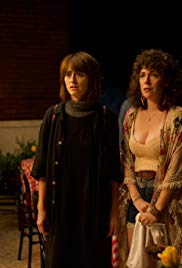
“Stage Manager” (and writer) Rachel (Ms. Utt) and actress Jackie (Ms. Tullock) are sisters who live a kind of bohemian lifestyle above a community theatre with their playwright dad (Mandy Patinkin) and Jackie’s 12 year old daughter Dodge (Oona Yaffe). There are daily struggles with this family. Money is always scarce. Dodge is growing up fast. Jackie and Rachel have very few career options, and Dad is a stubborn man who had one successful play and many that were, umm, not so successful.

An unexpected development has the grown sisters accidentally discovering their mother is not deceased (as they had lived most of their lives believing), but rather a famous soap opera actress (a terrific Judith Light). The rest of the story has this broken family trying to connect, while overcoming the assumptions that had been made based on a family history created by trying to protect kids from the truth.

Humor is injected to help soften some of the more emotional and dramatic moments, and there is a sense that the story-telling of Woody Allen films was an influence … plus there’s a visual near the end that evokes memories of MANHATTAN. Supporting work is provided by Mike Colter (“Luke Cage”), Alec Baldwin, Tim Daly, Peter Jacobson and newcomer Arica Himmel. The film also tosses in a hilarious ‘caterer’ line in regards to fashion, a singing Manny Patinkin, and most importantly, some terrific insight from two talented filmmakers.


PREMATURE

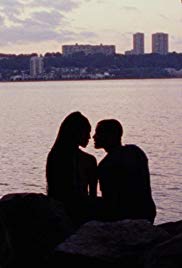
 While watching this latest from writer-director Rashaad Ernesto Green and co-writer Zora Howard, I kept flashing back to the strong reaction I had to IF BEALE STREET COULD TALK. That’s high praise. Co-writer Howard delivers not just a touching and realistic screenplay, but also a stunning debut as a feature length film actress. She plays Ayanna, a sharp young woman with a bright future – she’s headed to university after graduation, a rarity for her community.

Life often throws hurdles in our path, and Ayanna falls hard for handsome Isaiah (Joshua Boone). It’s a whirlwind romance that builds quickly over the summer. The first shoe drops when Isaiah’s ex-girlfriend shows up, which is soon followed by two much bigger and more impactful proverbial shoe drops. Through it all, Ayanna’s reactions come across as so real (and so atypical for Hollywood), and much of that is due to the expressiveness portrayed by Ms. Howard.

Filmed in Harlem, there is an organic quality to the interactions with the girls in this close-knit group. They may bicker and prod, but when support is needed, true friendship reacts quickly. The same is true for Ayanna’s mother (Michelle Wilson). Many parents can relate to their relationship between parent and kid ready to leave home. However, tiger mom emotions rear up at the time of need, and Ms. Wilson and Ms. Howard both have scenes that are seared into my brain.

Isaiah is into music, and Ayanna is a talented writer. Some of her poetry and lyrical philosophy is delivered as narration, and music also plays a key role in the tone of the film. This is an ultra-rare realistic relationship film and it also carries a “my body, my choice” message that rings true. In this community, many young women’s lives are altered by becoming mother’s at an early age, and the words that stick are “we were too young to live this old.”


THIS WORLD WON’T BREAK

 It’s easy to believe this is a Texas film through and through; however, it’s incredible to think it was made for only $36,000. Writer-director Josh David Jordan presents his feature film debut as the story of Wes Milligan, a 40 year old troubadour questioning his lot in life. We’ve seen music films about rising stars and we’ve seen them about falling stars, but it’s unusual to see a profile of a guy just plugging along.

Greg Schroeder plays Milligan and it is a terrific acting debut. Yes, he’s a very talented singer-songwriter, but somehow Mr. Schroeder is even more impressive in the humanistic and personal moments in the film. It’s interesting to note that as important as music is to Wes, we never actually see him perform on stage in front of an audience. Each song he sings is a personal moment, usually for just one other person: his fishing buddy Catfish (Mitchell Parrack), young neighborhood boy Sonny (Sonny Jordan), his widower Pops (Matthew Posey), or a local woman performing a hula hoop routine (Roxanna Redfoot). Oh, he also sings a very touching one over an answering machine for Roxanna – it’s his best attempt at flirtation.

The film looks great courtesy of cinematographer Chris Bourke, and it should be noted that director Jordan co-edited the film with his 17 year old son Julian. Kicking off with a couple of quotes from Lightnin’ Hopkins and Townes Van Zandt, many life lessons are served up for those paying attention. We feel Wes’ pain when he states, “I’m still here and nobody knows it”, and when he defines “don’t take any wooden nickels” for Sonny, we understand what he’s saying.

Many Dallas sites and architectural highlights make appearances, as does George Dunham from radio station The Ticket, who plays a country music DJ. Despite all of that, this is mostly about coming to grips with life … how crucial a support network is, and how alcohol (and lots of it) contribute to self-doubt and unclear thinking. Above and beyond, regardless of one’s situation, there is so much truth to the adage, “You’re gonna miss me when I’m gone”.


DIFF 2019 Day 2

April 13, 2019

2019 Dallas International Film Festival

 Greetings again from the darkness. I missed yesterday’s Opening Night Gala and feature film, but paid my penance today by taking in 5 films on Day 2 of this year’s Dallas International Film Festival. Changes have come to the festival this year, including reserved seats, and a shorter run that omits the encore screenings of award winners on the final weekend (there is no final weekend). The reserved seats policy is especially challenging for those of us who try to catch a couple of dozen films during the festival, but if it helps things run a bit smoother, then it’s something we will work around.

As with other years covering the festival, I will recap the films I see each day. Due to the time involved and the quick turnaround required, these will not be the usual full reviews, but rather an overview of the films and my initial reactions. If you are in the Dallas area, the festival runs through Thursday April 18, and more info can be found at http://www.DallasFilm.org


MS. PURPLE

 Kasie (an excellent Tiffany Chu) lives with her father, who has an unidentified terminal illness and is in an extended coma with no real chance for recovery. Kasie is the primary caregiver, and out of duty, refuses to put him in hospice for professional care. She also works as a Hostess/Escort at a popular Karaoke bar and has a rich boyfriend, although there seems to be no love between the two – it’s more of a business relationship.

Out of necessity, Kasie re-connects with her older brother Carey (Teddy Lee) who bolted from home many years ago after disputes with the father. He seems to have done little with his life, and frequently gets booted from an internet café for lack of cash. Carrying guilt for deserting his sister and father years ago, especially since the mother/wife left home when the kids were very young, he agrees to help Kasie with caregiving, and even takes dad for “road trips” in the neighborhood by pushing the bed through town (a comical sight).

Director and writer Justin Chon (co-written with Chris Dinh) was behind the critically acclaimed GOOK in 2017 (a Korean DO THE RIGHT THING). Here he uses Kasie’s flashbacks to childhood with her dad and brother as a framing device, demonstrating how the father dealt with his wife leaving, and laying out the responsibilities and burdens that family can bring. There are recurring shots of lone palm trees whose significance to Kasie is only explained late in the film … but does provide more insight into the bond with her father. A nice young valet (the car parking type) offers Kasie a taste of normalcy and it slowly brings her back towards center. The film has a terrific score of violin music from Roger Suen, and lets us know that finding one’s self while caring for another can be a breakthrough that may sometimes be loud, and may sometimes be quiet.


LEAVE THE BUS THROUGH THE BROKEN WINDOW (doc)

 Most documentaries explore a topic or an event, or provide a profile of a person or organization. Not this one. It’s an unusual … OK, very odd … documentary that follows Andrew Hevia, a Cuban-American photographer/filmmaker on his trip to Hong Kong to cover the Art Basel fair. His motivation in heading to Hong Kong from the United States is a nasty break-up in a long-term relationship with his girlfriend. It seems more likely that he’s running from rather than towards, and he is described as having a camera and little else.

Mr. Hevia admits to having no real knowledge of Hong Kong art and the initial culture shock he experiences includes securing lodging that can best be describes as “cozy” – a 40 square foot “apartment” that would be a tight closet and inhumane prison cell. Once he has a roof over his head, he hits the street with his camera. It’s at this point where we realize he has no real plan.

On his trek through the city, he crosses paths with fish balls, art galleries, jumpers, a street riot, artists, art collectors, expats, tourists, students, and a ferry ride. People come and go during his days and nights as he interacts with all sorts … often showing us a part of the city we wouldn’t likely see. He searches out different artistic outlets, attractive girls, and just about any party he can crash. The film plays like a travel video-diary narrated by electronic voice that’s a blend of Alexa and the computer voice from WAR GAMES. It’s an unusual viewing experience and one that leaves us feeling a bit empty. Fortunately, its run time is a brisk 68 minutes.


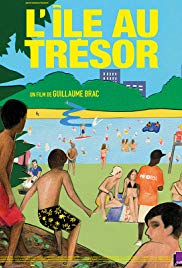
TREASURE ISLAND (doc) L’ile Au Tresor

 Yet another atypical documentary, this one from French director Guillaume Brac, who turns his lens on a water park in suburban Paris. The park is beautiful and wrapped in nature, as the lake offers many differing areas of attraction depending on one’s interests.

Brac presents various segments, some quite short, based on various groups visiting the park. We might be watching a group of underage adolescent boys trying to sneak in, and once caught, try to talk their way out of trouble. In a few segments we see the challenges facing the security guards who have to balance the park’s goal of fun with the need for safety. Of course this is France, so we also get the teenagers flirting and trying to impress each other (“Life is great”). There are families – large and small – enjoying a picnic in the bucolic setting, while young kids splash and frolic during their carefree days. Brac even takes us behind the scenes where park managers work on logistics based on weather, staff, and resources.

This is really more of a social project than a cinematic one, and we sometimes feel like we are snooping on people just having fun or doing their job. One segment with a 10 year old boy and his 3 year old brother is particularly sweet. The beauty of the park setting is contrasted with the pylon jumpers and the after-hours staff partying, but mostly it shows that people are pretty similar no matter the location.


WILD ROSE

 Quick … name all of the female Country music singers from Glasgow, Scotland! That’s the premise for this film from director Tom Harper and writer Nicole Taylor, both best known for their British TV work. Rose-Lynn Harlan is being released after a year in jail on drug charges. She uncomfortably adjusts her white boots over the ankle monitor and sets off to conquer Nashville with her singing.

Of course there are a few problems with her Music City dream. See, she’s a single mother with two kids, and she’s from a working class area where putting food on the table and paying the bills is a significant achievement. Jessie Buckley stars as Rose-Lynn, and by stars I mean she carries the film and flashes great promise as an actress. Her no-nonsense mother Marion is played by 2-time Oscar nominee Julie Walters, and while Rose-Lynn has stars in her eyes, mother Marion pushes her to take a housekeeping job and focus on her kids.

We know where all of this is headed, and it’s a credit to Ms. Buckley and Ms. Taylor’s script that we care enough to follow along. Rose-Lynn is employed by the wealthy Susannah (Sophie Okonedo), and we get one of the funniest vacuum cleaner scenes ever. Susannah soon takes on Rose-Lynn as a pet project with the goal of helping her get to Nashville for her shot.

Some rough language is peppered throughout and it’s spouted with the heaviest of Scottish accents, so much of it sounds a bit comical rather than threatening. The film is a bit uneven, but the mainstream approach keeps it from going too far off track. “Three chords and the truth” is used to describe country music, and if that’s your musical taste, you’ll likely enjoy the songs. However, if you prefer ‘Country and Western’, you’re flat out of luck.


THE DEATH OF DICK LONG

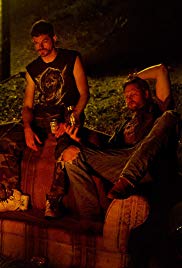
 “It’s been awhile” by Staind is the song we first hear from Pink Freud, a garage band formed by buddies Zeke, Earl and Dick. The music is awful, but “band practice” seems to exist solely for the purpose of getting these slackers together, hanging out, and drinking beer. Daniel Scheinert also directed SWISS ARMY MAN (2016) and this is the first screenplay from Billy Chew. Mr. Scheinert also plays the titular Mr. Long.

One evening, band practice takes a wrong turn, and Dick ends up dead … dumped in a hospital parking lot by his bandmates. If we previously had any doubts as to the intelligence of Zeke and Earl, all of that is cleared up as these two bumbling idiots try to cover up their involvement and what actually happened that night. The cause of death is slow to unfold, but once it does, it surely is the only one of its kind. The Sheriff (Janelle Cochrane) and her deputy (Sarah Baker) prove equally clueless in their attempts to solve the crime, and much of the film’s humor revolves around folks just not asking quite the right question in any situation.

Michael Abbott Jr plays Zeke and Andre Hyland plays Earl, and there scenes together will have you laughing and questioning human existence. Virginia Newcomb plays Lydia (Zeke’s wife), Jess Weixler is the perplexed wife of Dick, and Sunita Mani is hilarious as Earl’s friend Lake Travis (a name nearly as much of a punchline as the film’s titular character).  While the film has many funny and awkward moments, it can also be taken as a statement on testosterone-driven bad decisions and actions with consequences. If nothing else, we learn how to quickly answer when someone asks, “Y’all wanna get weird?”


STOCKHOLM (2019)

April 13, 2019

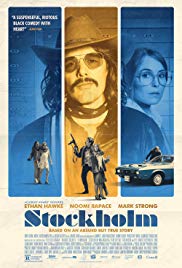
 Greetings again from the darkness. The film opens with a title card informing us that it is “based on an absurd but true story”. In 1973 the Kreditbanken of Stockholm Sweden was held up by an armed man. The ordeal was unusual for low-crime Sweden and it was broadcast live on TV. It has also been credited as being the origin for the term “Stockholm Syndrome” – a term to describe the bonding that sometimes occurs between a hostage and their captor.

Writer-director Robert Budreau wisely wastes little time with setting the stage. Lars (Ethan Hawke) dons a disguise meant to trick the police, and storms the bank lobby armed with a sub-machine gun. Wearing a cowboy hat and a leather jacket with a Texas flag, he proclaims “Remember the Alamo” as he secures some hostages and presents himself as Kaj Hansson, a well-known criminal. Of course, Mr. Hawke is certainly an American, and the actual robbery/hostage event was conducted by a Swede.

Lars is loud and boisterous to the cops, while simultaneously being sympathetic and understanding to the hostages – especially Bianca (Noomi Rapace), a married woman with two kids. Christopher Heyerdahl plays Police Chief Mattison, and he employs some unexpected psychological gamesmanship with Lars that gets even more convoluted when Swedish Prime Minister Olaf Palme becomes involved. Lars’ real goal here is to spring his buddy Gunnar Sorensson (Mark Strong) from jail and have them both ride off to freedom in a mustang like the one Steve McQueen drove in BULLITT.

Yes, I should mention that although guns are fired and hostages are held, this is really an offbeat comedic bank heist. It focuses on how the hostages bond with their captors and how Bianca quickly realizes that not only is she smarter than Lars and Gunnar, but that the cops are more of a threat to her than the criminals. She strategizes better than either side, and Ms. Rapace (from the original Millennium Trilogy) is the standout performer in the film.

Filmmaker Budreau and Mr. Hawke previously collaborated on an intimate look at jazz trumpeter Chet Baker in BORN TO BE BLUE (2015), and they prove again that they work well together. The other two hostages are played by Bea Santos as Clara and Mark Rendall as Elov. When Prime Minister Palme refuses to negotiate or allow Lars to leave with hostages, we can sense the emotional tide turn as Clara, Elov and Bianca realize they are safest remaining with the hostages.

Of course there are some liberties with history taken for cinematic reasons, and since most of the filming takes place within the confines of the bank, we do get to know each of the participants pretty well. The similarities to Sidney Lumet’s DOG DAY AFTERNOON (1975) are unmistakable, and one of the reporters covering the story even comments that it’s “almost like watching an American movie.” The odd ending works for the film, and thanks to Ms. Rapace, there is enough heft to the characters to prevent the humor for taking over.

watch the trailer:


SUNSET (Napszallta, 2019)

April 13, 2019

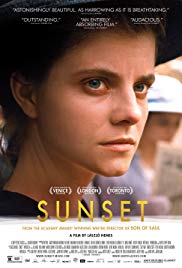
 Greetings again from the darkness. Hungarian filmmaker Laszlo Nemes mesmerized us with his first feature film, SON OF SAUL (2015), the Oscar winner for Best Foreign Language film. That debut was an incredibly unique viewing experience centered on the Holocaust at Auschwitz. Mr. Nemes got much of the band back together for this follow up, and their collaboration, while a bit frustrating to watch, is again quite fascinating to look at.

Mr. Nemes co-wrote the script with his SON OF SAUL writing partners Clara Royer and Matthieu Taponier (also the film’s editor). And for those that share my frustration in watching the film, it’s the story that is likely to blame. Is there a story?  Certainly not in the traditional sense – which makes it difficult to follow or try to explain. Irisz Leiter (played by Juli Jakab) is first seen being fitted for fine hats in the elegant shop that bears her family name. We soon learn her parents both died, and she has been absent from the city for many years. The new owner, Oszkar Brill (Vlad Ivanov, 4 MONTHS, 3 WEEKS AND 2 DAYS, 2007) is startled to learn of Irisz’s return, though we aren’t sure why he is so uncomfortable around her. Irisz soon discovers she has a brother (a surprise to her) and that he is quite notorious in these parts.

Much of the film focuses on Irisz trying to track down her brother, and then track him down again. That’s the closest thing to a plot we get. Mostly it’s a succession of scenes where people ask questions that never get answered. In fact, there is minimal dialogue to go with the now-familiar camera work of cinematographer Matyas Erdely who utilizes his SON OF SAUL first person perspective with background fuzzed out so that we see what one person is seeing. There is an underlying theme of what is apparently a corrupt part of a mysterious sub-culture in the society – even involving the Royal family. Keep in mind this is 1913 Budapest and war is at hand.

The set design and costume design are extraordinary … especially the lavish hats from the era. The score is from Laszlo Melis (also from SON OF SAUL), and while Ms. Jakab is pleasant to look at, the story is disorienting and unfulfilling. The approach with the camera work is designed to force us to see things through the characters’ eyes, but it’s not enough to offset the incoherent and aimless wanderings of Irisz as she collects scraps of information that may or may not be pertinent. Perhaps you are smarter than I am, and will be able to connect the dots … or at least find dots to work with.

watch the trailer:


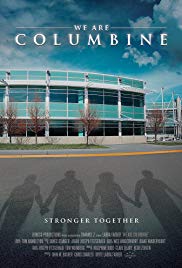
WE ARE COLUMBINE (2019, doc)

April 10, 2019

 Greetings again from the darkness. A great many things changed on April 20, 1999. The “Columbine Massacre”, a school shooting (and pipe bombs) that resulted in many deaths and injuries, and subsequent copycats, was broadcast live on television for the world to witness. Laura Farber was a freshman at Columbine High School that fateful day, and now, almost 20 years later, she’s a filmmaker taking a look at the fallout from such a traumatic event.

Rather than document the progression of events – something that’s already been done numerous times – Ms. Farber enlists four of her former classmates, plus a teacher and the school principal to discuss their memories of the day, and more importantly, the impact it has had on their lives since. Gus was the pot smoking slacker. Jaimi was an athlete whose big sister also attended the school. Amy was a cheerleader and social type, and Zach was a studious soccer player. Mr. Zeyba was a first year teacher at the time, and Mr. DeAngelis (“Mr. De”) was the school principal. None are especially anxious to revisit those memories, and without the trust they have for Ms. Farber, they probably wouldn’t.

With filming set up at an otherwise unoccupied Columbine High School, each of the participants walks us through where they were that day (cafeteria, classroom, etc) and how they remember things unfolding. News clips and a 911 call from that day are replayed, but filmmaker Farber wisely decides against showing the shooters or even mentioning their names. This is about the survivors and as difficult as the conversations are, we get the feeling it’s a cathartic exercise for them. We are stunned to hear that they have spoken very little of that day, even to each other or other classmates. There is an “understanding”.

This is a very intimate and personal look at how an unbelievably traumatic event can alter the life path of a person. Gus now expresses himself through his rap music. Jaimi is a nurse who values her time with her wife and kids. Amy is a social worker, and Zach is now a teacher at Columbine High School. Mr. Zeyba continues to teach and Mr. DeAngelis continued on as school principal … after testing numerous fire alarm signals to prevent flashbacks. Each is giving back in their own way after experiencing something most of us can barely imagine. It may not be a traditionally informative documentary, but it’s one that brings us as close as possible to what the survivors feel.

watch the trailer:


THE BEST OF ENEMIES (2019)

April 4, 2019

 Greetings again from the darkness. It’s easy to complain (and many do) about how Hollywood usually explores racism. Sometimes the stories seem a bit over-simplistic, as with THE HELP, GREEN BOOK, and HIDDEN FIGURES; however, rather than criticize, perhaps we should be thankful for any effort to prod. Often getting the conversation started is the best first step. That’s really the message from Robin Bissell’s directorial debut of a script he adapted from Osha Gray Davidson’s 1996 book “The Best of Enemies: Race and Redemption in the New South”. Mr. Bissell has previously been Executive Producer on THE HUNGER GAMES and SEABISCUIT, and Mr. Davidson’s book was previously adapted for a stage production.

Based on a true story that took place in 1971 Durham, North Carolina, the film portrays the remarkable events that led to the integration of public schools and a stranger-than-fiction friendship. Taraji P Henson stars as Ann Atwater, an African-American activist and community organizer, while Oscar winner Sam Rockwell co-stars as Claiborne “CP” Ellis, the Exalted Cyclops (basically the Chapter President) of the Ku Klux Klan. It seems the previous stranger-than-fiction description is aptly applied here when an aggressive black woman known as “Roughhouse Annie” can effectively sway the long ingrained beliefs of a KKK leader, and forge a friendship that would last 3 decades.

A school fire that partially gutted the elementary school attended by the black children in the community was the proverbial spark that kicked off the chain of events. When the white folks refused to share their school, the black children were forced to hold classes in the areas least affected by the fire … while demolition and renovation was being carried out. This led to the NAACP getting involved, which resulted in a judge ordering a “Charrette” – a blend of a committee and a civic debate – to determine how the community would move forward. Bill Riddick (Babou Ceesay, FREE FIRE, 2016) was charged with organizing the Charrette, and he named Ms. Alexander and Mr. Ellis as co-chairs. Keep in mind this was 17 years after Brown vs. Board of Education ruled in favor of school desegregation, but many pockets of the south were slow to come around.

The story structure offers synchronicity between the lives of Alexander and Ellis, as they each struggle with poverty and family challenges. It’s just one of the ways of trying to show they were more alike than different, and much more of the time is devoted to how the transition slowly occurs for Ellis. Of course, even though each side dislikes the other, it’s Ellis whose eyes must be opened as he clings to the only way of life he’s known. Because of this, Mr. Rockwell has the meatier role, but it’s Ms. Henson (and her fat suit) who draws the most laughs and nods of approval from the audience.

As you would expect, it’s a strutting Mr. Rockwell and boisterous Ms. Henson that dominate the film, however, some tremendous actors fill the supporting roles: Wes Bentley (as a Confederate soldier hat-wearing Klansman), Anne Heche (as Ellis’ wife), Nick Searcy, Bruce McGill, John Gallagher Jr, and Caitlin Mehner.

The film is a most entertaining (though a bit lightweight) look at an historic chain of events, and it’s right up there with a black cop infiltrating the Klan in Spike Lee’s 2018 film BLACKkKLANSMAN believe-it-or-not points. In 1980, Studs Terkel conducted an interview with Mr. Ellis, and it’s worth a read to gain a bit more insight into a man that truly changed his evil ways. The ending of this film leans heavily on the “feel-good” and “can’t we all just get along” approach, and maybe that’s not such a bad thing. The end credit sequence features some tremendous clips of the real Ms. Alexander (who died in 2016) and Mr. Ellis (who died in 2005), making it a bit easier to understand how the two opposites connected for the greater good.

watch the trailer:


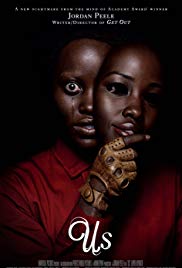
US (2019)

April 1, 2019

 Greetings again from the darkness. Jordan Peele first got noticed on “MADtv,” and then for his impersonation of Barack Obama. His career got a boost with “Key and Peele” with Keegan-Michael Key, and then it simply exploded in 2017 with GET OUT. For that film, he won his first Oscar for Best Original Screenplay, and was also nominated for Best Director (his directorial debut) and for Best Picture (as a Producer). With his follow-up to that breakout film, Mr. Peele has squashed any talk of being a one-hit wonder, and has actually elevated his work with this latest.

The film opens in 1986 as a family is on vacation at Santa Cruz, California. While taking in the amusement park along the boardwalk, their young daughter Adelaide wanders off into a house of mirrors where she comes face to face with her doppelgänger – her exact lookalike. It’s the film’s first creepy moment, but certainly not the last. The story then jumps forward to present day where Adelaide (Lupita Nyong’o, Oscar winner for 12 YEARS A SLAVE), her husband Gabe Wilson (Winston Duke, BLACK PANTHER), and their teenage daughter Zora (Shahadi Wright Joseph) and young son Jason (Evan Alex) are on a getaway to a lake house … one located near their friends Josh (Tim Heidecker) and Kitty Tyler (Elisabeth Moss), and their in sync twin daughters (Cali and Noelle Sheldon). Adelaide is not thrilled when husband Gabe suggests they head over to Santa Cruz beach.

Part of the brilliance of the film is that it works as a straight-forward horror film with some very funny moments (often thanks to Mr. Duke), but its real purpose is to inspire multiple theories along with the corresponding debate. Alternate meanings, metaphors and clues are dropped in most every scene. A toy ambulance, a JAWS shirt, a “Thriller” shirt, a TV commercial for the “Hands Across America” event, and the corresponding VHS tapes next to the family TV only hint at the numerous nods Peele serves up to other films, especially some horror classics.  You’ll note the director chooses an aerial shot not dissimilar to that of Kubrick’s THE SHINING as the family drives towards their vacation spot. Also present (in a couple of scenes) is the reference to bible verse Jeremiah 11:11, and sharp-eyed viewers will spot other references to the double 11.

While the Wilson and Tyler families are visiting on the sandy beach, young Jason wanders off sending mother Adelaide into a near-frenzy with recollections of her night on that same beach so many years ago. Later that evening, the true horror begins. A terrific shot of 4 figures all clad in red at the end of the Wilson’s driveway kicks the film into high gear. More doppelgangers appear and lead us to a subterranean community living in tunnels, and sharing the space with bunnies. We learn of “the tethered”; those who are (mostly) identical to those living above. Those of identical likeness square off in the ongoing battle for survival, and that’s really all you should know before seeing for yourself.

The cast is terrific, especially Ms. Nyong’o, who like the other actors seems to relish playing the dual roles. She also nails the final shot with a smile that will chill you to the marrow. Madison Curry makes a strong impression as young Adelaide, and as much fun as we have with the characters, the true joy lies in trying to “catch” all that filmmaker Peele throws at us. That final wall of folks in red is pretty easy to decipher, but some of  the little clues and prods require a second viewing. It’s fascinating and historic that Jordan Peele’s follow up movie could possibly make this yet another horror movie contending at Oscar time. One site currently places the odds at 19/1 to win Best Picture at the 2020 Oscars. If you are up for a fun little horror movie that’s also a mind-bending societal commentary on those who are born into privilege and those who aren’t, then Mr. Peele has just the flick for you.

watch the trailer:


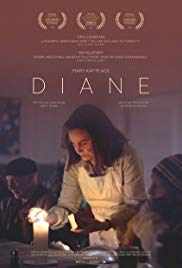
DIANE (2019)

March 31, 2019

 Greetings again from the darkness. In a film that is both grounded in realism as well as playing like an ode to underappreciated character actresses, our wonderment turns to full comprehension once we realize this is the work of Kent Jones. Mr. Jones is one of today’s foremost authorities on film, having been a respected film critic, served as director of the Film Society of Lincoln Center, and delivered a tremendous documentary showcasing the conversations of two more publicized film experts with 2005’s HITCHCOCK/TRUFFAUT. In other words, he’s a man who loves cinema and has both a trained eye and an instinct for what makes a film worth watching.

Mary Kay Place (THE BIG CHILL, 1983) is Diane. Our first reaction upon seeing her is that she has the well-worn, hangdog look of a woman burdened by life. As we follow her around, we soon learn that’s very true and that there is even more to her story. Diane is the kind of person who, rather than keep a list of things to do, keeps a list of people for whom she has to do things. And there are many on her list. Chief among these are her dying cousin Donna (Diedre O’Connell) and her drug-addicted son Brian (Jake Lacy). The self-imposed penance Diane pays all day each day stems from a story referred to as “The Cape” … a long ago act of betrayal and indiscretion that has clung to Diane ever since.

The rest of the cast is filled with faces you’ll recognize (and names you can’t recall), many for their work in the 1960’s, 1970’s and 1980’s, including: Estelle Parsons (Best Supporting Oscar winner for BONNIE AND CLYDE, 1967), Andrea Martin (MY BIG FAT GREEK WEDDING, 2002), Joyce Van Patten (sister of Dick, ST ELMO’S FIRE, 1985), and Glynnis O’Connor (ODE TO BILLY JOE, 1976). But don’t mistake this for some nostalgic tribute – each of these women offer up exactly what’s needed for their respective characters. It’s a joy to behold their work – and easy to take for granted.

This little Massachusetts community is tight-knit and speaks freely on the lives of each other. There are few secrets. Everyone asks Diane about Brian – her son that lies to her face, acts perturbed when she tries to help, forces her to listen to bible-thumping, and finally comes clean on why he’s treated her the way he has. Filmmaker Kent’s first narrative feature is an organic character driven story about aging, carrying a burden, striving to make amends, and suppressing true feelings by constantly serving others. When Diane writes in her journal, “My loved ones are gone and I’m left to be”, it takes her (and us) closer to her soul than any soup kitchen possibly could. Casserole dishes can only heal so much, and a lead role for a respected actress serves us all.

watch the trailer: