BRITTANY RUNS A MARATHON (2019)

September 5, 2019

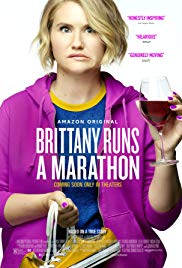
 Greetings again from the darkness. Philosophically speaking, each of us is running our own marathon of life. Of course, every person’s marathon has its own obstacles and challenges, and most of us have happiness as our end goal for the finish line. This first feature film from writer-director Paul Downs Colaizzo is based on the real life struggles of his friend Brittany, whose photos are shared over the closing credits.

Jillian Bell stars as Brittany, a 28 year old New York City party girl dedicated to avoiding adult responsibilities. She struggles to make ends meet financially, yet manages to drink copious amounts of alcohol and partake in recreational drug use. A trip to a Yelp-referred doctor in hopes of scoring Adderall ends with a harsh realization when he asks if she is making “healthy choices” … her BMI places her in the obese category. Suddenly her friends’ claiming she is the funniest person in the room can be interpreted as Brittany using humor as a coping method – a trait she recognizes in another character later in the story.

This is no simple “chick flick” filled with punchlines. Well, OK, it has plenty of punchlines thanks to the comedic brilliance of Ms. Bell, however, the film is also loaded with the emotional burdens that accompany societal standards. It exposes the nasty side of human nature in how we treat those who are overweight, or not meeting the accepted standard of attractiveness, or not wealthy enough, or not fashion-oriented, or whatever other standard being applied at any given time. Brittany takes us on the emotional journey of seeking happiness and self-actualization when one is mired in insecurities and depression. It’s a journey that can be tough to watch and tough to experience.

The underappreciated Michaela Watkins plays Brittany’s neighbor Catherine, whose athletic and artistic façade camouflage her shattered marriage and the accompanying pain. Ms. Watkins clearly embraces offbeat projects, as evidenced by her role in BRIGSBY BEAR (2017) and by appearing with Jillian Bell in this year’s indie gem SWORD OF TRUST. When Brittany laces up her Chucks and runs that first block, Catherine jumps in and invites her to join a runner’s club. It’s there that Brittany and Catherine meet Seth (Micah Stock), an out of shape gay man proving to his son he is a strong father that can be relied upon. We see all three become friends, and though Brittany may have motivated them to run the NYC Marathon, we see that each is running for their own reason.

Other supporting work is provided by Lil Rey Howery (GET OUT) as Demetrius, Brittany’s brother-in-law and surrogate step-father via Skype; Alice Lee as Gretchen, Brittany’s narcissistic vlogger roommate; and Utkarsh Ambudkar as Jern, Brittany’s slacker co-worker turned friend turned romantic partner. Even though Jillian Bell owns the film as Brittany, each of the talented support cast brings depth to their roles, allowing these to be actual people to whom we can relate. It’s a risky move casting so many improve comedians, but the result is quite impressive.

The film is loaded with life lessons and chuckles, and with that comes moments of cruelty, self-centeredness, insecurity and depression. Friendship is key here. Is someone your friend if they belittle you and keep you around so they feel better about themselves?  Are we a good friend if we don’t allow others to support and help us out in times of need? The message these days is to accept yourself, and find happiness in the type of person you are. Brittany shows us that finding yourself is a crucial first step, and that accepting yourself doesn’t mean accepting bad habits and poor health. The film was well received at Sundance, and it’s easy to see why … much easier than running that first block.

watch the trailer:


YOU ARE HERE: A COME FROM AWAY STORY (doc, 2019)

September 5, 2019

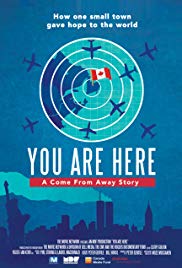
 Greetings again from the darkness. September 11, 2001 provided us examples of human nature at its worst, followed by human nature at its finest. Filmmaker Moze Mossenen begins with audio from the September 11 news reports playing over somber and beautiful shots of the Ground Zero memorial. We are immediately transported back to that fateful day, and the emotions come flowing back.

Rather than focus on the terrorists, Mr. Mossenen takes us to Gander, Newfoundland, a Canadian rock island on the far eastern shore of North America. A spectacular aerial view provides perspective for this remote village with a population of around 9000. Gander will forever be remembered as an example of human nature’s finest. On September 11, 2001, when United States air space was closed, Gander airport became a landing spot and parking spot for 38 passenger planes.

We hear from Beverly Bass, an American Airlines Captain who was directed to land at Gander. We also hear from Air Traffic Controllers, passengers, and local Gander citizens, including a local TV personality and Police Chief Oz Fudge and Mayor Claude Elliot. One of the teachers at Gander Academy relays what it was like that day. The locals shared in the worldwide shock from the terrorist acts. They feared for their own safety as the breadth of the terror plan was unknown. They watched in wonder as plane after plane landed at their small airport. And finally, they kicked into gear realizing there were thousands of passengers on the planes … each of whom were hungry, tired and frightened.

The “come from away” folks – Gander’s terms for anyone from somewhere else – numbered 6700, nearly doubling the town’s population. It took approximately 24 hours before the passengers could be taken from the planes, and in one of dozens of fascinating elements, we learn school buses are used for transport since the town only had 15 taxis. The local bus drivers were on strike, but all agreed to volunteer to drive the passengers to the churches, schools, and organizations providing shelter.

Mossenen does end up showing the footage of the planes hitting the towers, but it’s important to know that this is a film of personal stories … people doing extraordinarily kind things for those they don’t know. The spirit of Gander was something to behold. Religious and cultural differences were overcome and hospitality was the norm. It’s stunning to see the United States radar with zero planes in the air, but it’s life-affirming to see folks serving those in need, expecting nothing in return.

The film excels while Gander citizens and the air passengers recollect those few days, but it loses a bit of steam towards the end. On the 10th anniversary of September 11, Irene Sackoff and David Heim began interviewing folks and collecting stories in order to write a musical of the events. And they succeeded. Yes, “Come From Away” became a Broadway hit, and the film shows those from Gander who made the trip to NYC to see the show. This is one time where the lights of Broadway pale in comparison to ‘101 ways to cook goulash’. The willingness to do what needed to be done is the inspirational message delivered by Gander. Neighborly love and generosity in the aftermath of tragedy turned this into a beautiful story … the best of humanity. Moose stew anyone?

watch the trailer:


SUPER SIZE ME 2: HOLY CHICKEN! (doc, 2019)

September 5, 2019

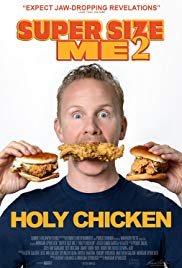
 Greetings again from the darkness. What we expect in a documentary is a presentation of the topic in a manner slightly slanted towards the filmmaker’s beliefs. What we hope for in a documentary is to learn something new or to be exposed to a different way of looking at a subject. We don’t typically expect a great many laughs or even a film with significant entertainment value. For those who recall Morgan Spurlock’s 2004 Oscar nominated SUPER SIZE ME, you likely won’t be surprised that his latest is heavy on humor and entertainment, and a bit light on education. Still, his formula works – and we allow ourselves to be dragged along.

Spurlock kicks the film off by announcing that he wants to open his own fast food restaurant. He proceeds to confer with some celebrity chefs, a marketing firm, and a business strategist. Capitalizing on his success as a documentary filmmaker is a key element to the strategy, and of course, his mission is to once again expose the fast food industry for perpetuating myths of healthier fast food options.

He legitimately asks, “Have things gotten better?” We are meant to interpret this as … have things gotten better since 2004 when Spurlock documented his self-imposed all-McDonalds food every meal for an entire month. It’s at this point where the research kicks in. Facts and statistics are discussed. We learn that 44% of us eat fast food regularly, and that chicken overtook beef a couple of years ago as the protein of choice. We first assume this must be due to consumers making the “healthier” choice, but then we are informed that fried chicken outsells grilled chicken – and the gap is widening.

The most interesting segment of the movie occurs as the buzzwords and their meanings are discussed. Having “nutrition” broken down from a marketing perspective truly exposes the outright fraud being perpetrated on the public. “Health Halo” is the moniker applied to descriptions like “fresh”, “all-natural”, and “no added hormones”. Even “crispy” is used in place of the more accurate “fried”, which is obviously a word no consumer would associate with healthy food. Spurlock is in his element when providing a startling visual for what qualifies as “free range” according to the FDA.

‘Big Chicken’ is compared to ‘Big Oil’, as 5 corporations control 99% of the chicken farming industry: Tyson, Perdue, Pilgrims, Koch Foods, and Sanderson Farms. We get an explanation of how these corporations apply enormous pressure on the farmers, keeping them in a constant state of debt – or worse for farmer Jonathan Buttram who has been blackballed for helping Spurlock make this movie. Spurlock bounces from Columbus, Ohio to Boulder, Colorado to Tennessee to Kentucky to Washington, D.C, to Alabama; and from Chick-Fil-A to Wendy’s to 7-11 to Popeye’s, and even to McDonalds – Spurlock’s first visit in 12 years to the establishment that put him on the movie map.

Very little new information is provided here, but Spurlock does what he does best – entertain with examples of extremes. While his “fried grilled” chicken sandwich is a publicity stunt, the real story is how menus and labels are used to manipulate the consumer, many who don’t seem to much care.

watch the trailer:


OFFICIAL SECRETS (2019)

August 29, 2019

 Greetings again from the darkness. Doing the right thing is usually pretty easy. However a person’s true character is revealed when it’s not so easy. In 2003, doing the right thing became very difficult for Brit Katharine Gun. How difficult? Well, her decision could jeopardize her job. It’s a decision that could get her husband deported. Making the choice could expose two powerful international governments and send her to prison for many years. And if that’s not enough risk, how about a decision that could lead to a huge (possibly illegal) war, costing thousands of lives? So you know what Katharine Gun did?  She did the right thing.

Keira Knightley stars as Katharine Gun. The film opens in 2004 with her facing a British court and the moment of her plea. We then flashback one year to see Katharine working as a staff member of GCHQ (Government Communications Headquarters). She spends her days translating and compiling intelligence for the British Government. It’s a job that requires the utmost discretion and the contractual obligation to keep work secrets at work. One day she reads a top secret memo making it clear that governments were conspiring to manipulate a United Nations vote required to authorize an invasion of Iraq.

Based on the (lengthy titled) book “The Spy who Tried to Stop a War: Katharine Gun and the Secret Plot to Sanction the Iraq Invasion” by Martha Mitchell and Thomas Mitchell, the film is directed by Gavin Hood (the excellent TSOTSI, 2005) who co-wrote the screenplay with Gregory Bernstein and Sara Bernstein. It’s presented as a moral quandary for Katharine. Say nothing and maintain the status quo in her personal and professional life, or speak up and risk everything noted above. We see Katharine’s impulsive decision-making, and behavior that would rank her among history’s least likely successful spies. It’s actually her naivety that guides her to speak up.

The media side is also addressed here, and although some terrific actors are involved, this segment is the film’s slickest and least realistic. Matt Smith plays political reporter Martin Bright and Rhys Ifans plays Ed Volliamy. The two journalists for “The Observer” worked together to verify the memo leaked by Ms. Gun, and Matthew Goode is Peter Beaumont, the editor who pushed to run the story. Previously, the paper had been an avid supporter of British Prime Minister Tony Blair, and took many of their stories directly from information provided by his office. Running the story exposed the paper to scrutiny that it was not accustomed to.

Where the film excels is in exploring Katharine’s personal turmoil. It’s also where it fails us as viewers. As her personal story, the subject matter is a unique and rare look at the wheels of government intelligence. Unfortunately, an inordinate amount of time is spent on the media and reporting, and not enough on what emotional torture the year of waiting must have been for her. Ralph Fiennes plays Ben Emmerson, the lead attorney for Liberty – the legal organization who takes on Katharine’s case. It’s the legal wranglings of this complex case that make for extraordinary drama, and the fallout of her personal choices had the potential for disaster. All of this is covered in a cursory manner, when more detail would have added more heft to a fascinating story. This includes her run-ins with an MI5 agent played superbly by Peter Guiness. The Official Secrets Act of 1989 is mentioned about 10 times, even though we understand pretty quickly that actions against this law likely results in treason. Ms. Gun is a hero for exposing illegal government activity, and a more intimate look at her personal turmoil would have provided more suspense and a better connection for the viewer.

watch the trailer:


RAISE HELL: THE LIFE AND TIMES OF MOLLY IVINS (doc, 2019)

August 29, 2019

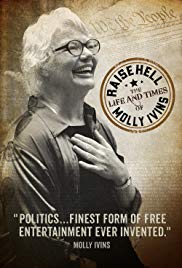
 Greetings again from the darkness. We can’t help but be drawn to that rare breed who possess a perfect blend of intelligence, humor, wit, and communication skills (whether written or oral). These people tend to make us laugh while they educate us and motivate us to think. Documentarian Janice Engel delivers a fascinating look at a fascinating woman, Molly Ivins.

With a subject like Molly Ivins, there is no question the time spent watching this will be entertaining; however, Ms. Engel doesn’t miss an opportunity to dig a little deeper. Of course we see many archival clips of Molly delivering her own expertly chosen words – typically at the expense of some conservative politician, and we also are treated to personal insights from her siblings, as well as a couple of childhood/lifelong friends.

A traditional timeline is used for this anything-but-traditional woman. She stood 6 feet tall at age 12, and even as an adult she was a physically imposing presence in an occupation where women were still battling for acceptance. Her dad was a right-winger and she was a 3rd generation Smith College graduate, yet Molly remained an independent and (very) critical thinker … delighting in exposing political corruption and incompetence. Her favorite punchlines typically skewered Texas politics and Texas politicians. A Master’s degree from Columbia finalized her educational pedigree, but it was her colorful writing style that elevated her observations to a level of brilliance.

Molly Ivins once described the idea of objective reporting as “horse pucky”. It’s this type of honesty and straight talk that set her apart from so many reporters – both in her day, and even more so today. She knew and admitted that her own political views affected what she wrote, yet readers from both sides lapped up anything she committed to the page. That’s not to say she didn’t ruffle feathers. In fact, her feather-ruffling was world class. During her career, she held newspaper gigs in Minnesota, Austin, New York, Denver, and Dallas … including The New York Times and The Texas Observer. Her column peaked when she was syndicated in more than 400 papers nationally. Molly Ivins was a big deal.

Others interviewed include Rachel Maddow, Dan Rather, Paul Krugman, and Ann Richards’ daughter Cecile. Everyone loves to talk about a woman who brings a 6-pack of beer to a job interview, and referred to herself as the “resident communist”. She admitted to being an alcoholic, and to being lonely at times; but the one thing she never did was sacrifice the work for personal gain. She wrote best-selling books, was a fabulous public speaker, appeared on TV and radio talk shows, and of course, spread her words on the page.

Molly Ivins was a wizard of words. She had much to say and many of us paid attention – whether we agreed or not. Her exceptionally strong and aggressive attacks on George W Bush might be what she is best remembered for, but “gang-pluck” may be a close second. Mostly we admire the tenacity and wit and genius that was the one and only Molly Ivins.

watch the trailer:


AQUARELA (doc, 2019)

August 29, 2019

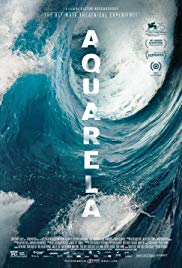
 Greetings again from the darkness. This is not your father’s Nature documentary. It’s more like Mother Nature giving us a glimpse at her most beautiful, peaceful, ferocious and terrifying self. And it’s just water. Simple H2O. Only it’s not so simple. In fact, water takes many forms, and Russian filmmaker Victor Kossakovsky serves up some stunning water photography from around the globe.

The film begins with a rescue team working frantically to pull out a car that has fallen through the ice. When the camera finally does pull back, we see the vast space of the lake covered in ice. Other cars speed across the frozen body of water as if it’s a sport or thrill for the driver. When another mishap occurs, we realize the tragedy is blamed on ice that has melted “3 weeks” earlier than usual. So we brace ourselves for another lecture on climate change.

It’s a lecture that never comes. Surprisingly, there is no narrator. Perhaps Morgan Freeman signed a non-compete with the penguins. Kossakovsky allows the camera and nature to show the story, albeit with periodic musical accompaniment from composer Eicca Toppinen – sometimes with heavy metal chords, sometimes with soothing strings. Filmed in Greenland, Venezuela, Siberia (Lake Baikal), and Miami, Florida, where we see the effect of Hurricane Irma, water is shown in its glory. At times peaceful, at times violent. A sailboat captain fighting a storm might be followed by a breath-taking waterfall, which might be followed by a flooded town … and even a swimming horse is photographed underwater.

Waves, glaciers, whales and dolphins combine for an unusual cinematic experience, and the most staggering sound comes courtesy of the ice moaning and water running. It’s one best enjoyed with theatre screen and sound, and a film that will likely lose something even on the finest home systems.  Filmed at 94 frames per second (rather than industry norm of 24 or 48), the visuals are truly breathtaking … and sometimes disorienting. As George (on “Seinfeld”) once said, “The sea was angry that day, my friend”; and now we have witnessed the anger for ourselves.

watch the trailer:


VITA & VIRGINIA (2019)

August 22, 2019

 Greetings again from the darkness. The historical landscape of relationships is littered with the remains of artist couples who began with a cosmic connection and ended with a sonic boom. Add in the socially toxic matter of same-sex attraction from a century ago, and you have a starting point for the romance-friendship-inspiration between writers Vita Sackville-West and Virginia Woolf. Director Chanya Button co-wrote the script with Eileen Atkins, and it’s adapted from Ms. Atkins play and the personal letters of Virginia and Vita … correspondence that covered many years and hundreds of letters.

Gemma Arterton (TAMARA DREWE, 2010 and QUANTUM OF SOLACE, 2008) stars as writer Vita Sackville-West, a successful poet, novelist, and columnist. Vita was also known for her free spirited ways, and sometimes scandalous behavior. Virginia Woolf is played by Elizabeth Debicki (“The Night Manager”, THE GREAT GATSBY), and she does really nice work capturing the troubled genius, and the glimmers of hope during her time with Vita. The two women were so very different in their approach to life and writing, although each faced their own challenges.

We see their first meeting, and the immediate enchantment that occurs as their eyes meet across the room. However, what makes their relationship interesting is the long and winding path to consummation. The interesting parts come as Vita toys with the fragile Virginia, though it’s clear their connection is quite strong. Though the connection was strong, the relationship was quite complex. Vita was a fan of Virginia’s talent. Virginia was an admirer of Vita’s strength and confidence. They seemed to push each other – sometimes for the better, other times for the worse.

The film opens as Ms. Woolf’s book “Jacob’s Room” is being typeset and printed. It’s quite an artistic way to show the mechanics of the process, and credit goes to Cinematographer Carlos De Carvalho for a segment that would typically be little more than filler. We learn about Vita’s secretly “open” marriage to diplomat Harold Nicholson (Rupert Penry-Jones) and her constant battle with her mother Lady Sackville (Isabella Rossellini) over scandals and the family reputation. Virginia’s husband Leonard (Peter Ferdinando) runs their printing business, and is seen as vital to his wife’s emotional stability, despite the void in other marital aspects. Virginia’s artist sister Vanessa Bell (Emerald Fennell) is quite an interesting character whose backstory (also a part of the Bloomsbury Group) is teased enough that she might deserve her own film.

The film features a couple of memorable lines of dialogue, both spoken by Vita. During a BBC radio program she boldly claims “Independence has no sex”, and in an early discussion with Virginia states “Popularity is no sign of genius”. Vita’s brazen step traveling as a man with her previous lover Violet Keppel is mentioned, but mostly this is focused on the class differences and the ‘snatched moments’ for Vita and Virginia. Vita’s exotic spirit and Virginia’s struggle with mental health are made clear (even using special effects for the latter). “Visions” of conversations bring the words on the letter pages to life, though it does seem that the filmmakers played things a bit too safe in order to capture a mainstream audience. The music of Isobel Waller-Bridge (Phoebe’s sister) brings a contemporary feel but it’s at times in contrast to the high gloss presentation. For the women who wrote and inspired the amazing novel “Orlando”, and led one of the more tumultuous historical lesbian affairs, it could be argued that they deserved a bit more risk taking on the big screen. Still, “X” marks the spot for Virginia’s writing room, and we do understand why discretion might be the right call.

watch the trailer:


AMERICAN FACTORY (doc, 2019)

August 22, 2019

 Greetings again from the darkness. In December 2008, General Motors shut down their truck plant in Dayton, Ohio, putting approximately 2000 employees out of work. Six years later, Chairman Cao Dewang, the founder of Fuyao Glass, invested millions to turn the shell of the plant into a retro-fitted factory and the first U.S. operation for his company – a company he claims owns 70% of the auto glass market. In doing so, the factory hired approximately 1000 locals, many of whom had not had consistent work since the GM plant closed years prior.

Co-directors Steven Bognar and Julie Reichert share an Oscar nomination (she has 3 total) for their 2009 documentary short, THE LAST TRUCK: CLOSING OF A GM PLANT. This time out, they have impressive access to a remarkable situation: a successful Chinese company opening a factory in the United States, and attempting to merge two distinctly different cultures. We hear much these days about globalization, and by the end of the film, you’ll likely be re-defining the word.

This unique business model came with good intentions on both sides. The differences that start out as kind of funny and well-intentioned turn into hurdles that are nearly impossible to manage. Fuyao ships many workers from China to Dayton for the training of U.S. workers. These ‘temporary’ transplants must spend two years away from their family as they try to make sense of an unfamiliar land far different from home. Workshops are held for the Chinese workers as they are lectured on what makes Americans different … they don’t work as hard, they don’t dress well, they talk too much on the job, they won’t work overtime, etc. The Chinese blatantly state that they are superior to American workers – a point that’s difficult to argue against when it comes to dedication, quality, and efficiency. We soon learn there is more to the picture.

U.S. labor and safety laws exist for a reason, and the Chinese company neither understands these, nor is very willing to abide by them. Additionally, since this is the ‘rust belt’, the shadow of unionization hovers from day one. While China’s Workers’ Union functions in sync with companies, U.S. labor unions are regularly in conflict with companies here. When the U.S. supervisors make a training and observation trip to China to see the Fuyao factory, the differences become even more obvious. The mostly overweight Americans show up casual – one even in a JAWS t-shirt – while the lean and fit Chinese are all in fine suits and ties. Morning shift routines are also contrasted to point out the gaps in discipline and attention to details.

What the filmmakers do best is allow us to see both sides of the issue. Surely the right thing to do is obvious when it comes to safety, and when Chairman Cao says the real purpose in life is one’s work, well, we realize these two cultures are farther apart than the 7000 miles that separate them. It’s a fair look at both sides, but for those who say U.S. companies are too focused on profit, they’ll likely be surprised to learn that Chinese factory workers typically get 1 or 2 days off from work each month!  As one of the dismissed American managers states, you can’t spell Fuyao with “fu”. The film seems to present a debate with lines drawn via citizenship and culture, and the contrast might be more relevant today than ever before.

watch the trailer:


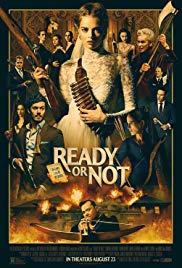
READY OR NOT (2019)

August 21, 2019

 Greetings again from the darkness. Rich people aren’t like you and me (unless you happen to be rich, in which case you fall into the first category). Their houses are different. Their vacations are different. Their family traditions are different. And that’s where this latest from co-directors Matt Bettinelli-Olpin and Tyler Gillet (known collectively with Producer Matt Villella as Radio Silence) really kicks in. Yes, the Le Domas estate is a maze of dark wood, music rooms, and hidden passages, but it’s the wedding day tradition of post nuptial game night that provides the thrills, chills, shocks and laughter for about an hour and a half.

Former foster child Grace (a star-making performance from Samara Weaving, THE BABYSITTER, THREE BILLBOARDS OUTSIDE EBBING MO), is nervous and excited just before her wedding ceremony begins. Her husband to be is Alex Le Domas (Mark O’Brien), the black sheep of an ultra-rich family, and the ceremony is being held within the lush garden and fountain grounds of the Le Domas mansion. Grace loves Alex and seems to have come to grips with his family: alcoholic brother Daniel (Adam Brody) who is always hitting on her, Daniel’s gold-digger wife Charity (Elyse Levesque), father and patriarch Tony (Henry Czerny) who is outspoken in his belief that Grace isn’t good enough for the family, mother and matriarch Becky (Andie MacDowell) who seems confused about her feelings towards Grace, crazy-eyed and wild-haired Aunt Helene (Nicky Guardagni) who seems to hate all living creatures, and coke-head sister Emilie (Melanie Scrofano) who, along with her douche-husband Fitch (Kristian Bruun) couldn’t even get to the ceremony on time.

The above lineup of players is crucial because of what happens next. For wedding day game night, Grace draws the “Hide and Seek” card, rather than the much preferred checkers or Old Maid. There is a nice set up for this tradition which includes a Faustian deal made by Great Grandfather Le Domas. It’s that deal that turns ‘hide and seek’ into ‘hunt and kill’. Oh yeah, Alex forgot to warn Grace about the stakes and it’s a blast to watch her transition as she figures it out. A torn wedding gown and yellow Chucks make up the visual of a bride fighting back against the antique weapons of crossbow, pocket pistol, elephant gun and battle-axe. You got it right – this family tradition is absolutely bonkers … and bloody … and deadly.

As has become the favorite pastime of Hollywood recently, the film torches the ultra-rich. But if you can overlook the political posturings, you’ll find a devilishly fun irreverent farcical zinger that offers some similarities to CLUE and SLEUTH, as well as many other games and movies. It has some of the look of SAW, but with significantly more tongue-in-cheek. In fact, dark comedy thriller might be a proper description, but you’ll likely find yourself laughing more often than jumping in your seat. It’s a wonderfully crafted and paced film that understands exactly what it is … an instant classic Midnight Movie (along with this year’s SATANIC PANIC from director Chelsea Stardust).

Co-writers Guy Busick and Ryan Murphy take full advantage of the ominous setting and the wicked set-up, however, a minor quibble would be that the dialogue could have been a bit wittier. Most of the laughs come courtesy of the moment or the actors, and the banter falls just a little short. The prologue provides a 30 year ago flashback that cautions us for the ride we are about to take, and even offers some insight into the characters as much younger versions of themselves. The opening credit sequence is a beautifully staged and filmed running shot of some classic board games, informing us of the industry closely associated with the Le Domas ‘dominion’.

It must be noted that a studio recently postponed the theatrical release of THE HUNT because of the political backlash to their premise – rich people hunting poor people. While the themes of these two films could be considered similar, only the most extreme hard-liners could view READY OR NOT as anything more than good demented fun. Much of the primary production was filmed on location at the Parkwood Estate in Ontario, and it’s the perfect setting for a family that chooses murder and fortune over all else. Two standouts on the soundtrack include “The Hide and Seek Song” by Headquarters Music and “Love Me Tender” by Stereo Jane (definitely not Elvis). For those who enjoy the twisted comedy approach to in-law jokes and violence, there are plenty of macabre moments that will deliver a smile … till death do us part.

***I’ve elected not to post the trailer here. If this is the type of movie you enjoy, it’s better that you allow the surprises and twists to sneak up on you. If you aren’t a fan of this type of movie, the trailer wouldn’t convince you to see it.


WHERE’D YOU GO BERNADETTE (2019)

August 15, 2019

 Greetings again from the darkness. Has she lost her way or lost her mind? The Bernadette Fox we meet is a misanthrope. She doesn’t much like her life. It’s a life with a loving husband, a workaholic tech genius. It’s a life with a crumbling, once majestic mansion that she is remodeling one spot at a time. It’s a life with a smart daughter who admires her mother. It’s a life that expects participation at a level Bernadette is unwilling to commit. And it’s a life that is not the one she envisioned for herself.

Two time Oscar winner Cate Blanchett plays Bernadette, and as with most of her roles, she embodies the character. It’s a role that more resembles that of her character in BLUE JASMINE than in CAROL. Bernadette is not really a likeable person and she clearly feels out of place in suburbia … yet we find her interesting – in a train wreck kind of way. She’s a bit reclusive and seems to best communicate with Manjula, her virtual assistant in India. The daily dictations come across as therapy as much as directives for such vitals as fishing vests.

Bernadette describes herself as a “creative problem solver with good taste” and as the self-proclaimed “Bitch Goddess of Architecture”. A mid-life crisis is pretty easy to recognize (unless it’s your own). It’s rarely about the person you sleep next to, and often about “finding one’s true self”. This syndrome is especially irksome for a parent, and is actually better described as selfish behavior. Bernadette was a rising star in the Los Angeles world of architecture, and when Microsoft bought her husband Elgie’s (Billy Crudup) software, the couple relocated to Seattle where he could continue his high-tech pursuits. Bernadette stopped designing and focused on being a mother to daughter (and the film’s narrator) Bee (Emma Nelson). In fact, it’s Bee’s request for a family trip to Antarctica that pushes Bernadette to the brink.

The supporting cast is brimming with talent. Kristen Wiig is Audrey, the neighbor and private school mom who manages to push every wrong button for Bernadette. Audrey is a victim of Bernadette’s mean streak in one of the more outrageous scenes in the film. Zoe Chao is Audrey’s friend and Elgie’s new Administrative Assistant. Laurence Fishburne appears as Bernadette’s mentor, and Judy Greer is underutilized in the role of psychologist. Others you’ll recognize include James Urbaniak, Claudia Doumit, and Megan Mullaly. But despite all of that talent, this is Cate Blanchett’s (and Bernadette’s) movie. Is it a powerful performance or an overpowering one?  I’m still not sure.

What is certain is that the Production Design of Bruce Curtis is exceptional. The old mansion is worthy of its own story, and provides a distinct contrast to Audrey’s spit-shined coziness next door. The scenes on the ships at sea are also well done, and Bernadette in the kayak makes for an absolute stunning visual.

Of course the film is based on the 2012 best-selling novel by Maria Semple, and director Richard Linklater co-wrote the script with his ME AND ORSON WELLES collaborators of Holly Gent and Vincent Palmo. We typically discuss how an actor might be miscast, but this time the debate could be in regards to the director. Mr. Linklater is a wonderful director with such diverse films as BOYHOOD (2014), BERNIE (2011), BEFORE SUNRISE (1995) and DAZED AND CONFUSED (1994). He’s a naturalistic story-teller with personalities we recognize. Bernadette looms so larger-than-life, with her grandiose gestures and over-dramatizing every moment that she’s almost cartoonish at times. At times, Linklater seems like everyone else … not sure what to make of Bernadette.

The film differs in many details from the novel, but the spirit remains. This plays like ‘Diary of a Mad-Disgruntled-Unfulfilled Housewife’, and it’s obvious to viewers that Bernadette’s near seclusion is actually her hiding from herself. Ms. Blanchett is a marvelous actress, one of the best of all-time. She is set to play the legendary Lucille Ball in Aaron Sorkin’s planned LUCY & DESI film. Ms. Blanchett commands our attention for Bernadette, whether it’s in the comedy segments or the more philosophical moments. Rarely will you see a film whose Act I and Act III are so tonally opposite. The first part plays like an old-fashioned Howard Hawks comedy, while the last part is Bernadette’s more somber search for artistic expression once she is freed from the constraints of family life. It’s the saddest comedy I can recall.

watch the trailer: