HARRIET (2019)

October 31, 2019

 Greetings again from the darkness. As far as I can tell, there has never before been a feature film profiling Harriet Tubman. Given her remarkable accomplishments and historic standing as an iconic American hero, we should all agree that it’s high time. The film plays as a passion project for writer-director Kasi Lemmons (EVE’S BAYOU, 1997) and her co-writer Gregory Allen Howard (REMEMBER THE TITANS, 2000). Cinematically speaking, it’s a fairly formulaic biopic; however, from a historical perspective, HARRIET is story that was due to be told.

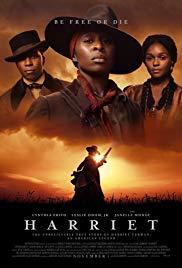
Cynthia Erivo (WIDOWS, BAD TIMES AT THE EL ROYALE) stars as Araminta Ross, known as Minty. She was born into slavery, and the film picks up in 1849 Maryland when she is being sold ‘down south’ by her heartless owner Gideon Brodess (an understated Joe Alwyn, THE FAVOURITE). Rather than be separated from her family, Minty runs (she does a lot of running). She runs until cornered, and then leaps from a bridge into rushing water. It’s only after her treacherous 100 mile walk to Pennsylvania that she becomes a free woman and changes her name to Harriet Tubman – in honor of her mother and husband.

She receives help along the way. Reverend Samuel Green (Vondie Curtis Hall) plays a recurring role in her escape and later rescues. Once in Pennsylvania, she meets abolitionist William Still (Leslie Odom Jr, MURDER ON THE ORIENT EXPRESS, 2017), who runs the Pennsylvania Anti-Slavery Society and introduces her to fellow abolitionist Marie Buchanon (Janelle Monae). Ms. Buchanan is a free black woman, as elegant in her manner as she is dedicated to the cause … and she’s worthy of her own story.

Harriet decides she must go back and rescue her family. She is told the trip is foolish and too risky – which doesn’t stop her from making 13 trips and saving 70 slaves. We learn of her work with the Underground Railroad – not a train, but rather a secretive organization committed to helping slaves escape to freedom. After the Fugitive Slave Act of 1850, Harriet’s work becomes even more difficult, as she must guide the slaves all the way to Canada. Omar J Dorsey plays Bigger Long, an expert slave hunter – yes, that’s an actual occupation – hired by Harriet’s owner to capture her. When Harriet converts Walter the scout (Henry Hunter Hall), the colorful character becomes a valuable ally and strong believer.

As a young girl, Minty/Harriet had her skull cracked by a slave owner whilst standing in the wrong place at the wrong time. After that, she experienced episodes, “spells” that she claimed were visions from God. The film captures quite a few of these and treats Harriet as someone “touched”. Was this the prophecy or was Harriet an extraordinarily resourceful and tenacious woman? The message of God is present throughout, and it’s difficult to not view this as unintentionally taking a chip out of what Harriet accomplished.

Slave owners were baffled by the rescues conducted by this mythic figure they named “Moses”. Of course, they assumed it was a man, and once Harriet’s identity was exposed, her former owner was held accountable by other slave owners. It’s at that point where Gideon Brodess’ mother Eliza makes one of the most cold-hearted, racist speeches we’ve seen on film. Eliza is played by Jennifer Nettles, the singer for C&W band Sugarland. In 1858, Harriet crosses paths with abolitionists John Brown and Frederick Douglas, and delivers an impassioned speech of her own in the presence of Senator William Seward (one of Booth’s targets in the Lincoln assassination). Harriet assisted Brown with recruitment for his raid on Harpers Ferry. In 1863, Harriet led the Comahee River Raid, which resulted in 750 slaves being set free.

The film might be a bit slick, but the acting is top notch, and Harriet’s story is remarkable. Director Lemmons forgoes the brutality of 12 YEARS A SLAVE, and tries to cover Harriet’s time as a slave, her first escape off the bridge, and her continued work freeing other slaves. Harriet went on to become a Civil War spy for the Union, and later a respected elder who worked for women’s voting rights and to make latter life a bit easier for former slaves. It’s possible a movie was not the best format to tell Harriet’s story … a story that continued to develop until her death in 1913 at age 91 (or thereabouts). But it’s important to have her story documented in some way other than the textbooks kids likely won’t read. A film that tackles such a towering historical figure deserves a little slack.

watch the trailer:


BADLAND (2019)

October 31, 2019

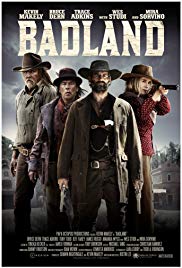
 Greetings again from the darkness. Westerns are always a risky proposition for a filmmaker, but some are drawn to the genre and seem to thrive on the intricacies that fans have come to expect. Justin Lee is one such filmmaker. He wrote and directed this film and follows the familiar tropes: a quiet, proud protagonist; the strong, lonely woman; the corrupt gunslinger – maybe wearing a badge, maybe not; and of course, the battle of good versus evil.

Kevin Makely stars as Matthias Breecher, a Civil War veteran and now Pinkerton detective carrying out the orders of Senator Benjamin Burke (Tony Todd, CANDY MAN, 1992). Senator Burke has pledged to track down war criminals and hold them accountable by administering justice. Breecher is the Senator’s hired hand who travels from town to town, serving warrants and dealing with those who refuse to abide

Mr. Lee’s film is divided into four chapters. Chapter 1, “The General”, finds Breecher face-to-face with tough-talking General Corbin Dandridge (Trace Adkins). It’s here where Breecher first flashes his impressive gun skills, and it’s soon after where he crosses paths with Harlow (recent honorary Oscar recipient Wes Studi), a competitor in the “bounty-hunter” game. Chapter 2, “The Cooke’s” has Breecher tracking down Reginald Cooke (played for all it’s worth by a finger-wagging Bruce Dern), a sickly old man dying slowly from pneumonia and living with his daughter Sarah (Oscar winner Mira Sorvino). Local bad guy Fred Quaid (James Russo) is trying to seize the Cooke’s land (apparently this is the possessive apostrophe in the chapter title). During this segment we get a nasty fist fight, an ugly shootout, and Breecher falling for Sarah and actually shushing his horse. Chapter 3, “The Sheriff”, brings us to the terrifically named town of “Knife’s Edge” where equally terrifically named evil guy Huxley Wainwright (Jeff Fahey) wears a badge and rules the town with a reign of terror, and with Old West waterboarding. There is even a double-tap grave side shootout. It’s an old mining town and the citizens live in fear – especially the good-hearted barkeep Alice (Amanda Wyss). The segment ends with a ‘high noon’ duel in the dusty street.

Chapter 4, “Breecher”, acts as a finale for our hero, a man we are told was “born to violence.” His dreams of owning land may have faded, and soul-searching has him reckoning with the man he’s become. Mr. Makely reminds of actor Anson Mount in his ability to hold a scene, and we can’t help but think that in his younger years, Mr. Fahey could have easily played the Breecher role. Despite the out-of-place linguistic stylings, director Lee proves the lessons of the old west never get old, and it leaves us with the message … ‘Be still, young man.”

watch the trailer:


THE CURRENT WAR: DIRECTOR’S CUT (2019)

October 24, 2019

 Greetings again from the darkness. Electricity. Bringing light and power to the world. Other than dependable food sources and clean water and air, nothing is more vital to our way of life today. However, going back in time only 125 years finds the sun and candlelight as the only forms of illumination. Oh, but behind the doors of laboratories for Thomas Edison and George Westinghouse, skilled engineers were working diligently to discover the breakthrough that would deliver light to the dark world.

Normally the making of a movie is not a story worth telling. The final work should speak for itself. But the story of this film’s road to the screen is not normal. This was the film Harvey Weinstein was working on when his sex abuse scandal broke. Weinstein went ahead with the screening of the film at the 2017 Toronto Film Festival despite pleas from the director that the film was not ready to be shown. Once the scandal hit, director Alfonso Gomez-Rejon (the excellent ME AND EARL AND THE DYING GIRL, 2015) was helpless – he couldn’t access the film for reshoots and final edit. Now, after two years of legal wranglings, he is finally able to present his finished project.

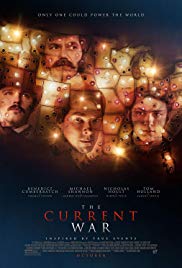
On one hand, it’s a feel good story for the director. On the other hand, the film falls short of being a top notch historical drama … despite it being a real life drama that changed the world. Most would agree there isn’t much entertainment value in watching the daily trial and error of engineers in a lab, so it makes perfect sense that director Gomez-Rejon and writer Michael Mitnick would turn their focus on the personal and professional rivalry between Thomas Edison and George Westinghouse, as well as a portion of the story involving Serbian immigrant Nikola Tesla – perhaps the most brilliant of them all.

Benedict Cumberbatch plays Edison, a true celebrity and renowned inventor. We see how Edison’s family life with wife Mary (Tuppence Middleton) takes a back seat to his work at his Menlo Park lab; a trait that becomes more extreme after a personal tragedy. Michael Shannon plays George Westinghouse, developer of railway air brakes, in a stoic and focused manner, and with a close relationship with his wife Marguerite (Katherine Waterston). Nicholas Hoult portrays Nikola Tesla, he of brilliant mind contrasted with quirky and fastidious ways. The other two key players here are Matthew Macfadyen as JP Morgan, the banker who finances much of the work, and Tom Holland as Samuel Insull, Edison’s loyal assistant.

While difficult to imagine now, the big debate boiled down to what form of electricity was most practical for the masses. Edison believed it was direct current (DC), while Westinghouse and Tesla were all in for alternating current (AC), which they believed to be cheaper and more powerful. Edison, ever the media manipulator, created questions of public safety in regards to AC by pulling dramatic public stunts. An interesting note here is that despite Edison’s pledge to never invent military weapons or anything designed to take a life, it was his work that led to the use of the electric chair as a replacement for hangings in death penalty cases.

This rivalry between two titans of industry never seems to click, and sadly, Tesla’s story comes across as an add-on to the movie – though his work is worthy of its own movie. Westinghouse deals with his Civil War flashbacks, and Edison’s coarse nature is dulled somewhat here in an effort to make him a bit more appealing as a character. The 1893 Chicago World’s Fair provides the “finish line” for this competition, with the winner lighting up the Fair and setting the stage for the rest of the country. There are flickers of a great movie here, and the performances reach the expected levels for such a strong cast, but overall the movie comes across a bit disjointed and trying much too hard to be regarded as a prestigious film.

watch the trailer:


MAKING WAVES: THE ART OF CINEMATIC SOUND (doc, 2019)

October 24, 2019

 Greetings again from the darkness. Did you hear that? While watching a movie, you are likely aware of explosions and spoken dialogue, but it’s quite astounding how many other sounds can make up a movie-watching experience. While it’s true that we think of movies as a visual medium, it’s not a complete description. Oscar winning director Steven Spielberg said, “Our ears lead our eyes to where the story lives.”

Midge Costin was a noted Sound Editor from 1986 through 1998 on such films as CRIMSON TIDE, CON AIR, and ARMAGEDDON. She then transitioned to education and has spent 20 years at the renowned USC Film School, holding the Kay Rose endowed chair in the Art of Dialogue and Sound Editing. She is truly a sound expert, and in this, her directorial debut, she beautifully lays out the art form of sound that takes place within the art form of cinema.

Ms. Costin structures the film with an historical timeline, personal profiles of some of the most important figures in sound, and a breakdown of sound segments and technology. Along the way she includes film clips to provide specific examples, and interviews for industry insight. The film takes us back to 1877 and Edison’s phonograph, and on to 1927 when THE JAZZ SINGER delivered Al Jolson’s voice. 1933’s KING KONG mesmerized with the first true sound effects, and we learn the direct connection between movie sound and radio. We really get the inside scoop on the breakthroughs of American Zoetrope (founded by Francis Ford Coppola and George Lucas), and the importance of Barbra Sreisand’s demands for A STAR IS BORN (1976), Robert Altman’s multi-track NASHVILLE, and the “Wookie” sounds of STAR WARS. Of course, many other films and filmmakers (including Stanley Kubrick) are singled out for moving sound forward.

Some of the most interesting data comes courtesy of the “nerds” known as Sound Designers. Walter Murch (APOCALYPSE NOW), Ben Burtt (STAR WARS), Gary Rydstrom (JURASSIC PARK), and Lora Hirschberg (INCEPTION) are all Oscar winners, and their insight is fascinating along with that of Cece Hall, Bobby Banks, and Anna Behlmer – the latter of whom recounts her experience as a woman doing the fighter jet sounds for TOP GUN.

Cinema sound is divided into Music, sound effects, and voice, with each of these sections have sub-categories. Automated Dialogue Replacement (ADR), digital layers (through Pixar), ambience, and the custom effects of the Foley are all parts of the circle of talent delivering puzzle pieces to the Sound Mixer for assembly. If all of this hits you as a bit too technical, you should know that it’s presented in a manner that makes it easy to follow. Sound is what pushes cinema into an immersive experience for viewers, and you’ll likely walk away from Ms. Costin’s film with an appreciation of just how many elements go into what you hear during a movie – and that’s worth listening to.

watch the trailer:


OBJECTOR (doc, 2019)

October 24, 2019

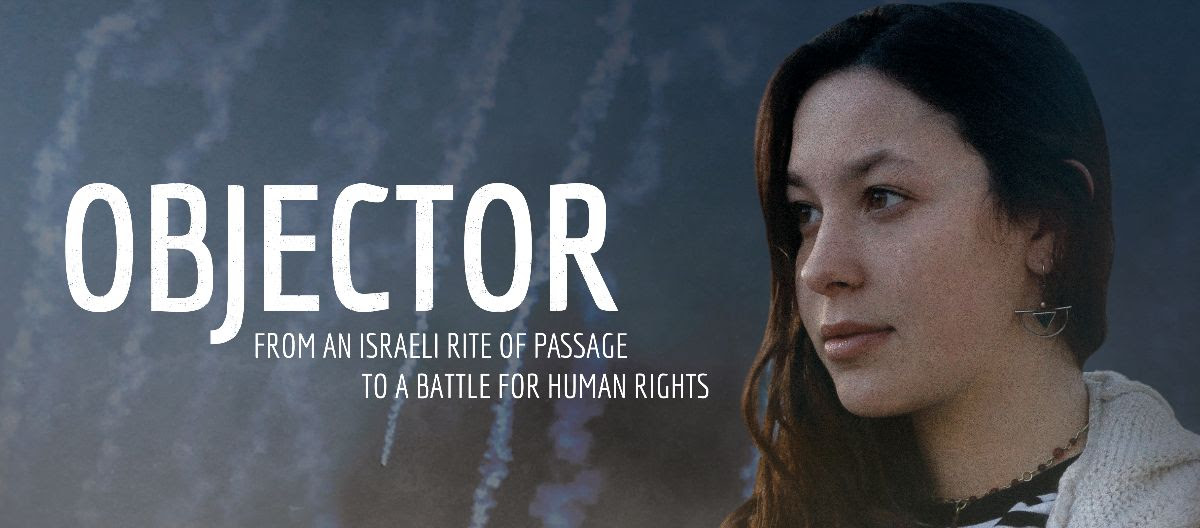
 Greetings again from the darkness. Decision time is 6 months away. That’s the scheduled day of Conscription for Atalya Ben-Abba, a 19 year old Israeli woman. On that day, she either accepts her mandatory Army assignment or subjects herself to a sentence in military prison. Filmmaker Molly Stuart expands her 2017 short film, and follows Atalya as she educates herself on just what is at stake.

Civil disobedience, conscientious objector, and traitor … all of these labels can apply, and only Atalya can make the final decision about what direction her life goes. By tagging along, we gain a perspective of the Israeli-Palestinian conflict through fresh eyes. It’s a very personal journey for Atalya. At times we feel that perhaps we are a bit too close, and maybe the camera is influencing the actions of those being filmed.

We have a seat at the family dinner table as Atalya debates the issue with her mother, father and brother. Her brother Amitai secured a military exemption, but both of her parents served, as did her Uncle, who states non-violence is for the weak. Her Grandfather and most everyone they know view the military as a civic duty not to be questioned. Her grandfather attempts to shame her by calling her an “optimist”, and labeling her ideas as “stupid”. It’s the most obvious sign of a society that has stopped questioning, and simply accepts its lot. Her family does question whether she knows enough to make this decision.

The film is at its best when Atalya is having conversations on the topic, and she is working through how best to articulate her views on this conflict and tradition she was born in to. At times, she comes across as a typical teenager, too young to be weighted down with this decision; while at other times, she is a deep thinker making up her own mind and reinforcing her beliefs and convictions.

Avoiding social shame and prison would be the easy choice, but of course Atalya refuses service in the IDF (Israel Defense Forces), serves 110 days in prison, and is denied status by the Conscience Committee. Her close bond with her brother and family is further strengthened as she transitions into a public figure – her very public stand leading to notoriety and a call-to-action speech in a town square near the film’s conclusion. Atalya’s main questions seem to all start with “why?” and most of the answers seem to be a twist on ‘because that’s how we’ve always done it.’ Every society needs citizens like Atalya who question the way things are done, and expect an answer as to why those things are being done. Ms. Stuart’s film will surely have you digging a bit deeper in your own thoughts.

watch the trailer:


MOUNTAINTOP (doc, 2019)

October 24, 2019

 Greetings again from the darkness. A trip to the Rocky Mountains in Colorado takes us more than 1.5 miles above sea level (8750 ft) to the Studio in the Clouds. It’s here where Neil Young and the band Crazy Horse have gathered to record yet another album in what has been a 50 year (off-and-on) musical relationship. It’s a rare opportunity to watch a band work out the finer points of their songs while in the studio.

Between deep hits from their oxygen tanks, these four musicians and producer John Hanlon deal with multiple takes, re-writes, and technical glitches. Sometimes the mood is quite tense, and other times quite laid back. Mr. Hanlon is suffering from a case of poison oak at the time of recording, making for a stressful environment when Neil Young scolds him for too much feedback, or not enough volume, or some other irritant that is likely related to as much to the artist’s general frustration with creating as it is to the antiquated wiring of the studio.

In addition to the expected guitar, piano, bass, and drums, an impressive array of instruments are utilized. Also in play here are: a pump organ, harpsichord, glass harmonica (very cool), and a xylophone. We even get to see Nils Lofgren tap dancing! Many will recognize Nils as a long-time member of Bruce Springsteen’s The E Street Band. Lofgren’s ability to keep Crazy Horse in step with Neil Young is underplayed here, yet still quite obvious.

“It doesn’t have to be good. It’s going to be great.” This is a line uttered as the band hears the playback on a particular song. It drives home the importance musicians put on performing, and perfectly complements what we see from Neil Young – love and commitment to the music. He’s still the amazing songwriter and rebel who wrote “Ohio” in a just a few minutes after seeing the photos from the Kent State tragedy in 1970. This current album proves his songs of societal awareness are not a fad, but rather a belief system.

The documentary is “In memory of Elliot Roberts, the greatest manager of all-time.” Mr. Roberts died in June of this year, and in addition to being Neil Young’s long-time manager, he also managed the careers of Joni Mitchell, Tom Petty, and The Cars. A driving force behind the music phenomenon from Laurel Canyon in the 1960’s and 70’s, Mr. Roberts was a very popular and talented figure in the music industry. Although the vast majority of the film takes place inside the studio, we do get a few clips from Neil Young performing songs live, and periodic shots outside – mountains, sky, and clouds. With this being billed as ‘a film by Bernard Shakey and DH LoveLife, it should be no surprise that the real folks behind those names are Neil Young and his long-time partner, actress Darryl Hannah. The film may not be an extraordinary work of art itself, but it’s very interesting to see one of the most successful and dedicated musicians of the past 50 years hard at work, doing what he does.

watch the trailer:


#NOJOKE (doc, 2019)

October 24, 2019

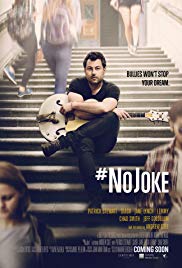
 Greetings again from the darkness. Bullying generates insecurity, hatred, and fear. The definition of bullying can range from calling someone a derogatory name, verbally abusing them, physically intimidating them, or causing actual physical pain. It’s an abuse of power that can happen at any age and in any environment. Los Angeles-based Canadian musician Andrew Cole set out a few years ago to create an all-star anti-bullying song … something similar to what “We are the World” did for the starving people in Africa in 1985.

Mr. Cole spends much of the film’s run time on camera, and he explains his motivation for starting the project. He attended approximately 20 schools and was often the “weird” kid or “newbie”, and he believes that made him an easy target. Part of his project involves trying to track down Paul Blades, a particularly evil bully he recalls. Cole also explains how his own Dad could flip a switch from being a great guy to a terrifying presence. He refers to these memories as scar tissue. It’s at this point when we begin to question whether Cole’s project is for the greater good, or simply for his own therapy.

Some time is spent on his efforts to convince celebrities and famous musicians to jump on board. Mr. Cole mostly seems to be winging it during the early phases, almost like he expects people to jump at the chance to work with an unknown musician with no foundation or charity backing him. Cole even goes so far as to label this as a form of bullying … celebs using their power to shut down the little guy with a dream. Doors do begin to open, once Jeff Goldblum agrees to play piano on the song.

Documentarian Manfred Becker is charged with turning years of footage into something coherent for viewers. Unfortunately, rather than focusing on the topic, there are segments included that appear to be there for no reason other than Cole’s ego. Specifically, a stunt at the front gate of Chateau Marmont and a ride-along with the paparazzi as they chase Harrison Ford down the street. The big news is apparently that Harrison Ford is caught texting while driving. The film is at its best when Cole is not talking, but rather letting others have their say. Watching Jane Lynch, Patrick Stewart and Michael Biehn admit to having been bullies in their younger years is powerful. Visiting Columbine High School and “the world’s worst parent”, Lenore Skenazy, is fascinating and insightful.

We are informed that 50% of youth suicides are related to bullying. Of course bullying has been a topic for generations, and it’s a topic that needs to remain in the forefront. Unfortunately, having a great idea, a great cause, or even a great song doesn’t ensure a great documentary. More research into the mentioned connection between bullying-hate crime- genocide could have elevated this look at the complex issue of the psychology of bullying. “Hurt people hurt people” (spoken by Russell Simmons) provides more insight than clips of Slash strumming a guitar. Hate, guilt, and forgiveness all play a role here and deserve more than a quick mention. Hopefully the film and Cole’s song, “Do You Think I’m a Joke?” can make a difference for the Center for Abuse Awareness.

watch the trailer:


THE LIGHTHOUSE (2019)

October 17, 2019

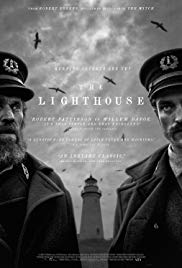
 Greetings again from the darkness. The opening sequence plays like something from 1920’s era cinema. The chug-chug-chug of a boat slamming against the waves of an angry sea while birds flap and chirp alongside. We hear the wind and “feel” the severe ocean spray. Several minutes elapse before any word is spoken. Immediately noticeable is the nearly square aspect ratio … the rarely (these days) seen 1.19:1 frame, making the black and white images appear both surreal and ominous.

All of the above makes perfect sense when we realize this is writer-director Robert Eggers’ first feature film since his 2015 indie horror gem THE WITCH won dozens of festival awards. Mr. Eggers obviously has his own vision for projects, and his approach borders on experimental, eschewing conventional. He co-wrote this script with his brother Max, and evidently much was drawn from the actual journals of lighthouse keepers … something that is evident in the vocabulary and the effects of solitude.

4-time Oscar nominee Willem Dafoe stars alongside Robert Pattinson as the two men charged with a 4 week assignment of tending to a lighthouse. The film is set in 1890, and Dafoe plays Thomas Wake, the epitome of a salty old sea dog, replete with bad leg, hardcore Atlantic accent, and upside down pipe. Pattinson is Ephraim Winslow, the assistant Wickie, who faces non-stop demands from Wake, and initially maintains a quietness as he goes about his duties … what Wake calls the ‘doldrums.’ We learn little about either man’s past. For Wake, other than knowing his previous assistant went mad, the clue is when he mentions “13 Christmases spent at sea” costing him a family. For Ephraim, when Wake asks, “Tell me what’s a timberman want with being a Wickie?” we get some insight into Ephraim’s desired future.

Eggers has delivered the anti-buddy movie. It’s a bleak, slow-motion race to insanity caused by being isolated with only one other person … a person you aren’t fond of. Only this is not a director or a film content with showing two men stuck on a storm-battered rock, as they slip towards insanity. No, we viewers are forced to experience some of these same feelings – how much of what we see is actually happening? It’s mesmerizing and hypnotic, and the above-mentioned narrow screen aspect purposefully emphasizes the sense of confinement and claustrophobia.

With no color and only a couple of characters … OK, 3 if you count the mermaid …OK, 4 if you count the seagull … the film still manages to pound us with sensory overload. We can barely process all we are seeing, despite relatively minimal ‘typical’ action. The black and white images are mostly just various shades of gray, and sunshine is non-existent.  Cinematographer Jarin Blaschke (THE WITCH) embraces the dreariness by allowing the fog, lanterns, candles, wind, rain, and harsh elements to become characters unto themselves. However, nothing is in sync with our two leads. Composer Mark Korven fills the many lapses in dialogue with sounds and tones we haven’t heard before, yet they fit perfectly here. This is also quite likely the first film to utilize farts and foghorns in harmony.

Director Eggers filmed this on Cape Forchu in Nova Scotia, and the extreme weather and less-than-welcoming terrain create quite the visuals – as do the faces of our two lead actors. Dafoe may never have chewed scenery so delightfully as he does here, and Pattinson starts slowly before delivering his best work – including a ferocious rant that is fascinating to watch and contrast to his character’s first meal with Dafoe. Is this a horror film? A fantasy? Macabre comedy? There is simply no way to describe this other than bizarre. It’s truly miserable cinema, and I loved every minute of it.

watch the trailer:


PAIN & GLORY (2019)

October 17, 2019

 Greetings again from the darkness. This marks the 13th Pedro Almodovar movie I’ve seen over the last 33 years. There is no logical explanation for why I feel connected to his movies. It seems obvious I have very little in common with the provocative filmmaker from Spain who won an Oscar for his extraordinary 2002 film HABLA CON ELLA (TALK TO HER). Yet, his movies invariably strike an emotional chord with me – and none more so than his latest.

As with many of his previous films (and more than most), this one has a strong semi-autobiographical feel to it. Antonio Banderas stars as aging filmmaker Salvador Mallo. No other actor could have been cast in the role. This is, by my count, the eighth collaboration between actor and director … no actor has a better feel for Almodovar over the past three decades. It must be noted that Banderas does not stoop to impersonation or mimicry. OK, he has similar spiked hair, beard, fancy clothes and a museum-quality house … but the performance is all Banderas, and it’s a thing of beauty. Salvador is an aged man who looks defeated despite numerous career achievements. His physical pains are many – chronic back pain, migraines, sporadic choking – but it’s his emotional isolation and solitude that stands out. Salvador is a lonely man with signs of depression.

The film bounces between two time periods: Salvador as an older man with the above listed struggles, and young Salvador (Asier Flores) growing up in poverty with his mother Jacinta (Penelope Cruz) and dreaming of a better life. The elder Salvador is reflecting on the life journey that brought him to this point, while the younger Salvador is filled with youthful hope for the future, even as his core being is taking shape.

Cinemateque has remastered Salvador’s first big movie “Sabor” and have invited him to attend the screening and participate in the Q&A. He sees this as a chance to re-connect with the film’s star (and his long ago friend) Alberto Crespo (played by Asier Etxeandia). The two haven’t spoken in over 30 years due to bad blood and artistic differences during the filming of “Sabor”. Now understanding Alberto’s approach to the role, Salvador is told by an actress that ‘the movie hasn’t changed, but the eyes you see it through have’. Salvador visits Alberto and soon the actor is sharing his heroin stash with his director. Salvador continues “chasing the dragon” as a form of relief from his physical pain, and as an escape from his solitude. It seems to work much better than his cocktail of prescription drugs.

Rather than a film of drug addiction, this is a film of reflection. Fellini’s 81/2 (1963) is surely the most famous and iconic of the autobiographical films by a director, and though Fellini may have the advantage of esoteric artistry, Almodovar’s signature style is ever-present through primary colors (especially red) and memorable sets. Deserving of special mention are frequent Almodovar collaborators Antxion Gomez (Production Design), Maria Clara Notari (Art Direction), Paola Torres (Costume Design), and cinematographer Jose Luis Alcaine. The music is provided by 3-time Oscar nominee Alberto Iglesias.

There are some intimate and touching scenes in the film, as well as a couple of lines of dialogue that hit pretty hard. Circumstances are such that Salvador reunites with Federico (Leonardo Sbaraglia), the love of his life. It’s a tender reunion that lasts only a short time, but allows for needed closure for both men. There is also a sequence where Salvador is having a heartfelt and intimate conversation with his elderly mother (Julieta Serrano). She tells him he was not a good son. This conversation between adult son and mother is an example of things that should be said, but rarely are. Ms. Serrano previously played Mr. Banderas’ mother in WOMEN ON THE VERGE OF A NERVOUS BREAKDOWN and MATADOR.

Almodovar’s movie premiered at Cannes, and it examines our expectations for life and how they contrast to our later recollections. The two timelines show one looking forward as the stage is set, and the other looking back at both the good times and bad. For an artist, it’s the life that molds their influences for their art/craft. Salvador’s memories even play like short movies. There may be no real plot to the film, and instead it focuses on reflection, introspection and perspective. “Love can’t cure the ones we love” is a gut-punch of a line, and one that can’t be comprehended until late in life. For an Almodovar film, this one is restrained and tempered – even tender at times. And yet despite this, it will stick with me for awhile.

watch the trailer:


SERENDIPITY (2019)

October 17, 2019

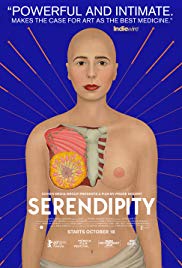
 Greetings again from the darkness. 31 years old. It’s an age that can feel old while in fact, it’s so young. Certainly too young for a diagnosis of breast cancer – not that there is ever a right age for such news. New York City-based French artist Prune Nourry was 31 when she was hit with the breast cancer diagnosis, and she turned her journey into a book, published in 2017, and subsequently this blend of art film and personal video journal.

The film opens with the camera on a hospital gurney as it is wheeled through various hallways and into examination rooms. It’s Ms. Nourry’s way of having us join her on her trip through the medical maze. One of the unique aspects of the film is how she connects her current situation to some of her past works. When she learns that she must freeze her eggs for future use before her chemotherapy sessions begin, she ties that into her 2009 art project entitled “The Procreation Dinner”, where the steps of In vitro fertilization are presented in food form … through birth and finishing with a flan breast feeding dessert. It’s at this time where she shows us her eggs magnified under the microscope lens. We now better understand the artist and her way of dealing.

With a mastectomy as first step, Ms. Nourry meets up with Oscar nominated French director Agnes Varda (FACES PLACES, 2017). Ms. Varda passed away earlier this year, but here she assists Ms. Nourry with cutting off 15-18 inches of her beautiful and braided hair so that it can be donated prior to her chemo. The film takes us through the treatment process, which includes the psychological impact of having one’s body altered so drastically. Is the challenge more physical or mental? We can only know that each person reacts in their own way.

Known as a sculptor, much of Ms. Nourry’s work can be considered performance, or even participatory. With work often related to the female body and female rights, other pieces of her work included here are “Sperm Bank” (2011), “Holy Daughters” (2010-11), “Holy River” (2011-12), “Imbalance” (2014, also a short film), “Terra Cotta Daughters” (to be unearthed in 2030), and “The Amazon” (2018).

Executive Producers of the film include Angelina Jolie and Darren Aronofsky, and while shaving her own head, Prune Nourry shares her philosophy of life that “everything is connected.” With the film documenting much of her art work, she emphasizes that this life philosophy focuses on Health, Life, and Art … just like her film.

watch the trailer: