Greetings again from the darkness. You are to be excused for not taking seriously any person, club, organization, or religion that chooses to be identified by wearing colanders (pasta strainers) on their head. After all, many municipalities and courts of law would and have agreed with you. Still, writer-director Michael Arthur takes a direct approach in presenting the Pastafarians, and many will be on board with some of the points made.
Bobby Henderson founded the “ancient but forgotten religion” in 2005 to oppose the teaching of creationism and intelligent design in schools, and claimed Pastafarianism as a real religion, “as much as any other.” The intent was to keep religion out of government-financed schools. While many will agree with the philosophy, it is difficult to gain credibility when one’s deity is an invisible ‘flying spaghetti monster’ and your leader defends the religion as legitimate by showing up in court wearing a colander on his head.
Mr. Arthur takes us through The Netherlands, Germany, Austria, Russia, and Costa Rica as he explores the followers and the factions. We meet Bruder Spaghettus, who claims humans and Pastafarianism are descended from pirates, and he attributes the increase in global warming to a decrease in the number of pirates. Many religions have had “splits”, and this one is no different in that regard. What is different here is that Bruder’s Pastafari followers wear pirate garb instead of colanders. Only you can decide if that’s an improvement. Is this a real religion, a fake religion or a parody of religion? Director Arthur interviews followers, as well as academic scholars in search of the truth.
Reading between the lines, it appears likely that the religion was started as a lark, but has evolved into a somewhat loose organization with a philosophy of opposition to “traditional” religions being given more power, respect, advantages, and influence than should be the case. There is no real evidence to support claims that Pastafari (a play on words from Rastafari, the Jamaican Abrahamic religion) is the ‘fastest growing religion’ or has ‘millions of believers.’ Is it possible to take a serious look at a ridiculous topic? What Mr. Arthur finds is that it seems legitimate to question the manner in which “real” religions are treated with privilege. The film doesn’t feature founder Bobby Henderson, which seems odd, and it skims the surface more for entertainment than enlightenment. And what I have to say to that is … R’amen, brother.
Greetings again from the darkness. You know what it’s like when people start talking about some great new restaurant that just opened (think back to pre-pandemic)? And then you start to hear your friends and co-workers raving about it … best ‘steamed broccoli’ (ok, insert your favorite entrée) I’ve ever tasted! Having been burned many times with high expectations, you remain skeptical, but make the reservation. Well, that’s been me with “Hamilton.” For almost 5 years, the hype was just too much. Surely folks were caught up in the frenzy, and peer pressure was such that no one would admit it wasn’t all that. So, now I’m here … throwing myself at the mercy of the Theater Gods. Thanks to Disney Plus, I only needed to invest a little (ok, a lot) of time, rather than a few hundred dollars for a ticket. This is me humbly admitting I was wrong. The show is fantastic, and I only wish my first viewing had been a live performance.
Unfortunately (because of what I mentioned above) this can’t be a comparison of a live stage performance and the film version. Instead, this will briefly outline what I noticed in the movie. First, and I believe this is key, the original stage director Thomas Kail is back to direct the film. It should be noted that the film version is a blend of a couple of recorded live shows, plus some recorded songs seamlessly edited in. This is the original cast doing what they do best, and the edits are imperceptible. Second, the main cast is filled with dynamic performers. In many stage shows, one or two actors are head and shoulders above the others. Not so here. At a minimum the top seven actors are as skilled and fun to watch as any you’ve seen. Third, this is a true musical in that the songs drive the story. Some of the early songs require serious concentration to catch the lines, but even if you miss some lyrics, the gist of what’s happening is pretty clear. These aren’t so much catchy sing-along types, but you’ll easily recall the scenes when you hear the songs again at a later date. We see a perfect melding of music-performance-story.
Of course most everyone knows that Lin-Manuel Miranda is the creative force behind the show. He credits writer Ron Chernow’s book on Alexander Hamilton as the inspiration for the production, but it’s Mr. Miranda that appeared on every talk show for a couple of years, and he also performs as Alexander Hamilton. Daveed Diggs has dual roles as the flamboyant Marquis de Lafayette and the equally flamboyant (at least here) Thomas Jefferson. Renee Elise Goldsberry takes over the stage with her powerful voice as Angelica Schuyler, and Chris Jackson is a dominating physical presence as George Washington. Jonathan Groff (from “Mindhunter”) is absolutely hysterical and unforgettable as King George III, both through song and strut. Everyone will have their favorite performers, and truly they are all exceptional, and I’d like to point out the two that took my breath away. Phillipa Soo as Eliza Hamilton has a pristine voice that will bring tears to many eyes. She may not be as involved with the political elements of the story, but in the most emotional moments, she is front and center. Lastly, the passion Leslie Odom Jr brings to his role as Adam Burr is beyond description. He may be the “villain”, but he makes Burr accessible and easy to understand … plus Odom is a terrific singer and performer, and he lights up the stage.
It’s easy to overlook the dance and stage choreography since it’s never over-the-top, but the dancers are terrific and the performers make great use of the single set – although props are regularly brought in and taken away. Perhaps what really makes this click as movie entertainment is the expert use of cameras and editing. We see the full stage when we should, and we are offered close-ups when it’s most effective. I do hope to catch the live show at some point, but if my Hamilton experience is limited to this cinematic version, well … “that would be enough.”
Greetings again from the darkness. Director Rod Lurie’s latest is not only based on a remarkable true story, it uses the real American soldier’s names (and some real soldiers) and depicts the valiant efforts of those who were part of the Battle of Kamdesh in Afghanistan on October 3, 2009. Mr. Lurie (THE CONTENDER, 2000) is a West Point graduate and Army veteran, and the film is based on the book by CNN correspondent Jake Tapper, with a screenplay from Eric Johnson and Paul Tamasy.
We first meet the new arrivals on their helicopter transport under the cover of darkness. They have been assigned to this combat outpost known as “Camp Custer.” The nickname comes from the assumption that everyone there is going to die. Why is that? Well for some reason, this military outpost is positioned so as to be surrounded by the foothills of a mountain range – creating a natural shooting gallery of which the soldiers are sitting ducks. It’s one of the most vulnerable military outposts ever created, and with it comes so many Taliban attacks that the soldiers can’t even take seriously their local scout’s constant warnings, “The Taliban are coming!”
There are 53 soldiers assigned to the camp, and the aura of impending doom hovers non-stop. To compensate, joking around and playing sports are utilized to pass the time between attacks. The men even debate whether calling home is a good thing or not. One of the bunk beds has “It doesn’t get better” carved into the frame – that’s a taste of the kind of inspiration floating around. “Thank you for your service” is pure parody amongst these soldiers, and it’s easy to understand, given the tension they must feel – we are nervous merely watching from the safety of an armchair.
The performances are solid and you’ll recognize a few. Orlando Bloom is Lieutenant Keating, Scott Eastwood is Sergeant Cline Romesha, and Caleb Landry Jones is a standout as Carter, the ex-Marine outcast who is more complex than initial impressions lead us to believe. On an unusual note, the list of “relateds” is quite impressive: Eastwood is of course the son of Clint, Milo Gibson is the son of Mel, James Jagger is the son of Mick, Will Attenborough is the grandson of Sir Richard Attenborough, and Scott Alda Coffey is the grandson of Alan Alda.
Director Lurie divides the film into chapters associated with officers, but the segment that most every viewer will find riveting is the near-40 minute attack on the outpost by hundreds of Taliban gunmen. It’s relentless battle action at a level rarely seen in movies, and we feel like we are in the middle of it. This onslaught feels like hopelessness, followed by desperation, followed by survival mode. Never does it feel like an outright victory, but more a relief for those who survive. Cinematographer Lorenzo Senatore makes this a visceral experience – one we won’t forget.
Very little politics come into play here. Instead this is about the men in the line of fire – their courage – and their desperate attempts to live and hold the outpost. All of which is followed by a haunting breakdown that stuns. This battle resulted in 8 dead and 27 injured American soldiers, followed by many medals, including two Medal of Honors. The closing credits honor those killed in action, and we see photos of the actual soldiers next to the actor who played them.
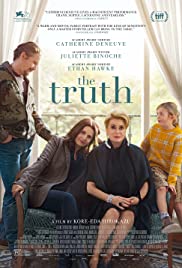
Greetings again from the darkness. Surely every movie lover will savor the chance to watch two of France’s screen titans go at each other as combative mother and daughter. Catherine Deneuve and Juliette Binoche don’t disappoint in this latest from writer-director Hirokazu Koreeda, who was previously Oscar nominated for SHOPLIFTERS (2018).
Ms. Deneuve stars as Fabienne Dangeville, an aging French Oscar winning actress who has recently published her memoir. To celebrate the book, her daughter Lumir (Ms. Binoche) is coming with her family for a visit. Husband Hank (Ethan Hawke) is a self-admitted second rate actor, and their daughter Charlotte (newcomer Clementine Grenier) is awfully cute and meeting her grandmother for the first time. Lumir is a scriptwriter, and harbors less-than-favorable childhood memories of dear old mom.
The personalities of mother and daughter are pretty easy to ascertain. Fabienne admits “I’d rather be a bad mother, a bad friend, and a good actress.” She’s a petty and sometimes nasty woman, who’s quite self-aware. Lumir is the type that has critiqued her mother’s memoir with post-it notes throughout, and calls her out on the false claims of being a doting mother. Most of the movie deals with memories, honesty, and family relationships. It’s not just Lumir who is bothered by book. Fabienne’s long time handler Luc (French screen veteran Alain Libolt) reacts strongly to being omitted entirely, as if he never existed.
Fabienne waves off the criticisms by claiming she’s an actress, so the naked truth is not expected … whereas interesting stories are. The film opens with Fabienne being interviewed by a journalist (Laurent Capelutto, “Black Spot”), and between this interview and what we learn of the memoir, we can’t help but chuckle at some of the real life similarities. First, Ms. Deneuve’s real middle name is Fabienne, and there are teases of her multiple lovers and “almost” movie with Alfred Hitchcock.
A large portion of the film is spent on the film-within-the-film that Fabienne is working on. It’s a science-fiction film (from a short story written by Ken Liu) that focuses on an unusual and difficult mother-daughter relationship. Lumir spots the obvious symmetry, but we are never really sure if Fabienne does, as she’s so busy firing barbs at the lead actress played by rising star Manon Lenoir (the first feature for Manon Clavel). For the elder Fabienne, acting has always been about being a star, so she struggles seeing the younger actress take a role she herself would have embodied 50 years prior.
Other supporting work comes from Christian Crahay as Jacques, Fabienne’s live-in cook (and more); Roger Van Hool as Pierre (man, not turtle) as Lumir’s father who is listed as deceased in the book; and Ludivine Sagnier (SWIMMING POOL, 2003) who plays a younger version of Fabienne’s character in the film-within-the-film. One key character we never actually see is Sarah, a deceased woman who was a friend and fellow actress to Fabienne, and a kind of surrogate mother to Lumir when she was a young girl. Sarah’s memory still hovers over the lives of Fabienne and Lumir, and may be at the heart of any possible reconciliation. Koreeda is a terrific director, and watching the performances here is quite entertaining. We do have the feeling that the script could have gone deeper emotionally had it not attempted to tackle so much. Additionally, many scenes felt like they were begging for more biting comedy than what was there. This is mostly played straight, which leaves Ms. Deneuve and Ms. Binoche to carry the load – a burden they handle quite capably.
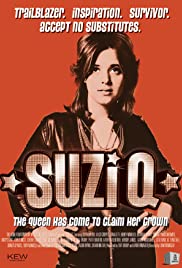
Greetings again from the darkness. “Home is where the heart is.” That’s a two thousand year old phrase whose sentiment has multiple interpretations. It’s the phrase that came to mind while watching Liam Firmager’s profile of Suzi Quatro, the pioneering female Rock ‘n Roller. She started as a middle-class Detroit girl who went on to have a huge international career, though her music never really clicked with the U.S. audience. The emotions from and towards her family are even more complicated.
Playing a bass guitar that made her look even smaller than her diminutive 5 foot frame, Quatro was quite the stage presence in her leather jump suits (inspired by Jane Fonda’s character in BARBARELLA) and constant motion. Kathy Valentine of The Go-Go’s admitted that she had never even thought about women playing instruments in a rock band until she saw Suzi. Most of the interviews here have a similar thread: Suzi Quatro was a main influence for such female rockers as Cherie Currie and Lita Ford of The Runaways, KT Tunstall, Debbie Harry, Tina Weymouth of The Talking Heads, and of course, Joan Jett. We hear from each of these musicians as they pay tribute to their trailblazer. When Suzi is described as “the quintessential rock ‘n roll chick”, it’s obviously a term of respect.
The film has a bit of a disjointed structure and uneven flow, but that doesn’t diminish the message. Suzi Quatro was a daring ground-breaker. We get some of the backstory regarding her family, as she credits her mother for instilling Catholic morals, and her dad for passing along his performing gene. But it’s the sisters who provide the most insight. These are the type of sisters who didn’t tell Suzi about an offer from renowned music producer Mickie Most, because they didn’t want her to quit their band and have success without them. It’s these same sisters who, almost 50 years later, refuse to give Suzi the respect she so craves.
Alice Cooper speaks to her influence, and Henry Winkler recalls her time as Leather Tuscadero, a recurring character on “Happy Days.” We also hear from Len Tuckey, Suzi’s guitarist and first husband, who offers insight to the band and the person. There is also a segment (with a clip) on her success in the stage musical “Annie Get Your Gun”, and, on a personal note, we learn Suzi is the aunt to actress Sherilynn Fenn (“Twin Peaks”).
Suzi Quatro has sold over 55 million records in her career … and she still plays live gigs today (well at least prior to the pandemic). The driving ambition that motivated her to pursue her dream is still there, although she admits “most girls gave up music to have a life.” We see her in 1973 and in 2019. The leather and the energy are still present, as is the mystery of why she was so much more popular internationally than in her home country. The film touches on the male-oriented business and the sexism that occurred. There is footage of a stunning moment on a British talk show where the host actually slapped her on her leather-clad derriere. Imagine that moment today! Was Suzi Quatro ahead of her time, or did she come along at just the right moment? Either way, the professional success contrasted with the unresolved family issues, make this more than a standard rock bio. It’s a history lesson with a moral to the story.
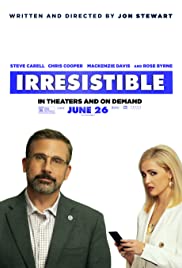
Greetings again from the darkness. For the fifteen plus years Jon Stewart hosted “The Daily Show”, he could be depended on to bring his acerbic wit and often scathing political commentary to virtually every show. His most devoted followers leaned left, though he was known to take down extremists on both ends. Stewart’s foray into filmmaking as writer-director was ROSEWATER (2014), a look at the detainment and interrogation of journalist Maziar Bahari in an Iranian prison. This follow-up takes a much lighter approach – one similar to his TV days – while still managing to skewer our election system and campaign financing.
Steve Carell spent a brief time as a reporter/correspondent on “The Daily Show” before heading off to mega-stardom in movies and on TV. Here he plays Gary Zimmer, a political strategist for the Democratic Party. The film opens on the 2016 Presidential campaign between Donald Trump and Hillary Clinton, and we first see Zimmer in a whirlwind media battle of words against his nemesis, Faith Brewster (played by a funny but underutilized Rose Byrne), a strategist for the Republicans. As you might imagine, Zimmer is a funk after the election, and his career is in shambles.
A ray of hope and inspiration enters Zimmer’s life in the form of a viral YouTube video. Wisconsin farmer and former Marine Jack Hastings (the great Chris Cooper) is recorded tearing into the Deerlaken Mayor and City Council. Zimmer recognizes the Patriotism and a potential Party savior, and seizes on the opportunity to convince Hastings that the Democrats stand for the same things he stands for … those things he rattled off in the video.
Zimmer in Deerlaken is the proverbial fish-out-of-water, and his trip is farmed for laughs. It starts in the local German beer hall and carries forward to Hastings’ farm where Zimmer spots daughter Diana Hastings (Mackenzie Davis) up to her elbow in cow. The other locals we get to know include Will Sasso and Will McLaughlin as Big Mike and Little Mike, CJ Wilson as the accommodating barkeep, Blair Sams as the eager baker, and Brent Sexton as Republican Mayor Braun. When Zimmer’s campaign for Hastings catches the eye of Ms. Brewster, we soon experience an all-out political brawl for the Mayor’s job in this tiny town … one recently made smaller by the closing of the local military base. Director Stewart labels this “Heartland USA.”
Of course, this isn’t a story about the candidates. It’s Stewart’s commentary on how campaigns are conducted today. Social media and the national news media are weapons, and we see that there’s no such thing as dirty politics … only politics. Topher Grace plays a pollster and Natasha Lyonne is in charge of analytics, and the over-dependence on data is made clear. However, the biggest point Stewart makes has to do with campaign finance and money. It’s all about the ‘Benjamins.’ The Super PAC is shoved (conveniently) to the back of the room in what Stewart terms “an election economy.”
There are plenty of Jon Stewart comedic touches on display. We get “Rhinestone Cowboy” used a couple of times, see “swing voters” listed on a first name basis, and get an advertising slogan of “a redder kind of blue.” When Faith Brewster says “I look forward to lying to you in the future”, we recognize this as prime form Stewart. The problem with political statements, political commentary, and political satire, is that people will complain it goes too far, or doesn’t go far enough, or points the finger, or doesn’t point the finger. It won’t cover what they want covered in a way they want it covered. Stewart lets neither party off here. In fact, he lays blame on both. However, given what we see and live through on a daily basis right now, Stewart’s observations come across a bit tame … we wish he had pushed harder.
The opening credits segment is brilliant with a slide show of previous campaigns accompanied by Bob Seger’s “Still the Same”, and the closing credits are worth sticking around for just to hear Trevor Potter, the former Chairman of Federal Election Commission.
Greetings again from the darkness. Madagascar is the fourth largest island in the world at 228,900 square miles. 90 percent of its wildlife is found nowhere else, and it features a unique ecosystem with staggering natural resources. It’s been the subject of National Geographic specials and very successful (and cute) animated kids’ movies. Contrasting to all of those details, is the fact that the vast majority of the citizens live in extreme poverty and suffer from malnutrition, while the government is in near-constant turmoil.
Cam Cowan is a former attorney, and this is his first documentary feature. Rather than bury us in bottom-of-the-world economic data, or frustrate us with details of years of political corruption and upheaval, he allows us to focus on the very personal stories of three women … each woman striving to survive the day and provide for her family.
Lin offers laundry services for the community. The first day we see her, she makes 28 cents, which just about covers the cost of 2 cups of white rice. One of Lin’s babies died a few months after birth, and she buried the young girl at the front door stoop, so that she never forgets. Deborah began as a sex worker at age 12. She recounts how some physically abuse her and don’t pay. Her dream was to be a lawyer, but now hopes her kids can get the education she was denied. Tina busts rocks in local quarry. She spends hours each day under the sun without even the luxury of gloves to protect her hands.
In 2009, Malagasy citizens took to the streets to protest corruption in government. The international community responded by cutting off support. That support accounted for 60% of social services, including food, healthcare, and education. A sinking country sunk even lower. We learn that Madagascar is the only country untouched by war where the populace is now poorer than they were in 1960. In fact, the majority of citizens earn less than $2.00 per day, and 80-90% fall below the poverty line.
As a mother plucks fleas and larvae from her kids’ feet, she admonishes them with, “From now on, tell me when you have fleas in your feet.” We may think parenting is difficult, but the guess is, you’ve never warned your kids about fleas nesting under their skin. The film touches on some of the issues with government structure, but there really isn’t enough time for a deep dive. We also learn about humanitarian Father Pedro, who helps educate and feed children. He’s the subject of Mr. Cowan’s next documentary, OPEKA, which is being released as a follow up to this one.
The island’s natural resources are not really discussed here, as the focus is on the people and the daily hardships they endure. There is an undeniable spirit amongst these people, even though it’s a struggle to find hope. Some of the international support has returned, but it’s clear real change won’t happen until the government is structured to support the citizenry and trust is restored. This is tough to watch, but we must.
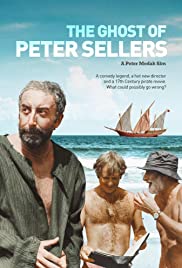
Greetings again from the darkness. Watching someone go through therapy – exorcising the demons of their life – is a bit uncomfortable. So while we understand Peter Medak’s ‘need’ to revisit the project (from almost 50 years ago) that nearly derailed his promising career, there are plenty of moments here where we feel like we are intruding. As a filmmaker, Mr. Medak’s most natural form of expression is with a camera, so re-tracing a dark time as a documentary makes some sense; we just wonder why he had to drag us along to share his misery.
A “67 day nightmare” is how Peter Medak describes the experience of filming GHOST IN THE NOONDAY SUN, a film that was never officially released. It was 1973 and Medak was a hot young director, fresh off THE RULING CLASS with Peter O’Toole. When Peter Sellers, one of the most sought-after international film stars, agreed to sign on, the 17th century Pirate movie based on the novel by Albert Sydney Fleischman, was thought to be a sure-thing box office smash. In reality, it was the beginning of Medak’s nightmare that still haunts him today.
While re-visiting the original Cyprus sets, and meeting with seemingly anyone who was involved with production and is still alive, Medak recollects specific instances of things that went sideways. The vast majority of it leads right back to the behavior of Peter Sellers, who seemed to be sabotaging the film from very early on. Was it arrogant “star” behavior? Was Sellers depressed over his breakup with Liza Minnelli? Was he bi-polar? We get interviews with co-writer (and Sellers’ buddy) Spike Milligan’s agent Norma Farnes, as well as the film’s Costume Director Ruth Myers, and Sellers’ stuntman Joe Dunne. None of these folks seem to have any pleasant memories of making the movie, and when you add in commentary from other filmmakers like director Piers Haggard (THE FIENDISH PLOT OF DR FU MANCHU, Sellers’ final film, 1980) and director Joseph McGrath (CASINO ROYALE, THE MAGIC CHRISTIAN), it appears the common denominator in creating anguish was Peter Sellers.
Among the tales we hear are in regards to Sellers firing a producer, his clashes with Medak and co-star Tony Franciosa, his push to keep Spike Milligan involved as writer and director of some scenes, and most shocking of all, Sellers’ faking a heart attack on set, and the admission of collaboration in fraud from Dr. Greenburgh. We expect artists to have unusual personalities and quirks, but it’s unfortunate when one person can affect the livelihood of so many others.
‘Why go through the pain of re-visiting this?’ Medak is asked the question a couple of times, and it certainly runs through our head while watching. Clips from the film are dropped in throughout the documentary, and it comes across as a pirate farce that appears to have been disjointed at best. I recently watched a “lost” Sellers film entitled MR TOPAZE (aka I LIKE MONEY) from 1961. It was the only feature film where he was credited as director, and if the stories from behind-the-scenes are true, it was yet another case was Sellers was guilty of sabotage.
Medak’s mission with this documentary seems to be one of catharsis. Or maybe it’s his chance to prove he wasn’t to blame for the tragedy of this project. When he talks to producer John Heyman, it seems clear that Heyman, despite losing millions on the film, was able to move on – to get over the setback … something Medak still hasn’t done. While no cast or crew members attended the wrap party, we do wonder if anyone will have an interest in this mess that occurred nearly five decades ago. The only value may be from the perspective of cinematic history or lore, at least other than, hopefully, Peter Medak’s mental well-being and soul cleansing.
Greetings again from the darkness. This is the latest addition to my “revisited” series where I re-watch and then write about (not a review) a genuine classic movie. It’s been 60 years on this one, so please expect spoilers with no spoiler alerts. Appearing on most every legitimate list of greatest cinematic comedies, director Billy Wilder’s film actually defies categorization and is a terrific blend of comedy-romance-drama and commentary on societal gender roles of that era. Mr. Wilder co-wrote the razor-sharp script with I.A.L. “Iz” Diamond. The two were collaborators off and on for 15 years, including what many consider to be the best comedy of all-time, as well as one of Marilyn Monroe’s finest films, SOME LIKE IT HOT (1959).
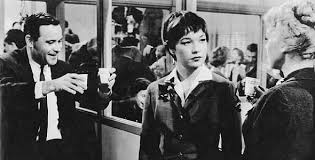
Jack Lemmon stars as CC “Bud” Baxter, a clerk at Consolidated Life, a New York insurance company with 31,259 employees. Baxter is but a minor cog in the conglomerate wheel, save for one thing: he allows upper management to use his apartment for their extramarital affairs. He doesn’t much like the arrangement, but lacks the backbone to stand up to them – especially since they dangle the carrot of promotion. Although the neighbors think he is a womanizing Lothario, Baxter’s life is void of companionship. He’s on the outside (of his own apartment) while others are living it up. Elevator Operator Fran Kubelik (Shirley MacLaine) has caught Baxter’s eye, yet while she is courteous and friendly, she politely deflects his flirtations.
When that promotion finally comes through, Baxter finds himself with yet another executive requiring use of the apartment. Jeff Sheldrake (Fred MacMurray) is the Human Resources Manager, and his demands lead to a most disheartening discovery. Baxter is crushed when a broken compact mirror and the office Christmas party allow him to figure out that Mr. Sheldrake is having an affair with Ms. Kubelik, and he himself has been providing the place.
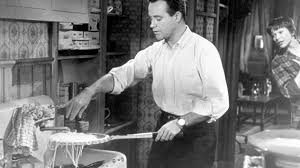
There are so many terrific scenes and performances, it’s not practical to go through each and every one. The early interactions between Baxter and Kubelik are quite fun – he’s so eager, and she’s so careful not to wound his pride. Kubelik and Sheldrake in the booth at the Chinese Restaurant is quite remarkable, and Baxter’s neighbors (Jack Kruschen and Naomi Stevens) are especially effective as the doctor and his quick-to-judge wife. Sheldrake’s secretary, Miss Olsen (Edie Adams), is a standout in her Christmas Party scene with Ms. Kubelik, and watching Baxter and Mrs. MacDougall (Hope Holiday) drunkenly dance the holiday hours away is comedic genius, although nothing can top Baxter deftly wielding a tennis racquet (wooden frame, of course) to strain pasta.
The film earned 10 Oscar nominations, and won in 5 categories: Best Picture, Best Director (Wilder), Best Screenplay (Wilder and Diamond), Best Art/Set Direction (Alexandre Trauner, Edward G Boyle), and Best Film Editing (Daniel Mandell, who also won Oscars for THE BEST YEARS OF OUR LIVES, 1946, and THE PRIDE OF THE YANKEES, 1942, and who also started in showbiz as an acrobat for The Flying Mandells in Ringling Brothers Circus). The film’s other nominees were Best Actor (Lemmon, a 2-time Oscar winner for MISTER ROBERTS, 1955, and SAVE THE TIGER, 1973), Best Actress (MacLaine, Oscar winner for TERMS OF ENDEARMENT, 1983), Best Supporting Actor (Kruschen), Best Cinematographer (Joseph LaShelle, and Oscar winner for LAURA, 1944), and Best Sound (Gordon Sawyer). Somehow Adolph Deutsch’s film score got nominated for a Grammy, but not for an Oscar. He did win 3 other Oscars for ANNIE GET YOUR GUN (1950), SEVEN BRIDES FOR SEVEN BROTHERS (1954), and OKLAHOMA!(1955).
Writer-director Billy Wilder is truly one of cinema’s giants. In his career, he was nominated for 21 Oscars, winning 6 (THE LOST WEEKEND 1945, SUNSET BLVD 1951). This film was released one year after SOME LIKE IT HOT (1959), a film that often tops the list of best all-time comedies. That film and this one, are also in the battle for best final line: “Nobody’s perfect” vs “Shut up and deal”. Wilder admitted that his idea for THE APARTMENT came from one scene in BRIEF ENCOUNTER, the excellent 1945 film from director David Lean, adapted from Noel Coward’s play.
Jack Lemmon’s “Bud” Baxter is just one of many memorable characters throughout his stellar career that featured 8 Oscar nominations, 2 Oscars, and roles in comedy and drama. He was a close friend of comedian Ernie Kovacs who was married to Edie Adams (Miss Olsen in this movie), and had a remarkable comedy partnership (10 movies) with Walter Matthau, the best known of which is THE ODD COUPLE(1968). Lemmon appeared in 7 Billy Wilder movies, and was the first actor to win Oscars for both Best Actor and Best Supporting Actor.
Shirley MacLaine was only 25 years old when she starred as Fran Kubelik. Like Mr. Lemmon, her (6) Oscar nominations were spread across four decades (50’s, 60’s, 70’s, 80’s), finally winning for TERMS OF ENDEARMENT (1983). In real life she is Warren Beatty’s big sister, although they’ve never appeared in the same film. Ms. MacLaine is renowned as a film actress, stage performer, dancer, author (multiple books), and of course, New Age guru. She’s now 86 years old and still working.
Fred MacMurray plays the scoundrel Jeff Sheldrake. Mr. MacMurray is best known for his 12 seasons and 380 episodes as the most patient father on “My Three Sons”. His career spanned fifty years (1929-1978), and he made his mark as a serious actor in such films as the ultimate film noir classic DOUBLE INDEMNITY (1944) and THE CAINE MUTINY (1954). He sprinkled in some westerns, before shifting to comedy in the first Disney live action film THE SHAGGY DOG(1959), and then family fare like THE ABSENT MINDED PROFESSOR (1961) and SON OF FLUBBER (1963). He was certainly an underrated, though never out-of-work actor. On an interesting side note, when he was age 22, he played saxophone in a band that featured Bing Crosby as the lead singer.
Edie Adams plays Miss Olsen, secretary to MacMurray’s Sheldrake. Her screen time here is limited, but her role is crucial to the story and well-crafted by Ms. Adams. She was the wife of early TV comedy legend Ernie Kovacs, who died in a car accident in 1962 at age 42. Ms. Adams put together a multi-faceted career including time as a nightclub singer, and actress on TV, stage, and film. She is still remembered for her iconic cigar commercials: https://www.youtube.com/watch?v=y7EbLIdE88Q
Baxter’s neighbors are played by Jack Kruschen as the understanding Dr. Dreyfuss and Naomi Stevens as the more direct Mrs. Dreyfuss. Mr. Kruschen’s 48 year career covered more than 220 credits in TV and film. Ms. Stevens is remembered for her role in VALLEY OF THE DOLLS (1967) and a recurring role on “The Doris Day Show”. She passed away (age 92) just a couple of months before her 70th wedding anniversary.
Joyce Jameson plays “the blond” Marilyn Monroe lookalike. She is best known for her roles in Roger Corman horror films, and for a recurring role as bombshell Skippy on “The Andy Griffith Show.” Another link to that classic TV series comes from Hal Smith, who dons the Santa Claus costume in the bar. You might recall Mr. Smith as Otis, the town drunk in Mayberry. He was also the voice of Owl in numerous “Winnie the Pooh” cartoons and movies. Hope Holiday plays Mrs. MacDougall, Baxter’s dance partner on Christmas Eve. Ms. Holiday was known as “the voice”, and made frequent appearances in Billy Wilder films.
In addition to MacMurray’s Sheldrake, the other four managers to take advantage of Baxter and his apartment were played by David Lewis (a recurring role as the Warden on “Batman” TV series), Willard Waterman (well-known character actor in radio, TV, film), David White (Larry Tate on “Bewitched”), and Ray Walston. Mr. Walston had many memorable roles including teacher Joe Dobisch in FAST TIMES AT RIDGEMONT HIGH (1982), JJ Singleton in THE STING (1973), co-starring with Bill Bixby in “My Favorite Martian”, and as Judge Henry Bone in “Picket Fences.” He’s yet another in the cast whose career lasted nearly 50 years.
The film’s lasting impact comes courtesy of the fun and energy and comedy on the surface, supported by a sadness lurking underneath. It offers a brilliant balance between lightness and serious social issues, and provides quite a statement of the times. A glance at the era shows us what a typical office environment was like. Women were subjected to endless harassment and unsolicited offers from the men in charge. They either had to find a way to deal with it, or quit and find another job – one where they’d likely face the same culture. Still, despite the sadness, the film does offer a bit of hope … plus some truly classic lines (including that last one). Girl with the “wrong guy” is common theme in movies and literature (and life), but “that’s the way it crumbles, cookie-wise.” And the next time you are debating with friends over a list of Christmas movies, don’t forget Billy Wilder’s THE APARTMENT. Hey, if DIE HARD qualifies, this one surely must!
Greetings again from the darkness. The first airplane hijacking movie I remember seeing was AIRPORT (1970, with Burt Lancaster and Dean Martin). Since then, it’s been a recurring, relatively common cinematic topic blending our natural fears (flying and terrorism) with our love and admiration of heroic people, as seen in such films as EXECUTIVE DECISION (1996) and AIR FORCE ONE (1997). Writer-Director Patrick Vollrath (first feature length film, Oscar nominated for his excellent 2015 Live Action Short EVERYTHING WILL BE OK/ Alles Wird Gut) and co-w Sanad Halibasic use some of the familiar tropes we’ve come to expect, but do so with a unique twist … the camera never leaves the cockpit (at least until the very end).
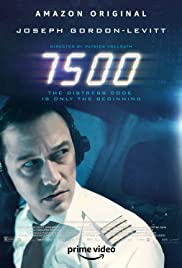
Joseph Gordon-Levitt stars as Tobias Ellis, the co-pilot to Captain Michael Lutzman (Carlo Kitzlinger) on this scheduled short flight from Berlin to Paris. Tobias is an American based in Berlin, living with his Turkish girlfriend Gokce (Aylin Tezel) and their young son. Gokce is also a flight attendant on the flight, and the two have attempted to keep their relationship a secret from their co-workers and employer.
The film opens with a quote usually attributed to Gandhi, “An eye for an eye leaves the whole world blind.” We then get a couple minutes of Berlin Airport security footage as passengers and their carry-ons proceed through security lines. We hear no dialogue or sound. The first actual scene puts us inside the cockpit as the flight crew arrives.
Not long after a smooth takeoff, the terrorists rush the cockpit when the flight attendant is delivering water to the pilots. A fight ensues resulting in injuries, including to both pilots. The crisis quickly escalates as Tobias has to take over flying the plane, while dealing with the pressure of a life-altering dilemma: does he follow protocol and keep the door shut, or does he hopefully save passenger lives by opening the door? The tension mounts as Tobias (and us) views the actions of the terrorist through the small cockpit monitor.
The film’s title is derived from the pilot’s Squawk code of 7500, which notifies the Air Traffic Controller of a hijacking-in-progress. As we learn, these aren’t the usual hijackers. These are extremists who are “avenging the deaths of Muslims.” These terrorists prove they aren’t afraid to kill, and proclaim they are “not afraid to die.” Well, all except one of them. Nineteen year old Vedat (Omid Memar) is the terrorists’ translator, and he’s left frantically trying to make the best of a bad situation, despite no real plan. His clouded-thinking exacerbates the situation as he tries to deal with the police negotiator.
What gives the film appeal is the ‘camera in the cockpit’ trick and the tension of the moment. The space is cramped and claustrophobic. Showing the crew going through the pre-flight checks allows us to get our bearings in an unfamiliar setting. To this non-pilot, the sequence delivers a very authentic look and feel. Spending the entire time in a confined space recalls such films as BURIED (2010), LOCKE (2013), and Hitchcock’s LIFEBOAT (1944). Joseph Gordon-Levitt carries most of the film with his performance, as he’s rarely off camera. His temperament during chaos is fun to watch, but the final act is just a bit overwrought, and some of the good from the first two acts unravels a bit. Still, the close-quarters of a cockpit makes a unique viewing experience, and one that has us asking how we would react in this situation.
 Greetings again from the darkness. You are to be excused for not taking seriously any person, club, organization, or religion that chooses to be identified by wearing colanders (pasta strainers) on their head. After all, many municipalities and courts of law would and have agreed with you. Still, writer-director Michael Arthur takes a direct approach in presenting the Pastafarians, and many will be on board with some of the points made.


 Posted by David Ferguson