OAK CLIFF FILM FESTIVAL 2017 recap
 The 6th annual Oak Cliff Film Festival ran June 8-11 and included even more local venues this year … further proof of the organizers’ commitment to spotlighting this unique neighborhood within the monstrosity known as the Dallas-Ft Worth metroplex. Despite the challenging schedule (much overlap, and only one screening per movie), the programming is a gift for true film lovers. I saw ten movies over the four days (it would have been 11 if not for the cluster of Sunday evening – more on that later) and not a single clunker in the bunch. For a festival that prides itself on unusual films and deep cuts, that’s quite a tribute to those responsible.
Below are quick comments on each of the films I watched, and at the end you’ll find some closing commentary on the OCFF.
Thursday June 8 – Opening Night
LEMON – When introducing the festival’s opening night spotlight feature, director Janicza Bravo described her finished project as “a bummer, but not a bummer”. She and her co-writer and lead actor (and real life spouse) Brett Gelman clearly had a great time with the film that took 5 years to complete. It’s an unconventional look at Isaac (played by Gelman), a guy so severely socially awkward that he might lose a two man race for “most likely to succeed” to Napoleon Dynamite.
Isaac’s girlfriend of 10 years (Judy Greer) is blind, and has lost all interest in their relationship. When she dumps him, Isaac’s life somehow becomes even more bizarre thanks to two Tiger finches, his job as an acting teacher, an attempt to get close with an actor (Michael Cera, sporting Gene Wilder tribute hair) and his near-criminal bonding moment with the elderly grandmother (Marla Gibbs) of his new romantic interest (a terrifically confounded Nia Long).
The cast is exceptionally deep for a low-budget indie and also includes Gillian Jacobs, Rhea Perlman, Fred Melamed, Martin Starr, David Paymer, Jeff Garlin, Jon Daly and Megan Mullally. Each of these talented folks offers up a dose of eccentricity to keep us viewers on our toes. There are many laughs to be had, and Mr. Gelman somehow delivers a performance that is a step backwards from deadpan. His walk alone is worth the price of admission, as is the use of such unusual music as “A Million Matzoh Balls”. The film is quite funny, but also a bit sad. Ms. Bravo’s description of her film is spot-on.
PORTO – Last year’s tragic death of Anton Yelchin becomes more heart-breaking every time we see him on screen. This is one of his final films and director Gabe Klinger and writer Larry Gross deliver a Portugal-based quasi-Before Sunrise story that mercifully chooses a much different path than the incessant babbling of that film.
Rather than narcissistic meanderings, this film explores how we deal with memories, as well as the fallout of an intense and short-lived connection formed mostly through a (prolonged and extended) sexual encounter between two otherwise broken people.
The film is divided into 3 sections: Jake, Mati, and Mati and Jake. In addition to the perspectives, the filmmaker utilizes multiple aspects and film formats (8mm, 16mm, 35mm), and we were fortunate to see it presented in 35mm. In addition to the human observations and insight, this is a film techie’s dream come true. So many various looks for a beautifully shot (by Wyatt Garfield) film is extremely rare for a low-budget indie. There is both a retro look and stunning shots such as those with Mati and the red umbrella, and the couple on a bench in the late night fog.
The splendid Lucie Lucas makes her feature film debut as Mati and the camera loves her, as does Jake … or at least he believes he does. She manages to capture both the flirtatious sparkle of the girl who first encounters Jake, and the less-energetic, more resigned to the future look of the woman who has made her life choice.
Toss in a Proust quote, some wonderful piano work, and the beauty of coastal town Porto Portugal, and the result is a piercing look at the fragility of humanity and passion of star-crossed connections.
Friday June 9
GOLDEN EXITS – Director Alex Ross Perry (Listen Up Phillip) conjures up an odd blending of Woody Allen classics Interiors (itself a tribute to Bergman) and Hannah and Her Sisters (with the funny parts removed). The paths of families and characters cross sometimes organically, and sometimes by force. The film was nominated for a Grand Jury award at Sundance, and it features all of the usual relationship traits – insecurity and mistrust, and anything else that leads to disenchantment and unhappiness. Yet somehow voices are never raised and anger seems (mostly) a distant emotion.
Naomi (Emily Browning, Sucker Punch) arrives from Australia and begins working for Nick (Adam Horovitz, former Beastie Boy) on a project to archive his deceased father-in-law’s documents/materials. Nick was hired by the estate trustee and his bitter sister-in-law Gwendolyn (Mary-Louise Parker), and she seems to be less miserable whenever she is busting his chops about the pace of his work – and anything else she can target. Nick receives little support from his wife and Gwendolyn’s sister Alyssa (Chloe Sevigny), who has plenty of reasons to lack faith in her husband. Nick has unpure thoughts regarding Naomi, but she is focused on Buddy (Jason Schwartzman) despite his marriage to Jess (Analeigh Tipton, Crazy Stupid Love).
If it sounds like a mess, it surely is … but it’s also an intricate tapestry of lies, love, jealousy and deficiencies of those in relationships. The film opens with Emily Browning singing “New York Groove”, which perfectly sets the stage for this strong ensemble cast playing cold, reserved characters who talk about seeing films with “normal” people in them – much like this one.
A LIFE IN WAVES (doc) – By opening this documentary with footage of Suzanne Ciani’s appearance on an early David Letterman show, it’s as if director Brett Whitcomb is trying to convince us that she is a celebrity and someone whose story is worth learning. Of course he’s correct, even if her story and career require no added publicity or marketing.
Ms. Ciani is a talented musician known best for her synth music featured in numerous commercials (Coca Cola) and video games. Her innovative sound design and effects may be difficult to categorize (New Age?), but the effectiveness is beyond question. We learn about her mentor Don Buchla (inventor of a 1963 synthesizer), her Wellesley alumni award, and her battle with breast cancer that led to her relocation from NYC to California in 1992. Some amazing archival footage takes us full circle through the three stages of career, and by the end, we are in awe of her talent, and fully admire her as a person.
Saturday June 10
LA BARRACUDA – Stuck with the festival’s least desirable time slot, co-directors Julia Halperin and Jason Cortland still managed to walk away as the Grand Jury Prize Winner – Narrative Feature. Filmed in Austin with Texas Hill Country pacing, the unconventional editing displays the messy legacy left behind by a deceased Country & Western singer of some fame.
The singer’s daughter Merle (Allison Tolman) is living her life of quiet desperation when she is surprised on her own front porch by Sinaloa (Sophie Reid), who claims to be Merle’s half-sister from England. Adding to the mess is Merle’s mother played by JoBeth Williams, who understandably wants little to do with Sinaloa. Ms. Reid plays Sinaloa in such a way that no one ever really knows whether her motivations are pure or vengeful. She’s quite creepy at times.
Musical director Colin Gilmore (son of Jimmie Dale Gilmore) ensures that the music throughout is spot on and crucial to telling the story. A campfire sing-a-long is a real ice-breaker for the sisters who share various mommy issues and daddy issues. Tack on Merle’s fiancé issues and work issues, and Sinaloa’s chip on the shoulder, and the scorpion line (it’ll come back to sting you) proves quite the foreshadowing. The rage within can rise up at any time and within any of us. The only questions are when, by whom and how severe.
TRUE CONVICTION (doc) – The people we tend to pull for in life are those who seemingly always find a way to turn the proverbial lemons into lemonade. Chris, Steven and Johnnie are the ultimate example of this. The three ex-convicts have decades of time served between them, and they also share exoneration after being wrongly convicted.
A Special Award winner at Tribeca, Jamie Meltzer’s film also took home this year’s OCFF Grand Jury prize – Documentary feature. These three gentlemen refuse to lash out at the system that did them wrong, and instead have formed an organization that researches and assists those in the same situation which they once found themselves in – behind bars and wrongly convicted. It’s an admirable cause and a career designed to turn a negative into a positive. We follow different cases as the men meet with a “false confession consultant”, as well as a prosecutor and detective from an old case gone bad. They acknowledge the danger in playing with the hope of convicts, and the film doesn’t shy away from the personal travails of all three. Steve and Chris face severe challenges, while Johnnie looks to start over in life. We never doubt the frustration these men have over the system that favors quick closure over accuracy, and more impressively, we are certain of their passion for their mission.
SANTA SANGRE (1989) – I typically avoid reparatory films at festivals, but made an exception in order to experience an Alejandro Jodorowsky double feature. At its core, this classic from almost 30 years ago is a horror film – and a very good one with the darkest of humor and surreal elements. But it’s also a psychological look at how childhood experiences form our character in life, and that’s not always a pretty sight.
Adan Jodorowsky plays boy magician Fenix, the son of a circus knife thrower (Guy Stockwell) and trapeze performer mother (Blanca Guerra). He befriends a young mute understudy Alma (Faviola Elenka Tapia in her only screen performance) who is horribly mistreated by the Tattooed Lady (a terrific Thelma Tixou). A particularly gruesome scene leaves Fenix traumatized and we then catch up with him some 15 years later (now played by Adan brother Axel Jodorowsky). Linked by witnessing the vivid violence, Alma tracks down Fenix in an effort to make things right for both of them.
Jodorowsky’s visuals are remarkable and are often tributes to those filmmakers he most admires. It’s certainly a movie for adults, but only those adults who are willing to dig in and follow the psychology of events that may seem cruel and meaningless – but often mean a great deal.
ENDLESS POETRY – The second half of the Jodorowsky double feature is the newest film from the famed director and it’s offered as a surreal autobiography – a story of his family and specifically, his time in Chile prior to leaving for Paris. The surreal part comes courtesy of his mother who operatically sings her every line, the head of a water buffalo perched above his parents’ headboard, an ultra modern bar that defies description – outside of the wakes held for customers/staff, and the inclusion of dwarfs and clowns (recurring in numerous Jodorowsky projects).
This is a continuation piece to Jodorowsky’s 2014 Dance of Reality, and features Adan Jodorowsky as the son (and also the film’s composer), and Brontis Jodorowsky as the father. Additionally, Alejandro himself periodically appears on screen in what works as kind of a live narration of his own thoughts during some segments of his life.
Life philosophy permeates every scene and every character. The mother experiences a run of frustration for every good-intentioned cake she bakes. There is an “ultrapianist” to showcase why you never want to invite one to your own party. The red-headed muse is a powerful character that seems to both make and break our protagonist, as does a relationship with a fellow poet, and life in an artist commune. All of these play into Jodorowsky’s apparent ideals of being fully engaged in youth, and then detaching in old age … making up what he calls “the sad joy of living”.
Sunday June 11
INFINITY BABY – Sometimes at film festivals we get a “work in progress”, and at only 71 minutes run time, it’s entirely possible that’s what we saw here – although director Bob Byington made no such claim in his pre or post screening comments. However, his comments and his films make it obvious he very much values comedy and laughter.
Filmed in Austin, two story lines intersect at a company run by Nick Offerman. His nephew and marketing representative is played (exceedingly well) by Kieran Culkin, who is the ultimate example of a shallow, self-centered millennial with commitment issues. His love life is a vicious circle that we witness: he falls quickly and hard for a woman, and then immediately begins finding reasons the relationship won’t work. In what’s supposed to be a test, he has them meet his “mother” (an awesome Megan Mullally) who proceeds to destroy their confidence and belittle their personality – putting an end to any further plans with her “son”. The other story revolves around two lackeys (Martin Starr, Kevin Corrigan) who report to Culkin. Their job is to deliver babies to the customers. What babies, you ask? Well, therein lies the hook.
In the not-too-distant-future, a stem cell experiment has gone awry and resulted in a batch of “infinity babies” that don’t age. Now anyone who has ever been a parent knows full well how frightening the concept of having a perpetual infant seems, so to think anyone would take on this duty for a mere $20,000 is absurd at best. And absurdity seems to be director Byington’s and writer Onur Tukel main objective, especially when we learn the truth behind Culkin’s momma scheme, and as it relates to the two lackeys making what they decide is a wise financial decision.
Also joining the terrific comedy ensemble cast is Noel Wells, Stephen Root and Trieste Kelly Dunn, who is a standout as one of Culkin’s girlfriends. The black and white look plays into the futuristic tale, and having Culkin’s character as one who is stuck in never-grow-up mode finely parallels the infinity baby story. Plenty of laughs here, but just be careful the next time a significant other invites you to “meet my mother”.
THE LITTLE HOURS – It’s not often when the obvious comparison to a movie is the classic 1975 comedy Monty Python and the Holy Grail, and it’s even more unusual for such a film to be making the rounds at festivals where schedules tend to be loaded with serious and dark subject matter. Proving yet again that its programmers aren’t tied to convention, this was the third outlandish comedy I watched at this year’s Oak Cliff Film Festival.
The year is 1347 when writer/director Jeff Baena’s story kicks off outside a convent where it takes less than a couple of minutes to realize that these aren’t your usual nuns. Profanity spews forth, as does laughter from the audience. Dave Franco plays a servant who has a good reason to flee from his King (Nick Offerman) and agree to a cockamamie plan suggested by the local priest (John C Riley). The plan has Franco working at the convent pretending to be deaf mute, while struggling to decline the advances from the aforementioned nuns played by Aubrey Plaza, Alison Brie, Kate Micucci (Unleashed).
Plot is barely an after-thought here, and most of the movie plays like interrelated Saturday Night Live skits. In fact, Fred Armisen and Molly Shannon are part of the ensemble, along with Paul Reiser and Adam Pally. Raunchy medieval comedies filled with debauchery and outrageously misdirected nuns could be classified as a bit of a stretch; however, Mr. Baena has adapted this from Giovanni Boccaccio’s “The Decameron”, and his use of modern day dialogue and attitudes, delivered by an ultra talented comedic cast, makes this one to watch after a particularly rough day or week of work. You’ll surely laugh and enjoy the temporary reprieve from real life … even without any killer rabbits or Knights who say “ni”.
A GHOST STORY – though this was #1 on my list of films to see during the festival, an extremely long line penalized those of us who watched the movie immediately preceding the screening. So even though I’ll have to catch this one later, the crush of humanity awaiting entry was a reminder that the OCFF has arrived.
Conclusion
This year’s Oak Cliff Film Festival gave every indication that the previously little-known neighborhood event had officially grown into a full-fledged nationally recognized festival. Of course, with that comes the good and the bad. In the positive column, a diverse and sought-after programming schedule now includes some films from large festivals (Sundance, Toronto), and also ensures the attendance of many writers, directors and producers. The challenges brought by success include crowd size that is difficult to manage … long lines for drinks, concessions and theatre entry, and of course, the cluster brought on by the closing night film and the penalty for those in the previous screening. On the whole, it’s wonderful to see such devoted folks finally receiving the recognition they deserve for building this dynamic event from scratch in a neighborhood they have helped revitalize.
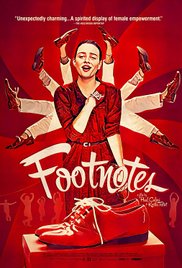 Greetings again from the darkness. On the heels of success experienced by LA LA Land, and “inspired by the films of Jacques Demy and Stanley Donen”, co-writers and co-directors Paul Calori and Kostia Testut find the right fit with this whimsical musical-comedy that puts coming-of-age and social commentary on equal footing.


 Posted by David Ferguson