THE FINEST HOURS (2015)

January 29, 2016

finest hours Greetings again from the darkness. The U.S. Coast Guard has played a role in many movies over the years, but only a few have placed this service branch directly in the heart of the story … most recently The Guardian (2006), which was little more than a cheesy, too-talkative water-based rip-off of Top Gun.  Director Craig Gillespie (Lars and the Real Girl, 2007) takes a much different approach as he presents a look at one of the most legendary and heroic real-life rescues in Coast Guard history.

The Oscar-nominated writing team behind The Fighter (2010): Scott Silver, Paul Tamasy, and Eric Johnson have collaborated on the screenplay based on the book from Casey Sherman and Michael J Touglas. It’s a worthy tribute (and clearly Disney-influenced) to what is described as the greatest Coast Guard small-boat rescue. It combines a boat-load (sorry) of tension-filled ocean-based sequences with some pretty interesting character-based sub-plots within a Massachusetts community that has become all too familiar with storm-based catastrophes.

Chris Pine stars as Bernie Webber, an awkwardly shy and obsessive rule-follower, who has lived under a cloud of doubt ever since a previous rescue mission failed, resulting in the death of a local fisherman/husband/father. We first meet Bernie as he bungles through a first date with Miriam (Holliday Grainger, a young Gretchen Mol lookalike). The film then jumps ahead to 1952 when they become engaged and Bernie is ordered into a questionable mission by his “not-from-around-here” commanding officer Daniel Cluff (Eric Bana). See, a huge storm has literally ripped apart not one, but two giant tankers, leaving crew members battling for survival. It should be noted that Bana the Australian, tosses out a laughable southern accent that is a joke within the movie and within the theatre (for different reasons).

Bernie and his crew: Richard Livesay (Ben Foster), Andy Fitzgerald (Kyle Gallner), and Ervin Maske (John Magaro), take off against all odds in a too-small boat against too-big waves in a desperate attempt to rescue the tanker crew that includes brilliant engineer (and quiet leader) Ray Sybert (Casey Affleck) and characters played by John Ortiz and Graham McTavish. Affleck excels as what can be termed a quiet leader. Of course, we know how the story ends, but the heroic efforts against a very powerful Mother Nature show-of-force make for compelling movie watching.

The special effects are stout, though not be as spectacular as The Perfect Storm (2010) or In the Heart of the Sea (2015), and it’s the human-factor that provides more than enough thrills, excitement, and tension. In fact, the biggest issue I had was that I saw a 3-D version which is an absolute disservice to the film. Most of the story takes place at night and at sea, so the 3-D consequence of dimmed light and muted colors results in a far too dark and dull look to the film. I spent much of the movie sliding the 3-D glasses down my nose in a simple attempt to enjoy a bit more brightness. The recommendation would be to skip the higher-priced (money grabbing) 3-D version and take in the more pleasing “standard” version.

Disney makes feel-good movies. Their target market is not cynics or the overly critical among us. The romance pushes the “corny” meter, but keeps with tradition of other Disney movies based on true stories like The Rookie (2002) and Dreamer: Inspired by a True Story (2005). Keep this in mind you’ll likely find this one pretty entertaining. Stick around for the closing credits as a slew of real photographs from the actual 1952 event are displayed, as are photos of the real heroes from that night.

watch the trailer:


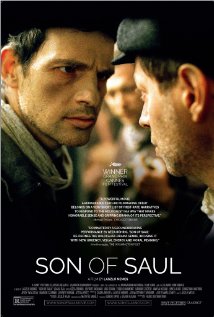
SON OF SAUL (Saul fia, Hungary, 2015)

January 21, 2016

son of saul Greetings again from the darkness. Not wanting to watch another movie related to the Holocaust is understandable. Why should you purposefully agree to experience the misery and unfathomable horror that occurred? The simple answer is that we should never forget one of the darkest and inexcusable periods in human history. Director Laszlo Nemes delivers a new approach … a different viewpoint … and it grabs us and doesn’t let go.

The startling opening is a long-tracking shot featuring Saul Auslander (played by Geza Rohrig) and his duties as part of the Sonderkommando unit at 1944 Auschwitz-Birkenau concentration camp. The red X on his jacket relegates Saul to corralling the next round of Jews into the gas chamber and then cleaning up for the next group. The reward of this position means the delay of his own inevitable death. It’s a closer, more intimate look at a process that we have not prevented ourselves to think much on.

What we soon realize is that dialogue is minimal and most of what we see is as if we were standing right beside or just behind Saul. The shallow focus means much in our sight line is blurred, and we are exceptionally dependent on the sound – what we hear often conveys more of the message than what we see. Cinematographer Matyas Erdely never allows our eyes to drift … he shows us only so much, forcing our brain to process and interpret so many more clues.

The horrific proceedings may be blurred, but it’s a devastating experience nonetheless. Saul’s stoic face masks his true emotions and disgust, and prevents him from drawing any unwanted attention. Saul’s dependability as a Sonderkommando changes in the blink of an eye – he sees the body of a young boy whom he claims is his own son. He becomes obsessed with finding a Rabbi to allow for a proper burial for the boy. It seems clear that this mission is a chance to break from his soul-crushing duties and grab a bit of redemption before it’s too late. Unfortunately, the timing of this mission conflicts with a planned prisoner uprising … adding more complexity to a nearly impossible quest.

This is the feature film debut of director Laszlo Nemes, who also co-wrote the story with Clara Royer. Some of the specifics are drawn from “Voices from Beneath the Ashes” (edited by Ber Mark) and “Auschwitz: A Doctor’s Eyewitness Account” by Miklos Nyiszli. It’s a fearless vision for Holocaust storytelling with many open-ended issues (we don’t always know identities and positions of those we see) and few conclusions provided. But then we all know the ultimate conclusion, and this look may be the most devastatingly intimate look we have ever had.

It’s not a movie that allows you to kick back on the sofa and simultaneously catch up with Facebook. It demands and deserves attention and patience. Nothing here is designed to allow us a “hands off” view from a safe distance. In fact, the lack of traditional story structure and dialogue direction forces us to face the ugliest reality through a different perspective than we’ve ever considered. Powerful stuff.

watch the trailer:


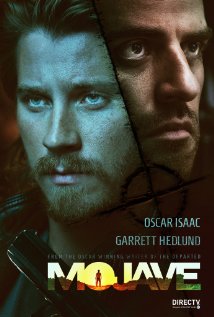
MOJAVE (2016)

January 21, 2016

mojave Greetings again from the darkness. The isolation of the desert seems the perfect place for an artist to achieve the existential awakening necessary during a time of personal doubt and crisis. The journey to find one’s true self becomes much more complicated when the one-man desert getaway is interrupted by heavy boozing, self-destructive tendencies, and a serial-killer sociopath. Such is the case with writer/director William Monahan’s (Oscar winner for his screenplay of The Departed) latest film.

Garrett Hedlund plays Thomas, a very successful filmmaker, who seems to take no joy from his life of luxury … a mansion in the hills, cool cars, a wife and daughter, and endless adulation. Sporting the ultra-cool celebrity look of sunglasses and long hair, Thomas heads off into the desert to either clear his mind or end his life. We aren’t really sure which, and neither is he. Lots of Vodka and reckless Jeep driving leave Thomas in a showdown of wits and machismo across a campfire from a sinister yet articulate drifter.

The drifter is Jack, played by Oscar Isaac, and it’s no surprise when we learn he is a serial killer … the sociopath part we figured out quickly, right along with Thomas. Their under-the-stars confrontation leads to a tragic accident the next day, and pits these two in a B-movie game of cat and mouse with a tone that reminds a bit of Cape Fear (1991) and U-Turn (1997).

Heading back to L.A., Thomas comes up with an incredibly stupid plan to cover his tracks. Being famous “since I was 19 years old” and having financial success with movies hasn’t trained Thomas on facing off against a clever nemesis. Even his discussion with his manager (played by an unusually low-key Walton Goggins) comes across as literary-speak rather than real advice. “Worry about what seems to be” is the advice Thomas rolls with.

Monahan fills the screen with tough-guy dialogue for these two characters that are both simultaneously stupid and smart. Jack and Thomas go at each like a couple of intellects, but it’s the class warfare that stands out. The 99% versus the 1%. The message seems to be that it comes down to circumstance on whether one is an artist or a psychotic felon … and the line separating the two is pretty slim.

It’s also not a very well disguised ripping of the film industry … especially of producers. Mark Wahlberg chews some scenery as a d-bag movie producer who talks loud and fast while accomplishing little. It’s a pretty funny turn for Wahlberg, though unfortunately his character spends limited time on screen. Louise Bourgoin has a couple of scenes, and quickly proves more would have been welcome.

The film may not be much to look at, and doesn’t really make much sense, but some of the dialogue duels and “brother” banter, manage to keep us interested throughout. “Take a left. Take a right.” It doesn’t much matter with these two well-read adversaries from opposite sides of the tracks.

watch the trailer:


THE REVENANT (2015)

December 28, 2015

the revenant Greetings again from the darkness. “Keep breathing.” A flashback in the opening sequence has Hugh Glass whispering the phrase as advice to his young son Hawk, the product of Glass and his beloved Pawnee bride. The phrase has a recurring role throughout the film … possibly serving as a courtesy reminder from director Alejandro Gonzalez Inarritu to the moviegoers mesmerized (and nearly traumatized) by the incredible brutality of what is on screen.

It’s a master class in filmmaking by those at the top of their game. Inarritu is the reigning Oscar winning director for Birdman or (The Unexpected Virtue of Ignorance), and he has re-teamed with the reigning Oscar winning cinematographer from that movie, Emmanuel Lubezki. Two of the finest actors of their generation, Leonardo DiCaprio and Tom Hardy, strip away any semblance of pampered movie stardom to deliver ultra-realistic performances in a story “based in part” on the true to life novel by Michael Punke.

An early action sequence is startling in its ferocity as Arikara surround and attack a group of hunters and trappers, and the whoosh of arrows – many of which find their mark – abruptly drag us into a world that we are unfamiliar with and certainly unprepared for. It’s early 19th century U.S. frontier, and just about everyone and everything can kill you.  Providing just enough time for us to pry our fingers off the armrests, Inarritu stuns us with what is undoubtedly the most fantastic grizzly bear attack on a movie star ever filmed. In what appears to be a single take (which also happens to be the number of breaths I took), Mama Grizzly treats Leonardo the way a young puppy treats its first chew toy.  Scratched, chewed, tossed and stomped.  This scene is savage and brutal, and sets the stage for the true, yet still unbelievable odyssey of survival by frontiersman Hugh Glass.

Tom Hardy excels as the calmly psychotic villain Fitzgerald, though some of his early hillbilly-tinged dialogue is difficult to catch. His hulking presence fits with our imagined look of the frontiersman of the era … tough and unforgiving nearly beyond belief. His bullying of youngster Jim Bridger (played by Will Poulter) and power struggles with Captain Henry (Domhnall Gleeson) are at frightening levels of intensity. Fans of Tarantino’s Inglourious Basterds will smile as they recognize the name of mountain man Jim Bridger … though that’s one of the few smiles offered by this 156 minute gut-wrenching ordeal. It would not be surprising if DiCaprio’s mantel sports an Oscar in a few months. He is that superb in a role that has nothing to do with good looks or charm.

A tale of survival. A quest for revenge.  It’s both of those, as well as a reminder that nature can be both beautiful and brutal. Some of the photography is almost poetic, and often reminds of the work of director Terrence Malick.  And in the blink of an eye, that moment is shattered by the torrential force of river rapids carrying Glass over the waterfall, or his taking a horseback ride off a steep cliff (one of the most dramatic shots of the film). The journey of Glass is unknown in distance or time in the movie, but there is no question as to the numerous struggles with the elements and the raw physicality required to persevere. If you can avoid diverting your eyes, there are visuals here that will be sincerely appreciated – even as you squirm, cringe and moan throughout.

From a technical standpoint, the film was shot on location in Canada and Argentina using only natural lighting, and emphasizing aspects of nature that often are overlooked. The sound of arrows, bears, and even DiCaprio’s breathing are profound and crucial to the overall effect, as are the animal skin garments and other costumes. It’s impossible to tell where CGI meets reality, but the visceral experience will be quite unique for most viewers … and not soon forgotten.

watch the trailer:


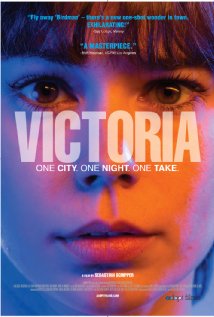
VICTORIA (2015)

November 28, 2015

victoria Greetings again from the darkness. You have surely seen more complex and intricate bank robbery movies, but it’s doubtful you’ve seen one more ambitious from a technical standpoint. In a remarkable achievement of commitment, planning, and technical execution (plus some good luck), director Sebastian Schipper and cinematographer Sturla Brandth Grovler deliver 2 hours and 14 minutes with a single take and a low budget. It’s a testament to the cast and crew, as well as the advancements in digital equipment (mobility and battery life).

Alfred Hitchcock’s Rope (1948) and last year’s Best Picture winner, Birdman or (The Unexpected Virtue of Ignorance), from Alejandro Gonzalez Inarritu, both utilized extended/seamless takes in fascinating manner; however, it’s Mr. Schipper’s film that takes us through multiple locations – a dance club, the streets of Berlin, the roof of a building, a local café, inside a stolen van, back to the dance club, through an inner city escape, and into a luxury hotel. That’s right … each of these puzzle pieces are generated without ever pausing the camera or editing a shot. You might expect nausea-inducing shaky cam, but instead it plays more like we viewers are along for the ride.

Beyond the technical goodies, we get two fine performances from Frederick Lau as the streetwise and smooth-talking Sonne, and especially Laia Costa as Victoria. The titular character is first spotted enjoying a sweaty dance to thumping club music before leaving the club and bumping into Sonne and his group of “real Berlin guys”. It all seems playful enough, but as the flirtations escalate between Victoria and Sonne, we sense things could become a bit more ominous. The first part of the film really allows us to get to know these two as they get to know each other. Victoria’s childhood story explains much about her reactions throughout the ordeal, and it’s also the point that we realize our infatuation with her is justified.

Things do in fact turn ominous for the group, and a criminal act conducted out of desperation leads to a few action-oriented sequences … each impressive in light of the single-shot approach. No CGI as a fallback and no carefully manipulated sets. Instead, the actors and camera must continue, no matter the glitches or obstacles that real time tosses in their path.

Run Lola Run (1998) may be the best comparison for the frantic pace, but in actuality, the film has no legitimate pairing given the 2 plus hours single shot approach. You may choose to see this for the technical achievement that it is, and the guess is you will be equally impressed with Ms. Costa.

watch the trailer:


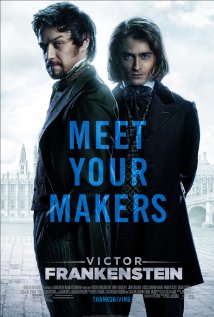
VICTOR FRANKENSTEIN (2015)

November 24, 2015

victor frankenstein Greetings again from the darkness. If a filmmaker is going to mess with the classics, there are two paths of creativity from which to choose: stay true to the original, or put a new spin on it. In this case, the classics in question are the nearly 200 year old novel from Mary Shelley (1818) and the nearly 85 year old movie from James Whale (1931). The filmmakers doing the messing are director Paul McGuigan (Lucky Number Slevin) and screenwriter Max Landis (son of director John). The spin they chose was (in theory) to tell the story from the perspective of Igor, the loyal assistant to Dr. Frankenstein.

It’s an interesting approach, but one that immediately presents a problem … since the title they chose was not “Igor”, but rather Victor Frankenstein. The film does begin with Igor’s backstory in the circus as a hunchbacked clown/amateur doctor, and the character does provide some early and late narration. The conundrum stems from the fact that pretty much everything else in the movie is centered on the mad scientist, rather than the skilled apprentice/partner.

Daniel Radcliffe plays Igor and James McAvoy plays Victor Frankenstein (not Fron-kin-steen, in a nod to Mel Brooks), and both actors seem to be doing everything possible to bring energy and enthusiasm to a movie that can’t seem to decide if it’s a reboot or a reimagination or simply an origin story. Radcliffe effectively uses his physicality as the circus clown who is so mistreated and misunderstood, and McAvoy is such a hyper-active mad scientist that I’m sure his fellow actors many times were inclined to advise “say it, don’t spray it”.  McAvoy does seem to be having a grand old time playing the brilliant yet unhinged young doctor-to-be, and to his credit takes a much different approach than Colin Clive when he gets to the infamous line “It’s ALIVE!”

The best parts of the movie are the intricate and amazing sets, the monster himself (albeit too brief), and the expert use of classical music and film score. The circus sets are colorful and active, while Frankenstein’s soap factory home/laboratory is fascinating and creative, and the final Scotland castle on a cliff is breath-taking. Pulleys, chains and cranks are everywhere … as is an incredible amount of body parts, organs and fluids.

After a very well done circus opening, we are jarred with a seemingly out of place action sequence involving a slo-motion chase and fight scene that seems to be attempting to mimic some of the recent Sherlock Holmes movie stunts. Here they are unwelcome and ruin the flow. Another aspect that seems forced and unnecessary is a romantic interlude between Igor and a trapeze artist (played by Jessica Brown Findlay). It feels like an add-on to remind us that it’s supposed to be Igor’s story. Additionally, Andrew Scott plays an intriguing Scotland Yard Inspector who is every bit as obsessed with his faith-based beliefs as Victor is with his science-has-no-bounds stance. A story told from the Inspector’s perspective might have worked, but instead it comes across as another add-on. Another add-on is the filthy rich and very devious fellow med student (played by Freddie Fox) who agrees to fund the experiments, but mostly the character is an after-thought necessary to move the plot along. Wasted is the always menacing Charles Dance, who has but one scene as Victor’s strongly disapproving daddy.

A combination of the romance, minimal role of Igor in the grand finale, the medical school bumbling, the clunky Inspector involvement, and the all too brief monster appearance makes the film all but impossible for viewers to connect. They tell us twice “You know the story … a crack of lightning, a mad genius, and an unholy creation”, but the reality is, the fact that we know the story, makes this one all the more disappointing. It’s fun to look at, but is lacking the depth and soul that has allowed Shelley’s book to stand up over two centuries.

watch the trailer:


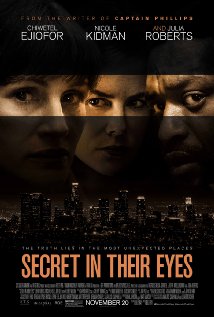
SECRET IN THEIR EYES (2015)

November 19, 2015

secret in their eyes Greetings again from the darkness. Why, Billy Ray, why? It’s not surprising that Hollywood green-lighted the Americanization of the 2010 Oscar winner for Best Foreign Language film, El secreto de sus ojos. That original from Argentina is exemplary filmmaking and a thoroughly entertaining and compelling mystery-thriller; a must-see for any true film lover. Even if an Oscar-studded cast is hired (2 Oscar winners, 8 nominations), the guiding inspiration for a remake should be more than losing the subtitles and filming Julia Roberts without make-up.

The story balances two timelines spanning 13 years. Jess (Ms. Roberts) is an investigator who works with FBI Agent Ray (Chiwetel Ejiofor), Assistant District Attorney Claire (Nicole Kidman), and a blustering District Attorney played by Alfred Molina. When Jess’ daughter is brutally murdered, the investigation is impacted by the suspect’s role as a department snitch. When we catch up all those years later, the unrequited attraction between now former FBI Agent Ray and now DA Claire is as strong as ever; Jess’ appearance is on par with someone suffering from a terminal illness, and the murder still hovers over these characters as if it had occurred last week.

It’s a fascinating story that was handled superbly in the original, yet mostly comes across as uninspired in this latest project. At times, it’s even a bit confusing in how the two eras are handled. The score from Emilio Kauderer and a couple of fine scenes from Ms. Roberts (although she gets no credit here for appearing sans-makeup) are the best parts of this one. Otherwise, Mr. Ejiofor (usually a fine actor) goes over-the-top, while Ms. Kidman is simply miscast and unable to generate the proficiency required for her position. Other support work comes courtesy of Dean Norris (“Breaking Bad”), Michael Kelly (“House of Cards”) and Zoe Graham.

Other than lacking the grit and realism of the original, the editing and camera work (so exceptional in the first version) at times come off as amateurish this time around. The soccer/futbol sequence from the original is replaced with Dodgers baseball (Chavez Ravine and Vin Scully) and a link to former Manager Walter Alston. Normally that would be considered an improvement, but again, these fall short and fail to generate the necessary suspense. A weak impersonation of the famous long-tracking shot certainly doesn’t help.

For anyone who hasn’t seen writer/director Juan Jose Campanella’s (an Executive Producer here) excellent original, this version from Billy Ray (Shattered Glass) might prove interesting enough; however, those same folks are strongly encouraged to instead track down the original, and experience the emotional depth and filmmaking expertise that made it such a worthy Oscar winner.

watch the trailer:


SPECTRE (2015)

November 8, 2015

spectre Greetings again from the darkness. Don’t come to me looking for objective judgment on Bond. By the time we hear that familiar opening trumpet blast of Marty Norman’s Bond theme, I’ve already been swept away into the land of MI6 enchantment – gadgets, cars, women, over-the-top stunts, globe-trotting, global villains and quintessential coolness. And it doesn’t help that this time director Sam Mendes treats this 24th (official) Bond film as an homage to those that came before. At times it plays like a tribute – and maybe even a closing chapter (for Mendes and Daniel Craig?).

A long tracking shot drops us into the Day of the Dead festival in Mexico, complete with skeleton masks and giant parade props. We follow a masked couple as they maneuver through the crowd and into their hotel room, where 007 quickly leaps out the window and makes his way across roof tops towards his mission. It’s one of the more visually stimulating and explosive openings in franchise history.

The story combines the personal back-story of Bond’s childhood with his relentless pursuit of the evil empire known as Spectre … the crime syndicate that has been part of the Bond universe for many years and films. The tie-in to the iconic Bond nemesis Blofeld, this new mastermind Franz Oberhauser, and Bond’s adoptive family make for an interesting chain of custody. However, as is customary, it’s the characters and action sequences that deliver the entertainment bang.

Oberhauser is played by Christoph Waltz (understated given his track record), and the two Bond “ladies” are played by Lea Seydoux (the daughter of Mr. White, and the key to finding Spectre), and Monica Bellucci (the widow of Bond’s Mexico victim). Mr. Waltz takes advantage of his limited screen time, while Ms. Bellucci is limited to a few lines and a chance to model some lingerie. Reprising their roles are Rory Kinnear as Tanner, Ralph Fiennes as M, Naomie Harris as Moneypenny, Ben Whishaw as Q, and Jesper Christensen as Mr. White. New to the mix is Dave Bautista as Hinx (in the mode of Oddjob and Jaws), and Andrew Scott as C … the latest of those trying to shut down the “00” program. Whishaw brings a nice element to his role, while Bautista’s Hinx gets to participate in both a car chase and train fight … while uttering only a single word of dialogue.

The evil doers have gotten more intellectual over the years, and Oberhauser and Spectre have the goal of global surveillance and controlling information and data. It’s a modern theme for a Bond film that also seems intent on reminiscing. There are nods to most (if not every) previous Bond film via (among other things) Nehru jackets, cats, scars, and a white dinner jacket. And it’s nice to see the gun barrel sequence back in the opening credits where it belongs. As for the new song, Sam Smith has a very nice voice, but his Bond song lacks the punch of the best.

In terms of globe-trotting, we get Mexico, Rome, Tangier (Morocco), London and Austria. The (prolonged) car chase occurs on the deserted streets (and steps) of Rome and features two stunning cars – Aston Martin DB10 and Jaguar C-X75. In addition to the cars and previously mentioned train, it’s helicopters that earned a couple of worthy action sequences.

It’s Daniel Craig’s fourth turn as Bond, James Bond. He brings his own brand of emotion and cheekiness, while also possessing a physicality that allows the action sequences to work. He has made the role his, much like Christian Bale took ownership of Batman. For those who refuse to accept the new generation, director Mendes delivers enough nostalgia that even the old-timers should be entertained.

R.I.P. Derek Watkins

watch the trailer:


CRIMSON PEAK (2015)

October 19, 2015

crimson peak Greetings again from the darkness. “It’s not a ghost story. It’s a story with ghosts.” Leave it to writer/director Guillermo del Toro (Pan’s Labyrinth, 2006) to make this distinction. The line is spoken by our lead character Edith, who is striving to write like her literary idol, Mary Shelley. She is explaining her most recent writing effort to a publisher, but the line also represents the movie we are watching … ghosts appear (some grisly ones at that), but they certainly aren’t the focus.

The story begins around the turn of the 20th century as young Edith has just experienced her first family tragedy, the passing of her mother. She grows into an independent young woman (played by Mia Wasikowska) being raised by her successful self-made-man father Curtis Cushing (played by Jim Beaver, “Justified”).  Tip of the cap to del Toro for his tip of the cap to the horror film great Peter Cushing.  Edith has remained steadfast in her independence despite the advances of her lifelong friend, the handsome Dr. Alan McMichael (Charlie Hunnam, “Sons of Anarchy”).  Things change when a mysterious stranger sweeps into town. Sir Thomas Sharpe (Tom Hiddleston) seeks investors for his “clay harvester”, a machine he designed to automate what now takes many men and much hard labor.  The elder Cushing senses something is “off” about Sharpe and his sister and travelling companion, Lady Lucille (Jessica Chastain), but the strong-minded Edith soon finds herself waltzing and blushing with Sir Thomas.

It would be pretty easy to recap the balance of the story, but that is actually the film’s weakness. It plays like a re-imagined script from one of those old 1940’s or 50’s movies that I watched on Friday nights as a kid. In other words, it’s not very frightening and the viewer’s enjoyment is totally based on the atmosphere. Fortunately, that’s where del Toro and his team excel. The set design (Tom Sanders) and costumes (Kate Hawley) are truly spectacular and among the best ever seen, especially for a horror movie. Dilapidated Allendale Manor features a hole in its roof allowing the elements to freely enter the colossal entry foyer. The furnishings and fixtures, as well as the layout of the house are perfection as a setting. The costumes for all characters are superb, but pay special attention to the fabrics and frills of Edith and Lucille. Camera work from Cinematographer Dan Lausten ties it all together for the eerie feel.

The film is so stunning and interesting to look at that it’s actually quite easy to forgive a story that has little to offer, and often … and I do mean often … relies on horror film clichés in what should be moments of difference-making. Having five such talented lead actors, who each go “all in” for their characters, help us overlook the script weakness, and it’s really the look and atmosphere of the film that make it worth watching … not words I have written many times over the years. For del Toro fans, you should know that Doug Jones does play the creepy ghost that inspires Edith’s first words (as narrator) … “Ghosts are real, that much I know”.

watch the trailer:


BRIDGE OF SPIES (2015)

October 16, 2015

bridge of spies Greetings again from the darkness. For a director, true power in the movie industry means you can obtain the financing and assemble the cast and crew you need to make the films that have meaning to you. With his 40 year career of unmatched combined box office and critical success, Steven Spielberg is the epitome of film power and the master of bringing us dramatized versions of historical characters and events. In his fourth collaboration with Tom Hanks, Spielberg tells the story of James B Donovan.

You say you aren’t familiar with Mr. Donovan? In the late 1950’s and early 1960’s, the CIA (Allen Dulles was director at the time) persuaded James Donovan to provide a bit of Cold War legal service. Mr. Donovan was by trade an Insurance attorney, but after others in his profession passed on the “opportunity”, his commitment to justice and human rights drove him to accept the challenge of defending suspected Russian spy named Rudolph Abel. In the face of an angry populace and government, Donovan took the case all the way to the Supreme Court – and his exact words are spoken in the movie by Hanks.

Not long after, Francis Powers (played by Austin Stowell) was piloting a CIA U-2 spy plane when he was shot down over Russia and taken captive. This sequence in the film is breathtaking to watch. Enter James Donovan again … this time to negotiate an exchange of prisoners: Rudolph Abel for Francis Powers. It’s these negotiations that provide the element of suspense in the story. Mr. Donovan was a family man, but he was also very confident in his ability to negotiate on the biggest stage and under the brightest spotlight (or darkest backroom).

The movie is exactly what you would expect from a master filmmaker. Spielberg slickly re-creates the era through sets, locations, and costumes. He utilizes his remarkable eye behind the camera, an interesting use of lighting, and the score from Thomas Newman. Nope, that’s not a misprint. It’s the first Spielberg movie in 30 years not scored by John Williams (who was unable to work on the project). Of course, the cast is stellar and it all starts with Tom Hanks. He just makes everything look so darn easy! Whether he is talking to his wife (Amy Ryan), his kids (including Bono’s daughter Eve Hewson), his law partner (Alan Alda), or agents from the U.S. or Russia … Hanks manages to make each scene real and believable.

It’s the scenes between Donovan and Rudolph Abel that are the most fascinating to watch. Mark Rylance plays Abel, and to see these two men grow to respect each other for “doing their job” is a true acting and screenwriting clinic. We find ourselves anxious for the next Rudolph Abel scene during an extended span where the focus is on Donovan’s negotiations. When the two finally reunite, it’s a quietly affecting moment where much is said with few words.

Spielberg utilized many of the locations where the actual events took place, and this includes Berlin and the Glienicke Bridge where the real exchange took place in 1962. While missing the labyrinth of twists and turns of Tinker Tailor Soldier Spy, it’s knowing that these are real people in real situations that make this historic drama so thrilling and riveting to watch.  Film lovers will also get a kick out of the fact that the script was co-written by the Coen Brothers, and history lovers will enjoy seeing some of the details provided by the written words of those involved, as well as their surviving family members. It’s an era that seems so long ago, yet the topics are so pertinent to what’s happening in the world today.  Beyond all of that, it’s a story of a man standing up for what’s right at a time when that was not the easy or popular way.

watch the trailer: