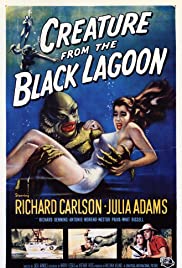
CREATURE FROM THE BLACK LAGOON (1954) revisited

July 26, 2020

Greetings again from the darkness. This is another addition to my “revisited” series where I re-watch and then write about a classic movie. Why are “creature features” so appealing, and why was Universal so good at producing these movies that mesmerized me during childhood (and yes, still to this day)? The Universal Monsters of the 1930’s and 1940’s included such classics as Dracula, Frankenstein, The Mummy, The Wolf Man, The Invisible Man, and The Phantom of the Opera. Many cinematic iterations of these characters/creatures exist including sequels, remakes and contemporary re-boots, and there is something magical about the mystique and legend and lore behind each of the monsters. By the 1950’s, Universal was looking to revive the genre.

William Alland is credited with the idea for CREATURE FROM THE BLACK LAGOON. It’s a twist on the 1740 fantasy classic “Beauty and the Beast” from French novelist Gabrielle-Suzanne Barbot de Villeneuve. Mr. Alland is the film’s Producer, and years earlier he played reporter Jerry Thompson in Orson Welles’ CITIZEN KANE (1941). Maurice Zimm is credited with the story, and the screenplay was co-written by Harry Essex (IT CAME FROM OUTER SPACE, a Ray Bradbury story) and Arthur A Ross (an Oscar winner for BRUBAKER, 1980).

Quite similar to KING KONG, the story from Edgar Wallace and Merian Cooper, this movie follows a scientific expedition down the Amazon River where a prehistoric “Gill-man” (half man, half amphibian) is discovered and captured. The creature seems enraptured by Kay, the fiancé of one of the scientists – much like Kong was drawn to Ann Darrow. There is the expected battle between science and commerce: the value of marine life research vs the chance to make a pot of money. The feuding scientists also have to remain focused on the ongoing concern for the safety of those on the expedition … especially Kay.

Jack Arnold is remembered today as one of the great sci-fi movie directors of the 50’s. His work included THE INCREDIBLE SHRINKING MAN (1957), IT CAME FROM OUTER SPACE (1953) TARANTULA (1955), and the excellent Audie Murphy western NO NAME ON THE BULLET (1959). He also directed many episodes of some of the top TV shows of the1950’s, 60’s, 70’s, and 80’s. For this one, he deserves a great deal of credit for generating sympathy for the creature, by positioning him, not as the villain, but rather as the victim of a home invasion by the humans. Director Arnold also does a nice job early on of teasing us with footprints and fossils, and letting us hear about the legend, prior to actually seeing the creature.

 For a movie that spends most of its time on a small boat named Rita, the cast is deep and talented. Richard Carlson (LITTLE FOXES, 1941) plays David Reed, the scientist engaged to Kay. Mr. Carlson dreamed of being a playwright, and had many guest starring roles on TV; however, “I Led 3 Lives” was his only starring role in a successful series. It was reportedly Lee Harvey Oswald’s favorite show. Co-starring here was Julie Adams (billed as Julia at the time) as Kay Lawrence, personal favorite of both David and creature. In the film she is stalked by the creature, even while she’s out for a leisurely swim in the Amazon (not recommended). Ms. Adams was a favorite on the cult movie circuit, and she died in 2019 at age 92. Having been crowned Miss Little Rock at age 19, she acted regularly into her 80’s, and even had a role at age 91, the year before she passed.

Richard Denning plays Mark Williams, the money man behind the expedition, and David’s boss and nemesis. He’s the one who sees dollar signs while capturing the creature. Mr. Denning served on a submarine in the US Navy during WWII. He starred with Cary Grant and Deborah Kerr in AN AFFAIR TO REMEMBER (1957), and then in the late 1960’s took an acting job as Governor on the original “Hawaii Five-0”, since he already lived in Hawaii. Mr. Denning’s wife, actress Evelyn Ankers, was known as “Queen of the Screamers” for her work as damsel in distress in many thrillers in the 1940’s (Wolfman, Frankenstein, Dracula movies).

Other cast members include familiar face Whit Bissell as Dr. Thompson. Mr. Bissell was a frequently working character actor from 1940 -1984 in TV and movies. He had over 300 credits, including I WAS A TEENAGE WEREWOLF (1958) with Michael Landon. Nestor Paiva plays Lucas, the Captain of the Rita, as a kind of Walter Brennan type. Mr. Paiva also appeared in more than 300 projects, and his wife was once employed as personal secretary to Howard Hughes. Antonio Moreno plays Carl Maia. Mr. Moreno had a huge career from 1912 to 1959, and was a rival of Rudolph Valentino for many “Latin lover” roles. The film’s narrator, Art Gilmore, became known for his narration and voice acting in shows such as “Dragnet”, “The Waltons”, “Adam-12”, “The Red Skelton Hour”, “The Roy Rogers Show”, and many more.

Of course everyone who watches the movie wants to know more about the creature. Well, two actors were involved. Ben Chapman, who was a Marine during the Korean War, played the creature on land, while Ricou Browning played the Gill-man we see in the water. Mr. Browning was also the co-creator of the popular TV series “Flipper” (1964-67), and directed the iconic underwater scenes in the James Bond classic THUNDERBALL (1965). Also involved here were a young Henry Mancini as uncredited composer and cinematographer William E Snyder. Mr. Mancini was a 4 time Oscar winner best known for his iconic “Pink Panther” theme, and Mr. Snyder achieved 3 Oscar nominations
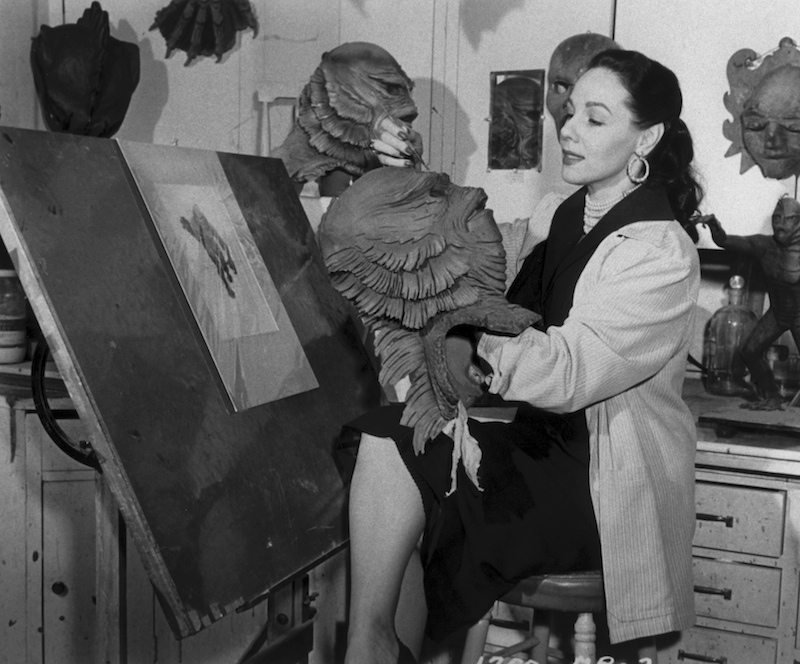
 Director Arnold insisted on shooting the film in 3-D, despite its low budget, and over the years, it became quite a cult classic (with its’ own festivals). There is even a scandal associated with the film. For many years, Hollywood make-up legend Bud Westmore took credit for the design of the creature. It took more than 50 years, but Mallory O’Meara’s book, “The Lady from the Black Lagoon: Hollywood Monsters and the Lost Legacy of Millicent Patrick”, finally allowed Ms. Patrick (pictured, left) to receive due credit for her design work. Sequels to the film included: REVENGE OF THE CREATURE (1955), and THE CREATURE WALKS AMONG US (1956), but it was perhaps director Guillermo del Toro’s stunning THE SHAPE OF WATER (2017) winning the Oscar for Best Picture, that brought CREATURE FROM THE BLACK LAGOON back into prominence. This allowed a new generation of movie lovers to behold the classic sequence of the creature’s synchronized swimming just below Kay in the murky Amazon water. What a sight!

watch the original trailer:


ELVIS FROM OUTER SPACE (2020)

July 6, 2020

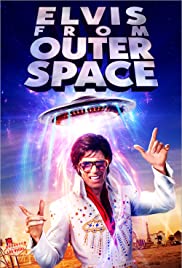
 Greetings again from the darkness. All you Elvis Presley fans out there can relax. This is not a documentary. In fact, trying to put a label on the film co-written and co-directed by Marv Z Silverman and Tracy Wuischpard would be pointless … unless we can just agree on “Midnight Movie Madness”, and leave it at that.

Not that I would ever encourage such activity, but some have declared that the best ‘midnight movies’ are most enjoyed whilst a sufficiently mind-altered state is achieved, and one is unnaturally influenced by beverage or ‘other’. Now that’s a category this film easily and happily (and likely by design) fits in. There is no reason to start this film while thinking clearly, and actually, thinking is best avoided for the entire 90 minute runtime.

The story kicks off with the narrator explaining that Elvis has spent the last 30 years or so with the aliens of Alpha Centauri. He has been playing music for the community of ETs proving “music is the universal language.” ’But now Elvis is homesick for Earth and wants to see his daughter, Linda Bess Truman. The aliens contact the CIA and arrangements are made for the drop in Area 51. Some quick math places the story sometime around 2010 or a couple years prior.

There is no way I will risk spoiling the zaniness that occurs, but Elvis, now codename John “JB” Burrows, finds himself in the 1970’s Elvis World Crown Competition at the Desert Sands Hotel in Las Vegas. You may have heard about the time that Charlie Chaplin lost a Charlie Chaplin look-alike contest, but here, JB brings down the house as an Elvis impersonator. He’s so good the other contestants (quite a motley crew) question his identity. One of those is “Big M” who is also the film’s narrator. All of this drama is broadcast via “Barry Live”, a TMZ type show delivers laughs along with the daily scoop.

George Thomas plays JB/Elvis, and he seems at ease in the jumpsuits, although those fake sideburns are a punchline by themselves. David Heavener is Big M and the narrator, and his initial role as rival shifts as the story progresses. Diane Yang Kirk plays CIA Agent Messina, who is on JB’s side, and Lauren-Elaine Powell is Jackie, the earthly love interest. Barry Ratcliffe nearly steals the show as the TV host of “Barry Live”, and I believe TJ Myers plays daughter Linda, while Martin Kove (you’ll recognize as bad guy Kreese from THE KARATE KID, 1984) is the State Trooper. Alexander Butterfield is CIA Chairman Townsend, and in real life, Mr. Butterfield served as Deputy Assistant to President Richard Nixon, and was the one who revealed the existence of the Oval Office recording system during the Watergate investigation. Best of all, Sonny West appears as himself. Sonny was part of Elvis’ “Memphis Mafia” back in the day. Sonny and his cousin Red West died within a couple of months of each other in 2017.

Hopefully you’ve picked up that this move is so far outside of mainstream that a traditional review is simply not possible. Animation is used for the aliens and spaceships and the rest of it must be seen to be … well, seen. It appears to be a re-boot of Mr. Silverman’s 2011 project entitled MEMPHIS RISING: ELVIS RETURNS, making most of the footage almost 10 years old. Still, a passion project is the heartfelt pursuit of a filmmaker, whether it’s SCHINDLER’S LIST or Elvis being held captive in ‘Area 52’.

watch the trailer:


SHIRLEY (2020)

June 4, 2020

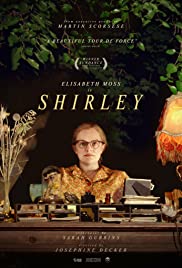
 Greetings again from the darkness. “Thrillingly awful”. That’s how Rose describes the feeling she had from reading Shirley Jackson’s 1948 short story “The Lottery.” It’s also a likely reaction many will have to watching director Josephine Decker’s (MADELINE’S MADELINE, 2018) mostly fictionalized biography of the author known for her widely diverse novels, short stories and articles. The film is uncomfortable to watch and challenging to process, yet thanks to the performances and fascinating interactions, we remain enthralled the entire time.

As the film opens, Rose (Odessa Young, ASSASINATION NATION, 2018) is on the train reading Jackson’s divisive story. We gain some insight into her personality as she allows a sly grin to cross her face, and then gets frisky with her husband Fred (Logan Lerman) in a train cabin. Soon they arrive at the home of Ms. Jackson (Elisabeth Moss) and her husband Stanley Edgar Hyman (Michael Stuhlbarg), a professor and literary critic. Shirley is suffering through a bout of depression brought on by writer’s block, and though she’s initially against the young couple staying with them, she slowly finds a use for Rose. It doesn’t take long for us to realize everyone here wants something from the others. Stanley is worried about Shirley’s mental stability, so he convinces Rose to take on the domestic chores. Fred hopes Stanley will bless his thesis so that Bennington College will hire him. Stanley seizes on Fred’s ambition by having him take over some of his teaching load. Rose endures some harshness from Shirley, but the two ladies end up with an awkward bond which has Rose serving as a quasi-muse for Shirley’s new novel.

The new novel is “Hangsaman”, which Shirley actually wrote years before this story is set. It’s about the disappearance of a college student named Paula, and it’s at this point where the visions and/or projections begin. Things get a bit hazy for us … and for Rose. At times, Shirley is downright creepy. Are we watching something supernatural?  Is she a good with or a bad witch … or something else altogether? At times, Shirley appears to be unraveling – and possibly bringing Rose down with her. But then we hear another of the razor sharp verbal sparring matches between Shirley and Stanley. These are works of art. Stanley needling her just enough to inspire more writing. Shirley fires off cutting remarks as brutal as any wounds a knife fight might cause. It’s an advanced course in the creative mind vs the pompous academic. Stanley understands that allowing her to become unhinged is all part of the process, and will likely lead to her best work.

Multiple dynamics between characters creates chaos for viewers. Shirley and Stanley have their gamesmanship, while Shirley and Rose are going down an entirely different twisted path. And then there is odd relationship between pregnant Rose and husband Fred, and again between Fred and Stanley. And we haven’t even gotten to what the outside world thinks of Shirley, and how Stanley’s disclosed infidelities keep a fire burning inside Shirley, despite her humiliation. There is a lot to take in – domestic life in the era of “little wifey”, the strains of starting and maintaining a career, and the inner-demons of the creative mind. One of the key elements that sticks out is how each character is striving desperately to establish their own identity, and given the times, this should be much easier for the men.

Sarah Gubbins’ first feature film screenplay is based on the 2014 novel “Shirley” by Susan Scarf Merrell. Again, this is mostly fiction, albeit with nuggets of Shirley Jackson’s real life mixed in. Of course Shirley’s and Stanley’s four kids are nowhere to be found, allowing for more focus on the contrasting featured couples. In fact, Ms. Young’s Rose is the perfect “opposite” for Ms. Moss’ Shirley, both in looks and demeanor. It’s impossible to miss the similarities between this and director Mike Nichols’ classic WHO’S AFRAID OF VIRGINIA WOOLF? (1966) starring Richard Burton and Elizabeth Taylor. That one had more yelling, but this one cuts just as deeply. One of the best ever onscreen jabs occurs when Stanley sourly describes Fred’s thesis as “terrifically competent”, and then adds in a disgusted tone, “There’s no excuse for that.”

Special notice should be made for the music and cinematography. Composer Tamar-kali (MUDBOUND, 2017) pierces us with music often limited to plucks of cello and/or piano, adding a near-horror element to the frightening interactions we are watching. And with most of the film taking place in the creaky, book-filled house, cinematographer Sturla Brandth Grovlen (WENDY, 2020 and VICTORIA, 2015) expertly captures the harrowing glares of Shirley and the bemused smirks of Stanley in close quarters. The camera work adds to the constant immediacy of each moment.

Shirley Jackson’s most famous full-length work was “The Haunting of Hill House” (1959), which was adapted into director Robert Wise’s 1963 film THE HAUNTING, as well as another version in 1999. Most recently, it was the source material for the very popular Netflix limited series in 2018. Ms. Jackson did suffer with anxiety issues and agoraphobia, and her writing influenced many who came along later. While Mr. Lerman is a bit short-changed, the other three leads are superb in this film that likely will have very little appeal to the masses … you know … those people who can’t find pleasure in almost two hours of misery and a head-scratching ending. The end result is a story about Shirley written in a manner that we can envision it as one of Shirley’s own.

Neon will release SHIRLEY on Hulu, VOD, Virtual Cinemas and participating Drive-Ins June 5th, 2020

watch the trailer:


“Hollywood” (Netflix limited series, 2020)

May 1, 2020

Netflix limited series premiering May 1, 2020

 Greetings again from the darkness. “I want to go to Dreamland.” One might assume that phrase is related to Hollywood being the place where dreams can come true, but co-creators Ryan Murphy and Ian Brennan take us down a much different path. The two have collaborated on the TV series “Glee”, “Scream Queens”, and “The Politician”, and here they offer up a revisionist history on the post- WWII Golden Age of Hollywood, in the vein of what Quentin Tarantino did in INGLORIOUS BASTERDS and ONCE UPON A TIME … IN HOLLYWOOD. Mr. Murphy and Mr. Brennan seemingly focused on idealistically imagining a film industry where one’s race, ethnicity, or sexual preference made little difference. In doing so, they devote significant time to racism and homophobia.

While the series mixes fact and fiction in such a way that the lines are often blurred, there are two main storylines that provide the backbone of the series: the actual suicide of 24 year old actress Peg Entwistle, which occurred in 1932 when she jumped from atop the Hollywoodland sign; and the mostly fictional crossing paths of a handful of aspiring actors, writers and filmmakers as they navigate the treacherous film industry waters. We see the new generation clashing with the establishment – a tale as old as time.

The 7 episodes cover approximately 7 hours, but it was somewhat challenging to make it through the first three. However, I’m so glad I stuck with it. The series starts off with what seems like a concerted effort to push every boundary possible in regards to sex and racism, with an emphasis on the proliferation of homosexuality within the industry. The characters that are new to town are trying desperately to survive as cling to the dream of their big break.

The series elevates significantly in Episode 4 when the attention turns to filmmaking and acting and running a studio. There is a terrific sequence where we bounce back and forth between two pairs of actors rehearsing for their auditions. We feel the pressure that actors endure during the audition process, and note the fine line … almost an indiscernible line … between success and failure. In addition to the newcomers trying to secure roles, we follow a gay, black first time screenwriter and a half-Filipino first time director. As a bonus, Eleanor Roosevelt is portrayed as preaching the social importance of a studio breaking from the industry norm.

“What if you could re-write the story?” is the tagline, and it applies not only to the screenplay of “Peg” (the movie within the movie), but also to Murphy and Brennan as they show how the industry should be, well except for the illicit sex, marital affairs, and mob interventions. Hypocrisy and double-standards are part of the fabric of the movie industry, but what if that gay, black screenwriter didn’t have his work defined by those labels, or the half-Filipino director wasn’t selected because he could pass as white, or if the talented black actress wasn’t relegated to playing domestic help? Those are the core issues at play here, and each of the characters has hopes of changing things in Hollywood.

As you would imagine, the cast here is deep and crucial to whether the project works or not. There are some acting veterans mixed with some regulars from Murphy’s previous projects. The newcomers in town are actor Jack Castello (David Corenswet), actor Rock Hudson (Jake Picking), actress Camille Washington (Laura Harrier), director Raymond Ainsley (Darren Criss), and screenwriter Archie Coleman (Jeremy Pope). These newcomers intermingle with industry types such as super-agent Harry Wilson (Jim Parsons, who gets the best dialogue in the series), Ace Studios owner Ace Amberg (Rob Reiner), his wife Avis Amberg (Patti Lupone), their daughter wannabe actress Claire (Samara Weaving), Ace’s mistress actress Jeanne Crandall (Mira Sorvino), Ace casting director Ellen Kinkaid (Holland Taylor), studio producer Dick (Joe Mantello), and Eleanor Roosevelt (Harriet Sansom Harris). Dylan McDermott shines as Ernie, the owner of Gold Tip Service Station, where customers come for the special service offered with the code word ‘dreamland’.

There is an underlying theme where most everyone here is acting – pretending to be something they aren’t. It begs the question, how much of yourself would you surrender for fame or money, or simply to avoid discrimination and hardship? There seems to a lust for fame, and a lust for just about everything except dignity. Three real life actors are noted for how they were marginalized as people and/or professionals based on either their race or sexual preference. The stories of Rock Hudson, Anna May Wong (Michelle Krusiec), and Hattie McDaniel offer up real life proof of the injustice that was prevalent during this era.

Movie history buffs will enjoy the name dropping, such as George Cukor’s party, and Noel Coward, Tallulah Bankhead, and Vivian Leigh. There is also fun to be had with industry terminology, but the purpose of the project has higher meaning. The dreams of those who arrive versus the power of those already there is on full display. The internal struggles and fallout that occurs when folks are trying to fit an image rather than stay true to themselves – that message is delivered. Dylan McDermott’s Ernie is meant to represent the reality of broken dreams that happen right down the street from where dreams come true.

Stylistically, the series is beautiful to look at. Even the opening credits have a surreal quality. The set/production design is top notch, from the studio lot to the sound stages to the small apartments decorated to the era … and the cars are spectacular. Black and White images are used sparingly, but effectively to stay true to his period in cinema, and the music/soundtrack is perfectly used and could be a top seller as a standalone. Watching the great Patti Lupone is reward enough, but seeing Dylan McDermott and Jim Parsons deliver their best ever work is really something to behold. The debate of Money versus Art versus Social Responsibility could fill many textbooks, and Murphy and Brennan succeed in getting us to think. For those that can fight through the first three episodes, the payoff is there (OK, the ending is a bit hokey), and as Hattie McDaniel tells us, “the most important thing is being in the room.”

watch the trailer:


WENDY (2020)

March 12, 2020

 Greetings again from the darkness. When you think of Peter Pan, you likely envision either the 1953 animated Disney film classic or the writings of J.M. Barre, who first introduced the character in his 1902 adult novel, “The Little White Bird.” Whatever your impressions and memories of Peter Pan, they likely differ from those of filmmaker Benh Zeitlin, who was Oscar nominated for his stunning 2012 film, BEASTS OF THE SOUTHERN WILD.

The story begins at a small town greasy spoon diner nestled along railroad tracks. Birthday boy Thomas (Krzysztof Meyn) is devouring a plate of bacon and taking ribbing from the locals who are teasing him with tales of his future working at the diner. He storms out yelping “I ain’t gonna be no mop and broom man”. Toddler Wendy watches as Thomas jumps on the passing train and disappears with the wind. A few years later, Wendy (newcomer Devin France) and her older twin brothers James and Douglas (Gage and Gavin Naquin) are awakened by a passing train and spot a giggling Peter (Yashua Mack) running along the top of the cars. The siblings climb out the window and leap to join Peter. Soon, they are on an adventure to an island (we assume is Neverland) which seems to be populated with kids who run and jump and play all day. Among them is Thomas, who hasn’t aged a day since his birthday bacon.

Any re-imagining of a classic comes with risks. Messing with people’s childhood memories inevitably leads to push-back. Benh Zeitlin gives the impression that he’s a passion-project only type of filmmaker. This interpretation means something to him, and it’s obvious in the detail and creativity. The similarities in visual style to his previous “Beasts” film are obvious, and render quite a different look and feel than we are accustomed to with fantasy movies. But then, this is not a Peter Pan for kids. It’s really a philosophical analysis of life. Everything is an adventure for kids, and then somewhere along the way, we lose ourselves and start the ‘adulting’ portion of life – leaving our childhood dreams behind.

Buzzo represents the once young boy who lost faith. He’s now an old guy dreaming of recapturing his youth. Mr. Zeitlin’s film, which he co-wrote with his sister Eliza Zeitlin, includes magical elements, fantasies, realism, life lessons, hardships, and the importance of personal connections. The score from Dan Romer is exceptional, as are the performances from youngsters Devin France and Yashua Mack. It was filmed on the volcanic island of Montserrat, and thanks to the mythical “Mother” who lives underwater, it becomes a fable about keeping the faith and never growing old. J.M. Barre’s famous first line was “All children, except one, grow up.” Are you that one child, or have you lost faith?

watch the trailer:


ONWARD (animated, 2020)

March 5, 2020

 Greetings again from the darkness. No studio has ever had a 25 year run like Pixar. This is their 22nd feature film over that span and every single one lands somewhere in the range of brilliant/instant classic to watchable/re-watchable. Though this latest may not reach instant classic level, it does stick to the Pixar standard template of highly entertaining while delivering a life lesson. This is the first time in the Pixar director’s chair for Dan Scanlon since MONSTERS UNIVERSITY (2013). It’s also the first original Pixar since COCO (2017) … and note, it’s rated PG.

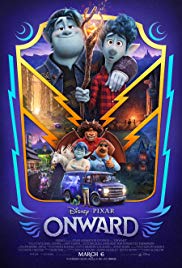
The film opens with a “history” lesson detailing how the world was once populated by enchanted creatures like elves, unicorns, wizards, mermaids, fairies and sprites. Science and technology created shortcuts and soon the world’s “magic” had disappeared, relegating these creatures to life in the suburbs. We pick up the story on Ian Lightfoot’s 16th birthday. Ian is part of an elf family that includes his older brother Barley and their widowed mother Laurel. While Barley is a loud and rambunctious type who is obsessed with the Quest of Yore game and mythology (think Dungeons & Dragons), Ian is a more pensive type who still mourns the late father he never met. Both brothers are surprised when their mother presents a “gift” from their dad – one he left instructions to be held until Ian turned 16. The gift is a magical wizard staff that, with the included precious stone, can bring dad back to life for 24 hours.

Barley’s knowledge of the magical spells combined with Ian’s lack of self-confidence ends up botching things to the point that only half of dad is brought back – the bottom half. Under a tight deadline and in need of a replacement gem to bring dad back for a much desired final conversation, the brothers take off on an adventure that turns pretty wild. Their quest leads them to cross paths with many of the previously enchanted creatures, including the fabulous Manticore, and mom’s boyfriend, Officer Colt Bronco.

We have come to expect ‘magic’ from Pixar with every movie, and this one doesn’t disappoint. It may not be quite as awe-inspiring as some of their best work, but it’s still a terrific suburban fantasy adventure filled with comedy and life lessons … the most crucial of which is: being happy with what you have is more crucial to your inner-peace than getting what you hope for.

As always, the voice acting is top notch. Tom Holland (SPIDER-MAN: HOMECOMING) delivers the goods as Ian, and Chris Pratt (GUARDIANS OF THE GALAXY) brings the necessary wonder and excitement to brother Barley. Julia Louis-Dreyfus never really gets to shine as their mother, but then this story is focused on the boys. Octavia Spencer has fun as Manticore (we needed more Manticore!), Mel Rodriguez is a hoot as Officer Colt Bronco, and yes of course, John Ratzenberger sneaks in – he’s now voiced a character in all 22 Pixar films.

This is the first Pixar film to be totally free of input from ousted President John Lasseter, and it’s one of the very few to be released outside of the summer or awards season. The likely reason is that the studio has a second original film being released this June. SOUL will be directed by Pete Docter and is viewed as a companion piece to the already classic INSIDE OUT (2015). Given the time of year, it could be easy to overlook ONWARD, but it nails the Pixar trademark emotional finale … delivering a sentimental scene likely to stick with you. I have praised Pixar many times over the years as their creative teams really seem to “get it”. Regardless of the month, ONWARD will cast a spell.

watch the trailer:


THE INVISIBLE MAN (2020)

February 27, 2020

 Greetings again from the darkness. I got hooked on “Monster” movies as a kid, and even all these years later, I still get a kick out of them. Of course, with today’s special effects, the look of these films is much different than in the early days. The big challenge for the genre now isn’t how to frighten us or create an awe-inspiring effect, but rather can it capture the charm and appeal of those ground-breaking B-movies? Universal Studio’s Dark Universe got off to a less-than-stellar start with Tom Cruise’s 2017 THE MUMMY. Now, after re-grouping, the fabled Monster studio re-boots THE INVISIBLE MAN … with roots in H.G. Wells’1897 sci-fi novel and the Claude Rains – James Whale film from 1933.

Perhaps their best decision was choosing Leigh Whannell to write and direct. I’m hesitant to mention that Mr. Whannell was a creative writing force behind both the SAW and INSIDIOUS franchises, as some may jump to conclusions on what to expect with this latest. All I can say is that you’d be incorrect to assume THE INVISIBLE MAN falls in line with those previous films. Instead, this film is a psychological thriller in the form of #MeToo vengeance. Whereas the 1933 film featured a brilliant scientist whose invention turned him sour, this contemporary version is told from the viewpoint of a woman who has been abused and controlled by her boyfriend.

When we first see Cecilia (Elisabeth Moss), she is sneaking out of her stunning cliffside home while her boyfriend Adrian (Oliver Jackson-Cohen) sleeps. Within just a few minutes, Ceclia’s escape has taken us on a tour of the home (including a high-tech laboratory), disclosed that she has drugged Adrian, introduced us to her sister Alice (Harriet Dyer), and above all, given us a glimpse at just how terrorized Cecilia feels. The sequence is complemented by a nerve-jarring score from composer Benjamin Wallfisch (BLADE RUNNER 2049).

We flash forward two weeks and find Cecilia taking refuge at a friend’s home, and she remains so paranoid, she is barely able to step outside. As the old saying goes, ‘is it paranoia if they are really after you?’ Her friend is James (Aldis Hodge, CLEMENCY), a stout no-nonsense cop and single dad raising teenage daughter Sydney (Storm Reid, A WRINKLE IN TIME). When it’s discovered that Adrian has committed suicide and, according to Adrian’s creepy attorney brother Tom (Michael Dorman), left millions to Cecilia, she allows herself to celebrate the moment. However, what fun would it be watching her spend and give away money? Instead, the tone shifts and Cecilia’s life becomes unbearable as she is convinced dead/invisible Adrian is torturing her. As you can imagine, this leads to questions about Cecilia’s mental stability, which then leads to more misery and tragedy.

Director Whannell’s brilliant approach and Ms. Moss’ superb performance combine to make this a thrill ride worth taking … it’s the kind where some folks in the audience shout warnings to the characters on screen! It’s difficult to tell which is more frightening, having everyone you know think you have lost your mind, or actually being stalked by an invisible, presumed-dead former abuser who wants you to suffer. Floating knives and physical fights are unsettling, but can’t compare to the tension created by cinematographer Stefan Duscio turning his camera to a blank wall or empty space. Our mind (and Ms. Moss’s face) fill in the gaps with Adrian’s evil presence. This is not a scientist-gone-bad, but rather a madman utilizing his most powerful tool. Having Adrian be an Optics innovator was a contemporary twist that takes us from the science fiction of the 1930’s to the technological world of modern day.

The film was originally going to star Johnny Depp, but it works so much better, and is so much more terrifying, having it told through the eyes of Ms. Moss’ Cecilia. Strangely enough, the movie I kept flashing back to was not the 1933 Claude Rains and Gloria Stuart (64 years later, she played reminiscing Rose in TITANIC) movie directed by the great James Whale, but rather the schlocky 1991 Julia Roberts film SLEEPING WITH THE ENEMY. This is the most fun kind of movie suspense, and what’s scarier than the things we can’t see? It’s nice to have Universal Studios’ monsters back on track, and we have talented filmmaker Leigh Whannell to thank for this “Surprise!

watch the trailer:


UNDERWATER (2020)

January 10, 2020

 Greetings again from the darkness. The opening credits have an “X-Files” look and feel. Newspaper headlines and redacted reports zip by … in fact, the rapid cuts are so quick that very few viewers will be able to keep up. Even if you haven’t finished your Evelyn Woods speed-reading course, the gist is clear: there is a (very) deep-water drilling lab located 36,000 feet below the ocean’s surface. Yep, that’s almost 7 miles deep for the crew of 316, and some mysterious bad things may or may not be lurking. That’s really our only set-up … unless you want to count Kristen Stewart brushing her teeth.

It’s literally less than 5 minutes in when the rig is rocked by an explosion of some kind. We are told the structure is 70% damaged. The survivors are quickly identified. Nora (Ms. Stewart) and Rodrigo (Mamoudou Athie) are together in the immediate aftermath. Nora is a mechanical engineer and computer whiz. They soon come across a co-worker buried in rubble. It’s wise-cracking TJ Miller and his (actual) stuffed bunny. Next up are the Captain (Vincent Cassel) and lovebirds Emily (Jessica Henwick) and Smith (John Gallagher Jr). With no time for early character development, we learn tidbits as their perilous journey hopefully leads them towards rescue. Of course anyone who has ever watched a movie can tell you, they won’t all make it. Maybe the 8 year old girl sitting in the row behind me wouldn’t know that … but no parent should take their 8 year old to a PG-13 movie that has “terror” in the parental warnings.

Director William Eubank and co-writers Brian Duffield and Adam Cozad create plenty of tension, danger and suspense. The movie is at its best when they let the moment speak. It’s the dialogue that is mostly cringe-worthy, as well as the predictable and unnecessary jump-scares. These people are stranded miles deep in the ocean and are running out of oxygen and options … and are being chased by something they can’t identify. The visual effects are successful in generating the environment of danger and claustrophobia.

It’s in the little things where the film falters. When we first see the Captain, he has his arm in a sling. He’s obviously injured. Once the bulky underwater suits are donned, his bad arm seems just fine … he’s even pulling one of the others with a rope! Nora makes a big deal about being the “smallest” of the group and volunteers to explore a narrow passage. The problem is that they are all wearing the same suits – a fact that should negate any advantage of Ms., Stewart’s slim, toned body. Lastly, the film has borrowed heavily from James Cameron’s classic ALIEN. In fact, it has been referred to as “Underwater Alien”. Of course, this film isn’t nearly as well-rounded or complete as that one … but then few are.

Mr. Eubank’s film is a sci-fi/horror mash-up, but it’s really more a survival thriller than science fiction or creature feature, although the sea creatures have their moments. Cinematographer Bojan Bazelli does a nice job in keeping with the ‘play it straight’ approach, and his camera work is complemented by the electronic score from Marco Beltrami and Brandon Roberts. Ms. Stewart and her buzzed blond hair hold their own amidst the danger. A blatant lecture about how we are going places (deep sea) we shouldn’t go and doing things (drilling) we shouldn’t do is included for those who might not figure it out on their own, but mostly we spend our time trying to figure out how to survive the deep sea pressure with little oxygen and no escape pods. Just leave the 8-year olds at home.

watch the trailer:


THE SONATA (2020)

January 9, 2020

 Greetings again from the darkness. A throwback to 1970’s cinema is easy to appreciate, whether it was intended or nor. Writer-director Andrew Desmond’s debut feature film certainly serves up the feel and style of so many of those low-budget horror films I watched as a youngster (many, it seemed, featured the late Roddy McDowall). Mr. Desmond and co-writer Arthur Morin (also his first feature film screenplay) likely viewed some of those same films, as this one succeeds in capturing the same creepy tone.

For some, the music they create comes from their soul … it makes them who they are. For these musicians, their obsession and quest for perfection can be off-putting to others. In an early sequence, we see young violist Rose Fisher (Freya Tingley, “Once Upon a Time”) react to news of her father’s death by shrugging and stating she wants to continue with her recording session. See, Rose’s father deserted the family when she was a toddler, and the two never spoke again. Richard Marlowe (the late great Rutger Hauer) was an exciting and brilliant young composer when he chose to drop out and live as a recluse (think Salinger). He’s even compared to Pink Floyd founding member Syd Barrett. Rose chose to never use her genetics as a springboard to success; never even telling her manager Charles Vernais (Simon Abkarian, CASINO ROYALE) of the connection.

Rose visits Marlowe’s house, and before learning of the startling manner in which his life ended, she discovers his final composition locked away in a drawer … a violin sonata seemingly left for her to find. Neither Rose nor Charles recognize some of the non-musical symbols included on the sheet music, but it’s clear there are elements of genius in the piece. While Charles envisions piles of cash to be made by capitalizing on this situation, Rose sets about tracking down clues to the unknown symbols by exploring her father’s estate.

It should be noted that Marlowe’s “house” is actually the 19th century Cesvaine Palace, and it makes a wonderfully gothic setting for this story. This sub-genre of horror films is always best when the setting is a creepy old mansion/castle, and includes a mysterious housekeeper, other-worldly children, a leather-bound book of secrets, and a subterranean room (this one is beneath a chapel) with curious wall murals telling some forbidden legend of the occult. The only element missing here is vicious dog that pops up periodically.

The symbols lead to a French secret society, and in their own ways, both Rose and Charles learn that finishing Marlowe’s final piece will conjure the Anti-Christ. While Charles pursues greed, Rose pursues the music. Spoken words pale in comparison to the music Rose creates. Screen veteran James Faulkner appears as Sir Victor Ferdinand in a vital supporting role. While it’s a bit disappointing that the late, great Rutger Hauer has very little screen time, it’s quite enjoyable to watch Ms. Tingley carry the lead. Mr. Desmond filmed in Latvia, and delivers a film that fits quite nicely for those who enjoy the creepy throwback horror style.

watch the trailer:


CATS (2019)

December 19, 2019

 Greetings again from the darkness. Director Tom Hooper must really enjoy this process. In 2012 he brought mega-hit stage musical LES MISERABLES to the screen. It was nominated for 8 Oscars and won 3, including one for Anne Hathaway. This time, Mr. Hooper again turns his talents towards a colossally successful stage musical, and costumes, make-up, and visual effects are even more crucial. Whereas Les Mis was adapted from Victor Hugo’s novel, CATS was adapted by songwriter Andrew Lloyd Webber from a 1939 poetry collection of T.S. Elilot. Of course, Mr. Webber is also the genius behind other brilliant musicals, including THE PHANTOM OF THE OPERA (from the novel by Gaston Leroux).

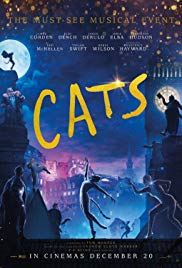
Tom Hooper and Lee Hall have adapted the screenplay from the stage presentation, and the sung-through musical approach means there is minimal dialogue. Songs are used to tell the story and introduce the key characters. Choreographer Andy Blankenbuehler (a 3-time Tony winner, “Hamilton”) is the real star. Multiple dance styles are featured, including: classical ballet, contemporary, hip-hop, and traditional tap. The dancing is tremendous, and of course, a big part of that is Francesca Hayward, who plays new kitten on the block, Victoria. Ms. Hayward is a Principal Ballerina at The Royal Ballet. Numerous other skilled dancers are in the cast as well.

The story (such that it is) revolves around a tribe of Jellicle cats who have an annual ritual of selecting one to ascend to the Heaviside Layer and come back with a new Jellicle life. Sweet Victoria is unceremoniously dumped in the alley by her owner, and is quickly surrounded by this tribe of cats that basically aren’t very nice. It’s in this opening sequence where we realize these humans as cats actually look a bit creepy and take a while to get accustomed to. Given the structure, the story plods along through each successive song, with certain characters getting their moment to shine. These include Rebel Wilson as humorous and chunky Gumbie cat Jennyanydots, Rum Tum Tiger cat played by talented musician/singer/dancer Jason Derulo, Oscar winner Jennifer Hudson as outcast Grizabella, James Corden as the usually-hungry Bustopher Jones, and Oscar winner Judi Dench as Old Deuteronomy.  Always hovering, is the mystical Macavity played by glowing-green-eyed Idris Elba, and making a later appearance is Taylor Swift as Bombalurina, singing the Macavity tribute song.

The two most memorable numbers come courtesy of Ian McKellan as Gus the Theatre Cat, and Ms. Hudson who belts out the most famous song of the production, “Memory”, in a vocal and emotional highlight of the film. Visually, it’s Mr. Mistofelees (Laurie Davidson) magic number that breaks us out of the muted palette. The other musical numbers mostly just fall flat and aren’t very entertaining or enjoyable.

It’s pure coincidence that the screening for this film was the same day as the new Star Wars movie. The franchise for the latter began in 1977, while “Cats” first hit the stage in 1981. That’s quite a legacy for both. As for this film version from director Hooper, I do wonder if enough viewers will respond to a musical where the story and songs are overshadowed by the dancing, and the sets and costumes offer no ‘wow’ factor. Many will find these characters hard to connect with … at least outside of that incredible Jennifer Hudson vocal. It seems these kitties should have remained on stage.

watch the trailer: