BABY DRIVER (2017)

June 29, 2017

 Greetings again from the darkness. If his movies are any indication, writer/director Edgar Wright would be fun to hang out with. He thrives on action and humor, and seems committed to making movies that are entertaining, rather than philosophical life statements. Many know his work from Three Flavours Cornetto trilogy (Shaun of the Dead, Hot Fuzz, The World’s End), while others are fans of Scott Pilgrim vs. the World. High concept, high energy and a creative use of music are identifiable traits within Mr. Wright’s films, all of which are crucial to the success of his latest.

Ansel Elgort (excellent in The Fault in Our Stars) stars as Baby, a freakishly talented getaway driver paying off a debt to a no-nonsense crime boss Doc played by Kevin Spacey. Baby has an unusual movie affliction – a childhood accident killed his parents and left him with tinnitus. He compensates for the constant ringing in his ear by listening to music through ear buds attached to one of his many iPods (depending on his mood). In fact, his insistence on finding just the right song for the moment adds a colorful element to each escape route.

The film opens with what may be its best car chase scene and the hyper-kinetic approach sets the stage for something a bit different than what we usually see. There are no car drops from airplanes or train-jumping (I’m looking at you Fast and Furious franchise). Instead these are old school chases in the mode of Bullitt, or more precisely, Walter Hill’s 1978 The Driver (Mr. Hill appears briefly here as a courtroom reporter). A heist-romance-chase film with a diverse and truly remarkable selection of songs, high energy, more than a few comedic moments (the Mike Myers mask sequence is brilliant) and a recurring Monsters, Inc quote requires a strong lead, and young Mr. Elgort aces the test. Baby is the DJ to his own life, and possesses a moral compass that others on his jobs can’t comprehend. It’s a heart of gold in a bad spot.

Spacey plays Doc with his chilling dead-eyed stare, and even has his own moment of action sporting an automatic weapon during a violent shootout. Spacey’s various crime teams (he varies the pairings) include psycho-lovebirds Buddy (Jon Hamm in his continuing effort to distance from Don Draper) and Darling (Eiza Gonzalez), Jon Bernthal, Flea, and an aptly named Bats (Jamie Foxx), who is not the clearest thinker of the bunch. Other supporting work comes courtesy of the rarely seen songwriter/actor Paul Williams, musician Sky Ferreira (as Baby’s beloved mother), young Brogan Hall as Doc’s talented nephew, and CJ Jones as Baby’s foster father. Mr. Jones is one of the few deaf movie actors and he adds much to Baby’s life outside of crime.

The crucial role of Baby’s love interest goes to the very talented and likable Lily James (Pride and Prejudice and Zombies) as singing waitress Debora, who introduces him to Carla Thomas’ “B-A-B-Y” song, while he plays “Debora” from T.Rex for her. She and Baby share the not overly ambitious life plan: “to head west in a car I can’t afford and a plan I don’t have”. They are good together and that helps make up for the always cringe-inducing red flag of “one last job” prior to the lovers running away together.

Buried in the Miscellaneous Crew is Choreographer Ryan Heffington, who deserves at least some of the credit for the most unique and creative aspect of the presentation. This appears to be a movie fit to the music, rather than music fit to the movie. There are some astounding sequences where the drum/bass beats are right on cue with the action – gunfire, driving, and character movements. “Harlem Shuffle” plays as Baby playfully dances past graffiti and sidewalk obstacles that perfectly match the beat and lyrics. We see what is likely the best ever movie use of “Bellbottoms”, and without question, the most creatively brilliant use of “Hocus Pocus” by Focus. At times exhilarating to the senses, the infusion of comedy shots and new love help offset the tension of crime jobs and the thrill of the chase.

watch the trailer:


THE WOMEN’S BALCONY (Ismach Hatani, Israel, 2017)

June 23, 2017

 Greetings again from the darkness. Religious conflict is not often the source of cinematic comedy, but this Israeli film from director Emil Ben-Shimon and writer Shlomit Nehama provides many laughs to go along with its commentary on religious traditions and the power of women.

It’s tempting to say the film kicks off with bar mitzvah and ends with a wedding, but it’s more accurate to say the bookend community celebrations provide the foundation of meaning for everything else that occurs. The people in this village of Jerusalem are close-knit and mostly happy. They are also religious, though perhaps had become a bit complacent until a near tragic event rattles the core of the congregation.

A young, charismatic Rabbi brings his views that conflict with how the folks in this village have lived and worshipped. A division occurs between the men and women based on such things as scarves covering heads, and women not being allowed in the main area of the synagogue. The backlash has men unable to confront the new Rabbi based on their trust in holy authority, and women banding together for their cause. Understand that the cause is not equality – they aren’t asking to sit with men in the synagogue, only to re-gain their own section. This is a percipient example of the crippling effects of religious beliefs and traditions that lack logical sense.

Is a collapsed balcony a sign from God (as the young Rabbi would have them believe) or an indication of a poorly maintained synagogue (like a long unrepaired broken window)? The Women for Women cause provides humor when they are tag-team negotiating with a contractor, and profundity when they are protesting or conducting an old-fashioned kickstarter – knocking on doors asking for donations.

What makes up religious beliefs? Is it the rituals and traditions, or is it the attitude that builds a close-knit community? The film reminds us to beware of false prophets – a concern that crosses all religions and political standards. The script is stellar and the performances are believable. We care about these people and want their happiness to return … even if it’s in the form of a fruit salad.

watch the trailer:


OAK CLIFF FILM FESTIVAL 2017 recap

June 19, 2017

OAK CLIFF FILM FESTIVAL 2017 recap

 The 6th annual Oak Cliff Film Festival ran June 8-11 and included even more local venues this year … further proof of the organizers’ commitment to spotlighting this unique neighborhood within the monstrosity known as the Dallas-Ft Worth metroplex. Despite the challenging schedule (much overlap, and only one screening per movie), the programming is a gift for true film lovers. I saw ten movies over the four days (it would have been 11 if not for the cluster of Sunday evening – more on that later) and not a single clunker in the bunch. For a festival that prides itself on unusual films and deep cuts, that’s quite a tribute to those responsible.

Below are quick comments on each of the films I watched, and at the end you’ll find some closing commentary on the OCFF.

Thursday June 8 – Opening Night

LEMON – When introducing the festival’s opening night spotlight feature, director Janicza Bravo described her finished project as “a bummer, but not a bummer”. She and her co-writer and lead actor (and real life spouse) Brett Gelman clearly had a great time with the film that took 5 years to complete. It’s an unconventional look at Isaac (played by Gelman), a guy so severely socially awkward that he might lose a two man race for “most likely to succeed” to Napoleon Dynamite.

Isaac’s girlfriend of 10 years (Judy Greer) is blind, and has lost all interest in their relationship. When she dumps him, Isaac’s life somehow becomes even more bizarre thanks to two Tiger finches, his job as an acting teacher, an attempt to get close with an actor (Michael Cera, sporting Gene Wilder tribute hair) and his near-criminal bonding moment with the elderly grandmother (Marla Gibbs) of his new romantic interest (a terrifically confounded Nia Long).

The cast is exceptionally deep for a low-budget indie and also includes Gillian Jacobs, Rhea Perlman, Fred Melamed, Martin Starr, David Paymer, Jeff Garlin, Jon Daly and Megan Mullally. Each of these talented folks offers up a dose of eccentricity to keep us viewers on our toes. There are many laughs to be had, and Mr. Gelman somehow delivers a performance that is a step backwards from deadpan. His walk alone is worth the price of admission, as is the use of such unusual music as “A Million Matzoh Balls”. The film is quite funny, but also a bit sad. Ms. Bravo’s description of her film is spot-on.

PORTO – Last year’s tragic death of Anton Yelchin becomes more heart-breaking every time we see him on screen. This is one of his final films and director Gabe Klinger and writer Larry Gross deliver a Portugal-based quasi-Before Sunrise story that mercifully chooses a much different path than the incessant babbling of that film.

Rather than narcissistic meanderings, this film explores how we deal with memories, as well as the fallout of an intense and short-lived connection formed mostly through a (prolonged and extended) sexual encounter between two otherwise broken people.

The film is divided into 3 sections: Jake, Mati, and Mati and Jake. In addition to the perspectives, the filmmaker utilizes multiple aspects and film formats (8mm, 16mm, 35mm), and we were fortunate to see it presented in 35mm. In addition to the human observations and insight, this is a film techie’s dream come true. So many various looks for a beautifully shot (by Wyatt Garfield) film is extremely rare for a low-budget indie. There is both a retro look and stunning shots such as those with Mati and the red umbrella, and the couple on a bench in the late night fog.

The splendid Lucie Lucas makes her feature film debut as Mati and the camera loves her, as does Jake … or at least he believes he does. She manages to capture both the flirtatious sparkle of the girl who first encounters Jake, and the less-energetic, more resigned to the future look of the woman who has made her life choice.

Toss in a Proust quote, some wonderful piano work, and the beauty of coastal town Porto Portugal, and the result is a piercing look at the fragility of humanity and passion of star-crossed connections.

Friday June 9

GOLDEN EXITS – Director Alex Ross Perry (Listen Up Phillip) conjures up an odd blending of Woody Allen classics Interiors (itself a tribute to Bergman) and Hannah and Her Sisters (with the funny parts removed). The paths of families and characters cross sometimes organically, and sometimes by force. The film was nominated for a Grand Jury award at Sundance, and it features all of the usual relationship traits – insecurity and mistrust, and anything else that leads to disenchantment and unhappiness. Yet somehow voices are never raised and anger seems (mostly) a distant emotion.

Naomi (Emily Browning, Sucker Punch) arrives from Australia and begins working for Nick (Adam Horovitz, former Beastie Boy) on a project to archive his deceased father-in-law’s documents/materials. Nick was hired by the estate trustee and his bitter sister-in-law Gwendolyn (Mary-Louise Parker), and she seems to be less miserable whenever she is busting his chops about the pace of his work – and anything else she can target. Nick receives little support from his wife and Gwendolyn’s sister Alyssa (Chloe Sevigny), who has plenty of reasons to lack faith in her husband. Nick has unpure thoughts regarding Naomi, but she is focused on Buddy (Jason Schwartzman) despite his marriage to Jess (Analeigh Tipton, Crazy Stupid Love).

If it sounds like a mess, it surely is … but it’s also an intricate tapestry of lies, love, jealousy and deficiencies of those in relationships. The film opens with Emily Browning singing “New York Groove”, which perfectly sets the stage for this strong ensemble cast playing cold, reserved characters who talk about seeing films with “normal” people in them – much like this one.

A LIFE IN WAVES (doc) – By opening this documentary with footage of Suzanne Ciani’s appearance on an early David Letterman show, it’s as if director Brett Whitcomb is trying to convince us that she is a celebrity and someone whose story is worth learning. Of course he’s correct, even if her story and career require no added publicity or marketing.

Ms. Ciani is a talented musician known best for her synth music featured in numerous commercials (Coca Cola) and video games. Her innovative sound design and effects may be difficult to categorize (New Age?), but the effectiveness is beyond question. We learn about her mentor Don Buchla (inventor of a 1963 synthesizer), her Wellesley alumni award, and her battle with breast cancer that led to her relocation from NYC to California in 1992. Some amazing archival footage takes us full circle through the three stages of career, and by the end, we are in awe of her talent, and fully admire her as a person.

Saturday June 10

LA BARRACUDA – Stuck with the festival’s least desirable time slot, co-directors Julia Halperin and Jason Cortland still managed to walk away as the Grand Jury Prize Winner – Narrative Feature. Filmed in Austin with Texas Hill Country pacing, the unconventional editing displays the messy legacy left behind by a deceased Country & Western singer of some fame.

The singer’s daughter Merle (Allison Tolman) is living her life of quiet desperation when she is surprised on her own front porch by Sinaloa (Sophie Reid), who claims to be Merle’s half-sister from England. Adding to the mess is Merle’s mother played by JoBeth Williams, who understandably wants little to do with Sinaloa. Ms. Reid plays Sinaloa in such a way that no one ever really knows whether her motivations are pure or vengeful. She’s quite creepy at times.

Musical director Colin Gilmore (son of Jimmie Dale Gilmore) ensures that the music throughout is spot on and crucial to telling the story. A campfire sing-a-long is a real ice-breaker for the sisters who share various mommy issues and daddy issues. Tack on Merle’s fiancé issues and work issues, and Sinaloa’s chip on the shoulder, and the scorpion line (it’ll come back to sting you) proves quite the foreshadowing. The rage within can rise up at any time and within any of us. The only questions are when, by whom and how severe.

TRUE CONVICTION (doc) – The people we tend to pull for in life are those who seemingly always find a way to turn the proverbial lemons into lemonade. Chris, Steven and Johnnie are the ultimate example of this. The three ex-convicts have decades of time served between them, and they also share exoneration after being wrongly convicted.

A Special Award winner at Tribeca, Jamie Meltzer’s film also took home this year’s OCFF Grand Jury prize – Documentary feature. These three gentlemen refuse to lash out at the system that did them wrong, and instead have formed an organization that researches and assists those in the same situation which they once found themselves in – behind bars and wrongly convicted. It’s an admirable cause and a career designed to turn a negative into a positive. We follow different cases as the men meet with a “false confession consultant”, as well as a prosecutor and detective from an old case gone bad. They acknowledge the danger in playing with the hope of convicts, and the film doesn’t shy away from the personal travails of all three. Steve and Chris face severe challenges, while Johnnie looks to start over in life. We never doubt the frustration these men have over the system that favors quick closure over accuracy, and more impressively, we are certain of their passion for their mission.

SANTA SANGRE (1989) – I typically avoid reparatory films at festivals, but made an exception in order to experience an Alejandro Jodorowsky double feature. At its core, this classic from almost 30 years ago is a horror film – and a very good one with the darkest of humor and surreal elements. But it’s also a psychological look at how childhood experiences form our character in life, and that’s not always a pretty sight.

Adan Jodorowsky plays boy magician Fenix, the son of a circus knife thrower (Guy Stockwell) and trapeze performer mother (Blanca Guerra). He befriends a young mute understudy Alma (Faviola Elenka Tapia in her only screen performance) who is horribly mistreated by the Tattooed Lady (a terrific Thelma Tixou). A particularly gruesome scene leaves Fenix traumatized and we then catch up with him some 15 years later (now played by Adan brother Axel Jodorowsky). Linked by witnessing the vivid violence, Alma tracks down Fenix in an effort to make things right for both of them.

Jodorowsky’s visuals are remarkable and are often tributes to those filmmakers he most admires. It’s certainly a movie for adults, but only those adults who are willing to dig in and follow the psychology of events that may seem cruel and meaningless – but often mean a great deal.

ENDLESS POETRY – The second half of the Jodorowsky double feature is the newest film from the famed director and it’s offered as a surreal autobiography – a story of his family and specifically, his time in Chile prior to leaving for Paris. The surreal part comes courtesy of his mother who operatically sings her every line, the head of a water buffalo perched above his parents’ headboard, an ultra modern bar that defies description – outside of the wakes held for customers/staff, and the inclusion of dwarfs and clowns (recurring in numerous Jodorowsky projects).

This is a continuation piece to Jodorowsky’s 2014 Dance of Reality, and features Adan Jodorowsky as the son (and also the film’s composer), and Brontis Jodorowsky as the father. Additionally, Alejandro himself periodically appears on screen in what works as kind of a live narration of his own thoughts during some segments of his life.

Life philosophy permeates every scene and every character. The mother experiences a run of frustration for every good-intentioned cake she bakes. There is an “ultrapianist” to showcase why you never want to invite one to your own party. The red-headed muse is a powerful character that seems to both make and break our protagonist, as does a relationship with a fellow poet, and life in an artist commune. All of these play into Jodorowsky’s apparent ideals of being fully engaged in youth, and then detaching in old age … making up what he calls “the sad joy of living”.

Sunday June 11

INFINITY BABY – Sometimes at film festivals we get a “work in progress”, and at only 71 minutes run time, it’s entirely possible that’s what we saw here – although director Bob Byington made no such claim in his pre or post screening comments. However, his comments and his films make it obvious he very much values comedy and laughter.

Filmed in Austin, two story lines intersect at a company run by Nick Offerman. His nephew and marketing representative is played (exceedingly well) by Kieran Culkin, who is the ultimate example of a shallow, self-centered millennial with commitment issues. His love life is a vicious circle that we witness: he falls quickly and hard for a woman, and then immediately begins finding reasons the relationship won’t work. In what’s supposed to be a test, he has them meet his “mother” (an awesome Megan Mullally) who proceeds to destroy their confidence and belittle their personality – putting an end to any further plans with her “son”. The other story revolves around two lackeys (Martin Starr, Kevin Corrigan) who report to Culkin. Their job is to deliver babies to the customers. What babies, you ask? Well, therein lies the hook.

In the not-too-distant-future, a stem cell experiment has gone awry and resulted in a batch of “infinity babies” that don’t age. Now anyone who has ever been a parent knows full well how frightening the concept of having a perpetual infant seems, so to think anyone would take on this duty for a mere $20,000 is absurd at best. And absurdity seems to be director Byington’s and writer Onur Tukel main objective, especially when we learn the truth behind Culkin’s momma scheme, and as it relates to the two lackeys making what they decide is a wise financial decision.

Also joining the terrific comedy ensemble cast is Noel Wells, Stephen Root and Trieste Kelly Dunn, who is a standout as one of Culkin’s girlfriends. The black and white look plays into the futuristic tale, and having Culkin’s character as one who is stuck in never-grow-up mode finely parallels the infinity baby story. Plenty of laughs here, but just be careful the next time a significant other invites you to “meet my mother”.

THE LITTLE HOURS – It’s not often when the obvious comparison to a movie is the classic 1975 comedy Monty Python and the Holy Grail, and it’s even more unusual for such a film to be making the rounds at festivals where schedules tend to be loaded with serious and dark subject matter. Proving yet again that its programmers aren’t tied to convention, this was the third outlandish comedy I watched at this year’s Oak Cliff Film Festival.

The year is 1347 when writer/director Jeff Baena’s story kicks off outside a convent where it takes less than a couple of minutes to realize that these aren’t your usual nuns. Profanity spews forth, as does laughter from the audience. Dave Franco plays a servant who has a good reason to flee from his King (Nick Offerman) and agree to a cockamamie plan suggested by the local priest (John C Riley). The plan has Franco working at the convent pretending to be deaf mute, while struggling to decline the advances from the aforementioned nuns played by Aubrey Plaza, Alison Brie, Kate Micucci (Unleashed).

Plot is barely an after-thought here, and most of the movie plays like interrelated Saturday Night Live skits. In fact, Fred Armisen and Molly Shannon are part of the ensemble, along with Paul Reiser and Adam Pally. Raunchy medieval comedies filled with debauchery and outrageously misdirected nuns could be classified as a bit of a stretch; however, Mr. Baena has adapted this from Giovanni Boccaccio’s “The Decameron”, and his use of modern day dialogue and attitudes, delivered by an ultra talented comedic cast, makes this one to watch after a particularly rough day or week of work. You’ll surely laugh and enjoy the temporary reprieve from real life … even without any killer rabbits or Knights who say “ni”.

A GHOST STORY – though this was #1 on my list of films to see during the festival, an extremely long line penalized those of us who watched the movie immediately preceding the screening. So even though I’ll have to catch this one later, the crush of humanity awaiting entry was a reminder that the OCFF has arrived.

Conclusion

This year’s Oak Cliff Film Festival gave every indication that the previously little-known neighborhood event had officially grown into a full-fledged nationally recognized festival. Of course, with that comes the good and the bad. In the positive column, a diverse and sought-after programming schedule now includes some films from large festivals (Sundance, Toronto), and also ensures the attendance of many writers, directors and producers. The challenges brought by success include crowd size that is difficult to manage … long lines for drinks, concessions and theatre entry, and of course, the cluster brought on by the closing night film and the penalty for those in the previous screening. On the whole, it’s wonderful to see such devoted folks finally receiving the recognition they deserve for building this dynamic event from scratch in a neighborhood they have helped revitalize.


THE HERO (2017)

June 17, 2017

 Greetings again from the darkness. It’s considered bad form to gush over a film or actor during a review, but come on … it’s Sam Elliott, dripping masculinity from his signature mustache – beloved by men and women alike. Writer/director Brett Haley (I’ll See You in My Dreams) offers up not just a rare lead role for Mr. Elliott, but also one that seems to closely parallel his actual 45+ year career.

Aging western actor Lee Hayden (Elliott) opens and closes the film in a sound booth, progressively more annoyed at each of the director’s requests for just ‘one more’ take on his voiceover for a BBQ commercial. What happens in between will likely be judged by critics as one cliché after another, but it’s also the chance to see an actor north of 70 years old fight through a wide range of emotions and situations, each grounded in struggles many of us will face at some point in our lives.

When the doctor delivers the worst possible news regarding a recent biopsy, Lee has every intention of telling his ex-wife (the rarely seen these days Katharine Ross, Elliott’s real life wife of 30+ years) and estranged daughter (Krysten Ritter). Neither attempt goes well, and instead, Lee finds himself on the sofa of child actor-turned-drug dealer Jeremy Frost (an admirable stage name for Nick Offerman’s character) toking on a joint and watching classic silent films. In fact, the recurring themes of beach, blunt, bourbon and Buster (Keaton) are there to solidify the notion that Lee is a creature of habit, and it’s meeting Jeremy’s customer Charlotte (Laura Prepon) that finally jolts him back to life.

Charlotte is a stand-up comedian and would-be poet who has an unusually accelerated attraction to older men. Of course, she can’t resist Lee, and a May-December romance develops in his last chance at happiness (cliché number 7 or 8, I lost track). Charlotte accompanies him to an event where an obscure group of western film lovers is presenting Lee with a Lifetime Achievement award, and she also becomes somewhat of a life adviser – counseling him to come clean with his family. To ensure no viewer misses out on the sentimentality, Charlotte recites the poems of Edna St Vincent Millay and reminds us all that buying more time is usually the right call.

As Lee and Jeremy munch on Chinese food after the cloud of smoke has cleared, Lee has a great rebuttal to Jeremy balking at hearing his story: “A movie is someone else’s dream.” That sentiment is something I try to hold onto whenever reviewing a movie, as it’s important to remember that it’s the artist (writer, director, actor) who is taking the risk by putting their work on display. It also fits in with the theme here of finding one’s place – putting one’s legacy in order. Contemplating morality and softening regrets are natural steps to take, and each of us should make it easier for those trying. So, scoff at the sentimentality and clichés if you must, but the messages here are loud and clear and important.

Although I had previously seen him (oh so briefly, accusing Redford of cheating) in Butch Cassidy and Sundance Kid (1969), and then again in the late night cult classic Frogs (1972), it was his breakout role in Lifeguard (1976) that made me a Sam Elliott fan for life. Depending on your age, your introduction to his screen presence might have been as Cher’s biker boyfriend in Mask (1985), Patrick Swayze’s pugilistic partner in Roadhouse (1989), Virgil Earp in Tombstone (1993), the wise stranger at the bowling alley in The Big Lebowski (1998), the Marlboro Man in Thank You for Smoking (2005), delivering a gut-punch as Lily Tomlin’s former lover in Grandma (2015), or as Timothy Olyphant’s nemesis in “Justified”. Elliott is the paradigm for the pregnant pause, and combined with that baritone drawl, ultra cool demeanor, bushy mustache, and head-cocked-at-an-angle glance, he undoubtedly won you over to believe him in whatever role it was … because that’s how icons become icons.

Paraphrasing a line in the film: the Sam Elliott voice can sell anything – pot, bbq, Dodge, clichéd roles – and I happen to be buying (gushing).

watch the trailer:


BEATRIZ AT DINNER (2017)

June 16, 2017

 Greetings again from the darkness. The movie industry frequently sources societal worries, concerns, issues and hot topics. It’s been less than 6 months, but here come the anti-Trump movies. Of course some will have clever disguises for their message, while others will slap us across the face. This re-teaming of The Good Girl director Miguel Arteta and writer Mike White actually uses both approaches.

Salma Hayek stars as Beatriz, a masseuse and holistic healer, who comes awfully close to being an angel on earth … unless she’s guzzled a bit too much white wine at your dinner party. Beatriz fights southern California traffic in her clunky VW as she rushes from her gig at the cancer center to Cathy’s (Connie Britton) Orange County cliffside mansion. See, Cathy is hosting a dinner party for her husband’s (David Warshofsky) business associates and she simply must have her massage prior to such a stressful event – after all, she did plan the menu. When Beatriz’s car stalls in Cathy’s driveway, she is invited to stay for the dinner party.

Things get awkward once the actual guests arrive. Alex (Jay Duplass) and his wife Shannon (Chloe Sevigny) are the young, entitled types so enticed by the fancy house and global traveling lifestyles on which they are on the brink. It should be noted that Mr. Duplass cleans up nicely and Ms. Sevigny spends much of the movie smiling – a look for which she’s not normally associated. The real squirming occurs once Doug Strutt (John Lithgow) and his shallow third wife Jenna (Amy Landecker, “Transparent”) arrive.

Beatriz and Strutt are polar opposites with contrasting lifestyles and character. She is a mystical presence with a deep connection to Mother Earth and all living beings. He is the Trump-like figure – charismatic, manipulating and laser-focused on the brass ring. She coddles her pet goat in her bedroom to protect it from a crazy neighbor, while he ignores the rare birds nesting on the valuable land he wants scraped for his newest development.

It’s by no means a superhero movie, but Beatriz is presented as a Mexican-born working class (minimal make-up, functional clothing and shoes) Wonder Woman, while Strutt is the ultra villain out to destroy the planet, one rhinoceros at a time. She views him as “The Source” of Earth’s pain, while he tries to laugh her off as a novelty act. It’s Cathy and her husband who are most taken aback by the direct words of Beatriz, as they have considered her a “family friend” since she helped their daughter through a health scare. How dare she spoil their dinner party!

There is a beautiful aerial shot of the Orange County mega-mansions, but most of the uncomfortable moments are derived through the ongoing duel of angelic Beatriz vs. the poisonous topics of politics and profit. There is no subtlety in the message, but having two talented actors go head to head, does make it more palatable.

watch the trailer:


THE JOURNEY (2017)

June 16, 2017

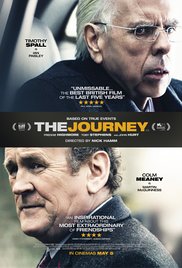
 Greetings again from the darkness. Only the rarest of fiction can match the depth and intensity of historically crucial watershed moments. A list of such moments would certainly include the 2006 St. Andrews Agreement that ended 40 years of violent civil war between the Unionist and Republican factions of Northern Ireland. Director Nick Hamm and writer Colin Bateman team up to bring us a speculative dramatization of the conversation that ‘might’ have led to the treaty.

Timothy Spall plays Reverend Ian Paisley, leader of the Unionists and an anti-Catholic evangelical minister. Colm Meaney plays Martin McGuinness, the rebellious former IRA leader (“allegedly”, he clarifies) who leads the Irish Republicans (Sinn Fein). These two extremists have been at war for most of their lives, yet had never met until circumstances brought them together for negotiations.

One’s take on the film will likely be determined by the level of need for historical accuracy and any personal connection to long-lasting war in Northern Ireland. Either of these traits will likely have you scoffing at the backseat verbal sparring and the plot contrivances that allow the two mortal enemies to slowly break down the ideological barriers. On the other hand, it can be viewed as a mis-matched buddy movie featuring a game of witty one-upmanship with political and historical relevance.

Either way, the dueling actors are a pleasure to watch. Mr. Spall surely has the more theatrical role, and he revels in the buttoned-up judgmental nature of Paisley – a man loyal enough to be attending his 50th wedding anniversary party, and sufficiently devoted to his beliefs that his last visit to a movie theatre was in 1973 as he led the protests against The Exorcist. In contrast, Mr. Meaney plays McGuinness as both determined to find common ground and worn down by the years of fighting and lack of progress.

Toby Stephens plays Prime Minister Tony Blair, while Freddie Highmore is the young driver charged with surreptitiously igniting conversation between the two rivals. He is fed instructions through his ear-piece by an MI5 director played by John Hurt, in one of his final film appearances. Unfortunately, this bit of “narration” came across as condescending to this viewer who surely could have done without such elementary guidance. Still, the sight of Mr. Hurt on film is always welcome.

The infusion of humor is nearly non-stop. There’s a comical exchange about Samuel L. Jackson, a joke about the Titanic, and a Paisley diatribe at a gas station over a declined credit card that would easily fit in most any Hollywood buddy flick. However, these elements undermine one of the early on screen interviews we see when a citizen states bombs going off as you walk down the street is “part of life”. “You can almost taste the hatred” is a great line, but unfortunately doesn’t match the script of what we witness on screen. The two men re-hash some key events such as 1972’s Bloody Sunday, and it’s these moments that remind us just how important this new agreement was to the country. It’s understandable (and relevant today) how 40 years of hate can become a way of life and difficult to end, and it also shows us just how far actual communication can go in finding common ground between folks … even The Chuckles Brothers.

watch the trailer:


CHURCHILL (2017)

June 4, 2017

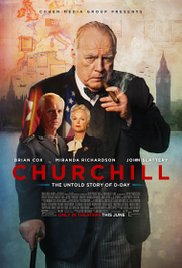
 Greetings again from the darkness. Well, well. The image to most of Winston Churchill is epitomized by his nickname, The Lion of Britain. Undeniably one of the most iconic historical figures of the last 150 years, there have been volumes of articles and books and movies documenting his important role in so many moments that shaped our modern world. Director Jonathan Teplitzky (The Railway Man) and writer Alex von Tunzelmann (she herself a British historian) take us behind the public façade and into the personal doubts and fears … even literally into his bedroom and the middle of his marital spats.

Brian Cox takes on the role of Churchill, and seems to relish more than the ever-present stogie and its lingering smoke. He captures many of the physical traits and movements, while employing his stage-trained voice in an exceptional reenactment of the infamous and impassioned D-Day radio speech. Complementing his performance is Miranda Richardson as Clemmie Churchill, the strong and diligent great woman behind the great man.

Most of the film takes place in the four days leading up to the June 6, 1944 Allied Forces invasion of Normandy, known of course as D-Day and Operation Overlord. At the time, Churchill was almost 70 years old, and what we see here is man teetering between past and present while cloaked in an almost paralyzing fear stemming from the 1915 Gallipoli debacle. He is presented as vehemently opposed to the Normandy invasion, though most documentation shows his initial resistance from (1941-43) had subsided, and he was fully on board by this time.

Although the ticking clock throughout the film leads to the invasion, this isn’t a war movie per se, but rather a peek at the human side of leadership in a time of crisis. Ask yourself if you could readily order tens of thousands of young soldiers to face slaughter, especially after you had experienced such tragic results a still-fresh-on-the-conscience 29 years earlier.

John Slattery (“Mad Men”) plays General Dwight Eisenhower, the Supreme Allied Commander (and future President of the United States) and he more than holds his own in scenes with Cox/Churchill. Julian Wadham plays Bernard Montgomery, the Spartan General. He was over all Allied ground forces and accepted Germany’s surrender in 1945. Taking on the role of British Field Marshal Jan Smuts (also the Prime Minister of South Africa) is Richard Durden. Having the thankless job of trying to keep Churchill on track, Smuts was the only person to sign the peace treaties for both WWI and WWII, and later established the League of Nations. James Purefoy does a really nice job as King George VI (replete with minor stutter), and Ella Purnell (Emma in Miss Peregrine’s Home for Peculiar Children) shines as Churchill’s bright-eyed new secretary, and invested British citizen.

The best scenes are between Winston and Clemmie, and those where he fine-tunes his remarkable speeches. At times the film veers into near-caricature mode, but manages to right itself thanks to the counsel and wisdom of two strong women. Later this year, Atonement director Joe Wright will present Darkest Hour, with the great Gary Oldman as Churchill, and it’s likely to feature more politics and acts of state. Despite the blustering and sense of “losing it”, all is well when the D-Day speech is delivered. It’s so much more than words on the page. Well, well.

watch the trailer:


BAND AID (2017)

June 1, 2017

 Greetings again from the darkness. “Where words fail, music speaks.” Danish author Hans Christian Andersen wrote those words more than 150 years ago, and he surely never imagined a 21st century California couple would prove true the adage. Zoe Lister-Jones (a regular on TV’s “Whitney”) has been acting regularly since 2004, and this is her first “all in” film project where she is writer/director/producer/lead actress. Her talent as a writer is evident in a topic assumed close to her heart: thirty-something angst.

Ms. Lister-Jones stars as Anna, a disenchanted Uber driver who is married to super slobby slacker Ben played by Adam Pally (Slow Learners, 2015). These two seem perfectly matched – or would be, if not for the constant bickering over anything and everything. Before you assume this is a remake of the ultra-depressing Revolutionary Road (2008), please note that the two leads are incredibly funny people and masters of witty one-liners. They make marital squabbles quite entertaining, once they decide to form a band with the sole purpose of singing their arguments.

Admittedly, it’s a shaky premise, but these two manage to pull it off with help from neighbor/drummer/sex addict “Weird Dave” (Fred Armisen). Along the way, they take shots at their friends’ exuberance over babies, the Holocaust, a kid named ISIS, pizza, dirty dishes, a mousetrap, sex, drugs, and art. They even bring levity to a marriage counseling scene featuring Retta (“Parks and Recreation”).

Just as impressive as the humor is how the film balances the drama associated with lingering depression tied to the trauma of a miscarriage. This and the couple’s inability to communicate their emotions are what drive their marital challenges. For a short time, the ‘argument music’ seems to improve their relationship, but it’s obvious that the real issue must be dealt with. Enter Ben’s mom (Susie Essman), whose only scene serves the purpose of explaining women to Ben and all the dumb guys in the audience.

There are actually quite a few familiar faces (many with ties to “Life in Pieces”) that appear in only one or two scenes: Chris D’Elia, Ravi Patel, the aforementioned Retta, Majandra Delfino, Jesse Williams, Colin Hanks, Brooklyn Decker, Erinn Hayes, Jamie Chung, Hannah Simone, and Angelique Cabral. These quick hit scenes serve as a dose of reality, as “moments” are what make up life … even if many interactions are “crazy” (D’Elia) or creepy (Williams).

The film was well received at Sundance, and it immediately marks Zoe Lister-Jones as a filmmaker to watch. Her comedic presence is a rarity, and is complimented nicely by her musical talent, and her willingness to hit serious topics head-on. Here, she offers a woman’s perspective on having kids, being questioned about having kids, and traditional women’s roles within society and marriage. Her inspired observations (a spontaneous jam session at the kid’s birthday party) are a welcome addition to today’s cinema, while also offering a west coast contrast to east coast indie film.

watch the trailer:


PAST LIFE (2017)

June 1, 2017

 Greetings again from the darkness. Renowned Israeli filmmaker Avi Nesher tackles the familiar topic of Holocaust survivors and drops in a related family mystery, two dueling and personality-opposite sisters, plus numerous sub-plots including: arguing spouses, musical sexism (it’s a thing), cancer, and a cross-country investigation. The film was inspired by the autobiography of Dr. Baruch Milch, who is the father of the rival sisters and whose past actions are at the core of the investigation.

It’s 1977 West Berlin, and after successfully performing a solo during a concert, no singer wants to be grabbed by a crazy-eyed old lady and accused of being the daughter of a murderer … an act exacerbated by the fact that the accusation is in a language she doesn’t understand. This is exactly what happens to young Sephi Milch (played well by Joy Rieger, who reminds of a late 1970’s Amy Irving). It’s an unsettling moment for Sephi and when she mentions it to her dissident older sister Nana (Nelly Tagar), who also happens to be a journalist/editor, the girls unite for an investigation that will take them deep into the mysterious past of their father.

The sisters of conflict are never really on the same page, as Nana is relentless in pursuit of the truth while the more reserved Sephi can’t see the benefit to uncovering something that could tear the family apart. Also, Sephi is focused on her dream of becoming the first respected female classical composer in history. In an odd twist of fate, it’s the son of the accusing crazy lady who is instrumental (apologies for the pun) in helping Sephi purse her goal. Thomas Zielinski (played by Rafael Stachowiak) is a well known conductor who is either a creepy guy (with an even creepier mother) with amorous intentions toward Sephi or a generous guy in a position to help the rising star.

The story could have been interesting enough with this foundation, but it becomes cluttered with side stories that actually bog down and divert our attention from what we care about. Doron Tavory plays Dr. Baruch Milch, and though his being a lousy father doesn’t make him a murderer, it certainly allows for doubt in both the girls and the audience. Often, the film feels like a jigsaw puzzle with missing pieces … or worse, including pieces from a different puzzle.

Taking place at a time when Egyptian President Anwar Sadat was working towards a peaceful accord with Israel, the film also acts as a reminder that war pushes people into actions that might be out of character, yet necessary in the moment. Should these digressions be forgiven or become one’s lingering shadowy legacy? The clashes with past and present, historical and modern, confuse these issues and divert our attention away from two sisters trying to understand the impact of their father’s actions during WWII on their family today. The rest is just noise … disguised as beautiful music.

watch the trailer:


WINE TASTING (2017)

June 1, 2017

 Greetings again from the darkness. The film isn’t likely to teach you much about wine, wine history or even wine tasting (despite the title), but at least you won’t have to watch Paul Giamatti guzzle the spit bucket. Director Josh Mitchell and writer Justin Samuels have combined on this look at four friends studying for the Master Sommelier exam, as well as how their friendship is impacted by the results.

The opening scene finds the four lads drilling blindfolded for the tasting section. When they are told their answers are “not even close”, we realize there is a bit of humor mixed in with the highly stressful process that requires years of studying and practice (and a high failure rate). It’s also our first indication that the film is a bit stagey, and that the cast may not have the acting chops we are accustomed to seeing on the silver screen. However, this is not a factor of effort, as everyone involved seems committed to their roles and the project.

The director Josh Mitchell plays Mateo, a chef who finds support not just with his buddies, but also with an understanding girlfriend played by Alysa Scanzano. Jesse O’Neill plays John, who tries to handle the stress and long hours with a boost from cocaine; while Josh Thrower portrays Ed, the wine taster who succumbs to alcoholism after his girlfriend dumps him. The most colorful character of the four is Franco, a rowdy and opportunistic Serbian played by Vanja Kapetanovic. These four toss around the “dude’s” and “bro’s” at a pace that would make any stoner movie proud.

The film is at its best when focused on the pressure of preparing for the exam, and it’s the second half that reminds us of the power of friendship … though it leans a bit heavy on dude-drama. The Jason Wise documentary Somm (2012) provides a more detailed, behind-the-curtain look at what it takes to become a Sommelier, and of course, Sideways (2004) and Bottle Shock (2006) are the two best known films centered on wine tasting and wine competition, respectively. While this one isn’t at the level of those films, its description of “fire hose of information” and the relentless studying and commitment to the cause, do hit home.