Greetings again from the darkness. There is a fine line between getting chewed out by your Costco supervisor one day and having the country claim you as a hero the next. Just ask Jeff Bauman. On April 15, 2013 Jeff was near the finish line for the Boston Marathon, holding a handmade sign in support of his runner-girlfriend Erin. When she was still about a mile away, the two bombs went off, killing three people and injuring hundreds. Mr. Bauman lost his legs that day.
When Jeff regained consciousness in the hospital (after two surgeries), he was able to provide the FBI a detailed physical description of one of the bombers. His information led directly to the identification of one of the scumbag brothers responsible for this atrocity. Immediately, Jeff was hailed as a hero – both locally and nationally. The film does a nice job of telling Jeff’s story and how his life unfolded over the next few months.
Director David Gordon Green is responsible for such disparate film projects as OUR BRAND IS CRISIS, MANGLEHORN, and PINEAPPLE EXPRESS. He may seem an odd choice to adapt the film from the book by Jeff Bauman and Bret Witter (screenplay by John Pollono), but the story is so moving and heart-warming, and the three lead actors are so good that we immediately connect with each of them.
Jake Gyllenhaal plays Jeff, Tatiana Maslany (“Orphan Black”) plays Erin, and Miranda Richardson tears up the screen as Jeff’s mother, Patty. Mr. Gyllenhaal is remarkable (as usual) as the working class local boy who truly believes his lucky seat and beer determine success or failure for his beloved Bruins and Red Sox. His initial portrayal is spot on for the normal guy who seems caught in the web of eternal teenage mentality so common in the male species. As he struggles with his new life challenges, he strives to do better, but simply doesn’t understand why he is viewed as a hero … and doesn’t particularly embrace what comes with the label, at least early on. Ms. Maslany is terrific as the guilt-ridden, confused-yet-strong, on-again-off-again girlfriend to Jeff. She fights through being treated as an outsider by the family, and the daily grind of caring for a guy who needs constant help. The twice Oscar nominated Miranda Richardson is unlike we have ever seen her on screen. Despite being a Brit, Ms. Richardson captures the Boston sauciness (in more ways than one) and takes no ‘stuff’ from anyone. Her performance is stunning.
Of course, at its core, this is an inspirational story about how a normal guy became a hero after a tragic event. The recent Mark Wahlberg film PATRIOTS DAYfocused on the aftermath and investigation, while here the attention is on the emotional story of one man and one family. We see the recreation of the flag-waving at the Boston Bruins game, and the ceremonial first pitch at Fenway Park. We also see the obstacles faced when rehabilitation and care-giving becomes too much to bear. Carlos Arredondo and his cowboy hat and heroics are also given much-deserved space here. His back story is heart-breaking, and a reminder that everyone has a story, and each of us can be a hero in some way. Since life isn’t a movie, the realities are that Jeff and Erin have since divorced, but that in no way reduces the impact of their touching story that inspires each of us to be stronger.
Greetings again from the darkness. Mid-life crisis has long been a popular movie topic. A list of the best would include: Fellini’s 8 ½,Blake Edwards’ 10, AMERICAN BEAUTY, CRAZY STUPID LOVE, SCENES FROM A MARRIAGE, THE BRIDGES OF MADISON COUNTY, THE SEVEN YEAR ITCH, and THELMA & LOUISE. Some of these are outright comedies, while others are turbulent dramas. With the label ‘white male privilege’ being applied so broadly these days, it’s impressive how writer/director Mike White (THE GOOD GIRL, SCHOOL OF ROCK, creator of TV’s “Enlightened”) so expertly and gracefully takes on the familiar topic.
Ben Stiller stars as Brad Sloan, a married man raising a teenage son and running a Non-Profit Organization in middle-class Sacramento. As Brad and his son Troy (Austin Abrams, PAPER TOWNS) embark on an elite northeast college visitation trip, we get the sense that Brad is only now waking up to his son’s rapid approach to adulthood and remarkable talent as a student and musical prodigy. This happens congruently to Brad’s mid-life realization that his own college buddies are richer and more famous than he. Self-loathing, insecurities and concern over the jealousy he feels towards his own son are the focus of Brad’s inner thoughts, which we hear courtesy of his narration.
Brad’s college friends who are unknowingly driving his defeatist attitude include: Jemaine Clement as Billy Wearsiter who retired in Hawaii at age 40 after selling his tech company; Mike White (the film’s director) as successful movie director Nick Pascale whose house is featured in Architecture Digest; Luke Wilson as hedge fund manager Jason Hatfield who married into money; and Michael Sheen as Craig Fisher, a best -selling author and frequently seen on TV political commentator. In comparison, and by today’s societal levels of achievement, Brad views himself as a failure – a man whose early idealism didn’t change the world, and instead prevented him from reaching the capitalistic heights of his friends.
There are a couple of elements that allow the film to work. First, Ben Stiller softens his usual snark, making him more relatable than his usual woe-is-me character. Next, the film isn’t as harsh on the white man as we’ve come to expect. There is no feeling sorry for Brad, but there is at least compassion … space for him to explore what he’s feeling and take stock in his life. The difference maker is Mr. White’s script. The underside of human nature is explored with a deft comedic touch and incisive societal observations.
Stiller’s tightly wound Brad contrasts with Troy’s easy-confidence leading to some unusual father-son scenes. When Troy questions whether his dad is having a breakdown, we understand that the existential crisis is actually fairly common. We certainly enjoy watching as Troy’s Harvard friend, and fellow musician Ananya (Shazi Raja) listens patiently before slapping Brad with the dose of reality he so desperately needs. Ananya’s beyond-her-years wisdom leads Brad to a moment of self-awakening during her concert of Dvorak’s “Humoresque”. Ms. Raja’s role is given much more weight than that of Jenna Fischer as Brad’s wife/Troy’s mother, who inexplicably only appears about every 20 minutes as a check-in during the boys’ trip.
Keeping up with the Jones is a no-win approach to life, and if a Hollywood film can help a few more people understand this, then it’s a beneficial way to spend a couple of hours. The Mark Mothersbaugh score has a sharpness to it that mirrors Brad’s tarnished idealism and search for self. We are reminded that normal insecurities can blow up if we focus too much on what others have, and not enough on what we do.
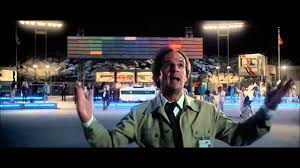
Greetings again from the darkness. Despite my fascination and quasi-obsession with movies, the Science Fiction genre has never really appealed to me. Sure, there have been a few dozen exceptions over the years (and it depends how you categorize certain movies), but it’s the non-classics in the genre that just never seem to connect with my love of film. So when Steven Spielberg states that he doesn’t consider his beloved CLOSE ENCOUNTER OF THE THIRD KIND(CE3K) to be a “sci-fi” film, you won’t see me get offended, or even offer a contrary argument. Of course, the difference is that Mr. Spielberg makes his claim based on his belief of life “out there”, while I simply have no desire to defend the category label.
For its 40th anniversary, the film is making the rounds in selected theatres, and the big screen is a must for this gem. Released in the same year and just a few months after George Lucas’ groundbreaking STAR WARS, Spielberg’s follow-up to JAWSconfirmed his status as a revolutionary filmmaker, and cemented 1977 as one of the finest movie years of all-time (including ANNIE HALL, SATURDAY NIGHT FEVER, A BRIDGE TOO FAR, JULIA). CE3K would become the first of 7 Best Director Oscar nominations for Spielberg (inexplicably only one win to date).
Spielberg is credited as the writer, though many contributors are “uncredited”: Hal Barwood (now known for video games), Jerry Belson (Emmy winner for “The Odd Couple” and his work with Tracey Ullman), and John Hill (QUIGLEY DOWN UNDER), and Matthew Robbins (CRIMSON PEAK). Paul Schrader and Walter Hill also contributed to the script, making this the veritable vegetable soup of screenplays. The film came at a time when Columbia Pictures was struggling, so in order to remain under budget, Spielberg had to make some compromises on the final version. In a highly unusual development in the movie industry, Spielberg was able to revise, re-edit, and add new scenes to a 1980 re-release of the film – realizing his original vision.
Richard Dreyfuss stars as Roy Neary, a blue collar family man from Muncie, Indiana. With an acting career spanning more than 50 years (many recognize his baby face in THE GRADUATEas he offers to call the cops), it was AMERICAN GRAFFITIthat caused his career to take off, leading to JAWS in 1975, and his stellar 1977 with both CE3K and THE GOODBYE GIRL. He later overcame a severe drug habit to star in such crowd favorites as WHAT ABOUT BOB?,MR. HOLLAND’S OPUSand “Madoff”. His wife Ronnie in CE3K is played by Teri Garr, whose acting career also covers more than 50 years, including small roles in five different Elvis movies in the 1960’s and her best known roles in YOUNG FRANKENSTEINand TOOTSIE (for which she received a Best Supporting Actress Oscar nomination). In recent years, she has had to turn her energy and attention to health issues.
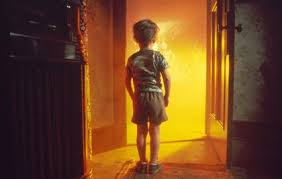
Melinda Dillon stars as Jillian, mother to young Barry (Cary Guffey) who is abducted by the aliens. Ms. Dillon received her first (of two) Oscar nomination for her work in the film, and is still seen annually breaking a leg lamp in the holiday favorite A CHRISTMAS STORY, although she retired from acting ten years ago. Young Mr. Guffey is now 45 years old and hasn’t acted since 1985. Director Stanley Kubrick considered him for the role of Danny in THE SHINING, but ultimately decided on Danny Lloyd, another youngster who decided against remaining in showbiz.
Francois Truffaut was an Oscar nominated director known for kicking off the French New Wave of Cinema with his all-time classics THE 400 BLOWSand JULES AND JIM, and it was quite surprising to see him cast in the role of UFO expert Claude Lecombe. It’s likely that cinephile Spielberg loved the idea of working with a peer whose work he so admired. Truffaut is a significant screen presence despite his challenges with the English language (which led to “dialogue cheat sheets” throughout filming). Bob Balaban, so familiar to “Seinfeld” fans, plays the translator, while Justin Dreyfuss (Richard’s real life nephew) is the noisy and obnoxious son during the hectic family scene. Roberts Blossom is the one in the film who admits to spotting Bigfoot, and is best known as Kevin’s neighbor in HOME ALONE and the braced-up car seller in CHRISTINE. He was also a well-respected poet before passing away in 2011. Other familiar faces include Lance Henrikson (ALIENS), George DiCenzo (BACK TO THE FUTURE), Carl Weathers (ROCKY), CY YOUNG (OK, more a name than a face), Bill Thurman (Coach Popper from THE LAST PICTURE SHOW), and gas mask salesman Gene Rader, who hails from Paris, Texas.
Desert discoveries are a key here, and offer more insight into Spielberg’s attention to history. The “lost” plane is a tribute to real life Flight 19 which disappeared in 1945, and The Cotopaxi was a real cargo ship that sunk … both becoming part of Bermuda Triangle lore. Devil’s Tower in Wyoming is also significant here, and it’s Spielberg’s nod to John Ford’s frequent use of Monument Valley in his westerns. Spielberg has admitted to watching Ford’s THE SEARCHERSdozens of times while filming CE3K. Another tribute comes in the form of a wind-up monkey with cymbals. It was previously seen in REBEL WITHOUT A CAUSE, and can also be viewed as a precursor to the infamous clown in POLTERGEIST.
Spielberg acknowledges being inspired by President Nixon and the Watergate scandal. He wondered what else the government might be hiding from us. Remarkably, he gets his point across with a total absence of modern day cynicism. As opposed to what we usually see these days, the military isn’t trying to bomb the mothership and citizens aren’t retreating in a panic to bunkers. Instead, the military is working to keep the public safe (albeit through some sneaky strategy), the scientists are approaching communication through a protocol steeped in research and data gathering, and Dreyfuss and Dillon are trying to figure out why they were “chosen”. Spielberg delivers sweetness and warmth rather than a show of power and might. It’s such a pleasant viewing experience to watch people we like and to whom we can relate.
Some points of interest related to the film include a cameo from famed UFOologist J Allen Hynek, who is seen smoking a pipe as the abductees are released from the mothership. Mr. Hynek actually created the phrases Close Encounters of the First, Second, and Third Kinds. ABC news anchor Howard K Smith is seen since CBS would not grant permission for Walter Cronkite to appear. The film’s stunning visual effects come courtesy of Douglas Trumball, who also collaborated with Stanley Kubrick on 2001: A SPACE ODYSSEY. Of course, the Visual Effects Oscar that year went to STAR WARS, and that speaks to the contrast between the films. STAR WARSis clearly a special effects movie, while CE3K is much more of a character study … a study of human emotions.
As for other Oscar categories, the film was nominated for 9 total, with the only win going to Cinematographer Vilmos Zsigmond, though it was also awarded a Special Achievement Oscar for Sound Effects Editing. Spielberg was nominated, but Woody Allen won Best Director for ANNIE HALL, and Richard Dreyfuss actually won the Best Actor Oscar that year for THE GOODBYE GIRL. The great John Williams was of course nominated for his iconic 5 note melody (following up his immortal JAWS theme), and he instead won the Oscar that year for … repeat after me … STAR WARS. A quirky note on the music – the “voice” of the mothership was a tuba, not an instrument that typically gets much publicity.
While Stanley Kubrick opted not to show aliens in 2001: A SPACE ODYSSEY, this film not only puts the aliens front and center, it reminds us to keep an open mind to those unfamiliar to us … a lesson that is still important today. The film was named to the National Film Registry in 2007, and seeing it on the big screen allows for the full impact of awe and wonderment. It’s rated PG and can be enjoyed by most ages. Spielberg only asks that you leave the cynicism at home.
Greetings again from the darkness. A nice story set-up is always welcome, and this one delivers a creative attention-grabber that draws us in pretty quickly. Brothers and long-time filmmaking collaborators Jean-Pierre Dardenne and Luc Dardenne (TWO DAYS, ONE NIGHT, THE KID WITH A BIKE) edited the film a bit after its Cannes screening, and the result is a quiet little whodunit with an interesting lead actress performance.
A doctor and her intern have a disagreement at closing time, and opt not to answer the clinic door when a young lady rings after hours. The doctor’s guilty conscience leads her to become obsessed with finding out the name of the lady when she turns up murdered the next morning. It’s passionate and amateur sleuthing at its most awkward, unconventional, and dangerous.
Dr Jenny Davin has recently accepted a post at the prestigious Kennedy Hospital, replacing a retiring doctor. The tragedy causes a change of mind on the job so that she may focus on the case and on continuing patient care through her clinic. The filmmakers initially wanted Marion Cotillard for the role (what filmmaker wouldn’t?), but Adele Haenel (LOVE AT FIRST FIGHT) brings her own approach, and though she doesn’t come across as the warmest person, it’s quite apparent that she is a dedicated doctor who cares very much for her patients. Even when she tells her intern Julien (Olivier Bonnaud) that “a good doctor must control his emotions”, she is ever-stoic with her delivery.
The story is missing the usual Dardenne brothers’ twist, and instead, at its core is an ill-advised detective story and a case of morality, guilt, and the drive to do the right thing. The house calls and open communication with doctors will confound some U.S. viewers, but the various vignettes during Dr. Davin’s gumshoe work keep us engaged. The sub-plot with Dr. Davin reigniting intern Julien’s passion for medicine also maintains the minimalist approach and restrained performances … all with a very grounded approach with mostly handheld cameras.
Greetings again from the darkness. “Holden Caulfield is dead.” So states Jerry’s letter to his mentor. You likely know Jerry better as J.D. Salinger, and he wrote that while hospitalized with Post Traumatic Stress Syndrome after WWII. Of course, we know this proclamation is premature, as Holden Caulfield is the main character from Mr. Salinger’s famous (and only) novel, “The Catcher in the Rye” … a high school literature staple for decades.
Imagine your dream is to become a great writer, but your own father continually reminds you that “meat and cheese distribution has been good for this family.” Your restlessness often works against you, and though you are hesitant to admit it, a mentor for writing and life direction is desperately needed if you are to avoid the family business. Enter Columbia professor Whit Burnett (Kevin Spacey).
This is Danny Strong’s first feature film as a director, though you would surely recognize his face from his frequent acting appearances – often as a weasly character. He is also the creator of TV’s “Empire” and wrote the screenplays for THE HUNGER GAMES: MOCKINGJAY(Parts I and II) and LEE DANIELS’ THE BUTLER. Strong does an admirable job in showing the commitment required to hone one’s writing skills and proving “the difference in wanting to be a writer and actually being one.”
Jerome David Salinger is played well by Nicholas Hoult. His scenes with Spacey’s professor are the film’s best, and Hoult also shoulders the responsibility of Salinger’s writing frustrations, personal life challenges, military service, and finally, his decision to become the most famous and long-lasting recluse (by comparison, Howard Hughes was an amateur).
We learn that Burnett was instrumental in getting Salinger’s first short story published, which finally gave Jerry the answer needed for a writer’s most dreaded question, “Have you been published?” Quite a bit of time is devoted to his odd romantic relationship with Oona O’Neill (Eugene’s daughter and the future, long-time wife to Charlie Chaplin). Zoey Deutch (daughter of Lea Thompson) plays Oona as an enigmatic lover attracted to Salinger’s genius, but incapable of being patient for his career that might happen (and might not). She opts for the sure bet.
Salinger’s military service included Utah Beach on D-Day, and nearly as remarkably, his toting the tattered manuscript ‘Catcher’ pages throughout his tour. He returned home in 1946, and in 1951 “The Catcher in the Rye” was published. It’s been referred to as the Great American novel and a rite of passage, while also being banned and derided for its whiny Holden.
Director Strong emphasizes Salinger’s turn to Zen Buddhism and his sessions with Swami Nikhilanda, as well as his evolving distrust of stalking fans and two-faced media. Support work is provided by Sarah Paulson as Salinger’s salty agent, Lucy Boynton as his wife, Victor Garber as his father, and Hope Davis as his supportive mother. Just as in real life, we get nothing of Salinger’s later years of solitude and isolation in New Hampshire, where he died at age 91.
The book has sold more than 65 million copies, and continues to sell well today. In a shift from the recent documentary SALINGER by Shane Salerno, and the book “J.D. Salinger: A Life Raised High” by Kenneth Slawenski, this dramatization doesn’t dig too deep, but it does allow a new generation to personify the legend. Perhaps it even paints a picture of a better/nicer man than what his real life actions showed. Regardless, the older Salinger certainly seemed to embrace the cause of “write and get nothing in return”.
Greetings again from the darkness. The 1947 Partition of India is personally important and influential to director Gurinder Chadha (BEND IT LIKE BECKHAM), though we don’t understand exactly how until the closing credits roll. Until that point, we find ourselves questioning why Ms. Chadha and her co-writers Paul Mayeda Berges (her husband) and Moira Buffini attempt such an obvious crowd-pleasing structure for this historical saga. Perhaps the strategy was to educate as many as possible on the events from 70 years ago.
An opening quote tells us “History is written by the victors.” Is this true? If so, who are the victors in this story? The British Empire ruled India for three centuries and their last Viceroy, Lord Mountbatten (great-grandson of Queen Victoria), was charged with structuring a peaceful transition to independence. The near impossibility of this challenge should have been readily apparent given the deep divisions created by religious and cultural differences, plus the immense friction between Hindus, Sikhs and Muslims. “Giving a nation back to its people” is not so simple when dealing with 20% of the world’s population.
Hugh Bonneville and Gillian Anderson play Lord Louis and Lady Edwina Mountbatten, respectively. Despite managing what history has proven to be a disastrous decision, he is treated quite kindly by the filmmakers. Seemingly with his heart in the right place, Lord Mountbatten is presented as a pawn for the real power broker in England. His wife, on the other hand, is quite progressive and appears sincere in her efforts to better understand the Indian citizenry. In fact, as the most intriguing figure in the film, more focus on Edwina would have been welcome.
Michael Gambon plays General Hastings Ismay, while Tanveer Ghani is Jawaharlal Nehru (India’s first Prime Minister) and Denzil Smith plays Muhammed Ali Jinnah (Pakistan’s leader). These are the key players in negotiations, while inexplicably, the filmmakers choose to veer from history and offer up the worst kind of cinematic melodrama: star-crossed lovers in the vein of Romeo and Juliet.
As a metaphor for the Partition, the two lovers being torn apart by forces beyond their control is quite simply an unnecessary distraction. Mani Dayal (so good in THE HUNDRED FOOT JOURNEY) plays Jeet, a Hindu servant (one of 500) at the Viceroy House, while Huma Qureshi plays Aalia, the beautiful Muslim daughter of Ali (the late great Om Puri). Furtive glances are about as close as the two come to an actual relationship, but the film spends an inordinate amount of time on their wishes to be together.
There are too many cringe-inducing moments for the film to be considered a serious historical epic. Gandhi gets some screen time and is absurdly described as “The British Empire brought to its knees by a man in a loincloth”. Other moments seem all too relevant today. The promise that “Muslims will not be treated as second class citizens” could easily be heard on a current newscast. The decision to split Pakistan and India seems motivated by Britain’s design on oil and geographic protection from Russia … both contemporary motivations for many decisions these days.
The closing credits highlight the effects of the Partition: 14 million people migrated with approximately one million dead. We also get actual newsreel footage of the key figures from the story, as well as the documented reasoning of why this was so personal for director Chadha … perhaps too personal.
Greetings again from the darkness. If the synopsis were phrased, “Based on the real life story of a figure within a secret society”, we would likely be prepared for either a spy movie or yet another undercover look at a cult. Instead director Joshua Z Weinstein provides a rare glimpse into a community we outsiders rarely see: the ultra-Orthodox Hasidic Jews of Brooklyn. He does so with a deft touch and due respect, while bringing to light traditions that have existed for generations.
Supposedly shot in secret and featuring non-actors, the dialogue is almost entirely Yiddish (with subtitles), and the sets are mostly small apartments, back rooms, and the streets and stores of the community. There is no sound stage in sight. The story centers on Menashe, a sweaty schlub of a man. Menashe is neither matinee idol nor hero of the silver screen. He’s a regular guy whose wife passed away, and who wants little more from life than to raise his son Rieven (Ruben Niborski). Unfortunately, tradition calls for every child to be raised in a home with a mother, so Menashe’s former brother-in-law Eizik (Yoel Weisshaus) has taken on the parenting role.
As the memorial for the one year anniversary of his wife’s death approaches, we initially believe Menashe’s actions may be related to his mourning. But we soon discover, he didn’t really have things together when she was alive either, and his borderline incompetence at work, and failings as a father, simply define who he is. Menashe Lustwig plays the lead in the movie based on his life events, and his approach leaves us wondering if we are witnessing his worst days or merely his every day.
Menashe is hard-headed, but not ambitious. He is anxious to show his Rabbi The Ruv (Meyer Schwartz) that he is independent enough to organize the memorial and raise his son. The Rabbi is understanding and reminds him The Torah states what makes a good life: a nice wife, a nice house, and nice dishes. Menashe falls short on all three, and his actions on dates set by The Matchmaker prove that he has little interest in a new wife, despite that being one of the conditions to his regaining his son.
The tight camera shots throughout play up the closeness of the community and the claustrophobic feel of Menashe’s life. The writers Alex Lipschultz, Musa Syeed, and Joshua Z Weinstein (director) detail the traditions that seem foreign to us in a way that evokes authenticity and realism, rather than compromise for a wide audience. There is an odd intensity to the film, and it’s more naturalistic than sentimental. The violin pieces written by Aaron Martin and Dag Rosenqvist complement the perspective that even in a close-knit community, every one of us goes through “stuff” in life that deserves a touch of empathy and understanding. Is it a happy ending? It’s certainly not a Hollywood ending, but it does stay true to the vaguely hopeful tone.
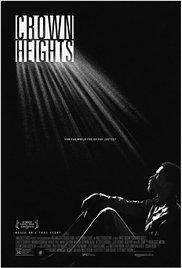
Greetings again from the darkness. Being wrongly accused of a horrible crime would be a nightmare. Being wrongly convicted would be the worst possible nightmare. Prison life must be a daily nightmare. What could make such nightmares even worse? How about serving 21 years for a crime you didn’t commit, with about 4 years of that in solitary confinement.
Numerous recent projects have focused on a legal and justice system that sometimes seems broken. Some of the best include: HBO’s “The Night Of”, Ana DuVernay’s documentary 13TH, and Jamie Meltzer’s documentary TRUE CONVICTION. Writer/Director Matt Ruskin has adapted this most recent based-on-a-true-story docudrama from a podcast episode of “This American Life”.
While the general topic of “justice” is interesting enough, it’s the individual personal stories of justice denied that add such power, immediacy and emotion. In April 1980, in the Crown Heights section of Brooklyn, a young man is arrested on suspicion of murder. Lakeith Stanfeld (SHORT TERM 12) plays Colin Warner, a local petty thief whose family is from Trinidad. The “suspicion of murder” is really not accurate, since the arresting cops knew Colin wasn’t the guy, but were more interested in clearing the case than actually solving it.
What follows is a commentary on crooked cops, a flawed judicial system, and the willingness by the guilty party to let another go to jail if it means they remain free. However, more than any of that, this is a wonderful story of one man’s unrelenting pursuit of justice for his friend. Former NFL star Nnambi Asomugha (married to Kerry Washington) plays Carl “KC” King – Colin’s friend who refuses to give up on him and constantly hunts for someone to ensure justice is served … no matter how much time has passed. KC never stops, even when he realizes this is a system that doesn’t often admit its mistakes. The tenacity of KC is likely to have viewers questioning if they have a friend so loyal … or if they themselves could be such a friend.
Supporting work is provided by Zach Greiner, Josh Pais, Luke Forbes, Marsha Stephanie Blake, Adriane Lenox, Nestor Carbondell, Bill Camp, and Yul Vazquez. Natalie Paul plays Antoinette, the saintly woman who falls in love with Colin and marries him while he is incarcerated.
We watch as the wheels of injustice roll over Colin – even demanding that he admit remorse in order to have his request for probation considered. Being a man of strong conviction, Colin holds firm on his innocence despite being hardened by life behind bars. Director Ruskin has delivered a decent movie, but with its vital story and issue, it’s one probably better suited to a documentary structure. He wisely chooses not to pile on the legalities, and focuses more on the frustrations with a flawed system while also including an anti-death penalty message supported by the statistic of 2.4 million in prison – an estimated 120,000 of which are innocent.
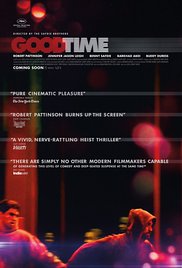
Greetings again from the darkness. The Drifters and later George Benson sang “the neon lights are bright on Broadway”. Well, we aren’t on Broadway, and though they aren’t bright, the neon lights are ever present and crucial to the tone of the latest from brothers and co-directors Benny Safdie and Josh Safdie.
Robert Pattinson stars as Constantine “Connie” Nikas, and turns in a performance unlike anything we have previously seen from him. Connie is protective of his brother Nick (played by director Benny Safdie), and he’s also a grungy unhinged bank robber. He doesn’t look like a man with a plan, but fortunately, Connie is a smooth talker who thinks ‘quick on his feet’. We say fortunately, because he is barraged with an endless stream of danger, catastrophes and near traumatic events as the story progresses.
A botched bank robbery separates the brothers and sends Nick to jail and Connie on the lam. Co-writers Ronald Bronstein and Josh Safdie seemingly take immense pleasure in launching Connie off-the-rails has he desperately attempts to avoid capture while simultaneously figuring out how to spring brother Nick. With a frenetic pace that escalates Griffin Dunne’s misery in AFTER HOURS, Connie’s escapades have him crossing paths with his girlfriend played by Jennifer Jason Leigh (wish she had more screen time), a psychiatrist played by Peter Verby, a new anxious-to-help acquaintance in Taliah Webster, an accidental partner-in-crime played by Buddy Duress, an amusement park security guard played by Barkhad Abdi (“Look at me!”), and a brutish thug played by hip-hop artist Necro.
The pounding, pulsating techno/synth music perfectly complements the unusual tone (almost noirish, and bordering on comedic), feverish pace, and fascinating visuals throughout this hyper-kinetic frenzied trip. Some viewers will be turned off quickly, and those that stick with it will be rewarded with an entertaining crime thriller featuring Pattinson’s best performance to date.
Greetings again from the darkness. A gritty, New Jersey based story of a blue-collar white girl trying to make it in hip-hop sounds like the makings of a film festival favorite – especially since it’s the first feature from its director and features a star-making turn from an unusual leading lady. After being warmly received at Sundance and Cannes (and other festivals), the only remaining question is, will mainstream audiences show the love?
The obvious comparison here is Eminem’s 8 MILE, but there is also a touch of ROCKY, THE COMMITMENTS, and most all other sports and music movies featuring the dreams of those from ‘the other side of the tracks’. Writer/director Geremy Jasper has a nice feel for setting and actors, and it’s only the (at times) formulaic nature of the script that keeps this one in the crowd-pleasing category rather reaching a level of greatness.
Australian native Danielle Macdonald plays Patti Dombrowski, also known as Killa P, and most every other cruel nickname (Dumbo, White Precious) one might pin on a plus-sized Anglo girl found street rapping. As you would expect, her tough outer visage masks an all-too-familiar inner insecurity borne from a larger than life mother who blames her daughter for every misery in life. Bridget Everett plays the mother Barb, a hard-drinking, hard-singing, hard-blaming type who gives such sterling mother advice as ‘lose the top button’ for that job interview. Mother Barb, providing proof of her distance from reality, refers to herself and daughter Patti as “the Dombrowski sisters”, whom she claims are “setting the world on fire”.
The tenuous mother-daughter relationship is at the core of the film, and these two actresses (and the movie) are at their best in their scenes together. On the music side, Siddarth Dhananjay plays Jhen, Patti’s eternal optimist-pharmacist-music partner, while Mamoudou Athie is Basterd, a self-proclaimed anti-Christ anarchist. The three form a band called PB&J (Patti, Basterd, Jhen) which provides friendship, a creative release, and, mostly, a reason for existence. Their band, and especially Patti, gets a boost from Nana (a remarkable Cathy Moriarty) on vocals and the CD cover. Ms. Moriarty is now 56 years old (playing older here), and was only 19 when she made her stunning screen debut in RAGING BULL. Other supporting work is provided by MC Lyte, Wass Stevens and Sahr Ngaujah.
The neighborhood is Bayonne New Jersey (see CHUCK), an area where lines such as “blood is thicker than Jager” actually make sense. A 23 year old would-be rapper can work as a bartender and caterer, and still find time to hone her musical skills. It’s the land of misfits and music that only sounds sweet to a few ears – where dreams don’t consist of owning yacht, but rather “making it across the bridge”. Crowd-pleasing movies are quite welcome these days, and filmmaker Jasper has joined with dynamite actresses Macdonald and Everett in delivering just that. Expect all to reach greater heights over the next few years.
 Greetings again from the darkness. There is a fine line between getting chewed out by your Costco supervisor one day and having the country claim you as a hero the next. Just ask Jeff Bauman. On April 15, 2013 Jeff was near the finish line for the Boston Marathon, holding a handmade sign in support of his runner-girlfriend Erin. When she was still about a mile away, the two bombs went off, killing three people and injuring hundreds. Mr. Bauman lost his legs that day.


 Posted by David Ferguson