WONDERSTRUCK (2017)

October 26, 2017

 Greetings again from the darkness. If you know an adolescent who is ready to step up from comic book movies, this would be a terrific introduction to more emotionally dramatic and narrative-driven cinema. That’s certainly not meant to imply that director Todd Haynes’ latest is only for kids, or even that it’s aimed at that demographic. Instead, it’s the rare opportunity to follow two intersecting story lines over two different time periods with kids as the main focus, and have some very interesting post-movie discussions related to characters, eras, and filmmaking techniques.

We follow the stories of two kids who are separated by 50 years. Although the time boundary exists, the similarities between their journeys are many. Each is running away from home in search of their roots and identity. They are both hearing-impaired and living in less than ideal family environments. Additionally, their footsteps cross many of the same places in New York City as two museums play key roles.

Ben (Oakes Fegley, PETE’S DRAGON) is a 12 year old living in Gunflint, Minnesota. It’s 1977 when his mother (Michelle Williams) dies unexpectedly and a freak accident takes his hearing. Convinced an odd bookmark is a clue to finding the father he’s never met, Ben sets off for New York City. Rose (remarkable first time actress Millicent Simmonds) lives in 1927 Hoboken, New Jersey and is obsessed with silent screen star Lillian Mayhew (Julianne Moore in a dual role). Rose is an artistic child whose domineering dad has little time for her, so she hops aboard the ferry and heads to the big city to track down an idol – who may be more closely tied than we first imagine.

Brian Selznick adapted the screenplay from his own novel (he also wrote “The Invention of Hugo Cabret”, which was the basis for Scorcese’s HUGO), and some may find the two story lines muddled or difficult to follow. However, for those who connect with the characters and their adventures, it’s a fascinating and entertaining ride. Director Todd Haynes (FAR FROM HEAVEN, CAROL) has established his expertise in visual stylings, and here he gets to present two distinct looks for the separate eras. Ben’s 1977 world is filled with the polyester and neon colors of that era and it’s even given the washed-out look of 1970’s cinema. On the opposite end of the spectrum, Rose’s 1927 world is presented in black and white as a silent movie. The lack of dialogue allows us to focus on her facial expressions and body language, which tell us what we need to know.

The American Museum of Natural History plays a significant role in both stories, and the Queens Museum is central to the finale which ties up the two pieces for us. The contrasts of the two eras are as vital as the similarities. Along the way, each of the kids gets a bit of help. Ben befriends Jamie (Jaden Michael) whose connection to the museum and the city provides Ben a boost, while Rose’s much older brother Walter (Cory Michael Smith) also has a connection to the museum and helps put Rose on the right track. The distinct photographic styles help us easily switch between eras, and much credit goes to cinematographer (and frequent Haynes collaborator) Edward Lachman and editor Affonso Goncalves.

Oscar Wilde’s quote, “We are all in the gutter but some of us are looking at the stars”, takes its shot as the theme for the two stories, and really it’s a heartfelt film with interesting storytelling and unusual cinematic effects. The set design is terrific throughout, and especially vital during the silent movie segments of Rose’s story. Carter Burwell’s prominent score also effectively shifts styles between stories and eras. The ties that bind us – a core need to understand our roots – do so regardless of age and time period. This is a nifty little film that provides much to discuss and consider.

watch the trailer:


ALL I SEE IS YOU (2017)

October 26, 2017

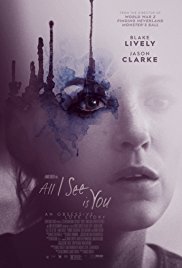
 Greetings again from the darkness. Director Marc Forster has crafted a career of making movies that are readily watchable, though for the most part, not especially memorable. These include: FINDING NEVERLAND, STRANGER THAN FICTION, QUANTUM OF SOLACE, WORLD WAR Z, and his best film, MONSTER’S BALL (2001). His latest falls short of those, but thanks to Blake Lively and some creative visuals, we remain interested enough.

This is Ms. Lively’s follow up to last year’s surprise summer hit THE SHALLOWS, her nearly one-woman sea-based spectacle. This time out she does an admirable job of carrying the film in spite of script flaws. It’s co-written by Sean Conway and director Forster, and despite teasing some fascinating psychological aspects, we find ourselves constantly waiting for the movie to show us what we already know is about to happen. Predictability is rarely an asset for a film, and here it acts as a ball and chain to the pacing.

The first third of the film works to establish two things: what Gina’s (Lively) daily life is like as a blind person, and the type of relationship she and her husband (Jason Clarke) have. We get an abundance of distorted light flashes to simulate what she has lived with since the car accident that took away her parents and her vision during childhood. Her marriage finds her very dependent on her husband and Clarke’s character thrives on this … even giving brief glimpses of his demented personality that will eventually take over the film in the final act.

Gina’s doctor (Danny Huston) performs a transplant which successfully restores her vision. The bulk of the story revolves around the changes that vision brings to her life and how the marriage begins disintegrating. The best message here is what happens to a relationship as the individuals change and evolve. Specifically in this case, the wife gains an entirely new perspective, while the husband longs for the days where she was dependent on him.

At times it feels as if director Forster is working hard to create the look and feel of an experimental movie, rather than focusing on the story. There are some interesting visuals provided by locations and camera angles, although the moody atmosphere never really clicks. Ms. Lively singing “Double Dutch” provides an ending that is both odd and mesmerizing in a strange way. We are reminded that evil and self-centeredness can take on many forms, though this film never quite packs the dramatic punch it might have.

watch the trailer:


GOODBYE CHRISTOPHER ROBIN (2017)

October 19, 2017

 Greetings again from the darkness. Are you ready for a family-oriented movie based on the origins of the universally beloved children’s character “Winnie the Pooh”? Well, despite the PG rating, this is not one for the kids – no matter how much they adore the cuddly, honey-loving bear. When you realize it was directed by Simon Curtis (WOMAN IN GOLD) and co-written by Frank Cottrell Boyce (MILLIONS), filmmakers known for their crowd-pleasing projects, the final version could be considered borderline deceitful.

It’s 1941 when we first see A.A. Milne and wife Daphne receiving an unwanted telegram whilst tending the English garden. We then flashback to 1916 when Mr. Milne was serving on the front lines of WWI, and returned with a severe case of shell-shock (described as PTSD today). His episodes can be set off by bees, balloons, and bulbs. This affliction also has him in a deep state of writer’s block accompanied by a need to write an important anti-war manuscript.

Domnhall Gleeson plays the famous writer and Margot Robbie his wife. The 1920 birth of their son Christopher Robin makes it clear that lousy parenting exists in every era. Neither father nor mother have much use for their offspring, so they enlist the help of a Nanny Olive, played by Kelly Macdonald. Does it sound like a wonderful family flick so far? Well things do pick up when C.R. is shown as an 8 year old played by screen wonder Will Tilston. His bright eyes and dimples so deep we wonder if they are CGI, bring joy to the viewers, even if the parents remain icy and self-centered.

The film’s middle segment allows father and son to bond on long walks through the 100 acre wood, and we are witness to how the toys become the familiar icons of children’s stories: Winnie the Pooh, Eeyore, Piglet, Kanga, Roo, and of course, Tigger. The picturesque English countryside makes a beautiful setting for the adorable and energetic C.R., known at home as Billy Moon (nicknames abound in the Milne household).

Unfortunately, the father-son segment leads to even more atrocious parenting. After the book is first published in 1926, young Christopher Robin becomes little more than a marketing piece for the family business. The walks in the woods are replaced by radio interviews and publicity appearances. No matter how Nou (the nickname for Nanny Olive) tries to bring normalcy to the boy’s life, the parents remain oblivious to what is happening.

Alex Lawther appears as the 18 year old Christopher Robin. He’s committed to serving his duty in WWII after surviving boarding school bullying and hazing. Equally important to him is escaping the shadow of the celebrity childhood, and finding his own identity – one that is not associated globally with a fuzzy bear. The innocence of childhood stolen by selfish parents is painful to watch, whether 90 years ago with the Milne’s, or today with any number of examples.

The 3 reasons to watch this film are: the photography is beautiful (cinematographer Ben Smithard), those other-worldly dimples of a smiling boy, and the near-guarantee that you will feel better about yourself as a parent (if not, you need immediate counseling, and so does your kid). In this case, being a well-made movie is not enough. The film is a bleak downer with the few exceptions teasing us with the infamous whimsy of the classic stories. Sometimes pulling the curtain back reveals a side of human nature akin to war itself. We are left with the impression that the audience and readers are to blame – being held accountable – for the misery suffered by the real Christopher Robin. Crowd-pleaser? More like the blame game.

watch the trailer:


THE FLORIDA PROJECT (2017)

October 18, 2017

 Greetings again from the darkness. “The Happiest Place on Earth” has long been a Disney catchphrase. The irony for those living on the road to Disney World is the focus of the latest from ground-breaking filmmaker Sean Baker. Mr. Baker was the creative force behind the remarkable TANGERINE (shot entirely with iphones) a couple of years ago, and his most recent film solidifies his brilliance at bringing us the fringes of society – those we don’t typically see on screen. Beyond that, these are the folks many of us pay little attention to in real life.

The Magic Castle Motel is a lavender monstrosity that belies the daily struggles of those who live behind its purple doors. It’s actually a seedy extended-stay that caters to ultra-budget guests. Included among those are 6 year old Moonee (Brooklyn Kimberly Prince) and her friend Scooty (Christopher Rivera). As we watch them spit on a car below their perch on the motel balcony, we quickly judge these as kids with a bit too much free time and a shortage of parental guidance.

As the summer days roll on, we tag along as Moonee leads Scooty and their new friend Jancey (Valeria Cotto) in some boundary-pushing adventures. Their fun ranges from typical kid mischief to accidents with more serious ramifications. The brilliance here is that through the child’s eye, we see joy and excitement and fun. We hear the purity of giggles and giddy screeches as the kids bound between tourist traps, ice cream parlors, and rooms forbidden as off-limits. All of this miscreant activity occurs amidst the adults who trudge on simply trying to survive another day.

While we might be tempted to recall Cat Stevens’ lyrics, “while the sinners sin, the children play”, it’s director Baker that refuses to pass judgment. Moonee’s mother Halley (Bria Vinaite) was recently fired from her “dancing” job, and is now constantly on the prowl to make enough money to cover the weekly motel bill. She clearly loves her daughter, but is too proud and angry, and just has no idea of how to pull out of this vicious cycle of poverty. The artificial dreams that are prevalent in so many films have no place at the Magic Castle Motel. It’s about the next meal and keeping a roof above.

Don’t go searching for plot here. Instead, at times it feels like a documentary on Moonee or the spirited need for fun and laughter that is in the DNA of kids. We are just following a real kid around, and that’s a tribute to the marvel that is Brooklyn Kimberly Prince. She steals every scene and most of the movie … and that’s in spite of the terrific performances from Ms. Vinaite and screen vet Willem Dafoe. It’s a rare “normal” role for Mr. Dafoe, and he makes the most of it as Bobby, the motel’s manager. He is also a father figure, mediator of disputes, bill collector, and protector of damaged souls. With no hint of saccharine or Hollywood mush, Bobby is unable to detach emotionally from those who live at the hotel, not because he is soft, but rather because he is human. We see his demeanor change drastically when the owner of the hotel arrives for inspection. Bobby understands the fragility of his own situation due to what he witnesses each day.

Director Baker is a master of color use and the blending of abrupt framed images with the handhelds in close proximity within motel rooms and personal interactions. His story (co-written with his TANGERINE and STARLET collaborator Chris Bergoch) never feels condescending, preachy or romanticized. There is no blatant political statement being made. These are folks living their lives as best they are able within the confines of their situation. The police and Child Protective Services are always hovering as a reminder that the next mistake could significantly alter lives. Somehow, the film is both hilarious and heart-breaking. The obvious comparison is to last year’s MOONLIGHT, and it could even be viewed as a prequel to AMERICAN HONEY. Mostly it’s a slice of rarely seen life and further proof that Sean Baker is already an important filmmaker, and one that likely has more to say. As for the debate around the final scene, does it really matter? There is no better place for a child to escape reality … even if it might only be in their mind. Sometimes that’s the only escape we get.

watch the trailer:


LOVING VINCENT (2017)

October 13, 2017

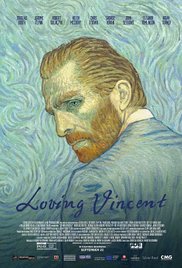
 Greetings again from the darkness. For those skeptics who scoff when filmmaking is described as an art form and labor of love, co-directors Dorota Kobiela and Hugh Welchman invite you to take in their nearly decade-in-the-making project. It’s the first fully hand-painted on canvas feature film – experimental filmmaking crafted by more than 100 artists and including an estimated 130 paintings, with 65,000 individual shots/frames.

The spectacular visuals were created by painting over the images … both of actors performing scenes and van Gogh’s paintings. By adding to and amending images, even 10 times or more, the scenes come to life with movement and a pulsating psychedelic feel. The familiar colors of his paintings create a level of connection, while black & white images are used for flashbacks and reenactments.

Though we have never seen this look on screen before (this goes beyond Linklater’s WAKING LIFE), the stunning visuals are accompanied by what can be described as a detective story or murder/suicide mystery. It picks up in 1891, one year after van Gogh’s suspicious death. A local Arles postman holds one last letter from Vincent to his beloved brother Theo. Having held onto it for much too long, he asks his son Armand Roulin to hand-deliver the letter to Theo. Sporting the yellow blazer so recognizable from his portrait, the angry and skeptical Armand heads to Paris. Little does he know, this is only the beginning of his journey … a journey that finds him researching Vincent’s life and a journey that helps him discover more about himself.

There have been many movies made focusing on this amazing artist: LUST FOR LIFE (1956), VINCENT (1987), VINCENT & THEO (1990), and VAN GOGH (1991). This one is filled with contrasting and conflicting stories, theories and recollections, and descriptions of events from those who crossed paths with the artist on a daily basis. We listen right along with Armand as he spends time in Avers-sur-Oise … where Vincent lived, painted, and died.

Many of the actors involved are recognizable even in this artistic format: Chris O’Dowd is the postman, Douglas Booth is Armand, John Sessions plays art supplier Pete Tanguy, Eleanor Thompson is the innkeeper’s daughter Adaline, Jerome Flynn is the controversial Dr. Gachet, Saoirse Ronan is Gachet’s daughter Margarita (recognizable from her piano portrait), Helen McCrory plays the disgruntled Gachet housekeeper, Aidan Turner is the boatman, and Robert Gulaczyk is Vincent. Since these folks were all part of van Gogh’s artwork, we are fascinated to see them come to “life”.

Vincent van Gogh picked up a brush for the first time at age 28. He was dead at age 37, and left behind approximately 800 paintings of portraits and landscapes – many among the most famous pieces in the world today. Did he try to commit suicide as he claimed or was there a more sinister explanation for his death? Of course the filmmakers only hint at possible answers and can’t solve a mystery that is approaching two centuries. Understanding the man is challenging, and perhaps our best hope is through the work he left behind. This is a compelling cinematic experience and we have certainly benefitted from the filmmaker’s labor of love. Clint Mansell’s score leans heavily on strings and piano, and is perfect accompaniment for the story. One could question the closing credits use of Lianne La Havas’ version of “Vincent” (renamed “Starry Starry Night”) rather than Don McLean’s, but one mystery per day is plenty. Spot the paintings, play detective, and mostly enjoy the visuals built on the works of a complex, talented, and tragic figure.

watch the trailer:


MARSHALL (2017)

October 12, 2017

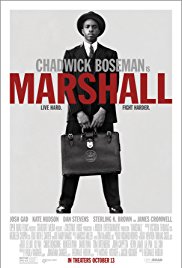
 Greetings again from the darkness. The question must be asked: is the movie worthy of the man? The man was the first attorney for the NAACP. He won 29 of the 32 cases he argued in front of the U.S. Supreme Court, including the ground-breaking 1954 Brown v. Board of Education (separate but equal public education). This man was a trailblazer for Civil Rights, and in 1967 became the first African-American Supreme Court Justice. This man was, of course, Thurgood Marshall … a man who unquestionably deserves not just a movie, but a really good and important one.

Chadwick Boseman has taken on film versions of such icons as Jackie Robinson in 42 and James Brown in GET ON UP, so he likely jumped at the chance to play the revered figure, Thurgood Marshall. Mr. Boseman has true movie star screen presence, and supplies the young Mr. Marshall with a self-assured swagger that accompanies a brilliant legal mind – a mind that refused to be ignored during a time it was desperately needed. Lest he be labeled a superhero, the film does portray Marshall smoking and drinking, while also hinting at his carousing. The common flaws of a great man.

It’s 1941 and the young (33 years old) Marshall is the lone NAACP attorney, so he spends his time ping-ponging around the country fighting for fair trials for those African-Americans accused simply because they aren’t white. He works only for “innocent” people and his efforts during this time were crucial to the Civil Rights movement gaining attention and legitimacy. Most of the film centers on a case in Connecticut (no, not the Jim Crow south) where a black man, Joseph Spell (Sterling K Brown), is accused of sexual assault of a “respectable” married white woman, Eleanor Strubing (Kate Hudson). If you are reminded of the great book and film TO KILL A MOCKINGBIRD, you must know that those literary and cinematic standards are such that few can ever hope to reach.

What follows is not one of the more dramatic or tension-filled cinematic courtroom dramas. There is simply too much levity for the film to be classified as a historical heavyweight. That said, the man and his story are fascinating, and though director Reginald Hudlin chooses a deft touch rather than a sledge hammer, it’s likely the wise choice if the goal is to entertain, while also educating the masses to Marshall’s early career. Josh Gad co-stars as Marshall’s co-counsel Sam Friedman, a specialist in legal technicalities within the insurance industry. Boseman and Gad have nice chemistry (at times it feels like a buddy movie), and as a Jew in those times, Friedman is himself stuck in limbo between staunch racism and acceptance by the white community.

James Cromwell plays Judge Foster, yet another man caught between the old world he has lived in his entire life and the fast-changing society and legal system that permits him to silence Marshall, while also forcing (somewhat) fair treatment of the accused Spell. Dan Stevens (BEAUTY AND THE BEAST) is Loren Willis, the disgusted and disgusting prosecutor. This character is so cartoonish that the only thing missing is a neon necklace that flashes “racist” as he speaks. Sophia Bush has a brief, yet important scene and Sterling K Brown (as Mr. Spell) has the film’s most heart-breaking moment as he sits on the stand and explains why he lied.

Director Reginald Hudlin seems like an odd choice for the project. He has been working mostly in TV since back-to-back-to-back bombs BOOMERANG (Eddie Murphy), THE LADIES MAN (Tim Meadow) and SERVING SARA (Matthew Perry). Mr. Hudlin has experienced more success as a Producer, having been Oscar nominated for DJANGO UNCHAINED. Here he works with the father and son screenwriters Jacob Koskoff and Michael Koskoff. The elder Michael is a well respected criminal attorney and legal historian, and certainly understands the expectations that come with offering a public look at a near-mythical figure … especially one as revered as Thurgood Marshall.

This isn’t so much a movie about the icon as it is about a young man on the path to greatness and importance (he served on the Supreme Court from 1967-1991). The soundtrack is filled with jazz which complements the light-hearted approach, and further distances from any semblance of “heavy” or “historical”. Director Hudlin adds a contemporary touch by having Trayvon Martin’s parents (Sybrina Fulton, Tracy Martin) appear in a scene near the end. On the downside, multiple upshot camera angles are designed to make his lead character look larger than life. The truth is, Thurgood Marshall required no help in looming large. Hopefully this mainstream approach pays off and many are introduced to the legacy of a man who is more than worthy of this movie … and another.

watch the trailer:


PARADISE (Rai, Russia, 2017)

October 10, 2017

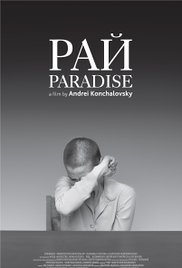
 Greetings again from the darkness. Hollywood, and the movie industry as a whole, absorbs a fair amount of criticism for the perceived lack of originality and creativity in this era of remakes and sequels. However, filmmakers also deserve some credit for constantly finding fresh stories associated with The Holocaust and World War II – seemingly endless sources of material for new movies. As Russia’s official Oscar Foreign Language entry, this film from director Andrey Konchalovsky (co-written with Elena Kiseleva) offers up three distinct perspectives of the same tumultuous period.

Julia Vysotskaya plays Olga, a former Russian Countess and member of the French resistance. Ms. Vysotskaya is the wife of director Konchalovsky and has a screen presence somewhat reminiscent of Ingrid Bergman with her ability to appear alternatingly tough, loving, sensitive and stubborn. Her character Olga has been arrested for sheltering two Jewish boys. Philippe Duquesne is Jules, the lead detective assigned to Olga’s case. His questionable loyalties are accompanied by a weakness of the flesh that is all too common among those in a position of power. Christian Clauss plays Helmut, a nobleman and German SS officer who is emotionally torn between his personal desires and his duty to the cause of his country.

The story is told from the perspective of each character through a blend of flashbacks and interviews. Harsh lighting, stark surroundings, and their respective wardrobes during the interviews appear to show each being held captive as they are interrogated by an entity that remains unheard and unseen. The interviews provide some insight into the characters, but almost seem intent on keeping us off-balance as the film progresses. It’s really the flashbacks that are the most interesting and provide the fascinating details for Olga, Jules, and Helmut.

Beautifully filmed in black and white with an excellent use of lighting effects by cinematographer Alexander Simonov, the tangled web of paths intersecting during war time offers some terrific sequences: a father and son on a morning walk, an isolated and guilt-ridden officer in a fog-draped forest, the immediate scavenging after an unexpected prisoner death, the excruciatingly emotional deportation of Jews, and a remarkable sequence involving a meeting with Himmler and Helmut’s subsequent mission to audit the concentration camps.

The brief flashes of joy are usually crushed by the weight of despair and bleakness, yet by the end, we believe we know each of these characters – and what motivates them. Director Konchalovsky’s film is an unconventional, creative, and ambitious combination of The Holocaust, Germany’s quest for perfection, and the greed and daily desperation of those involved. The interviews might not be what you assume, yet cause us to wonder how might our own interview sound while reminding us that, no matter the circumstances, we can always choose to do good.


WALKING OUT (2017)

October 5, 2017

 Greetings again from the darkness. Man vs Nature movies tend to remind us of both our tenacity when things go badly, and our lack of control or overall insignificance in the big picture of life. This tends to be true in the mountains, on the water, under the ocean, in caves and in space. Twin brothers Alex Smith and Andrew J Smith have adapted and co-directed this film from a short story by David Quammen. The filmmakers were raised in Montana, and have an inherent feel for the stunning and often treacherous landscape.

Matt Bomer, in a sharp left-turn from his usual pretty-boy roles, plays Cal, a live-off-the-land mountain man with seemingly few needs outside of food, water and a desire to connect with his teenage son through a hunting trip. Josh Wiggins (who exploded on the scene in 2014’s HELLION) plays David, a suburban Texas boy who is out of his element without his cell phone. The opening panoramic view of snow-covered mountains is contrasted with David’s engrossed concentration on his hand-held video game as the plane approaches the landing zone. “How was your year?” is David’s greeting from Cal, instantly elucidating their relationship.

Cal excitedly reports to David that he has been tracking a bull moose for 11 weeks, and wants this to be David’s first big game kill. We are constantly reminded that this isn’t trophy hunting, and that this single moose will provide Cal enough meat for a year. David has no real interest in killing a moose, but longs to connect with his father … and “longs” is interpreted through the teenager’s shrugs, glances and body language. Wiggins plays David with the subtle authenticity of the teenagers most of us have known, raised, and at one time, been.

As Cal explains the history of the mountains, he also works in stories of his youth when his father (David’s grandfather) was teaching him the ethics of nature. Numerous flashbacks feature Bill Pullman and Alex Neustaedter (as young Cal). The flashbacks are a bit artsy, and sometimes intrusive, but in the end, form a parallel story structure that works.

A couple of poor decisions lead to an accident that could be straight out of the Dick Cheney’s field guide to hunting. Cal and David are both injured – Cal severely so. It’s at this point where David must grow up quickly. The skills he has learned, or at least absorbed, are now necessary if he expects to save his father’s life. What was a story of two polar opposite blood relatives trying to connect, transitions instantaneously into one of survival, maturity, persistence, and love.

Movies such as THE REVENANT and THE EDGE come to mind, but this one is short on thrills, and is instead a trudging struggle to survive – taking a quiet approach, rather than a showy one. Lily Gladstone, fresh off her terrific work in CERTAIN WOMEN, has a brief sequence near the film’s end. The beautiful landscape and terrain is captured by cinematographer Todd McMullen, while Ernst Reijseger’s score effectively complements the odd mixture of slow pacing and non-stop danger. Whether you are trying to live a reclusive life off the land, or simply one of the many parents attempting to connect with their kids, keep in mind that regardless of the beauty of the mountains, “snow is not our friend”.

watch the trailer:


BATTLE OF THE SEXES (2017)

September 29, 2017

 Greetings again from the darkness. At least two generations are too young to have experienced the 1973 media circus that was the tennis match between Billie Jean King and Bobby Riggs. However, what matters is that the impact and social changes that began in earnest that night at the Astrodome are still being felt and evolving today. It might seem incredulous that the 29 year old top-ranked women’s player emerging victorious against a 55 year old who played his last professional match 14 years prior would have an impact on anything other than TV rankings, but in fact, it caused a significant societal shift.

Real life married couple and co-directors Jonathan Dayton and Valerie Faris are well known for their collaborations on iconic music videos and TV commercials, and since joining the movie world have brought us LITTLE MISS SUNSHINE and RUBY SPARKS. Their talent for visual presentation is on display here in both the tennis scenes and the more intimate character moments. And, oh my, there are some intimate moments thanks to the script from Oscar winning screenwriter Simon Beaufoy (SLUMDOG MILLIONAIRE). There is no shying away from Ms. King’s sexual confusion/awareness/preferences.

Emma Stone (Oscar winner for LA LA LAND) stars as tennis legend Billie Jean King and manages to convey three different sides: the ultra-competitor, the champion for equal rights, and the married woman coming to grips with her sexual identity. Steve Carell captures the essence and mannerisms of Bobby Riggs, the former tennis champ, floundering in middle-age and always on the lookout for his next hustle or gambling opportunity. Surprisingly, only a minor portion of the film deals with the actual tennis match. Instead, the film dives into the personal lives of these two polar opposite personalities, each with their own challenges and issues.

Despite the fun and outrageousness that the Riggs character delivers, the film might have been better served focusing even more on Ms. King. While she needed the “villain”, it was really her dedication to the cause and strength amidst the backlash that made the difference … along with her court skills. Watching her stand tall in confrontations with the chauvinistic and powerful Jack Kramer (Bill Pullman) is something to behold. Again, those that weren’t around might not believe some of the outrageous claims by the men of the times.

Supporting work comes from Andrea Riseborough as the all-important Marilyn, who turns Billie Jean away from her husband Larry (Austin Stowell), Sarah Silverman as promoter Gladys Heldman, Natalie Morales as Rosie Casales, Alan Cumming as the colorful clothes designer, an underutilized Elisabeth Shue as Riggs’ wife, Fred Armisen as Rheo Blair – Riggs’ partner in the herbs and vitamins game, and Lewis Pullman (Bill’s real life son) as Riggs’ son, Larry. We are even treated to a Bob Stephenson sighting as the Sugar Daddy PR guy at the match.

This was the era when the Vietnam War was winding down, the Watergate scandal was raging, outside “the norm” sexual preferences were kept in the closet, prize money for men’s tennis was 8-10 times that of women, and the overall respect for women and their sports was excruciatingly misguided. Listening to Howard Cosell speak so condescendingly during the national broadcast merely confirms the inequity. Of course, these same issues are discussed and debated even today, as society evolution is often slow, even when moving in the right direction. The film might not add much to today’s cause, but it reinforces the early legacy of Billie Jean King as a difference-maker.

watch the trailer:


VICTORIA AND ABDUL (2017)

September 29, 2017

 Greetings again from the darkness. Director Stephen Frears has enjoyed a long career by focusing on the interesting stories of people, rather than the salient specifics of history or politics. He received Oscar nominations for THE QUEEN and THE GRIFTERS, and helmed other crowd-pleasers such as MRS. HENDERSON PRESENTS, PHILOMENA, HIGH FIDELITY, and FLORENCE FOSTER JENKINS. While purely entertaining movies are always welcome, it’s important to note the filmmaker’s approach when the story is entwined with historical importance.

“Based on real events … mostly” is Mr. Frears’ cutesy way of kicking off the film and asking us to enjoy the unusual story of connection between a Queen and a servant, and cut him some slack on the historical depth. For most of us, the real enjoyment will be derived from watching yet another standout performance from Oscar winner (and 7 time nominee) Dame Judi Dench as the longest-reigning monarch, Queen Victoria in her elderly years. It’s a role she played twenty years ago in MRS. BROWN, and her relationship with John Brown (presented in that film) has some parallels to what we see here with Abdul Karim (Ali Fazal). Dame Judi is the rare actress who can capture both the loneliness and tiresome burden of six decades of rule and the re-invigorated woman we see learning a new language and new religion. She plays weary and spunky with equal believability.

Victoria was Queen of the United Kingdom of Great Britain and Ireland and Empress of India, and in 1861 her beloved husband Prince Albert died. This film picks up in 1887 with the pomp and circumstance of the Golden Jubilee – a celebration of her 50 years of rule. The early scenes tease us with obstructed views, and the comedic element becomes quite obvious as we see her so carelessly slurping her soup at the formal lunch. Part of the celebration includes the presentation of an honorary coin by two Indians peasants Abdul (Fazal) and Mohammed (Adeel Akhtar), the first chosen because of his height, and the second as a last minute fill-in.

Lee Hall (Oscar nominated for BILLY ELLIOT) wrote the screenplay based on the book by Shrabani Basu. The journals of Abdul Karim were only discovered in 2010, a hundred years after his death. Some of the less favorable moments of this era are mentioned, but most of the Queen’s lack of knowledge or awareness is attributed to the “boring” reports from her advisers. This leads to some awkward moments later in the film regarding the Muslim mutiny and the subsequent Fatwa.

Rather than dwell on history, the film prefers to focus on the unconventional friendship and the re-awakening of the Queen. Abdul becomes her “Munshi” – a spiritual advisor and her teacher of Urda and the Koran. As you would expect, this is all quite scandalous and frustrating for those such as Prime Minister Lord Salisbury (Michael Gambon), Lady Churchill (Olivia Williams), Victoria’s son Bertie (Eddie Izzard), and the royal staff: Sir Henry (the recently deceased Tim Pigott-Smith), her physician Dr Reid (Paul Higgins), and her quivering maid Miss Phipps (Fenella Woolgar). There is even a comical sequence with the great singer Puccini (Simon Callow) as the Queen herself belts out the Gilbert and Sullivan song “I’m Called Little Buttercup”.

Balmoral, the Isle of Wight, and Windsor Castle are all part of the breath-taking scenery, while the absurdity of the royal status is viewed through the eyes of the Indian servants. Most of the focus is on Victoria’s transformation from joyless, isolated monarch to the anything-but-insane (an Oscar worthy scene) and eager to engage elderly woman (one who has an entire era named after her) falling back in love with life as she fights off “the banquet of eternity”. Come for the laughs and the performance of Dame Judi … just not for a history lesson.

watch the trailer: