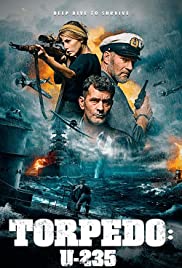
TORPEDO: U-235 (2020)

May 18, 2020

 Greetings again from the darkness. “Desperate times, desperate measures” is a phrase that dates back to ancient Greek physician Hippocrates (he of the Hippocratic Oath), and has been applied in many and varied situations since … war strategy being one of the most common. We hear the phrase a couple of times in the War Room during an early scene in the feature film directorial debut of writer-director Sven Huybrechts submarine movie. The term “submarine movie” is used with the utmost respect, as I’m a huge fan of the sub-genre.

Opening with a well-orchestrated attack on Nazi soldiers, we are soon in the midst of a group of resistance fighters – a rag tag bunch committed to wiping out as many Nazis as possible. In the War Room scene, this group is referred to as “The Bad Eggs”, and everyone from all sides seems to want them stopped. However, there is a problem – this group is made up of the only ones crazy enough to accept the current ‘suicide’ mission: delivering a Uranium filled submarine from the Belgian Congo to the United States, where the cargo will be used for the Manhattan Project.

The cast is excellent, led by the ongoing conflict between two outstanding and renowned leads: Belgian actor Koen De Bouw as Nazi-hater Stan, and German actor Thure Riefenstein as captured U-Boat Captain Franz Jager. Co-writers Huybrechts and Johan Horemans effectively use the dangers and claustrophobia of the submarine, and are truly expert in their pitting Stan against Jager. Stan’s beautiful (and sharpshooter) daughter Nadine (Ella-June Henrard) is also on the mission, but it’s Stan’s tragic backstory (which we see in tension-filled flashbacks) that have filled him with a lust for revenge and over-protectiveness.

Training for submarine crews typically lasts a year, and this group of misfits has only three weeks to prepare. Some of the early soundtrack reminds of the iconic Elmer Bernstein theme to THE MAGNIFICENT SEVEN, which comes across a bit misplaced, but that’s a minor quibble for a film that gets most everything else right – except for a too-good-to-be-true sequence near the end. Along the way, we see vivid images of the brutality and cruelty of Nazis, which helps us understand why all of these folks are so committed to the mission.

Working with a low budget, the film still manages to deliver the danger and tense situations we expect from a submarine during WWII. There is even a sub vs sub battle for some underwater action. The lineup of other worthy submarine movies over the years include: Jules Verne’s 20,000 LEAGUES UNDER THE SEA (1954), THE ENEMY BELOW (1957) with Robert Mitchum, RUN SILENT, RUN DEEP (1958) with Clark Gable and Burt Lancaster, ICE STATION ZEBRA (1968)  based on the Alistair MacLean novel, the nerve-rattling DAS BOOT (1981) from Werner Herzog, THE ABYSS (1989) from James Cameron, THE HUNT FOR RED OCTOBER (1990) from Tom Clancy’s novel starring Sean Connery, CRIMSON TIDE (1995) pitting Denzel Washington against Gene Hackman, U-571 (2000) with the great Thomas Kretschmann, and BLACK SEA (2014) with Jude Law. And let’s not forget the 1968 classic featuring The Beatles animated, YELLOW SUBMARIINE.

This latest begins in 1941 and the final scene takes place on August 6, 1945. Huybrechts’s film could be described as a cross between INGLORIOUS BASTERDS and DAS BOOT, and it includes plenty of material for conversation on race, religion, nationality, and duty.

Available VOD beginning May 19, 2020

watch the trailer:


AMERICAN TRIAL: THE ERIC GARNER STORY (2020)

May 18, 2020

 Greetings again from the darkness. We open on a blank screen, but immediately recognize the audio. “I did nothing.” Producer-Director Roee Messinger slowly brings up the all-too-familiar video of Eric Garner being wrestled to the ground by multiple police officers. Mr. Garner is heard to say “I can’t breathe” eleven times during the cell phone video. Those were to be his last words.

His death was ruled a homicide, but a Grand Jury refused to indict NYPD Officer Daniel Pantaleo. Filmmaker Messinger presents a “What if?” there had been a trial. This is Messinger’s first feature film, and it’s non-scripted … a mock trial featuring former NY state prosecutors, practicing attorneys, actual witnesses, field experts, Garner’s wife, and actor Anthony Altieri playing the role of Officer Pantaleo. We see Mr. Pantaleo in consult with his attorneys, but the vast majority of the film is spent in the courtroom as we watch the proceedings, and hear testimony.

For those of us whose time in a courtroom is limited to mandatory appearances for jury duty, it’s very interesting to see how a trial is conducted; though we should keep in mind that the pace is a bit faster in an edited movie version than what would occur in real life. Still, listening to the experts – a Medical Examiner and Pathologist offering conflicting opinions on the evidence drives home the point of what a challenging job jurors would have had with the case. And then there is Mr. Garner’s friend who testifies that he witnessed the whole thing while standing just a few feet away. His reason for not getting involved was fear of being arrested himself. Of course, the most emotional testimony comes from Esaw Snipes Garner, Eric’s wife of 26 years. She’s defensive and impassioned while on the stand, and her frustration and distrust of the system is palpable.

In the film, Officer Pantaleo is charged with Manslaughter and Strangulation. When he takes the stand, we learn some of his background and police training. We hear the definition of a chokehold versus “necessary” force in bringing a suspect under control. Mr. Garner was a large man – approximately 395 pounds. He made it very clear to the officers on the scene that he was not going to cooperate with being arrested. Was it a chokehold? Was it necessary force? Was Garner really unable to breathe? All of these questions are addressed, as was the reason police approached him in the first place – suspicion of illegally selling cigarettes (“loosies”) on the streets of Staten Island.

Just like cameras and recording devices, we aren’t allowed to witness the jury deliberations. In fact, the purpose is to have viewers act as jurors in the case – listen to the evidence and testimony and arguments, and then make your own decision. Famed Harvard Law Professor Alan Dershowitz serves up his thoughts, and we learn of Mr. Garner’s many underlying health issues (asthma, high blood pressure, sleep apnea) while making up our own mind on what happened that day, and what Garner’s death should have led to.

Opens in Virtual Cinemas May 18, 2020

watch the trailer:


SEBERG (2020)

May 15, 2020

 Greetings again from the darkness. “Who is Jean Seberg?” A reporter asks the question to her, just before the movie star’s agent escorts him away as she prepares for publicity shots on PAINT YOUR WAGON, the outlandish 1969 musical-comedy in which she co-starred with Clint Eastwood and Lee Marvin. It’s also a question we expect a film entitled SEBERG to answer, though it never really does. Oh sure, we get the basics: small town girl (Marshalltown, Iowa), Hollywood starlet, activist, target of FBI, and tragic ending. Unwisely, the film tries to cram in too many other pieces of a puzzle – a puzzle plenty interesting on its own.

Kristen Stewart stars as Jean Seberg, the breakout star of the French New Wave Cinema in Jean-Luc Godard’s BREATHLESS (1960). Ms. Stewart brings much more than a short haircut to the role. It’s not a stretch to imagine Ms. Stewart has experienced some of the downside to fame that Ms. Seberg experienced during her career, so it’s no surprise that the moments of torment and frustration and anxiety are the film’s best. Even as a teenager in Iowa, Ms. Seberg showed signs of an activist-in-development. She ran off to Hollywood and was discovered by director Otto Preminger and cast in the lead role for his SAINT JOAN (1957). Seberg actually suffered severe burns during the filming of a key scene – one which is reenacted by Stewart for this film.

Director Benedict Andrews working with a script from Joe Shrapnel (grandson of actress Deborah Kerr) and Anna Waterhouse (they also co-wrote THE AFTERMATH and RACE), focuses mostly on the period of 1968-1971. We see Seberg’s first encounter with Hakim Abdullah Jamal (Anthony Mackie) on a commercial flight, and her follow-up pose with the Black Panthers for a publicity shot on the tarmac. This kicks off an FBI investigation, as well as an affair between Seberg (married to novelist and filmmaker Romain Gary, played by Yvan Attal) and Jamal (married to Dorothy, played by Zazie Beetz). We see how Seberg landed on Hoover’s FBI watch list, and how she was sincerely trying to help what she saw as a worthy cause.

We watch the FBI meticulously build a file on Seberg, albeit illegally under the COINTELPRO (counter-intelligence program) program. Surveillance was used to work towards their goal of running a smear campaign against Seberg due to her support of the Black Panther Party. Jack O’Connell plays FBI Agent Jack Solomon, and Vince Vaughan plays his partner Carl Kowalski. Family dinner time at the Kowalski home is anything but leisurely fun, and it’s an unnecessary scene meant to contrast Kowalski’s character with that of Solomon. It’s here where the film falters. An inordinate amount of time is spent on Agent Solomon and his conscience and his med-student wife Linette (a sinfully underutilized Margaret Qualley).

The film would have been best served by focusing on either Seberg or Solomon. The two stories dilute the effectiveness, and beyond that, the Black Panther story line fades, as does the whole celebrity-as-an-activist subplot. Instead, Seberg’s breakdown and Solomon’s second thoughts share center-stage. The film does succeed in exposing the extremes Hoover’s organization would go to in order to discredit someone whose beliefs might not have meshed with what was deemed proper for the times. What happened to Seberg was a tragedy, and according to Mr. Gary, led to the loss of her career and eventually to her death.

The film bounces from Paris to Los Angeles, and the set decorations and costumes are picture perfect for the era. There are actual Black Panther clips shown, and Ms. Stewart also reenacts a scene from BREATHLESS. Regardless of the script and story issues, Kristen Stewart delivers a terrific performance as Jean Seberg, and keeps our attention the entire time. We like her and feel for her as she slips. The real Ms. Seberg was found dead in a car at age 40, and suicide was suspected, though mystery still surrounds her death to this day. Lastly, just a piece of free advice … if you are looking to do good things in life, having a marital affair is rarely the right first step.

Available on Amazon Prime beginning May 15, 2020

watch the trailer:


CAPONE (2020)

May 11, 2020

 Greetings again from the darkness. I was really hoping for a Josh Trank resurgence. When his FANTASTIC FOUR became one of the worst reviewed movies of 2015, he lost out on a chance to direct a Star Wars film. Given creative control as writer-director-editor, CAPONE was supposed to be his chance bounce back and re-capture the intrigue and promise of his first film, CHRONICLE (2011). And he even chose the fascinating notorious gangster Al Capone as the subject for his comeback. What could go wrong? Well … most everything.

Tom Hardy usually adds enough interest to make any of his projects entertaining to watch, and sometimes he’s downright brilliant. Going back to BRONSON (2008), and on through TINKER TAILOR SOLDIER SPY (2011), WARRIOR (2011), THE DARK KNIGHT RISES (2012), MAD MAX: FURY ROAD (2015), THE REVENANT (2015), and TV’s “Peaky Blinders”, Mr. Hardy has quite a resume of memorable characters – and the above list barely covers half. This time out he plays Al Capone … “Fonse” … don’t dare call him Al “in this house.” He has recently been released from Alcatraz where he was serving his sentence for tax evasion. Confined to his Florida mansion, Capone is only 47 years old, but looks twenty years older thanks to the effects of neurosyphillis-induced dementia. His mind is never clear and his visions take him back to his violent criminal past, or snapshots of his youth (with an ever-present gold balloon).

We can’t really tell if filmmaker Trank meant this as a parody or not. Capone is seen as a mumbling near-zombie, almost always wearing a bathrobe. His eyes are bloodshot, and the once menacing gangster is now a paranoid, saggy diaper-wearing shell who noisily chomps on a cigar (or carrot), fires off his gold-plated Tommy Gun, and has constant issues with vomit-bladder-bowels. Typically a parody offers either slapstick or black comedy, but I only recall a single chuckle … one that occurs when Capone pulls out a shotgun while on a fishing boat with his old mob buddy Johnny (Matt Dillon). Other than that, it’s mostly a bleak look at dementia and the lost power of a man who follows his visions into closets and basements, and jumps up during a movie to sing-a-long with the Cowardly Lion’s “If I Were the King of the Forest.”

The supporting players are given little to work with. The great Linda Cardellini plays Mae, Capone’s supportive wife, while Kyle MacLachlan is his crooked doctor, Noel Fisher is Al junior, Al Sapienza is Capone’s brother Ralphie, and Kathrine Narducci is Ralphie’s wife. There is a secondary plot point involving government surveillance as they attempt to discover the whereabouts of the $10 million Capone supposedly stashed years ago. Of course, Capone doesn’t remember, and when and FBI agent (Jack Lowden, with director Trank in a cameo) interrogates him, he’s unsure whether Capone is acting or actually that far gone. There is also a bit about phone calls from “Tony”, possibly a long-lost Capone son borne from an affair.

The film covers Capone’s final year, and mostly it comes across as a sad and depressing view of dementia. The most obvious statement on Capone’s loss of power, comes in the form of a metaphor, as his beloved “Lady Atlas” garden statue is removed to be sold off. There is also a recurring moment where Capone tunes the radio to a broadcast of the Saint Valentines’ Day Massacre, and family time at Thanksgiving is nothing short of painful to watch. Cinematographer Peter Deming (MULHOLLAND DRIVE, 2001) gives us a well shot film, but despite a couple of David Lynch-type moments, the film mostly lacks entertainment value. I can’t figure out who might want to watch this. Trank seemed to go the deeply artistic route on a subject that’s tough to watch. Maybe he’ll get yet another shot.

Available on VOD beginning May 12, 2020

watch the trailer:


FINDING EDEN (2020)

May 11, 2020

 Greetings again from the darkness. Director Rodney Luis Aquino opens his first feature film on a happy and loving family consisting of father/husband, mother/wife, and son. They are a normal family who eat dinner together while discussing spitballs. The wife questions the husband’s “vacation beard” … a beard that has, by the looks of it, been growing for 3-4 months, leaving us to wonder what kind of benefits his employer offers. Their paradise is rocked one evening when the National Emergency Warning goes off. We learn from the news reports that the Earth has gone off its axis, leading to weather catastrophes around the planet.

We then flash forward as narrator Lisa (the wife) informs us “The Turn” occurred three winters ago, and sometimes she wonders if this is all a dream. It’s not a post-apocalyptic world, but it might as well be. She tells us there are rumors of cannibalism; however, in this family they hunt for food and scrounge for water. Adam takes his bow and three arrows in hopes of nabbing dinner. But Adam (Jason Sutton) is no superhero. He leaves his beloved Lisa (Jennifer Faith Ward) and son Sam (Michael Campion) at the campsite. When he returns empty handed, he discovers his family has been taken. His mission is no longer wild rabbit for dinner, but rather rescuing his loved ones.

On his journey, Adam crosses paths with Fred (Joseph Gatt, whom you’ll recognize from many roles), who tells him about “Eden”, a community of good folks who are forming a new society. It’s here where we learn that the bloody handprint signs Adam has seen along the way belong to Donner, a vicious guy who was kicked out of Eden. Of course, we understand that Adam and Donner are headed for a showdown if the family has any hope of survival. Veteran character actor Tom Proctor plays Donner, and he brings all he can to a role that embodies evil … Donner is a deliciously nasty fellow.

With an ultra-low budget project, some slack must be given for production value. Kraig Swisher takes on the rare combination of screenwriter and cinematographer, and at times the dialogue could have used a jolt, while the visuals never seem to take full advantage of the Florida and Georgia filming locations. The sound mixing is entirely too noticeable at times (those footsteps), and Mr. Sutton doesn’t really have the chops yet for leading man. Mr. Gatt and Mr. Proctor certainly elevate the film during their sequences, and the soundtrack is mostly in sync with what we see on screen. Overall, there are some fine moments, though we would have preferred the scenes of peril and danger to go much deeper, along with some more incisive commentary on the likelihood that most humans would take shortcuts when things go badly (like what is currently happening).

watch the trailer:


HOW TO BUILD A GIRL (2020)

May 7, 2020

 Greetings again from the darkness. British writer Caitlin Moran has adapted her own 2014 semi-autobiographical novel-memoir for the screen, because who better to write about the coming-of-age of a talented outcast than that talented outcast herself? Given the profusion of coming-of-age movies that hit the screen every year, it’s a welcome change when one takes a different approach. And this one does just that.

Beanie Feldstein (BOOKSMART, and Jonah Hill’s sister) stars as Johanna Morrigan, replete with British accent. Johanna is a dreamer, and as she sits in her usual spot at the library, she fantasizes about Mr. Darcy riding in to save her from this mundane life. We quickly learn that Johanna is bright, and treated as quite the misfit at school. Even her English teacher asks her to scale back her writing assignments. See, in addition to being a world class dreamer, Johanna is a very talented writer … and she sees that as her only means to escape Wolverhampton.

At home, Johanna has a “Wall of Gods” featuring photographs of her literary and historical heroes, including: Sylvia Plath (Lucy Punch), Elizabeth Taylor (Lily Allen), Bronte sisters, Sig Freud (Michael Sheen), and Maria von Trapp (Gemma Arterton). Johanna speaks to these photos, and they answer her. Johanna’s family hustles to stay just above poverty. Her dad’s (Paddy Considine) dream of rock stardom has passed, and now he breeds black market Border Collies while remaining optimistic about life. Her mother (Sarah Solemani) suffers from post-partem depression after giving birth to twins (kids number 3 and 4).

Johanna shares a small bedroom space (divided by “the Berlin wall”) with her cool brother Krissi (Laurie Kynaston). We know he’s cool, because he hangs out in the cool room at school – a room to which Johanna has never been invited. After embarrassing herself on a televised poetry reading show (hosted by Chris O’Dowd), Johanna is encouraged by brother Krissi to apply for a music critic job at a local publication. Her heartfelt submission on “Annie” the musical causes guffawing among the ultra-cool writing staff at the magazine; yet her writing skill and persistence land her a shot. It’s at this point that things change for Johanna.

An unusual interview with popular and earnest singer John Kite (Alfie Allen, brother of singer Lily Allen and son of actor Keith Allen) results in a connection and teenage crush, leading to a sappy article rejected by her employer. Given a second chance by the magazine, Johanna’s alter-ego Dolly Wilde does in fact turn wild. Her ‘bad girl’ image and mean spirited critiques of bands gain her a cult following – a type of notoriety. The pen may be mightier than the sword, but when the pen is used as a sword, the damage is severe. What follows, of course, are the inevitable hard (and painful) life lessons.

Director Coky Giedroyc has spent most of her career on TV shows, but she has a feel for this material. However, it’s mostly the no-holds-barred performance of Beanie Feldstein that makes this work – both the comedy and drama. We’ve seen the outsider with talent many times before, and because of that, expectations are a bit low going in. This time, a different twist and passionate filmmakers and actors turn this into quite an entertaining 100 minutes.

IFC Films will release the film on VOD on Friday, May 8, 2020

watch the trailer:


CLEMENTINE (2020)

May 7, 2020

 Greetings again from the darkness. A lovely opening sequence shows Karen in bed, the morning sun barely able to match the light of love emanating from inside her. We never see Karen’s lover’s face, but we hear D’s voice as the two ladies share the beginning of a day. Our next scene has Karen unable to enter the house the two shared. Ramsey the dog barks at her through the glass pane of the door that Karen’s key no longer opens. Frustrated, she hops back in her car.

We soon learn that Karen’s idea of revenge (or coping) after being dumped is to break into D’s Oregon lake house, take down a painting from over the bed, smoke some pot, drink some wine, and replay D’s voice messages. Her plan doesn’t seem to go much deeper, but it’s not long before she has met Lana, a local girl who claims to be 19 years old – though we all know she’s younger. Lana is a bit odd, though clearly attracted to Karen, herself intrigued by the unusual girl. This strange little cat and mouse game is then crashed by Beau, the handyman for D’s lake house.

The first feature from writer-director Lara Gallagher excels at keeping us off-balance, despite moving at a pace that allows the viewer plenty of time for thought and observation. Complementing the uneasiness is the score from Katy Jarzebowski, with its harsh single piano note, sometimes accompanied by violin … the sound of a horror film, though this is no Hollywood cabin in the woods. Three times we are shown the handgun in the drawer, and though it plays a significant part, it’s not in the way that our movie mind has been trained.

Otmara Marrero plays Karen, and rising star Sydney Sweeney is Lana. The two joust very well, though it’s Lana who fascinates. She’s curious of love and life, while not quite being ready. Lana is a manipulator thanks to an innocence that draws Karen in. Will Brittain (BLOW THE MAN DOWN) plays Beau in a manner of which we are never really certain – friend or foe? Finally, Sonya Walger is D. She doesn’t show up until late in the film, but she is precisely what we have envisioned.

There is an odd cadence to the film, and the performances assist with confounding us. It’s a coming of age story for two females of different ages, and we can’t help but notice that Karen has been involved in two relationships featuring the older woman/younger woman dynamic. Of course, her role reversal in the two relationships is at the core of the film. Indie band Lightning Dust contributes an outstanding song with “Antonia Jane”, and we are left thinking this is a psychological thriller without the thrills. Filmmaker Lara Gallagher has delivered a personal project reminding us that toxic relationships aren’t limited to man-woman.

Opening in Virtual Cinemas everywhere May 8, 2020

watch the trailer:


SOUTH MOUNTAIN (2020)

May 4, 2020

 Greetings again from the darkness. The grill is fired up and the beer is cold. Friends and family are gathered in the Catskills. Everything seems pretty normal until writer Edgar (Scott Cohen) sneaks off to take a “work” call in the privacy of a back room. We see the reality of his FaceTime call with his mistress Gemma (Isis Massoud), who is in full baby delivery mode. Edgar talks her through it as the midwife does her thing. The delivery and baby are so realistic that I’m fairly certain writer-director Hilary Brougher has included actual footage.

Talia Balsam stars as Edgar’s wife Lila, an artist and teacher. There is a sadness connected to Lila, and it hovers like a curse. Her initial reaction to being told that Edgar is leaving her for a new life is little more than resignation to her own life where she seems to regularly get the short end. Edgar and Lila have a teenage daughter Dara (Naian Gonzalez Norvind), and daughter Sam (Macaulee Cassady) from Edgar’s first marriage. We learn that Talia has previously endured Edgar’s wanderings, though not always gracefully. She also wonders why people are constantly leaving her – a fact of life as kids grow older.

Filmmaker Brougher counts off the days in the corner of the screen for us, and it’s helpful as time jumps a bit … although most days seem eerily similar even after Edgar leaves (he’s still around a lot). This plays out like a passive-aggressive break-up, save for one unpredictable lash-out from Lila – one that is likely a frequent fantasy of wronged spouses. Lila’s close friend Gigi (Andrus Nichols) has breast cancer and is undergoing chemotherapy, and her son Jake (Guthrie Mass) and daughter Charlotte (Violet Rea) add to the teenage angst we see from Dara and Sam. Sam’s friend Jonah (Michael Oberholtzer) has a key role as well – one that starts with sharing a sauna with Lila, and ends where you would imagine.

There is no shortage of movies or real life stories of middle-aged men starting over and “women of a certain age” are left to figure things out. Ties of a long-term marriage run deep and aren’t easily or cleanly severed; and kids, regardless of age, don’t always understand how to be supportive. Cinematographer Ethan Mass (husband to Ms. Brougher) does a terrific job with the visual landscape, as the claustrophobia of the house gives way to the stunning beauty of nature. The acting is superb throughout, and Ms. Balsam (daughter of Martin Balsam and Joyce Van Patten) excels in a rare leading role. If only the material were a bit more complex, she could be in awards consideration. Unfortunately, the restrained storytelling prevents us from connecting to Lila, despite the best efforts of Ms. Balsam. It’s clear Hilary Brougher is a filmmaker with talent, but the message that life goes on, no matter the inconveniences or heartbreaks, is just a bit too familiar and low key.

available VOD May 5, 2020

watch the trailer:


“Hollywood” (Netflix limited series, 2020)

May 1, 2020

Netflix limited series premiering May 1, 2020

 Greetings again from the darkness. “I want to go to Dreamland.” One might assume that phrase is related to Hollywood being the place where dreams can come true, but co-creators Ryan Murphy and Ian Brennan take us down a much different path. The two have collaborated on the TV series “Glee”, “Scream Queens”, and “The Politician”, and here they offer up a revisionist history on the post- WWII Golden Age of Hollywood, in the vein of what Quentin Tarantino did in INGLORIOUS BASTERDS and ONCE UPON A TIME … IN HOLLYWOOD. Mr. Murphy and Mr. Brennan seemingly focused on idealistically imagining a film industry where one’s race, ethnicity, or sexual preference made little difference. In doing so, they devote significant time to racism and homophobia.

While the series mixes fact and fiction in such a way that the lines are often blurred, there are two main storylines that provide the backbone of the series: the actual suicide of 24 year old actress Peg Entwistle, which occurred in 1932 when she jumped from atop the Hollywoodland sign; and the mostly fictional crossing paths of a handful of aspiring actors, writers and filmmakers as they navigate the treacherous film industry waters. We see the new generation clashing with the establishment – a tale as old as time.

The 7 episodes cover approximately 7 hours, but it was somewhat challenging to make it through the first three. However, I’m so glad I stuck with it. The series starts off with what seems like a concerted effort to push every boundary possible in regards to sex and racism, with an emphasis on the proliferation of homosexuality within the industry. The characters that are new to town are trying desperately to survive as cling to the dream of their big break.

The series elevates significantly in Episode 4 when the attention turns to filmmaking and acting and running a studio. There is a terrific sequence where we bounce back and forth between two pairs of actors rehearsing for their auditions. We feel the pressure that actors endure during the audition process, and note the fine line … almost an indiscernible line … between success and failure. In addition to the newcomers trying to secure roles, we follow a gay, black first time screenwriter and a half-Filipino first time director. As a bonus, Eleanor Roosevelt is portrayed as preaching the social importance of a studio breaking from the industry norm.

“What if you could re-write the story?” is the tagline, and it applies not only to the screenplay of “Peg” (the movie within the movie), but also to Murphy and Brennan as they show how the industry should be, well except for the illicit sex, marital affairs, and mob interventions. Hypocrisy and double-standards are part of the fabric of the movie industry, but what if that gay, black screenwriter didn’t have his work defined by those labels, or the half-Filipino director wasn’t selected because he could pass as white, or if the talented black actress wasn’t relegated to playing domestic help? Those are the core issues at play here, and each of the characters has hopes of changing things in Hollywood.

As you would imagine, the cast here is deep and crucial to whether the project works or not. There are some acting veterans mixed with some regulars from Murphy’s previous projects. The newcomers in town are actor Jack Castello (David Corenswet), actor Rock Hudson (Jake Picking), actress Camille Washington (Laura Harrier), director Raymond Ainsley (Darren Criss), and screenwriter Archie Coleman (Jeremy Pope). These newcomers intermingle with industry types such as super-agent Harry Wilson (Jim Parsons, who gets the best dialogue in the series), Ace Studios owner Ace Amberg (Rob Reiner), his wife Avis Amberg (Patti Lupone), their daughter wannabe actress Claire (Samara Weaving), Ace’s mistress actress Jeanne Crandall (Mira Sorvino), Ace casting director Ellen Kinkaid (Holland Taylor), studio producer Dick (Joe Mantello), and Eleanor Roosevelt (Harriet Sansom Harris). Dylan McDermott shines as Ernie, the owner of Gold Tip Service Station, where customers come for the special service offered with the code word ‘dreamland’.

There is an underlying theme where most everyone here is acting – pretending to be something they aren’t. It begs the question, how much of yourself would you surrender for fame or money, or simply to avoid discrimination and hardship? There seems to a lust for fame, and a lust for just about everything except dignity. Three real life actors are noted for how they were marginalized as people and/or professionals based on either their race or sexual preference. The stories of Rock Hudson, Anna May Wong (Michelle Krusiec), and Hattie McDaniel offer up real life proof of the injustice that was prevalent during this era.

Movie history buffs will enjoy the name dropping, such as George Cukor’s party, and Noel Coward, Tallulah Bankhead, and Vivian Leigh. There is also fun to be had with industry terminology, but the purpose of the project has higher meaning. The dreams of those who arrive versus the power of those already there is on full display. The internal struggles and fallout that occurs when folks are trying to fit an image rather than stay true to themselves – that message is delivered. Dylan McDermott’s Ernie is meant to represent the reality of broken dreams that happen right down the street from where dreams come true.

Stylistically, the series is beautiful to look at. Even the opening credits have a surreal quality. The set/production design is top notch, from the studio lot to the sound stages to the small apartments decorated to the era … and the cars are spectacular. Black and White images are used sparingly, but effectively to stay true to his period in cinema, and the music/soundtrack is perfectly used and could be a top seller as a standalone. Watching the great Patti Lupone is reward enough, but seeing Dylan McDermott and Jim Parsons deliver their best ever work is really something to behold. The debate of Money versus Art versus Social Responsibility could fill many textbooks, and Murphy and Brennan succeed in getting us to think. For those that can fight through the first three episodes, the payoff is there (OK, the ending is a bit hokey), and as Hattie McDaniel tells us, “the most important thing is being in the room.”

watch the trailer:


OUR MOTHERS (Nuestras madres) 2020

April 30, 2020

 Greetings again from the darkness. Every war is ugly and devastating, and few lasted as long as the Civil War in Guatemala, which ended in 1996 after many years and many deaths. Its history tracks back to the early 1960’s, and the fighting between the government and various leftist rebel groups was violent, resulting in more than 200,000 deaths (mostly Mayan) in the 1970’s and 80’s. In his first narrative feature, writer-director Cesar Diaz chose not to examine the causes of war, but rather the fallout … the tattered lives left in its wake.

Armando Espitia stars as Ernesto, a young anthropologist at the Forensic Foundation – an institute that specializes in locating, identifying, and carefully packaging the remains of the casualties of war. It’s 2018, and the news reports we overhear call this an “historic moment”, as war criminals are brought to trial. The film opens on Ernesto as he is assembling the skeletal remains taken from a mass burial site that the Institute was recently permitted to excavate. We soon learn that Ernesto has his own personal mission – finding out what happened to his father, who is identified only as a guerilla fighter. Ernesto’s mother (Emma Dib), with whom he lives, discourages him from searching for his dad. He states ‘I need to know’, while she says ‘I don’t wish to remember.’

Director Diaz includes a gut-wrenching sequence of women in a local village. It’s almost like a series of photographs … a lineup of local woman who are victims of the war. The work of cinematographer Virginie Surdej is extraordinary in this sequence. These aren’t actors, but rather natives to the area – women whose weathered faces show the story being told by the movie. They lead Ernesto to a mass grave on private land where many of the slaughtered men and children are buried. The atrocities toward the women were often worse than death, and now they are going about living, fully aware that their loved ones never received the respect in death that is so valued.

Ernesto takes statements from the women, and is so devoted to finding his father that his social life consists of sleeping in his car and fantasizing about the local bartender. Ernesto and the women, who are the face of war, are simply looking for closure. They want dignity for the dead, and he wants to know his roots. There is much family pain and pride, and often when family secrets gets solved, the result is more pain than relief. Director Diaz was born in Guatemala and delivers a mostly quiet film that is only 78 minutes in run time, but its message rings loud and clear … the horrors of war don’t end when the war does. The film was a multi-award winner at Cannes, and justifiably so.

watch the trailer: