 Greetings again from the darkness. We tend to think of ‘coming-of-age’ movies as centered on teenagers as they face the challenges of transitioning into adulthood. The reality is that folks come of age during different phases of life (and some seemingly never do). Filmmaker Joanna Hogg continues her autobiographical look back with the follow-up to her exceptional 2019 arthouse film. Is it a sequel? Technically, yes; but it’s more of a continuation, and the two parts actually function best as a single 4-hour story.
Starting off shortly after the first movie ended, part two finds Julie (Honor Swinton Byrne) in bed at her parents’ house. They try to comfort her as she grieves the death of Anthony (played so well in the first by Tom Burke). For those who have not seen the 2019 film, I’ll tread lightly as it should be seen prior to this one due to the continuing story line and numerous references. Despite her confusion and despondency, Julie heads back to film school. Using art to deal with her emotions, she starts all over with the script for her graduation film. The Film School committee of like-minded middle-aged men thrash her idea of dealing with her situation on film. Despite their harsh words, she persists.
For such a ‘quiet’ movie, it’s astonishing how many things are going on in Ms. Hogg’s film and in Julie’s world. The jealousies of film school students are noted, as are the discrepancies between overly confident young filmmakers (a brilliant Richard Ayoade) and those still trying to find their voice (Julie). Ayoade’s arrogant Patrick is recognizable to us as a big production filmmaker in the vein of many who have come before him. On the other hand, Julie stumbles over how best to convey the emotions for the actors in her film … a film that is so personal she’s dealing with memories even while setting up scenes.
Honor Swinton Byrne (Tilda Swinton’s daughter) excels at relaying a certain sadness in Julie as she pushes onward. Anthony’s ghost hovers everywhere for her. She bravely visits his parents. The confusion over Anthony’s story, and her shock at not having recognized the signs, are exemplified as she presents the common façade of appearing OK while struggling inside. Julie’s parents, played by (the always great) Tilda Swinton and James Spencer Ashworth walk on egg shells around her, while trying to offer support, despite their detachment – not just from the relationship, but from Julie’s life in general (other than lending her money in times of need).
Supporting work comes from Charlie Heaton, Harris Dickinson, and Ariane Labed, as student actors. In Julie’s film, Ms. Labed plays the role of Julie, which in reality, is the role of Ms. Hogg as a young aspiring filmmaker. Joe Alwyn has a terrific cameo as Julie’s editor in one of the most awkward and tender scenes. Ms. Hogg did not film the two parts simultaneously, but her style is so unique (as an example, songs cut off abruptly mid-scene) that it’s a challenge not to rave about the look and feel. Her talented collaborators include Film Editor Helle le Fevre, who serves up some creative transitions; Production Designer Stephane Collonge, whose sets are crucial in a film with minimal dialogue; and Cinematographer David Radeker whose lensing gives the film the perfect look for its time. Tilda Swinton stars in Ms. Hogg’s upcoming film, THE ETERNAL DAUGHTER; however, we will have to be patient to see if Honor Swinton Byrne continues to pursue acting, a profession to which she seems destined.
In theaters beginning November 12, 2021
*link to my review of THE SOUVENIR (2019)


 Posted by David Ferguson
  Greetings again from the darkness. Writer-director-editor-actor Jim Cummings’ 2018 film THUNDER ROAD was quite popular on the festival circuit, and Cummings is back with another story of a stressed out man … at a time when the world doesn’t much care about stressed out men, especially those who carry themselves with a heavy dose of self-importance. Cummings and co-writer, co-director, and co-star PJ McCabe have delivered a satire on traditional Hollywood in the shape of a whodunit with dark comedy that teeters into thriller territory.
 Greetings again from the darkness. We’ve seen most of this before in a long list of inspirational sports stories where the beleaguered, tough as nails coach comes in and unites a rag-tag team while teaching life lessons. However, with (2-time Oscar nominee) Michael Shannon cast as the coach, we know there will be at least one performance worth watching. The screenplay is from Vojin Gjaja and it’s directed by Michael Mailer (son of 2-time Pulitzer Prize winning author, Norman Mailer).
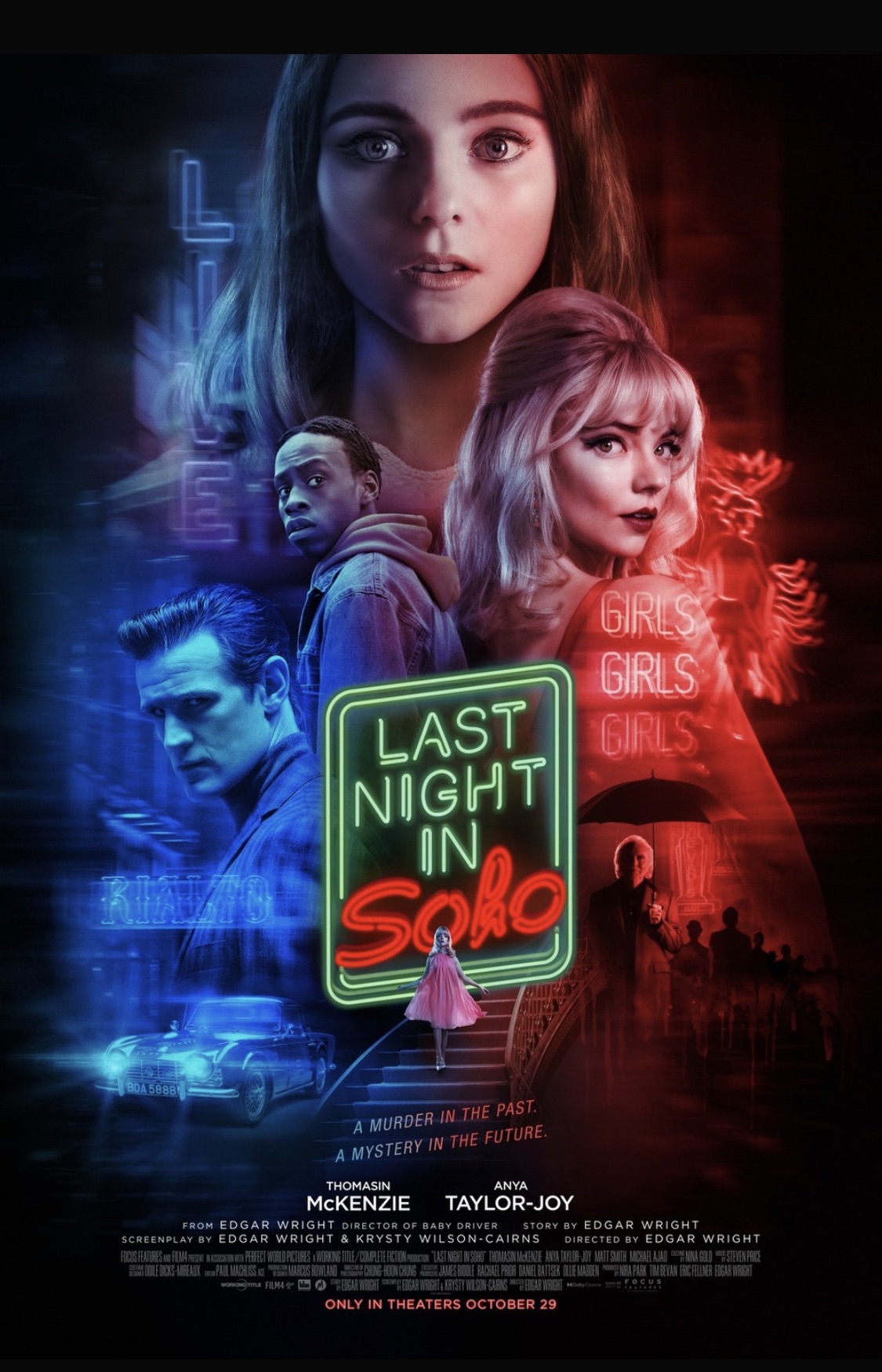 Greetings again from the darkness. Every once in a while a movie captures that magic feeling of being swept away, and this wild film from writer-director Edgar Wright and co-writer Kristy Wilson-Cairns (1917) did just that for me. This is my kind of psychological-horror-thriller and with the exception of one sequence that went a bit too “slasher” for my tastes, I had a blast watching it. I’ll admit that, while also acknowledging more people will probably not enjoy this, than will. But for those who do, I feel confident they will share my enthusiasm.
 Greetings again from the darkness. Few things in the cinematic world are more instantly recognizable than a Wes Anderson movie. In fact, historically speaking, perhaps only Jacques Tati comes as close to having a signature style easily spotted by viewers (unless you want to count Tom Cruise sprinting or Julia Roberts cackling). This is Mr. Anderson’s 10th feature film in 25 years, and I now rate 5 of these very highly, though all 10 have a certain appeal. This latest, co-written by Anderson with frequent collaborators Roman Coppola, Hugo Guinness, and Jason Schwartzman, could be considered his most ambitious to date … and likely the most ‘Wes Anderson’ of all.
 Greetings again from the darkness. The symphonic crescendo of Maurice Ravel’s “Bolero” is perfectly synched with this film’s crescendo, creating a heart-racing, frantic few moments of passion, lust, revelation, and shock – for both the characters and viewers. Also shocking is discovering that this is writer-director Gabriele Fabbro’s first feature length narrative film (after many shorts and videos). This is expert filmmaking and creative storytelling that harkens back to classic 1970’s cinema in a time when it’s certainly needed and appreciated.
 Greetings again from the darkness. Most mothers tell their kids, “If it’s too good to be true, it probably is.” Young Doctor James McCune (Thomas Hobson) has decided to take up the offer from his Uncle Matthew (Phil Morris, who “Seinfeld” fans will recognize as outrageous attorney Jackie Chiles), and become the town doc in North Fork. The year is 1866, and after an eventful trip that sets us up for a horror film, James arrives to find one of the earliest ‘gated communities’.
 Greetings again from the darkness. Sometimes what we see on screen doesn’t tell the whole story about a movie. Writer-director Kazuya Murayama delivers his first feature film, and it’s based on the true story of a 1992 murder in Japan. Not only did Murayama fund the making of this film (there is no producer or Production Company), but the murder took place in the town where he was growing up … and in the same park where he often played.
 Greetings again from the darkness. This compelling film is the debut narrative feature film from co-writers and co-directors Adam Sjoberg and Seanne Winslow. Filmed on location in Oman (not sure I’ve ever seen another filmed there), it’s based on a true story and features first time actors in the key roles.
 Greetings again from the darkness. I don’t know her inspiration for all of the relationships and events in the film – and I don’t need to. Lorien Haynes originally wrote this for the stage, and now her multiple movie shorts have been edited together for a feature film that feels like a gut punch. Her film is unusual for a number of reasons, not the least of which is that 20 directors are responsible for the various segments. Yep, twenty.
