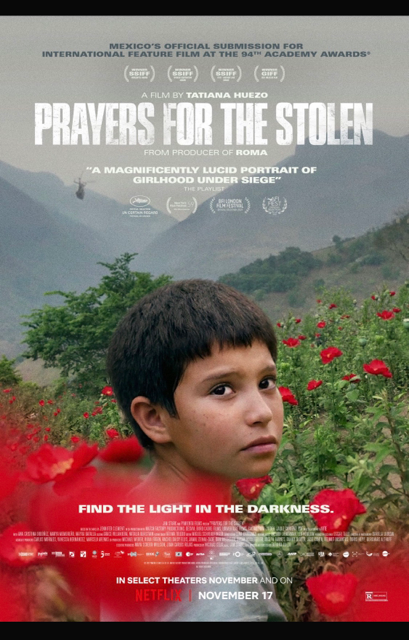
 Greetings again from the darkness. This is Mexico’s official Oscar submission for 2021 Best International Feature Film. Written and directed by Tatiana Huezo (her first narrative feature), the story is adapted from the 2014 best-selling novel by Jennifer Clement. It’s an unusual film that lacks a traditional plot, and instead focuses on the daily lives within a small village in Mexico.
Young girls Ana, Paula, and Maria are good friends. They live in a poverty stricken area, and most of the males work in the quarry/mine or for the cartel, leaving women and children to make do scrounging for food and working in the poppy fields at harvest time. Rita (Mayra Batalla) is Ana’s mother. She’s a proud, hard-working woman who is very protective of her daughter. Why? Well the area is patrolled by the cartel, and neighbors regularly go ‘missing’ – especially young girls. When Ana shows up wearing lipstick, Rita doesn’t find it cute. Instead she serves up a harsh reprimand to the girl too young to understand the risk.
Our view is from Ana’s perspective, and there are two distinct halves. In the first, Ana and her friends are very young (likely between 7 and 9). When we flash forward, the girls are 13 or 14. As a youngster, Ana is played by Ana Cristina Ordonez Gonzales, and she cries when her mother chops off her long hair and styles it like a young boy. This is not done for punishment, but rather to make her less desirable to the cartel. Her friend Paula goes through the same ordeal, while Maria’s cleft palate is deemed to serve the same purpose. As a teenager, Ana is played by Marya Membreno, and the haircut no longer hides her femininity, though her friend Maria faces a tough decision when medical assistance becomes available.
Director Huezo and the actors do a superb job in conveying the ever-present aura of danger hovering over the village. Rita digs a grave-like hole as a hiding place for Ana, and their strategy is put to use. In one particularly tense scene in conflict with the cartel, what keeps Rita alive is that she works in the poppy field – so she is viewed as an asset. As if possible starvation or abduction aren’t enough to keep everyone worried, the poppy fields are sprayed with poison in an attempt to control the crops – only the poison gets dumped on the village instead, as the helicopter pilots have been bribed and threatened by the cartel.
This is a haunting film and we connect quickly with Rita and Ana. We feel the relentless pressure of living in an environment where the cloak of danger is always worn and constant fear is a part of daily life. School provides the girls with a glimmer of hope, although it’s fleeting. This is no place for childhood innocence, and the responsibilities of parenting are almost beyond anyone’s ability. Cinematographer Dariela Ludlow perfectly captures the images, the acting is terrific, and director Huezo has delivered a gem.
Available on Netflix beginning November 17, 2021


 Posted by David Ferguson
 Greetings again from the darkness. Despite Irish ancestry, during my childhood, Ireland was vaguely described as a place to avoid due to the Northern Ireland Conflict (also known as The Troubles). In contrast, the childhood of writer-director Kenneth Branagh was smack dab in the middle of this political and religious mess. This autobiographical project is a sentimental look back at his youth and the connection to his career as a filmmaker. This is very attractive and appealing filmmaking, and one that acknowledges the violent atmosphere without dwelling on it.
 Greetings again from the darkness. We tend to think of ‘coming-of-age’ movies as centered on teenagers as they face the challenges of transitioning into adulthood. The reality is that folks come of age during different phases of life (and some seemingly never do). Filmmaker Joanna Hogg continues her autobiographical look back with the follow-up to her exceptional 2019 arthouse film. Is it a sequel? Technically, yes; but it’s more of a continuation, and the two parts actually function best as a single 4-hour story.
 Greetings again from the darkness. Writer-director-editor-actor Jim Cummings’ 2018 film THUNDER ROAD was quite popular on the festival circuit, and Cummings is back with another story of a stressed out man … at a time when the world doesn’t much care about stressed out men, especially those who carry themselves with a heavy dose of self-importance. Cummings and co-writer, co-director, and co-star PJ McCabe have delivered a satire on traditional Hollywood in the shape of a whodunit with dark comedy that teeters into thriller territory.
 Greetings again from the darkness. We’ve seen most of this before in a long list of inspirational sports stories where the beleaguered, tough as nails coach comes in and unites a rag-tag team while teaching life lessons. However, with (2-time Oscar nominee) Michael Shannon cast as the coach, we know there will be at least one performance worth watching. The screenplay is from Vojin Gjaja and it’s directed by Michael Mailer (son of 2-time Pulitzer Prize winning author, Norman Mailer).
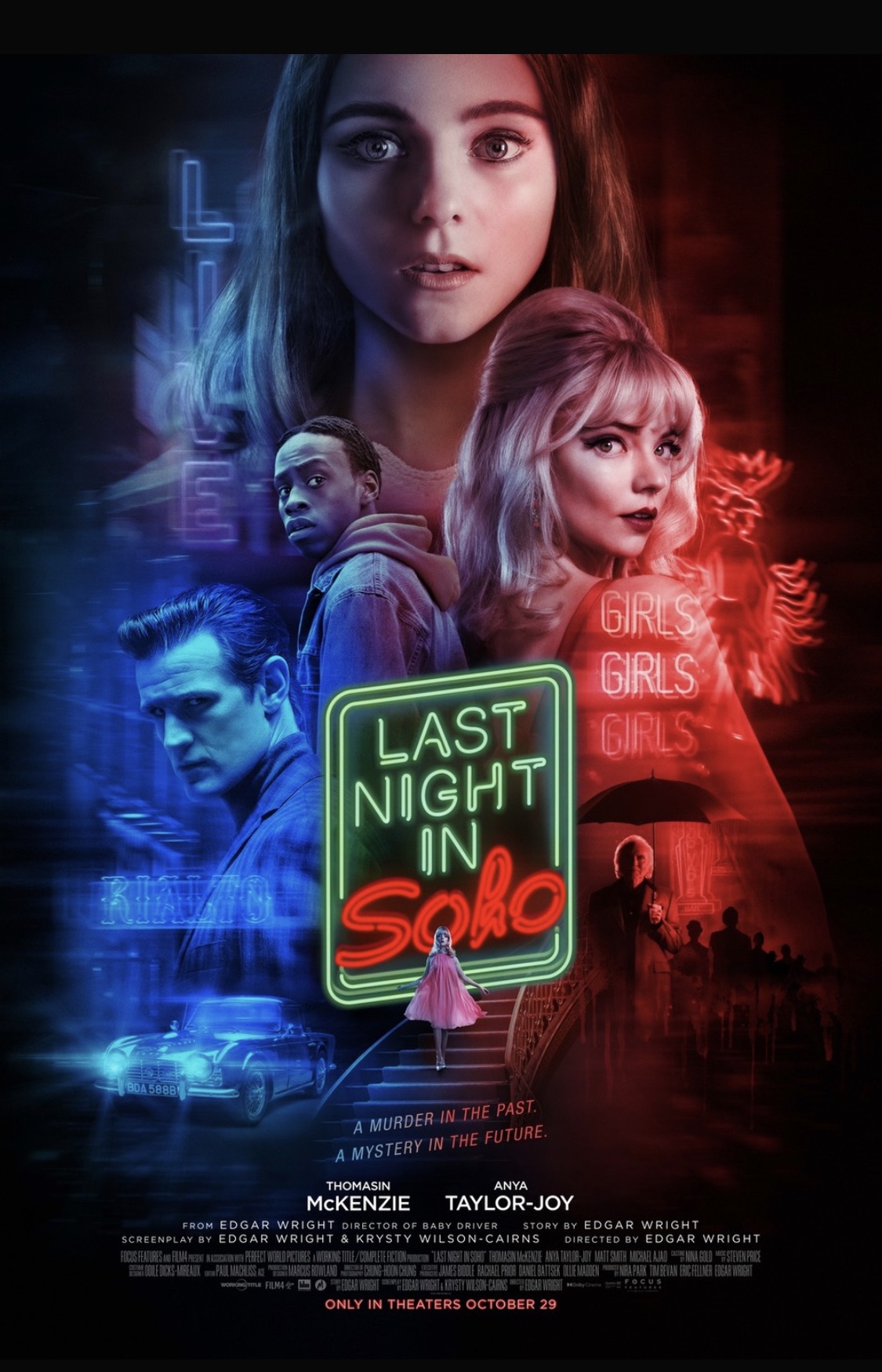 Greetings again from the darkness. Every once in a while a movie captures that magic feeling of being swept away, and this wild film from writer-director Edgar Wright and co-writer Kristy Wilson-Cairns (1917) did just that for me. This is my kind of psychological-horror-thriller and with the exception of one sequence that went a bit too “slasher” for my tastes, I had a blast watching it. I’ll admit that, while also acknowledging more people will probably not enjoy this, than will. But for those who do, I feel confident they will share my enthusiasm.
 Greetings again from the darkness. Few things in the cinematic world are more instantly recognizable than a Wes Anderson movie. In fact, historically speaking, perhaps only Jacques Tati comes as close to having a signature style easily spotted by viewers (unless you want to count Tom Cruise sprinting or Julia Roberts cackling). This is Mr. Anderson’s 10th feature film in 25 years, and I now rate 5 of these very highly, though all 10 have a certain appeal. This latest, co-written by Anderson with frequent collaborators Roman Coppola, Hugo Guinness, and Jason Schwartzman, could be considered his most ambitious to date … and likely the most ‘Wes Anderson’ of all.
 Greetings again from the darkness. The symphonic crescendo of Maurice Ravel’s “Bolero” is perfectly synched with this film’s crescendo, creating a heart-racing, frantic few moments of passion, lust, revelation, and shock – for both the characters and viewers. Also shocking is discovering that this is writer-director Gabriele Fabbro’s first feature length narrative film (after many shorts and videos). This is expert filmmaking and creative storytelling that harkens back to classic 1970’s cinema in a time when it’s certainly needed and appreciated.
 Greetings again from the darkness. Most mothers tell their kids, “If it’s too good to be true, it probably is.” Young Doctor James McCune (Thomas Hobson) has decided to take up the offer from his Uncle Matthew (Phil Morris, who “Seinfeld” fans will recognize as outrageous attorney Jackie Chiles), and become the town doc in North Fork. The year is 1866, and after an eventful trip that sets us up for a horror film, James arrives to find one of the earliest ‘gated communities’.
 Greetings again from the darkness. Sometimes what we see on screen doesn’t tell the whole story about a movie. Writer-director Kazuya Murayama delivers his first feature film, and it’s based on the true story of a 1992 murder in Japan. Not only did Murayama fund the making of this film (there is no producer or Production Company), but the murder took place in the town where he was growing up … and in the same park where he often played.

