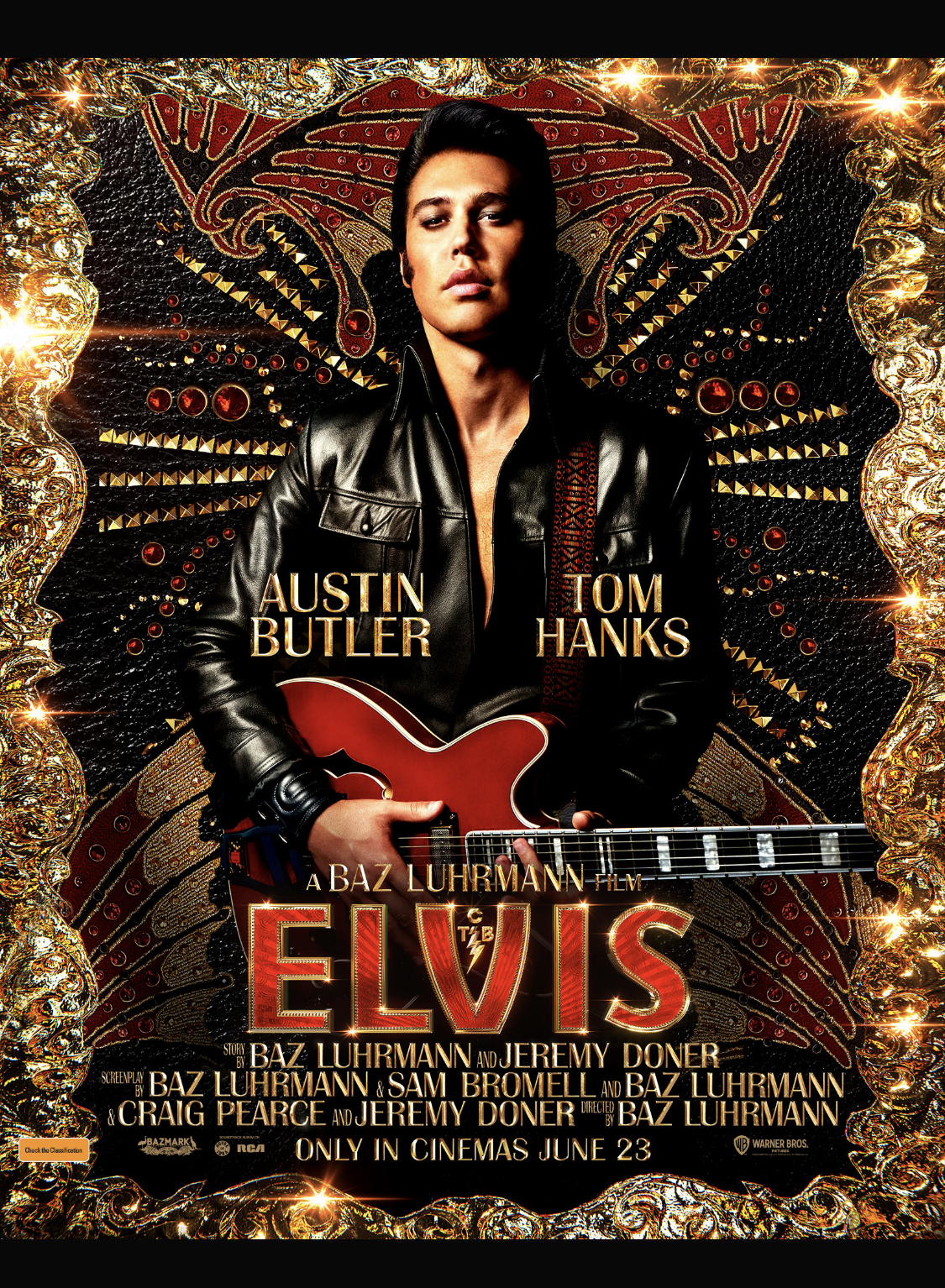
 Greetings again from the darkness. I’m one who grew up spinning my mother’s Elvis 45s and LPs for hours on end. Long before I ever saw one of his movies, I had memorized and mimicked the vocals and stylings of his early recordings. For me, the love of his music was ingrained before any understanding of the cultural influence and impact that had occurred years prior. This background undoubtedly played a significant role in my enjoyment of this film. Many will find bashing this movie to be easy and justified, and I do understand. There are those who view Elvis Presley as little more than a punchline – a drug addicted fat guy chomping on peanut butter and banana sandwiches and forgetting lyrics on stage. Then there are those who view writer-director Baz Luhrmann (THE GREAT GATSBY, MOULIN ROUGE) as a cinematic trickster more committed to flashy visuals than facts and story. For me, the visuals and music of this spectacle were driven by a fully committed actor and a filmmaker serving up a tribute to a cultural icon.
Luhrmann co-wrote the script with Sam Bromell and Craig Pearce (a frequent Luhrman collaborator), and their approach seems three-pronged: the background history and influences of Elvis’ music, the “caught-in-a-trap” life he led, and the force that was Colonel Tom Parker (Elvis’ manager). In fact, much of the story is told from the tainted perspective of an elderly Parker, who is in poor health and near death. In Parker’s mind, he is the ‘hero’ who delivered Elvis to the world, and not the evil huckster who rode his meal-ticket into the ground, while severely limiting artistic opportunities like serious movie roles and international tours.
Playing Colonel Tom Parker, buried beneath a fat suit and facial prosthetics, is Oscar winner Tom Hanks. Further distractions come courtesy of the accent, which is actually pretty close to Parker’s speech pattern. We see Parker’s carnival background and hustler mentality, and watch as he first drools over Elvis along with the teenage girls in the Louisiana Hayride audience … although while the girls enjoy the sexuality, Parker sees nothing but dollar signs. It’s atop a Ferris wheel that Parker entices Elvis with dreams of stardom and wish fulfillment. Elvis is played by Austin Butler (Tex Watson in Tarantino’s ONCE UPON A TIME … IN HOLLYWOOD), and Butler perfectly captures Elvis’ early innocence and naivety, as well as the immense physicality of those early stage performances that sent girls (and some boys) into a tizzy.
Luhrmann takes us back to Presley’s childhood in poverty while living in Tupelo, Mississippi, and it’s here as a young boy wearing a Captain Marvel Jr logo (played by Chaydon Jay) where he is first moved by the gospel music from inside the black church. In fact, Luhrmann makes a point throughout the film to connect Elvis to the music roots of blacks – gospel, blues, R&B. He later befriends BB King (Kelvin Harrison Jr), and is awed by Little Richard (Alton Mason), Big Mama Thornton (Shonka Dukureh), and a stunning Sister Rosetta Tharpe (Yola). This is crucial as Luhrmann is aware of the ’cultural appropriation’ talk associated with Elvis these days, and how the singer absorbed the music that moved him and presented it to the wider audiences that had been previously untouchable by black artists. The influences are beyond debate just as the opening of doors was welcome.
Elvis’ path from Beale Street to Sun Records to RCA is tracked. The Sam Phillips and Sun Records connection is shown only briefly, but Phillips (Josh McConville) is acknowledged for releasing Elvis (driving his Crown Electric truck) so that he could sign with Parker. It was a remarkably standup thing to do and a familiar situation that has resulted in many court battles over the years for other artists and agents. We get a glimpse at Elvis’ extremely close bond with his mother Gladys (Helen Thompson), whose faith and heavy drinking are both on display. We can see the pride Elvis carries as he shows her Graceland for the first time. Richard Roxburgh plays Elvis’ father Vernon, and as time goes on, he’s not portrayed in a flattering light – seemingly more interested in money than in doing right by his son.
Elvis enlisting in the Army is viewed as a necessary public relations step due to the outcry from religious conservatives over his onstage movements clearly sponsored by the devil himself. We see one scene of Elvis courting Priscilla (Olivia DeJonge), but she’s only described as a teenager, so Luhrmann has chosen to gloss over the age difference and the unusual circumstances of those years between meeting and marrying. Also receiving the ‘glossed over’ treatment is Elvis’ movie career. It’s handled via montage with Austin Butler’s face superimposed into actual clips of the films. Another element that the film quickly skips through is the “Memphis Mafia”, Elvis’ entourage of assistants and hangers-on. They are mostly shown here as background characters, and some of these guys went on to write ‘tell-all’ books to line their pockets after Elvis died. It turns out the Elvis’ loyalty to them was not reciprocated once the gravy train ended.
Colonel Tom Parker was neither a Colonel nor a Parker. He was born Andreas van Kujik in The Netherlands and emigrated to the United States in order to pursue the American Dream and boat loads of gambling debt. Supposedly he treated Elvis pretty well, but it’s frustrating to know that so many business decisions were based on Parker’s personal needs rather than Elvis’ artistic development. As you would expect, Tom Hanks handles the role of ‘villain’ and Snowman quite well.
Austin Butler portrays Elvis from the early 1950’s to the mid-1970’s. It’s a terrific performance and one worthy of great admiration. Butler immersed himself in Elvis and it shows, perhaps never better than the infamous 1968 Comeback special. Black leather in the round, rocking to his hits, was a smash in TV ratings, and re-established Elvis as the star he was. The special also features Elvis in white suit belting out “If I Can Dream”, and Butler nails the emotion-filled performance. I consider this (Elvis’ actual song) one of the all-time most memorable rock/pop moments alongside Bill Haley and the Comets releasing “(We’re Gonna) Rock Around the Clock” (1954), Chuck Berry’s “Maybellene” (1955), Bob Dylan going electric at Newport Folk Festival (1965), Sinatra singing “My Way” (1969), Hendrix at Woodstock (1969), Live Aid (1985), and Kurt Cobain/Nirvana unplugged on MTV (1994).
We go behind the scenes for the dealings that brought Elvis and his new big band approach to the International Hotel (now The Hilton) in Las Vegas. Once again, Butler is spot on during the stage performances, and this brings the musical catalog full circle. Elvis’ musical roots and that early fascination never left him – regardless of whether it was his early trio, or the orchestra in Vegas. Despite the extended run time of 2:49, Luhrmann had to make some tough choices on what to include and what to omit. In a career that spanned less than 25 years, Elvis recorded more than 700 songs … none with the help of Auto-Tune. His amazing voice could be smooth, soulful, playful, or powerful, depending on the song – even at the end. We see one of his final stage performances (with Butler’s face superimposed over the clip) recorded a mere two months before his death in 1977. With guitarist Charlie Hodge holding the microphone, a bloated and drug-addicted Elvis delivered a most memorable rendition of “Unchained Melody”. He would soon be dead at age 42.
Baz Luhrmann and Austin Butler have provided a dazzling look at a remarkable career that changed the music industry and society. The film is quite a visual and musical and historical treat. We have grown so accustomed to reveling in the “bad” side of celebrities, that a celebration of one might seem trite to some. However, fans will enjoy most of this, despite the constant feeling that Elvis was trapped and lived with an underlying sadness for so many years. Elvis may have left the building, but Baz Luhrmann, Austin Butler, and the musical legacy continue ‘Taking Care of Business in a Flash.”
The film opens in theaters on June 24, 2022
WATCH THE TRAILER
 Greetings again from the darkness. Dementia and/or Alzheimer’s Disease have touched most every family by now; a fact that works to the detriment of this film from writer-director Jay Giannone and co-writers Erich Hover and Eric Watson. The opening screen informs us that it’s based on a true story, and in fact, it’s actually similar to countless family stories around the globe. Of course, this doesn’t minimize the stress and strain and frustration and pain that this causes for family and friends, and it likely helps some understand that they aren’t alone in this battle.


 Posted by David Ferguson
 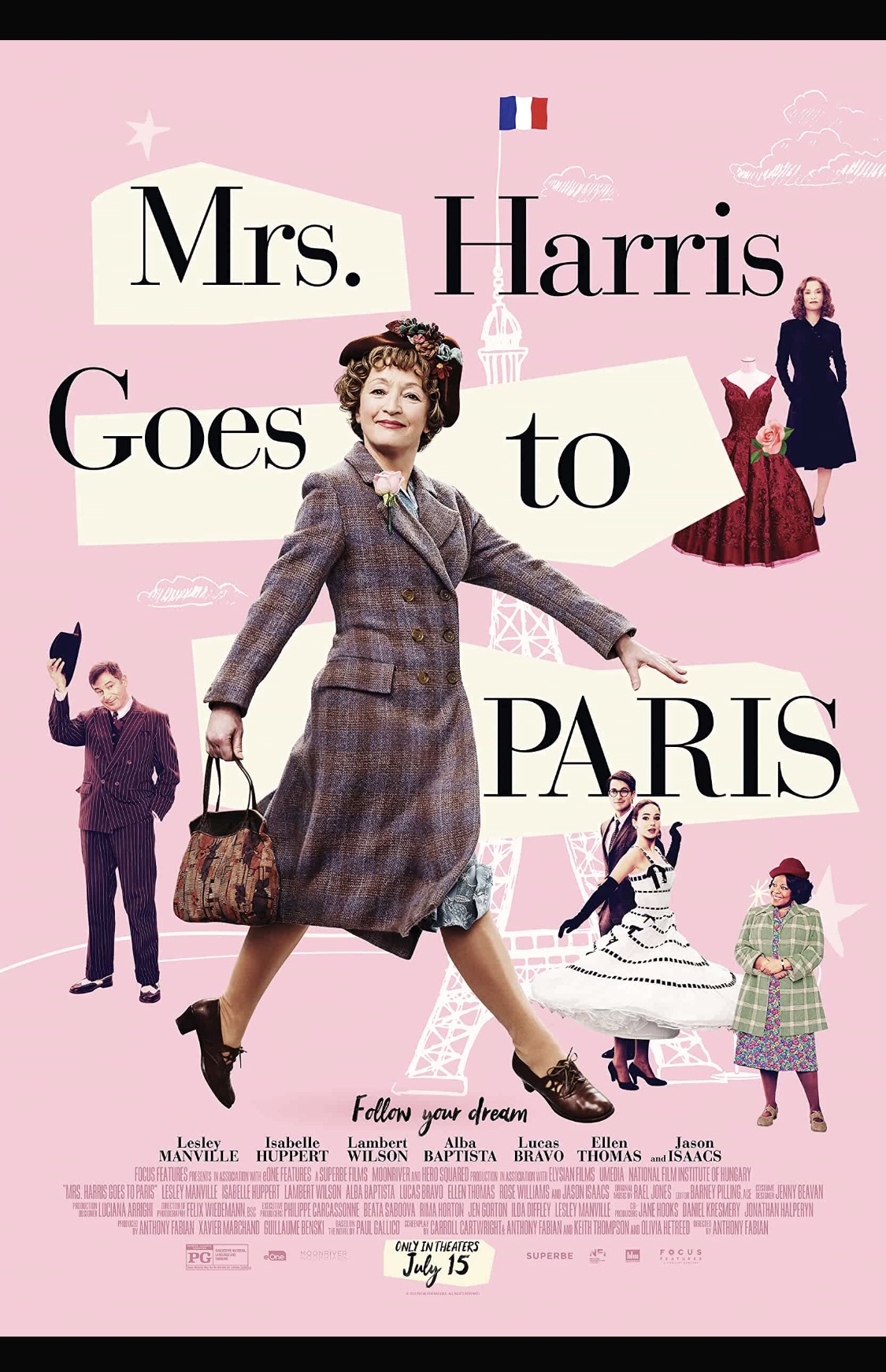 Greetings again from the darkness. Leslie Manville is one of those actors we take for granted. She’s so talented and versatile and typically “perfect” in the supporting roles she embodies. For us followers of British filmmaker Mike Leigh, we’ve been treated to numerous Manville performances over the years, but it’s likely she’s most widely recognized for her Oscar nominated performance in Paul Thomas Anderson’s PHANTOM THREAD (2017), where she played Daniel Day-Lewis’ sister and business partner with an icy efficiency that added heft to a terrific film. This time, Ms. Manville embraces the lead and delivers a turn as a Mrs. Harris that we would all welcome into our lives.
 Greetings again from the darkness. Sometimes a movie synopsis just screams “Lifetime Channel”. As an example: A road trip movie with a single father and his teenage daughter would be a typical beginning. Oh, and the father has been recently diagnosed with a brain tumor. And then, let’s have them track down the mother that abandoned the girl when she was a baby. Those pieces certainly lay the groundwork for a sappy melodrama meant only to induce tears from those who enjoy a good cry after a hard week of work. Fortunately and surprisingly, crisp writing, proficient filmmaking, and a talented cast work together to make this film something entirely different – a heartfelt saga grounded in real life feelings and moments.
 Greetings again from the darkness. This is the kind of movie that requires upfront disclosure: have you read the book or not? Since it was number one on New York Times best seller list for 2019 and 2020, and remained on the list for almost three years, it’s a legitimate question and likely the driving force behind Reese Witherspoon producing the film. I have not read the book and came in with only a few preconceived notions, and enough background information to make it more interesting, not less. This is director Olivia Newman’s first film since her debut FIRST MATCH (2018), and Lucy Alibar (BEASTS OF THE SOUTHERN WILD, 2012) adapted the screenplay from the enormously popular novel written by Delia Owens.
 Greetings again from the darkness. For proof that social media and the internet can be used for good, I offer as evidence this film from writer-director Dean Fleisher-Camp and co-writers Elizabeth Holm, Nick Paley, and Jenny Slate. The first ‘Marcel’ short film hit the internet in 2010 and was such a hit that there were two follow-up short films and a best-selling picture book. Now expanded to a feature length film of 90 minutes, the innovative and curious premise holds up due to the fully-formed character of a precious one-googly-eyed mollusk shell wearing … yes … shoes.
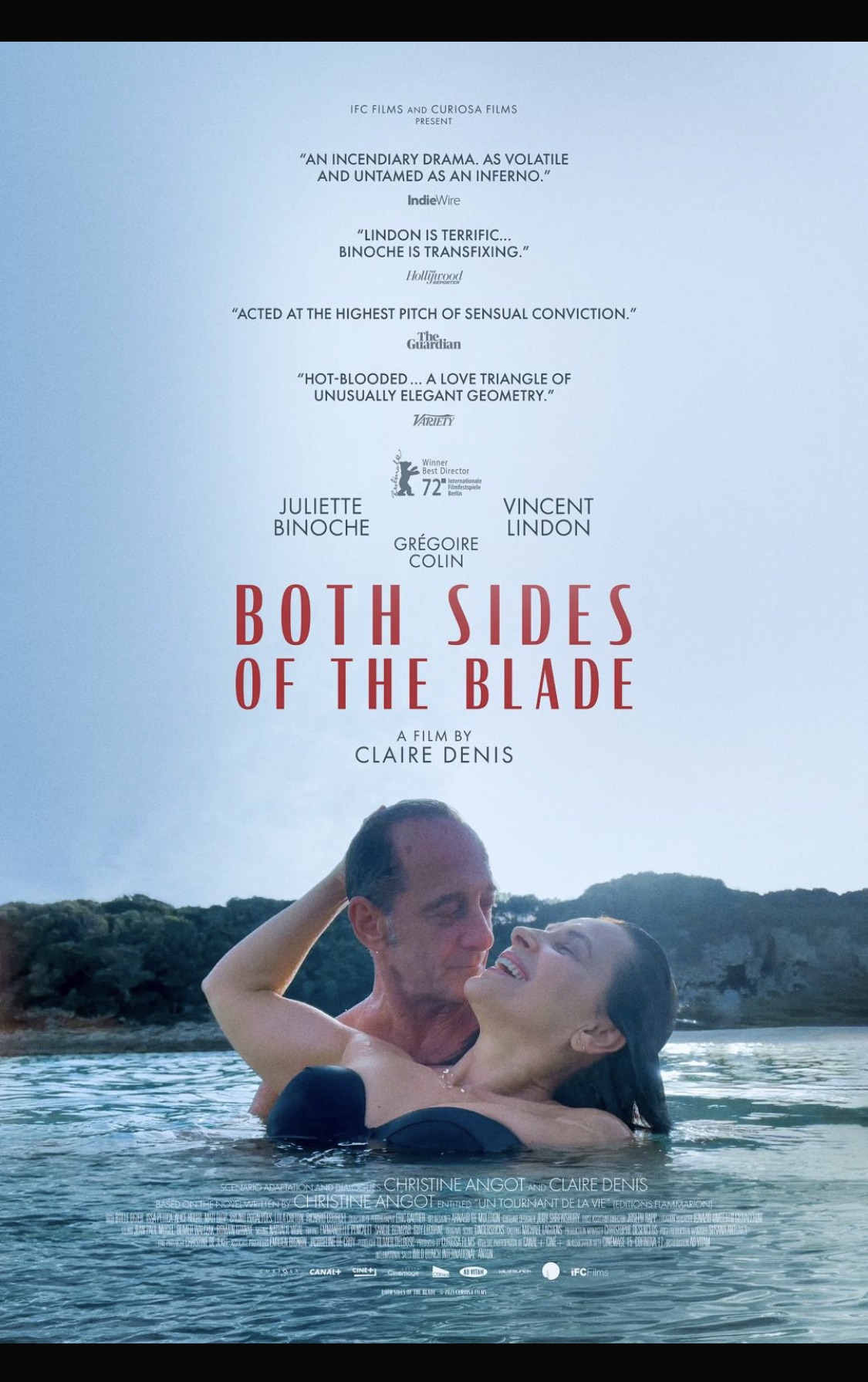 Greetings again from the darkness. If you are one of the many who need someone to cheer for – a nice person – in order for a movie to work for you, then this latest from renowned French director Claire Denis (BEAU TREVAIL, 2019) is going to be a challenge. Ms. Denis co-wrote the script with Christine Angot (they previously collaborated on LET THE SUNSHINE IN, 2017), an adaptation of Ms. Angot’s novel.
 Greetings again from the darkness. Writer-director John Michael McDonagh (older brother of Oscar winner Martin McDonagh) has delivered a couple of fine movies in the past: CALVARY (2014) and THE GUARD (2011), and he’s never been one to shy away from controversial characters or topics. This time, he has adapted the 2012 novel from British writer Lawrence Osborne, and in this process, has continued his fascination with the all-too-human dark nature of some folks. Somewhat surprisingly, most of this is so obvious and blatant, only those who prefer thoughts be spoon-fed will appreciate the lack of subtlety.
 Greetings again from the darkness. At this point, I believe it’s fair to say we have a Jane Austen sub-genre for film, TV, and books. After all, it’s been more than 200 years, and her novels have remained in print, have also been adapted too many times to count, and inspired countless writers and filmmakers to follow in her footsteps. The success of the “Bridgerton” series is a testament to the Jane Austen realm, despite being adapted from the novels of Julia Quinn. For this first feature film from director Emma Holly Jones, Suzanne Allain has adapted the screenplay from her own novel, and interestingly, this is a feature length version of Ms. Jones’ 2019 short film, with most of the cast and crew returning.
 Greetings again from the darkness. Satire is one of the most challenging cinematic genres to get right. The script and performances are crucial, and the director must walk a fine line between too subtle and over-the-top. The long-time collaborative filmmaking team of co-writers and co-directors Mariano Cohn and Gaston Duprat, along with co-writer Andres Duprat, strike just the right chord and deliver a gem that is funny, insightful, and quite entertaining. The film was well received at last year’s Venice Film Festival, but is only now getting distribution.
 Movie Reviews from the Dark