CAKE (2014)

January 30, 2015

cake Greetings again from the darkness. This completes what I call the triumvirate of female film misery: Julianne Moore in Still Alice, Marion Cotillard in Two Days, One Night, and now Jennifer Aniston in Cake. Each film focuses on the physical and emotional struggles of a previously strong female character adjusting to life’s cruel obstacles.

Claire (Ms. Aniston) is a former attorney in constant chronic pain who appears to be on a mission to make everyone around her as miserable as she is. The scars on her face make it obvious she has survived some trauma, and it’s also clear that there is an additional emotional loss that is contributing to her situation. However, director Daniel Baraz (Beastly) and writer Patrick Tobin tease us for awhile with exactly what tragedy Claire is working through. Further proof of her lack of charm comes when her support group (led by Felicity Huffman) boots her out after an especially uncaring rant.

Claire takes a bizarre interest in researching the suicide of one of the group’s members (Anna Kendrick). This leads to some uncomfortable interactions with the woman’s husband (Sam Worthington) and their young son, and even more bizarre interactions – through dreams and hallucinations – with the Kendrick character (yes, the dead one). Claire’s abusive persona comes through in these moments, just as it does with all other people who dare cross her path … especially that of her caregiver Silvana (a wonderful Adriana Barraza, Babel).

Many have used the dreaded “snub” term to describe Aniston not receiving an Oscar nomination. My perspective is that she does a fine job in a role that is stunning in its variance from her typical fluffy rom-com roles. However, it is not a performance that I would favorable compare to Julianne Moore, Marion Cotillard or Felicity Jones. To see America’s sweetheart go 90 minutes sans make-up and with unkempt hair is a welcome change, but the script contrivances and the choppiness of the presentation – a stream of big name actors make single scene appearances – do nothing to help the case for Aniston. In fact, I would still rate her work in The Good Girl as her best.

The trend of glam-downed actresses is welcome, though it’s important to remember that a full-bodied script is still necessary for a quality movie. Other than the language, this one felt like it was more in line with a Lifetime movie. However, it does provide hope that Ms. Aniston will devote more time to dramatic roles and indie films.

watch the trailer:


TWO DAYS, ONE NIGHT (Deux jours, une nuit, Belgium, 2014)

January 29, 2015

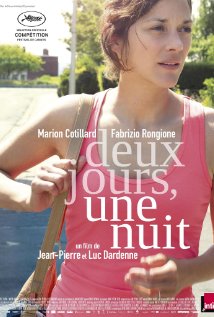
two days one night Greetings again from the darkness. The Dardenne Brothers (Jean-Pierre Dardenne, Luc Dardenne) are filmmakers who excel at forcing us to take notice of human nature. This time they take the unusual step of working with an A-lister in Marion Cotillard, yet rather than create a distraction, this works for making the lead character even more realistic and believable.

Sandra (Ms. Cotillard) is a working class wife and mother who has gone through recovery after a bout with severe depression. She has been on leave from her factory job and now uses her Xanax as a crutch when she gets a little anxious. Just as it’s time for her to return to work, she learns her co-workers chose a bonus over allowing Sandra to keep her job, through some type of cruel vote facilitated by company management.

Sandra’s friend Juliette (Catherine Salee) encourages the boss to allow a re-vote on Monday, and Sandra’s husband (Dardenne regular Fabrizio Rongione) advises her to visit each of the 16 co-workers and request that they reconsider their vote. Though she would rather curl up in bed, Sandra’s trek to visit each co-worker takes every ounce of courage and energy she can muster.

This is a fascinating study of economic realities vs human nature, even right vs wrong. Can these people look beyond what is best for themselves and do the right thing for Sandra? These individual meetings are excruciating to watch. Asking each person to vote for her is agonizing for Sandra, while each of the co-workers has their own personal struggles that make the decision not so simple.

Marion Cotillard is a revelation here. This is not the glamorous movie star you might think of. Instead, she dresses down, wears minimal make-up, and walks and talks like the desperate working class woman she is playing … all while carrying the burden of a clinical depressed person. Mostly, she taps into an emotional state that is powerful to watch. The Oscar nominated is definitely justified.

While it seems the suspense of each scene is almost more than Sandra can take, there is a moment of release and joy during the sing-along with Van Morrison (on the radio). The character of Sandra defines “putting up a good fight”, and she proves that sometimes that is the most important thing.

watch the trailer:


STILL ALICE (2014)

January 29, 2015


still alice Greetings again from the darkness. I’ve never understood the phrase “cruel disease”. Are there diseases that aren’t cruel? One could say the level of cruelty is determined by how the disease affects you and your loved ones, but a stunning performance by Julianne Moore provides a glimpse of what Alzheimer’s does to those afflicted. She shows us what it’s like when we are robbed of what makes us who we are.  And yes, it’s very cruel.

Most “disease” movies spend a significant amount of effort demonstrating how this will affect the victim’s family and friends, but co-directors Richard Glazer and Wash Westmoreland have adapted Lisa Genova’s novel to focus on Alice (Ms. Moore) … her family is mostly trotted out to help the viewer understand how the disease has progressed. We first meet Alice on her 50th birthday, and soon learn she is a brilliant Linguistics Professor at Columbia and has 3 brilliant kids (Kristen Stewart, Kate Bosworth, Hunter Parrish) and a brilliant husband (Alec Baldwin). These are brilliant, successful and beautiful people. And that’s one of the points here … Alzheimer’s doesn’t pick on the poor, the slow or the weak. It doesn’t discriminate at all (other than a slightly higher rate amongst women).

Julianne Moore somehow is equally effective as the energetic, very confident professor and the shell of a person with vacant eyes who only periodically recognizes the face in the mirror or the faces at the family meal. This is a movie and a performance about moments … moments of panic, isolation, and one particular moment of unleashed emotion when Alice comes clean to her husband early on. We hear the fading of her verbal skills (in her speeches) and we witness the slow fail of her body (she was once a runner). It’s torturous to hear and see.

There have been other movies that touched on Alzheimer’s: The Notebook (2004), The Savages (2007), and Away From Her (2007), but Julianne Moore is the first to take us inside, to force us to feel the slow loss of self. It’s painful, and yes it’s cruel.

**NOTE: that is Julianne Moore’s son (with director Bart Freundlich) playing guitar on the park bench near the end of the movie

SEE THIS MOVIE IF: you want to see a personal portrayal of Alzheimer’s rather than reading a brochure OR you want to see the likely Oscar winner for Best Actress

SKIP THIS MOVIE IF: you and your family have been touched by Alzheimer’s and you need no reminder

watch the trailer:


BLACK SEA (2015)

January 21, 2015

black sea Greetings again from the darkness. One of my first favorite TV shows as a little kid was “Voyage to the Bottom of the Sea”. Each week I sat wide-eyed in front of the tube (yes, it was actually a cathode ray tube back then) anxiously awaiting underwater adventure. It wasn’t until later that I discovered Irwin Allen’s 1961 movie of the same name, and more importantly, Jules Verne’s novel “Twenty Thousand Leagues Under the Sea”, which featured the wild exploits of Captain Nemo and the Nautilus.  Since then, count me in for just about any movie based aboard a submarine (Down Periscope being a rare exception).

Director Kevin MacDonald is best known for his excellent 2006 film The Last King of Scotland (with Forest Whitaker’s Oscar winning performance as Idi Amin). This time he works with a script from playwright Dennis Kelly to deliver a gritty, tense thriller that is lacking any traditional Hollywood fluff … it’s a down and dirty look at greed, desperation and the survival instinct.

Inherent to a story based aboard a submarine is the immediate and constant threat of claustrophobia and death. This one adds another element of danger by blending a crew of Russians and Brits with the goal of bringing back millions of dollars in gold locked away on a sunken German U-Boat in the Black Sea waters. Lest you think the Russians are just another group of southern California actors faking the accent, director MacDonald confirmed that he cast actual Russian actors – including Grigoriy Dobrygin (A Most Wanted Man), Konstantin Khabenskiy (one of the most popular actors in Russia), and three others named Sergey, which MacDonald acknowledged contributed to on-set confusion. This decision elevates the onboard tension between adversarial characters to an armrest-gripping level. Yet another slightly psychotic Ben Mendelsohn (Animal Kingdom) role doesn’t hurt, either.

Jude Law continues the second phase of his career – far removed from his pretty boy early films – as a tough, revenge-seeking sub captain fired by his long-time employer. Should you doubt Law’s acting range, I would recommend not just this film, but also last year’s Dom Hemingway (a raucous ride). Law’s performance here is very strong as he transforms from a p.o.’d former employee to an eye-on-the-prize, win-at-all-cost treasure seeker. The onboard tension mounts every time there is interaction between the Russians and Brits, and Law’s character attempts to mediate. The progression of this three-way dynamic is fascinating to watch as it unfolds.

To provide that true underwater feeling, MacDonald filmed some scenes onboard an old Soviet submarine that is moored in the River Medway in Kent (UK). We never have that feeling of Hollywood soundstage; instead we as viewers share in the tight space and constant dread. This combination of characters, setting and mission deliver an intense thriller that is sure to please, and feels uncommonly welcome this early in the year.

The pinnacle of submarine movies is Das Boot (1981), a must-see for any movie lover. Other popular sub films include Crimson Tide (1995), The Hunt for Red October (1990), and K-19: The Widowmaker (2002), and for those of us who are fascinated by life (and possible death) under the sea, we gladly welcome a new entry to the sub-genre, especially one as well made and tension-packed as Black Sea.

watch the trailer:


SONG ONE (2014)

January 21, 2015


Song One Greetings again from the darkness. Fresh off her Oscar winning performance and infamous onscreen haircut in Les Miserables, Anne Hathaway stars in this infinitely smaller film from writer/director Kate Barker-Froyland.  A Sundance Film Festival entry, the movie winds through the clubs, coffee shops and second hand stores that make up the indie music scene in northern Brooklyn.

Ben Rosenfield (“Boardwalk Empire”) plays Henry, the kind of musician so enamored with his own folk sound that he is willing to play for pocket change in the subway tunnels. Failing to adhere to mother rule #1, Henry pays the price for not looking both ways prior to crossing a street in front of a New York cabbie. Next thing we know, he is comatose in a hospital bed. Henry’s mom (Mary Steenburgen) beckons wayward daughter Franny (Anne Hathaway) home from her worldly pursuit of a Ph.d in Anthropology.

When last they spoke Franny and brother Henry had one of those nasty sibling fights where angry words were spoken and no apology followed. It’s been six months and now a guilt-ridden Franny sits by his hospital bed hoping for a shot at redemption. She soon discovers Henry’s journal and begins re-tracing his favorite hang-outs and bands. This journey leads her to a meeting with Henry’s musical idol James Forester (played by Johnny Flynn). Lacking suspense, the story leads right where one would expect – James and Franny taking a liking to each other, Franny discovers her own love for music, and the songwriting block that has burdened James slowly breaks down.

The film is at its best in the musical moments. Flynn is a very talented guy as a musician (not so much as an actor), and 5 or 6 live musical acts make appearances as the story unfolds. Most of the quiet scenes between Hathaway and Flynn seem a bit awkward, but not awkward in the good way that leads to real romance. Connection and re-connection are quite common in times of tragedy, as we are at our most emotionally vulnerable state. The biggest issue here is that everything develops just as we would expect … no surprises, no twists. Even the re-connection of Franny and her mother is a sweet scene where Franny sings along to America’s “I Need You”.

Jenny Lewis (of Rilo Kiley fame) and Jonathan Rice co-wrote the original songs used in the film, and as stated, a hand full of other bands perform their own material. For a musically based romantic drama, it does have a couple of really nice scenes, but for the most part, the drama and romance lag the music.

watch the trailer:


THE WORLD MADE STRAIGHT (2015)

January 21, 2015

the world made straight Greetings again from the darkness. The Hatfields and McCoys family feud has long been a favorite topic and inspiration for literary and film projects. Lesser known, but ultimately more tragic and historically vital, is the 1863 Shelton Laurel Massacre during the Civil War. The novel from Ron Rash is the foundation of director David Burris’ film that explores the fallout of that incident more than 100 years later in the very rural Appalachian hills of Madison County, North Carolina.

It doesn’t take us long to get a line on Travis (Jeremy Irvine, War Horse), a high school dropout with authority issues who hangs out with his equally aimless friends, including Shane (Haley Joel Osment, The Sixth Sense). We have seen many film depictions of hillbillies over the years, so the grim atmosphere of unemployment, isolation, lack of education, drugs and lack-of-hope aren’t surprising, and the undercurrent of the 1863 event is what should have set this one apart.

Interest picks up when teacher-turned-drug dealer Leonard (Noah Wyle) takes Travis under his wing after Travis has an unfortunate run-in with Carlton (Steve Earle), another local drug dealer. Travis moves in with Leonard and his drug-addicted girlfriend (Minka Kelly), and takes a real interest in the journals of Civil War soldiers that Leonard has collected. These stories spark a curiosity within Travis, in particular the saga of 13 year old David Shelton – one of the victims of the massacre.

It’s the fact that Travis is oblivious to the history of his family, and how this event has so affected life in his hometown, that makes this story difficult to buy into. In spite of the communication void between Travis and his father, it’s just not possible that the massacre would not have been a frequent topic of discussion throughout the years. Beyond that, this is little more than a typical small town battle between drug dealers … albeit two very articulate drug dealers.  And yes, guns and turf do play a role here.

Jeremy Irvine, Noah Wyle and Steve Earle each make their characters someone interesting to watch. On the other hand, the female characters are mostly after-thoughts or plot devices. Travis’ mother maintains a forlorn look that registers her resignation to fate, while Minka Kelly mostly gets knocked around (save for one excellent scene while alone with Travis), and Adelaide Clemens provides the rare sparks of light and optimism as Travis’ love interest – and then just as quickly becomes a non-entity.

The fine acting and excellent camera work deserved a better story, especially given the framework of history. There is a recurring hillbilly philosophy in the movie that states “Time don’t pass. It’s just layers. It’s all still happening.” That philosophy could have better tied the current story into the past, which would have elevated this film to a new level.

watch the trailer:


LITTLE ACCIDENTS (2015)

January 17, 2015

little accidents Greetings again from the darkness. You know how we always hear that there are no secrets in a small town – how everyone knows your business? This first feature film from writer/director Sara Colangelo exposes the fallacy of that notion. It seems all residents of this small mining community are carrying secrets, and some are whoppers!

The story picks up about a year after a horrible coal mining accident killed ten local miners. The lone survivor was Amos (Boyd Holbrook) who is struggling with physical limitations resulting from the incident.  However, generating more pain for Amos than his withered arm and leg is the internal battle the ongoing investigation is causing him. Should he expose the known safety issues that caused his co-workers to die?  If he does, those 10 families probably get justice and a financial reward, but the mine likely shuts down – crippling the local economy and throwing much of the town out of work.  If keeps quiet, those families get nothing and it’s business as usual for everyone else.

Amos is joined in a daily conundrum of secrets by: Owen (Jacob Lofland), who is much too young to handle the situation an accident has placed him; Owen’s brother James (Beau Wright) who has Down Syndrome and is even less equipped to keep his secret; the mine’s supervisor Bill (Josh Lucas) who defends his poor decisions by saying he only did what the company forced him to do; and Diane (Elizabeth Banks) who is Bill’s wife and reacts to the disappearance of her son and lack of respect for her husband in a manner that can’t possibly end well.

As is common in poverty-stricken communities, there is even more to add. Owen’s father was one of the miners killed in the accident, and Owen was among the group who last saw Bill and Diane’s son alive. Also, Amos is living with his father who is paying the health price for a lifetime of coal mining. The film is bookended by Amos’ testimony regarding the accident, and in between we see these intertwined lives and much soul-suffering and personal stock-taking. It’s a reminder of how powerful grief can be, especially after such an instantaneous tragedy.

Boyd Holbrook and Jacob Lofland deliver outstanding performances. Mr. Holbrook’s career is in skyrocket mode as he appeared in 8 projects during 2013-14 (including Gone Girl, The Skeleton Twins), and has 5 more for 2015 (including Terrence Malick’s next film). Young Mr. Lofland was a standout in both Mud (2012) and his recent recurring role on TV’s “Justified“. Also of note is one of the few dramatic turns for Elizabeth Banks. We have come to expect comedy excellence from her (even as Effie in The Hunger Games), but we have rarely seen the emotional depth she portrays here.

The movie is beautifully shot by Rachel Morrison, and the film stock provides the grainy look that adds to the realistic feel necessary for us to be absorbed into this isolated world. Comparisons to other mining movies are expected, and North Country (2005) and Matewan (1987) come to mind, however, those were centered on mistreatment in the workplace and labor issues, respectively. This movie is much more concerned with grief, and for some reason The Stone Boy (1984) comes to mind. Dealing with tragedy does not become easier with age, financial status or social standing. Ms. Colangelo’s film provides an intimate look at this.

watch the trailer:


AMERICAN SNIPER (2014)

January 17, 2015

american sniper Greetings again from the darkness. “Uneasy lies the head that wears a crown”. Shakespeare wrote those words for “Henry IV”, but director Clint Eastwood’s latest film depicts the sentiment for Chris Kyle, the Navy SEAL sharpshooter known as “Legend”. Screenwriter Jason Hall adapted the story from Kyle’s memoir (co-written with Scott McEwen and Jim DeFelice).

You may not be aware of the sniper’s role during a war. In an early scene (used in the trailer) we experience the incredibly stressful moment of decision that Chris Kyle (played by Bradley Cooper) faces as a mother and young child enter the street … are they a threat to the platoon or not? The decision means killing a woman and child or risking the death of many U.S. soldiers. If he is wrong, he faces a jury and military shame.  Most of us lack the capacity for such decision-making.  As a flashback to Kyle’s childhood shows, most of us are either sheep or wolves. Only a very few are sheepdogs with the aggressiveness to protect the flock. Chris Kyle: sheepdog.

The story takes us through Chris’ aimless young adult years on the cowboy circuit. He’s a tough guy who likes to drink and party with his friends. September 11 acts as a call to action, a call to service. SEAL training is shown and the point is made that Chris is the old man in the group, but he displays a quiet leadership trait. We then witness his flirting with a snippy Taya (Sienna Miller) at a bar counter as his SEAL buddies throw darts at each other’s bare backs (don’t try that at home, kids).  Soon enough Chris and Taya are married, and Chris is called to the front.

Back and forth we go through Chris Kyle’s four tours. His expertise in war is offset by his inability to adjust to family life. He has a compulsion to serve and to protect his fellow soldiers, but he is unable to fit into the suburban life of cell phones and grilled hamburgers. Not surprisingly, Taya struggles with his struggles. Bradley Cooper gets to be the legend, while Sienna Miller is the emotional mother who has seemingly lost her husband – not to death, but to an obsession to serve.

The film does little to explain why Chris Kyle is exponentially more productive than other snipers, and even less to explore his PTSD and mental anguish outside of the front. It’s Bradley Cooper’s acting that provides us what insight we do get, and he does a remarkable job capturing the hulking, uncommunicative giant who doesn’t really understand the “legend” title … he’s just doing his job and following his nature.

The tragic end is handled with grace by Eastwood, and it left my full-capacity movie theatre as quiet as a church during prayer. It’s possible to be a legend, but not a feel like a hero, and the movie makes no political statements regarding war or foreign policy. What it does show is that most of us are not sheepdogs.

watch the trailer:


A MOST VIOLENT YEAR (2014)

January 14, 2015


a most violent Greetings again from the darkness. The tar pits of La Brea. Michael Corleone. These are the two things that come to mind as I grasp for descriptive terms to use for writer/director JC Chandor’s latest film. Picture a slow simmer never quite reaching the boiling point … that’s the designed tone here. It’s certainly not the period piece crime thriller that the trailer might have you poised for. In fact, there is more focus on marital communication than the criminal element so prevalent for the times.

In 1981, New York City was in the midst of an era filled with crime, corruption, violence and filth. Enter Abel Morales (Oscar Isaac) as a tough-minded, but idealistic owner of a heating oil business. Abel’s vision is to become the top oil distributor, and remain a really good guy in the process. When he tells his less-idealistic competitors to “have some pride in their work”, it’s good advice to an audience incapable of comprehending.  Despite regular violence and criminal activity against his drivers and trucks, Abel continues to deny he is at war … he truly believes if he can stay above the fracas, he can overcome the blight of his industry.

We never really see Abel have a good day. Even the high points are paired with hard knocks. A signed contract is followed by bank woes. A kid’s birthday party at the new house is interrupted by a search warrant. New market share is offset by a driver illegally defending himself. Each step Abel takes to realize his business vision is a potential land mine set by either his competitors or an ambitious District Attorney (David Oyelowo). And those aren’t even his most animated battles. See, Abel has willed himself to extraordinary self-control. He never blows a gasket, even if the moment calls for it. The only exception to this is with his vicious business partner and wife Anna (Jessica Chastain).

Anna grew up the daughter of a gangster … her dad once ran the business that she and Abel now run. Given the times, Anna takes a back seat to Abel and she handles the books, while he is the face of the business with banks, competitors and Teamsters. It’s not difficult to imagine a movie focusing on Anna rather than Abel, and a couple of times, she makes it quite clear that she views herself as the real backbone of the business – a much tougher leader than her doe-eyed husband.

Isaac and Chastain are exceptional here, and they both pull off very tough roles. Abel is a philosopher is a world of barbarians. He is the most polite angry person you have likely ever seen. Anna, on the other hand, is the pretty face masking a ruthless gangster. They each believe their own way is the best way. When Abel explains that ‘The result is known’, and that there is only ‘one path that is most right’, we immediately know he believes this and lives his life accordingly.

In addition to Isaac, Chastain and Oyelow, other actors deserve recognition for their work here: Albert Brooks is Abel’s consigliore, in a style reminiscent of his Drive character; Alessandro Nivola is the most frightening type of gangster – the quiet, powerful kind; Catalina Sandino Moreno (Maria Full of Grace) is outstanding in her only scene; Elyes Gabel captures the frustrated driver looking for hope; Peter Gerety is spot on as the Teamsters lead; and Jerry Adler is a most unusual Jewish business man.

The camera work of cinematographer Bradford Young (Selma) helps make the style and story work. He films two of the most unusual chase scenes – one on foot across the highway, and another with a car and truck on railroad tracks and through a dark tunnel. Both are critical to story and character, and provide a stylistic flourish that pumps things up in a movie otherwise devoid of traditional action.

The story is captivating because of things that are intimated, rather than things that are said. A couple of other films set in this era are Prince of the City and Serpico, and though the tone and look may be familiar, Chandor’s approach is unique. It’s not difficult to imagine Oscar Isaac took his acting cues from Al Pacino as Michael Corleone, and oddly enough, it’s possible to imagine him as Tony Montana in a Scarface remake! At the core of all of these characters … the American Dream.

SEE THIS MOVIE IF:  you are wondering if something is “disrespectful” … Jessica Chastain will let you know!

SKIP THIS MOVIE IF: you are expecting The Godfather or “The Sopranos” … this is the most gangster non-gangster movie I’ve seen

watch the trailer:


MR TURNER (2014)

January 11, 2015

mr turner Greetings again from the darkness. Director Mike Leigh is one of the least celebrated expert filmmakers working today. It’s a shame more people aren’t familiar with his films, and it’s also a shame that his latest, a fantastic biopic of artist J.M.W. Turner, probably won’t generate much mainstream appeal.

The spectacle begins with Timothy Spall’s performance as Joseph Mallord William Turner, an artist known for his use of light and color in seascapes and landscapes. Turner communicates in three ways, sometimes blending all three for quite a unique sequence: 1. Artwork 2. Verbal eloquence 3, Guttural grunts. We get to know Turner and his unusual methods of conversation in environments such as: the high society gatherings of the London art scene, at home with his aging father and uber-loyal housekeeper, and at the inspirational seaside community of Margate.

Director Leigh and cinematographer Dick Pope brilliantly use color, light and texture in an artistic and atmospheric manner to complement the style of Turner the painter. Rather than run through a catalog of Turner’s most famous paintings, the time is spent showing us his method for inspiration and his frequent sketching to capture a potential sight for later work.

This is a most unsympathetic presentation of a creative man. Turner’s commitment to hard work and diligence with his art often rubs wrong those who most admire him, including the mother of his two children and those who make the art world thrive. One of the most glaring examples is his treatment of 19th century art critic John Ruskin (Josh McGuire) who dares favorably compare Turner’s work to other artists.

Mr. Leigh brings back many of his usual and familiar acting troupe including Ruth Sheen as Turner’s angry and boisterous ex, Paul Jesson as Turner’s dad (Turner really was an SOB – son of a barber), Dorothy Atkinson as the heart-breaking housekeeper (who ironically also adds a dash of humor), and Leslie Manville as Mary Somerville – the scientist who shared Turner’s fascination with light and color. Of special note is Marion Bailey who brings extraordinary and welcome energy and warmth to her role of Sophia Booth, who dredges up an inkling of intimacy from Turner.

Timothy Spall’s performance is reason enough to watch the film a second time. He physically and emotionally embodies the being of Turner in a manner never before seen on screen. From his thunderous footsteps (reminiscent of Robocop) to his pained and telling facial gestures to the aforementioned grunts and groans, Spall delivers one of the most interesting and captivating performances of the year. If you are a Mike Leigh fan, you will surely be quick to see this one. If you are unfamiliar with his work, this is one worth seeking out.

watch the trailer: