SELMA (2014)

January 7, 2015


selma Greetings again from the darkness. Historical dramatizations can be a tricky business, as delivering both truth and entertainment value is quite challenging. There is always an expert quick to point out any artistic license taken at the expense of historical accuracy. Of course, most movie lovers have come to accept that even the best-intentioned Hollywood looks at history will be at least as focused on selling tickets as educating the public. Because of this, the swirling controversies for this film are neither surprising nor overly distracting from its message.

March 7, 1965 is known as Bloody Sunday and marks one of the most despicable moments in U.S. history. It was also a turning point in the Civil Rights Movement and can be viewed as shrewd strategy from Martin Luther King, Jr. and his organization, the Southern Christian Leadership Conference. The movie makes it clear that MLK had a full understanding that Selma, Alabama and it’s racist, redneck Sheriff Jim Clark provided the perfect opportunity for a violent reaction to King’s demonstrations and protests. It also makes it very clear that there was boundless ignorance, hatred and racism on the part of many southern whites.  If the subject matter is somehow not enough to grab your attention, the startling event that occurs 5 minutes in will surely leave you shaken.

The film does an outstanding job of focusing on two pieces of this most complex puzzle: 1. the boots on the ground – the grass roots movement of the people, and 2. the ongoing political debates occurring between MLK and LBJ, between LBJ and his staff, and between MLK and his lieutenants.

The Civil Rights Act had already been passed, so the efforts were in hopes of overcoming the obstacles faced by southern blacks who wished to vote. One of the film’s best scenes has activist Annie Lee Cooper (Oprah Winfrey) trying yet again to have her voter registration processed, but being rebuffed by a county clerk through an impossible Q&A session. These intimate moments are where the film excels: Coretta questioning MLK on his love for her, MLK speaking with grandfather of Jimmie Lee Jackson outside the morgue, and MLK turning down the proposal of US Attorney John Doar (Alessandro Nivola).

In an odd twist of casting, four of the leading characters are played by Brits: David Oyelowo as MLK, Tom Wilkinson as President Lyndon Johnson, Tim Roth as George Wallace and Carmen Ejogo as Coretta Scott King. All four are excellent, but it’s Mr. Roth as the racist-beyond-belief Alabama Governor Wallace that is the most slitheringly evil, while Mr. Oyelowo gives what can only be described as a towering performance of the man many of us know only from history books and news reels (and a January holiday).

The supporting cast is vast and talented, and because the story spends so much time on the individuals, many of these spend little time on screen. In addition to Andrew Young (Andre Holland), Reverend Hosea Williams (Wendell Pierce), J Edgar Hoover (Dylan Baker), and Lee C White (Giovanni Ribisi), we also see activist Diana Nash (Tessa Thompson), CT Vivian (Corey Reynolds), John Lewis (Stephen James), and Judge Johnson (Martin Sheen). The most bizarre moment has Malcolm X (Nigel Thatch) in a quasi-Mr Rogers depiction as he discussed his new found approach with Coretta.

The original King speeches are owned by another studio so those delivered here by Oyelowo have been re-written and revised, yet the words and Oyelowo’s powerful oratory deliver the message loud and clear. While it can be argued that the film delivers only one point of view (the FBI was no friend to the movement), it can just as easily be argued that previous films have done the same thing – only from the “other” perspective (Mississippi Burning, Ghosts of Mississippi).

In what can be viewed as the first serious movie on Martin Luther King, director Ava DuVernay announces her presence with authority. She will have no need to return to her career as a movie publicist, and we will be watching to see what type of projects appeal to her after this. In a brilliant move, the story focuses on a period of just a few months in 1965, rather than tackling the MLK legacy. She presents him as a man with strengths, flaws, doubts, and determination. It’s clear why so many followed him, and it’s all the more painful to know that so many resisted.

watch the trailer:


A GIRL WALKS HOME ALONE AT NIGHT (2014)

January 4, 2015


a girl walks home Greetings again from the darkness. This is my third “first feature” from a writer/director this week, but there endeth any similarities. Ana Lily Amirpour presents the first ever Iranian romantic vampire thriller that blends the styles of Spaghetti Westerns, graphic novels and 1950’s rebel flicks, while making a social statement regarding Muslim women.

This festival favorite is an expanded version of Ms. Amirpour’s 2011 short film of the same title, and the use of black and white, combined with cinematographer Lyle Vincent’s extraordinary photography, delivers a beautifully stark dream-like atmosphere that lends itself well to the sparse dialogue approach.

Despite minimal conversation, we quickly recognize Saeed (Dominic Rains) as the ultra-arrogant drug dealer and bullying pimp, Arash (Arash Marandi) as the hard-working dutiful nice guy who sees himself as a would-be James Dean, Hossein (Marshall Manash) as the drug-addicted dad who burdens his son, and Atti (Mozhan Marno) as the aging, powerless prostitute with little hope. There is even the street boy (Milad Eghbali) who sees all and says little … and is the target of the film’s most terrifying scene (and maybe one of the most terrifying bloodless scenes of any horror film).

What really stands out about this low-budget gem is the seamless and effective mixing of genres. In addition to the “vampire” moments, there are a couple of the most quietly erotic scenes that I can recall (including an ear-piercing), and even a quite humorous scene with an under-the-influence Arash mesmerized by a lamp post while wearing a Dracula costume and being observed by a real vampire.

The vampire is played perfectly by Sheila Vand, whose intoxicating eyes and subtle facial gestures convey all whether she is feeding her appetite, being gently seduced by Arash, or slowly coasting on her skateboard. Her only time to unleash pent-up emotions is the previously mentioned scene when she warns “Be a good boy”. Otherwise, she is the lonesome vampire in search of connection who periodically weeds out the bad men – simultaneously improving society and empowering women.

It’s an odd production as the characters speak Farsi, but filming took place outside Bakersfield, California in a locale that fits the story town’s name, Bad City. Any influence of Iranian culture is only evident through interpretation and the excellent cast. The beautiful camera work is complemented by an outstanding and unusual soundtrack … a combination that proves Ms. Amirpour’s eye and feel for storytelling. The minimal dialogue approach is successful thanks to the atmospheric style and the talents of the cast (many of whom will be familiar to American TV and film audiences). It’s an exciting first feature and has many anxiously awaiting the next project from Ana Lily Amirpour.

**NOTE: In the 2011 short film, the vampire was played by Nazanin Boniadi, whom you might recognize as Fara from “Homeland”

watch the trailer:


APPROPRIATE BEHAVIOR (2014)

January 4, 2015


appropriate behavior Greetings again from the darkness. It’s finally here! That is, if you have been anxiously awaiting a twist in the New York hipster Romantic Dramedy genre; and if the twist you want is a semi-autobiographical story of a Persian bi-sexual female whose focus in life is making her ex-partner jealous, while hiding the truth from her own conservative parents.

Desiree Akhavan is the first time writer/director who also stars as Shirin, the lead character described above. Ms. Akhavan and the movie owe so much to Lena Dunham (“Girls”) that the opening credits should have had a placard stating “Inspired by Lena”. There is no shame in crediting those who influence one’s work. We also see touches of Woody Allen and Nia Vardalos in Akhavan’s writing, and Greta Gerwig in her acting style. What we haven’t seen before, is an opening scene depicting the leading character breaking up with her partner and walking down the street toting her strap-on.

Shirin is a twenty-something New Yorker who is insecure and judgmental, cynical yet hopeful, lacking in self-esteem, without any discernible professional talent or social skills, and void of any ambition … other than making her ex, Maxine (Rebecca Henderson) so jealous that she will come running back. Her “plan” is to sleep with many strangers of both sexes until one of these trysts makes Maxine realize that she can’t live without Shirin. She does all of this while dodging poverty working at a kindergarten teaching filmmaking to 5 year olds.  We are told Shirin has a Masters in Journalism, just so we understand she has chosen this path in life.

As a filmmaker, Ms. Akhavan shows real promise. Her feel and eye for crucial scenes between two people is very strong, though the dialogue could have used some help – many of the one-liners probably sounded funnier in her head than they come across on screen. Her use of flashbacks was especially creative as she juxtaposed good and bad moments of Shirin/Maxine with what’s happening at any given moment. The sexual escapades and the unique community of New York hipsters will probably prevent this from any type of mainstream success, but it should provide opportunities for Akhavan as a filmmaker. Not surprisingly, as an actress, she will be appearing in the next season of “Girls”.

The Persian undercurrent seemed to provide the most potential for a real story of interest, though the focus on bi-sexuality more readily grabs headlines. Shirin’s relationship with her parents and the Iranian community offered a chance for illumination and unique exchanges, but unfortunately most of these were glossed over for the next party or pick-up. “Persians communicate mostly through gossip” is a fascinating line that begged for more attention, and Shirin’s attempt to come out while talking with her mom was well done and so deserved a follow up.

Supporting work is provided by Halley Feiffer (daughter of Jules Feiffer) as Shirin’s best friend Crystal. Ms. Feiffer steals every scene in which she appears, and had me wanting to learn more about her character. Scott Adsit (“30 Rock”) plays the urban-stoner dad who gets Shirin her the teaching job that leads to the “Tale of the Lost Fart” – the turning point for Shirin as she finally reaches the moment when she realizes she has gotten over Maxine. The first film from an exciting new talent always brings a balance of anticipation and a reminder to keep our hopes in check. Here’s hoping Desiree Akhavan has more to say than “I hate so many things, too“.

watch the trailer:


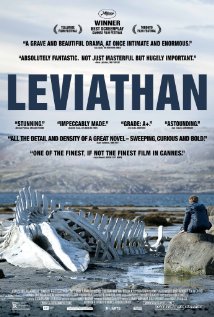
LEVIATHAN (Russia, 2014)

December 28, 2014

leviathan Greetings again from the darkness. It may surprise some that the most relatable of the Foreign Language films submitted for Oscar consideration this year may be a rural Russian re-imagining of the Book of Job with a tip of the cap to a 1651 book from Thomas Hobbes, and so much alcohol consumption that it should carry a Warning notice for anyone in recovery.

Please don’t interpret the description of relatable to mean likable or enjoyable, at least not in the traditional sense. This latest from director Andrey Zvyagintsev (The Return, 2003) is tough to watch with its theme of the working class vs the government. Who holds the power in this clash is obvious in a case of eminent domain, as Kolya (Aleksey Sorebryakov) tries everything (including blackmail) to hold on to his home and business in a fight against the Mayor (Roman Madyanov).

Religion, politics, and the judicial system team up to ensure the imbalance of power remains in effect, and Kolya’s belief in the system slowly evaporates. It’s particularly interesting to note how his consumption of Vodka evolves from a shot glass to full bottles as his home slips away.

The story takes place in northwest Russia in the Kola Peninsula of the Barents Sea. It’s a dramatic setting with vast landscapes, including the carcasses of fishing boats and giant whales … a statement of what happens to those left behind as times change – much like what happens to Kolya.

As dramatic as the landscape is, the story is actually quite small. It’s the struggle of one family against a system that has corruption down to a science. When Kolya asks his lawyer friend Dmitri (Vladimir Vdovitschenkov) to play dirty with the Mayor, he has no idea how this will impact his life and that of his younger wife Lilya (Elena Lyadova) and son Roma (Sergey Pokhodaev).

There is very little comic relief in the film … only a single sequence involving target practice on pictures of past Russian officials, but the story and acting are so grounded that at times it feels much like a documentary. It’s always a bit of a cold slap to be reminded of how the righteous often struggle with injustice, but rarely will you see it better presented than this.

watch the trailer:


UNBROKEN (2014)

December 27, 2014


unbroken Greetings again from the darkness. Louis Zamperini was a true American hero and his life story is epic and legendary. The son of Italian immigrants, young Louie easily found trouble, and only the efforts of his older brother and a local police officer allowed him to discover inner strength through his talent for distance running. As a 19 year old, Louie ran in the 1936 Berlin Olympics, and later enlisted in the Air Force and served as a bombardier during WWII. After a horrible plane crash, he spent a grueling 47 days adrift at sea in a life raft, until rescued/captured by the Japanese. Zamperini served as a Prisoner of War, where he was subjected to immense physical and psychological torture, until the war finally ended.

Zamperini’s story has long deserved to be made into a movie, and it has bounced around Hollywood since 1957. However, it wasn’t until Laura Hillenbrand’s biography on Zamperini became a best seller in 2010 that the film version was given the go-ahead. With screenplay credits for Joel Coen, Ethan Coen, Richard LaGravenese, and William Nicholson, cinematography from the great Roger Deakins (the first Air Force battle sequence is breath-taking), and a score from Alexandre Desplat, it was a bit surprising when Angelina Jolie was named director. After all, she only had one previous credit as a director, and that film (In the Land of Blood and Honey, 2011) was nowhere near the scope of this project.

Given the true life inspirational story and the truly heroic events of its featured character, the film can best be labeled a mild disappointment. It is extremely impressive to look at, but somehow lacking in emotion … despite some excruciatingly uncomfortable moments. The film strives for the level of historic epic, yet its conventional tone and approach leave us wondering what’s missing. The single most effective and emotional moment occurs in a short clip of the real Louis Zamperini running as an Olympic torch bearer at age 80 for the 1998 Olympics (in Japan!).

Jack O’Connell pours everything he has into capturing the spirit of Zamperini, and he is certainly an actor to keep an eye on. Japanese rock star Miyaki plays “The Bird” Watanabe, a sadistic POW camp commander who brutalized Zamperini, but Miyaki lacks the chops to pull off this crucial role – going a bit heavy on the posturing. The film uses the line “If you can take it, you can make it” as its rallying cry, but too many gaps are left for the audience to bridge as we watch Louie go from a punk kid to a war hero with almost mystical courage and perseverance. Other supporting work comes from Domhnall Gleeson, Garrett Hedlund, Jai Courtney and CJ Valleroy (as young Louie).

unbroken2 On paper, all the pieces are in place for an Oscar contender, and the film may very well play well with voters. My preference would have been to have the real life Louis Zamperini more involved … through either narration or interviews. He spent the second half of his life as a motivational speaker and story-teller, and would have added an incredible element to the film. Unfortunately, Mr. Zamperini (pictured left) died 4 months prior to the release of the film so he never saw the finished product. It’s likely he died knowing that his legacy is part of American history and that he did in fact “make it”.


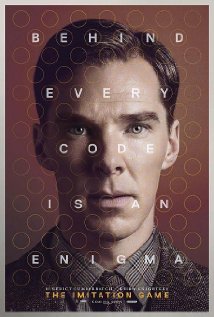
THE IMITATION GAME (2014)

December 26, 2014

Imitation Game Greetings again from the darkness. This year’s holiday movie season has presented us with three very different war-based films – each a potential Oscar contender, and each with its own life lesson.  Norwegian director Morten Tyldum (the excellent Headhunters, 2011) brings Andrew Hodges’ biographical book  to the screen in the form of the remarkable and true story of Alan Turing, the man credited by many (including Winston Churchill) for helping win WWII.

Alan Turing was a brilliant mathematician and cryptoanalyst. He was also homosexual. Celebrated for his work in helping Great Britain crack the German’s “Enigma” messages, he was also persecuted (through chemical castration) for his homosexuality. His suicide at age 41 (1954) was the likely result of his “treatment” during an era when such “unacceptable” behavior overshadowed any and all mental genius.

The film utilizes Turing’s 1951 police interrogation by a sympathetic and curious detective (Rory Kinnear) as a framing device for the three significant time periods of his life. We see Turing as a bullied schoolboy (played by Alex Lawther) discovering the early signs of his own brilliance, as well as his first love. Most significantly, we witness Turing’s work with the Hut 8 team at Bletchley Park as they worked on complex code-breaking; and finally we see the remnants of a broken man, bathed in solitude and work, who has no real place in society.

Benedict Cumberbatch gives an astounding performance as Alan Turing. We cannot take our eyes off of him, despite his Asperger’s-type social awkwardness. Cumberbatch manages to expertly capture each extreme emotion that befalls Turing, not the least of which is the frustration of the genius, when lesser minds are unable to follow his vision. Some of the best scenes are of Turing’s confrontations with a Royal Navy Commander (perfectly played by Charles Dance), and of course, the critical moments with the other members of his code-breaking team (including Matthew Goode and Keira Knightley).

There are so many aspects to Turing’s story: his impact on ending the war, how society treats true genius, his isolated childhood and final years, the extreme lack of civil rights for homosexuals of the time, and how his work on “Christopher” led to the development of computers. The second half of the film certainly presents the moral quandary, and the performance of Cumberbatch as a tortured genius overpowers any clichés that might creep in. Alexandre Desplat’s piano and strings score is a nice compliment without ever becoming overbearing, and the use of actual war newsreels adds just enough reminder of what the mission was for this group of geeks (today’s terminology).

SEE THIS MOVIE IF: you are interested in how brains, not just brawn, can impact a war OR you want to see one of the best performances of the year by an actor in a lead role

SKIP THIS MOVIE IF: you are expecting WWII battlefield reenactments

Watch the trailer:


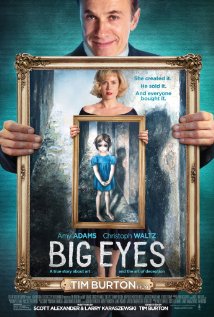
BIG EYES (2014)

December 22, 2014

big eyes Greetings again from the darkness. Based on the true events of artist Margaret Keane and her husband Walter, the latest from director Tim Burton is the closest thing to reality he has produced since his only other biopic, Ed Wood (1994). But fear not, ye fans of the Burton universe, his style and flair remains ever-present with a stunning color palette on this trek through the 1950’s and 60’s.

If you have never heard the story, Margaret Keane is an artist with a unique style that features exaggerated eyes of her subjects, hence the movie title. When she first met Walter, she fell hard for his charm and his exuberance and professed love of her work. What happened next seems impossible to imagine these days, but this was the 1950’s. Walter began to market and sell her paintings as his own … in fact, the real marketing was himself as an artist. The empire of Keane paintings, postcards, posters, etc literally exploded forcing Margaret to paint in silence and solitude while her husband inexplicably took public credit, sighting his defense as no one will buy “lady art”.

That may sound like the description of an “issues” film – one that digs into the male dominance of the pre-women’s movement era, or possibly even a look at artistic integrity or the battle of popular kitsch versus critical acclaim. Instead, this is more of a relationship film and a character study. We witness how Walter (Christoph Waltz) lures Margaret (Amy Adams) into this trap and truly undervalues her as an artist or a person. She is merely a means to his financial and public success. Margaret feels trapped right up to the point where she doesn’t.

There could have been real fun in the exploration of Dick Nolan (played by Danny Huston) from the “San Francisco Examiner” in his role as cheesy journalist contrasted against the socially revered serious art critic John Camady (played by Terence Stamp). Instead, both the relationship aspects of the Keanes and the tabloid battles of the critics come off as a bit lightweight, though right in line with Mr. Waltz’ incessant smirk through most of his lines. Fortunately, the film is filled with subtext … each scene carrying the weight of multiple issues.

Many will enjoy the deliciously evil approach Waltz takes for the role, but I mostly felt sad that a woman as apparently smart as Margaret would fall for this obvious shyster and his over the top self-promotion. Still, her battle for independence and ownership is quite interesting given the times and the hole that was dug. Adams is terrific in the role, and she is one of many actresses who bring their own “big eyes” to the picture (Krysten Ritter and Madeleine Arthur are others).

The film never attempts to answer any social issues or even take on the question of “what is art?”. The lack of a stance doesn’t change the fact that it’s beautiful to look at, and brings to light an incredible true story. The set design and costumes are wonderful, and composer Danny Elfman delivers a complimentary score. For those wondering, neither Johnny Depp nor Helena Bonham Carter (both Burton staples) appears in the film. However, the real Margaret Keane is shown sitting on a park bench while Ms. Adams paints in one scene. So if you are after a good-looking film that doesn’t (on the surface seem to) ruffle many feathers, the battle of the Keanes is one that should satisfy.  If you are willing to dig a little deeper, there is much to discuss afterwards.

SEE THIS MOVIE IF: you enjoy the “truth is stranger than fiction” stories

SKIP THIS MOVIE IF: you are expecting the Burton bizarre style

watch the trailer:


THE GAMBLER (2014)

December 18, 2014


gambler Greetings again from the darkness. “I’m all in!” That’s a gambling phrase of which even the most risk-averse amongst us recognizes. When Blackjack addict Jim Bennett (played by Mark Wahlberg) goes all in, which he does every time, it’s more proof that he is “the kind of guy that likes to lose” … a description offered by one of the mobsters and loan sharks who lend him money.

Director Rupert Wyatt (Rise of the Planet of the Apes, 2011) and screenwriter William Monahan (The Departed) deliver a remake of the very cool 1974 film of the same title starring James Caan and written by James Toback. Wahlberg is spot on as the self-destructive gambler who, rather than live for the thrill of winning, seems intent on pushing the envelope of misery and turmoil. His character manages to go seriously in debt to the Koreans who run the underground gambling establishments, as well as ruthless gangster Michael Kenneth Williams (“Boardwalk Empire”), and a philosophical mobster (a bald John Goodman) doing his best Jabba the Hut impersonation.  These are three guys most of us would avoid at all costs.

Unfortunately, it’s a bit more challenging to accept Wahlberg as the rebellious writing prodigy with a privileged background, who articulates in a motor-mouthed rapid-fire onslaught of derisive observations meant to prove how he so despises mediocrity. It’s obvious Wahlberg is “all in” for this role, but it’s difficult not to compare to the more nuanced performance of Caan forty years ago.

Brie Larson (so great in Short Term 12) plays the bright student in Wahlberg’s class, but her role is so limited we are left to only imagine the heights of her talent. Anthony Kelley plays Lamar, a college basketball player ripe for Wahlberg’s world, and Andre Braugher has a blink-and-you’ll-miss-it scene as the college dean. Richard Schiff offers up some comic relief as a pawn broker making Wahlberg’s misery just a tad worse. The great George Kennedy plays Wahlberg’s dying grandfather in the film’s opening scene, and he is the first to provide warning on the mess his grandson has created.

Jessica Lange does a wonderful job as Wahlberg’s estranged mother who is filled with both scorn and sadness at the state of her son, and offers up one last bag of cash in an attempt to allow him to begin anew. The support work is strong across the board, but it’s Goodman who stands out, both with dialogue and a physical presence that deserves some type of award for personal courage and lack of inhibition. His monologue on “F.U. money” is worth the price of admission, though you may request a refund after seeing him shirtless in the sauna.

There is a distinctive style to the film, though at times it comes across as a Scorcese wannabe. From a soundtrack perspective, the diversity of music ranges from classical to folk to big band, with some of the lyrics acting as commentary on the story. The film is pretty entertaining as you watch, but leaves an emptiness once it’s over. With so much that works, it’s a shame it all disappears so quickly … just like money on a Blackjack table.

SEE THIS MOVIE IF: you need a lesson on “F.U. Money” OR you need proof that a shirtless movie star is not always a pleasant thing

SKIP THIS MOVIE IF: you are seeking gambling tips OR your ears burn when exposed to profanity

watch the trailer:


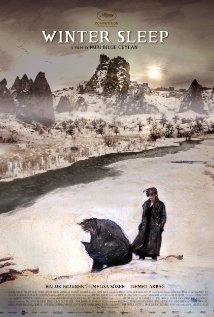
WINTER SLEEP (Kis uykusu, Turkey, 2014)

December 18, 2014


winter sleep Greetings again from the darkness. Brace yourself for 3 hours and 19 minutes of heavy listening. Yes, the film was named Palme d’Or at the most recent Cannes, and the dialogue is exceptionally well written, but this isn’t one you can just kick back and enjoy. It requires some effort. The two big “action” sequences involve a 10 year old boy tossing a rock and later, his too proud father dropping something into a fireplace. The real action occurs between the ears of the viewer as we assimilate the moods and nuances and double-meanings that accompany the stream of conversations.

Award-winning director Nuri Bilge Ceylan co-wrote the script with his wife Ebru Ceylan, and that probably attributes to the sharpness and poignancy of the relationships between Aydin (Haluk Bilginer) and his wife Nihal (Melisa Sozen) and his sister Necla (Demet Akbag). Much of the film is devoted to one of two things: Aydin making himself feel important, or Nihal and/or Necla voicing their opinions on why he isn’t. While that may sound simple, the wordplay and grounded performances often leave us with the feeling that we are eavesdropping on very private conversations.

Filmed in the breathtakingly beautiful Cappadocia region of Anatolia, the geological spectrum contrasts mightily with the near claustrophobic interior scenes that dominate the run time. In fact, when one of the characters does venture outdoors, viewers will find themselves breathing easier and in relief of the stressful intimacy of other scenes.

Hotel Othello is cut directly into one of the more picturesque hillsides of the area, and owner Aydin spends his days locked away in his office, kicking off his latest article bashing societal and morality changes within the village. Aydin has a pretty easy life, as he has inherited the hotel and numerous income producing rental properties from his father. Aydin’s career as a stage actor also adds a bit to his local celebrity (and ego). He fancies himself an important man with an important voice, and never hesitates to broadcast his charitable offerings.

Aydin lives at the hotel with his much younger wife Nihal, and his recently divorced sister Necla. The dysfunction abounds as none of the three much respect the others, and manage to express this in the most incisive, passive-aggressive ways possible. There are two extended (each pushing 30 minutes) exchanges that are unlike anything you may have ever seen on screen. One has Necla letting Aydin know what she thinks of his articles, while the other has Nihal finally coming clean with her feelings of being held back, emotionally captive. Both scenes are captivating and powerful, yet voices are never raised and facial expressions are crucial. This is intimate filmmaking at its best and most uncomfortable … psychological warfare would not be too extreme as a description.

Conflict is crucial for a dialogue-driven film. Some of the best include My Dinner with Andre, Who’s Afraid of Virginia Woolf?, and 12 Angry Men. These are the type of movies that cause us to study all the subtleties within a scene … not just what is said, but how it is said and how the message is conveyed. Pride, loneliness and despair run rampant through the characters here and the philosophical discussions force each to lay bare their soul.

For so little action, an undercurrent of wild emotions flows through every scene. In addition to the three leads, there is a character named Hamdi (an Islamic teacher/advisor, played by Serhat Mustafa Kilic) who plays the role of peace-keeper and mediator. His constant smile is but a mask he is forced to wear in his role, and I found his character the most painful of all to watch.

The title may be interpreted as either a “hibernation” or “sleep-walking through life’s final stages”, and both fit very well. The hotel provides a cave-like hiding place for Aydin, as he pretends to play his final role – that of an important man in the village. There are some truly masterful moments in the film, and it’s easy to see why it appeals to only a certain type of film goer. Inspired by the short stories of Chekhov (“The Wife”, “Excellent People”), as well as the writings of Tolstoy, Dostoyevsky, and Voltaire, means the viewer is investing emotionally in characters quite full of resentment and oh so dishonest with themselves. It’s an undertaking that is difficult, but does offer the opportunity to test one’s listening skills and ability to read body language. It also comes with wisdom such as … Donkeys lead camels (you’ll have to watch the movie!).

***NOTE: as a caution, there is a scene that could be considered animal cruelty. There is an ongoing investigation into whether a law was broken.

watch the trailer:


INSIDE THE MIND OF LEONARDO (2014)

December 17, 2014

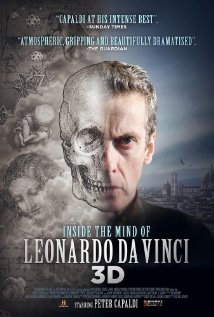
inside the mind of leonardo Greetings again from the darkness. Whenever you start to feel confident – even a little cocky – about how good you are at your job, stop for a moment and consider Leonardo da Vinci. How is this for a dose of humility? Even today, Leonardo is still considered one of the foremost painters, sculptors, inventors, engineers and mathematicians. This despite no formal education … and dying almost 500 years ago! It makes you wonder what he could have accomplished with computers and the internet.

History Films and director Julian Jones were provided access to Leonardo’s private notebooks, drawings and journals … more than 6000 pages that range from shopping lists, to mechanical inventions, to nature drawings. This Docu-Drama is presented in the unique manner of casting actor Peter Capaldi (“Dr Who”) as the interpreter of Leonardo’s words and works. He facilitates the movements between Leonardo’s childhood (as an illegitimate kid) in Tuscany, his move to Florence at age 16, his nearly two decades in Milan, and subsequent return to Tuscany where he spent 15 years painting a merchant’s wife … a painting now known as the “Mona Lisa”.

Playing very much like an educational tool designed for junior high and high school students, the film is also is an engaging way to present some insight into history’s single most observant and curious deep thinker. We see and hear Leonardo’s thoughts on war strategy and weapons, the geometrics of the human face, tips on fitness (“eat only when hungry”) and of course, his obsessions with human flight and anatomy. Beyond that, the journals offer a taste of his sense of humor and thoughts on sexual desire. It’s clear his thoughts bounced from topic to topic, and his sense of wonder created a never ending flow of ideas. While we often term it observation and analysis, Leonardo’s words are translated into experiencing something and then seeking out the cause. Newly filmed images are blended with Leonardo’s own drawings to keep the viewer on track.

Vitruvian Man is one of the more iconic images seen throughout society, and Leonardo’s painting “The Last Supper” has been copied and reproduced frequently. Although he died in France at age 67 having finished only 21 paintings, and having most of his inventions survive in theory only, the breadth of his knowledge and writings explain why the phrase “Renaissance Man” was coined to describe Leonardo (as well as Michelangelo). The film offers an entertaining and engaging introduction to Leonardo da Vinci, and today’s “thinkers” will undoubtedly be inspired to learn more.

watch the trailer: