Greetings again from the darkness. There aren’t many of us left. I’m referring to fans of the 1960’s TV series who will always think of Robert Vaughn, David McCallum and Leo G. Carroll as the real United Network Command for Law and Enforcement – shortened to U.N.C.L.E. Of course, these days, the movie industry is committed to remakes, sequels and re-boots, and it’s not surprising that it takes “Superman” and “The Lone Ranger” to try and fill the shoes of Napoleon Solo and Ilya Kuryakin.
Henry Cavill as Solo and Armie Hammer as Kuryakin join forces with Alicia Vikander (Ex Machina) as Gaby in a mission to thwart the sale of a nuclear warhead built under duress by Gaby’s estranged father. Also joining in the fun are Jared Harris as Sanders, Hugh Grant as Waverly (Mr. Carroll’s old role) and Elizabeth Debicki (she made quite an impression as Jordan Baker in The Great Gatsby), who makes a very intriguing “bad guy” as Victoria.
A one word description of this movie would be pretty. Most EVERYTHING and EVERYONE are pretty. The clothes are pretty. The sets are pretty. The Italian locations are pretty, and Lord knows the people are pretty. Most of the lead actors have spent some time modeling: Cavill, Hammer, Vikander, Grant, Debicki, and Luca Calvana. Heck, David Beckham even has a cameo just to make sure every scene includes someone really pretty.
In the same year with the latest Mission: Impossible (Mission: Impossible – Rogue Nation) and James Bond (Spectre) movies, it’s understandable that the Sherlock Holmeswriter/director team of Lionel Wigram and Guy Ritchie take a less serious and more tongue-in-cheek approach. Unfortunately, the comic chops are a bit weak on the leads, so while they look pretty … many of the punchlines come off pretty weak.
For any other surviving loyalists to the original TV series, the best advice would be to accept the movie for what it is, and avoid comparing to those classic memories. Even Jerry Goldsmith’s original theme song only merits a few moments of airtime. Those unfamiliar with the original material will likely accept this as the Pirates of the Caribbeanof spy movies, and understand that the current TV show “The Americans” handles the Cold War much more dramatically and intensely. However, if anyone is looking for pretty …
Greetings again from the darkness. It takes some talent – acting, writing, directing – to make a watchable movie that centers on a teenage girl sleeping with her mom’s boyfriend. Ordinarily that would be considered a (nausea-inducing) spoiler; however, it is disclosed in the trailer and is the focus of the best-selling YA novel from Phoebe Gloeckner. The author claims the story is “semi-autobiographical”, but we are all better off not knowing which parts she actually experienced.
The film begins in 1976 San Francisco with 15 year old Minnie (Bel Powley) celebrating her recent sexual escapades. As we hang with Minnie, we see and hear her dictating her diary entries into a microphone and clunky cassette deck. The thing that immediately jumps out as a difference in this film is the authenticity in its portrayal of teenage girls and the thoughts and perspectives of Minnie. She lets us in on her desire to be desired and her conscious decision to give up her virginity to Monroe. Ahh yes, Monroe. The biggest issue here (and it’s a major issue – not just legally, but morally) is that Monroe (played by Alexander Skarsgard) is the boyfriend of Minnie’s mom (Kristen Wiig).
There are many complex aspects to the story, and you must get past the repeated illegal (no matter how consensual) sexual activity (it’s only a movie) to appreciate the rare insight from a teenage female perspective. Minnie is an artist being raised by what can conservatively be termed a lackluster parent. Her mom Charlotte spends much of her time drinking and drugging, setting a less-than-stellar example for her two daughters. It’s no wonder Minnie works so hard at being noticed and desired … feelings she mistakes for love. Witnessing the teenage brain attempt to transition to adulthood is excruciatingly painful, and a reminder that emotional maturity is a process and not an on/off switch.
Bel Powley is a new screen presence to most of us, and she is shockingly strong in carrying much of the movie. Alexander Skarsgard never once backs off from his thankless role – knowing full well his actions will disgust many viewers. Kristen Wiig brings nuance to her role as crappy parent, while Christopher Meloni, Margarita Levieva and Abby Wait are all strong in support.
Any film that kicks off with Dwight Twilley’s “Looking for the Magic” and later shows a clip of “H.R. Puffenstuff” deserves a shot, and first time director Marielle Heller rarely makes a safe choice in the presentation of Minnie’s journey. It’s a rare film that forgoes “teenage cuteness” for emotional growth. The film states that alienation is good for your art, and Ms. Heller and Mr. Gloeckner risk audience alienation for their courageous storytelling. It’s no wonder the film has been a favorite on the film festival circuit.
Greetings again from the darkness. An animated, artistic, philosophical parable based on a 1923 book from a Lebanese poet … it’s as if the filmmakers went out of their way to make sure most everyone would be turned off by some aspect. Instead, director Roger Allers delivers a beautiful and thoughtful representation of nine of the 26 stories from Kahlil Gibran’s influential best-seller.
The story revolves around Mustafa, an artist and poet who was exiled seven years earlier when his words were deemed harmful to the local regime. Mustafa is informed that he will be granted his freedom to return home, and as he is escorted through town, Mustafa periodically delivers his insightful and inspiring words to the people of the land. These make up the 9 segments (Freedom, Children, Marriage, Work, Love, etc) within the movie, and each of these segments is the unique work of a different renowned artist/director. The artistic style and presentation varies between each segment, and some employ the use of music (Damien Rice, Glen Hansard).
As Mustafa recites the words of Gibran, the individual segments unfold with the artistry of each director. These blend well with the overall story which also features Mustafa’s housekeeper and her young daughter (who initially doesn’t speak). The voice acting is top notch thanks to Liam Neeson (Mustafa), Salma Hayek (the housekeeper), Quvenzhane Wallis (Almitra), John Krasinski (a lovesick guard), Alfred Molina (Sergeant), and Frank Langella (regime leader). Mr. Neeson is especially effective as the soothing voice of Gibran’s words.
This was evidently a pet project of Salma Hayek, who also is Producer of the film. She wisely enlisted director Roger Allers, who has ties to Disney and the hugely popular The Lion King. The film is Disney-esque in its approach, but is certainly not aimed at kids. It’s really a blend of the segmented structure of Fantasia, the adult-themed style of Watership Down, and the philosophical meanderings of Gandhi.
Gibran writes that “all work is noble”, and the work of these filmmakers certainly is. As with any poetry or philosophy, one must be receptive to the message and willing to be inspired. If not, it’s merely “love and flowers”.
Greetings again from the darkness. One of the staples of Romantic Comedies is that the two key players are the only ones who don’t realize they are “right” for each other. This is often accomplished through one of two methods: either two characters who “despise” each other, or as characters who are “just good friends”. This little film manages to blend those two approaches … and make us laugh in the process.
The first 15 or 20 minutes of the film are packed with very sharp comedy writing and acting. Adam Pally (“Happy Endings”) plays Jeff, and Sarah Burns (“Enlightened”) plays Anne. These two misfit adults get along very well together both as co-workers and friends who quote literature at (not to) each other. Anne’s opening visit to the doctor (played by Peter Grosz of Sonic ad fame) is outright hilarious, while Adam’s book club features some real zingers from Bobby Moynihan, Gil Ozeri, and Reid Scott (“Veep”).
It’s not until Jeff and Anne make a pact to change their public personas in an effort to be “cool” and more attractive to the opposite sex that the film takes kind of a nasty – well at least unlikable – turn. Becoming alcoholic d-bags does help them experience a summer of wild escapades, but predictably, neither is especially happy. Anne picks up pointers from some trashy reality TV show called “Prisoners of Love” … a knock-off of “The Bachelor” that deals with convicts and the women who would love them.
Adding to the comedic elements are quick scenes with Cecily Strong, Catherine Reitman (daughter of Ivan) and Kate Flannery, along with a couple of sequences with Jeff’s parents (Kevin Dunn, Marceline Hugot). More interactions with the parents would have been a welcome respite from the extended d-baggery of Jeff and Anne.
Mr. Pally is a master of the deadpan delivery, while Ms. Burns can best be described as a Kristen Wiig starter kit (that’s a compliment). Co-directors Don Argott and Sheena Joyce, and co-writers Matt Serword and Peter Swords lost sight of what delivered such a strong beginning for the film, and instead focused on reminding us to “embrace the darkness” and to “Be yourself. Everyone else is taken”. Good lessons indeed, but maybe not the comedy gold mine that was expected.
Greetings again from the darkness. Sex, Drugs, and Rock ‘n Roll – not just a bumper sticker, but also frequent and fun movie topics. Throw in 1980’s New York City, some excruciatingly dysfunctional parenting, and the coming-of-age struggles of three youngsters, and you have the latest from co-writers and co-directors Shari Springer Berman and Robert Pulcini (the real life couple behind American Splendor, 2003).
Based on the novel from Eleanor Henderson, it’s a nostalgic trip with little of the positive connotations usually associated with that term. The surprisingly deep cast features Ethan Hawke and Julianne Nicholson (August: Osage County, 2013) as parents to son Jude played by Asa Butterfield (Hugo, 2011). Emily Mortimer plays Hawke’s new girlfriend and mother to Eliza played by Hailee Steinfeld (True Grit, 2010). Avan Jogia plays Jude’s best friend Teddy, and Emile Hirsch is Teddy’s big brother Johnny. It’s an unusually high number of flawed characters who come together in a story that features some familiar coming-of-age moments, yet still manages to keep our interest.
The story centers on Jude as he comes to terms with finding out he’s adopted, works to overcome his less than stellar parents, and spends an inordinate amount of time finding new ways to experiment with drugs. One night changes everything as it leads to a tragic end for one character and pregnancy for Eliza. Ms. Steinfeld is extraordinary as Eliza and really makes an impressive step from child actress to young adult. Julianne Nicholson is also a standout, and Ethan Hawke provides some offbeat comic relief.
So many elements of 1980’s New York are included, and no effort is made to add any touches of glamour. The Tompkins Square park riots also play a role, if only briefly as the key characters realize life is just not so simple … a consistent theme for both kids and parents. The fragility of life is always an interesting topic, and the filmmakers bring this to light through some characters that we feel like we know – and wish we could help.
Greetings again from the darkness. Joel Edgerton has become one of the more interesting actors working today. His projects range from indies like Warrior and Animal Kingdomto award winners like Zero Dark Thirtyand big budget releases like The Great Gatsby. He has written screenplays, and now comes his feature length directorial debut … and an impressive debut it is.
Simon (Jason Bateman) and Robyn (Rebecca Hall) are seeking a fresh start as they relocate to Los Angeles from Chicago. A new house and new job are an attempt to put an unfortunate situation regarding an unborn child behind them. Things get off to a great start for them as they buy a beautiful house, and Simon is put up for a promotion. An encounter with Gordo (played by Edgerton) leads to some awkward social interactions and some downright creepy stalking.
The film will work best the less you know about it. The psychological thriller aspects never devolve into the slashfest we have come to expect. Instead the film blurs the lines between good guys and bad guys. In fact, it brings into debate what makes a good person … it even states “you may be through with the past, but the past isn’t through with you”. Do our past misdeeds ever totally fade? What about high school bullies … do they mature? Can the proverbial zebra change its stripes? All of these questions and themes are touched.
While you may struggle to identify the protagonist and antagonist, the performances of both Edgerton and Bateman are fun to watch. And it’s Ms. Hall who is the grounding force who initially trusts both men, before questioning everything. There is also a very nice, understated performance from Allison Tolman as an understanding neighbor. Ms. Tolman was terrific in the first year of the “Fargo” series.
Don’t allow anyone to tell you much about this before you see it … just know that it will remind you of the importance of the Golden Rule. Treat others how you would like to be treated … or know that bygones are never bygones.
Greetings again from the darkness. Having worshiped at the acting alter of Meryl Streep since 1977 (her brief appearance in Julia), this frequent movie-goer takes great delight in seeing her donning a leather jacket and bangles while strumming an electric guitar. Somehow she continues to expand on her already unmatched diverse resume of movie characters – this time as an aging leader of a cover band that plays to a small but loyal audience at a Tarzana bar.
Ricki is no rock star, though she clearly chased the dream. We learn of this when we see her working as a checker at the local supermarket, and then again when her ex-husband (Kevin Kline) calls her home to Indianapolis in a desperate attempt to pull their daughter Julie out of a suicidal depressive state brought on by her husband leaving for another woman. Julie is played by Ms. Streep’s real life daughter Mamie Gummer, and their bond plays out well enough on screen.
The movie’s peak occurs with the family dinner scene, as Ricki is united with her three kids, including sons Josh (Sebastian Stan – known in the Marvel world as Bucky Barnes) and Adam (Nick Westrate). It doesn’t take long before true emotions are bubbling over causing much discomfort throughout the restaurant. See, Ricki left her family to chase her music dream, leaving Kline and his second wife Maureen to provide a sense of normal family life. Maureen is played by six-time Tony Award winner Audra McDonald, who sadly doesn’t get to “flash” her famous singing voice in a movie that is comprised of songs for about half of its running time.
Director Jonathan Demme (an Oscar winner for Silence of the Lambs) and writer Diablo Cody (an Oscar winner for Juno) inexplicably drop the family drama soon after the dinner scene and we spend most of the second half watching Streep and Rick Springfield play out their dysfunctional relationship onstage. If you are unfamiliar with Springfield, he was a pop star in the 80’s and was the Dr. McDreamy predecessor while on “General Hospital”. Lately you may have seen him as the creepy plastic surgeon on “True Detective” … he looks much more normal here.
The band does a nice job with the familiar songs, and Streep is effective as the lead singer and audience favorite. However, even with Demme’s stellar track record with musical documentaries (Talking Heads, Neil Young, Bruce Springsteen), it’s difficult to understand why so much time is devoted to the musical performances after the extensive family drama set-up. A perfect example is that once the final act hits, Julie is given no more dialogue. It’s a strange turn.
The script does make a couple of very interesting points. The first involves the repercussions of a mother in chasing her dream … Ricki compares herself and perception to that of Mick Jagger. The second involves addressing the “job” of parents to love their kids. Either of these could be the central theme of a very interesting film, but as with other topics, the surface is barely scratched in this film. Despite the odd choices made by writer and director, it’s clear Ms. Streep is loving her time on stage … her version of Dobie Gray’s “Drift Away” is alone worth the price of a ticket.
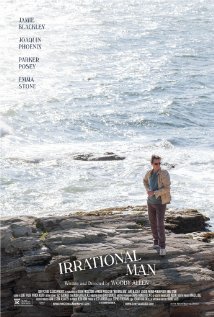
Greetings again from the darkness. Woody Allen turns 80 years old later this year, and he continues to crank out a new movie every 12 -15 months. While his production level is impressive, many of his films cause us to question if possibly fewer films, each receiving a bit more attention to detail, might prove more effective. Revisiting one of his favorite themes – life is meaningless – this latest provides a funked-up burned-out philosophy professor as our tour guide.
We feel for the three lead actors: Joaquin Phoenix, Emma Stone, and Parker Posey. Somehow all three roles are underwritten, causing some awkward moments on screen as these talented folks grasp for inspiration or direction in many scenes. The character of Abe (Mr. Phoenix) is introduced as a brilliant mind and popular teacher who has a reputation of being intimate with his students. When we first see him, he’s but a paunchy, alcoholic shell of a man … nearly oblivious to social graces. Jill (Ms. Stone) is the talented and gregarious student, and daughter of two professors, who should be entirely too smart to fall for anyone as self-loathing and careless as Abe. Drawing the shortest of all short straws is Ms. Posey as the stereotypical middle-aged woman seeking excitement somewhere other than her stable husband.
Evidently quoting Kant is designed to provide depth to character and story, and trick us into thinking existentialism is the only topic worthy of discussion … as long as it occurs while sucking down beer and nursing a flask. We are to believe that Abe’s decision to carry out a horrific crime can be justified since the victim was not a “good person” and it leads to a shift in attitude and renewed interest in life and yes, even sex. The film’s title does little to extinguish the writer/director’s apparent belief that questionable personal actions do not make a bad person. It seems real life and cinema have intersected yet again.
There are many topics touched on here, though unfortunately the story merely scratches the multiple surfaces. The professor’s reputation precedes his arrival, but we are never given any indication what makes him brilliant … what makes him popular with students … or what makes him attractive to so many. The idea of a crime being justified if the victim is not a credit to society has been explored much better in numerous other stories. Murder acting as Abe’s muse may be the most intriguing aspect of the script, but it’s treated mostly as a gimmick and never allowed to fully develop. Lastly, there are a couple of lines that seem to contradict each other. One is related to whether a passionate thinker can change the world, while the other says “wishing doesn’t work”. Again, these competing thoughts could have been explored and provided more thought-inducing moments. Instead, we are left with an excellent jazz score (especially the Ramsey Lewis Trio) on a paved road with few answers to the basic philosophical questions offered up by default.
Greetings again from the darkness. Co-directors Olivier Nakache and Eric Toledano delivered one of the best movies of 2012 with The Intouchables, and reunite to adapt a novel from Delphine Coulin. It’s another “odd couple” story, this time focusing on Samba (Omar Sy) and Alice (Charlotte Gainsbourg). The familiar blend of drama and comedy is present, and the French immigration process takes a few shots.
Omar Sy exploded on the scene in The Intouchablesand again proves what a tremendous screen presence he has. However this time his turn is mostly dramatic, while the bulk of the comedy arrives courtesy of his friend Wilson (played by Tahar Rahim from A Prophet). Ten years ago, Samba immigrated to France from Senegal, and has been sending money home ever since. A police incident leaves Samba in danger of being deported, and he receives help from Alice, an inexperienced immigration worker who is dealing with her own issues … she’s a hard core corporate burn out (hide your cell phone fellas!).
Given the subject matter, the film is much funnier and pleasant to watch than one might expect. The actors listed above, along with Izia Higelin as another immigration worker, are all wonderful and interesting to watch as their characters struggle through the hand they’ve been dealt. Samba and Wilson steal moments of joy while living in constant fear of being discovered, while Alice is borderline depressive and insomniac. She and Samba spend much of the movie in clumsy flirtations while their stressful situations swirl around. It’s awkward to watch, but we do find ourselves hoping things work out for each of them.
A very promising opening sequence contrasts the attendees of a high-dollar wedding with the working class of those in the kitchen- of which Samba is one. Unfortunately, this contrast is mostly hinted at for the rest of the film, except for one terrific “back and forth/ him and her” segment. The best guess is that there is an outstanding dramatic story hidden by the overuse of comedy. While the laughs are legitimate and appreciated, the film leaves us feeling a bit empty, given the lack of information and insight we take away in regards to French immigration.
Greetings again from the darkness. Is it possible to have a boxing movie without a crusty old trainer? Or a cute kid? Or a stubborn macho lead who makes poor personal choices? It doesn’t seem to matter much as this latest from director Antoine Fuqua (Training Day) checks off most of the expected cliché’s, and still slides easily into the canon of boxing movies that now covers nine decades.
This one packs a satisfactory punch both inside the ring and out. Jake Gyllenhaal stars as Billy Hope (the name courtesy of first time screenwriter Kurt Sutter, known for “Sons of Anarchy”). Mr. Hope follows the expected arc: 1. On top of the World! 2. A nasty crash landing 3. Redemption and comeback. However, just because we are familiar with the trail, doesn’t mean we can’t enjoy the hike.
Gyllenhaal continues his impressive string of performances that include End of Watch, Prisoners, and Nightcrawler. In the latter, he transformed his body by losing 40 pounds. This time, he packs on the muscle to become convincing as a boxer. The recent trend of actors getting fat, skinny, ripped or ugly to attract awards attention is nothing new to Gyllenhaal, who has made a career of melding into his roles.
The supporting cast includes Rachel McAdams as Hope’s wife. The two share a background as orphans in Hell’s Kitchen and have a strong relationship with each other and their young daughter played by Oona Laurence. Curtis “50 Cent” Jackson plays Hope’s long-time manager who telegraphs his true colors much too early (and no, this doesn’t refer to the recent news involving Mr. Jackson). Naomie Harris is a bit underutilized as the social worker, but the film is at its best once Forest Whitaker enters as Hope’s last hope (sorry). Mr. Whitaker always elevates a film with his presence, and his character here would have provided a boost with even more screen time.
A few topics are touched upon, though none very deeply. The father-daughter story line was pretty effective, but the anger management issue could have been explored more effectively since it was so crucial to the story and Hope’s personality.
Eminem provides some new music for the film, and it should be noted that this was the final score composed by the great James Horner, who only recently passed away. Sure the film “borrows” from Rocky and Raging Bulland many other boxing classics, but at least it doesn’t go full “Champ” on us.
 Greetings again from the darkness. There aren’t many of us left. I’m referring to fans of the 1960’s TV series who will always think of Robert Vaughn, David McCallum and Leo G. Carroll as the real United Network Command for Law and Enforcement – shortened to U.N.C.L.E. Of course, these days, the movie industry is committed to remakes, sequels and re-boots, and it’s not surprising that it takes “Superman” and “The Lone Ranger” to try and fill the shoes of Napoleon Solo and Ilya Kuryakin.


 Posted by David Ferguson