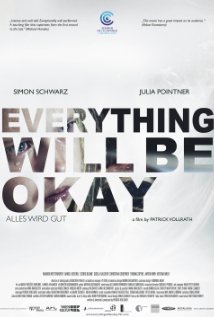
Greetings again from the darkness. Dramatic short films are challenged with generating an ultra-quick connection with viewers. German director Patrick Vollrath begins the film by showing a man anxiously pacing and buzzing the gate bell outside a suburban home. Our instincts that tell us he must be in some kind of trouble fade a bit when an 8 year old girl runs into his arms exclaiming “Daddy!”
Lea (newcomer Julia Pointer) clearly loves her father, and we quickly figure out this must be the scheduled every other weekend visit resulting from a recent divorce. Lea’s excitement is palpable as they stop off at a toy store where her dad tells her she can pick out any two items she wants. A simple gesture that’s probably repeated thousands of times each weekend, re-ignites the instincts we felt in the opening scene. Some “little” hints confirm our suspicion as the two hurriedly rush to an appointment at a government office and then on to the airport.
Simon Schwarz plays Michael Baumgartner, the dad who transitions from anxious to warm/loving to purely desperate. His performance, and that of young Ms. Pointer, are realistic and so spot on that we as viewers are sympathetic to both. It’s an exceptionally tense and dramatic half-hour reminding us that in a broken family, it’s rarely the case that “everything will be okay”, and sometimes things escalate into a literal tug-of-war that is heart-breaking. This is expert work from a filmmaker that understands the magic of short films, and it’s little wonder the film has been so well received at AFI, Cannes and numerous other festivals.
Greetings again from the darkness. With a Best Foreign Language Oscar for his previous film The Great Beauty(La grande bellezza), expectations were sky high for this one from writer/director Paolo Sorrentino. Cinematographer Luca Bigazzi is also back and the two create yet another artistic entrée that is a visual extravaganza, worthy of the admission price even if no dialogue existed. Combine the visual artistry with a commentary on age and emotions, and the result is a film that will either enchant or stultify … with probably no middle ground.
Michael Caine stars as Fred Ballinger, a renowned Orchestra conductor, who is vacationing at a stunning Swiss Alps spa with his daughter Lena (Rachel Weisz) and his long-time best friend, screenwriter Mick Boyd (Harvey Keitel). Fred, a self-professed retiree, is being pursued by Queen Elizabeth’s representative to perform one last concert. Fred is adamant in his refusal … for personal reasons we later learn are due to his nostalgic belief that his wife (no longer able to sing) is the only one who will sing his “simple” songs as long as he is alive. In the meantime, Mick is working with a group of ambitious young writers in an attempt to leave a legacy with his most important film ever. So you can already see that both men are working through their golden years in different ways.
Lena is devastated when her husband dumps her for a young pop singer (played by the real pop singer, Paloma Faith). Oh, one other detail … Lena’s husband is also Mick’s son (Ed Stoppard). This makes for some awkward (but entertaining) moments, and also leads to one of the film’s best scenes – Lena spilling her emotional guts to Fred while they are both covered in a mud bath. Director Sorrentino is a master at twisting these poignant moments with dashes of levity or irony. Another example is when Miss Universe (Romanian model Madalina Diana Ghenea) puts a condescending movie actor (Paul Dano) in his place with a devastating shift in tone and a comeback for the ages.
Sorrentino executes a couple of bizarre dream or fantasy sequences – one with Fred conducting a cow pasture (replete with cows and other bits of nature), and another with Mick being haunted in a meadow by all the female stars from his films (each in costume of their character). Suffice to say, this is not a conventional look at aging. What’s also clear is that Sorrentino believes our emotions drive our actions. The most jarring example is the aftermath when Mick’s long-time leading lady Brenda Morel (played by Jane Fonda) declines to appear in his latest film.
Even the most bizarre segments are presented with a visual artistry that forces our brains to process overtime. How about an obese Diego Maradona (played by Roly Serrano) repeatedly kicking tennis balls into the air? Or big time actor Jimmy Tree (Dano) struggling with his decision to sellout by appearing in a popular robot movie instead of pursuing his desire to be taken seriously as an actor? Or Lena bouncing back with a socially awkward mountain man? Or the seemingly minor role of a young masseuse (played by Luna Zimic Mijovic) who has us yearning for more? In addition to how each of these segments is startling to look at, Jane Fonda’s role has so many nuances that an entire movie could be made about her.
As with The Great Beauty, the film will have the most profound impact on those of us old enough to be looking through the binoculars and noticing how far away the past looks … and wondering just how long until “Life’s Last Day”.
Greetings again from the darkness. There was a time when movies were cultural trendsetters in such areas as speech, style and behavior. Somewhere along the way, a transition occurred, and these days movies are more a reflection of the times – showing us who we are and focusing mostly on what society focuses on. Oscar winning director Tom Hooper (The King’s Speech) capitalizes on the current movement to mainstream the LGBT community by telling the story of Einar Wegener/Lili Elbe, a transgender from more than 40 years before Dr. Renee Richards, and 75 years before Bruce/Caitlyn Jenner.
Lucida Coxon has adapted the 2000 novel from David Ebershoff, which is a fictionalized version of the 1933 “Man Into Woman” … the personal letters and diaries of Einar/Lili (edited by Niels Hoyer). The film opens in 1926 Copenhagen as successful landscape artist Einar Wegener and his struggling-to-gain-respect portrait artist wife Gerda appear to be happily married and quite attracted to each other. During this segment, Hooper and cinematographer Danny Cohen utilize a somewhat distracting quasi-fisheye lens that distorts most every shot … presumably making the point that this couple’s life is itself distorted. There is no shortage of foreshadowing despite the bohemian artist lifestyle. Einar doesn’t miss a chance to caress the silks and frills as he visits his ballet dancing friend Ulla (Amber Heard), and things escalate quickly once he poses in stockings for one of Gerda’s portraits.
The best and most interesting segment of the film is the middle as Einar begins to explore his Lili persona, and Gerda is diligent in her support … going as far as to encourage her husband to attend a party as Lili (introduced as Einar’s visiting cousin). The public interactions with their friends and acquaintances are a little difficult to accept, though the scenes with her initial male suitor Henrik (Ben Whishaw) make it clear this is a point of no return. Despite this, the times are such that Einar willingly attempts to repress the Lili side, and even visits multiple medical and psychological specialists. It’s this segment that reminds us how quickly the medical profession of the era overreacted by prescribing radiation, electrotherapy, and even by institutionalizing those who were so inclined.
Gerda and Einar/Lili “escape” to Paris, where it becomes obvious that it’s Lily who has been masquerading as Einar, rather than the other way. The duality of Einar/Lily soon dissolves and daily life is filled with lessons … such as a Paris peep show where hand and body movements become part of the transition. Eddie Redmayne (last year’s Oscar winner for The Theory of Everything) gives an extraordinary performance, and is at his best when exploring the subtle nuances of Lili. It’s crucial to note that while Redmayne’s performance is a physical marvel, it’s Alicia Vikander (A Royal Affair, Ex Machina) as Gerda who provides the real heart and soul of the story. Though the film glosses over some traits of the real life Gerda, Ms. Vikander is stunning in more than a few scenes, which in the hands of a lesser actress, could have proved cringe-inducing.
Adding some depth in limited roles are Matthias Schoenaerts (Rust and Bone) as Hans, Einar’s childhood friend all grown up, and Sebastian Koch (The Lives of Others) as the pioneering doctor who performs the sex reassignment surgeries that physically transition Einar into Lili. Even with the strong supporting cast, there is no mistaking this as anything other than a film that belongs to Mr. Redmayne and Ms. Vikander.
Director Hooper takes a very conventional approach to an unconventional story, and this “safe” direction seems designed to make the uncomfortable story more palatable for mainstream audiences (similar to how Brokeback Mountainhandled homosexuality). However, don’t mistake this for Tootsie or Mrs. Doubtfire. There are two serious stories here: the struggles of one person’s identity, and the corresponding challenges of a married couple. Hooper’s style is by no means cutting edge, but does feature one of the best lines of the year … “I’ve only liked a handful of people in my life, and you’ve been two of them.” This story has bounced around the movie world for awhile, and for many years was rumored to have Nicole Kidman in the Einar/Lili role. Your imagination can determine if that would have made for a better fit.
Greetings again from the darkness. All we need is one more miracle. Having been beatified with one “confirmed” miracle, it’s that missing second one that stands between Mother Teresa and Sainthood. At times the film from director William Riead plays like a highlight reel for Mother Teresa’s induction into the Catholic Hall of Fame, as the dual emphasis is on all the good things she did for the poor, as well as the surprising sense of isolation and abandonment she felt most of her life.
The film is structured in flashback form as a priest played by Rutger Hauer is charged with researching the case for canonizing the late Mother Teresa. He crosses paths with Father Celeste van Exem (Max von Sydow), who shares the saved correspondence from Mother Teresa that provides the title of the movie. These very personal letters spanned 50 years and act much as a journal of her work and emotions.
Most of the movie takes us through the progression of Mother Teresa’s life. A slump-shouldered Juliet Stevenson portrays the nun as a woman on a mission from God … despite the obstacles from her detractors: jealous and disapproving nuns, many in the Catholic Church, and even some of the local citizens whom she desired to help. Her commitment to assist “the poorest of the poor” placed her in some tough situations and undesirable environments. She seemed to take on the suffering of those she was serving.
Given her proclamation that “It’s God’s will, not mine”, the Vatican approved her plan to go outside the Loreto Order to serve the poor. Two years later, her application for a new order was approved, resulting in the congregation of The Missionaries of Charity. Her mission then had structure and backing, and so began to make real progress.
Capturing the essence of this woman is what the film does best. We absolutely understand how she became “an icon of compassion for all religions” by giving “voice to the poor”. Perhaps, given the times we are in, this ability to serve multiple religions could itself by considered a miracle. As with any person who serves others, Mother Teresa had (and has) her detractors and critics. She (like her Catholic Church) opposed contraception … despite the needs within the community she served. Others accused her of mismanaging the millions in contributions, and spending too much effort recruiting new Catholics. Again, those accusations are not the purpose of the film, which instead profiles a woman who helped so many who otherwise would have been ignored in their misery.
As a Nobel Peace Prize winner in 1979, her commitment to the cause resulted in her most public recognition and brought her full circle from an early line of dialogue: “I may not be wanted here, but I am needed.” Regardless of the Catholic rule book requirements, it’s difficult to imagine a modern day person more worthy of being considered a Saint.
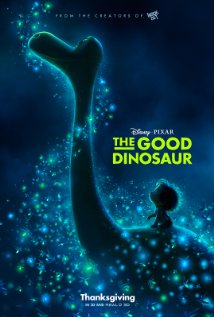
Greetings again from the darkness. Two Pixar films in one year? Earlier this year, the brilliant Inside Outreminded us just what sets Pixar apart from other animation studios … the film was intelligent, insightful, thoughtful, beautiful, funny and emotional enough to bring tears to the eyes of many parents. In other words, it’s a tough act to follow – even for Pixar!
Of course, 2015 was not intended to be a double-header for Pixar. The Good Dinosaurran into serious production and story issues at the same time the studio was going through layoffs and reorganization. So the six year project turned into eight, as a new creative team was brought in (led by director Peter Sohn), and the story and characters were re-worked and re-imagined. The finished product is likely the most staggeringly beautiful animation to ever hit the big screen, while at the same time being some of the darkest and bleakest material ever presented by Pixar.
The premise is pretty interesting: What would Earth be like if THE asteroid had missed, and the dinosaurs survived? That’s about as sciency as the story gets, other than it does portray nature as a colossal adversary (what’s with the hallucinogenic berries?). We first meet Momma and Poppa Apatosaurus as they work their corn fields (huh?) and wait for their baby eggs to hatch. The runt of the litter is Arlo, who just can’t keep up with his more active siblings and who feels inadequate in comparison to his majestic father.
Arlo and nature are responsible for the tragedy that sends Arlo off on a journey that features the full spectrum: the importance of family, the sadness of loss, the strength of friendship, and the self-discovery that leads to independence. While there are quite a few laughs along the way, the fear and isolation that Arlo experiences takes up most of the movie, and could leave all but the strongest kids feeling anything but upbeat and happy.
There is a life lesson about making one’s mark, and an oddball friendship between Arlo and young boy (named Spot??) who is wise to nature. But this one lacks the charm of most Pixar outings, while at the same time reaching technical levels that are breathtaking to behold. It’s difficult to imagine many kids wanting to watch this one again and again, but for all you Pixar nerds, you can rest easy … John Ratzenberger does make a vocal appearance.
Greetings again from the darkness. You have surely seen more complex and intricate bank robbery movies, but it’s doubtful you’ve seen one more ambitious from a technical standpoint. In a remarkable achievement of commitment, planning, and technical execution (plus some good luck), director Sebastian Schipper and cinematographer Sturla Brandth Grovler deliver 2 hours and 14 minutes with a single take and a low budget. It’s a testament to the cast and crew, as well as the advancements in digital equipment (mobility and battery life).
Alfred Hitchcock’s Rope (1948) and last year’s Best Picture winner, Birdman or (The Unexpected Virtue of Ignorance), from Alejandro Gonzalez Inarritu, both utilized extended/seamless takes in fascinating manner; however, it’s Mr. Schipper’s film that takes us through multiple locations – a dance club, the streets of Berlin, the roof of a building, a local café, inside a stolen van, back to the dance club, through an inner city escape, and into a luxury hotel. That’s right … each of these puzzle pieces are generated without ever pausing the camera or editing a shot. You might expect nausea-inducing shaky cam, but instead it plays more like we viewers are along for the ride.
Beyond the technical goodies, we get two fine performances from Frederick Lau as the streetwise and smooth-talking Sonne, and especially Laia Costa as Victoria. The titular character is first spotted enjoying a sweaty dance to thumping club music before leaving the club and bumping into Sonne and his group of “real Berlin guys”. It all seems playful enough, but as the flirtations escalate between Victoria and Sonne, we sense things could become a bit more ominous. The first part of the film really allows us to get to know these two as they get to know each other. Victoria’s childhood story explains much about her reactions throughout the ordeal, and it’s also the point that we realize our infatuation with her is justified.
Things do in fact turn ominous for the group, and a criminal act conducted out of desperation leads to a few action-oriented sequences … each impressive in light of the single-shot approach. No CGI as a fallback and no carefully manipulated sets. Instead, the actors and camera must continue, no matter the glitches or obstacles that real time tosses in their path.
Run Lola Run(1998) may be the best comparison for the frantic pace, but in actuality, the film has no legitimate pairing given the 2 plus hours single shot approach. You may choose to see this for the technical achievement that it is, and the guess is you will be equally impressed with Ms. Costa.
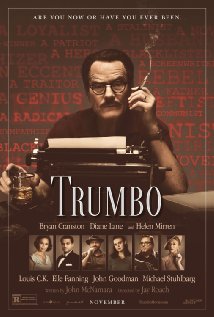
Greetings again from the darkness. For an industry that thrives on ego and self-promotion, it could be considered surprising that more movies haven’t focused on its most shameful (and drama-filled) period. The two Hollywood blacklist films that come to mind are both from 1976: Martin Ritt’s The Front(starring Woody Allen) and the documentary Hollywood on Trial. There are others that have touched on the era, but director Jay Roach and writer John McNamara (adapting Bruce Cook’s book) focus on blacklisted writer Dalton Trumbo in a film that informs a little and entertains a lot.
Director Roach combines his comedic roots from the “Austin Powers” and “Meet the Parents” franchises with his more recent politically-centered HBO projects Recount and Game Change. His subject here is the immensely talented writer Dalton Trumbo, whom Louis B Mayer signed to the most lucrative screenwriting contract of the 1940’s. It was soon after that Trumbo’s (and other’s) affiliation with the American Communist Party came under fire by the House Un-American Activities Committee headed by J Parnell Thomas. The divide in Hollywood was clear. On one side were the staunch Patriots like John Wayne (David James Elliott) and the Queen Muckracker, gossip columnist Hedda Hopper (Helen Mirren); on the other were “The Hollywood Ten” … those accused of being traitors simply because they stood up for freedom.
What’s interesting here is that despite the dark subject matter, the film has an enormous amount of humor … including multiple laugh out loud moments. This happens because most of the focus is on Trumbo the family man and Trumbo the justice fighter. Of course, as a writer, Trumbo does his best fighting with words … words whose message is “they have no right” to question the thoughts and beliefs of individual citizens. The committee’s mission was to prove treason by linking to the Russian agenda, but in reality these folks were mostly supportive of labor rights … most assuredly not a crime. The investigations, such as they were, seemed to prove the gentlemen were more Socialist than Russian – which makes an interesting contrast to modern day where we have an admitted Socialist running for President. The Hollywood Ten stood their ground, served jail time, and were either forced out of the industry or forced to go “underground” using pseudonyms. Trumbo, while unceremoniously writing under other names, won two Best Writing Oscars – one for Roman Holidayand one for The Brave One.
Bryan Cranston delivers a “big” performance as Dalton Trumbo. Everything is big – the glasses, the cigarette holders, the mustache, and definitely the personality. He does his best writing in the bathtub, and is never without a quick-witted comeback … whether sparring with The Duke or the committee. Unfortunately, Hedda Hopper does her most effective work in undermining the rights of Trumbo and his cohorts, including Arlen Hird (Louis CK) and Ian McClellan Hunter (Alan Tudyk). We also see how Edward G Robinson (Michael Stuhlbarg) quietly supports the cause, while also trying to salvage his fading career.
Trumbo is by no means presented as a saintly rebel with a cause. Instead, we see him as a loving yet flawed father, husband and friend. Once released from prison, he is so focused on writing and clawing his way back, that his relationships suffer – especially with his eldest daughter Nikola (Elle Fanning) and loyal wife (Diane Lane). It’s the King Brothers Production Company led by Frank (John Goodman) and Hymie (Stephen Root) who give Trumbo an outlet for writing and earning a living. Most were schlock movies, but there were also a few gems mixed in (Gun Crazy). However, it’s Kirk Douglas’ (Dean O’Gorman with an uncanny resemblance) courageous stand for his (and Stanley Kubrick’s) movie Spartacus, and director Otto Preminger (Christian Berkel) and his film Exodus, that put Trumbo’s name back on the screen, effectively ending Ms. Hopper’s crusade.
The ending credits feature clips of the real Dalton Trumbo being interviewed, and it brings clarity to Cranston’s performance, while more importantly relaying some incredibly poignant and personal words directly from the man … maybe they really should be “carved into a rock”. It’s an era of which Hollywood should not be proud, and it’s finally time it was faced head-on … and it’s quite OK that they bring along a few good laughs.
Greetings again from the darkness. A popular proverb “Home is where the heart is” is filled with truth … unless the heart belongs in two places. Such is the case with Ellis, an Irish girl who leaves behind her family and homeland to discover the new world opportunities afforded by 1950’s America. The film is based on the popular and critically-acclaimed novel from Colm Toibin, and is directed by John Crowley (Is Anybody There? 2008) with a screenplay from Nick Hornby (About a Boy, An Education). It’s a blend of romance, drama, and self-discovery, while also examining a couple of diverse cultures from lands separated by more than 3000 miles (and a big ocean).
Saoirse Ronan plays Ellis in a performance that is sure to garner much Oscar talk. It’s only been 8 years since Ms. Ronan exploded onto the screen as 13 year old Briony in Atonement. In this current role we watch her blossom like a flower as she grows from a timid and reserved shop girl with a bleak future in Ireland, to a fully-realized woman with much spirit and hope. On that journey, she experiences many life obstacles including seasickness, homesickness, catty and envious housemates, heartbreak and romantic awkwardness … all while dealing with the overwhelming nature of her new world.
Director Cowley makes some interesting visual choices. We begin with a muted color palette and mostly close camera shots of Ellis’ life in Ireland. This “closed in” feeling continues through her crossing of the Atlantic. However, once she steps through the blue doors of Ellis Island, the world opens up with wide shots and shocks of bright colors. These contrasts blend together in the third segment where Ellis returns to Ireland after a family tragedy. The look of the film at any given time mirrors the mood and circumstance of our lead character.
Ellis struggles to adjust to the United States, both in the bordering house run by the colorful Ms. Kehoe (a terrific Julie Walters), and in the ritzy Bartocci store where she clerks for a demanding supervisor (Jessica Pare’, “Mad Men”). Ms. Kehoe provides her girls with such life guidance as “Giddiness is the 8th Deadly Sin”. It doesn’t take long for Ellis to meet Tony (a breakout performance by Emory Cohen, The Place Beyond the Pines), a pleasant and polite local Italian plumber who is enchanted by her. Their time together provides a wonderful comparison piece for today’s courtship vs. that of the 1950’s.
The movie is beautifully paced, filmed and acted; however, there are some issues to fight through with the story and details of the main character. Her return to Ireland introduces Jim Ferrell (solid work from the ever-evolving Domhnall Gleeson), and just like that, Ellis is confused about Tony’s line: “This is where your life is”. This time of confusion for her, creates similar type confusion for viewers as we either understand her uncertainty, or question it. This distracts a bit from some of the impactful elements like her transition from clueless fish-out-of-water on her first cruise, to strong mentor for an Irish girl much like her younger self on a later trip. The script has more than a few of these moments of gold, and Saoirse brilliantly nails each.
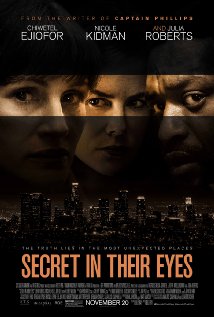
Greetings again from the darkness. Why, Billy Ray, why? It’s not surprising that Hollywood green-lighted the Americanization of the 2010 Oscar winner for Best Foreign Language film, El secreto de sus ojos. That original from Argentina is exemplary filmmaking and a thoroughly entertaining and compelling mystery-thriller; a must-see for any true film lover. Even if an Oscar-studded cast is hired (2 Oscar winners, 8 nominations), the guiding inspiration for a remake should be more than losing the subtitles and filming Julia Roberts without make-up.
The story balances two timelines spanning 13 years. Jess (Ms. Roberts) is an investigator who works with FBI Agent Ray (Chiwetel Ejiofor), Assistant District Attorney Claire (Nicole Kidman), and a blustering District Attorney played by Alfred Molina. When Jess’ daughter is brutally murdered, the investigation is impacted by the suspect’s role as a department snitch. When we catch up all those years later, the unrequited attraction between now former FBI Agent Ray and now DA Claire is as strong as ever; Jess’ appearance is on par with someone suffering from a terminal illness, and the murder still hovers over these characters as if it had occurred last week.
It’s a fascinating story that was handled superbly in the original, yet mostly comes across as uninspired in this latest project. At times, it’s even a bit confusing in how the two eras are handled. The score from Emilio Kauderer and a couple of fine scenes from Ms. Roberts (although she gets no credit here for appearing sans-makeup) are the best parts of this one. Otherwise, Mr. Ejiofor (usually a fine actor) goes over-the-top, while Ms. Kidman is simply miscast and unable to generate the proficiency required for her position. Other support work comes courtesy of Dean Norris (“Breaking Bad”), Michael Kelly (“House of Cards”) and Zoe Graham.
Other than lacking the grit and realism of the original, the editing and camera work (so exceptional in the first version) at times come off as amateurish this time around. The soccer/futbol sequence from the original is replaced with Dodgers baseball (Chavez Ravine and Vin Scully) and a link to former Manager Walter Alston. Normally that would be considered an improvement, but again, these fall short and fail to generate the necessary suspense. A weak impersonation of the famous long-tracking shot certainly doesn’t help.
For anyone who hasn’t seen writer/director Juan Jose Campanella’s (an Executive Producer here) excellent original, this version from Billy Ray (Shattered Glass) might prove interesting enough; however, those same folks are strongly encouraged to instead track down the original, and experience the emotional depth and filmmaking expertise that made it such a worthy Oscar winner.
Greetings again from the darkness. Success on the film festival circuit is much deserved for this first feature film from writer/director Jonas Carpignano, as he expands his short film A Chijana(2012). It’s based on the true story of a young man who migrated from Burkin Faso to the southern Italy town of Rosarno. What makes this special is that the real immigrant, Koudous Seihon, stars in the film and recreates much of what he went through.
We witness the obstacles facing those trying to leave Africa … they need money and assistance and a whole lot of luck. Mr. Seihon plays Ayiva, and he is traveling with his brother Abas (Alassane Sy). The rickety boat they pile into is one most of us wouldn’t consider sea-worthy enough to cross the Mediterranean Sea (especially through a storm), but it’s their only option.
They are certainly disappointed in the shanty town that becomes their new home. However, soon enough they realize sleeping on the ground in cold weather with but a thin quilt is no hardship compared to the everyday risk of violence and racism. Most of the locals are not welcoming in the least, and the hatred often escalates. It’s what led to the riots of 2010, which director Carpignano touches on here.
The film has a no-frills docu-drama feel to it, and Seihon has a real screen presence. Ayiva’s survival skills are enhanced by his ability to blend into his environment – he becomes what he needs to be to persevere. Unfortunately his brother rebels and lets his anger affect his actions. The real world struggles of migrants and refugees are a global issue these days, and the film brings into focus some of the struggles faced by those who see no other option.
 Greetings again from the darkness. Dramatic short films are challenged with generating an ultra-quick connection with viewers. German director Patrick Vollrath begins the film by showing a man anxiously pacing and buzzing the gate bell outside a suburban home. Our instincts that tell us he must be in some kind of trouble fade a bit when an 8 year old girl runs into his arms exclaiming “Daddy!”


 Posted by David Ferguson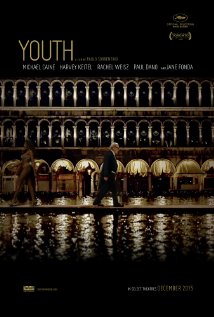





 Movie Reviews from the Dark