 Greetings again from the darkness. She wasn’t yet 30 years old when her first novel, “Strangers on a Train” was published. A year later, Alfred Hitchcock directed the film version, an opportunity many writers would kill for. Patricia Highsmith then crafted a career writing about murder, or the threat of it. Her most famous character, Tom Ripley, was central to five of her novels, or what’s been called “The Ripliad”. On screen, the Ripley role has been played by Alain Delon, Dennis Hopper, Matt Damon, John Malkovich, Barry Pepper, and Adam Scott (in the recent terrific mini-series, “Ripley”).
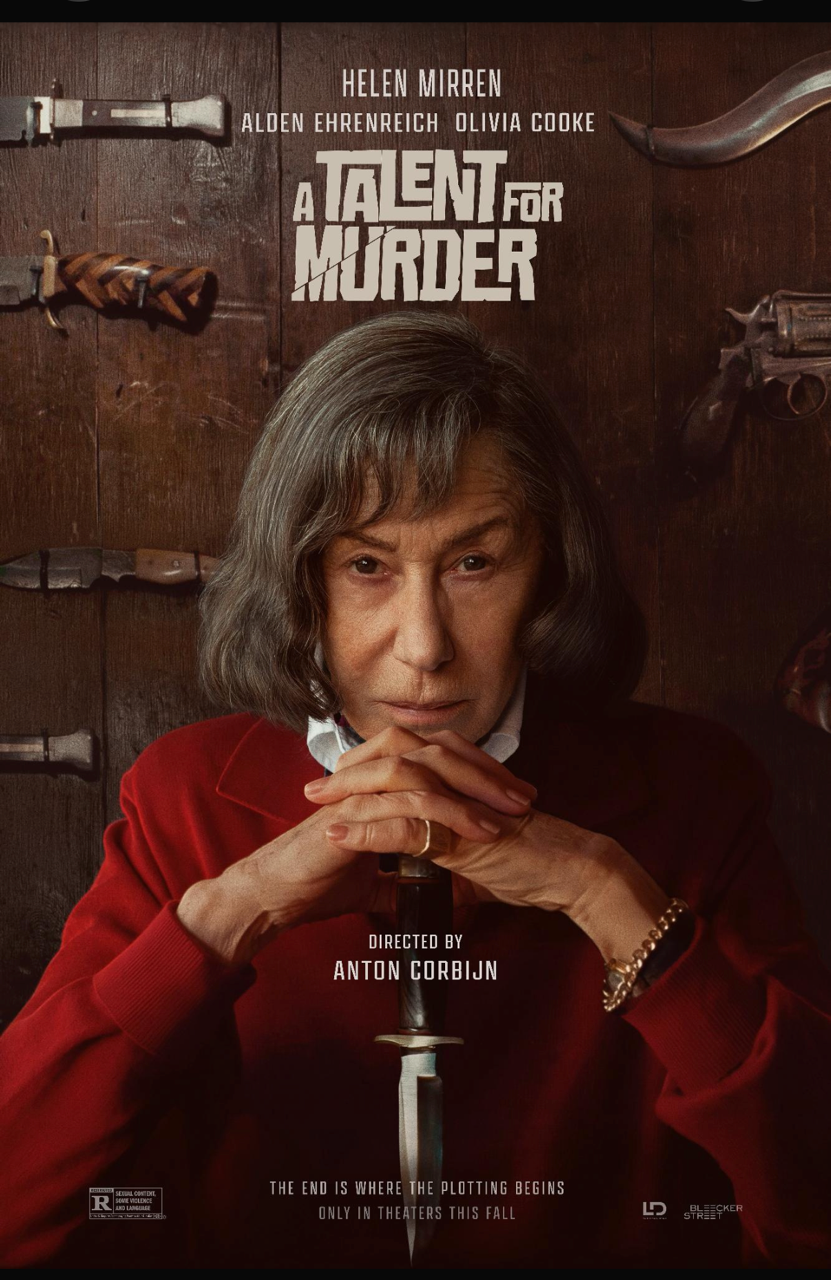
The Ripley character is (kinda sorta) back again in this film from director Anton Corbijn, adapted by Joanna Murray-Smith from her own stage play “Switzerland”. Edward Ridgeway (Alden Ehrenreich, SOLO: A STAR WARS STORY, 2018) is sent by the unnamed publisher to persuade renowned writer Patricia Highsmith (Oscar winner Helen Mirren) to write one more Ripley novel. Upon his arrival at her remote Tegna, Switzerland home, young and ambitious Edward finds the writer to be as ornery and difficult as her reputation led him to expect. In fact, his predecessor, sent on the same mission, has disappeared without a trace, leaving Edward a bit leery … although his career hinges on his success in getting her to sign the contract.
The game of cat-and-mouse actually begins on Edward’s train ride when he meets Clementine Harriet Balfour (Olivia Cooke, SOUND OF METAL, 2019). The flirtatious encounter finds both on missions of persuasion. Edward needs a stubborn writer’s commitment, and Clementine would like her wealthy Aunt Peggy (Juliet Stevnson, BEND IT LIKE BECKHAM, 2002) to release the trust fund so she might enjoy life. A literary game between Edward and Highsmith not only brings Clementine back into the story, but also finds Edward playing a fictionalized version of the already fictional Ripley. It’s quite fun to watch him take on the dual role and see how things proceed with Clementine. Simultaneously, the changes to Edward’s demeanor become palpable.
Dame Helen Mirren tackles the role of the author with gusto. It’s not just the cigarettes and alcohol, but also the mind games and psychological tricks she employs on Edward that keep us on our toes. The result of their ‘new’ Ripley story fails to impress, but the path to that point is quite something to watch as it unfolds. What we see is a story within the story or a movie within the movie, and all three leads are excellent. A special nod to Brid Brennan (BROOKLYN, 2015) who has a brief turn as Kathryn Grierson – yet another character whose psychological powers add some intrigue here.
It should be noted that the work on Highsmith’s house is especially effective, as the weapons collection (guns and knives) and the artwork speak to the real-life home of the writer … and that modernist portrait of Highsmith in red plays like another character. Cinematographer Robbie Ryan does fine work inside the confines of the house as Highsmith and Edward go at each other. As for director Anton Corbijn, the best I can tell, this is his first narrative feature since LIFE (2014) and A MOST WANTED MAN (2014). It’s nice to have him back, as the suspense and psychological aspects play to his strengths. Patricia Highsmith passed away in 1995, which is the year this film is set, and it should be quite clear to all viewers that this is a fictional story about a real person.
Opening in theaters October 23, 2026


 Posted by David Ferguson


