FLORENCE FOSTER JENKINS (2016)

August 12, 2016

Florence FJ Greetings again from the darkness. Stranger than fiction. No more fitting description can be provided for the true-to-life story of 1940’s New York socialite Florence Foster Jenkins. How else to describe this “opera singer” who performed at Carnegie Hall? Not so unusual you say? Well how about if I add the not-so-minor detail(s) that the lady, simply put, was an atrocious singer … couldn’t carry a note … was apparently tone deaf?

Meryl Streep gamely takes on the titular role, and despite her own finely honed singing voice, manages to spot-on mimic the off-key, yet enthusiastic wailing of FFJ. Beyond that, Ms. Streep captures the spirit and passion and ego that inspired her real life counterpart to pursue her lofty dreams. At her core, FFJ was a tortured soul who overcame syphilis (from her first husband) and the central nervous system challenges brought on by the mercury and arsenic treatments of the era. On the outside, she was a bubbly, eccentric personality who supported the arts and lived life to the fullest.

With inheritances from both her mother and father, Florence received full professional support (and emotional protection) from her common-law husband St Clair Bayfield – played superbly by the seldom seen these days Hugh Grant. Accompanying Florence on stage, and even composing music with her, was her piano player Cosme McMoon, in a scene-stealing performance from Simon Helberg (“The Big Bang Theory”). Also in the mix is Rebecca Ferguson as Bayfield’s mistress … did I mention how strange this story is? Other support work is provided by David Haig as FFJ’s singing coach, and Nina Arianda as … well … an interesting character.

Other than the cast, those responsible for this delightful cinematic experience are director Stephen Frears (Oscar nominated for The Queen and The Grifters), writer Nicholas Martin, and cinematographer Danny Cohen (Room, The King’s Speech). It’s a confounding movie … on the surface quite jovial and light-hearted, while also reaching emotional depths that touch on loyalty, greed, and self-delusion.

The recordings made by Florence are rare collectibles today, and the film does touch on her time as child prodigy who played piano at The White House during the Rutherford B Hayes administration. There are many life lessons here, including pursuing your dreams with a passion, and having the tenacity to overcome obstacles. There is an undeniable underlying sadness to the story, but rather than feel sorry for her, Florence provided the guiding light quote, “People may say I can’t sing, but no one can say I didn’t sing.”

watch the trailer:


EQUITY (2016)

August 11, 2016

equity Greetings again from the darkness. A film made by women in a male-dominated profession about women in a (different) male-dominated profession becomes the first female-centric Wall Street movie. Director Meera Menon (Farah Goes Bang) and writers Amy Fox, Sarah Megan Thomas and Alysia Reiner have a lot to say … maybe even more than they intended.

Anna Gunn (“Breaking Bad”) delivers a strong lead performance as Naomi Bishop, a hard-driving and successful investment banker – a self-described “banker chick”. She’s coming off a failed client IPO – her biggest career failure. Naomi basically torments and disrespects her first assistant Erin (Sarah Megan Thomas), and she regularly sleeps with a co-worker and hedge fund manager Michael Connor (James Purefoy) for the benefits only. In other words, Naomi is much like the men we have seen in these roles over the years.

While pursuing her next IPO with a hotshot d-bag tech entrepreneur (Samuel Roukin as Ed) who claims to have a revolutionary impenetrable cyberware, Naomi is unwittingly (although it could be argued that she SHOULD have known) being played by multiple parties. One of these is a Justice Department investigator (Alysia Reiner as Samantha) who is trying to use their old college connection as a way to gather intel on Naomi’s firm and Michael Connor. Adding complexity and turmoil are Craig Bierko as an egotistical investor who pressures Michael for insider info, Sophie von Hasselberg (Marin) who is a disgruntled programmer for Ed’s company, and Tracie Thoms as Samantha’s partner and co-parent of their kids.

Fractured relationships abound as all characters are driven by something other than the relationships. We are told “money is not a dirty word”, but it sure seems like motivation for these folks is centered on power, ambition, and yes … money. The social issues and moral dilemmas come across as less important than the challenge of competing (rather than collaborating). Seamless backstabbing is a valued skill in this world, and always present are greed, desperation and paranoia. This is post-2008 Wall Street, but it looks pretty darned familiar.

Previous films have taken us inside this world. Wall Street (1987), Margin Call (2011), The Wolf of Wall Street (2013), and The Big Short (2015) each provided some lesson on this corrupt-to-the-core industry and helped us understand the dual meaning of the title, but this is the first to show us the women who fight the same fights. If there is a disappointment here, it’s the apparent conclusion that putting women in the same high-stakes game as men means they will compete in much the same way, rather than finding a better, more graceful way. Gordon Gekko may not have been right when he said “greed is good”, but it seems pretty clear that greed is prevalent. It’s a lesson we evidently must be reminded of on a regular basis … and whatever you do, make sure to count the chocolate chips before giving that cookie to Naomi!

 watch the trailer:


INDIGNATION (2016)

August 4, 2016

indignation Greetings again from the darkness. Quite often, Hollywood “period pieces” feel dated and somewhat irrelevant to our world today – as if they were a snapshot from an old magazine. But the best ones transport us to a different era while also serving up themes and characters that are just as interesting and germane today as then … and that’s what we have here.

First time director James Schamus (founder of Focus Features) is an Oscar nominated producer (Brokeback Mountain) and writer (Crouching Tiger, Hidden Dragon), and he tackles the popular 2008 Philip Roth novel … one that the 83 year old novelist admits to being influenced by his own college years. Mr. Roth has been writing novels for more than 50 years and won the Pulitzer Prize for his 1997 “American Pastoral”.

Taking on the lead role of college-bound Marcus Messner is Logan Lerman … an actor who has been on screen since he was 8 years old, and seems to have the eternal youth DNA so sought after by Ponce de Leon. While his looks haven’t changed much since the “Percy Jackson” films or the excellent The Perks of Being a Wallflower, Lerman shines here as the working class Newark Jewish boy, smothered by his parents, and as naïve to the world as he is academically gifted.

It’s 1951 and too many neighborhood boys are arriving back home in pine boxes after serving in the Korean War. Marcus’ father (Danny Burstein) is a kosher butcher and is half of the hyper-cautious parental unit that is alternatively thankful and frightened that their son is avoiding serving in the military by heading off to ultra-conservative (and fictional) Winesburg College in Ohio.

Once on campus, Marcus discovers little of the hoped-for freedom. Mandatory chapel attendance, roommates assigned via religious leanings, and the expectations of joining the Jewish fraternity and hanging out with his own kind combine to be only a different kind of emotional stifling than what he had at home. A series of events serve to shake up Marcus and his beliefs. Date night with his dream girl from the library ends with him being both repulsed and enchanted by a sexually assertive Olivia (Sarah Gadon). An argument with his lughead roommates ends with his being given the worst dorm room on campus. Meeting with the College Dean (Tracy Letts) results in an exhilarating debate that will surely be treasured by all who adore wordplay and oratory sword-fighting. Finally, an emergency appendectomy brings a hospital visit from Marcus’ mother (Linda Emond), and a conversation that drastically alters the course of his life.

The conservative social mores of the 1950’s are on full display, as is the restlessness of the young who would change society forever. Fear would be replaced with daring, and the film does a terrific job of highlighting how revolution often comes at a high price. Bookended by war scenes that dramatize the fine line between civilized society and the brutality of war, it all comes together … bringing more power and poignancy to the two best scenes: as previously mentioned, Letts and Lerman go mano y mano in arguing the brilliance of Bertrand Russell, and their word battle highlights the age-old idealist vs. real world struggles; a mother-son scene towards the end is as heart-breaking as any we’re likely to see on screen this year. Mr. Letts, Ms. Emond and Ms. Gadon all work well with Logan Lerman in order to provide an excellent presentation of Roth’s novel and Schamus’ first film.

 watch the trailer:


CAFE SOCIETY (2016)

July 21, 2016

cafe society Greetings again from the darkness. 80 year old Woody Allen continues to amaze with his proclivity to crank out a movie every year. With such movie abundance comes the inevitable hit and miss conversations. Of course, there are those who have never had a taste for his work and another group who have sworn off his films due to the headlines from his personal life. Still, as a filmmaker, his work is usually good for some analysis and debate.

This time out, Woody’s story is set in the 1930’s and it revolves around a young man from the Bronx who heads to Hollywood in hopes of making something of himself. Bobby (Jesse Eisenberg) is the typical on screen alter-ego for Mr. Allen and displays many of the physical and personality traits we have come to expect. It’s a perfect fit for Eisenberg. Bobby’s naivety takes a beating as he assumes a gofer job under his Uncle Phil (Steve Carell), a power broker agent to the stars. Things really get juicy when Phil directs his secretary Vonnie (Kristen Stewart) to show the local sites to Bobby. As the two youngsters grow closer, Vonnie must choose between the romantic idealism of Bobby, and the luxuries afforded by her older boyfriend (guess who??).

Allen revisits many (if not all) of his familiar themes: religion and the afterlife, misfit relationships, Los Angeles vs New York, jazz, older man/younger woman, and one of his favorites … “what’s the point?” This time he also throws in a nostalgic look at Hollywood by name-dropping some famous stars of the era, but he’s just as quick to flash his lack of respect for the movie industry and seems to compare it to the world of east coast gangsters (such as Bobby’s brother played by Corey Stoll).

This is Mr. Allen’s first digital movie, and it’s his first time to work with legendary cinematographer Vittorio Storaro (3 time Oscar winner for Apocalypse Now, Reds, The Last Emperor). The golden hue and low-level lighting provide a nostalgic feel and warmth to the scenes – even when the characters themselves aren’t so cuddly. Excellent set design and costumes add to the beautiful and classy look of the movie. As always, Allen is working with a deep cast – this one includes Sheryl Lee, Anna Camp, Parker Posey, Paul Schneider, Blake Lively, Jeannine Berlin and Ken Stott.

Life is a comedy … written by a sadistic comedy writer.” It’s the perfect Woody Allen line and we get the feeling he actually believes it. Heard here as a somewhat emotionless narrator, Mr. Allen makes it clear that Bobby’s character (with no apparent skills) is a fish out of water in L.A, but thrives in nightclub management once he returns to the beloved NYC. Bobby’s adventure hardens the young man, while he maintains the mushy core of first love that Woody so adores. Toss in a love triangle and little respect for the women characters, and we end up with a movie that feels like a movie about Woody Allen movies.

watch the trailer:


THE CHILDHOOD OF A LEADER (2015)

July 21, 2016

childhood of a leader Greetings again from the darkness. Brady Corbet has established a pretty nice career as an actor (Melancholia, Funny Games), and along comes his feature film debut as a writer/director (co-written with Mona Fastvold). In this day of remakes and reboots, this one is anything but. The “Overture” sets the mood with video clips of the WWI aftermath and the explosive score from Scott Walker quickly establishes itself as a character unto itself.

Subsequent title cards are broken into three “Tantrums”, as we witness the ever-escalating inappropriate behavior from young Prescott (Tom Sweet). In what on the surface could be classified as a nature vs nurture expose’, the film leaves little doubt that Prescott is rebelling against the monotony of his environment and the disengaged parents to which he is tethered. However, it also seems evident that young Prescott is inherently “off”. He seems to be cold and emotionally removed as he engages in battles of will with his parents … his father (Liam Cunningham) a US diplomat knee-deep in negotiations that will lead to the Treaty of Versailles, and his mother (Berenice Bejo), a self-described “citizen of the world”.

Two obvious film comparisons would be The Omen (1976) and We Need to Talk About Kevin (2011). The ominous music and settings leave little doubt that we are headed somewhere very dark here, though it’s not in the religious sense of The Omen and it’s more global than the intimacy of ‘Kevin’. Thinking of this as evil in the making would be a just description, though a different title might have held the ending a bit longer.

Support work is provided by Stacy Martin as the French teacher and Yolanda Moreau as the housekeeper who has moments of connection with the challenging Prescott, but Robert Pattinson fans will be surprised at how little screen time he has – especially for dual roles.

Young Tom Sweet is fascinating to watch in a very tough role for a child actor, and director Corbet proves he is a filmmaker we should follow closely. His visual acumen is something special, and offsets a script that could have used a bit of polishing. The movie will probably prove divisive – either you will find it mesmerizing and creepy, or you simply won’t connect at all. That’s often the case with a creative and bold project.

watch the trailer:


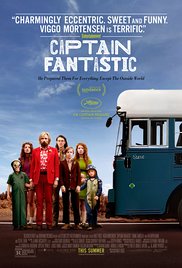
CAPTAIN FANTASTIC (2016)

July 15, 2016

capt fantastic Greetings again from the darkness. There seems to be no end to the theories on how to be an effective parent and raise kids who are productive, well-adjusted and successful.  Writer/director Matt Ross offers up a creative, entertaining and thought-provoking story of one family’s unconventional approach in a world that seems to expect and accept only the conventional.

We are first introduced to Ben (Viggo Mortensen) and his six kids as they are stalking a deer while deep in the Pacific Northwest forest … only this isn’t your buddy’s weekend deer hunting trip. Each family member is covered head-to-toe in mud and other means of camouflage, and the oldest son Bodevan (George MacKay) takes the lead with his knife in what is presented as a rite of passage into manhood.

The family carries out a daily ritual that includes extreme physical conditioning, lessons on survival and living off the land, and advanced education that includes reading such diverse material as Dostoevsky and Lolita. Each evening is capped off with an impromptu musical jam. It’s evident that self-sufficiency, intelligence and family loyalty are crucial to Ben’s approach … an approach that is challenged when circumstances require the family board their Partridge Family bus (named Steve) and take a cross-country road trip into a civilization that doesn’t know what to make of them (and vice-versa).

The film is jam-packed with social commentary on education, parenting, societal norms, societal influences, and even grief. Who gets to decide what is best for a family or what’s the best method for education? Sometimes the dysfunctional family isn’t so easy to identify. Director Ross proves this in a gem of a dinner table scene as Ben and the kids visit Kathryn Hahn, Steve Zahn and their two sons in suburbia.

In addition to the terrific performance by up-and-comer George MacKay, the other actors playing the kids are all very strong and believable: Samantha Isler as Kieyler, Annalise Basso as Vespyr, Nicholas Hamilton as Rellian, Shree Crooks as Zaja, and Charlie Shotwell as Nai. Screen vets Frank Langella and Ann Dowd bring presence to the role of their grandparents and provide the greatest contrast to the off-the-grid existence of the kids.

Viggo Mortensen truly shines here and gives a performance full of grace and depth as he displays many emotions (some of which aren’t so pleasant). He even goes full-Viggo for one of the film’s many humorous moments … though the comedy is balanced by plenty of full scale drama. His best work comes in the scenes when he begins to question that there may be some flaws in his plan … the moments of self-realization are stunning.

Many will note some similarities between this film and Little Miss Sunshine (2006), though this one carries quite a bit more heft. It’s beautifully photographed by cinematographer Stephane Fontaine (A Prophet, Rust and Bone) and captures the danger and solitude of the forest, while also capturing the more personal family dynamics. It’s a film that should generate plenty of discussion, and one of the questions is … will Noam Chomsky Day ever match Festivus in popularity?

watch the trailer:


THE INFILTRATOR (2016)

July 13, 2016

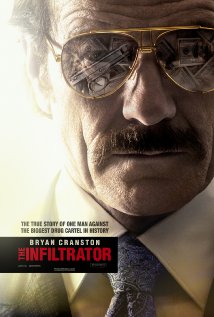
infiltrator Greetings again from the darkness. The war on drugs has become a bit of a punchline in the real world, but has proven to be fertile ground for filmmaking: Sicario (2015), American Hustle (2013), Traffic (2000). Additionally, the popular Netflix show “Narcos” takes on the same Medellin drug cartel as this latest from director Brad Furman (The Lincoln Lawyer, 2011). The movie is based on the true events of Robert Mazur’s book “The Infiltrator: My Secret Life Inside the Dirty Banks Behind Pablo Escobar’s Medellin Cartel” (a title that’s very descriptive, if a bit long).

Bryan Cranston continues his impressive Hollywood run this time as Robert Mazur, the man who goes undercover to expose the money-laundering system of the cartel. His flamboyant alter-ego is known as Bob Musella, a character that allows Mazur (and Cranston) to show a side not typically seen. His antics get him inside Columbian Drug Lord Escobar’s organization in the mid-1980’s.

When Mazur realizes the traditional method of chasing the drugs isn’t working, he decides the age-old idiom “follow the money” might be a better approach. This takes him inside the world of international money laundering, and he learns that banks and governments are quite dependent on this huge business of drug money movement.

There are specific groups of people here: the government agencies, the small task force, the corrupt (and appreciative) bankers, the various levels within the cartel, and even Mazur’s family … all these forces intertwine to make life difficult for Mazur and his team, and provide a glimpse into the complexities of undercover work.

In addition to stellar work from Cranston, the cast is terrific. John Leguizamo plays Mazur’s motivated partner Abreu; Diane Kruger plays his undercover fiancé; Juliet Aubrey is Mazur’s real life wife who doesn’t much appreciate his declining the early retirement offer; Olympia Dukakis provides a dash of comedy relief as Mazur’s Aunt; Yul Vasquez is the creepy money manager for Escobar; Benjamin Bratt plays Roberto, Escobar’s right-hand man and the key to Mazur’s case; and Elena Anaya (The Skin I Live In, 2011) is Roberto’s wife. Also present are Amy Ryan, Jason Isaacs and the always great Michael Pare.

There are a couple of standout scenes – one involving chicken and voodoo, and another with a briefcase mishap, but my favorite is the Happy Anniversary cake scene in the restaurant where Mazur flashes his alter-ego Musella for his real wife to see … and she is understandably stunned.

The movie does a nice job of capturing the look and feel of the era (30 years ago), but it’s somehow missing the elevated suspense it portends to drag us and the characters through. Some elements seemed impossible to believe – why would Mazur risk his family’s safety? The timeline was a bit muddled. We aren’t sure how much time has passed, but there certainly don’t seem to be enough interactions before Roberto is telling Mazur he is “like family”. It plays a bit like those romance movies where the two leads are head over heels in love after a conversation or two. An element is missing and it affects the level of tension throughout the film. And that’s something even a Leonard Cohen song (“Everybody Knows”) can’t fix.

watch the trailer:


HUNT FOR THE WILDERPEOPLE (2016)

July 7, 2016

Oak Cliff Film Festival 2016

hunt for Greetings again from the darkness. It just doesn’t seem very many movies are designed to be funny to a wide range of viewers. There are raunchy comedies for taboo lovers. There are comedies for young kids. There are even Nicolas Cage movies for unintentional laughs. But writer/director Taika Waititi actually delivers a thoroughly entertaining movie that will generate laughs across multiple generations … it’s quite simply, a fun time at the theatre.

Based on the 1986 book “Wild Pork and Watercress” by Barry Crump, who himself is a bit of a legendary figure in New Zealand, the film begins with Child Protective Services (or whatever it’s called in New Zealand) dropping off 12 year old Ricky Baker to his new foster family. Paula, the CPS agent, considers Ricky a lost cause and describes him as “a very bad egg” as she rattles off his list of previous rebellions to new foster mom Bella, who takes note of Ricky’s heft with a couple of wisecracks – delivered with a well-meaning smile.

In a terrific screen introduction, “Uncle” Hec slowly comes into frame flashing a world class scowl and a wild boar slung over his shoulder. Ricky continues his habit of running away at night, but Bella slowly wins him over with her kindness, understanding and breakfast offerings. A tragic occurrence and fear of being shipped back to the juvenile center, has Ricky disappearing into the New Zealand bush. Soon enough Hec catches up and the two begin a relationship that is the core of the film.

Rima Te Wiata plays Bella as a perpetually optimistic woman with a sincere drive to help Ricky adjust and find some joy in life. Sam Neill plays Hec in full grumpy curmudgeon mode … a nice compliment to the extraordinary presence of Julian Dennison (Paper Planes) as Ricky. Ricky and Hec together are a hoot to watch. It’s not simply the generational differences, but also a clash of one man who wants little more than to be left alone and a young boy who wants little more than to be noticed and cared about. It’s not so much the direction of their relationship that surprises, but rather the manner in which it develops.

Director Waititi’s next film is Thor: Ragnarok, so this makes us appreciate even more his pleasant little indie film that features not just colorful and interesting characters, but the beautiful landscape of the New Zealand bush … much of which we see during the humorous manhunt for Hec and Ricky. It’s a farcical comedy with a dose of profundity and loads of adventure for two social misfits. Rachel House is pretty funny as the obsessed CPS worker, and Rhys Darby (“Flight of the Conchords”) is downright hilarious as Psycho Sam. Watching criminial-wannabe Ricky literally count off his Haiku, leaves little doubt as to why this one has been such an “audience favorite” at multiple film festivals.

watch the trailer:


SEPTEMBERS OF SHIRAZ (2016)

June 23, 2016

septembers of shiraz Greetings again from the darkness. It’s 1979 in Tehran, and the Shah of Iran has recently been overthrown in favor of Ayatollah Khomeini and the shift to fundamentalist Islam. Director Wayne Blair informs us that the Hanna Weg script from Dalia Sofer’s bestselling novel is “based on true events”. As soon as we realize the story is about a wealthy Jewish family, we are prepared for the sure to be unpleasantness.

Adrien Brody plays Isaac, a self-made man whose jewelry business has profited through his dealings with the previous regime. His wife Farnez is played by Salma Hayek, and their beautiful home is the setting for the going-away party for their son who is headed to the United States to continue his education, leaving behind his parents and younger sister.

Ignoring his own warnings that things are getting bad, Isaac is soon arrested by the Revolutionary Guard. As Farnez tries to see him, while also keeping things together at home, Isaac is being interrogated and later tortured as he is held captive.

As in many revolutions, it comes down to rich versus poor, and those who had power versus those who now wield the big stick. Isaac and Farnez are presented as good people who have helped others … including their housekeeper played by the always interesting Shohreh Aghdashloo (House of Sand and Fog). Her loyalties begin to waver even as her son joins forces with the Guards. Why should she clean toilets while Farnez lives the high life? The scenes with Ms. Hayek and Ms. Aghdashloo are the film’s best, but even those aren’t strong enough given the material.

The film tries to maintain a neutral stance on religion and politics, though it’s clear where the sympathies fall. The ending dedication to “all victims of persecution” gives some idea of the lack of focus here. The over-acting from Adrian Brody does distract some from the manner in which the story ends. The lesson seems to be that one is never free when focused on material things, and yet revolutions always seem to be about the power that comes with money … rather than the issues initially proclaimed. In book form, this is a terrific and personal story about the impact of the revolution. Unfortunately, on the screen, it comes across as all too familiar and lacking in danger and suspense … none of which lessens the true hardships faced by this family.

watch the trailer:


GENIUS (2016)

June 17, 2016

genius Greetings again from the darkness. Most biopics provide a look into the life of someone who had an impact. If after watching this film, you are confused about just who the main subject is, that’s understandable. It’s rare to find a biopic about two people … a duo biopic … but that’s what the film directorial debut of noted British theatre director Michael Grandage presents. Novelist Thomas Wolfe and editor Max Perkins are forever linked in history, and the screenplay by John Logan (Oscar nominated for Gladiator, The Aviator, Hugo) shows us just how intertwined these two lives became. It’s based on A Scott Berg’s 1978 book “Max Perkins: Editor of Genius”.

It’s 1929 and writer Thomas Wolfe (Jude Law) is tapping his foot as he smokes a cigarette while standing on the sidewalk staring at Scribner’s Sons Publishing building in New York City. A moment later he is bursting into an office whilst unleashing a rapid-fire blast of words to which our ears can barely keep pace. Taking in the verbal fireworks is an elegantly quiet and eternally hatted man behind the desk. With only the phrase “Mr. Wolfe, we intend to publish your book”, editor Max Perkins (Colin Firth) manages to silence the bombastic writer for a few stunned seconds … mostly the only time we witness this.

And so begins not so much a friendship as a professional dependency and surrogate father/son relationship. Thomas Wolfe was other-worldly prolific in his ability to craft words into stories. He was also an exceedingly creative workaholic and alcoholic who found his way to Perkins via North Carolina and Harvard. Yes, it’s the same Max Perkins who was editor to such literary luminaries as Ernest Hemingway and F Scott Fitzgerald.

Seen as personality polar opposites, we also get to witness the differences within the personal lives of the two gentlemen. Both have strong women at home. Mr. Perkins’ wife Louise is played by Laura Linney, and their 5 daughters are smitten with the outlandish behavior and stories of Mr. Wolfe as he visits for dinner. In an unusual twist for the times, an older married woman Aline Bernstein (Nicole Kidman), was Wolfe’s lover and supporter … even through his carousing and endless nights of work with Perkins.

The red pencil of Perkins is as ever-present as the hat on his head, as he slashes and burns through paragraph after paragraph and page after page of Wolfe’s writing in order to fashion an end product that is “marketable”. The result was Wolfe’s first novel “Look Homeward, Angel” … even the title was changed by Perkins. The editing sequences and Perkins’ directive for “Big story, fewer words” have us (and Perkins himself) questioning the role of an editor. Do they make the story better or just different? Is marketable more important than the original words of the author? It’s a legitimate point of discussion, as it’s doubtful anyone told da Vinci that his Mona Lisa should have a bigger smile, or Mozart that The Magic Flute should have fewer notes. Are book editors underappreciated or overly critical?  In the case of the second Wolfe novel “Of Time and the River”, Perkins reduced the work by not hundreds, but rather thousands of pages … all for the goal of marketability. And it turned out to be Wolfe’s best-selling book.

The best scene in the film is also the most insightful. Wolfe drags the always dignified Perkins to a late night jazz club, and with the help of the band, displays in song how Wolfe’s brain kicks into writing mode. It’s a moment of enlightenment for Perkins, as well as us viewers. Law’s Wolfe is a whirlwind of words and prose and those in his path are simply overwhelmed by the enormity of his way. In what feels like a touch of name-dropping, the film tacks on a couple of scenes with Hemingway (Dominic West) and Fitzgerald ( ). Though the scenes are a bit heavy-handed, they do serve as a reminder of what terrific writing came from this era, as well as the impact of editor Perkins.

It’s a little disconcerting to see the leads in an America tale played by Brits and Aussies, but there is no denying the effectiveness of Firth, Law, et al. It’s truly a tale of two geniuses, and Aline was correct … after Wolfe, there was “a great hush”.

watch the trailer: