LION (2016)

January 12, 2017

lion Greetings again from the darkness. Sometimes the real life story is enough. The story of Saroo Brierley is proof. A 5 year old boy from rural India gets stranded at a train station and inadvertently takes a train trip that strands him in Calcutta, thousands of miles from home. He is adopted by a Tasmanian couple and later uses Google Earth to systematically track down his village, family, and ultimately his self.

Saroo’s story would be interesting enough had a writer fabricated it; but in fact, Luke Davies adapted the screenplay directly from Mr. Brierley’s book “A Long Way Home”. Director Garth Davis and an exceptional cast bring this incredible and inspirational and touching story to the big screen in a wonderfully entertaining manner.

The first part of the film introduces us to 5 year old Saroo (a bright-eyed and energetic Sunny Pawar) and his beloved and protective older brother Guddu (Abhishek Bharate). The two boys are nearly inseparable and seem oblivious to the hard life provided by the small village they live in – where their mother literally carries rocks all day. A fluke of circumstance causes the train station separation for the brothers, and young Saroo finds himself on a train ride that will forever change his life.

Very little dialogue is found in this first part, but we immediately connect with the young boy, and we feel his frantic desire to return home as a tightness in our chest as he falls into the quagmire of homeless kids in Calcutta. When Saroo first meets Sue and John Brierley (Nicole Kidman, David Wenham), he isn’t sure how to react. His assimilation into this unrecognizable new world might just as well have been on another planet as a home in Tasmania.

Once the film jumps ahead, Dev Patel takes over as Saroo and the film turns into a journey for the universal need to understand our identity … where we come from, and who we really are. Rooney Mara has a small but important role as Saroo’s girlfriend Lucy (a composite character), as does Divian Ladwa as Mantosh, another boy adopted by the Brierleys. It’s here where Google Earth enjoys its biggest plug as the tool Saroo utilizes to solve the mystery of his origin.

The film is beautifully shot by cinematographer Greig Fraser, and he perfectly captures the harshness of young Saroo’s home village, the frenzied pace of Calcutta and the beauty of Tasmania … all without losing the emotions of any given moment. To cap it off and to prove the filmmakers never stooped to any ‘trickery’, the film ends with actual footage of Saroo reuniting with his mother, and then the magical moment when his two mothers embrace. Good luck maintaining composure during this part!

watch the trailer:


PATRIOTS DAY (2016)

January 12, 2017

patriots-day Greetings again from the darkness. Is it too soon? If not, is it too painful to revisit? Even if the time is right, is injecting a fictitious supercop into the horrific events an acceptable approach? Every viewer of the film will have their own answers to these questions, but clearly writer/director Peter Berg (Deepwater Horizon, Lone Survivor) and Boston area native Mark Wahlberg believed now is the time and that this is the best way to re-create this catastrophe and its fallout.

Wahlberg plays Tommy Saunders, a Boston detective kicked back to uniform duty as penance for a run-in with another cop. His character is evidently a composite of multiple cops and first responders, and though he is the center of the film, the character is the weak link. He’s some type of supercop who never sleeps and manages to be literally everywhere something is happening … either the Boston Marathon finish line, FBI control center, the hospital interviewing survivors, or cruising the streets with his spotlight tracking down the bad guys.

Beyond Wahlberg’s character, the film does a remarkable job at re-creating the tragic events, the emotional and physical fallout, and the urgent law enforcement manhunt. Since it’s been less than 4 years, most every piece of this is fresh in our minds. We follow along from when the street cameras are used to identify the suspects all the way through the final capture from the backyard boat.

Another thing the film does well is tell the stories of certain individuals who were impacted. We experience the emotions of Boston Police Commissioner Ed Davis (John Goodman), the preparedness and cool of Watertown Police Chief Jeffrey Pugliese (JK Simmons), the highs and lows of MIT Officer Sean Collier (Jake Picking), the terror and courage of captive Dun Meng (Jimmy O Yang), and the focus and conflicts of Governor Deval Patrick (Michael Beach) and FBI Special Agent Richard DesLauriers (Kevin Bacon). There is also the story of survivors Jessica Kensky (Rachel Brosnahan) and Christopher O’Shea (Patrick Downes), and a few others who we get to know a little bit.

The bombers/terrorists/brothers are played by Alex Wolff and Themo Melikidze, and no effort is made to sympathize or explain their actions. The closest we get is an argument in the apartment with the wife (played by Melissa Benoist) over the wrong type of milk. I will not use the real names here as I don’t believe in providing any publicity for such creators of evil.

The film successfully establishes the “normal” start to what seemed to be a “normal” day. Of course, April 13 2013 turned out to be anything but. We hear the Newtown tribute at the opening of the race, and we see David Ortiz with his color proclamation at Fenway Park. The music by Trent Reznor and Atticus Ross is always spot on with the mood, and the last 10 minutes are by far the most emotional … we hear from the real life survivors, first responders and others so crucial to that time. I may believe that this story would best be told in documentary form, but there is no denying that it’s a reminder of the power of love, and the spirit of Boston and America.

NOTE: why does it seem Michelle Monaghan is underutilized in almost every movie she appears? She is such a fine actress, but she rarely seems to get the screen time she should

watch the trailer:


20th CENTURY WOMEN (2016)

January 12, 2017

20th-century Greetings again from the darkness. Writer/director Mike Mills has found a niche, and a form of therapy, by exploring and exposing his life in a most public manner … on the silver screen. Beginners (2010) brought us the story of his father’s (an Oscar winner for Christopher Plummer) late life pronouncement of homosexuality. This time, Mr. Mills turns his lens and his pen towards his mother, and he seems to understand her much better in retrospect than in the summer of 1979 when the film is set.

This can be viewed as the story of three women, masked as a coming-of-age story for a teenage boy. Annette Bening stars as Dorothea, a chain-smoking single mother in her mid-50’s who seems to have surrendered to her own sadness and loneliness, while simultaneously trying to make sense of a changing world. One of her tenants is Abbie (Greta Gerwig), a photographer and NYC punk scene drop-out, who is now battling cervical cancer. The third female is the seemingly always present Julie (Elle Fanning), a sexually promiscuous and borderline depressive 18 year old who values the platonic friendship she has with Dorothea’s 15 year old son Jamie (Lucas Jade Zuman).

Factor in another tenant in the form of laid-back handyman and former hippie William (Billy Crudup), and we have a makeshift family in a communal setting that seems almost normal for 1979 Santa Barbara. Dorothea enlists the other two women to show Jamie their lives – the intent being to influence his growth in ways an older mother can’t. Of course, Jamie is at the age where exploring life isn’t necessarily best served by tagging along on a trip to the gynecologist with Abbie or having no-touch sleepovers with Julie.

Ms. Bening finds her groove as the story progresses and we feel her struggling to connect to each of the characters. When William plays a Black Flag song, her reaction is priceless: “They know they’re not good, right?” She doesn’t mean it as a put down, but rather her attempt to understand why her son is drawn to this. An even more emotionally naked moment occurs when Jamie is reading a passage from “The Feminine Mystique” to his mother. It’s a passage that captures what he thinks of her, as well as what she thinks of herself … a mostly invisible woman finding it difficult to be a parent while also maintaining a self.

Mills is not one to be nostalgic or glorify the past. His brilliant writing includes lines like “Wondering if you are happy is a great short cut to being depressed.” The movie can be slow moving at times, but it’s the best I’ve seen in awhile at expressing what makes us tick. The film is what Running with Scissors should have been. Real people are sometimes interesting, sometimes boring, and sometimes annoying. Each of the characters here are all of the above (just like you and me).

watch the trailer:


CLAIRE IN MOTION (2016)

January 12, 2017

claire-in-motion Greetings again from the darkness. A math professor and an art professor are apt to view the world discordantly, but it doesn’t mean they aren’t capable of a strong personal relationship together. After planting a morning kiss on the cheek of his wife, Paul sets off on a one-man survival hike through the hills and forest. When he doesn’t return, the mystery begins. Only it’s not really a mystery, and it’s certainly not the thriller it seems to be disguised as. Rather, it’s a character study of how a rational mind works to make sense of a world that can’t always be explained logically.

Lisa Robinson and Annie J Howell have co-written and co-directed this story that gives Betsy Brandt a chance to really spread her dramatic acting wings after her time on “Breaking Bad”. Here she plays Claire, a math professor, wife, and mother to Connor (Zev Haworth). Being of sound mind and structured thought, Claire immediately starts trying to find the logical reason for the disappearance of her husband. What she discovers is her husband often secretly veered from the structured life she so valued. This leads Claire to an awkward meeting with Allison (Anna Margaret Hollyman), one of his grad students. It turns out Allison and Paul had a pretty close connection over an upcoming art project.

By now, you are probably sure you have this movie figured out. Fortunately, the filmmakers ensure it’s not as predictable as you might think. It’s not a thriller like Gone Girl or Deceived. We watch Claire re-trace Paul’s steps on a path unfamiliar to her, and this evolves into a self-realization that she had been sleep-walking through life: doing her job, raising her kid, going home each day. There’s a key moment when she’s watching an old video of herself and Paul, and he says “look at me”. It’s at this point she begins to understand – and it’s enhanced by a chance meeting in a bar with a former student. Maybe Paul isn’t the only missing person.

Son Connor probably doesn’t get the screen time his character deserves. Like his father, Connor has some secrets of his own. His friends don’t know he enjoys knitting, and he intends to keep it that way. It’s one more indicator that no matter how close we are to someone, we don’t know or share all. Finding and discovering one’s self can be a torturous process before it ever reaches enlightenment, and though the story short-changes the process of grief, we do understand not to mindlessly nod when someone says “you know me”.

watch the trailer:


PATERSON (2016)

January 8, 2017

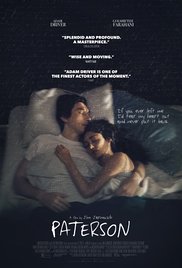
paterson-b Greetings again from the darkness. Do you find poetry in everyday life? What about poets … do you envision loners whose lives are filled with angst and suffering? Our lead character here is a pretty normal guy who drives a city bus, has a happy marriage, and walks his dog each evening. He’s also a poet – and a pretty interesting one.

Writer/director Jim Jarmusch (Broken Flowers, 2005) often seems like he is making films for his circle of friends … all whom must be much cooler than you and me. This time, however, he takes an opposite approach and brilliantly focuses on a dude that any of us could know. Paterson (Adam Driver) is a New Jersey Transit bus driver who writes poetry based on his observations of life’s seemingly minor details (his first poem notes “We have plenty of matches in our house”).

You should be forewarned: there are no murders, kidnappings, bank robberies or shootouts. Things move rather deliberately. Also missing are any special effects – heck, Adam Driver even got licensed to drive a bus for the role. Instead, we are forced to slow down and see each of the seven days of a week through the eyes and words of Paterson. He observes. He listens. He people watches. He then commits his thoughts to the page and recites them for our benefit. Sometimes he is eavesdropping on bus passengers, while other times he curiously tries to figure out the newest “dream” for his beloved wife Laura (Golshifteh Farahani). Having the soul of an artist, Laura cloaks her world in a geometric black and white color scheme while energetically bounding from cupcakes to country and western music to cooking as she pursues her place in life.

There are many Jarmusch touches throughout. Paterson the poet actually lives and works in Paterson, New Jersey … yep, Paterson from Paterson. The interactions at the neighborhood bar (run by Barry Shabaka Henley) are simultaneously real and surreal – right down to the wall of local fame (including Hurricane Carter and Lou Costello, but no mention of Larry Doby). Coincidences abound. A young girl recites her poem to Paterson … her writing style, personal book, and delivery make her seem like his poetic doppelganger – all while the recurring appearance of numerous sets of twins make us believe in the law of attraction. Lastly, the closest thing to a villain in the film is Paterson’s bulldog Marvin, in what plays like a love-hate relationship with the mailbox being center-ring.

Another local Paterson (the city) aspect is Paterson’s (the poet) admiration of the works of William Carlos Williams, a poet whose style he emulates. One of the terrific scenes near the end involves a spontaneous interaction between Paterson and town visitor (Masatoshi Nagase) that takes place next to The Great Falls, and serves as a reminder that we should accept who we are, no matter the challenges or lack of glory. This is truly director Jarmusch’s ode to the artist/poet in each of us and in ordinary life. Creating art as best we can is a very personal thing, and for some it’s a need – while for others it’s one of life’s simple pleasures. Regardless, a “normal” life with daily routines is not to be scorned, but rather embraced, should you be so fortunate. If you doubt this, Paterson asks, “Would you rather be a fish?”

**NOTE: sharp moviegoer eyes will recognize Kara Hayward and Jared Gilman, who both had their debut in Wes Anderson’s Moonrise Kingdom (2012).

watch the trailer:


A MONSTER CALLS (2016)

January 5, 2017

a-monster-calls Greetings again from the darkness. “From ghoulies and ghosties/ And long-legged beasties/ And things that go bump in the night,/ Good Lord, deliver us”. It’s an old Scottish poem that doesn’t take into account what movies like Pete’s Dragon, The Jungle Book, The BFG, and now this latest from director JA Bayona have intimated this year … not all those ‘bumps’ are necessarily evil.

Lewis MacDougal delivers an incredibly nuanced performance displaying a wide array of emotions as “a boy too young to be a man, and too old to be a child”. His beloved mother (the always terrific Felicity Jones) is bedridden with a terminal illness, and Conor faces relentless pressure for a kid: bullies at school, a dying mom, a strict grandmother, and some rough and vivid dreams/nightmares. As his clock flips to 12:07 am, he watches as a Groot-like giant sprouts from a nearby Yew tree. It’s an intimidating and magnificent beast who, through the dulcet tones of Liam Neeson, informs Conor that he will tell the boy three stories … after which Conor must tell his own.

The meaning behind the three stories (Prince/Queen, Apothecary/Parson, Invisible Man) is not immediately obvious to Conor, but the stories are animated through beautiful watercolors providing depth to the dreams and the lessons. This fascinating film is based on the novel by Patrick Ness who completed the idea of Siobhan Dowd after she passed away from the terminal illness that inspired the story.

I made the mistake of assuming this was going to be a kid’s movie in the style of another featuring the voice work of Mr. Neeson (as Aslan) – The Chronicles of Narnia: The Lion, The Witch, and the Wardrobe (2005). Instead, it’s a heavy drama, filled with emotions beyond what most kids experience. Conor is trying to come to grips with living with his stuffy grandmother (a solid Sigourney Weaver) while his mother slowly fades (but not without first introducing her son to the original misunderstood beast in King Kong), and already having a mostly absentee Dad (Toby Kebbell).

As with most tearjerkers (and this certainly is that!), there will be those who describe it as manipulative and obvious, but it’s likely most will find it to be a touching, well-written, superbly acted film with standout special effects utilized for the advancement of the story. Young Mr. MacDougal carries most of the movie and seamlessly bounds from anger to sadness to hopeful. Director Bayona proved in The Impossible and The Orphanage that he has an eye for kid actors, and when combined with the voice of Liam and the other fine actors it makes for a powerful experience … and a reminder that dealing with death is difficult for both kids and parents, and we all need a little help letting go (displayed literally here).

**NOTE: sharp-eyed viewers will spot a photograph of Liam Neeson as Conor’s grandfather on a shelf in the house.

watch the trailer:


SILENCE (2016)

January 5, 2017

silence Greetings again from the darkness. Martin Luther King said “Faith is taking the first step even when you don’t see the whole staircase”. Martin Scorcese’s esteemed film career could be described as unveiling that staircase, one step/film at a time. Religion, spirituality and yes, faith, have played a key role in his life and his films – most notably, Kundun and The Last Temptation of Christ, but also most of his other projects.

A high-ranking priest (Ciaran Hinds) is meeting with two younger Portuguese priests and informing them of the rumor that their mentor Father Ferreira (Liam Neeson) has reportedly renounced his faith and is now living as a Japanese Buddhist in Nagasaki. The two young Jesuit priests, Rodrigues (Andrew Garfield) and Garupe (Adam Driver) refuse to believe this and request to be allowed to track down Ferreira and bring him home. It could be termed a rescue mission, and the two men could be called missionaries, but what follows is an excruciating test of their own faith.

Martin Scorcese has been working on this passion project for more than two decades – ever since he read the Shusaku Endo novel (published in 1966). Cast members have changed through the various iterations of the project, but after the box office success of The Wolf of Wall Street, Scorcese received the financial backing to bring his vision to the screen. He co-wrote the screenplay with Jay Cocks (Gangs of New York) and the result is the visual and emotional epic that you might expect from one of the greatest filmmakers of all time.

17th century Christianity in Japan might be a difficult subject to sell to the general movie-going public, and Scorcese goes out of his way to leave unanswered the multitude of questions the film raises. Rather than wrapping it up with a clean ending, he leaves viewers craving further discussions, clarity and explanations. In other words, it lacks mass appeal and shouldn’t be confused with light-hearted entertainment.

Rodrigues is resolute in his belief that God is the answer … even when the film’s title is at the forefront. As Rodrigues and Garupe minister to the village of secret Christians (led by Yoshi Oida and Shinya Tsukamoto) at night and hide during the day, we learn of the Japanese state’s commitment to eradicating Christians and Christianity to ensure the power and isolation of the country. The oddest character in the film is that of Kichijiro (an excellent Yosuke Kubozuka). He is both guide to the priests and a constant challenge to their faith, while also providing moments of comic relief in a film with very few. Were this a Kurosawa film, this role would have been a perfect fit for the great Tishiro Mifune.

The most obvious adversary for the priests is the Japanese elder known as The Inquisitor. Issei Ogata excels in the role as a wily, half-smiling, quite knowledgeable wartime (a war on Christianity) leader intent on creating the most painful and public extermination of Christian believers and those priests who dare to infect his country (Japan’s 1614 Edict of Expulsion). The torture and persecution is too much to detail here, but it portrays how even the most ardent believers could choose life over faith.

The film blends fiction with some true-to-life aspects, and is most effective at asking questions and spurring thought. Which is more crucial – public or private faith? Is doubt allowable and even understandable? Is Rodrigues so committed to faith or is there also an element of martyrdom present? How about the “Judas” sub-plots? Is it betrayal if it saves one’s own life? Just where is that line? Is Ferreira a disgraced priest or simply a man valuing survival? The film is beautiful to look at (superb work from cinematographer Rodrigo Prieto and editor Thelma Schoonmaker) while being exceedingly tough to watch (and quite long). Be prepared to set aside time for reflection and discussion … you may even discover some surprises in your views and beliefs.

watch the trailer:


FENCES (2016)

December 23, 2016

fences Greetings again from the darkness. Just about any use of words you can think of serves some part in this screen adaptation of renowned playwright August Wilson’s Pulitzer Prize and multiple Tony award winning stage production. It first hit Broadway in 1987 with James Earl Jones and Mary Alice in the leads, and the 2010 revival starred Denzel Washington and Viola Davis – both who reprise their roles for the movie version. It’s also the third directorial feature from Mr. Washington (The Great Debaters, Antwone Fisher).

The story takes place in mid-1950’s Pittsburgh and is a family drama character study centered on patriarch Troy Maxson (Washington), a former Negro League star and ex-con, who now works days on a garbage truck before coming home to his wife Rose of 18 years (Ms. Davis) and their son Cory (Jovan Adepo, “The Leftovers”). The Friday night after work ritual finds Troy holding court in his backyard with his best friend and co-worker Bono (Stephen Henderson), as they share a bottle of gin and pontificate on the injustices that have landed them in this place and time.

Another regular Friday occurrence is the drop-in of Troy’s son by his first wife. Lyons (Russell Hornsby) is a musician who shows up on payday for a “loan” from dad. To say there is tension between the two would be an understatement, and it’s the complex relationships between Troy and everyone else that is the crux of the story. Another player here is Troy’s brother Gabriel (Mykelti Williamson), who periodically wanders by talking about battling demons and hellhounds. See, Gabriel suffered a severe head injury during WWII and now has a plate in his head but no real place in society.

Troy is a proud and bitter man, unwilling to acknowledge that the world is changing. Instead he holds firm to his belief that the white man will always hold back the man of color. It happened to him in baseball (though actually he was too old by the time Jackie Robinson joined the Dodgers) and he refuses to believe Cory can succeed in football despite his being recruited by a college. Troy jumps between charming and caustic, and his fast-talking bellowing style can be entertaining, enlightening, condescending and intimidating … sometimes all of the above within a few sentences.

There is magic in the words of Austin Wilson, and as a film, this is a true acting clinic. The performances keep us glued to the screen in each scene. Denzel is a dominating presence, and the single best moment belongs to the terrific Viola Davis. Her explosive release conveys the agony-of-the-years, the broken dreams, and the crushing blow of broken trust. As a viewer, we aren’t sure whether to stand and applaud her or comfort her with a warm hug. The only possible criticism might be that the stage roots are obvious in the film version. The theatrical feel comes courtesy of the sets which are minimal and basic with no visual wow factor. But this minor drawback only serves to emphasize the characters and their interactions.

It’s pointed out to us (and Troy) that fences can be used to keep things out or keep things in. During his pontificating, Troy uses a couple of phrases more than once: “Living with a full count”, and “Take the crooked with the straight”. He often waxes philosophical, and it’s through these words that we realize both he and Rose took their sense of duty and responsibility so seriously that they both lost their selves in the process. Making do with one’s situation should not mean the end of dreams and hopes, and it certainly gives no one the right to hold back anyone from pursuing the path they choose. While watching the actors, don’t miss the message.

watch the trailer:


HIDDEN FIGURES (2016)

December 21, 2016

hidden-figures Greetings again from the darkness. The space program has created many iconic images over the years: rhesus monkeys in space suits, the Mercury 7 Astronauts press conference, Neil Armstrong and Buzz Aldrin erecting a flag on the moon, and numerous Space Shuttle missions – some successful, others quite tragic. We’ve even been privy to cameras inside the space station and the NASA control center. Despite all of that, director Theodore Melfi’s (St Vincent, 2014) latest film uncovers a part of history of which most of us knew nothing.

Adapted from the book by Margot Lee Shetterly, the film stuns us with the story of the “Colored Computers” … the African-American female mathematicians who manually checked and cross-checked the endless calculations, formulas and theories required to launch a rocket into space and bring it (and the astronaut) back home. It’s a crowd-pleasing history lesson and an overdue tribute to, and celebration of, three intelligent women of color who played crucial roles in the success of the American space program

We first meet a young Katherine Johnson as a child math prodigy whose school can’t provide her the challenge she needs. Next we see her as a bespectacled adult (Taraji P Henson) on the side of the road beside a broken down car with her friends and co-workers Dorothy Vaughan (Octavia Spencer) and Mary Jackson (musician Janelle Monae). They are on their way to work at Langley in the computing department. Dorothy is the ad hoc supervisor of the group and is in a non-stop battle for the title and increased pay that comes with the job. Mary is the razor-tongued one who is striving to overcome all of the obstacles on her way to becoming the first female African American Engineer at NASA. These are good friends and smart women caught up in the racism and sexism of the times and of the organization for which they work.

Soon, Katherine is promoted to the Space Task Group run by Al Harrison (Kevin Costner). This is a group of true rocket scientists, and Katherine is charged with checking and confirming their work … a thankless job for anyone, but especially for a black woman in the early 1960’s. Her supervisor (Jim Parsons) refuses to give her the necessary security clearance – huge portions of the work are redacted, making it increasingly difficult for Katherine to run the numbers. This is a seemingly accurate and grounded portrayal of racism in the workplace. At the time, racism and sexism were mostly woven into the fabric of society … it’s “just the way things are”. It’s almost a passive-aggressive environment with separate coffee pots and restrooms clear across campus.

There are numerous sub-plots – probably too many. We even get an underdeveloped romance between Katherine and a soldier named Jim Johnson (Mahershala Ali, so great in this year’s Moonlight). We follow Mary as she goes to court in pursuit of the right to take the engineering courses required for her certification. We see Dorothy with her kids, as well as her ongoing head-butting with her condescending supervisor (Kristen Dunst), who claims to have nothing against ‘you people’. Dorothy’s response is clever, crowd-pleasing and a reminder that this is an air-brushed version of reality … but also a view that we rarely see. As the Mercury Project progresses, we note how Harrison (Costner) is so focused on getting the job done, that he is oblivious to the extra challenges faced by Katherine – that is until her emotions erupt in a scene that will have Henson under Oscar consideration.

The slow implementation of the first IBM mainframe is important not just to NASA, but also to Dorothy and her team. They see the future and immediately start self-training on Fortran so that they are positioned for the new world, rather than being left behind. Eye-opening sequences like this are contrasted with slick mainstream aspects like no slide-rules (not very camera friendly, I guess), stylish and expensive clothing for the underpaid women, and a steady parade of sparkling classic cars in vibrant colors – no mud or dents in sight. Sure, these are minor qualms, but it’s these types of details that distract from the important stories and messages.

The film does a nice job of capturing the national pride inspired by the Mercury project, and astronauts such as John Glenn (played here by Glen Powell, Everybody Wants Some!!). It even deploys some actual clips and captures the pressure brought on by the race to space versus the Russians. There is an interesting blend of Hans Zimmer’s score and the music of Pharrell Williams that gives the film a somewhat contemporary feel despite being firmly planted in the 60’s. This mostly unknown story of these women is clearly about heroes fighting the daily battles while maintaining exemplary self-control. It offers a positive, upbeat and inspirational message … believe in yourself, and don’t pre-judge others. Don’t miss the photos over the closing credits, and don’t hesitate to take the family to the theatre over the holidays.

watch the trailer:


LA LA LAND (2016)

December 10, 2016

la-la-land Greetings again from the darkness. Is this a nostalgic throwback to the movie musicals of Stanley Donen and Fred Astaire, or is it a contemporary film designed to revitalize the movie musical genre in an era dominated by superheroes and sci-fi? However you might choose to label writer/director Damien Chazelle’s follow-up to Whiplash (2014), it’s clearly one of the best and most entertaining movies of the year.

While the opening credits are still rolling (“Presented in CinemaScope” being the first gag), the film kicks off with its only large scale (think Busby Berkeley on a L.A. freeway rather than in a swimming pool) musical production, “Another Day of Sun”. It’s also the first of 3 less-than-warm-and-fuzzy “meetings” between the two lead characters before they finally click.

Emma Stone and Ryan Gosling light up the screen with the same incredible chemistry they displayed in Crazy, Stupid, Love (2011). Mia (Ms. Stone) is a struggling actress-wannabe working behind the counter at the Warner Brothers studio coffee shop. Sebastian (Mr. Gosling) is a pianist committed to the traditions of jazz music … even as he toils in a club playing mainstream tunes for folks who aren’t even listening.

As their relationship develops, we are treated to a tap dance number in the Mulholland Drive moonlight. Soon, Sebastian (either a brooding Gene Kelly or a dancing James Dean) is forced to make a choice between finding a way to open his own jazz club or compromising his integrity by making lots of money joining a “hot” band (led by John Legend), while Mia is focusing on auditions and her writing (which leads to a disastrous one-woman show).

Director Chazelle and cinematographer Linus Sandgren create a look in line with Singin’ in the Rain, but a tone more suited to A Star is Born. There is no shortage of romance and music, but it’s equally balanced with melancholy, foolish dreams, and shattered hopes. While it’s an homage to old Hollywood, Los Angeles and movie musicals, it seems to gracefully swing between past and present – and reality and fantasy.

Mia has a bedroom wall mural of Ingrid Bergman, while Sebastian treasures his piano stool that once belonged to Hoagy Carmichael … two more examples of past and present intertwined. Ms. Stone and Mr. Gosling possess solid (not exceptional) singing voices, which aids in having the songs tell their story. Ms. Stone is quite a talent, and especially stands out in her audition scenes … we feel her pouring her heart out to casting agents who may or may not even be paying attention. It’s remarkable work from her.

Supporting work is provided by Rosemarie DeWitt (as Sebastian’s sister), JK Simmons (as a club owner and Sebastian’s boss), Finn Wittrock (as Mia’s boyfriend) and Damon Gupton. Also in supporting roles would be the Griffith Observatory (after a Rebel Without a Cause viewing), the Los Angeles scene, and the Warner Brothers lot.

The “What Could Have Been” ending sequence is top notch filmmaking in all aspects, and perfectly caps a movie that drips with nostalgia … while also being touching, funny, and downright fun. Watching this film is much like going through the ups and downs of a relationship, and rather than a fairy tale, it’s a painful jab at “the one who got away”. It deserves to be seen on the big screen – enjoy the full palette of colors and the full spectrum of emotions (love and heartbreak, frustration, anger, and utter joy). This is one to tell your friends about … don’t wait for them to tell you.

watch the trailer: