THE SISTERS BROTHERS (2018)

September 27, 2018

 Greetings again from the darkness. It was a good news – bad news kind of day for westerns. First, it’s announced that Mel Gibson will direct a remake of Sam Peckinpah’s 1969 classic THE WILD BUNCH. Talk about an undesired and unnecessary project! Fortunately, the movie gods understood this gut-punch and as a peace offering, delivered this near-masterpiece that doesn’t so much re-invent the Western, but rather provides a tonal and stylistic twist to the genre.

This is the first English language project from writer/director Jacques Audiard, who has previously delivered such powerful and well-crafted films as A PROPHET (2009), RUST AND BONE (2012), and DHEEPAN (2015). Based on the Patrick DeWitt novel, with a screenplay from Mr. Audiard and his frequent collaborator Thomas Bidegain, this latest is a very unusual film that teeters on satire at times, but is simply too bleak to be a comedy – although it’s too darn funny to be an outright drama.

A terrific opening sequence in 1851 Oregon features a nighttime shootout that sets the stage both visually and tonally for what we will experience for the next couple of hours. It’s beautifully shot and there is some misdirection on what exactly the Sisters brothers are made of. John C. Reilly is absolutely wonderful as Eli Sisters, the soulful forward-thinking one who also has a dash of goofiness to him. His younger brother Charlie Sisters, played by Joaquin Phoenix, is the slightly unhinged one who frequently follows in his hated father’s footsteps by drinking heavily. Charlie is alternatingly quietly menacing and drunkenly menacing. The two brothers are hired assassins, and while Eli dreams of a peaceful retirement, Charlie can’t imagine not doing what they do.

The brothers have been contracted by ‘The Commodore’, a rarely seen power broker played in brief glimpses by the great Rutger Hauer. They are to meet up with advance scout John Morris (played by Jake Gyllenhaal with a quasi-British accent) and kill Hermann Kermit Warm (Riz Ahmed), who has supposedly stolen from The Commodore. Of course, there is more to the story. Warm has actually developed a chemical compound that allows for the easy gathering of gold from waterways – remember this is the height of the Gold Rush.

This is kind of a road trip film … only it’s on a horse trail from Oregon to San Francisco, and it’s kind of a buddy film … only it’s two brothers. Along the way, bonds are forged and broken, and paths are crossed with a kind-hearted saloon gal (Allison Tolman), a greedy town lord (trans actor Rebecca Root), and the brothers’ mother played by the always interesting Carol Kane. There is also a cringe-inducing run-in with a spider, an unfortunate end for a favorite horse, and the hilarious first use of a toothbrush. There is also a Dallas joke that drew quite the laughter from my Dallas audience.

It’s such an unusual film, and it’s presented with a non-traditional pace and rhythm. The moments of laughter surround a core with a dramatic story of destiny, the meaning of life, dreams and visions, and the greed of man. All of this is set to yet another terrific score from Alexandre Desplat and the visually striking photography of Benoit Debie. Director Audiard has delivered a bleak comedy or a comical drama, and he’s done so with more than a fair share of violence. Whether you consider yourself a fan of westerns or not, this one deserves a look.

watch the trailer:


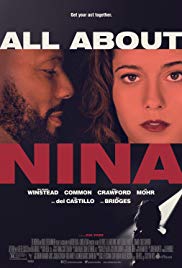
ALL ABOUT NINA (2018)

September 27, 2018

 Greetings again from the darkness. There are dark comedies and then there is the first feature film from director Eva Vives (although she wrote the screenplay for RAISING VICTOR VARGAS). It’s really a dark drama with both feet in the stand-up comedy world, so we find ourselves laughing at the (profane) jokes, despite a lead character that is in desperate need of emotional salvation.

Mary Elizabeth Winstead is dynamite as Nina Geld. And dynamite is meant to have two definitions here. She is terrific in the role, and she (her character) explodes with little notice. Nina Geld is definitely provocative. She is definitely a feminist. She is definitely funny, and she is most definitely messed up. We learn all of this in the first 5 minutes, and spend the rest of the movie waiting to see whether she self-destructs or is somehow saved.

We first see Nina as she delivers a set on stage at a comedy club. Her act is mostly about sex and the misery of relationships. We soon learn why she seems to have little happiness in life. The abusive married cop (Chace Crawford, Tony Romo’s brother-in-law) she has been seeing interrupts the one-night stand she was looking forward to. It’s quite unsettling to watch this unfold, and it seems to be the final straw needed to push Nina to relocate from New York City to Los Angeles. It’s southern California where her agent (Angelique Cabral) has arranged for to audition for “Comedy Prime” – a one hour comedy special produced by Larry Michaels (played by Beau Bridges).

In L.A., Nina rooms with a stereotypical southern California “New Age” type (Cate del Castillo) who senses energy fields and remains quite civil in her arguments with her partner (played by Clea DuVall). Mostly we see what a damaged soul that Nina is, and bearing an unfair brunt are her mother (Camryn Manheim), her mom’s friend (Mindy Sterling, AUSTIN POWERS), and a fellow comic (Jay Mohr).

When Nina meets Rafe (Common, in a rare leading man role), she begins to show her first signs of actual human connection. And of course she is confused by this, and her self-destructive being rears up. The big reveal as to the cause of Nina’s constantly confused state (I don’t believe the therapy sessions are working) is held back until late in the final act … and it’s a doozy that leads to a painfully honest on stage meltdown.

Ms. Winstead is really terrific here, and she is absolutely believable in her stand-up bits. In fact, the montage of impressions and her constant fine-tuning of the act are almost as good as the heavy drama pieces she excels at. The film itself is kind of a mash-up of stories, but it’s her performance that keeps us onboard … even as we question her character’s stability (and incessant hair tussling).

watch the trailer:


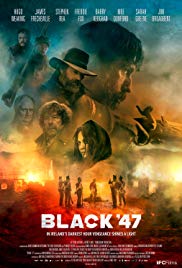
BLACK 47 (2018)

September 27, 2018

 Greetings again from the darkness. While filmmakers don’t tend to shy away from sad or even depressing characters or events, Ireland’s Great Famine has rarely been depicted on the big screen, for whatever reason. The film’s title refers to the worst year of the famine (1847). These were bleak times and folks were desperate – nearly without hope. More than one million people died, and between one million and two million emigrated from Ireland (depending on what time frame you exam). It all began with potato blight.

Director Lance Daly co-wrote the script with PJ Dillon, Eugene O’Brien, and Pierce Ryan, and have chosen to explain history through a personal story rather than an epic big picture one. Feeney (James Frecheville, ANIMAL KINGDOM, 2010) goes AWOL from the British Army in order to check on his family. The home he finds hardly resembles the one he left. His mother is dead from starvation and his brother was hanged. The rest of his family has been evicted and is soon dead as well. Apparently what he witnessed in war prepared Feeney for the horrors he discovers in his homeland. To complicate matters, he is not only viewed as a deserter by the British, but also a traitor within his own community (for fighting for the British).

Feeney becomes a renegade on a mission to avenge the deaths in his family. The film plays like one of those Charles Bronson movies, where a man of principle believes in doling out his own form of justice. A posse of 4 is assembled to track down Feeney. Captain Pope (Freddie Fox, THE THREE MUSKATEERS, 2011) is a despicable soul and by-the-book soldier who blindly follows orders and ignores the suffering of citizens he views as barely human. Young Hobson (Barry Keoghan, THE KILLING OF A SACRED DEER, 2017) is the Captain’s personal valet, while Conneely (Stephen Rea) is local added as a translator – and some much needed comic relief. The most interesting of the group is Hannah, a disgraced Inspector and Feeney’s former commanding officer.

Hugo Weaving (THE MATRIX) plays Hannah as a man driven to the edge by his war experience. One a hero, now slightly unstable in his actions, Hannah agrees to join the posse instead of spending his life in prison. His commitment to the cause is always in question, as we are led to believe there is much to the connection of Hannah and Feeney … a connection that plays out dramatically when they finally cross paths again. Mr. Weaving’s great face is contrasted nicely by Mr. Frecheville’s dead eyes (‘like a doll’s eyes’).

The revenge mission plays out with some violence, but director Daly never stoops to gratuitous gore. Instead, we typically see the aftermath … one of which brings a twist to the phrase “pig-headed”. Feeney’s time as a soldier has well prepared him for this mission. Even Crocodile Dundee would be proud of Feeney’s knife, and he does tend to make a statement with each of his killings.

Supporting work is provided by Jim Broadbent, Moe Dunford (“Vikings”), and Sarah Greene (“Penny Dreadful”). There are a couple of themes on display here: the politics (and power grab) of the time, and one man’s drive to knock down corruption and clean up his beloved country … while showing no mercy to those who have harmed his family. The contempt for the British is quite clear. Religion doesn’t escape commentary and judgment, with a sequence involving a Protestant minister, a Roman Catholic priest and a soup line with a catch.

Director of Photographer Declan Quinn (MONSOON WEDDING, IN AMERICA, LEAVING LAS VEGAS) does work capturing the contrast between beautiful vistas and incredible hardships. The stunning Connemara (western Australia) landscape is offset by immense suffering and cruelty … only the art design is a bit shaky, which is understandable given budgetary challenges. Though we’ve rarely, if ever, seen such a cinematic treatment of this era, it’s clear the guns misfired more often than this production.

watch the trailer:


MADRE (Spain, short film, 2018)

September 26, 2018

 Greetings again from the darkness. Filmmaker Rodrigo Sorogoyen begins his film with a long, slow pan shot across a deserted beach until we see the waves rhythmically rolling in and out. It appears to be a most peaceful setting, but instead it’s actually the set up for one of the most intense and emotionally shattering short films ever.

Marta Nieto and her mother Blanca Apilanez are hanging around the apartment on what’s a typical day for them. When Marta’s answers a call, an unimaginable horror unfolds via cell phone. On the other end is her 6 year old son. He’s on holiday with his father, Marta’s ex. Only her son tells her, as his cell phone battery is dying, that dad left him and now he’s alone on a beach … he thinks it’s France, but could be Spain.

Marta and her mother juggle cell phones as they try to track down the father, while keeping the young boy as calm as possible. It’s a captivating and stunning performance by Marta Nieto, and a brilliant piece of filmmaking from Mr. Sorogoyen. It may be the most unsettling 19 minutes of movie I’ve seen, and if it had gone any longer, it might have become truly unbearable.


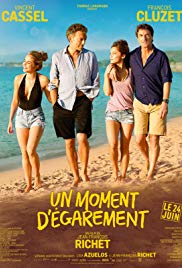
ONE WILD MOMENT (2018)

September 26, 2018

 Greetings again from the darkness. In 1977, French Producer-Writer-Director-Actor Claude Berri directed a film version of his own original screenplay entitled IN A WILD MOMENT. In 1984, director Stanley Donen’s (SINGIN’ IN THE RAIN) final feature film was an Americanized remake that inexplicably left Mr. Berri as uncredited. Perhaps that’s how Berri preferred it, since Donen’s BLAME IT ON RIO was atrocious and nearly unwatchable despite a cast that included Michael Caine and a 21 year old Demi Moore. This third iteration, directed by Jean-Francois Richet (who co-wrote the adapted screenplay with Lisa Azuelos) does credit Berri, and returns the material to France where it’s a better fit.

Best friends Antoine and Laurent take their teenage daughters Louna and Marie (who are also best friends) on holiday to Antoine’s childhood home in the Corsica countryside. The house is a bit rustic and neglected, has spotty (at best) internet, includes a family burial plot, and is miles from town. The only neighbor is an elderly gentleman and his roaming dog. The girls aren’t nearly as taken with the serenity as their dads seem to be.

Both dads are loving and protective of their daughters, though the usual teenager-parent squabbles occur regularly. Watching the interactions between the dads and daughters, between the two men, and between the two teenagers is quite entertaining and exceedingly believable. Of course, the core of the story is what happens in one “wild” moment when Laurent is simply being supportive of Antoine’s daughter Louna – and her teenage crush of the older man shifts into seduction. A late night naked frolic on the beach crosses the line that should never be crossed. Laurent instantly regrets the action, and Louna falls “in love” like only a teenager can.

The rest of the movie becomes an uneasy dance of lies, threats, insinuations and betrayals. Most of it is handled with a comedic intentions, and that compounds the feelings of queasiness and disgust that we have towards Laurent and his unacceptable and unforgivable (and illegal) actions. We see the two men frazzled for much different reasons. Though he doesn’t know the identity of the “older man” who took advantage of his daughter, Antoine is obsessed with tracking him down and making him pay. On the other hand, Laurent is desperate to keep the secret from his friend, and that forces him to play along with Louna’s taunting games.

Two of France’s biggest stars, Vincent Cassel (MESRINE) and Francois Cluzet (THE INTOUCHABLES, TELL NO ONE) play Laurent and Antoine, respectively, while Lola Le Lann (age 19 during filming) and Alice Isaaz are Louna and Marie. Mr. Cassel and Ms. Isaaz are especially effective – he in a no-win role, and she leaving us wanting even more characterization.

Though it was filmed more than 3 years ago, it’s now getting a second life. Original writer Claude Berri is probably best known for his stellar work on JEAN DE FLORETTE and MANON OF THE SPRING, and we can’t help but think his script would work better in contemporary times if the comedy turned much darker and made it abundantly clear that Laurent’s actions were entirely unacceptable – instead of leaving his response to young Louna’s come-on as understandable. The film is produced by Thomas Langmann, the son of Claude Berri, and kicks off with the beautiful and familiar version of “La Mer”, a 1946 song by Charles Trenet.

watch the trailer:


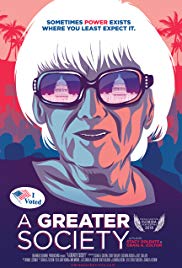
A GREATER SOCIETY (2018, doc)

September 22, 2018

 Greetings again from the darkness. President Lyndon Johnson used the term “The Great Society” to describe the series of domestic programs designed to minimize poverty and racial discrimination, and offset the medical obligations of seniors (through Medicare and Medicaid) in the U.S. It was compared to FDR’s “The New Deal” (including the Social Security Act of 1935). Co-directors Craig Colton and Stacy Goldate titled their film as a twist on these programs, because the focus is the actions of some senior citizens who fight for the programs that are needed to protect their demography.

The Wynmoor Retirement Community in Broward County, Florida was developed in 1973, and marketed to seniors in New York and the entire northeast as a wonderful place to live out those golden years in warm weather and with modern amenities. A funny thing happened along the way … the residents of Wynmoor changed the politics of the area. And therein lies the most important message of the film: senior citizens can wield substantial political power through organization and commitment. Keep in mind that many of these folks are more than 90 years old. One of the most interesting that we meet is Rose. She was born in 1916 during Woodrow Wilson’s term in office.

Those we meet range from children of the depression era to children of the 60’s, and though that’s quite a diversity in sociological upbringings, it’s clear that they embrace the need to engage politically … even, and perhaps especially, these days. The cameras follow these men and (mostly) women as they strive to “get out the vote” for the 2014 midterm elections and the Florida gubernatorial race between Rick Scott and Charlie Crist.

Most of those we get to know are hardcore democrats, but there is one conservative gentlemen thrown in for contrast. Despite his being well spoken and educated on the issues, he gets little camera time. Co-directors Colton and Goldate are both highly successful editors, mostly on TV projects. Their expertise in how to put a movie together is obvious, as even though it’s slowly paced, that pace seems to mirror the process of these volunteers so dedicated to the political cause.

Broward County Public defender Howard Finkelstein offers recurring commentary during the film, but it’s really the Wynmoor residents who are the most interesting. We see the generational changes occurring within the community as new residents replace the older ones. The New York Jewish community is fading while there is an increased Latino presence. The challenge is for Wynmoor to retain the political power and dedication that has long defined it. In what is really a tribute to their efforts, the film acts as a kind of “how to” in gaining community involvement; though it’s Rose who gets the last word by reminding us of the message of “My brother’s keeper”.

watch the trailer:


WHITE RABBIT (2018)

September 22, 2018

 Greetings again from the darkness. You have probably not met anyone like Sophia. I certainly haven’t. She’s a Korean-American performance artist who uses various personalities/characters in her “act”. She also lives alone in Los Angeles, and bikes everywhere … collapsing after a full day that consists of some mixture of delivering public diatribes, crafting her latest bizarre YouTube video, fulfilling her current TaskRabbit assignment, or trying to connect with a fellow human being – one that’s not someone else’s toddler requesting a horseback ride.

Sophia is played by Vivian Bang, who also co-wrote the script with director Daryl Wein (co-writer with his now-wife Zoe Lister-Jones of LOLA VERSUS). Ms. Bang is herself a performance artist, so we can assume much of this is cultivated from her daily life. As Sophia explains to her mother in one scene, “It’s not art that people can buy.” We first see Sophia screaming silently into the portable P.A. system she totes around while sporting a snow white wig and white jump suit.  She is standing in the middle of a grocery store and then proceeds to tell “her” story about immigrating to this country (it’s a story, but not really hers). The shoppers mostly ignore her. You might question why she is screaming silently or why she picks a grocery store (or public park) as a venue. The answers unfold slowly.

Sophia has multiple interactions with Victoria (Nana Ghana), an African-American photographer of roughly her same age. The two women hit it off, with Sophia being very attracted to Victoria. As their friendship builds, and “signs” possibly misconstrued, Sophia admits to learning English by watching John Hughes movies – explaining her Valley Girl accent and overuse of “like” (a disservice to Molly Ringwald). The chemistry between the two actresses is terrific and we actually would have enjoyed a bit more, especially after yet another bombshell rocks Sophia’s world.

An awkward movie audition, the use of cheese puffs and powdered sugar for YouTube videos, and a misplaced confrontation with a former lover/partner all lead us to better understand Sophia (and Ms. Bang) seeking validation of her work. On a couple of occasions she says “Can you hear me?” We might be trying, and Ms. Bang might have something of value to offer, though this film merely offers a tease. We sense there are similarities to the very talented Miranda July, only with differing missions. The excellent soundtrack is an added plus, and we will just have to sit quietly (without screaming) to see where this takes Vivian Bang.

watch the trailer:


LIFE ITSELF (2018)

September 21, 2018

 Greetings again from the darkness. The theory is that heavy dramas find it challenging to attract an audience during times when real life and newscasts are filled with daily downers. One need only tune in to the local news to see that we are in just such a “downer” period right now, and it would be difficult to argue that this latest from writer/director Dan Fogelman (“This is Us”) is anything but the weightiest of heavy dramas – with an emphasis on the preciousness of time and life.

It’s highly likely that this film will fall into the love it or hate it category. It’s a sure bet that many critics will bash it as pretentious and overly melodramatic. It will be labeled a manipulative tear-jerker with outlandish coincidences. I won’t debate the merits of that criticism, and instead will remind all that creative fictional storytelling can often seem fantastical and improbable, but that doesn’t mean it can’t also be entertaining, thought-provoking, and carry a worthwhile message.

Because of the overlapping and intertwining stories, characters and timelines, filmmaker Fogelman breaks the film into 5 chapters. This should allow most viewers to keep track. Chapter 1 is entitled “The Hero” and features Samuel L Jackson as the unreliable narrator – a recurring theme throughout. It’s also in this chapter that we meet Will and Abby. Will (Oscar Isaac) is an emotionally unstable man who has been in a mental institute for the 6 months since his wife Abby (Olivia Wilde) left him. He is despondent and attending required sessions with a therapist played by Annette Bening, and we get cutesy flashbacks to the Will and Abby courtship. See, Abby and Will are the kind of couple who see themselves as Tarantino characters, argue about the merits of Bob Dylan (poet or Chewbacca noises?), and come up with the worst dog name in cinematic history.

Chapter 2 is where we meet Dylan Dempster, daughter of Will and Abby, and granddaughter of Mandy Patinkin and Jean Smart. She is named after the poet songwriter, not the Star Wars character. There is a cool effect that evolves Dylan’s face from a child surrounded by death and tragedy to a just-turned-21 year old played by Olivia Cooke (THOROUGHBREDS), who also happens to front an atrocious punk rock band and flashes quite the temper. Chapter 3 shifts from New York City to Carmona, Spain where we are introduced to “The Gonzalez Family” of Javier (an outstanding Sergio Peris-Mencheta), his wife Isabel (another excellent performance from Laia Costa, VICTORIA), and Javier’s boss Saccione (Antonio Banderas). Javier works Saccione’s olive orchard, as he and Isabel start a family. Chapter 4 focuses on their son Rodrigo (Alex Monner) as he grows into a talented young man while his beloved mother suffers with a debilitating disease. Finally, in Chapter 5 we meet Elena Dempsey-Gonzalez (Lorenza Izzo) and the story comes full circle … or all the dots are connected. Even the identity of the narrator who took Samuel L Jackson’s place after Chapter 1 is revealed.

Filmmaker Fogelman seems to be better suited as a writer (CRAZY STUPID LOVE) than as a director (DANNY COLLINS), and his script here is extraordinary in its ambition. While there may be some developments that seem contrived, there are also some terrific moments throughout. We see a cross-continent ripple effect that makes this the CRASH of family dramas (the 2004 movie, not the one from 1996). Who is a hero and who is a villain is one of the key elements here, but Fogelman seems intent on making the point that traumatic events and tragedy shape who we are as people. The message is that our ability to bounce back – to “stand up” after being knocked down, is really what defines the human experience. For those who keep an open mind, the emotional jolts provided here will likely resonate.

watch the trailer:


WHITE BOY RICK (2018)

September 13, 2018

 Greetings again from the darkness. When “based on a true story” appears, we can usually bank on either a hero or criminal as the subject. A good person, or a bad one. With this story, we get a teenager who is basically a good kid, but one who does bad things for what he believes are good reasons. It’s likely to test your empathy and judgment. Director Yann Demange (’71) brings us the story of young Richard (Rick) Wershe, Jr through a script from writers Andy Weiss and brothers Noah and Logan Miller.

We begin in 1984, the height of the “Just Say No” era, when Rick (a terrific debut by newcomer Richie Merritt) is a 14 year old living near poverty with his dad and older sister. Mom walked out years ago. Rick helps his dad in the firearm resale business (some legal, some not). Richard Wershe, Sr is played by Matthew McConaughey, who is outstanding as the dreamer who desperately wants a better life for himself and his kids. Unfortunately, the man simply lacks the capacity to do better. Sister Dawn is played by Del Powley (THE DIARY OF A TEENAGE GIRL), and Dawn is an addict who leaves/escapes home with her boyfriend. This is most definitely not “The Brady Bunch”.

Detroit was in the midst of a rapid and tragic decline, and the east side where Rick lived had already hit bottom with crime, violence, drugs and poverty. Rick’s teenage resume would read firearms dealer, known gang associate, FBI informant, gunshot victim, cash-flowing drug dealer, baby daddy, rescuer of sister, and server of life sentence. It was quite a run for someone who hadn’t yet celebrated birthday number 20.

Director Demange shows us how two sides were played against the middle, with Rick being stuck in the middle with no hope for escape. We even see a TV clip of SERPICO for a bit of foreshadowing into life as an informant. What makes the film work, beyond the remarkable true story, is how each of the main characters is humanized to the point that we understand what makes them tick. Dad (McConaughey) is a dreamer who thinks he can sell enough guns to finance a chain of video stores that will be successful enough to keep his family together. Daughter Dawn tries to escape her “loser” dad by numbing herself with drugs and running off with the first guy that will take her. Son Rick takes advantage of his ability to create trust by trying to serve his father, a drug kingpin, the FBI, and himself. These three all seem to have good hearts and best intentions, but nothing every really works out for them – despite dad being a glass-half-full kind of guy

This is also a story of contrasts … especially between black and white in many situations. We learn the difference between ‘black jail time’ and ‘white jail time’, and the FBI obviously chose Rick because he was a white kid who infiltrated a black crime ring – he even gets invited to the local skating rink to hangout, and to Las Vegas for a Tommy Hearns fight. There is also the way Richard Sr sees himself as “above” the criminals as he protests the proliferation and danger of drugs, while then turning around and selling guns to those who peddle drugs. Selective morality.

The FBI recruits Rick to feed them information by threatening to arrest his dad. He is coerced into the world of selling drugs and then later railroaded by the Feds so that they could wash their hands and walk away “clean”. Because of their influence, Rick is later sentenced to life in prison for non-violent offenses. Of course, he was surrounded by violence, and even the victim of it, but it begs the question of whether the punishment fit the crime. We are never sure if we should feel empathy for Rick, disgust at the system, or frustrated and fed up with a society that set this into motion.

The supporting cast runs deep. Bruce Dern and the rarely seen Piper Laurie are Rick’s grandparents, while Jennifer Jason Leigh and Rory Cochrane play the influential FBI agents. This marks a 25 year reunion for McConaughey and Cochrane from their appearance in DAZED AND CONFUSED (1993). Also appearing are RJ Cyler (“I’m Dying Up Here”) as Rick’s friend Boo, Brian Tyree Henry as a detective, and Eddie Marsan and Jonathan Majors as drug dealers.

A surprising amount of humor is mixed in with the gritty crime stuff and family struggles. There is even a comical FOOTLOOSE moment at the drive-in – providing yet another contrast between blacks and whites. Cinematographer Tat Radcliffe (“71) works wonders in some of the least appealing settings you’ll likely find in a movie, and his approach perfectly complements our personal conflicts on who to pull for throughout this quagmire.

watch the trailer:


THE CHILDREN ACT (2018)

September 13, 2018

 Greetings again from the darkness. There are some actors who are so talented that they elevate most any material to a watchable status. Emma Thompson is one of the few. She is an Oscar winner for Best Adapted Screenplay (SENSE AND SENSIBILITY) and for Best Actress (HOWARD’S END), and her career is comprised of interesting characters … many made so because of her performance. The film is directed by Richard Eyre, who has two terrific films in NOTES ON A SCANDAL (2006) and IRIS (2001), and adapted from his own novel by Ian McEwan (ATONEMENT, ON CHESIL BEACH).

We are introduced to British High Court Judge Fiona Maye (Thompson) as she announces her opinion on a case involving conjoined twins. As an expert in family law cases, Judge Maye is respected for fairness and decisiveness. Just as the reality of her crumbling marriage to Jack (Stanley Tucci) hits, she is drawn into yet another case where emotions (and media) are running high. Adam (Fionn Whitehead, DUNKIRK) is in dire need of a blood transfusion, which his Jehovah’s Witness religion and parents will not allow.

It’s at this point that we believe we are in for a stressful courtroom drama facing religious intricacies. However, there is very little to the court case – only the highly unusual step of the judge visiting the sick minor in the hospital. The highly anticipated moral dilemma never unfolds, and instead we get an oddball friendship, ever-creepier stalking sequence, and emotional unmasking. It’s a bit of a letdown. Are we to believe that Judge Fiona Maye is conflicted about anything?  She doesn’t appear to be. She made up her mind to focus on work, and only seemed to have forgotten to mention this to her husband, whose wants push him towards infidelity.

Jason Watkins has a terrific turn as Nigel, the judge’s meticulous assistant who is there in good times and bad. The story could be viewed from a woman’s perspective on how the dedication to career comes with a cost, but that same cost would likely be paid by a man in this situation as well. The title of the film is specific to a British law in dealing with aspects of minors, making the court case even less suspenseful than we might think. It’s not a courtroom drama per se, and it doesn’t dive deep enough to be a look at a dysfunctional marriage, and it’s simply too bland to be the study of a workaholic carrying guilt over never having kids – shouldn’t this issue have been resolved by now, given the age of this couple? It’s a crazy “R” rating over one line of dialogue, and it’s really Ms. Thompson’s performance that provides the only reason to see the film.

watch the trailer: