A SIMPLE FAVOR (2018)

September 13, 2018

 Greetings again from the darkness. In the vein of Gillian Flynn/David Fincher’s GONE GIRL and Paula Hawkins/Tate Taylor’s THE GIRL ON THE TRAIN comes yet another vanishing woman mystery. This latest is based on Darcey Bell’s novel (screenplay by Jessica Sharzer), only this time the biggest twist comes with the selection of Paul Feig as director. That’s right, the director best known for BRIDESMAIDS and other comedies, tackles a ‘whodunit and what did they do’.

Neurotic Mommy Vlogger Stephanie (Anna Kendrick) is a widowed mother to a young son, and she’s the overly perky and perfect mom that causes other parents to sneer and snark behind her back. She’s also so desperate for human connection that she’s willing to befriend Emily (Blake Lively), the martini-guzzling fashion industry executive who is a hands-off mother to Stephanie’s son’s friend. We soon learn that martinis and playdates shouldn’t be mixed.

Stephanie and Emily share dark, personal secrets. Emily discusses the financial woes she and her husband Sean (Henry Golding, CRAZY RICH ASIANS) are experiencing, even though they live in an ultra-modern mansion. He had success with his first novel, but has been hit with writer’s block since marrying Emily. Those secrets pale in comparison to what Stephanie unloads, leading Emily to anoint her with a crass (though quite accurate) label that no one would relish. Of course we later uncover Emily’s truly dark (and deadly) secrets go far beyond possible late payments on the mortgage.

As the two ladies bond, we get the feeling that Emily is playing some type of game with the always-cheerful Stephanie, though to what end we aren’t sure. One day, Stephanie does Emily a “favor” and then Emily disappears without a trace or word. The days pass and a sexual energy develops between Stephanie and Sean, while Stephanie users her Vlog as a tool in her amateur sleuthing.

It’s tough enough to pull off a mystery, but a mystery-comedy is nearly the unicorn of cinema. Director Feig is at his best in the comedic moments – especially those featuring banter between Ms. Kendrick and Ms. Lively. Their scenes together are the highlights of the film … well, those and the French pop soundtrack, including “Ca S’est Arrange” over an opening credit sequence that is itself, worthy of admission. The film is oddly structured, yet still entertaining. Act I is really a dark comedy and budding friendship between polar opposite personality types, while the rest is a messy mystery with some interesting elements.

Strong support work comes courtesy of Andrew Rannells, Aparla Nancherla, Kelly McCormack, and Jean Smart, though two standouts are Rupert Friend (“Homeland”) as Emily’s boss and a character seemingly straight out of ZOOLANDER, and Linda Cardellini (“Bloodlines”) as an unhinged artist tied to Emily’s past. The downside is that most of these scenes add to the comedy-sketch feel, which clashes so harshly with the mystery element that the sharp edge needed in the script becomes quite dulled.

Most every director dreams of being Hitchcockian, and that dream tends to push them towards this genre. Unfortunately, most end up disappointed, their films end up disappointing, and the genius and difficulty of what Hitchcock achieved is reinforced. It’s clear Director Feig is a fan of the genre, as he includes nods to DIABOLIQUE, GASLIGHT, DOUBLE INDEMNITY, and even Nancy Drew. However, acknowledging classic noir isn’t enough to qualify for the label. The film has its moments, Ms. Kendrick is once again stellar in her role, and most viewers will find it entertaining despite the messiness.

watch the trailer:


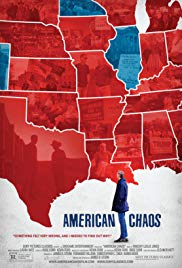
AMERICAN CHAOS (2018, doc)

September 13, 2018

 Greetings again from the darkness. Politics in the United States is an embarrassment to any citizen who is paying attention these days. And by “these days”, I’m referring to at least a couple of generations, if not even more. The bickering between and within political parties is more closely related to playground arguments than debates among statesmen. The most effective wall being built is the one between the two sides – it’s a wall that has little to do with reason or “the greater good”, and everything to do with standing steadfast in one’s belief that an opinion is a fact that should be shared by all. Enter stage and film producer Jim Stern … a self-described political junkie.

Mr. Stern grew up in a house of “Kennedy Democrats” and all but worships former President Barack Obama. He opens his film with clips of past Presidents, dating back to Theodore Roosevelt, and states his purpose as a desire to understand how so many Americans could vote for Donald Trump. It’s an admirable mission, and Mr. Stern is to be commended as one of the few extremists (on either side) willing to listen to what the other side is saying. It’s 9 weeks after the election, and Stern is in the audience for Obama’s farewell speech. He (Stern) has tears in his eyes, as the man he so admires is being replaced by one who inspires little faith or respect.

We now flashback to 6 months prior to the election. Stern paraphrases Atticus Finch from TO KILL A MOCKINGBIRD, and pledges to try and understand the other side by getting to know their point of view. His road trip takes him from Florida to Cleveland to West Virginia to Arizona. Stern’s approach is to present himself as a neutral interviewer so that folks don’t get defensive, and instead just open up about their views. He speaks to a man who is a legal immigrant from Cuba, a Midwest Pastor who is every bit as adamant in his beliefs as Stern is in his own, a conservative radio talk show host in Arizona who eloquently states her case, and folks in West Virginia who just want the coal mines back up and running so that they might escape poverty. One of the men he speaks with is part of the infamous Hatfields and McCoys feud, and he admits to voting for Obama twice – but is now convinced Trump is the best hope for rescuing the state’s economy.

Stern uses the ongoing campaign as the structure for his road trip and story, and doesn’t shy away from admitting Hillary Clinton’s “basket of deplorables” speech was a turning point … as was the last minute renewing of the FBI investigation into her actions. But since we know all of that, what is most fascinating here is listening to regular folks … voters … providing insight into their viewpoints. These mid-America citizens are tired of politicians being bought and sold. Trump was saying what these people were thinking – he was reaching out to (mostly white) disaffected voters. Stern is stunned at the ovation Trump receives at the Republican convention in Cleveland. He is surrounded by tens of thousands of Americans who don’t believe what he believes. It’s a powerful moment for him and the film.

“They hate her (Hillary) and they hate Obama too.” Stern is hit with the harsh reality that his idol is not idolized by all. His most accurate statement is that blue state voters and red state voters simply do not understand each other. With so many of one group clustered in California and the northeast, while the others are spread across the middle of the country, it’s really no surprise that these citizens have different views and needs. It’s also not surprising that since the “mainstream media” is equally clustered in those two geographic areas, that information distributed is skewed towards those views and issues. Abortion and gay rights appear to be non-factors in his discussions, while jobs, corruption and illegal immigration are what matter.

Again, Mr. Stern is to be commended for letting these citizens speak their mind. It’s a nice contrast to another high profile documentarian renowned for editing to prove his own well-publicized views. Stern’s brother was a key negotiator in the Paris Accord, so he certainly has a personal stake in the drastic political change. In fact, we often see his true emotions despite his ability to remain impartial to those speaking on camera. Election night with violin music is a bit too much, but for the most part, Jim Stern and Atticus Finch work together here to enlighten the “other” side.

watch the trailer:


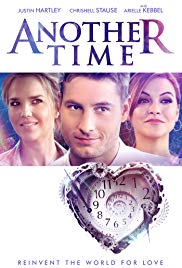
ANOTHER TIME (2018)

September 13, 2018

 Greetings again from the darkness. Dating back to H.G. Wells’ 1895 book and 1960 film THE TIME MACHINE, time travel has long been a favorite and familiar trope for filmmakers and writers. It’s been a central topic for comedies (BILL & TED’S EXCELLENT ADVENTURE, HOT TUB TIME MACHINE), science fiction (LOOPER, INTERSTELLAR), oddities (PLANET OF THE APES, DONNIE DARKO), adventures (BACK TO THE FUTURE, MIDNIGHT IN PARIS), and romance (SOMEWHERE IN TIME, ABOUT TIME).

Since time travel has crossed many genres, it only makes sense that a filmmaker looking to tackle the topic would understand something new must be brought to the party, if a new project can hope to have any appeal. Director/writer Thomas Hennessy and co-writer Scott Kennard attempt to blend romance with a dose of science and philosophy, but unfortunately, even as a low budge B-movie, it just comes across as a lackluster effort with a too-simple script. I’m not familiar with director Hennessy’s TV work on “Bugmashers” and “Ten for the Chairman”, but his background as a cinematographer should have at least resulted in a more visually impactful film.

Justin Hartley (“This is Us”) stars as Eric Lazifer, a successful Account Manager who saves his money, watches science shows on TV, and is easily “bored” by the married women who hit on him in bars. So, Eric is a fiscally conservative Brainiac who looks like a male model … clearly a rough way to go through life. Eric’s best bud Kal (James Kyson) serves as the comic relief, and is one of the few who bring some energy to their role. A recent company acquisition has Eric’s boss (Mark Valley) mandating he iron out the details with that firm’s leader Julia, played by Crishell Stause (Mr. Hartley’s real life wife).

It’s pretty easy to see where this is headed. Eric falls hard for Julia. However, she fails to swoon for his ice cream-philosophy-romance recipe since she is already engaged to a great guy. So Eric does what any guy would do … he tracks down disgraced Physics professor  Dr Joseph Goyer (Alan Pietruszewski) so that Eric can travel back in time to meet Julia before she connects with her fiancé. It’s a solid and logical plan with very little chance for something to go wrong (!). If the story was ever on track, it’s here that it really flies off the rails. Watching Eric assist the Physics expert with solving unsolvable equations is just a bit too much.

On the bright side, this segment allows Eric to meet a bartender named Ally, played by Arielle Kebbell. Ms. Kebbell definitely brings a welcome screen presence to this otherwise uninspired project. The soap opera look and feel likely relegate this one to the world of streaming, where, if it’s lucky, it might find some time travel obsessed viewers.

watch the trailer:


HAL (2018, doc)

September 6, 2018

Oak Cliff Film Festival 2018

 Greetings again from the darkness. There may never have been a director with a comparable streak of 6 films in terms of quality and variety as Hal Ashby delivered between 1971 and 1979. At least 4 of those films would be included on a list of my all-time favorites. Ashby was a maverick filmmaker during an era when filmmaking style and tone shifted, and he was at least partially responsible for some of that change. Amy Scott (fittingly trained as a film editor) chose to make Ashby the subject of her directorial debut, and we can only assume her admiration for his work and curiosity about his later career was her inspiration.

HAROLD AND MAUDE (1971), THE LAST DETAIL (1973), SHAMPOO (1975), BOUND FOR GLORY (1976), COMING HOME (Best director nomination, 1978), and BEING THERE (1979) are the films that comprise the aforementioned “streak”, and are also the projects that afforded Ashby the opportunity to work with such industry talents as writers Robert Towne, Jerzy Kosinski, and Waldo Salt; cinematographers Haskell Wexler, Michael Chapman, and Caleb Deschanel; and actors such as Ruth Gordon, Jack Nicholson, Warren Beatty, Lee Grant, Jon Voight, Jane Fonda, Shirley MacLaine, Melvyn Douglas, and Peter Sellers. All of these folks contributed to the edge in independent filmmaking that arose in the 70’s.

Director Scott works diligently to paint a full portrait of Ashby the man, so that we might better understand the odd career arc. A challenging early family life pushed him to grow up too fast, and with 5 marriages balanced by 5 divorces, it’s likely that Ashby was never destined to be a settled down family man. His drug addictions served to undermine what was already his difficult and demanding style on set, and his trademark look of long scraggily hair and unkempt beard ensured he was never mistaken for an industry insider.

Much of what we learn comes from the voice of Ashby himself, courtesy of audio tapes. Other insights and remembrances come from interviews with: Judd Apatow, Rosanna Arquette, Jeff Bridges, Beau Bridges, Lisa Cholodenko, Caleb Deschanel, Jane Fonda, Lou Gossett, Lee Grant, Dustin Hoffman, Alexander Payne, David O Russell, Cat Stevens, Jon Voight, and Haskell Wexler. We also hear from legendary director Norman Jewison, who gave Ashby his first job as film editor. Ashby later won an Oscar for Best Editor on Jewison’s IN THE HEAT OF THE NIGHT (1967) … and the clip shown of him accepting the award highlights a man who barely resembles the man we would come to recognize over the next few years.

We learn that his ever-present battle with studio executives likely led to his not getting the opportunity to direct TOOTSIE, and more importantly to me, we get an explanation of what happened to Ashby’s 8 MILLION WAYS TO DIE (1986) – a film I always thought was oh-so-close to being a great 80’s movie, but instead was a bit of a mess. And now we know why. There may not be a more revered and respected filmmaker and influencer of other filmmakers … certainly not one who is less discussed. Ashby’s BEING THERE ranks with the very best political satires of all-time (yes, even DR STRANGELOVE OR: HOW I LEARNED TO STOP WORRYING AND LOVE THE BOMB), and few could juggle comedy and drama any better. Hal Ashby died from cancer in 1988 at age 59. Was it his uncompromising manner or was it the effects of drugs that brought his career to a halt, and prevented him from achieving the blockbuster status of his peers Coppola, Scorsese, and Spielberg? We’d like to think it’s the age old ‘art vs. commerce’ argument, but that simply doesn’t hold up. Regardless, for a few years, no one did it better than Hal Ashby, and he did it his way.

watch the trailer: