THE PHOENICIAN SCHEME (2025)

June 11, 2025

Greetings again from the darkness. At this point it seems clear that Wes Anderson makes movies for himself and his devoted followers … and his loyal troupe of actors. I can’t think of another filmmaker whose movies are so instantly recognizable and consistently similar in look and feel. The pacing, verbal style, color palette, and overall rhythm of his latest compares favorably to some of his previous, including: ASTEROID CITY (2023), THE FRENCH DISPATCH (2021), THE GRAND BUDAPEST HOTEL (2014), and MOONRISE KINGDOM (2012). Rather than a criticism, that’s intended instead as a notice to viewers. If, like me, you’ve enjoyed his past films, you’ll likely take pleasure in this one.

Benecio Del Toro (one of the great faces in cinema) takes the lead here as wealthy businessman Zsa-zsa Korda, who inexplicably defies death about as often as most people brush their teeth. Due to his frequent near-death experiences and the risk involved in pursuit of his latest project, Korda names his daughter, Liesl (Mia Threapleton, daughter of Kate Winslet), a nun-in-training, as his sole heir and invites her to be part of the latest venture. The enterprise is exceedingly well-planned as evidenced by the labeled wardrobe boxes. Of course, the project is too convoluted for us to understand, but that matters little. It’s the globe-trotting and interactions with famous faces that raise the entertainment value.

‘Deadpan’ is today’s magic word – as it is in most Wes Anderson films. And if there is a secondary word of the day it would be ‘goofy’, because this undoubtedly falls on the light-hearted end on the Anderson scale. It’s filled with jokes, site gags, and purposefully oddball moments designed to elicit laughter (or at least enjoyment). The third of the lead triumvirate here is Michael Cera, who seems completely at ease – actually excelling in the Anderson world. He plays Bjorn, a character more complex than we are initially led to believe … although we don’t believe it, even initially.

Joining in the fun is an all-star line-up of actors other filmmakers only dream of casting. These include: Willem Dafoe, Scarlett Johansson, Rupert Friend, Richard Ayoade, Jeffrey Wright, Hope Davis, Benedict Cumberbatch, and Mathieu Amalric, each memorable in their segments. You won’t want to miss Tom Hanks and Bryan Cranston as brothers taking on the infinitely unskilled duo of Del Toro and Riz Ahmed (as a crowned Prince) in a game of basketball … and even that pales to the scene with Bill Murray as God.

Anderson co-wrote the script with frequent collaborator Roman Coppola and the score comes from 2-time Oscar winner Alexandre Desplat. Cinematographer Bruno Delbonnel perfectly captures the Anderson flavor in what I believe is their first time working together. What I find fascinating is that while watching the film, the characters and story struck me as a bit of a lark, yet some moments have come back around in my mind, and it seems quite clear that Anderson purposefully and slyly buried some life messages in this little comedy. What I’m saying is that the film works as a comedy, but also may carry a bit more heft that what I thought while watching. That falls under the definition of refined filmmaking.

WATCH THE TRAILER


NOSFERATU (2024)

December 24, 2024

Greetings again from the darkness. My first exposure to Count Orlok was in a film class at the University of Texas. We were shown a portion of director FW Murneau’s 1922 silent film, NOSFERATU: A SYMPHONY OF HORROR. I was mesmerized with the look of the film and especially with Max Schreck as Orlok. While growing up, I fawned over other vampire movies – Bela Lugosi, Lon Chaney Jr, Christopher Lee, and even Frank Langella – but I never again saw anything like Schreck’s Orlock. And yes, over the years, vampires have become frequent subjects of movies and even TV shows, and “Nosferatu”, based on the original Bram Stoker story from 1897 spawned NOSFERATU THE VAMPYRE (1979, directed by Werner Herzog, starring Klaus Kinski) and NOSFERATU (2023, directed by David Lee Fisher, starring Doug Jones). My anticipation soared when it was announced that the extraordinarily creative filmmaker Robert Eggers (THE WITCH, 2015; THE LIGHTHOUSE, 2109; THE NORTHMAN, 2022) would be basing his version on Henrik Galeen’s script from the 1922 original.
At its core, the story is a gothic tale of a woman haunted by the terrifying vampire obsessed with her. The “her” is Ellen Hutter played by Lily-Rose Depp (WOLF, 2021, and yes she’s Johnny Depp’s daughter). Ellen’s husband is Thomas Hutter played by Nicholas Hoult (familiar with the look of this genre via WARM BODIES, 2013, and RENFIELD, 2023). When Thomas’ job takes him out of town, friends Friedrich Harding (Aaron Taylor-Johnson) and Anna Harding (Emma Corrin, DEADPOOL & WOLVERINE, 2024) invite Ellen to stay with them. It turns out the work Thomas is assigned is a real estate transaction with a mysterious recluse named Count Orlok. You may have experienced a bad real estate deal in your life, but it’s nothing like this one.

When it becomes apparent that Ellen’s trauma is not merely nerves, but rather an evil spiritual presence, the expertise of Professor Albin Eberhart von Franz is sought in an attempt to gain some control. The professor is played by Willem Dafoe, who once portrayed the aforementioned Max Schreck in SHADOW OF A VAMPIRE (2000). Playing Count Orlok this time is Bill Skarsgard, who you likely recall was superb as Pennywise the Dancing Clown in IT (2017) and IT CHAPTER TWO (2019). Skarsgard’s actual features are undetectable here, and especially jarring is his voice that truly sounds from another world (supposedly months of training). His Orlok is a true and memorable presence.

Eggers’ film looks stunning and gorgeous and creepy. The opening sequence is fascinating and everything one could ask for in how a vampire horror movie appears on screen. He surrounded himself with previous collaborators: Director of Photography Jarin Blaschke, Production Designer Craig Lathrop, Costume Designer Linda Muir, Film Editor Louis Ford, and Composer Robin Carolan. It’s an excellent team and one that excels at every step. My only issue with the film comes down to the cast. Lily-Rose Depp has the perfect look for the character, yet her torment never quite works. Aaron Taylor-Johnson and (the usually stellar) Willem Dafoe both seem to be showboating as if attempting to stand out in a movie dominated by a fearsome creature. It pains me to say that the cast (other than Skarsgard) simply take away some of the impact that the film should have had. Despite this, the film is lyrical, mystifying, and absolutely glorious in its look.

Opens in theaters on December 25, 2024

WATCH THE TRAILER


SATURDAY NIGHT (2024)

November 13, 2024

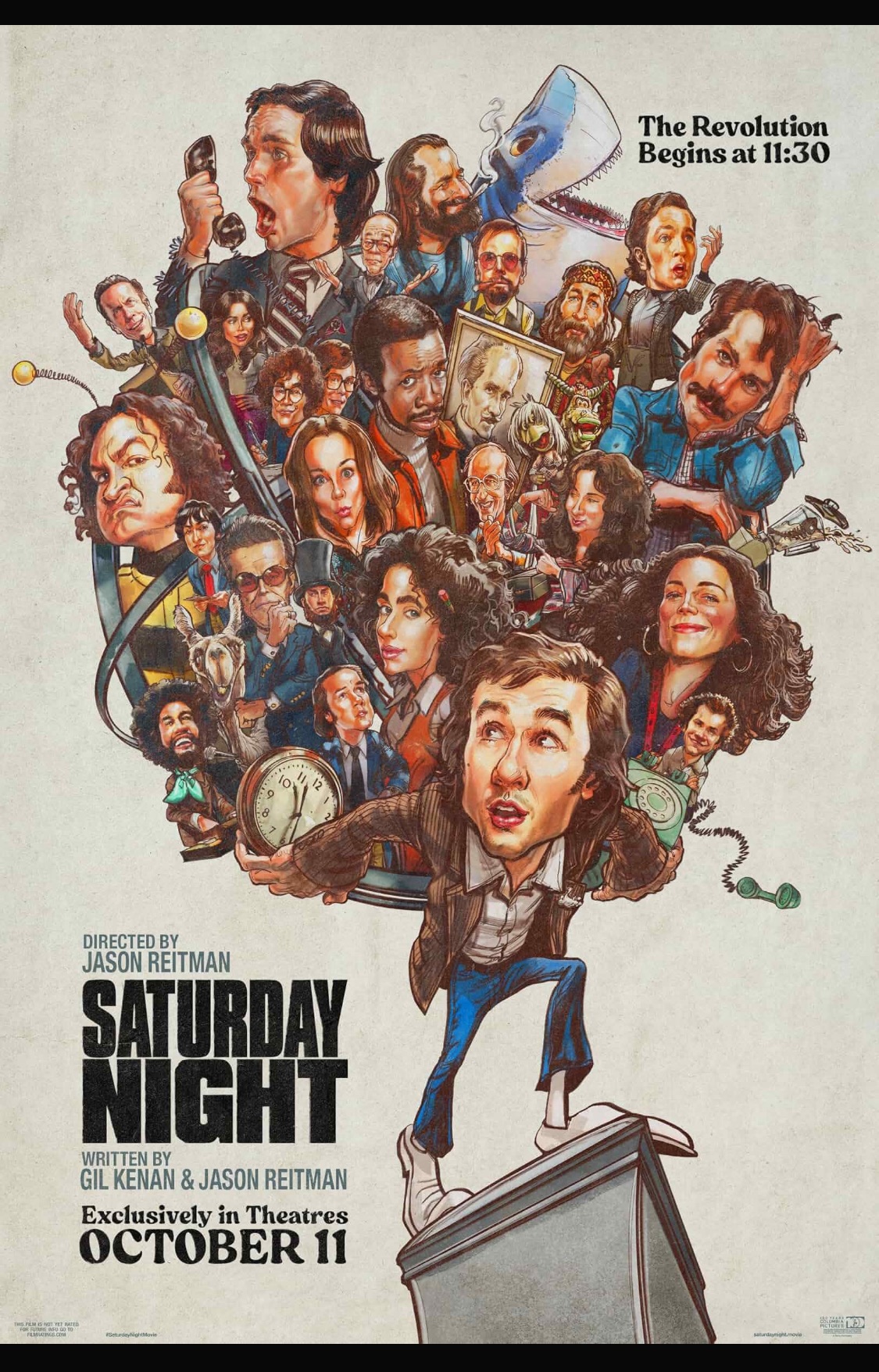
Greetings again from the darkness. For those of a certain age, October 11, 1975, changed television forever. Now celebrating it’s 50th anniversary season, “Saturday Night Live” (SNL was originally just ‘Saturday Night’) has been maligned and criticized so many times over the years, yet it persists in providing commentary and comedy when so many other shows have failed. No better choice exists to present the show’s origin story than writer-director Jason Reitman w-d (JUNO, UP IN THE AIR, THANK YOU FOR SMOKING, TULLY), who along with co-writer Gil Kenan, go extreme with the ‘origin’ by tracking the 90 minutes prior to the first show’s airing.

Thanks to a clock counting down to the 11:30pm showtime and a few periodic reminders, we are always aware of just how few minutes remain for showrunner Lorne Michaels (a terrific Gabriel LaBelle) to pull off this minor miracle. Backstage chaos barely scratches the surface of what Michaels is dealing with (in addition to his own anxiety). Network executives and censors, an out-of-control cast of truly ‘Not Ready for Prime Time Players’, a writer’s room in disarray, incomplete set assemblage, and more than double the material necessary to fill the allotted time are just some of the hurdles facing Michaels.

What we immediately notice is the fine job done in casting the cast: Cory Michael Smith captures Chevy Chase’s looks, ambition, ego, and talent; Dylan O’Brien nails Dan Aykroyd’s physicality and rapid-fire speech; Ella Hunt is underutilized as ultra-talented Gilda Radner; Emily Fairn is insecure Laraine Newman; Kim Matula shows Jane Curtin’s coolness; and Lamorne Morris plays up Garrett Morris’ realization of stereotyped characters. Perhaps the key to the show and this movie is Matt Wood’s portrayal of John Belushi, who initially rebels against the bee costume, refuses to sign his contract, and clearly is the most explosive and vital member of the cast.

 “What is the show?” Lorne Michaels fields that question a few times and fails to give a satisfactory answer … until just before showtime when he eloquently explains it and wins over NBC’s Dave Tebet (Willem Dafoe), the key network executive who was fully prepared to show a Johnny Carson rerun rather than risk embarrassment with the newbies. The frantic pace is unrelenting as a nervous Director of Programming Dick Ebersol (Cooper Hoffman, son of Phillip Seymour Hoffman) tags along wondering if his own career is going to crash and burn right along with Michael’s. Acting as a calming influence is Lorne’s (first) wife Rosie Shuster (Rachel Sennott), who brings serenity to those on the edge.

Revolution is difficult – especially with a bunch of twenty-something no-name actors. Bringing in ‘Mr. Television’ Milton Berle (Oscar winner JK Simmons) allows for further contrast with old comedy versus new, not to mention Berle’s most infamous appendage, which he doesn’t hesitate to flaunt. Others of note include Finn Wolfhard as an NBC page charged with filling the studio audience, a too-tall Nicholas Braun who plays both an out-of-place Jim Hensen and Andy Kaufman (complete with “Mighty Mouse” segment). Matthew Rhys plays coked-out host, George Carlin, and Nicholas Podany is a desperate for stage time upstart named Billy Crystal. Tommy Dewey plays head writer Michael O’Donaghue, and Jon Batiste performs as Billy Preston (while also writing the film’s score).

A couple of highlights include a sound check with Garrett Morris singing about what he’s going to do with his shotgun, Aykroyd as Fred Garver, and of course, Belushi whenever he’s on screen. Director Reitman includes numerous callbacks to sketches and characters … some of which require a sharp eye by viewers. Kudos to Jess Goncher for Production Design that recalls this hectic time, and to cinematographer and frequent Reitman collaborator, Eric Steelberg, for using the camera in sync with a time that was totally out of sync. Capturing an event of anti-establishment or counterculture rebellion is almost as impressive as what Lorne Michaels and the cast and crew pulled off that night (drugs and all).

On Digital November 12, 2024 and on Blu-ray January 7, 2025

WATCH THE TRAILER


POOR THINGS (2023)

December 6, 2023

Greetings again from the darkness. Greek filmmaker Yorgos Lanthimos is possibly the most divisive director working today. Movie goers tend to either love his films like THE FAVOURITE (2018), THE KILLING OF A SACRED DEER (2017), THE LOBSTER (2015), and DOGTOOTH (2009) or walk away baffled that any decent human being could enjoy such dark works of strangeness and oddity. Despite this, two of his films have received Oscar nominations, and this latest may be both his most accessible and most outrageous project yet. It’s also a rare outing where Lanthimos left the writing to others. His co-writer on THE FAVOURITE, Tony McNamara (“The Great”) has adapted the screenplay from the 1992 novel by renowned Scottish writer Alasdair Gray, whose tome was influenced by Mary Shelley’s “Frankenstein”.

Oscar winner Emma Stone delivers a truly remarkable (and physically demanding) performance as Bella Baxter. When we first meet Bella, she has the mind and coordination of a toddler in an adult woman’s body … the product of Dr. Godwin Baxter (you can call me God), played by Willem Dafoe. God is a surgeon-slash-mad scientist, his own scarred body the result of experiments conducted by his father. God is both doctor and monster. Although various animal blends (ducks, chickens, dogs, etc) roam the premises, it is Bella who is clearly God’s most treasured production. Her reanimation process and backstory are spelled out in the movie.

Bella develops daily, and when Godwin’s lawyer, Duncan Wedderbum (Mark Ruffalo) shows up to take care of some business, he is intrigued by Bella and offers to take her on an adventure … one that ultimately spans Lisbon to Paris, and a luxury cruise ship to a brothel. Duncan and Bella engage in “furious jumping” (her phrase for sex) and soon her libido is quite advanced, and her river of independence flows freely, turning Duncan into a whiny buffoon. This story, Bella’s story, is really about a woman finding her own way in a world where men try to control/manager her. It’s fascinating to see her hyper curiosity about the world and her surroundings. On top of that, Bella is often quite direct and unfiltered in her statements.

The humor here is frequent and unconventional as evidenced by Bella being described as “a beautiful retard”, and the stream of deadpan one-liners. Still, the message comes across loudly and clearly as we marvel at Bella and Emma Stone’s performance. I hesitate to use the word fearless (unless it’s Tom Cruise) since it’s just acting, but the word applies to Ms. Stone here. Supporting work comes from Christopher Abbott, Margaret Qualley, Ramy Yussef, Jarrod Carmichael, Hannah Schygulla, and Kathryn Hunter, while Mark Ruffalo revels in flashing his comedic chops.

Cinematographer Robbie Ryan interjects black and white for effect and makes good use of the fish-eye lens. Production Designers James Price and Shona Heath get creative with set pieces, especially the cruise ship and brothel, and Costume Designer Holly Waddington nearly steals the spotlight with Bella’s outfits, which are always a bit exaggerated. The music adds a specific element and works quite well, and there is a truly awesome dance scene. Yorgos Lanthimos again earns the title Master of Strangeness with this outlandish film with bits from Frankenstein, Bride of Frankenstein, and Young Frankenstein (a common thread). The film is somehow both extremely funny and severely disturbing, and is an example of good people trying to come to grips with the realization that people often do bad things. My only complaint is the film features what are possibly the worst closing credits ever.

Opening in theaters on December 8, 2023

WATCH THE TRAILER


INSIDE (2023)

March 16, 2023

Greetings again from the darkness. We’ve seen movies about isolation, and we’ve seen movies with survival stories. However, as best I can remember, this is the first survival story about a guy isolated and trapped in an ultra-luxury Manhattan penthouse apartment. Ben Hopkins wrote the screenplay from an idea of director Vasilis Katsoupis. The best idea was casting the always interesting Willem Dafoe in the lead (and almost the only role), while the worst idea was wedging in a forced statement on the one-percenters.

Mr. Dafoe plays Nemo, an art thief working with a never-seen/only heard walkie-talkie partner. After being air-dropped onto the balcony via helicopter, the first few minutes are a thing of beauty in a criminally precise way. Nemo swiftly navigates his way through the apartment gathering paintings by famed expressionist Egon Schiele, whose self-portrait is to be the gem of the haul. The first problem is that painting is nowhere to be found, and the second, much more serious problem occurs when Nemo is ready to leave and the security system malfunctions. This renders Nemo a prisoner, trapped like a rat.

This is the type of apartment that features a plunge pool in the living room, two massive aquariums, a steel-reinforced door, and an automatic indoor sprinkler system for the plants. Valuable art is professional displayed throughout. What it doesn’t have is an easy escape route. The sleek modernism of luxury slowly transforms into a cold, prison-like fortress. We watch as Nemo’s initial panic is slowly overtaken by a sinking feeling of despair. His partner’s final walkie-talkie words, “You’re on your own”, ring out as Nemo takes stock of his dire straits.

It’s an unusual security lockdown. There is no running water, phone line, or emergency escape, yet the HVAC seems to have a mind of its own by spontaneously shifting from desert-level heat to Arctic winter cold. And for some reason, there seem to be no security cameras inside this high-tech apartment, yet the TV periodically displays closed-circuit video from around the building. Those cameras give Nemo his only link to the outside world, and also help us understand how far he has drifted from reality … especially in regards to Jasmine, a cleaning lady he spots. He scavenges for food and water in some not-so-appealing ways, including some scraps inside a refrigerator that plays “Macarena” on full blast if the door is left open too long. Although we aren’t told exactly how many days this ordeal lasts, we get some idea from a certain pile shown.

Any movie that has us engaged enough for us to ask ourselves, “What would I do in this situation?” has something going for it, but it’s really Dafoe’s performance as a guy losing his grip that keeps us zoned in. Supposedly the owner of this apartment is away in Kazakhstan, and given the weak attempt towards the end to comment on the ultra-rich, we assume this detail is meant to prevent us from having too much sympathy for him. It appears the filmmaker believes we should take a morality lesson from a criminal (one who doesn’t carry a cell phone) who, as the narrator, tells us twice, “Cats die. Music fades. Art is for keeps.”

Opens in theaters on March 17, 2023

WATCH THE TRAILER


THE NORTHMAN (2022)

April 21, 2022

Greetings again from the darkness. After two incredible arthouse films that earned the label “visionary filmmaker” for Robert Eggers, some would not have been surprised to find him cashing in on a huge payday for the next colossal superhero movie. But for those of us who adore and respect him for THE WITCH (2015) and THE LIGHTHOUSE (2019), we knew Mr. Eggers was not the comic book type. Instead, he secured a hefty budget (still less than $100 million) and with his co-writer, Icelandic author Sjon (writer of last year’s mesmerizing LAMB), created the most epic Viking movie to date … while firmly maintaining his artsy stylings.

Every now and then a movie comes along and I must accept that my words will fall short; that I won’t be able to do justice to what I’ve experienced on screen. This is certainly one of those times. Based on the same Scandinavian folk tale that inspired Shakespeare to pen “Hamlet”, this Eggers film is not just meticulously researched, it also pulls us right in so that we slosh through the mud and muck. We shiver from the cold. We feel the wind and the brutality of the violence. We live the harsh elements of Viking life.

The film opens in the year 895 AD as young Prince Amleth welcomes home his battle-weary father, King Aurvandil (Ethan Hawke). Not long after jester Heimer the Fool (Willem Dafoe) jokes about the Queen and the King’s brother, the boy witnesses his uncle Fjolnir (Claes Bang, the excellent “Dracula” TV mini-series, 2020) strike dead the king. Amleth escapes, pledging to avenge his father’s murder and the kidnapping of his mother, Queen Gudrun (Oscar winner Nicole Kidman). Flash forward twenty years and Amleth has become a behemoth of a man played by Alexander Skarsgard (Eric Northman in “True Blood”), who lives, fights, and kills alongside violent 10th century Vikings. Amleth is a hulking beast unmatched in battle, yet one who never unnecessarily harms women or children.

His revenge plan leads him to the farming village where his mother and Uncle Fjolnir now live as wife and husband, an arrangement Amleth is certain she adheres to for her own safety and that of her new son. Bjork, in her first big screen role since DANCER IN THE DARK (2000), appears as the seeress who knows Amleth’s destiny. It’s here where Amleth meets Olga “of the Birch Forest” (Anya Taylor-Joy) and reveals his plan to her. Olga describes her supernatural abilities as breaking men’s minds in contrast to his breaking their bones. The two are quite the match.

Eggers stages a stunning final showdown with a naked sword fight atop a burning volcano to ensure we aren’t subjected to an ending that falls short. The visceral savagery on the screen is somehow both brutal and beautiful. This is epic cinematic brilliance from Eggers and cinematographer Jarin Blaschke, who treat us to numerous long takes in harsh weather and discomforting action. This is 136 minutes featuring some of cinemas best faces, while also proving that visionary is simply not a strong enough word to describe director Robert Eggers.

Opening in theaters on April 22, 2022

WATCH THE TRAILER


THE FRENCH DISPATCH (2021)

October 28, 2021

Greetings again from the darkness. Few things in the cinematic world are more instantly recognizable than a Wes Anderson movie. In fact, historically speaking, perhaps only Jacques Tati comes as close to having a signature style easily spotted by viewers (unless you want to count Tom Cruise sprinting or Julia Roberts cackling). This is Mr. Anderson’s 10th feature film in 25 years, and I now rate 5 of these very highly, though all 10 have a certain appeal. This latest, co-written by Anderson with frequent collaborators Roman Coppola, Hugo Guinness, and Jason Schwartzman, could be considered his most ambitious to date … and likely the most ‘Wes Anderson’ of all.
Billed as a love letter to journalists, it becomes crystal clear, that by this, Anderson means the esteemed stable of writers from the early days of “The New Yorker”. In fact, Anderson structures the film as if it were following the path of a magazine being published. We are informed upfront that this edition features “an obituary, a travel guide, and 3 feature articles”. An episodic format is not unusual for films, yet Anderson never does anything by the book. Each piece takes place in its own time period, and there appears to be little connection or crossover among key characters. Still, somehow he makes this work by ensuring each piece stands on its own and is filled with unusual characters and those patented, fabulous Anderson visuals.

The obituary is that of Arthur Howitzer Jr (a deadpan Bill Murray), the founder and publisher of “The French Dispatch” magazine, a spin-off from The Liberty Kansas Evening Sun … a move from a small town in Midwestern United States to a charming small town in France (hilariously and fittingly) named Ennui-sur-Blasé. Howitzer adores his writers, and the only guidance he offers them is, “Just try to make it sound like you wrote it that way on purpose”. He also has a “No Crying” sign posted in his office, likely as much as a reminder to himself as a rule for the staff.

Our travel guide section is fortunately quite brief since it involves Owen Wilson as a bicycle tour guide showing us around the town – the “Local Color”- of Ennui-sur-Blasé. This takes us to the first feature story, and the best of the lot. Tilda Swinton excels (doesn’t she always?) as a writer and art expert giving a colorful lecture entitled “The Concrete Masterpiece”. She tells the story of Moses Rosenthaler (Benecio del Toro), a genius modern artist serving a life sentence for murder, and as she lectures, we see it play out. While incarcerated, Moses continues to work and his muse is a prison guard named Simone, played exceptionally well by Lea Seydoux. Her nude posing for him leads to his signature modern art piece, which attracts the attention of an ambitious art dealer played by Adrien Brody.

“Revisions to a Manifesto” is the next feature, and it involves a young activist named Zeffirelli (Timothee Chalamet). He’s a chess expert, quite moody and has a questionable quest. He’s being covered by writer Lucinda Krementz (Frances McDormand), who is unable to maintain objectivity, and inserts herself right into the story, amongst other things. The segment pays tribute to the activism of the 1960’s and is filmed mostly in black and white.

The third feature, “The Private Dining Room of the Police Commissioner” involves writer Roebuck Wright (Jeffrey Wright) telling his story while a guest on Liev Schreiber’s Talk Show in the 1970’s. Roebuck is obviously inspired by James Baldwin, and he famously recalls every line he’s ever written. The story he recites involves a legendary chef played by Steve Park.

Actors mentioned so far are just the headliners, and Anderson has packed the film with his usual troupe, as well as dozens of others – some you’ll recognize, and some you won’t. There are at least seven Oscar winners involved: Christoph Waltz, Fisher Stevens, and Angelica Huston (as narrator), in addition to the aforementioned Swinton, McDormand, del Toro, and Brody. Numerous Oscar nominations and awards are included in the group of other familiar faces like Willem Dafoe, Saoirse Ronan, Edward Norton, Lois Smith, Henry Winkler Bob Balaban, Elisabeth Moss, and Mathieu Amalric.

Other frequent Anderson collaborators who deliver standout work include Production Designer Adam Stockhausen, Cinematographer Robert Yeoman, Editor Andrew Weisblum, and composer Alexandre Desplat. The film looks and sounds remarkable, and somehow it doesn’t feel like it’s moving fast – although we can barely keep pace. The film can be compared to ordering a flight at your local distillery. Each flavor is tasty, but they may not add up to a full drink.

Wes Anderson has delivered another stylish, fun film to watch, and one that is endlessly entertaining. It may not have as many moments of laughter as some of his previous films, yet there are still plenty of sight gags, insider references, and light-heartedness bathed in nostalgia – even if it’s not quite as whimsical. Shot in the French town of Angouleme, the visuals are as impressive as any you’ll find, serving up a collage of time, caricatures, color, and topics.

Opening nationwide in theaters on October 29, 2021

WATCH THE TRAILER


MOTHERLESS BROOKLYN (2019)

October 31, 2019

 Greetings again from the darkness. Gumshoe film noir from the 1940’s and 1950’s is probably my favorite genre after suspense thrillers. Classics like THE MALTESE FALCON, KISS ME DEADLY, A LONELY PLACE, LAURA, and DOUBLE INDEMNITY draw me in with style, mood, and character flaws. Tough guys and clever women combined with secrets, empty clues, and false bunny trails can mesmerize me for hours. Evidently Edward Norton shares my affection for this genre, as he purposefully shifted the time frame of Jonathan Lethem’s novel from 1999 to 1957 for the big screen adaptation.

Norton dons 4 hats for his passion project that’s been brewing for almost a decade. He writes, directs (his second time at the helm), produces, and stars as Lionel Essog, the assistant to Private Investigator Frank Minna (played by Bruce Willis). Lionel, often referred to as “Brooklyn” or “Freak Show” suffers from Tourette’s syndrome, causing him many uncomfortable moments of awkward verbal outbursts and physical tics, while also blessing him with a photographic memory and world class attention to detail. The concern here was that Norton the actor would turn the character into a gumshoe “Rain Man”, but that never happens, as his affliction rarely overshadows a scene or the story.

One of the first things we notice is that the film looks beautiful. The costumes (Amy Roth) and set design (Beth Mickle, Kara Zeigon) and cinematography (2-time Oscar nominee Dick Pope) are all spot on and top notch. The classic cars are especially impressive, despite my pet peeve of each being perfectly washed and waxed in every scene. Daniel Pemberton’s retro score perfectly captures the neo-noir moments.

This era in New York included jazz clubs, corrupt politicians and power struggles for profiteering from the growth. Norton’s film delivers The King’s Rooster jazz club with the great Michael Kenneth Williams as the featured trumpet player … he looks like a natural on stage in the smoky club. We also, of course, have plenty of big time corruption and scheming. The main culprit being City Planner Moses Randolph, the epitome of corruption and racism. Alec Baldwin could play this role in his sleep, and he performs admirably in the not-so-subtle riff on the real life Robert Moses.

The film’s opening sequence leaves Lionel committed to solving the murder of Minna, his mentor and (only) friend. His co-workers played by Dallas Roberts, Bobby Cannavale, and Ethan Suplee come in and out of the story, contributing very little. Things are most interesting when Lionel crosses paths with brilliant city engineer Paul (Willem Dafoe in a less salty role than in THE LIGHTHOUSE) and activist Laura Rose (Gugu Mbatha-Raw), in a role that would have benefitted from some beefing up in the script. Other supporting roles are filled by Leslie Mann, Fisher Stevens, Cherry Jones, and Josh Pais.

The story follows a path not dissimilar to the all-time classic CHINATOWN, and it’s in that comparison where the weaknesses in Norton’s film are most evident. The dialogue never quite clicks like it should, and at times it comes across like the actors are simply playing dress up 1950’s-style, rather than actually experiencing the struggles of the story. Everything just seems too ‘clean’ for this genre, even the moments of violence. It’s the details that make the difference in this genre, and even Norton’s voiceover is mishandled. As narrator, his voice is low and gruff which is customary for noir; however, while in character, the voice is high-pitched and sporadic. Both voices are as they should be, but since it’s the same character, the contrast takes us out of the moment when the narrator chimes in. The Tourette’s Association of America gave its stamp of approval to the film, and we do walk away with sage advice: “Never lie to a woman who is smarter than you.”

watch the trailer:


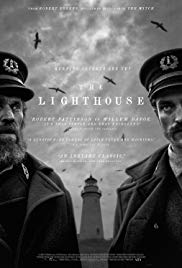
THE LIGHTHOUSE (2019)

October 17, 2019

 Greetings again from the darkness. The opening sequence plays like something from 1920’s era cinema. The chug-chug-chug of a boat slamming against the waves of an angry sea while birds flap and chirp alongside. We hear the wind and “feel” the severe ocean spray. Several minutes elapse before any word is spoken. Immediately noticeable is the nearly square aspect ratio … the rarely (these days) seen 1.19:1 frame, making the black and white images appear both surreal and ominous.

All of the above makes perfect sense when we realize this is writer-director Robert Eggers’ first feature film since his 2015 indie horror gem THE WITCH won dozens of festival awards. Mr. Eggers obviously has his own vision for projects, and his approach borders on experimental, eschewing conventional. He co-wrote this script with his brother Max, and evidently much was drawn from the actual journals of lighthouse keepers … something that is evident in the vocabulary and the effects of solitude.

4-time Oscar nominee Willem Dafoe stars alongside Robert Pattinson as the two men charged with a 4 week assignment of tending to a lighthouse. The film is set in 1890, and Dafoe plays Thomas Wake, the epitome of a salty old sea dog, replete with bad leg, hardcore Atlantic accent, and upside down pipe. Pattinson is Ephraim Winslow, the assistant Wickie, who faces non-stop demands from Wake, and initially maintains a quietness as he goes about his duties … what Wake calls the ‘doldrums.’ We learn little about either man’s past. For Wake, other than knowing his previous assistant went mad, the clue is when he mentions “13 Christmases spent at sea” costing him a family. For Ephraim, when Wake asks, “Tell me what’s a timberman want with being a Wickie?” we get some insight into Ephraim’s desired future.

Eggers has delivered the anti-buddy movie. It’s a bleak, slow-motion race to insanity caused by being isolated with only one other person … a person you aren’t fond of. Only this is not a director or a film content with showing two men stuck on a storm-battered rock, as they slip towards insanity. No, we viewers are forced to experience some of these same feelings – how much of what we see is actually happening? It’s mesmerizing and hypnotic, and the above-mentioned narrow screen aspect purposefully emphasizes the sense of confinement and claustrophobia.

With no color and only a couple of characters … OK, 3 if you count the mermaid …OK, 4 if you count the seagull … the film still manages to pound us with sensory overload. We can barely process all we are seeing, despite relatively minimal ‘typical’ action. The black and white images are mostly just various shades of gray, and sunshine is non-existent.  Cinematographer Jarin Blaschke (THE WITCH) embraces the dreariness by allowing the fog, lanterns, candles, wind, rain, and harsh elements to become characters unto themselves. However, nothing is in sync with our two leads. Composer Mark Korven fills the many lapses in dialogue with sounds and tones we haven’t heard before, yet they fit perfectly here. This is also quite likely the first film to utilize farts and foghorns in harmony.

Director Eggers filmed this on Cape Forchu in Nova Scotia, and the extreme weather and less-than-welcoming terrain create quite the visuals – as do the faces of our two lead actors. Dafoe may never have chewed scenery so delightfully as he does here, and Pattinson starts slowly before delivering his best work – including a ferocious rant that is fascinating to watch and contrast to his character’s first meal with Dafoe. Is this a horror film? A fantasy? Macabre comedy? There is simply no way to describe this other than bizarre. It’s truly miserable cinema, and I loved every minute of it.

watch the trailer:


AQUAMAN (2018)

December 13, 2018

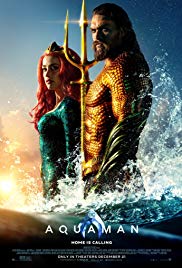
 Greetings again from the darkness. Were the TV series “Entourage” still on the air, they would now need a new recurring punchline. The AQUAMAN movie is real! At the helm, we are surprised to find the master of horror, James Wan, in the director’s seat. Mr. Wan is known for such genre flicks as SAW, INSIDIOUS, and THE CONJURING, and his talent for visuals transfers well to the comic book style. In fact, with a run time of almost 2 ½ hours, the visual effects are both exhilarating and exhausting.

Sure, we’ve seen short bursts of Jason Momoa as Aquaman in a couple of previous DC movies, but this time he owns the pool. Momoa plays Arthur Curry as a hunky beer-chugging rock and roll party dude who just happens to talk to fish and breathe underwater.  Since it’s the first Aquaman movie, writers David Leslie Johnson-McGoldrick (ORPHAN) and Will Beall (GANGSTER SQUAD) provide us the backstory.

On the coast of Maine in 1985, a lighthouse attendant named Tom Curry (played by Temuera Morrison) discovers Princess Atlanna (Nicole Kidman) washed ashore. What follows is a whirlwind romance, the birth of their son Arthur, Nicole snacking on a goldfish, as well as her first kick-ass action fight scene. To protect her son, she agrees to head back to Atlantis where she faces the consequences of birthing a half-breed with a landlubber.

When we first see a grown Arthur – with a classic hair flip – he is thwarting the hijacking of a Russian submarine by Black Manta (Yahya Abdul-Mateen II) and his father (Michael Beach, IF BEALE STREET COULD TALK). Manta is one of the two main villains – the other being Orm (Patrick Wilson), Arthur’s war-mongering, power-thirsty half-brother. Sharing a common enemy, Orm enlists Manta and provides a highly-advanced weapon that, for some unfathomable reason, Manta begins (via montage) to ‘Iron-Man’ it to another level – one much less stable. It’s Orm who gets much more screen time as he plots a massive attack on surface dwellers (humans) who have been destroying the sea for years. You didn’t think Hollywood would miss a chance to tell us how despicable we are, did you?

The basic story is that Orm must defeat Aquaman to claim the throne and become Master of the Sea. Of course, Arthur is reluctant to get involved and only does so at the urging of his old mentor Vulko (Willem Dafoe) and Mera (Amber Heard), both of whom wish to avoid a war with humans. The first battle of the would-be kings takes place in The Ring of Fire, a royal battleground missing only the accompaniment of Johnny Cash. The duel ends prematurely, so that an epic battle can later serve as the film’s epic climax.

Although director Wan may throw a bit too much ‘plot’ and action at the proverbial wall, it is interesting to note the history/mythology associated with Atlantis, the ruling class, and the missing trident. The legends are fascinating and the journey takes us to all ends (and depths) of the globe … from the deepest seas to the middle of the Sahara Desert (itself once a sea) to the incredible core of the Earth. We see the ancient ruins, as well as the high-tech futurama Atlantis … and it’s all stunning to watch.

Don’t tell Marvel, but the film is somewhat a blend of BLACK PANTHER and THOR, and Momoa is every bit the Aquaman that Chris Hemsworth is Thor (quite a compliment). Yes, we find out that Atlantis, like our dry land world, is burdened with politics and power-hungry types, but the underwater world and the visual effects keep us mesmerized. We see terrific dragon-like sea horses, a drumming octopus, and a Kraken-like creature supposedly voiced by Julie Andrews (fact or fiction?). There is an early sequence that takes swimming with dolphins to a level you didn’t experience on your vacation, and the lighting effects at times recall TRON and can be a bit disorienting.

This is probably the largest scale DC movie to date, and director Wan chooses to make a splash with every element – character, mythology, setting, and effects. We also get appearances from Dolph Lundgren as King Nereus and Randall Park as a TV talking head/oceanographer making the case that Atlantis is real and a threat. We even get Roy Orbison singing “She’s a Mystery to Me”, and the IMAX aspect ratio makes the first ever over-the-top underwater spectacle. And what a spectacle it is.

watch the trailer: