Greetings again from the darkness. Is there such thing as an ordinary life? If so, what does it look like? Writer-director Clint Bentley and co-writer Greg Kwedar have collaborated twice before – first on the underrated JOCKEY (2021), and then on SING SING (2023), the latter of which they received Oscar nominations for writing. For this latest, they have adapted the late Denis Johnson’s 2011 novella for the big screen, and the result is one of the most soulful films we’ve seen.
The story follows Robert Grainier, and evolves into a character study running cradle to grave. After a rough childhood, though not one necessarily unusual for the late 1800’s, the adult Robert is portrayed by Joel Edgerton (a career best performance). Robert is a quiet man who works as a logger. We see him on crews that clear forests, build bridges, and lay railroads for a country that is rapidly developing. His jobs during logging season take him away from home for extended periods of time. This is never an issue until he meets Gladys (Felicity Jones). These two fall deeply in love and are clearly soul mates. A terrific scene finds the giddy and hopeful couple laying rocks on a riverbank to map out the foundation of the log cabin home they are to build. The two in love become three when baby Kate arrives. Robert’s extended time away from home becomes more challenging, yet he manages since he now has a reason to return.
Although Robert rarely speaks while on jobs, narrator Will Patton and the individual scenes tell us much about him and the interesting folks he works alongside. William H Macy plays Arn Peeples, an old-timer who is not only the dynamite expert, he’s also the on-site philosopher (acting as a life mentor to Robert). Other standout supporting characters include Clifton Collins Jr as an unfortunate soul, Paul Schneider as a bad luck apostle, John Diel as one who teaches us the importance of boots nailed to a tree, and Kerry Condon as a forester who shares a sense of loss with Robert. It’s Robert’s loss that becomes the heart of the story and sticks with him for the balance of his years.
Tragedy turns Robert into a hermit, a heartbroken hermit. His titular dreams sometimes have a hallucinogenic feel as they come in flashes. Some of this revolves around his regret for not doing more to stop the mistreatment of a Chinese man, Fu Shang (Alfred Hsing) on the railroad crew. He’s haunted by that event. Of course, Robert’s other dreams take him back to childhood or recall Gladys and Kate. When it seems that Robert can’t sink any lower, a local Native American store owner named Ignatius Jack (Nathaniel Arcand) selflessly offers support, kindness, and friendship. The sequence reminds us of the humanity that exists in all of us … and that there’s a fine line between offering kindness and needing it.
This beautiful film will undoubtedly remind many of the works of Terrence Malick, mostly thanks to the connection between life and nature. One of the messages conveyed is that the deeper one loves, the more painful loneliness can be when it arrives. Life and death make up the cycle as evidenced by majestic trees being cut down to build houses and bridges. Kerry Condon’s character has the film’s best line, “The dead tree is as important as the living one.” Beauty and harsh reality are as connected as art and tragedy. Cinematographer Adolpho Veloso uses creative framing throughout the film, while composer Bryce Dessner perfectly captures the essence – with an assist from Nick Cave’s song, “Train Dreams”. For those seeking emotional depth and philosophical meanderings, this film from Clint Bentley is tough to beat. And if that’s not your thing, just enjoy the beauty of nature.
Greetings again from the darkness. It’s always disappointing when a book is so interesting and enjoyable to read, only to be followed up by a movie version that doesn’t live up to the source material. My son recommended the 2013 best-selling non-fiction novel from Daniel James Brown, and it was truly fascinating to read such an inspirational story around the 1936 Olympics in Berlin. Of course, we all know the Jesse Owens story, yet somehow the remarkable and unlikely tale of the University of Washington crew team never received the publicity it earned. Director George Clooney (GOOD NIGHT AND GOOD LUCK, 2015) and screenwriter Mark L Smith (THE REVENANT, 2015) have attempted to reach a wider audience by adapting Brown’s book for the big screen.
The story begins in Seattle during the Great Depression. Engineering student Joe Rantz (an excellent Callum Turner, EMMA., 2020) is behind on his tuition and has had no luck securing work. We learn Joe has been on his own for years, and has remained focused on his education despite living in such poverty that he frequently goes without meals and uses folded newspapers to keep dirt and moisture out of the hole in his shoe sole. His buddy Roger (Sam Strike) informs him of crew tryouts, and a spot on the JV team comes with a job and stipend. No-nonsense coach Al Ulbrickson (Joel Edgerton) isn’t much for motivational speeches and lets the rookies know most won’t survive the training to claim one of the eight seats on the boat.
Contradictory arguments can be made that director Clooney either took on too much of the story, or not enough. The result is a middling movie about an incredibly inspirational story of underdogs reaching the highest levels of achievement. Included here are only brief glimpses of the personal life of Coach Ulbrickson and his pertinent past, the motivation and wisdom of boat maker George Pocock (screen vet Peter Guiness), and the blossoming romance between Joe and Joyce (up and coming Hadley Robinson, LITTLE WOMEN, 2019). However, the biggest gap here is the connection and camaraderie between Joe and his teammates. The importance of working together “as one” is preached, but we aren’t privy to how this happened so quickly. Skimming over this is the film’s major flaw, as that bond is the key to their growth and success. By the end of the film, most will only recall Joe’s name and two or three other faces on the team.
The racing scenes on the water were surely challenging to film, and come across as realistic, even though we know these are actors and not world class athletes. The rich versus poor element is touched on, as are the politics which, yes, even existed in sports 90 years ago. Initially it’s the newcomers against legendary coach Ky Ebright (Glenn Wrage) and his favored team from Cal, and then it becomes the blue-collar Washington boys against the Ivy League elites … before heading to Berlin. The Olympics give us swastikas, a cheesy meet between the boys and Jessie Owens, and Daniel Philpott reprising his portrayal as Hitler from “The Crown”, only with more outlandish mannerisms.
The radio broadcasts provide a nostalgic look of how challenging it was to keep up with things during the era, and the newsreels are another nice touch. For those who have never been part of a crew, the term coxswain is likely a new one, and Clooney includes actual photos of the team over the closing credits. The memorable quote is “We were never eight, we were one”, but for some reason director Clooney thought it a good idea to have a lame framing device set in more modern times around this historic tale. Somehow, we don’t feel the adrenaline rush we should during this movie as it falls short of Oscar winner CHARIOTS OF FIRE (1981), perhaps the film that Clooney was attempting to mimic.
Opening in theaters nationwide on December 25, 2023
Greetings again from the darkness. The word of the day is “awkward.” Every character, every situation, every moment, and every conversation in this film can be described with that word. An attempt will be made to not overuse that adjective here, but yours truly offers no guarantees. Paul Schrader has had a long and impressive career as both writer and director. His early successes include screenplays for TAXI DRIVER (1976), ROLLING THUNDER (1977), RAGING BULL (1980), and THE LAST TEMPTATION OF CHRIST (1988), as well as directing AMERICAN GIGOLO (1980) and AFFLICTION (1997). The past few years have been a bit of a resurgence for Schrader with the excellent FIRST REFORMED (2018) and THE CARD COUNTER (2021).
In his latest, Schrader gives us Narvel Roth, an expert horticulturalist played by Joel Edgerton. Narvel is responsible for the massive gardens on the estate of wealthy dowager Norma Haverhill (Sigourney Weaver). Narvel’s daily rituals are carried forth with his meticulous approach, including daily journaling in his sparse living quarters located on the grounds of the estate. As narrator, Narvel tells us, “a change will come in its due time”, and though he’s speaking of the garden, we understand the words also apply to him. Soon enough, we learn that this current lifestyle represents a significant change from his past, and it’s clear another is brewing.
The relationship between Narvel and Ms. Haverhill is quite unorthodox, and yes, awkward (she has nicknamed him ‘Sweet Pea’). She is filled with entitlement and thrives on her power over others, not hesitating to use Narvel for more than his gardening skills. In fact, his past likely provides quite an enticement for her. Ms. Haverhill soon charges Narvel with taking her estranged and off-track great-niece Maya (Quintessa Swindell, BLACK ADAM, 2022) under his wing and teaching her the profession of gardening. This creates the second and third of the three relationships at play in the film. Narvel and Maya hit it off, as her intelligence and work ethic win him over. However, things aren’t as smooth between Maya and Ms. Haverhill. Their first chat, though long delayed, epitomizes the awkwardness prevalent throughout the film.
Adding complexity to the story is Maya’s personal life which brings a couple of drug dealers to the forefront. It’s this development that uncovers the past Narvel has worked so hard to cover up. After a meeting with his Witness Protection contact (Esai Morales), Narvel begins his process of ‘saving’ Maya … a clear attempt at redemption from his past life, and this is where her being bi-racial is a significant plot point.
The first two acts offer an unconventional form of entertainment. Edgerton nails the Narvel role with his Steven Wright delivery, slicked back hair, SLING BLADE wardrobe, and fastidious procession through the day. Even his posture and stride change along with his character’s shifting outlook. The three relationships between the tormented characters weave quite the web, and as secrets are exposed, the dynamics of these relationships change as well. Schrader includes a few cringy lines of dialogue (perhaps by design?), and the drug dealers seem purposefully cartoonish, rather than intimidating or menacing. There are call-backs to earlier Schrader works, as it seems many of his characters over the years have battled personal demons, yet this one does offer a glimmer of optimism, which could be considered a step forward … even if it’s a bit awkward.
Greetings again from the darkness. It is 2018 and a group of boys have just finished soccer practice. After some motivational words from their coach, the boys start joking around with one of their teammates who has a birthday party slated for later that day. Boys being boys, they decide to bike over the local cave for some pre-party exploring. Their coach tags along to keep an eye on them. All of that sounds innocent enough until we realize this is the Tham Luang cave, and they don’t realize Thailand’s monsoon season is about to arrive early and with full force.
The film is directed by Oscar winner Ron Howard, who is adept at mainstream storytelling as evidenced by APOLLO 13 (1994), A BEAUTIFUL MIND (2001), and CINDERELLA MAN (2005). The script was penned by William Nicholson (GLADIATOR, 2000) and Don MacPherson (THE AVENGERS, 1998), and tells the all-too-true story of the daring rescue mission that most of recall following on news reports. When the boys were no-shows for the birthday party, parents and friends rushed to the cave to find the bicycles, but not the 12 boys and their coach. Immediately, rescue efforts began with Thai Navy SEALS rushing to the sight. Cave diving is a unique skill practiced by only a few, and is much different than the open water diving in which the SEALS excel.
British cave divers John Volanthen (Colin Farrell) and Rick Stanton (Viggo Mortensen) are called in. Volanthen is the father of a son, and can’t help but empathize with what the parents must be going through, while Stanton is crusty old geezer who admits to not liking kids, while also understanding he’s one of the few on earth capable of making the necessary dive. Once the two men reach the stranded boys and coach, it becomes apparent that, as difficult and challenging it was to find the group, getting them out of the cave seems all but impossible. Death hung heavy over the operation of last resort, which included calling in Dr. Harry Harris (Joel Edgerton), a cave diving hobbyist, and more importantly, an anesthetist.
The diving scenes are expertly filmed by DP Sayombhu Mukdeeprom and underwater camera operator Tyrone Canning. The ever-present claustrophobia and risk of disaster underscores how courageous these men were. Director Howard offers up multiple perspectives: the government, the military, the divers, and the parents. We get very little from those trapped, but that adds to the tension. We get a feel for the entire operation as water is being pumped out of the cave, a water expert and volunteers frantically divert new rainwater into the rice fields, and political maneuvering occurs as the outgoing Governor (Sahajak Boonthankakit) is being set up as fall guy in case the efforts fail.
So many elements could have caused failure – low oxygen levels in the cave, a brisk current of water making diving more difficult, and obviously too much rainwater entering the cave would endanger the boys and the divers. The rescue mission lasted more than two weeks. It’s a disaster movie based on a real event, and follows up the excellent 2021 documentary, THE RESCUE. Evidently the dramatization is for those who don’t watch or have access to documentaries, and as strong as Howard’s movie is, there is simply no way for it to eclipse the documentary or what occurred in real time. At its best, the film offers tension and a reminder of what can be accomplished with collaboration.
Greetings again from the darkness. If you are at all inclined to see this movie, then I would encourage you to do so … and brace yourself for a surreal and mystical treat unlike any other medieval tale previously adapted for the big screen. Writer-director David Lowery re-teams with A24, the studio that also distributed his critically-acclaimed 2017 film, A GHOST STORY, to deliver a trip for your senses based on the tale of Sir Gawain – a tale that’s been told in various and often contradictory ways over many years.
Dev Patel (LION, 2016) stars as Gawain, the nephew of an ailing King Arthur (Sean Harris, MISSION: IMPOSSIBLE – FALLOUT, 2018) and Guinevere (Kate Dickie, THE WITCH, 2015). When not imbibing with his friends, shaggy Gawain spends his time in the throes of intimacy with his paramour, Essel (Oscar winner Alicia Vikander sporting a pixie do). Young Gawain feels unworthy when he’s amongst the knights and dreams of becoming an important man, so that he too may regale the King with his tales of adventure.
Gawain’s mother (Sarita Choudhury), in an attempt to facilitate her son’s dreams, uses her witchcraft to conjure up his first opportunity for greatness … and the film’s first visually stunning moment. We are mesmerized as The Green Knight (Ralph Ineson, THE WITCH, 2015) makes his entrance riding a great steed into the room where the Knights are gathered at their Round Table. The Green Knight, best described as a giant Groot (from GUARDIANS OF THE GALAXY), puts forth a challenge that only Gawain is willing to take up. The scene is stunning and memorable, and allows Gawain one year of celebrity before the second part of the challenge must be faced.
It’s at this point where Gawain sets off on his journey … one that can be likened to Homer’s “The Odyssey”, in that it’s filled with surprises and obstacles that defy logic and explanation. The surprises include: Barry Keoghan (DUNKIRK, 2017) as a garrulous, yet deceitful forest scavenger; the ghost of St Winifred (Erin Kellyman) requesting help locating her skull in the swamp; scantily-clad (CGI) bald-headed giants slowly roaming the forest; and a Lord (Joel Edgerton) and his mistress who offer shelter and advice that may or may not be helpful. Also on his journey to meet back up with The Green Knight, Gawain is accompanied by a red fox that holds his own surprises.
Director Lowery’s film is a surreal, hypnotic medieval becoming-a-man tale that is both epic and intimate. There is much to unwrap here, including the witches who clearly establish women’s control of men, and the idea that some may view themselves as destined for greatness, but blink when the moment of truth arrives. We do get a glimpse of Excalibur, and Lowery’s frequent collaborator Daniel Hart’s excellent score expertly blends with the infusion of metal music. The film requires the heightened use of your senses, and the fascinating work of cinematographer Andrew DrozPalermo keeps us zoned in on each character and every scene.
Greetings again from the darkness. It has taken two movies this year, THE MISEDUCATION OF CAMERON POST and this one from writer-director-producer-actor Joel Edgerton, and I finally understand that the practice of conversion therapy (treatment designed to change a person’s orientation to heterosexual from something else) is real … and it’s widespread … and it’s cruel … and it’s absurd. I’ll readily admit that my little life bubble has previously protected me from knowing much about the world of conversion.
Lucas Hedges has quickly developed into a dependable dramatic actor with his moving performances in such films as MANCHESTER BY THE SEA, LADY BIRD, and MID90S. Here he stars as Jared Eamons, a college aged young man struggling with the inner turmoil that accompanies being a gay man raised by a Pastor-dad in the heart of the Bible belt. Since the film is based on the memoir of Garrard Conley, we can assume much of what we see and hear has been seen and heard by Mr. Conley in his life.
Jared’s parents are played by Nicole Kidman and Russell Crowe, and while the parental actions of their characters may confound us, both deliver strong performances. One especially impactful scene allows Ms. Kidman to show what sets her apart … it occurs in her scene at a table with Hedges when momma finally takes control. Director Edgerton appears as Victor Sykes, the director and “therapist” at Love In Action, the refuge program where Jared’s parents send him.
Over the opening credits we get childhood clips showing Jared was a “normal” little boy being raised in a loving household. Flash forward to his awkward date with a girlfriend who asks him “what’s wrong?”. Later, after being sexually assaulted by a college buddy, Jared comes out to his parents. His time in Sykes’ program is filled with unimaginable steps. A Genogram is to be completed, listing all of the personal problems and “dangerous” traits of relatives on the family tree – the point is to isolate the source of sin. One boy is beaten with bibles by his family in an effort to drive out the demons of homosexuality (nope, that’s not a joke). There is also a macho counselor (played by Flea of Red Hot Chili Peppers) who gives inspiring manly talks and teaches how to look, act, and stand like a real man. It’s all so pathetic and tragic.
Rather than focus on Jared and the others in the program, much of the time is spent with his parents and why/how they could make the decision to enter him into conversion therapy. Jared’s dad tells him he won’t be loved by God … a message also delivered by Sykes. When Jared’s mom (Kidman) states “our family is so normal”, we aren’t sure whether she believes it, or wishes it so – although she leaves no doubt how she pictures a normal family. Of course, it’s really Jared’s dad (Crowe) who takes the news as a personal affront to his manhood and religious beliefs … beliefs somehow more important than his own son.
Support work is provided by Joe Alwyn, Cherry Jones (as a doctor, and the only reasonable adult), Frank Hoyt Taylor, Britton Sear, and Jess LeTourette. Filmmaker Xavier Dolan (MOMMY, 2014) also has a role as Jon, one of those in the program. The music is provided by Danny Bensi and Saunder Jurrianns, and for the most part, director Edgerton stays consistent with his focus on characters – though his frequent use of slo-motion loses impact with each successive use. The film avoids any cheap sentimentality or emotional gut-punches, instead focusing on the daily dealings. Perhaps it’s meant to appeal to parents in this situation – those parents who are confused and misguided. We see this film more than we feel it, although I often found myself looking at these parents and asking, ‘what’s wrong with these people?’ When the film ends by telling us 36 states allow for conversion therapy, we quickly realize Jared’s parents may be more ‘normal’ than we thought (incredible as it seems).
Greetings again from the darkness. In a perfect cinematic world, great acting elevates a terrific script. However, the best case scenario for a weak script, or in this case a messy one, is that it can be offset by acting. Fortunately for director Nash Edgerton (it’s been 10 years since his underappreciated THE SQUARE), he has assembled such a quality cast that what amounts to little more than organized chaos is mostly watchable – even if it’s not consistently entertaining.
The cast is loaded with international talent from Australia, England, South Africa and Latin America. David Oyelowo, far removed from his Martin Luther King role in SELMA, stars as Harold/Harry, a Nigerian immigrant just trying to do his job and live his life according the morals and work ethic instilled by his father. Harold is the trusting type who believes that his free-spending wife is faithful and that his boss is his friend. That boss is Richard Rusk (we should call him Dick) played by Joel Edgerton (the director’s brother), and together with Charlize Theron as his Executive VP Elaine, combine to exemplify modern day douche-baggery.
The story revolves around the formula for a medicinal marijuana pill that their company is making, and the secretive proposed merger being ironed out. To clean up the books for the audit, Richard and Elaine travel to Mexico to convince their supplier to stop the illicit sales to a local drug lord. They bring the unaware Harold along for his contacts. The turmoil that follows includes a faked kidnapping and staged ransom phone call, two local hotelier brothers scheming for a big take, an American tourist couple with conflicting reasons for their trip, DEA involvement, a grown-up tantrum, an un-retired mercenary on a mission, and an ongoing argument over the best Beatles’ album. And you wonder why I described it as messy?
Of course, rarely if ever does staging one’s own kidnapping go well, so we know Oyelowo’s Harold is in for a rough and tumble ride. Multiple car chases turn into multiple car crashes, guns are fired, tequila is consumed, and backs are stabbed – in the proverbial sense. Oyelowo seems to be enjoying his trip outside of movie drama, and Edgerton and Theron do their best to create savage jerks. Sadly, Ms. Theron’s character sets the women’s movement back a few years with her sexual boardroom viper approach. On top of that are the stream of fat and ethnic jokes that would make Archie Bunker cringe.
Co-writers Matthew Stone (muck like BIG TROUBLE, MAN OF THE HOUSE) and Anthony Tambakis (the compelling WARRIOR) are responsible for delivering a script that tries so hard to be too many things: action, comedy, satire, white collar crime, and an expose of greed and lack of integrity. The deep cast also includes Thandie Newton (as Harold’s wife), Melonie Diaz (as Rusk’s receptionist), Amanda Seyfried as the aptly named Sunny and Harry Treadaway as her misguided boyfriend, Diego Catano and Rodrigo Corea as the brothers running the motel, Yul Vasquez as Angel, Alan Ruck as the schmuck who falls for Elaine’s wiles, Carlos Corona as the drug lord Black Panther (talk about bad timing!), Michael’s daughter Paris Jackson in her film debut, and a standout as always, Sharlto Copley as the brother-mercenary-humanitarian. As is often said, it’s better to be good at one thing, and though this one brings a few laughs and some creative moments, it’s mostly an overblown mess that aims to high – or at too many targets.
Greetings again from the darkness. Imagine you are sound asleep in bed with your significant other. It’s the middle of the night. Suddenly, the sheriff and his deputies crash through your bedroom door with pistols drawn and flashlights blinding you. You are both taken into custody. For most of us, this would be a terrible nightmare. For Mildred and Richard Loving, it was their reality in June of 1958. Their crime was not drug-dealing, child pornography, or treason. Their crime was marriage. Interracial marriage.
Writer/director Jeff Nichols (Mud, Take Shelter) proves again he has a distinct feel and sensitivity for the southern way. There is nothing showy about his style, and in fact, his storytelling is at its most effective in the small, intimate moments … he goes quiet where other filmmakers would go big. Rather than an overwrought political statement, Nichols keeps the focus on two people just trying to live their life together.
Joel Edgerton plays Richard Loving, a bricklayer and man of few words. Ruth Negga plays Mildred, a quietly wise and observant woman. Both are outstanding in delivering understated and sincere performances (expect Oscar chatter for Ms. Negga). These are country folks caught up in Virginia’s Racial Integrity Act of 1924, though as Richard says, “we aren’t bothering anyone”. The counterpoint comes from the local Sheriff (an intimidating Martin Csokas) and the presiding Judge Bazile (David Jensen) who claim to be enforcing “God’s Law”.
Nichols never strays far from the 2011 documentary The Loving Storyfrom Nancy Buirski, who is a producer on this film. When the ACLU-assigned young (and green) lawyer Bernard Cohen (played with a dose of goofiness by Nick Kroll) gets involved, we see how the case hinges on public perception and changing social mores. Michael Shannon appears as the Life Magazine photographer who shot the iconic images of the couple at home … a spread that presented the Lovings not as an interracial couple, but rather as simply a normal married couple raising their kids.
In 1967, the Supreme Court decision in Loving v. Virginia, unanimously held Virginia’s “Racial Integrity Act of 1924” as unconstitutional, putting an end to all miscegenation laws (interracial marriage was still illegal in 15 states at the time). In keeping with the film’s direct approach, the Supreme Court case lacks any of the usual courtroom theatrics and is capped with a quietly received phone call to Mildred.
Beautiful camera work from cinematographer Adam Stone complements the spot on setting, costumes and cars which capture the look and feel of the era (over a 10 year period). Nichols forsakes the crowd-rallying moments or even the police brutality of today’s headlines, but that doesn’t mean there is any shortage of paranoia or constant concern. We feel the strain through these genuine people as though we are there with them. The simplicity of Richard and Mildred belies the complexity of the issue, and is summed up through the words of Mildred, “He took care of me.”
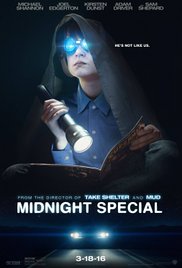
Greetings again from the darkness. Austin-based filmmaker Jeff Nichols serves up some of the familiar themes of spiritualism and parenting seen in his first three films: Mud (2012), Take Shelter(2011), Shotgun Stories(2007), but this time he goes a bit heavier on the science fiction … while maintaining his focus on the individual.
An exceptional opening scene kicks off the story, and Nichols makes sure we are alert by forcing us to absorb and assemble the slew of clues flying at us … an Amber alert, cardboard on the windows of a cheap motel, a news report tying us to San Angelo, Texas, duct tape on the peep hole, a duffel bag of weapons, two anxiety-filled men, and a goggled-boy under a white sheet who seems extremely calm in an otherwise hectic environment. We learn a lot, yet many questions remain.
As the boy and the two men speed off down the backroads, the setting switches to an eerily calm Calvin Meyer (the always great Sam Shepard), who is the leader of a religious cult similar to the Branch Davidians. “The Ranch” is desperate to get the boy back, and we learn they worship the numbers and words the boy has “received” from above. An FBI agent (Paul Sparks) leads the raid on the compound and takes us to an interrogation of Calvin by NSA analyst Paul Sevier (Adam Driver).
Alternating between sci-fi special effects and an “on the run” story line, we slowly pick up more details about the boy Alton (Jaeden Lieberher), as well as the men with him – his father Roy (Michael Shannon) and Roy’s childhood friend Lucas (Joel Edgerton). It’s not long before they reunite with Alton’s mother Sarah (Kirsten Dunst) and we really start to comprehend just how different and special Alton is.
It’s easy to see the influence of such films as Starman, E.T.: The ExtraTerrestrial, Close Encounters of the Third Kind, and The Day the Earth Stood Still. We are reminded that our society inevitably assumes the worst when something we don’t understand appears right in front of us. The Ranch sees the boy as a savior, and the government labels him a weapon. But it’s Shannon who captures the protective determination of a father trying to do the right thing for his son. Shannon again flashes the best ‘pained’ expression in the business, but it’s young Lieberher (so terrific in St. Vincent) who allows us to accept the father/son story in spite of the bright white lasers shooting from his eyeballs.
There are plenty of unanswered questions – not the least of which is, how did two “normal” parents end up with this “special” son? The visuals near the end are impressive to see on screen, but don’t appear to have much impact on the final questioning of Lucas or our understanding of how it all happened. It should also be noted that the piano score is especially impactful during both the quiet and thrilling moments. Director Nichols is a talented idea man, but he does leave us wanting more details. (That’s his brother singing the song over the closing credits.)
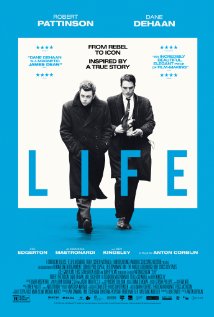
Greetings again from the darkness. The film’s title has multiple meanings: “Life” Magazine as the source for the famous photographs we have seen so many times; the crossroads in “Life” of both rising star James Dean and photographer Dennis Stock; and a philosophical look at “Life” – how quickly things can change, and how we should appreciate the moments.
Director Anton Corbijn (A Most Wanted Man, The American) and screenwriter Luke Davies offer up a snapshot of 1955 as the not-quite-yet-famous James Dean (Dane DeHaan) traveled cross-country with photographer Dennis Stock (Robert Pattinson) from Los Angeles to New York to Indiana. Each man was searching for their true self as Stock’s professional ambition and personal stress are palpable, while 24 year old Dean’s ambivalence about his pending superstardom borders on self-destructive.
DeHaan and Pattinson both underplay their roles, and it’s certainly more than a little confusing to see Pattinson in a movie about James Dean where he is not the actor playing the icon. DeHaan captures the low key, soft-spoken side of Dean but only teases at the “rebel” studio head Jack Warner (Sir Ben Kingsley) wanted so badly to control. We get a feel for Dean’s vision of challenging roles in quality productions … a commitment to the art of acting he no doubt sharpened in his time with acting guru Lee Strasberg. The story leans more heavily to the tale of photographer Stock, which is unfortunate, because he is significantly more awkward than interesting. Pattinson plays him as a social misfit who broods nearly as much as the “moody” young actor he is stalking through the streets.
The period look is well appointed, and we are privy to some of the moments of Dean’s life just prior to the release of East of Edenand his being cast in Rebel Without a Cause. His relationship with Pier Angelli (Alessandra Mastronardi), friendship with Eartha Kitt (Kelly McCreary), and his bond to the family and farm of his childhood in Indiana are all captured. In fact, it’s the clumsy relationship with Stock that comes across as the least realistic portion … though it may very well have happened this way. Even the manner in which the famous photographs were taken is underplayed … although it makes for a terrific tie-in with the closing credits where the real Stock/Life Magazine photographs are displayed.
It’s now been 60 years that James Dean has exemplified Hollywood “cool”, a label that can never be removed due to his tragic death in 1955 after making only three films. Capturing the essence of what made Dean cool is unnecessary because it’s present in every scene of those three films, as well as the photographs taken by Dennis Stock. That’s all the legacy either man needs.
 Greetings again from the darkness. Is there such thing as an ordinary life? If so, what does it look like? Writer-director Clint Bentley and co-writer Greg Kwedar have collaborated twice before – first on the underrated JOCKEY (2021), and then on SING SING (2023), the latter of which they received Oscar nominations for writing. For this latest, they have adapted the late Denis Johnson’s 2011 novella for the big screen, and the result is one of the most soulful films we’ve seen.


 Posted by David Ferguson
  Greetings again from the darkness. It’s always disappointing when a book is so interesting and enjoyable to read, only to be followed up by a movie version that doesn’t live up to the source material. My son recommended the 2013 best-selling non-fiction novel from Daniel James Brown, and it was truly fascinating to read such an inspirational story around the 1936 Olympics in Berlin. Of course, we all know the Jesse Owens story, yet somehow the remarkable and unlikely tale of the University of Washington crew team never received the publicity it earned. Director George Clooney (GOOD NIGHT AND GOOD LUCK, 2015) and screenwriter Mark L Smith (THE REVENANT, 2015) have attempted to reach a wider audience by adapting Brown’s book for the big screen.
 Greetings again from the darkness. The word of the day is “awkward.” Every character, every situation, every moment, and every conversation in this film can be described with that word. An attempt will be made to not overuse that adjective here, but yours truly offers no guarantees. Paul Schrader has had a long and impressive career as both writer and director. His early successes include screenplays for TAXI DRIVER (1976), ROLLING THUNDER (1977), RAGING BULL (1980), and THE LAST TEMPTATION OF CHRIST (1988), as well as directing AMERICAN GIGOLO (1980) and AFFLICTION (1997). The past few years have been a bit of a resurgence for Schrader with the excellent FIRST REFORMED (2018) and THE CARD COUNTER (2021).
 Greetings again from the darkness. It is 2018 and a group of boys have just finished soccer practice. After some motivational words from their coach, the boys start joking around with one of their teammates who has a birthday party slated for later that day. Boys being boys, they decide to bike over the local cave for some pre-party exploring. Their coach tags along to keep an eye on them. All of that sounds innocent enough until we realize this is the Tham Luang cave, and they don’t realize Thailand’s monsoon season is about to arrive early and with full force.
 Greetings again from the darkness. If you are at all inclined to see this movie, then I would encourage you to do so … and brace yourself for a surreal and mystical treat unlike any other medieval tale previously adapted for the big screen. Writer-director David Lowery re-teams with A24, the studio that also distributed his critically-acclaimed 2017 film,


 Movie Reviews from the Dark