TWO WAYS HOME (2020)

December 29, 2020

 Greetings again from the darkness. It’s a bit of a rough start. The armed robbery of a convenience store doesn’t come across as menacing or threatening, but rather almost comical as the burly dude retreats, leaving the ski-capped (not masked) woman behind to face the cops. The scene does however set the stage and background for that woman’s story. Kathy (Tanna Frederick) is sent to jail where she is diagnosed with bi-polar disorder. Transferred to a treatment center, Kathy is given medications for control, and released early.

Kathy seeks redemption and normalcy as she heads back to her family. The reception is lukewarm at best, and her now 12 year old daughter Cori (Riley Behr) outright rejects her. Cori has been raised by her father Junior (Joel West) and Kathy’s parents, and is now the ultimate overachieving adolescent who wants nothing to do with her ex-con mother. In the midst of Kathy’s homecoming, her beloved grandfather Walter (Tom Bower) has had a heart attack on his pig farm, and now the family is trying to have him certified as “not competent” so they can take over his land (a generational farm). Kathy is disgusted by this, and wants nothing more than to give her grandfather what he wants most … a chance to live out his final days on the same land where his father died.

With no shortage of awkward conversations or situations, Kathy struggles to acclimate back into her family and small Iowa hometown. The best and most poignant scenes are with Kathy and her grandfather, and with Kathy and Cori. Kathy relates to her grandfather, as he’s being labeled just as she has been. In his case, he carries the weight of old age, while she carries the stigma of mental illness. The conversations between Kathy and Cori are more intimate, as a mother and daughter try to reconnect.

Director Ron Vignone and writer Richard Schinnow do a nice job creating small town authenticity, and proving that family dysfunction is certainly not limited to big city life. Cinematographer Christopher C Pearson captures some nice shots of beautiful Iowa farm land, and mixes it with the often uncomfortable family moments. Veteran actor Tom Bower is a real standout here, and we ultimately wish he had more screen time. Ms. Frederick captures the essence of her character, and faces the challenges of those burdened with the mental illness stigma. We should appreciate the inclusion of Kathy encouraging her grandfather to write down his memories and experiences for future generations. It’s a valuable step that too few folks take.

Available on VOD beginning December 29, 2020

watch the trailer


WONDER WOMAN 1984

December 26, 2020

 Greetings again from the darkness. Some of the key elements that make Wonder Woman appealing is that she’s smart, she’s nice, she’s dedicated to doing good, she’s grounded in her history, and her use of her powers makes sense (in a comic book kind of way). Most of that holds true in filmmaker Patty Jenkins’ sequel to her 2017 blockbuster WONDER WOMAN. So why did that one work so well, while this one falls short? It’s not an easy question to answer, though it could be as simple as having the wrong target.

Gal Gadot returns as Diana Prince, and this time she’s plopped into 1984 (the year, not the novel). This creates a cornucopia of opportunity for social commentary and satire from Ms. Jenkins and her co-writers Geoff Johns and Dave Callaham. After all, it was the era of atrocious popular music, outlandish fashion, and a relentless pursuit of greed by the “me” generation. The film pounces on each of these by using the return of Diana’s main squeeze, Steve Trevor (Chris Pine), as a device for highlighting the absurdity of belly bags and pastel tank tops for men. In the first movie, the WWI pilot wakes up in Themyscira, and this time, he just kind of materializes in the year of GHOSTBUSTERS, shopping malls, and President Ronald Reagan. While this certainly qualifies as extreme culture shock, the parade of outfits and Steve’s wide-eyed tour through the city are over-the-top, even for their attempted comedic effect.

Over-the-top also describes the film’s two main villains. Pedro Pascal (“Game of Thrones”) plays TV hypester and con man Maxwell Lord. He’s a greedy, self-centered man willing to do anything to get “more”. Kristen Wiig is Barbara Minerva, a bumbling, forgettable klutz who works at the same museum as Diana. She simply wants to be cool like Diana and have people acknowledge her existence. Things shift quickly thanks to the Dreamstone sitting in Barbara’s in-box waiting for research. What follows is more than two hours of seeing the fallout of people having their wishes come true. If you’ve learned anything about human nature during this pandemic year, then you won’t be surprised at how people react to gaining power.

Maxwell Lord is not dissimilar to Lex Luthor in SUPERMAN (1978), as his goal is ultimate power and control – though to what end, he’s not sure. Barbara Minerva was never really power hungry, but a taste of it was much to her liking, and she transitions to The Cheetah for Wonder Woman’s biggest fight scene. There is also a message about what one sacrifices to have their wishes come true. This aspect of the film could be psychoanalyzed were one so inclined. Lord’s relationship with his son is convoluted, and the early Barbara is a mess … making their “sacrifices” a bit less obvious than that of Diana.

The opening sequence is the one this viewer most enjoyed. Spectacular camera work takes us to a competition on Themyscira, as a very young Diana (Lilly Aspell returns) goes against the grown warriors, while Antiope (Robin Wright) and Hippolyta (Connie Nielsen) look on and teach hard life lessons. Not only do these actors return, but most of Ms. Jenkins’ WONDER WOMAN crew is back, including cinematographer Matthew Jensen. The changes include Film Editor Richard Pearson and Hans Zimmer provides the new score. Some of the dialogue is tough to take. As an example, Diana says “I don’t know what to think, Steve. I only hope I’m wrong.” And later, Steve explains, “Flying is easy. It’s only wind and air.” Dialogue like this makes us want to renounce our own wishes. It may be one film later than it should have been, but Ms. Jenkins does deliver a much-appreciated cameo at film’s end, and if nothing else, it leaves us wondering, ‘what would you give up for a wish?’

watch the trailer


NEWS OF THE WORLD (2020)

December 25, 2020

 Greetings again from the darkness. Even in the midst of a pandemic, December is Oscar-qualifying time. And that means we get Tom Hanks’ latest movie. This time out, the two-time Oscar winner reunites with his CAPTAIN PHILLIPS (2013) director Paul Greengrass (three “Bourne” movies, and Oscar nominated for UNITED 93, 2006) for Hanks’ first ride into the western genre. Luke Davies (Oscar nominated for LION, 2016) adapted the screenplay from Paulette Jiles’ 2016 novel.

The beloved Mr. Hanks stars as Captain Jefferson Kyle Kidd. We know his full name because he proudly announces it at each stop of his news-reading route. That’s right, even in 1870, which is before television and radio and internet, a person could earn a living reading the news. OK, so it wasn’t the millions that national anchors make these days, as he was dependent on the audience dropping a coin or two in the tin cup. For this they were treated to Captain Kidd’s robust presentation of news and events (and some gossip) from around the nation … straight from the news clippings he collected during his travels.

On the trail one day, Captain Kidd comes across a horrific scene of violence, and a 10 year old girl with a shock of blonde hair. She only speaks Kiowa, but the found paperwork lists her name as Johanna (the first American film for Helena Zengel). It turns out, tragic events in her family’s home many years earlier left Johanna being raised by the Kiowa Indians. Captain Kidd is now on a mission to return her to her surviving relatives (an aunt and uncle), but there are at least three obstacles to his plan: it’s a rigorous trip of about 400 miles, the girl doesn’t want to go, and there remains much tension in the split among the post-war citizenry. So what we have here is a western road trip (trail ride) that’s a blend of TRUE GRIT (minus the witty banter) and THE SEARCHERS.

It should be noted that Captain Jefferson Kyle Kidd has served in three wars, including the recently concluded Civil War. He may make his living wearing bifocals and reading newspapers, but Kidd is no nerd. He handles pressure quite naturally, as we witness in chase scene up a rocky hill. The resulting shootout not only creates the first bond between Kidd and Johanna, but also flashes the Captain’s calming influence. This is a soulful and principled Tom Hanks (as usual), but this time he’s riding a horse and his furrowed brow is working overtime.

The trip to Johanna’s home coincidentally takes Kidd very close to where he once lived – a place that holds his best and worst memories. As viewers we see what Captain Kidd and Johanna don’t. They are both headed back to a past they no longer belong to. Along the way, the two travelers cross paths with characters played by Elizabeth Marvel, Ray McKinnon, Mare Winningham, and the always great Bill Camp. There is nothing rushed about the story or these people. Fans of director Greengrass will be surprised to find an absence of his trademark rapid-cut action sequences, but he has delivered a sweeping epic with superb cinematography (Dariusz Wolski, “Pirates of the Caribbean” franchise), expert editing (Oscar winner William Goldenberg, ARGO), and a terrific score (8-time Oscar nominee James Newton Howard). Mr. Hanks delivers yet another stellar performance (of course), and young Ms. Zengel’s assured performance likely means we will be treated to her work for years to come. It’s a quasi-western period piece that is plenty interesting to watch, yet lacks the memorable moments to justify multiple watches or a place among the genre’s best.

Opens December 25, 2020

watch the trailer


PROMISING YOUNG WOMAN (2020)

December 23, 2020

 Greetings again from the darkness. “Revenge is a dish best served cold.” The protagonist in writer-director Emerald Fennell’s (“Killing Eve”) feature film debut is a woman on a mission to avenge not just what happened to her friend, but also change the mentality of predatory men … one “nice guy” at a time. She is a #MeToo heat-seeking missile.

Carey Mulligan stars as Cassie, and when we first see her, she appears to be nearing blackout mode while drinking alone on a bench inside a bar. Most people have hobbies like crochet or golf. Cassie’s hobby, or maybe mission is a better word, is to lure men, with the appearance of a drunken easy score, and then scare them straight into respecting boundaries. She’s a non-violent vigilante (as opposed to Beatrix Kiddo) for morality and respect towards women.

As the film progresses, we pick up bits about what traumatized her to this extent. It turns out her best friend Nina was victimized by a group of men from their law school class. See, Cassie is the titular ‘promising young woman’ whose career dreams were dashed over what happened to her friend. Now, Cassie works in a coffee shop with a supportive and wise-cracking friend Gail (Laverne Cox, “Orange is the New Black”), who knows nothing of Cassie’s hobby … and neither do Cassie’s parents (Jennifer Coolidge, Clancy Brown) who can’t help but wonder what happened to their bright, ambitious daughter, and why she still lives at home with them.

Cassie’s mission gets momentarily de-railed when former classmate Ryan (an excellent Bo Burnham, THE BIG SICK) pops in to the coffee shop and awkwardly proclaims his long-time distant crush on her. The two are clumsy and believable together, and their relationship has more ups and downs than a pogo stick. For most movies, this would be enough to hold our attention, but not for ambitious filmmaker Fennell who has much more to offer. There is a cleverness to the presentation with four specific segments: a friend who didn’t believe her (Alison Brie), the law school dean who didn’t want to ruin a boy’s future (Connie Britton), a regretful defense attorney who took the money (Alfred Molina), and a bachelor party that gathers those who make up her nightmare.

Ms. Fennell is also an actor (and has a cameo in this one), and it’s clear she has a real feel for putting actors in the best position to maximize a scene. Of course, Ms. Mulligan is an outstanding actor on her own, but the actors benefit from Ms. Fennell’s work. Other supporting work is provided by Adam Brody, Christopher Mintz-Plasse, Molly Shannon, Max Greenfield, Chris Lowell, and Sam Richardson. The color palette is similar to an early Tim Burton movie, and in fact, Cassie’s home looks like a museum or possibly a middle-class Liberace setting.

There is a lot going on here, and some of it is quite uncomfortable – and sprinkled with dark humor in unexpected moments. Advice like “move on” and excuses like “we were kids” ring hollow to Cassie, who carries some guilt over what happened to Nina, and remains focused on attacking a system that enables inexcusable behavior. Ms. Mulligan embraces a character who possesses raw nerves and emotions she sometimes hides, while other times flashes in neon. This isn’t about a guy here or there who takes advantage, but rather a faulty system that protects these guys at the expense of victims. The ending is unusual and unexpected, and kudos to an exciting new filmmaker.

In theaters December 25, 2020

watch the trailer


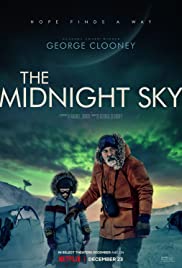
THE MIDNIGHT SKY (2020)

December 22, 2020

 Greetings again from the darkness. Screenwriter Mark L Smith has described his adaptation of Lily Brooks-Dalton’s book, “Good Morning, Midnight”, as a cross between the Oscar-winning GRAVITY (2013) his own THE REVENANT (2015, nominated for 12 Oscars). It’s a lofty comparison, and unfortunately, one that doesn’t prove out. Two-time Oscar winner George Clooney takes on the dual role of director and lead actor, and it’s his first movie role since 2016’s MONEY MONSTER.

Clooney plays Dr Augustine Lofthouse, a renowned scientist, and the only one staying behind as everyone else evacuates the Arctic Observatory after some unspecified “event” as left the earth uninhabitable. Augustine has a terminal disease (also unspecified) and evidently decides to stay behind because he likes drinking alone and self-administering blood transfusions. The drinking alone fun ends when he “finds” a stowaway young girl named Iris (Caiolinn Springall in her first film) and must assume the role of father-figure. To complicate matters, Iris doesn’t speak.

It’s 2049, and the film cuts between 3 storylines. While Augustine and Iris and working on a survival plan, we get flashbacks to a time when he was a younger scientist (played by Gregory Peck grandson Ethan Peck) and sacrificing a relationship with Jean (Sophie Rundle, “Peaky Blinders”) to focus on his career. The third story occurs simultaneously with Augustine and Iris, and involves Aether, a manned spacecraft on a years long mission to determine if Planet K23 can be inhabited by humans. The crew is commanded by Adewole (David Oyelowo, SELMA), and includes his partner, a pregnant Sully (Felicity Jones, THE THEORY OF EVERYTHING), pilot Mitchell (Kyle Chandler, “Bloodline”), navigator Sanchez (Demian Bichir, THE HATEFUL EIGHT), and rookie astronaut Maya (Tiffany Boone, “Hunters”).

When Augustine learns of Aether and its route back to Earth, he takes it as his responsibility to inform them that they need a new plan. In order to do this, he and Iris must trek across the frozen Arctic tundra through a blinding snowstorm to reach the satellite equipment that will allow communication with Aether. This road trip through a whiteout allows for the best effects during the Augustine/Iris section. Aboard Aether, the crew is relatively non-descript, but there is a spacewalk segment that is quite something to watch thanks to the cinematography of Martin Ruhe. There is also a visually interesting segment featuring blood in zero gravity.

So what we have is a three-piece post-apocalyptic science-fiction space survival tale with a surprise twist that won’t surprise anyone. It’s likely meant as a warning about how we are destroying our planet, and global catastrophe may not easily be solved through space exploration. The film presents an interesting symmetry between the vast wasteland of Arctic winter vs the vastness of space … neither seem to have borders or boundaries, yet are fraught with dangers. If you pay much attention to the story, you’ll likely be disappointed; however, if you watch for the visuals, you should be fine.

Premieres on Netflix December 23, 2020

watch the trailer


SYLVIE’S LOVE (2020)

December 22, 2020

 Greetings again from the darkness. For those who enjoy an old fashioned Hollywood romance, with set design and costumes taking priority over the intricacies of a story, then writer-director Eugene Ashe has the cure for what ails you. In contrast to the numerous films this year addressing topics of socially-conscious issues, this is an unapologetic, soapy, melodrama with beautiful actors and some cool jazz.

Tessa Thompson (CREED, 2015; AVENGERS: ENDGAME, 2019) stars as Sylvie, a young woman working in her daddy’s (Lance Reddick) Harlem record store while her fiancé is off fighting in the war. Her co-star is Nnamdi Asomugha (a 10 year NFL career, mostly with the Raiders) as Robert, a saxophone player in the Dickie Brewster Quartet. They have their ‘meet-cute’ moment, and despite the fiancé and Sylvie’s career aspirations of being a TV producer, they fall in love. The chemistry between Sylvie and Robert works because Ms. Thompson can light up the screen with her smile.

Director Ashe starts the movie in 1962 as Sylvie and Robert bump into each other by mere chance. It’s then that we flashback 5 years to their first meeting in the record shop. It doesn’t take long to establish that Sylvie is an expert on music and television, and has an independent streak that would be considered unusual for the era. As the two fall in love and appear well-matched, Robert’s group lands a prestigious gig in Paris. Just like that, the relationship is over.

Falling in and out of love over many years isn’t the right description for what happens to Sylvie and Robert. No, they are always in love (whether together or apart) … it’s just that life happens, and timing can be cruel in such matters. Additional supporting performances include Jemima Kirke as the Countess and Robert’s agent, a character based on Baroness Pannonica de Koenigswarter; Wendi McLendon-Covey as Lucy, a TV actor on a cooking show; Erica Gimpel as Sylvie’s appearances-obsessed mother; Eva Longoria as Carmen, replete with a New Year’s Eve song and dance routine; John Magaro as a music producer; and Alamo Miller as Lacy, Sylvie’s fiancé and husband. Despite her limited screen time, Aja Naomi King is a standout as Sylvie’s friend and party-girl-turned Civil Rights Activist. Her character is one of the few that gives any indication of what’s happening socially in the country at that time.

It’s a film that fully embraces the melodrama – a predictable love story, contrived to the point that Sylvie keeps a secret so personal that we would ordinarily find her despicable; yet in this film, her actions are presented as compassionate. Mr. Ashe’s film is a soap opera that looks fantastic, while glossing over the real challenges faced by blacks in the era. It’s truly a throwback in style, era, and substance. The people are beautiful. The cars are shiny. The music is hypnotic. Production design by Mayne Berke and Costumes by Phoenix Mellow add to the elegance presented by Ms. Thompson and Mr. Asomugha. You surely know if this is your type of movie. See you later alligator.

Available on Amazon Prime December 23, 2020

watch the trailer


MA RAINEY’S BLACK BOTTOM (2020)

December 21, 2020

 Greetings again from the darkness. As an Executive Producer, Denzel Washington has pledged to bring 10 August Wilson plays (collectively known as ‘The Pittsburgh Cycle’ or ‘Century Cycle’) to cinema. The first was the Oscar-nominated FENCES (2016), and George C Wolf directs this, the second. Ruben Santiago-Hudson has adapted Wilson’s 1984 play into a feature film vehicle for some of the finest on screen acting we will see this year.

Viola Davis (Oscar winner, FENCES) stars as Gertrude “Ma” Rainey, the “Mother of Blues”, and the recently deceased Chadwick Boseman co-stars as Levee, her ambitious trumpet player. Ms. Davis delivers a towering performance, and Mr. Boseman leaves us with his career best. The film opens in 1927 rural Georgia with two African-Americans running through the woods under the cover of darkness. If your mind goes where my mind did, we are both wrong. They are headed to a shack acting as a nightclub, and we get our first look and listen at Ma belting out a tune. It’s a powerful image and one that expertly sets the tone.

Soon we are in Chicago as Ma’s band makes their way to a recording studio. Cutler (Colman Santiago, IF BEALE STREET COULD TALK, 2018) plays the trombone and is the de facto leader, Toledo (an excellent Glynn Turman, “Fargo”) is the piano player, and Slow Drag (Michael Potts) plays the bass. The three older men all arrive on time at the studio and are waiting on trumpet player Levee (Boseman) and Ma. When Levee does show up, he struts into the rehearsal room and flashes his new shoes. The generational difference is immediately evident, and the fiery banter is superb. Levee is charming and cocky, while the older men are wise from experience and have undoubtedly seen dozens of Levees throughout their years. Cutler’s strong religious beliefs become known and Toledo’s sage advice falls on deaf ears.

Ma literally crashes into the scene, and we quickly understand that this woman will apologize for nothing, and has earned the right to call her own shots – even if that’s only true in this one corner of the universe. She understand the power her record sales give her, and she seizes every possible upper hand – whether it’s which arrangement to sing on a song, allowing her stuttering nephew to record, or even demanding a cold coca-cola before singing. Ma speaks in third person and her attitude is not that of a warm, grateful person, but rather of a woman who understands what she has earned. When she says, “All they want is my voice”, we know exactly what she means.

More collisions occur, this time figuratively. There is a collision of swagger between Ma and Levee. The collision of generations with Levee and the band. Finally, there is the collision of Levee and the white man. Ma wants to sing her songs on the record the way she sings them for her fans, while Levee is pushing for the “new” up-tempo sound. Levee’s ambition for songwriting and putting together his own band clashes with the older musicians who are satisfied to be working, and Levee tries to play the game by playing up to the white men in power, only to be taught the lesson that his bandmates tried to warn him of.

Wilson is known for his speeches, and the key players get their moment. Toledo describes blacks as “the leftovers”, while Ma describes white people listening to the blues … “They hear it come out, but they don’t know how it got there.” These are powerful moments, yet standing above them are the two soliloquies we hear from Levee. The first is about his background of family and introduction to white men, while the second is truly an other-worldly cinematic moment – he contests the unwavering religious beliefs in what ultimately proves to be the most tragic way. It’s a scene which will be Mr. Boseman’s long-lasting acting legacy.

Supporting work is provided by Jeremy Shamos as Ma’s agent Irvin, Taylour Paige as another line in the sand between Ma and Levee, Dusan Brown as Ma’s nephew, and Jonny Coyne as the studio owner/producer. This is not so much a story, but rather inspiration for us to assemble the various pieces into the backstories of these characters. It’s a way for us to better understand what they did to get here, and how they are handling it now. Step on the shoes at your own peril. When someone overcomes so much in life, they aren’t likely to back down gently. The music is terrific, the message is strong, and the performances are unforgettable.

Now streaming on Netflix

watch the trailer


FIRST COW (2020)

December 19, 2020

 Greetings again from the darkness. A modern-era woman (Alia Shawkat) is hiking along an Oregon river with her trusty dog. Something catches her eye and she begins tentatively brushing away decades of leaves and soot. Ultimately it turns into an excavation of two human skeletons nestled together. How many years since these two laid down for the last time? Why in this spot?  It’s a terrific way to begin a story, and does justice to what follows … all of which takes place in the early 19th century.

Director Kelly Reichardt has already made her mark with such standouts as CERTAIN WOMEN (2016), MEEK’S CUTOFF (2010), and WENDY AND LUCY (2008), and this time she adapts the screenplay with Jonathan Raymond from his 2004 novel, “The Half-Life”. Cookie (John Magaro, also seen in this year’s SYLVIE’S LOVE) is initially seen traveling west with a band of trappers. Skirting the law as they make their way in this new world, the men act as bullying brutes towards Cookie, a quiet and sensitive man. During one stop for camp, Cookie is rummaging the brush for food when he stumbles upon a naked Chinese man who is hungry and running from Russians (aren’t we all?). Cookie provides King-Lu (played by Orion Lee) with food and shelter, a Golden Rule act that comes full circle not long thereafter.

Cookie and King-Lu begin establishing something more than a friendship. It’s a life bond (but probably not in the way you might be thinking). It’s more natural instinct – a ‘two heads are better than one’ partnership. Despite the hardships of early frontier days, the two men share their version of the American Dream, and it’s about this time that our titular bovine makes her entry stage left. The cow belongs to Chief Factor (Toby Jones) who is eager to create a more refined life in this untamed wilderness. Cookie views the cow’s milk as the key to creating tasty biscuits (a rare treat), and King-Lu immediately recognizes the possibility of profit. The nightly heist features Cookie’s one-directional conversation with Evie the cow … presumably making her first screen appearance.

Ms. Reichardt’s film is not nearly as simple or slow moving as it appears. She fills it with a slow-build tension, especially in the second half. The film requires patience and attention to detail from viewers. How can something so quiet and peaceful be filled with such danger and difficulty? That’s the brilliance of the film. Supporting work is provided by Scott Shepherd as a military officer Factor tries to impress, the late Rene Auberjonois (whose presence seems a tip of the cap to Altman’s classic MCCABE AND MRS MILLER), Ewan Bremner (whose accent requires subtitles for comprehension), and Lily Gladstone as Factor’s Native American wife.

This is the first film I recall where a clarfoutis plays a key role, and there are sprinkles of dark comedy throughout … which plays well off the rugged characters and environment. William Tyler’s score and Christopher Blauvelt’s cinematographer mesh well with the fine performances throughout.  Ms. Reichardt opens the film with a William Black quote, “The bird a nest, the spider a web, man friendship”. We witness the friendship, and by the end, we wonder if it’s also a web.

Available on Showtime and streaming outlets

watch the trailer


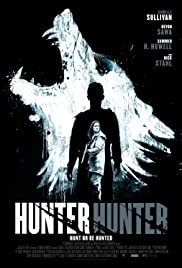
HUNTER HUNTER (2020)

December 19, 2020

 Greetings again from the darkness. The initial assumption is that this is a story of a lone wolf stalking a family. Early on, it shifts into the story of Joseph Mersault, a throwback trapper teaching his 13 year old daughter how to survive off the land. Yet, what writer-director Shawn Linden ultimately delivers is the story of Joseph’s wife, Anne, who combats not only the wolf, but something even worse.

Joseph (Devon Sawa) is one grumpy dude. He’s no fan of society or people, and the only pleasures he seems to find in life are living in an isolated cabin and teaching his daughter Renee (Summer H Howell) how to do the same. They are joined in this quiet and very hard life by wife and mother, Anne (Camille Sullivan). Anne dutifully carries out her chores, but dreams of a more normal life for herself and her daughter. The family barters animal skins for food and supplies and live mostly off the grid – and we later learn there are complications to even something as simple as their cabin.

The forests of Manitoba provide what the family needs, but just barely. Winter is approaching and now a wolf is stealing from their traps, leaving them short of food. This wolf has previously stalked the family, and Joseph aims to hunt him down. The camera work in the forest is terrific – giving us the visual beauty, as well as the constant danger. And in this story, danger and traps take on many forms, including the secrets folks keep from each other.

The wolf only makes a couple of appearances, yet the threat is always present. There is a terrific sequence that cuts between Joseph, Anne, and Renee, as each are in different areas of the forest at the same time. Each of the situations is tension-filled and our minds are bouncing around as much as the characters. Other characters enter the story, including a couple of Rangers who are unprepared for what they are about to face, and another character (Nick Stahl) who shifts the entire dynamic of the film.

Director Linden gives us a survival thriller, one that probably best compares to LEAVE NO TRACE. This one is also a psychological study of just what a person is capable of when pushed to the limit. Anne’s story is about her ability to navigate this world while raising a daughter. The final sequence leads to extreme violence, and acts as her emotional release every bit as much as rage and revenge.

VOD beginning December 18, 2020

watch the trailer


THE ART OF POLITICAL MURDER (2020, doc)

December 16, 2020

 Greetings again from the darkness. Very few documentaries can also be labeled political crime thrillers, but that description fits Paul Taylor’s film based on Francisco Goldman’s 2014 book. It’s a blend of history, religion, corruption, and investigative work as it all relates to a brutal murder. Even in these times when trust is broken on so many fronts, we as viewers are left wondering how something like this could happen.

The Guatemalan Civil War spanned 1960 through 1996, and had the right wing military facing off against leftist rebels supported by the indigenous Mayans. More than 200,000 civilians were killed, and the people’s faith in their government was destroyed. But this isn’t the story of the war. Bishop Juan Gerardi publicly condemned the government and military for war crimes and atrocities in his deeply researched 1996 REMHI (Recovery of Historical Memory Project) report. Two days later, 78 year old Bishop Gerardi was murdered. Savagely murdered. Bludgeoned in the head and face with a concrete slab, outside his parish home.

The bulk of the film is dedicated to what happened after the April 26, 1998 murder: a botched crime scene, numerous theories, citizen protests, and a high profile trial. It’s really the stories behind the story. The Bishop was an outspoken activist for the Mayan people and he was beloved by many. However, the exploration of the police investigation left many wondering what kind of government would issue a state-sponsored hit on a religious leader of the people.

We hear from the key witness and see clips of the prosecutors. There are interviews with a journalist and activists, and we learn of some of the theories of who killed the Bishop and why. These theories included: organized crime, drug traffickers, church thieves, and it was even proposed that it was a crime of passion. Not only does the film chronicle the police investigation, but we are also privy to the more fascinating investigation into the investigation. It’s an exploration of the crime and its aftermath – including governmental and military corruption, and more attempted violence. The clips from the courtroom scenes are stunning, and although those at the highest level may never answer for what happened, the dedication of Bishop Gerardi is still remembered.

This HBO Documentary is premiering December 16, 2020

watch the trailer