CATCH HELL (2014)

October 28, 2014

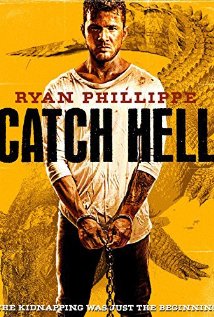
catch hell Greetings again from the darkness. Ryan Phillippe has hit the big Four-O, so it makes sense that he would want to explore the other side of the camera with writing, directing, and producing. He’s had a pretty successful acting career given what could be termed a minimal lack of range and a quiet screen presence. His feature film directorial debut (Direct-To-Video) utilizes a script he co-wrote with Joe Gossett, capitalizing on Phillippe’s lot in Hollywood right now … the once promising star looking to recapture the magic with a “game-changer”.

The film opens with a dramatic shot of actor Reagan Pearce’s (RP … get it?) stunning mansion. We see him catch a flight to Shreveport, Louisiana and take a meeting with a slightly spastic director and blow-hard producer. He decides to stick with the project in an effort to re-establish his career … he’s just out of rehab (of course). The next morning, things go really badly as Reagan is kidnapped by a couple of Louisiana hillbillies and locked up in a swamp cabin.

Brutal torture scenes follow and we soon enough learn that one of his captors (Ian Barford) is seeking revenge for Reagan’s dalliance with his wife on the set of a movie. The plan is to destroy Reagan’s reputation and then kill him once he is hated by all. The script attempts some Hollywood satire and makes some obvious commentary on the whole tabloid and celebrity world, but mostly it comes off as a bit self-indulgent for Mr. Phillippe.

There are some flashes of interesting moments, mostly involving Stephen Grush as the second hillbilly with homosexual overtures towards Reagan. Unfortunately, the film does not take advantage of the colorful swamp setting and instead takes place almost entirely within the run down cabin. You will note dashes of Deliverance, Black Snake Moan, and Misery, but this one isn’t at that level. Instead it comes off like a bucket list item for Phillippe … director/writer/producer/star of his own film.

watch the trailer:


WHIPLASH (2014)

October 26, 2014

whiplash Greetings again from the darkness. The pursuit of greatness is not always pretty. No matter if your dream is athletics, dancing, music or some other; you can be sure hard work and sacrifice will be part of your routine. You will likely have a mentor, teacher or coach whose job is to cultivate your skills while pushing you to new limits. This film questions whether the best approach is intimidation or society’s current preferred method of nurturing.

Miles Teller plays Andrew, a first year student at an elite Manhattan music conservatory. Andrew dreams of being a great jazz drummer in the vein of Buddy Rich. When offered a rare shot at the top jazz orchestra, Andrew quickly discovers the conductor is a breed unlike anything he has ever encountered. The best movie comparison I can offer for JK Simmons’ portrayal of Terence Fletcher is R Lee Ermey’s Drill Instructor in Full Metal Jacket. This is no warm-hearted Mr Holland’s Opus. Fletcher bullies, intimidates, humiliates and uses every imaginable form of verbal abuse to push his musicians, and especially young Andrew, to reach for greater heights.

Andrew and Fletcher go head to head through the entire movie, with Fletcher’s mental torment turning this into a psychological thriller … albeit with tremendous music. We witness Andrew shut out all pieces of a personal life, and even take on some of Fletcher’s less desirable traits. Andrew’s diner break-up with his girlfriend (Melissa Benoist) is much shorter, but just as cold as the infamous opening scene in The Social Network. At a small dinner party, Andrew loses some of the sweetness he inherited from his dad (Paul Reiser), and unloads some Fletcherisms on some unsuspecting family friends.

Writer/Director Damien Chazelle has turned his Sundance award-winning short film into a fascinatingly brutal message movie that begs for discussion and debate. The open-ended approach is brilliant, though I found myself initially upset at the missing clean wrap that Hollywood so often provides. What price greatness? Is comeuppance a reward? Are mentors cruel to be kind? For the past few years, I have been proclaiming that Miles Teller (The Spectacular Now) is the next John Cusack. Perhaps that bar is too low. Teller just gets better with each film. His relentless energy draws us in, and we find ourselves in his corner … even though this time, he’s not the greatest guy himself. Still, as strong as Teller is, the film is owned by JK Simmons. Most think of him as the dad in Juno, or the ever-present insurance spokesman on TV, but he previously flashed his bad side as the white supremacist in “Oz“. Even that, doesn’t prepare us for Simmons’ powerhouse performance … just enough humanity to heighten his psychological torturing of musicians.

You should see this one for Simmons’ performance. Or see it for the up-and-coming Teller. Enjoy the terrific music, especially Duke Ellington’s “Caravan”. See it for the talking points about teachers, society and personal greatness. See it for any or all these reasons – just don’t tell director Damien Chazelle “good job“.

SEE THIS MOVIE IF: you want to see JK Simmons in a likely contender for the Best Supporting Actor Oscar OR you have been waiting for someone to prove a drum solo can actually be worthy of your attention

SKIP THIS MOVIE IF: you have no interest in exploring what is involved in attaining greatness, regardless of the talent or skill

watch the trailer:


STONEHEARST ASYLUM (2014)

October 23, 2014

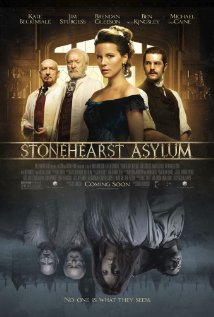
stonehearst Greetings again from the darkness. A surefire indication that a movie is a must-see for me are the words “based on a story by Edgar Allan Poe” … no matter how loosely. Then, set the film in a creepy turn of the 20th century insane asylum, and cast Ben Kingsley, Michael Caine and Brendan Gleeson, and consider me exceptionally excited.

From the opening moments, there is a certain nostalgic or throwback feel.It recalls the “B” movie feel of so many from the 40’s and 50’s that I grew up watching on late night TV. Imagining the production in Black & White rather than color, and picturing Vincent Price as one of the leads, probably give this one more credit than it earns. Despite the stellar cast – also featuring Kate Beckinsale, Jim Sturgess, David Thewlis, and Sinead Cusack – it doesn’t manage to generate any real suspense or feeling of danger.

Director Brad Anderson works mostly in television, but has kicked out some films of interest along the way. These include Session 9, Transsiberian, The Call, and especially The Machinist. Here, he has an exceptionally deep and talented cast, yet manages to waste Mr. Caine and Mr. Gleeson with minor roles. Even Ms. Beckinsale is treated as simple eye candy with a stunning wardrobe that defies logic, given the circumstances.

Three characters that deliver some fun are Sophie Kennedy Clark as Millie (the nurse), David Thewlis as the comically named Mickey Finn, and of course Sir Ben Kingsley as Silas Lamb. Kingsley is one of the few actors who can walk the fine line between elegance and madness, and leave us wondering (even if we really know). He thrives on scenery-chewing roles and this one definitely qualifies.

The script avoids any real insight or statement on the cruel treatment of the mentally afflicted from the pre-psychoanalysis days brought on shortly thereafter by Freud. Allowing the inmates to run the asylum does make it clear that insanity comes in many forms with differing degrees. In fact, I would challenge viewers to name one truly sane person in this film. Loosely based on Poe’s short story “The System of Doctor Tarr and Professor Fether”, what the film lacks in tension and terror (it’s not Shutter Island), it mostly makes up for in production design and nostalgia.

SEE THIS MOVIE IF: a throwback to the asylum movies of the 40’s and 50’s brings you a warm nostalgic feeling

SKIP THIS MOVIE IF:  you prefer not to see electro-shock therapy administered to Michael Caine

watch the trailer:


THE MAGIC OF HEINEKEN (2014, doc)

October 21, 2014

heineken Greetings again from the darkness. The iconic green bottle is from Holland, not Germany. It’s a product of which the Dutch are proud. Founded in 1864, the family was forced to sell in the aftermath of WWII, and thanks to Freddy, the family bought it back and remains in control today. Heineken … it’s all about the beer.

An archival opening statement from Alfred (Freddy) Heineken speaks about his grandfather and father, who founded and helped build the family business. We then move into a musical montage of advertisements old and new, footage of breweries and bottling plants, and many Heineken images – some familiar, others not. The movie then takes us through four generations of the family who have run and influenced the global growth.

Some pieces of this story are quite interesting. Running through 70 operating companies covering 180 countries, we share the globetrotting trek through breweries in Amsterdam, Europe, the Congo, Vietnam and Poland. Especially fascinating is the grand opening of a huge facility in China. Chemistry plays a role in the success of the beer as we learn in the segment about Heineken “A-yeast”, as well as the company’s approach to hops and barley farming. There is even a kidnapping that made international news.

This family owned business is presented as the ultimate socially responsible organization. Their Heineken Foundation helps the underprivileged in Nigeria, plus running numerous other medical clinics around the world. They are also committed to recycling and encouraging socially responsible drinking.

Even learning about the “smiling e’s” in the logo, and the marketing commitment to social media, sports, music and other cultural events helps us understand what makes the company successful. What never quite clicks is the purpose of director Michael John Warren’s film. Is it a recruiting film for the firm? Is it purely propaganda? Is it an ego piece for the family?  It could even be an attempt to drive up the price of a possible sale of the company?  As viewers, we can’t answer these questions, as we are just supposed to accept this love fest as proof that not only is the beer tasty, but Heineken is a friend to the global economy.  Maybe it’s not all about the beer.

watch the trailer:


ST. VINCENT (2014)

October 19, 2014

st vincent Greetings again from the darkness. Moments after Bill Murray’s Vincent cracks a rare on screen “Chico and the Man” reference, we get our first glimpse of scrawny Oliver (newcomer Jaeden Lieberher), and we immediately know where this story is headed. The fact that we never lose interest is thanks to Mr. Murray, the rest of the cast and writer/director Theodore Melfi (his first feature film).

Though this is ultra-predictable and even strains credulity, we nonetheless connect to Murray’s Vincent – a grumpy, drunken, slobby, chain-smoker who has a bond with a pregnant Russian prostitute/stripper (Naomi Watts). Melissa McCarthy plays Oliver’s mom Maggie, who has separated from her philandering husband, and is intent on making a life for her son. It’s here where it should be noted that Ms. McCarthy plays the role straight – none of her usual funny-fat moments. Instead, she excels in a scene with an emotional dump on Oliver’s principal and teacher (a standout Chris O’Dowd).

Surprisingly, this could even be described as a message movie. Vincent quickly notices that Oliver is lacking street smarts and sets out to correct this. The story reminds us that all people are multi-faceted. The good have their rough edges, and the “bad” likely have a back-story and some redeeming value. Vincent is so cantankerous that it takes a kid as appealing as Oliver to balance the story. Even knowing a feel good ending is coming, we as viewers don’t mind being dragged through the sap.

Murray is outstanding, and if the script had a bit more heft, he would probably garner some Oscar consideration. McCarthy deserves notice for going against type, and Naomi Watts flashes some real comedic timing (maybe the biggest surprise of all). O’Dowd has some of the best one-liners in the film, and shows again that he is immensely talented. Terrence Howard seems a bit out of place as a loan shark, but he has limited screen time, as does Ann Dowd as the nursing home director.

Prepare for the feel-bad-then-good ride, culminating in a school auditorium event that reunites the key characters, and allows the child actor to draw a tear or two from the audience. Good times that end with classic Murray over the closing credits.

SEE THIS MOVIE IF: you have missed the fully-engaged Bill Murray last seen in Lost in Translation (2003)

SKIP THIS MOVIE IF: unpredictable endings are why you see movies

watch the trailer:


FURY (2014)

October 18, 2014

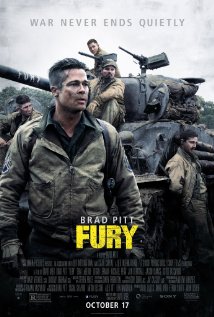
fury Greetings again from the darkness. When a filmmaker takes on WWII, he better have something new to say or a new way to show it. Director David Ayer (highly recommend his End of Watch, 2012) literally takes us inside a Sherman tank with its crew of 5 men, including their leader played by Brad Pitt.

Having the tank as a centerpiece brings a level of claustrophobia to the treacherous German war front. The battle scenes are excruciatingly tense, and actually beautifully filmed. This may seem an odd description for a war movie, but bouncing from inside the tank to the German countryside is done with such style that it provides contrast to the brutality and violence of war.

Pitt’s crew is made up of Shia LaBeouf, Michael Pena and Jon Bernthal (especially good). They are forced to take on a rookie with no tank training … but he can type 60 words per minute. Logan Lerman plays the rookie and he brings the natural sensitivity we’ve come to expect from his roles in The Perks of Being a Wallflower, and Noah. We buy off on the difficult transition since the others have fought campaigns together in Africa, Belgium and France. Jason Isaacs is also well cast as an Allied forces captain.

What works here are the battle sequences. What doesn’t really work are the numerous moments of personal drama injected to help us understand how war can change a man … no matter how hard he tries to hold on to his humanity. The sequence with the two German women, a piano and fried eggs seems especially drawn out and unbelievable. We understand the point pretty quickly, but the extended sequence becomes downright awkward.

The most interesting question the movie asks is whether a soldier can be so disgusted and sick of war, yet somehow addicted to the action. Mr. Ayers previously wrote U-571 (2000), so he is clearly interested in the mentality of soldiers in a claustrophobic setting. More of this approach would have been welcome here.

***NOTE: The film uses actual WWII tanks, and it’s the first time a Tiger I tank has been used in film.

***NOTE: Just a personal note here, but every time Brad Pitt said anything, I flashed back to his role in Inglourious Basterds. A change of inflection would have helped.

watch the trailer:


A COUP IN CAMELOT (2014, doc)

October 18, 2014

a coup in camelot Greetings again from the darkness. With no shortage of books, movies, TV specials, documentaries, or research papers about President John Kennedy’s assassination, one could wonder what yet another new project could possibly bring to the table. The answer is: eye-opening evidence presented in a concise manner by a group of experts.

The film begins with the actual break in regular TV programming for the announcement of November 22, 1963. It then moves forward by reminding us of the litany of unanswered questions remaining 50+ years later. We see many of the most familiar images from JFK’s trip to Texas (“nut country”), including an enhanced Zapruder film. A quick history lesson follows showing how JFK was planning a full withdrawal of troops from Vietnam, which is later described as the basis for what could be the conspiracy or titular “coup”. The Warren Commission is discussed along with the gaps in interviews and evidence.

Five key areas are examined under the microscope here: the Secret Service, forensics, chain-of-custody with the body, the autopsy process and report, and Lee Harvey Oswald. Experts from each category detail their research and conclusions. The panel includes Vince Palamara, Sherry Feister, Douglas Horne, Dr David Mantik, Barry Ernest, Jerry Dealey, and Dick Russell. This group represents an extraordinary amount of time and diligence in researching testimony, documents and evidence … in fact, dwarfing the time spent compiling the Warren Report. Discussions of lapses in Secret Service protocol, triangulated crossfire, contradictory medical testimony, doctored photographs, and “patsy”, take on real weight and substance. The documentation appears strong to corroborate these conclusions and theories, and at a minimum raise significant doubt about who was involved and why.

If you are expecting testimony from wild-eyed conspiracy theorists living on the fringes of society, you will be disappointed. Instead, filmmaker Stephen Goetsch and writer Art Van Kampen offer screen time to historians, physicians, researchers, and experts-in-field so that they may provide an educated and trained interpretation of the evidence. Much of the material may be familiar to those who are well read, but the methodical and deliberate method of presentation is what makes this one worth a look.

To see the trailer and learn more about the film (and a screening at The Texas Theatre), go to: www.acoupincamelot.com


AMERICA THE BEAUTIFUL 3 (2014, doc)

October 17, 2014

ATB3 Greetings again from the darkness. This is the third in filmmaker Darryl Roberts’ documentary series focusing on America’s obsession and ideals of physical beauty. His first was released in 2007 and centered on plastic surgery, while the second from 2011 explored dieting and the quest for thin. Installment number three takes on the sexualization of society, and of girls in particular.

Make no mistake; this is not one of those funny “taboo TV ad” specials. Instead, it’s a sobering look at beauty pageants for little girls, marketing methods (TV, print, retail), and the proliferation of porn into the daily lives of teenagers. The dots are connected to show how these have led to a society struggling with sexual dysfunction.

Mr. Roberts kicks this off with an introduction to what is termed, a Mental Health Crisis – specifically, the Sexualization of little girls. The models used in advertising continue to skew younger and younger, often with 11 or 12 year olds made up and posed to look “desirable”. We are informed that kids watch 25-50,000 TV commercials per year, and many of these advertisements are targeted directly to this ever-growing economic group. Disbelief accompanies our trip to rural Georgia as we meet Beauty Pageant mothers who see nothing sexual about their little girls being half-dressed on stage, performing the type of “dance” moves one would see in a hard-edged rap video. This is our first (but not last) glimpse of how clueless many parents are on this issue.

A well-known psychologist explains the harm in having “girls versus girls” in a contest to see who is chosen as the best, simply on the basis of their looks. The connecting dots then lead us to the frightening topic of teenage pregnancy, where a group of girls detail how they started having sex as young as age 14. Interviews with kids (boys and girls) make the very crucial point that abstinence and even safe sex are not frequent subjects of conversation.  Brain development is scientifically proven to be a factor in the frequent “immediate gratification” decisions made by teens. More on this would have been welcome.

We meet the two interns Mr. Roberts hired to assist with this project. One of the girls, single-handedly takes on the Abercrombie & Fitch chain, after the CEO makes a statement claiming their clothes are exclusionary … basically, A&F only sells to the young and beautiful. One of the interns becomes a crusader against A&F and that leads her to become a spokesperson against teenage bullying – in its many forms.

A university professor explains how there has been a Sexuality Generation Shift, and much of it can be traced to the frequency and accessibility of online porn. This has become the educational front for kids in regards to sexual relationships. These days, girls are either “F***able or Invisible” and “Gonzo porn” never gives any indication that intimacy or feelings should play a role, and now, the dots connect to the high rate of sexual abuse and rape on college campuses.

Though I may not be a huge fan of the look and structure of the film, it’s the message that matters. Mr. Roberts offers up significant statistics throughout, and the interviews prove quite insightful … whether it be a college professor or the clueless mother supporting her wannabe teenage model (who can’t grasp the concept of consistent safe sex). The most significant takeaway is that the world of youngsters today is not just void of any of real guidance, but even worse, their introduction and education of sex is coming directly from the world of online porn. We are judged as a society on how we care for our children, and a disgusting example is provided near the film’s end as Mr. Roberts discloses that one of his interns was (at a minimum) sexually harassed by a producer during the project. It makes for an abrupt reminder that we all must take responsibility for our actions and for the protection and guidance of kids.

Thanks to sponsorship of Carolyn Costin and the Monte Nido Treatment Center, the film will be screened free of charge in a few U.S. cities, including Dallas on October 20. For more information, and to watch the trailer, go to: http://www.americathebeautifuldoc.com/

PUMP (2014, doc)

October 17, 2014

pump Greetings again from the darkness. Documentaries with a message are usually most effective when they engage in debate … share both sides of the argument, if you will. Preaching from a soapbox typically causes the viewer to tune out, and the opportunity is missed. The one exception to this is when the stance is heavily supported with history, facts, data, research and pertinent interviews. Husband and wife co-directors Joshua Tickell and Rebecca Harrell Tickell deliver what amounts to a visual thesis on how to break the big oil monopoly.

Beginning with a montage of beautiful and colorful automobiles, we are quickly reminded of Americans love of their cars which leads to the addiction to oil. The next 90 minutes provides a trek through the key historical events that led to our oil dependency, and ends with a proposal on how to stop it.

The history lesson discusses John D Rockefeller and his Standard Oil monopoly, followed by his political influence to get Prohibition passed. This after Henry Ford called alcohol “the perfect fuel”. We then learn of how large companies drove out the trolley system in favor of an interstate freeway system for cars. We re-live the 1973 gas shortage as the Arab countries flexed – or extorted, depending on your take. Jumping to 2008, the surge in oil prices to $147 per barrel is described as the economic earthquake, with the Stock Market crash termed an aftershock. In other words, oil is the foundation of our economy. Today’s global market is discussed along with the exponential growth of China’s car industry – 15 million cars sold this year. This time-line with specific data leads to the impressive second half of the film … how to get ourselves out of this mess.

For those who say it’s foolish to discuss breaking our dependency on oil because it is used in so many other ways, they are missing the point. The cause is less oil dependency for cars, not a total break from it’s use in products such as medicines, clothes, plastics, etc. The filmmakers offer the options of both electric cars and alternative fuel sources.

Elon Musk’s Tesla Motors is briefly discussed, with the acknowledgment that battery technology improvement is vital to the future success of electric cars. A more immediate solution comes in the form of alternative fuels – ethanol and methanol. We see the exceptional strides Brazil has made with strong leadership. We see how our current vehicles already have the capability to run on these biofuels, if not for a simple software adjustment built-in by auto-makers. Nine million flex fuel cars on the road now, and many of these owners remain unaware of their options. Why? Because fueling stations are so tough to come by, as only the most independent of stations are not contractually obligated to big oil companies.

The film is exceptionally well researched and the data delivered in an easy to understand format. The Tickell team won the Sundance award for the 2008 documentary Fuel, and their message is even stronger this time out. By the way, Ms. Tickell is a former child actress known as Sam Elliot’s daughter in the 1989 Christmas classic Prancer. She and her husband are now renowned environmental activists, and this project is really a call to action … the choices are available NOW to break the oil monopoly.

watch the trailer:


LIFE AFTER DEATH FROM ABOVE 1979 (2014, doc)

October 15, 2014

life after death from above Greetings again from the darkness. By definition, documentaries tell us the story of something that has already happened. The best ones expose a great story, and it usually boils down to how interesting we find the subject. The Canadian Punk duo Death From Above 1979 has a history that is both entertaining and a bit unusual – even within the music industry.

Between 2001 and 2005, the band performed 546 live shows around the world. And then it was over. Bandmates Sebastien Grainger (drums and vocals) and Jesse F Keeler (bass, keyboard, backing vocals) melded their creative flow into an incredibly energetic live experience. They were in perfect sync onstage, and audiences responded.

Filmmaker Eva Michon (Grainger’s wife) provides us with interviews from music executives, members of other rock bands, and especially Grainger and Keeler. We learn of their influence, and also witness their conflicting insecurities and musical confidence.

Their first full album “You’re a Woman, I’m a Machine” sold 100,000 units in 2004, but the follow-up “The Physical World” wouldn’t be released for a decade. The reason for the delay is the crux of this band’s story … they broke up! It seems clear the two band members grew apart creatively, causing a crack in the friendship. They quit speaking, even while on tour. In 2005, they were opening for Nine Inch Nails at Madison Square Garden, and a few weeks later they went their own separate ways.

Grainger finally reached out to Keeler in 2011, and the band reunited with an invitation to play famed music festival Coachella. A surprise show at SXSW in Austin was shut down by the cops after the crowd spun out of control. The video here is the best we see, and certainly more exciting than the actual footage from Coachella.

The reunion just doesn’t play well on screen, and it robs the film of it’s core moment. The interviews are insightful and the photos and early footage are excellent. All that’s lacking is a wow moment. Still, fans of the band will be all over this, while those unfamiliar will find it interesting enough.

watch the trailer: