YELLOW SUBMARINE (1968, animation) revisited

July 7, 2018

 Greetings again from the darkness. “It was 50 years ago, Sgt Pepper taught the band to play”. OK, I know that’s not the lyric, but 50 fits better than 20 when we are talking about the latest re-mastered 4K version of the classic animated YELLOW SUBMARINE from The Beatles. Originally released in 1968, the story is by Lee Minoff and is based on the Lennon-McCartney song of the title. Additional dialogue and story elements were contributed by (at least) four other writers, including Erich Segal of LOVE STORY fame, and after all these years, the film not only remains quite entertaining, it has attained a certain legendary status.

Directed by George Dunning (animation producer), also instrumental in The Beatles “unaffiliated” animated TV series of the same era, the film requires a bit of historical perspective to bring the full picture into focus. This was the year before Woodstock, and the Beatles were no longer the four fresh faced lads from Liverpool. Their songs had not only changed the music world, it had changed them as individuals. Much of their charm had turned to cynicism, and drug use was prevalent. The band reluctantly agreed to allow production of this animated movie for the sole purpose of fulfilling their 3 film contract with United Artist (A HARD DAY’S NIGHT, HELP!). Other than the songs and a closing segment, they were barely involved … not even voicing their own characters.

The true legacy is what we see on screen, and after 50 years, it remains magical. The psychedelic pop art visuals were unlike anything most of us had ever seen. The colors and images seemed to explode in vibrancy and come alive before our eyes. Some have mistakenly credited pop artist Peter Max as the man behind the colorful images, and fans of Monty Python (especially Terry Gilliam) will easily recognize the stylistic influence. Sharp ears will pick up references to Beatles lyrics not included on the soundtrack, and much of the dialogue captures the droll tone of Lennon or the whimsy of McCartney. However, we never stop thinking about how much more effective this could have been with John, Paul, George and Ringo providing the voices.

An extended opening sequence provides the basics of the story – The Blue Meanies are coming (!) and they intend to expunge all music and color from Pepperland. The only way to stop them is with Beatles music. Once we ‘understand’ the story, we hear Ringo’s vocals kick off the title song over the opening credits. Through the adventure we meet some fascinating and creative characters, see an abundance of green apples (the logo for Apple Records), play spot the icon (with actual photographs), laugh along with Ringo and his “hole” in the pocket, and catch the essence of Beatles wit, though the dialogue is sometimes a bit muddled.

Of course, beyond the animation, it’s the music that matters. Two songs that stand out because of the corresponding animation are “Eleanor Rigby” and “Lucy in the Sky with Diamonds”.  Some of the 11 Beatles songs mish-mashed from various albums include:  “Sgt Pepper’s Lonely Hearts Club Band”, “All You Need is Love”, “All Together Now”, and “When I’m Sixty-Four”. There are also a couple of George Harrison songs that aren’t otherwise available, and a personal favorite, “Hey Bulldog”, which has its own sequence, and was originally only included in the UK movie version. We also notice the beautiful orchestra music composed by long-time Beatles producer George Martin.

At the time it was released, hippies would claim the movie looks better when you’re stoned, and it’s likely for those folks, that sentiment held true for most things in life. The message of the day and one present in much of the Beatles’ work, is that of Love. It’s a message that rings true today, and also part of why the film works so well for both kids and adults. Although we may be a bit disappointed that the fab four don’t provide the voices of their characters, the stunning visuals and classic songs make this a film for everyone. The short live action sequence at the end where we see the real John, Paul, George and Ringo is simply the cherry on top … or is that an Apple?

watch the (U.S.) trailer:


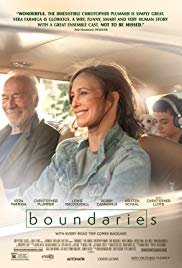
BOUNDARIES (2018)

July 6, 2018

 Greetings again from the darkness. One of the more recent cinematic trends has been stories involving an adult child facing the plight of caring for an elderly parent. Some have chosen the comedic route, while others lean towards the all-too-real burden carried by care-givers. Writer-director Shana Feste (COUNTRY STRONG, 2010) continues her streak of tolerable fluff in this tale of a stressed single mother raising a challenging teenager while also dealing with daddy issues, and the octogenarian daddy at the source.

The film opens with said stressed mother Laura Jaconi (played by Vera Farmiga) in the midst of a therapy session as she talks through those long-simmering daddy issues … and we get the feeling these same discussions have occurred numerous times over the years. As an actress, Ms. Farmiga is at her best in frazzled mode, and here she’s a perfect fit. Her son Hoyt/Henry (Lewis McDougall, who was so good in A MONSTER CALLS) is a social misfit at his school, thanks in part to his mostly unwelcome and quite vivid artwork depicting faculty (and others) in various unclothed states. When he is expelled, private school becomes the best alternative, and Laura’s need for cash coincides with her estranged father’s (Christopher Plummer) simultaneous expulsion from his retirement center … for morality reasons.

Daughter Laura has her dad listed as “Don’t Pick Up” on her cell phone, and we understand before her that he is a rascal with a criminal streak. He even serves up an extremely rare pedophile joke – at the expense of his grandson. Laura’s ongoing challenges are intensified when circumstances require her to drive her and her son cross country in a classic Rolls Royce that never comes close to blending in with the surroundings. The purpose of the road trip is so the father/grandfather can make secretive pot-selling trips along the way. This allows for cameos from such recognizable folks as Peter Fonda, Christopher Lloyd and Bobby Cannavale, the latter of which is Laura’s ex-husband and biological father of her son.

Adding to the frenzy is Laura’s commitment to her real lot in life – that of serial animal rescuer. Dogs are EVERYWHERE throughout the film – to the point that her father labels her the Pied Piper of mange. These type of interactions, along with the ruse of adult diapers and a bow and arrow sequence keep the film on the verge of slapstick; however, we can never accept that we are supposed to get a comedic kick out of Laura’s too-much-to-handle lot, since it’s mostly depressing.

Kristen Schaal as Laura’s sister and insecure California goofball is always a welcome addition to any film, and Yahva Abdul-Mateen II brings a nice touch to one of the few characters we’d like to get to know better. Lousy childhood memories connected to present-day adult troubles just don’t combine for effective humor in the light that the filmmaker seems to be aiming for. Though well-acted, a grown woman still in need of daddy’s approval is just a bit too predictable and too much of a downer to work.

watch the trailer:


ANT-MAN AND THE WASP (2018)

July 4, 2018

 Greetings again from the darkness. The mystery of why Ant-Man was not involved with the battle for the galaxy in AVENGERS: INFINITY WAR has been solved as director Peyton Reed returns to helm the sequel to his 2015 hit ANT-MAN. The reason is very simple: Scott Lang/Ant-Man was under house arrest for his role in CAPTAIN AMERICA: CIVIL WAR. Yep, an ankle monitor sidelined this superhero for the biggest, baddest clash with Thanos. Somehow, this seems fitting for the most “normal” and grounded of all the Marvel characters, as Scott (Paul Rudd) is just a guy trying to overcome his petty thief tendencies while becoming a better father.

The story picks up two years after “Civil War” and Scott has only 3 days of house arrest remaining. An unusual “dream” is the cause of his reluctant reunion with Dr. Hank Pym (Michael Douglas) and Hank’s daughter Hope (Evangeline Lilly). A remarkable laboratory (quite the sight-gag), that could also be carry-on luggage, is the source of Hank and Hope’s mission to bring back mother Janet (the original Wasp, Michelle Pfeiffer) from the Quantum Realm.

It’s at this point, if you are a Marvel Universe fan, that you might ask yourself … so the story is about trying to save one person who has been gone for 30 years?  Yes, that’s a bit less pressure than being charged with saving the galaxy, which is common occurrence in other Marvel films. Look, this isn’t rocket science. Umm, well, it’s quantum physics, which is way more complicated … but the point is, Ant-Man is the Marvel fluff piece. Its purpose is to be light-hearted and entertaining, rather than burdensome and ominous.

There may not be an overabundance of depth to the story, but it is overflowing with entertainment value. There are four new writers (along with Mr. Rudd) for this sequel, and they offer up a nice blend of personal redemption, crazy action sequences, and heart-felt emotion. The villains aren’t even all that bad. Walton Goggins (“Justified”) is Sonny, a greedy dude who just wants the other-worldly Pym technology, and Ghost (Hannah John-Kamen) is after that same technology, but only for self-preservation. Her own molecules are separating, causing a fast track to death – despite the help of Hank’s old partner, played by Laurence Fishburne.

The age-reversing effects we saw on Michael Douglas in the first ANT-MAN are also used this time on Mr. Fishburne and Ms. Pfeiffer. It’s quite something to behold. Michael Pena returns as Scott’s motor-mouthed partner, and he displays some pure comic genius in the truth serum scene. Randall Park plays the hapless FBI agent in charge of keeping track of Scott, but it’s Abby Ryder Fortson as Scott’s daughter Cassie who steals every one of her scenes … and possibly sets the stage for the Ant-Man franchise to carry on to the next generation.

Only a certain level of seriousness can be attained for a movie that blasts “The Partridge Family” theme song “Come On, Get Happy”. Or that awards Paul Rudd with a certain trophy designation. Or that has a character scream “You got Pezzed!”. However, a level of respect is earned with some terrific action – giant and tiny – as well as an exceedingly creative chase scene through the streets of San Francisco. There is a post-credit stinger that ties the film into AVENGERS: INFINITY WAR. It’s brilliant, but also caused quite the outburst from my fellow viewers. If you enjoy playful and amusing (and you should), then the team of Ant-Man and The Wasp (comedian and straight man/person) will put a smile on your face – just watch out for the seagulls!

watch the trailer:


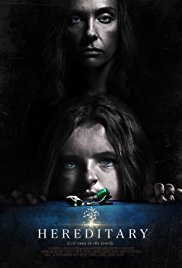
HEREDITARY (2018)

July 4, 2018

 Greetings again from the darkness. I will forever carry this flame of hope for quality horror films since they were such a part of my childhood movie watching. It’s such an odd genre because the really good ones are quite rare, but the category in general is quite profitable. We enjoy being frightened and stressed … in the safety of a dark movie theatre with a few dozen fellow movie goers. This debut feature film from writer/director Ari Aster is filled with foreboding and dread – key elements to a successful horror film.

The clever filmmaker spends the first portion of the movie tricking/manipulating us into thinking this is going to be a “normal” ghost story – one we’ve seen before, albeit with a stronger than usual cast. Time and again I found myself thinking “this poor family”. Toni Collette plays Annie, mother of son Peter (Alex Wolff, brother to Nat and son of Polly Draper) and daughter Charlie (Milly Shapiro), and wife of Steve (Gabriel Byrne). Some scenes are loaded with realistic family banter – the kind that’s a bit passive-aggressive and judgmental in tone. This adds to the unsettling mood of dread that cloaks most of the characters and most every scene.

Annie is an artist who creates miniature settings, and once she unloads her family history on an unsuspecting group therapy session, we are provided a big clue, as well as confirmation that the bad times aren’t over. When tragedy strikes again, the family seems beyond repair, as do the individuals. Peter is a seemingly normal teenage boy who likes to smoke weed, and dutifully lets his little (and slightly disturbed) sister Charlie tag along to a party since his mother asked. Ms. Shapiro is a revolution in the role – somehow simultaneously both creepy and sympathetic. Father and husband Steve is very patient, a trait that rarely pays off in horror films.

The family house makes for a terrific setting, especially considering the impressive treehouse that seems to always require a space heater. Ms. Collette fully commits to the role with all its grief and terror. It’s really her performance combined with a creative story that harkens back to THE EXORCIST and ROSEMARY’S BABY, that allow the film to click. By the end, this family only wishes they were in a “normal” ghost story. And as a reminder, if you are born into a family where one member has a sleep-walking incident similar to what’s described here, you have every right to lock your door before going to sleep – that is, assuming you could ever sleep again.

watch the trailer:


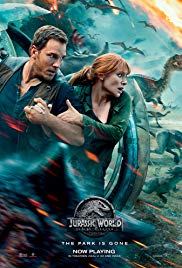
JURASSIC WORLD: FALLEN KINGDOM (2018)

June 29, 2018

 Greetings again from the darkness. While I will never tire of seeing really cool dinosaurs on the big screen, I’ll probably never avoid frustration from a poorly written and poorly acted film. On the bright side, I got to see this at the Grand Opening of the beautiful new Alamo Drafthouse in Denton, Texas. A 66 foot curved screen with the best available sound system made the dinosaurs that much more impressive, while simultaneously exposing the acting for the disappointment it is … especially the almost impossible to watch Bryce Dallas Howard.

J.A. Bayona directs this follow up to the 2015 JURASSIC WORLD, but he’s saddled with a subpar script from the writers and director of that previous entry, Derek Connolly and Colin Trevorrow. The creatures of the late, great Michael Crichton deserve better. In addition to the aforementioned Ms. Howard (as Claire Dearing), Chris Pratt also returns as the smirking Owen Grady, and this time he flashes some fighting skills that would make Jean-Claude Van Damme proud. Not sure how his experience training baby dinosaurs and building a cabin in the mountains prepared him to single handedly take on an army of armed mercenaries, but such things are possible in a cartoon … which is exactly what this plays like: a live action cartoon with high dollar special effects.

We have a spoof of a villain in Eli Mills, played by an over-the-top Rafe Spall, a quivering techie played by Justice Smith (PAPER TOWNS), a tough Paleo vet in Daniela Pineda (MR ROOSEVELT), a dying billionaire former partner of John Hammond played by James Cromwell, a greedy capitalist who should be twirling a mustache in Toby Jones, a big-gun toting badass by Ted Levine, and a good-hearted housekeeper played by Geraldine Chaplin. Mr. Cromwell and Ms. Chaplin add a touch of class in their all too brief scenes. BD Wong is back doing things with dino DNA, and sadly, Jeff Goldblum probably filmed his two courtroom scenes in a couple of hours. One nice addition is young Isabella Sermon, in her screen debut. She is part of the only decent twist in the story.

Despite the disappointments, it remains awe-inspiring to see the dinosaurs on screen. If only those moments weren’t ruined by such superfluous bits such as a close up of Ms. Howard’s footwear to prove that she’s not wearing high heels in the jungle this time. Director Bayona has three very fine movies under his belt: THE ORPHANAGE (2007), THE IMPOSSIBLE (2012), and A MONSTER CALLS (2016). He’s likely to make more good films during his career, and this will surely be a box office smash because people love seeing the dinosaurs, and are willing to overlook the people. As a frequent movie goer, I’m just unable to cut slack to a mega-budget film that expects us to overlook shoddy writing and laughable acting. We don’t expect to recapture the (25 years ago) magic of Steven Spielberg and composer John Williams in the stunning JURASSIC PARK, but we do expect a better effort than this.

watch the trailer:


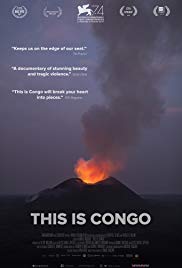
THIS IS CONGO (2018, doc)

June 28, 2018

 Greetings again from the darkness. We citizens of the United States complain if our coffee is too strong or the line to purchase our new shoes is too long. In fact, we are world famous for our tendency to complain about anything and everything. Filmmaker Daniel McCabe never compares us directly to those in his subject country – but then he doesn’t need to. The words and pictures speak for themselves. For most, if not all of their lives, citizens of The Congo have been immersed in war … each day a struggle to survive, with only rare moments of feeling safe.

McCabe’s approach is to show us the lives of three separate individuals – each different, yet the same. We meet Colonel Ndala, a Congolese Army officer and war hero who has 12 bullet wounds to show for his love of country. There is also Mama Romance, an illegal mineral dealer who for 10 years has risked her life to make a better one. Lastly, there is Hakiza Nyantaba, an elderly tailor who totes his sewing machine with him every time war forces him to evacuate his home for the latest displacement camp. Early in the movie, we learn that growing up a child in The Congo should be “paradise”, but instead it’s “misery”. We witness the misery through the eyes of these three people.

Through the altered voice of a shadowy military figure, director McCabe presents a timeline of the unfortunate history of this region, dating back to King Leopold II “rescuing” the enslaved citizenry from the Arabs … only to exploit the region’s vast rubber mineral supply for his own riches. We also learn about the power struggle for control of The Congo between the U.S. and Russia during the Cold War, and the role neighboring countries Rwanda and Uganda have played in financing the multiple rebel factions (more than 50 and counting). This history lesson drives home the point that for the people of this area, regime changes, political corruption, self-serving involvement of other countries, and rebel uprisings are quite sadly, the way of life. As recently as 2016, President Joseph Kabila canceled the country’s election in order to extend his reign of power.

The film is beautifully photographed, and perfectly captures the often stunning landscape between violent bursts of war and personal fright. Mama Romance tells us that “hunger will teach you how to eat”, and with that, we understand the risks she takes. Colonel Ndala speaks to his dream of returning to his family farm life if somehow the never-ending war actually ends. Mostly we feel how these folks only experience joy and hope in short spurts. They are a resilient lot and their story deserves to be known, despite our being told “the country belongs to hell”.

watch the trailer:


THE CATCHER WAS A SPY (2018)

June 22, 2018

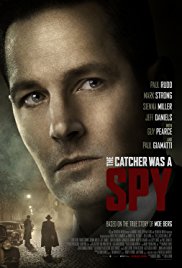
 Greetings again from the darkness. World War II. Baseball. Spies. A true story. Assemble all those pieces and you have Morris “Moe” Berg. Director Ben Lewin (THE SESSIONS, 2012) brings the fascinating story to the big screen with Robert Rodat’s (Oscar nominated for SAVING PRIVATE RYAN) screenplay adapted from the 1994 biography “The Catcher was a Spy: The Mysterious Life of Moe Berg” written by Nicholas Dawidoff. This is neither your typical spy movie nor your typical baseball movie.

Background information is provided by pre-movie title cards: in 1938 German scientists split the atom for the first time, ushering in the nuclear age; renowned German physicist Werner Heisenberg (1932 Nobel Prize winner) was charged with building an atom bomb; the United States responded by sending a baseball player to assassinate him. It’s 1944 Zurich and two men exchange uncomfortable glances across a dimly lit room.

We then flashback 8 years to see Moe Berg utilizing his gut instincts to survive as a veteran journeyman catcher for the Boston Red Sox at Fenway Park. We later learn his sixth sense is not limited to the baseball diamond, and is used in situations much more important than whether a baserunner is stealing a base. Growing up Jewish, Berg had always been somewhat of an outsider, admitting, “I don’t fit in.” In baseball, they called him a walking enigma. Educated at Princeton, Columbia and Sorbonne in Paris, Berg spoke several languages, had a ‘fake’ wife, was a regular on quiz shows, and was constantly followed by insinuations of homosexuality … though he only admitted to being good at keeping secrets.

Berg’s is a truly fascinating story, but unfortunately Paul Rudd is a bit overmatched in the lead role. He just doesn’t quite have the dramatic acting chops to convey the intellectual depth of the man. However, the rest of the cast is stellar: Paul Giamatti (as Samuel Goudsmit), Connie Nielsen, Mark Strong (Heisenberg), Sienna Miller, Hiroyuki Sanada, Guy Pearce, Jeff Daniels (as William J Donovan), Tom Wilkinson (as Paul Scherrer), Giancarlo Giannini (a 50+ year career), and Shea Whigham (as Joe Cronin). Many of these are little more than cameos, and the choppy feel of the film’s flow prevents us from ever really connecting to characters.

An extended battle scene volleys from intense and well-filmed to slightly comical as Mr. Giamatti is forced to run and dodge bullets. The look, tone and color palette of the film is quite similar to Spielberg’s BRIDGE OF SPIES (another true story), though this current one pales in comparison, as director Lewin presents it as a “will he won’t he kill the guy?” scenario. Berg’s story is likely more suited to documentary treatment, as his time with the U.S. Office of Strategic Services (OSS, later the CIA), resulted in his being awarded the Medal of Freedom. Upon his death in 1972, Newsweek’s headline read “3rd String Catcher, 1st String Spy”.

watch the trailer:


THE PASSION OF JOAN OF ARC (1928) revisited

June 20, 2018

Oak Cliff Film Festival 2018


 Greetings again from the darkness. It’s a rare treat to watch a 90 year old silent movie. Especially in a remastered format. Especially on the big screen. Especially at a historic theatre. Especially with a nearly packed house. And especially with a live score! The 7th annual Oak Cliff Film Festival, held at the Texas Theatre (opened 1931), afforded just such a treat with its Friday evening screening.

Most know the story of Joan of Arc (Jeanne d’Arc), a teenage heroine of France for her role in the Hundred Year War. She claimed that she received spiritual and religious guidance through voices and visions. Once she was captured by English allies, she was charged with heresy and burned at the stake in Rouen in 1431. A quarter century later, the Pope declared her a martyr and she became a symbol of France – canonized as a saint in 1920. Of course, here the story is as much about the film as it is the martyr and historical figure.

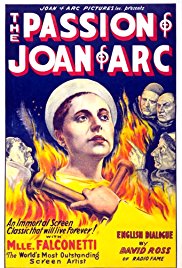
The eyes are what first grab our attention. The eyes of actress Maria Falconetti as Joan of Arc. It was Falconetti’s only screen appearance, and though she spent the rest of her career on stage, this role cemented her place in cinematic history. Without the benefit of sound and voice, the silent era performer had to emote through eyes, facial expression and body movement. Few ever did it better than Falconetti. It’s gut-wrenching to watch the church counsel attempt to break her resolve. Our minds hear the intensity of their voices though we only read the subtitles.

Renowned Danish filmmaker Carl Theodor Dreyer directs the script from writer Joseph Delteil (taken mostly from the transcripts of the trial), and the cinematography is through the eye of 5 time Oscar nominee Rudolph Mate’ (FOREIGN CORRESPONDENT, PRIDE OF THE YANKEES). It’s impossible not to notice a style so different from modern day filmmaking. The harsh lighting and almost exclusive use of close-ups and medium shots bring an immediacy of which we aren’t accustomed. The single piece set is quite unusual and provides a stage aura. Another thing that stands out is the editing style. Continuity of scene wasn’t important here. What mattered was the sense of frantic pacing and over-bearing stress brought on by the rapid-fire questioning. We share the claustrophobic feeling with Joan, though of course, we know where this is all headed.

As part of this special showing, the Oak Cliff Film Festival arranged for a live score performed by composer George Sarah, a 4 piece chamber orchestra, and a vocal group accompanying the music.

Perhaps this meant even more to me since I visited Rouen last year, and the lasting legacy (almost 600 years) of this courageous young woman is evident throughout much of France. The re-mastered film is stunning to look at, and even more historically important knowing that the film had long thought to be lost to a fire. The story and the film are quite something to experience.

watch the trailer:


THE GOSPEL ACCORDING TO ANDRE (2018, doc)

June 20, 2018

 Greetings again from the darkness. Being an expert, or even a genius, in one’s chosen field doesn’t necessarily translate to celebrity or a life in the public eye. Few of us can name the best structural engineer or the best commercial airline pilot, yet we regularly drive over bridges and book flights to our vacation spots. However some professions lend themselves to a bit of fame … and that’s either a burden or an opportunity depending on perspective.

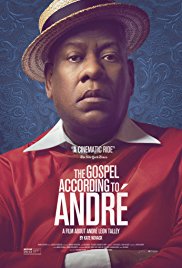
Director Kate Novack (writer of PAGE ONE: INSIDE THE NEW YORK TIMES, 2011) focuses her camera on one who seized the opportunity. Andre Leon Talley was raised in the Jim Crow South of North Carolina and rose up to become a literal giant in the fashion industry. It’s mostly a biopic of a fascinating, larger than life figure, but also a quasi-history of the fashion industry since the 1970’s. Andre crossed paths with all of the greats, and many of them are interviewed here: Marc Jacobs, Anna Wintour, Tom Ford, Valentino, Fran Leibowitz, Manolo Blahnik, and Isabella Rossellini – along with her pigs, a chicken and a turkey. We learn that he worked for Andy Warhol, was mentored by Diana Vreeland, and worked alongside Anna Wintour (teaching her as much as he learned).

Fashion is fleeting, style remains.” So Andre tells us as the film begins. He knows the difference between the two, and understands that beauty comes in many forms. Certainly the first, and often the only black man on the front row of runways in Paris and New York, Andre has lived quite the life. Director Novack’s film is at its best when Andre is front and center. He commands attention with his size, his clothes, his voice, his charisma, and mostly his talent. Claiming his eye developed watching the Sunday fashions at the black church of his youth, we also learn young Andre preferred shopping to attending a ballgame with his taxi-driving father.

Thin until age 40, Andre now describes himself as a manatee. The racism he faced within the industry is vivid as he recalls being called “Queen Kong”. Sometimes criticized for not taking a more active and vocal stance against racism, Andre simply proclaims that he was too busy with his career … his same reason for having ‘no love life’. The emotional moments of his recollections fade quickly in the segments where he discusses capes, and later veils. His expertise is on full display.

Looming over much of the film is the backdrop of the 2016 Presidential election. It’s often distracting, but does lead to one of the more powerful moments. This verbose, grandiose couture figure is stunned and mostly at a loss for words as Donald Trump takes his oath. For most of the film and for most of his life, Andre has talked the talk and walked the walk – and continued talking while he walked. As one of style and influence, he has plenty to say and there’s a reason for us to listen.

watch the trailer:


EATING ANIMALS (2018, doc)

June 18, 2018

 Greetings again from the darkness. Our food supply and sources have become a deserved focal point of interest over the past few years, and director Christopher Quinn brings the 2009 best- selling book by Jonathan Safran Foer to the big screen to ensure we are paying attention. What began as a project looking at how animals were raised to fulfill the demand for edible meat, evolved into an analysis of traditional farming methods versus today’s prevalent factory/big corporation farming. We learn that the growing demand for affordable and convenient food in the 1970’s really kicked off the factory farming industry, and now it’s roughly 99% of the market. Only 1% of farmers resisted and survived (as farmers).

We eat meat not because of how it’s produced, but in spite of it.” Consumers demand delicious, affordable and convenient food, and the film looks at beef, chicken, turkey, pigs and dairy. We are told that factory farming began accidentally thanks to an overshipment of baby chicks several decades ago. Farming and our food supply haven’t been the same since. There is some rare behind-the-scenes footage from factory farms that is difficult to watch. Narrator and Producer (Oscar winning actress) Natalie Portman talks us through the disgusting “pink lagoons” of hog poop, as well as how the raising of animals for food is said to be responsible for up to half of climate change, and for having a significantly negative impact on air pollution and water quality.

Of course most people, when asked, are against animal abuse and geological degradation so what goes on “inside” the barns remains confidential and secure. Going behind the doors of Confined Animal Feeding Operations, we witness conditions and actions that we would prefer not to see. We are informed that 80% of the anti-biotics being produced go towards farm factory animals, and the goal is to modify normal growth size and speed by 4 times. With this approach comes increased risk of pandemics, superbugs, and flu viruses. That’s our tradeoff for the delicious, affordable and convenient demands.

The USDA comes under attack here as well. The agency is accused of silencing the whistleblowers who are doing the job the agency was created to do. They are now ‘protecting the fox, not the hen house’. This is all tracked back to politics and money from the big corporations affiliated with or benefitting from factory farming. Some old clips of Col Harland Sanders (of KFC fame) proves even he was concerned about this many years ago.

Emotion comes into play here as the connection of traditional farmers to their animals is contrasted to the mass production of farm factories. Industry secrecy and protection is presented as a red flag, and the independent farmers are shown as good guys while the giant corporations remain faceless and (mostly) nameless. Only towards the end of the film do we gain some insight into the research being conducted on meat replication through plant-based systems. It’s brilliantly compared to the early days of “gas light substitute” as a name for Edison’s electricity. We are told that India and China now combine to total almost 3 billion people, and their diets are trending towards that of the U.S. – leading to more pressure for faster and cheaper food. Traditional farming isn’t even taught in school these days, and the film barely touches on the always on-going debate between “humanely” raising animals for food vs. veganism. The film succeeds in showing us the problems, but doesn’t offer much in the way of solutions or even a better way … although it’s clear one is needed.

watch the trailer: