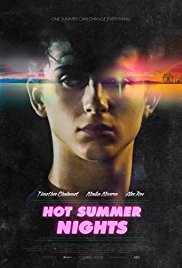
HOT SUMMER NIGHTS (2018)

August 5, 2018

 Greetings again from the darkness. Crime, Romance and Bromance battle it out in the summer of 1991, accompanied by music from the 1970’s, influenced by classic films of the 1980’s and 90’s, and starring 4 rising young stars of today. The debut feature film from writer/director Elijah Bynum comes across as the work of a film and music fanboy concerned with not leaving out any ideas in his only opportunity to make a movie. He shows enough here to likely justify another chance, but we can’t help but wonder if assistance from a mentor might have fine-tuned this into a nice little gem, rather than a blip on the resume of the shooting stars he’s working with.

Fresh off his Oscar nominated performance in CALL ME BY YOUR NAME, Timothee Chalamet stars as Daniel, a socially awkward 18 year old. After the death of his beloved father, Daniel’s mom ships him off for the summer to live with family in Cape Cod – yet another place where he will be an outsider as neither a ‘Townie’ nor ‘Summer Bird’ (the wealthy preppies in summer homes). An odd meet-cute kicks off the bromance between Daniel and local heartthrob/legend and dime-bag pot dealer Hunter Strawberry (Alex Roe, FOREVER MY GIRL). It’s also the beginning of a business relationship that both showers them with cash and puts them on the road to ruin. Hunter’s estranged sister McKayla is the local object of desire for the male population. Played by Maika Monroe (IT FOLLOWS), McKayla is the town vixen who ultimately and predictably falls for Daniel, unaware of his business dealings with her bad boy brother.

Also in the mix here are Emory Cohen (so good in BROOKLYN) as Dex, the no-nonsense “supplier” who pushes the Hunter and Daniel dealings to greater heights, Thomas Jane as the local law enforcement presence, William Fichtner as the coke dealer Daniel tangles with, and Maia Mitchell as Hunter’s love interest. There is also the fallout from recently deceased parents for Daniel, Hunter and McKayla, as well as the impending storm (now known as Hurricane Bob).

An air of familiarity is not uncommon in movies, but this one is downright creepy in how many films it seems to mimic in either tone, style or content. The romance between Daniel and McKayla is the least effective story line. We want to know more about the brother-sister relationship, and are disappointed that the uber-talented Maika Monroe is given little to do other than bat her wicked eyes. It plays like a Greek tragedy where the only question is whether the tropical storm will beat the group’s self-destruction.

This summer story is billed as ‘coming of age’, but that description doesn’t seem to fit unless it refers to the ever-present young narrator whose place in line only becomes clear near the end. There is a nostalgic look and feel to Mr. Bynum’s film, and it’s always nice to have a drive-in theatre play a role; however, his music choices – though terrific to listen to – seem to fit better two decades prior to the setting: Mott the Hoople’s “All the Young Dudes”, David Bowie’s “Space Oddity”, Uriah Heep, Linda Ronstadt and The Modern Lovers. Beyond all of that, we do learn that Hunter Strawberry does not like sprinkles.

watch the trailer:


CHRISTOPHER ROBIN (2018)

August 2, 2018

 Greetings again from the darkness. “It’s always a sunny day when Christopher Robin comes to play.” You know when it’s not a sunny day?  When grown man Christopher Robin ignores his wife and daughter to work every waking hour at his job as an Efficiency Manager for a struggling luggage company. Whatever made the filmmakers spend so much time here on the gloominess of adulthood is beyond me, but oh my, when the friends all reunite in the Hundred Acre Wood, it’s truly a joy to behold.

It was only last year when GOODBYE CHRISTOPHER ROBIN hit the theatres, and while that was more of a biopic of A.A. Milne and the origin of Winnie the Pooh, this version focuses instead on the adult Christopher Robin, and how responsibilities can rob us of all the joys of childhood if we aren’t careful.

Ewan McGregor plays the grown-up Christopher Robin, and we see him back from WWII as a boring workaholic who has little time for his wife Evelyn (Hayley Atwell) or daughter Madeline (Bronte Carmichael). The story begins with young Christopher Robin (Orton O’Brien) sharing a farewell lunch with his friends just before he heads off to boarding school, leaving his childhood far behind. In addition to Pooh bear, we also see Rabbit, Piglet, Owl, Kanga and Roo, as well as a bouncy Tigger and classically mopey Eeyore. It should be noted that these aren’t the animated creatures you and your kids are accustomed to. These are stunning CGI stuffed animals modeled after the early drawn images of Ernest Shepard. They are lifelike … as much as talking stuffed animals can be … and kid viewers are likely to fall quickly for them.

There are three screenplay credits: Oscar winner Tom McCarthy (SPOTLIGHT), Oscar nominee Allison Schroeder (HIDDEN FIGURES) and Alex Ross Perry (LISTEN UP PHILIP). Their work is based on a story from Greg Brooker (STUART LITTLE) and Mark Steven Johnson (SIMON BIRCH), and of course the characters from AA Milne and Ernest Shepard. It might not surprise you that the director Marc Foster also directed the excellent FINDING NEVERLAND, but it’s a bit eye-opening to think he also directed MONSTER’S BALL and QUANTUM OF SOLACE, neither of which have a single scene that kids should watch!

Despite the heavy gloom of the portion of the story dealing with Christopher Robin’s family and job, the film (and the kids in the audience) lights up when all the friends are on screen. Playing the “Say what you see” game on the train emphasizes that creativity sprouts from nothing (doing nothing is a recurring theme in the Pooh stories), and of course, the ever-present red balloon plays a role (much different than the red balloon in IT), as does the familiar “Winnie the Pooh” song from 1977, which most everyone in the audience hummed along with in its various pop-ups during the movie.

The voice acting is necessarily superb, and credit goes to Jim Cummings as both Pooh and Tigger – roles he also voiced in the animated series and previous animated films. Of course the great Sterling Holloway was the original Pooh voice, and he passed away in 1992. Nick Mohammed is Piglet, Peter Capaldi is Rabbit, Sophie Okonedo is Kanga, while Sara Sheen is Roo. Toby Jones is Owl, and Brad Garrett gets some of the film’s best and funniest lines as everyone’s favorite downtrodden donkey Eeyore.

Pooh, the ‘silly old bear’, states “People say nothing is impossible, but I do nothing every day.” This type of humor and philosophy goes on throughout the film, whenever the friends are on screen. The moral of the story is that it’s crucial that we maintain some sense of childhood wonder and joy, even as adult responsibilities close in on us. If you can wake up each morning and say “Today is my favorite day”, you are likely not a bear of little brain … plus you’ll avoid Heffalump traps!

watch the trailer:


GENERATION WEALTH (2018, doc)

August 2, 2018

 Greetings again from the darkness. John Lennon wrote “Money don’t get everything, it’s true. What it don’t get, I can’t use. Now give me money. That’s what I want.” Gordon Gekko said “Greed, for lack of a better word, is good.” Photographer-Director Lauren Greenfield (THE QUEEN OF VERSAILLES, 2012) has spent the past 25 years chronicling the excesses of society. She now lets us in on what she has seen under her microscope (camera lens). It’s no surprise that we see a society that values money and beauty, no matter the cost. She also makes this very personal by confessing her own decisions and experiences along the way.

Serving as her own videographer, Ms. Greenfield’s film began as a photographic gallery exhibition, was published as a photography book, and has now morphed into a feature length documentary – one that blends much of her previous work. Her lens focuses on such varied subjects as celebrity kids, porn stars, eating disorders, the fashion world, beauty pageants for kids, high commerce, plastic surgery, family sacrifices, the end of the gold standard, and historical societies. It will likely cause you to blush, as well as shake your head in a disgusted all-knowing manner.

An unusual lineup of interviewees includes author Bret Easton Ellis, whose “Less Than Zero” is acknowledged as an inspiration by Ms. Greenfield; porn star Kacey Jordan, whose affiliation with bad boy Charlie Sheen made tabloid headlines; former billionaire Hedge Fund Manager Florian Homm; a workaholic woman with no time for a family or life; a participant from “Toddlers and Tiaras”; and journalist Chris Hedges who offers up a history lesson.

Every segment of the film is about excess. The beauty pageant kid crows “money, money, money”. Mr. Homm croons “come to me” as if speaking directly to money. The son of a rock star (Kevin Cronin of REO Speedwagon) speaks to growing up wealthy, and a high school classmate of Kate Hudson recalls her spouting off about her famous parents. Ms. Jordan admits to hoping one of her sex tapes (she has “lots”) will put her on top like it did for her hero Kim Kardashian. Mr. Hedges explains via the Great Pyramids, that societies accrue their greatest wealth at the moment their decline begins (which of course is an obvious mathematical certainty). His point is that all “great” societies of the past have crumbled, but he expects when it happens to us, it will bring down much of the world.

As director Greenfield interjects her own family (including her two sons) into the film, we get the feeling she is either making amends or perhaps using the process as her own therapy for the sacrifices she made for her career … a career that puts a magnifying glass to society. She discusses the emphasis on wealth during the Ronald Reagan Presidency, and even throws in a glimpse of similar excesses in China, Moscow, Ireland and Dubai.

The old values of hard work and saving money have morphed into what has now become the new American Dream of consumption and luxury. It’s a Kardashian society – or at least a society that dreams of living the life of a Kardashian. By the end of the film, the entertaining tales of Mr. Homm’s lust for the almighty greenback has given way to a devastatingly sad (in a pitiful way) story unworthy of his cigar twirling. A Beverly Hills woman so desperate to purchase the hot new luxury handbag explains the “what’s next” syndrome. The fixation, even addiction, to money, status, and physical beauty seems to be one that can’t be cured … though the film ignores those who don’t share in the “dream”. We are reminded to be careful what you wish for, and that “Money can’t buy me love” … or even much happiness. Ms. Greenfield’s tale attempts to end with a lesson in values – hug those close to you, but the overall message is entirely too downbeat for such a final pick-me-up.

watch the trailer:


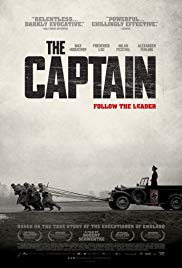
THE CAPTAIN (Der Hauptmann, 2018)

July 27, 2018

Greetings again from the darkness. It’s mind-boggling how many fascinating stories – both large and small – continue to come from World War II, even 75 years later. Writer/director Robert Schwentke (RED, FLIGHTPLAN) abruptly opens his latest with a single soldier desperately running from a posse of Nazi soldiers who appear to be hunting him down. The soldier manages to escape, kicking off an incredible journey that we are informed occurred during the final two weeks of the war (April 1945).

Max Hubacher stars as Willi Herold, the soldier we are to assume has deserted his military outfit and is now dirty, hungry and cold as he evades German patrols. Things change drastically for Herold when he stumbles on an abandoned suitcase neatly packed with a German Captain’s coat and full uniform. We are left to wonder what happened to the officer, but do get to watch Willi’s crazy next few days as he impersonates a German officer and assumes command of his situation.

Circumstances result in “Captain” Herold gaining followers, each of whom are as lost or unwilling to continue fighting as himself. The ragtag group ends up at prison camp Aschendorfermoor … a camp containing German deserters and looters. Herold has convinced those in charge that he has direct orders from Hitler to take command of the camp, and a horrific massacre of prisoners takes place over the next few days.

While this is a stunning story ripped from historical documents, the film works even better as a psychological character study. Herold first employs his newfound power as a survival strategy, but he is soon corrupted by the power of his assumed position. We witness as some blindly follow orders, and we watch (dumbfounded) as Herold’s thirst for power overtakes whatever integrity he might have had prior to the desperation injected by war.

The film moves at a meticulous pace and at times feels redundant. It could have been a stellar short film, but director Schwentke uses the slow pace to allow our shock to grow as Herold evolves into a coy monster (with a fine performance from Mr. Hubacher). Filmed in stark black and white, it offers some beautiful shots from cinematographer Florian Ballhaus (THE DEVIL WEARS PRADA), the son of famed cinematographer and 3 time Oscar nominee Michael Ballhaus (GANGS OF NEW YORK). The elder Ballhaus passed away in 2017, and the son continues to build his own legacy. Set in Germany during April 1945, this blend of docudrama and black comedy is a collaboration of German, Poland and France, and as a true story, packs quite a punch.

watch the trailer:


MISSION: IMPOSSIBLE – FALLOUT

July 25, 2018

 Greetings again from the darkness. Welcome back Ethan Hunt, and the other members of IMF. This is the 6th film in the franchise born (not Bourne) from the classic TV series (1966-73) created by Bruce Geller (credited in each film). Writer/director Christopher McQuarrie returns for this companion piece to his 2015 MISSION: IMPOSSIBLE ROGUE NATION, as of course does mega-star Tom Cruise as the aforementioned Ethan Hunt.

Hunt’s team of Benji (Simon Pegg) and Luther (Ving Rhames) returns, as does really really bad guy Solomon Lane (a glowering Sean Hayes), and MI6 agent Ilsa (Rebecca Ferguson). New to the scene is Agent August Walker (Henry Cavill, MAN OF STEEL), a hulking hunk of a man who doesn’t share Ethan’s belief in brainy strategy. Speaking of strategy, I was a bit tricky in inviting a friend to the screening who is in the midst of a years long boycott of Alec Baldwin movies. Although I felt a fleeting twinge of guilt, I believe the payoff was such that it lessened the impact of deception. Also appearing are Angela Bassett as a CIA toughie, Michelle Monaghan, Wes Bentley, and Vanessa Kirby (“The Crown”) as White Widow.

Most fans of this franchise have likely accepted that the stories are overly intricate – this one is unnecessarily jumbled – and they just enjoy the clamorous ride to an ending that typically has something to do with a bomb and saving the world. It’s the action and stunts that drive ticket sales, and this one has the most extreme and over-the-top action sequences we’ve seen yet. Even though there is a familiarity to some, the stunts are still quite impressive; and yes, Mr. Cruise, now in his mid-50’s, still performs his own stunts. This includes the leap between buildings where he actually suffered a broken ankle, shutting down production for a few months. The jump where he was injured is included in the film. And fear not, the Cruise Sprint is in full force on numerous occasions. Sadly, there is also a quick shot of a Ving Rhames jog – nothing but painful to watch.

The film opens with a wedding day nightmare, but quickly moves to what the fans want – globetrotting, chase scenes, slick advanced technology and wacky stunts. The streets, bridges and landmarks of Paris are on full and spectacular display, while the chase scenes occur on foot, on motorcycle, in cars, and in helicopters. Crazy stunts include HALO jumping, rock climbing and dangling from an elevator shaft. There is a relentless brawl scene in a men’s room where Hunt gets face planted into a porcelain sink and thrown through a wall … and thanks to the magic of Hollywood, five minutes later, he has nary a scratch and looks as debonair as James Bond ever has. However, it’s the final helicopter sequence through the mountains and cliffs of Kashmir that provide the signature moments of the film. Even with the nod to JURASSIC PARK, it’s a breathtaking scene.

Running nearly 2 ½ hours, this is the longest of the MISSION: IMPOSSIBLE films, and Ethan Hunt remains, along with Maverick in TOP GUN (sequel filming now), the best fit for Tom Cruise the actor and celebrity. Unfortunately the same can’t be said for Henry Cavill. He’s blessed with extraordinary genes – just not the thespian types. Filled with double and triple and quad crossings, whether you can follow the story or not, only the most stoic would claim you will find this anything less than an adrenaline rush … should you decide to accept. Plus, it still features one of the best theme songs ever – especially powerful with today’s phenomenal theatre sound systems. Thanks Lalo Schifrin.

watch the trailer:


DON’T WORRY, HE WON’T GET FAR ON FOOT (2018)

July 20, 2018

 Greetings again from the darkness. Being neither an alcoholic, an artist nor a quadriplegic, I found myself wondering if I would be able to connect at all with the real life story of John Callahan. At most, I figured another stellar, oddball performance from Joaquin Phoenix might keep me engaged. It turns out, director Gus Van Sant (GOOD WILL HUNTING, 1999) focuses more on the quite interesting road to sobriety … a road that also happens to lead directly to a reason to live.

Based on Mr. Callahan’s autobiography, the film stars the enigmatic Mr. Phoenix. First seen as a 21 year old (a bit of a stretch) slacker who constantly needs a “fix” of alcohol, no matter the time of day, the talented actor excels after the alcohol-induced car accident that robs Callahan completely of the use of his legs, leaving him only minimal function with arms and hands. Even this doesn’t inspire Callahan to give up the bottle. However, a vision of his mother does. Callahan’s mommy issues are a key element of the story, as she gave him up for infant adoption – leading to many years of drowning his self-pity in whatever type of alcohol was in the glass.

The film picks up some momentum once Callahan begins attending AA group therapy sessions conducted by Donnie (Jonah Hill). Donnie is part Zen sponsor and trust fund guru. It’s a wonderful performance from Mr. Hill, who makes the most of each of his scenes. Others in the group include a terrific (musician) Beth Ditto, Kim Gordon (of Sonic Youth fame), (German icon) Udo Kier, Ronnie Adrian and Mark Webber. Individually they don’t have much to do, but they do make for a fascinating group. Also appearing are Tony Greenhand as Callahan’s attendant, the fabulously talented Carrie Brownstein (“Portlandia”), and Rooney Mara as Callahan’s physical therapist-turned-girlfriend. Ms. Mara is especially short-changed in the script.

It was 1972 and Callahan was 21 when the car accident left him a quadriplegic. Slowly, he discovered his talent as a cartoonist – albeit a controversial and darkly funny one. In today’s climate of political correctness, it’s likely Callahan would find no audience, but at the time, he developed a national following. This was the time of other single panel cartoonists like Gary Larson and Bill Watterson.

Attempting to avoid the traditional and familiar biopic structure, director Van Sant (who has a cameo) chops the movie into bits that work better individually than as a whole. At times it plays like an advertisement for Alcoholics Anonymous. But some of the bits are outstanding. The film is somehow both funny and sad, and includes a terrific scene near the end with Callahan and Jack Black’s Dexter reuniting for the first time since the accident. It’s a powerfully honest scene.

A destructive lifestyle doesn’t always lead to good things, and substance abuse is not very entertaining – though, the road to recovery can be. Getting of glimpse of the 12 step program, we see that not drinking is merely the beginning. It’s like a runner who must first lace up his shoes before beginning the actual run. Callahan died in 2010 at age 59, but his impact continues.

watch the trailer:


MAMMA MIA! HERE WE GO AGAIN (2018)

July 19, 2018

 Greetings again from the darkness. It’s been 10 years since director Phyllida Lloyd presented the crowd-pleasing MAMMA MIA! movie. It was a box office hit (over $600 million worldwide) and was, for a few years, the highest grossing musical of all-time. Most importantly, it was extremely entertaining and a joyous cinematic romp for viewers. This year’s sequel is directed by Ol Parker (THE BEST EXOTIC MARIGOLD HOTEL and husband to actress Thandie Newton), and though the melancholy is slathered on a bit too thick, it also fulfills its number one priority – entertaining the fans.

The story begins with Sophie (Amanda Seyfried) putting the final touches on the house-turned-hotel in preparation for the upcoming Grand Opening. It’s named Hotel Bella Donna in honor of Sophie’s mother (Meryl Streep). What looks to be a straight-forward story surprises us with a flashback to Donna’s 1979 graduation, which features not only the first song-and-dance number “When I Kissed the Teacher”, but also the first of two ABBA cameos … Bjorn Ulvaeus as a professor. The young Donna is played brilliantly by Lily James, and she effortlessly captures the free-spiritedness that led to the conundrum of the first movie – 3 possible dads for Sophie.

Those 3 dads return not only as Pierce Brosnan (Sam), Stellan Skarsgard (Bill), and Colin Firth (Harry), but also as Jeremy Irvine (young Sam), Josh Dylan (young Bill), and Hugh Skinner (young Harry). In fact, most of the run time is dedicated to the backstory of these characters and how they first met as youngsters. Each has a segment (and song) with young Harry featured in “Waterloo” accompanied by Benny Andersson (ABBA cameo #2) on piano. Young Bill is the charming sailor who saves the day for Donna, while young Sam assists her with saving a storm-shaken horse (kind of humorous since Mr. Irvine starred in WAR HORSE).

Also back are Dominic Cooper as Sky, Sophie’s true love, who can’t decide between romance and career, and Donna’s life-long friends Tanya (Christine Baranski) and Rosie (Julie Walters), who are also part of the flashback as Jessica Keenan Wynn (excellent as young Tanya) and Alexa Davies (as young Rosie). New to the cast are Celia Imrie in the graduation number, Andy Garcia as the hotel manager, and drawing the biggest applause of all … Cher as Sophie’s grandmother (and as my viewing partner commented, an early peek at what Lady Gaga will look like as a grandma)! It’s best if you experience Cher for yourself, and it should be noted that this is her first big screen appearance since BURLESQUE in 2010.

Of course, the songs are key and many of the ABBA numbers from the first movie are featured again this time. In particular, “Dancing Queen” is a nautical standout, and “Fernando” is a show-stopper. While it may not be quite as raucous as the first, it’s a treat watching Lily James, and there is a wonderful blending of “old” and “new” in the finale. The only real question remaining is, did the casting director do the math before casting Cher (age 72) as Meryl Streep’s (age 69) mother?

*As a special treat, there is a “most interesting” cameo near the end of the film

watch the trailer:


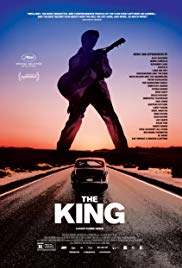
THE KING (2018, doc)

July 19, 2018

 Greetings again from the darkness. Those of us in the United States have always loved a rags-to-riches success story … it’s the personification of the American Dream. The only thing we seem to enjoy more is tearing down the pedestals that we build for those folks, and then ripping apart their legacy. Acclaimed director Eugene Jarecki (WHY WE FIGHT, 2005) strains rigorously in his attempts to connect Elvis Presley selling out his talent for money with the transformation of the U.S. from a democracy to a crumbling capitalistic empire (likened to ancient Rome). The really interesting thing is that the film, despite being a staccato mess, is quite fascinating.

Director Jarecki’s gimmick here is that he is taking a musical and historic road trip in the 1963 Rolls Royce once owned by Elvis. Along the way, he picks up passengers – some of which are musicians who perform in the backseat. The passenger list includes James Carville, John Hiatt, M Ward, Linda Thompson (ex-girlfriend of Elvis), Immortal Technique, and “best friend” Jerry Schilling (a comical description if you’ve read his book).

Chuck D from Public Enemy is interviewed due to his famous lyric: “Elvis was a hero to most, but he never meant s**t to me”. The contradictions from this interview fit nicely with the contradictions throughout the film. George Klein takes Jarecki on a quick tour of Humes High School, and Ashton Kutcher babbles about fame – though he makes one spot on remark regarding the prison of fame, something much of the film seems to ignore. Producer Ethan Hawke spends a good amount of time on camera and in the front seat, while author and activist Van Jones seems narrowly focused on cultural appropriation and angry that Elvis never used his clout to help the minorities that influenced him.

Filmed in 2016, the film works hard to include the Presidential election, and we even see the sanctimonious Alec Baldwin adamantly proclaiming that Trump won’t win. Jarecki is himself an activist, and here he stretches to prove his points – tying together everything from Elvis’ induction into the Army to the Trump election more than a half-century later (and 40 years after his death).

The road trip kicks off in Elvis’ birthplace of Tupelo, where we meet some locals who talk about the lasting impact of Elvis on their town – a town still drenched in poverty. Memphis is next, and we hear about the 3 local kings: BB, Elvis and MLK. Jarecki even inserts a shot of the Rolls next to the Lorraine Motel. There is a terrific bit with the students from Stax Music Academy who perform “Chain of Fools” in the backseat. We then head to NYC and Nashville, capping off the musically creative portion of Elvis’ career. Next up is Hollywood, Hawaii, and finally Las Vegas.

At times, the film is just flat out weird. One segment force feeds parallels with the 1933 KING KONG movie (yes, really), then Elvis as a tourist, and finally, Dan Rather’s all too familiar voice performing “America the Beautiful” … each piece featuring the Empire State Building. But just when a Bernie Sanders rally makes you want to turn off the film, we get an insightful Mike Myers effectively pointing out the hypocrisy of the American Dream as sold by the government, or David Simon questioning the choice of the Rolls over one of Elvis’ prized Cadillacs, or Sam Phillips’ (Sun Records) son re-telling the story of how his father lost Elvis to the carnival-barker Colonel Tom Parker (neither a Colonel nor a Parker).

Jarecki and co-writer Christopher St. John try to weave a tapestry of fame and money with cultural and societal shifts. Some segments work, while others fall flat. The editing of talking heads sometimes gives the feel of a debate, but often the scattered and choppy film meanders through multiple messages whilst driving the backroads of the country. We get clips of Elvis on the Ed Sullivan Show and getting his famous locks sheared in the Army, and the 1968 comeback special; however, there is little mention of Priscilla, Lisa Marie or Graceland.

Judging Elvis for money grab without seeming to take into account his young age (he was 21 when he first appeared on Sullivan, and 23 at his Army induction) and his extreme poverty of youth, much less the power of his domineering agent, seems to be harsh judgement in an era that had never seen such media giants as the Kardashians or Justin Bieber. When Jarecki’s road chief admits, “I don’t know what the hell you’re doing” (when Jarecki asks him what he thinks he’s doing with the movie), it’s the first time we can actually relate to what someone has said. Despite all of that, you’ll likely be glued to the screen for the full run time – either enjoying the songs, watching the clips, or trying to see if Jarecki’s puzzle pieces even fit together.

watch the trailer:


SORRY TO BOTHER YOU (2018)

July 12, 2018

 Greetings again from the darkness. All movie watchers know that the first rule of Fight Club is ‘Don’t talk about Fight Club’. And now we know that the first rule of Telemarketing is STTS: Stick to the script. The similarities between the two movies may be few, but hip-hop artist (The Coup) turned first time filmmaker Boots Riley comes out swinging in this offbeat, quite clever satire on race, corporate culture, economic factions, social division, and politics. It makes for a nice companion piece to last year’s critical darling, GET OUT.

LaKeith Stanfield (GET OUT, SHORT TERM 12) stars as Cassius “Cash” Green, a low key good dude living with his girlfriend Detroit (Tessa Thompson) in his uncle’s (Terry Crews) garage. Four months behind on rent, Cash wants to do something important with his life, he just doesn’t know how … and his current financial circumstances aren’t helping. You may call him a dreamer, but he’s not the only one (a Lennon reference seems fitting for this film).

Cash’s best buddy Salvador (Jermaine Fowler) gets him an interview at a dingy basement telemarketing firm – an interview that clues us in on the type of humor we are in for. Thanks to advice from one of the veteran telemarketers (Danny Glover), Cash utilizes his “white voice” and immediately has remarkable success … and we get some pretty funny sales call visuals to correspond to the obvious capitalism statement.

Ultimately his sales success gets him promoted to the “power caller” level and his own mentor, accessible only through the gold elevator. This leads to conflict with his friends, his girlfriend and his own moral standards. See, the basement dwellers are being led by Squeeze (Steven Yeun) in an effort to unionize for a living wage and tolerable work environment. As Cash continues to pursue … well, uh … cash … his friends carry out their form of civil disobedience. This leads to police brutality, examples of corporate greed, and the downside to individual ambition.

Armie Hammer plays Steve Lift, the egomaniacal corporate d-bag who takes Cash under his wing – for the purpose of making more money. The sales pitch turns to “Worry Free”, a lifestyle being marketed through brain-washing advertisements for guaranteed food and shelter. One need only commit to a lifetime of corporate servitude. If that sounds like slavery, well, that’s the point Riley is making. It’s not so far off from the life many of us lead today, but of course this is presented in satirical fashion, so we are manipulated into laughing at ourselves and our society. There is even a popular reality TV show titled “I Got the S**T Kicked Out of Me”, and folks can’t get enough!

The story kind of flies off the rails in the second half with some wacko-science fiction genetic engineering. The equisapiens have to be seen, as no written description will do. Even this segment has purpose. It speaks to how individuals and corporations can seize power and head in a questionable direction – all in the name of progress, efficiency and stock price.

Stanfield excels in one of his first lead roles, and Ms. Thompson is her usual shining star. Kate Berlant (as the humorously named Diana DeBauchery) has a couple of excellent scenes, and David Cross and Patton Oswalt are terrific as the (extremely) white voices of Cash and Mr. _________ (played by Omari Hardwick).

Filmmaker Riley offers up not a call to arms, but rather a call to wake up! Many of the decisions here mirror real life. Personal success can cost us friends, and political and professional choices may challenge our inherent morals (here, bordering on Faustian). The film is both provocative and funny, though a bit messy at times. You’ll laugh while you think, or laugh after you think, or think after you laugh … somehow you’ll do both. OFFICE SPACE and Terry Gilliam’s BRAZIL may be the closest comparisons; just be cautious if Boots Riley ever invites you to join in some horse play.

watch the trailer:


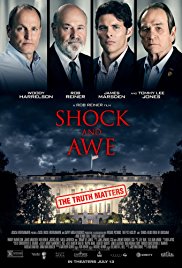
SHOCK AND AWE (2018)

July 12, 2018

 Greetings again from the darkness. The film begins with a Bill Moyers quote about the importance of a free and open press, has a line about ‘reporting stories for families who send their kids to war’, and is directed by liberal activist Rob Reiner … who labels the film as a true story. So it’s no surprise that the approach is to paint the folks at Knight Ridder News Service as the sole saints on an island of integrity … even as it is blessed with perfect vision in hindsight.

Written by Joey Hartstone, who also collaborated with Mr. Reiner on LBJ (2016), which also starred Woody Harrelson, the film continues the recent cinematic trend of placing the media on a pedestal of righteousness and beacon of truth as it serves the role as a check on political process and power. In this case, the ‘spotlight’ is on the Bush administration and the questionable decisions that led to the war in Iraq. The film begins with a 2006 Veterans’ Affairs Senatorial committee hearing where a wheelchair bound soldier ends his statement by asking the committee members a fair and legitimate question, “What the hell went wrong?”

We then flashback to September 11, 2001 and the aftermath of the bombings. Patriotism, pride, activism, volunteerism, and charitable contributions all increased, as did the Bush administration’s focus on going to war. Was it a war to get those responsible for the bombings or was there another agenda? Knight Ridder reporters Warren Strobel (James Marsden) and Jonathan Landay (Woody Harrelson) are dedicated to finding the truth, and are led down the path of discovery by D.C. Bureau Chief John Walcott (played by director Rob Reiner).

This is presented as a time more extreme than the mainstream media not often questioning the administration, but the film actually labels The New York Times as a shill or puppet of the Bush/Cheney/Rumsfeld/Powell/Rice regime.  Only these two courageous Knight Ridder reporters (Strobel, Landay) were questioning the administration’s efforts to turn the focus from Afghanistan and Al-Qaeda leader Osama bin Laden to Iraq and Saddam Hussein. My how times have changed since the most recent election. Though it could be argued that rather than questioning the current administration’s policies, it might better be described as written and verbal attacks.

The preaching here is relentless, especially by Reiner’s Walcott, who is posed as something of a truth guru. Missteps abound in the presentation, and the film is crushed under the weight of the obvious and necessary comparison to ALL THE PRESIDENTS MEN (an influential era noted by the characters). The banter between Strobel and Landry often seems forced like what we see in buddy flicks, and the needless and distracting romantic interlude plays like a meager attempt by director Reiner to humanize the message with a grinning Jessica Biel. The same could be said for Tommy Lee Jones’ curmudgeonly portrayal of respected military reporter Joe Galloway.

We really want to commend the filmmakers for bringing light to inexcusable government actions, but the manner in which it does this is so aggravating that kudos can’t be justified. The incessant patronizing wears thin quickly. The story deserves to be told without the sermonizing. Somehow we and the reporters are supposed to be stunned that political corruption, misleading statements from government officials and power struggles even exist. With this discovery, the reporters seem as ‘shocked’ as Captain Renault (Claude Rains) in CASABLANCA when he is told gambling is occurring (even as he pockets his winnings). With a stated emphasis on truth, we should never forget that politicians and the media are both selling something … and it’s still caveat emptor.

watch the trailer: